

Qualifying Questions Examples: The Only Ones You Actually Need
67% of lost B2B sales trace back to poor qualification. Not bad pitching, not weak demos - reps didn't figure out whether the deal was real before investing hours into it. The average lead-to-MQL conversion rate sits at just 31%, which means most of your pipeline was never going anywhere.
You don't need a sprawling list of qualifying questions examples. You need 5-8 great ones and the discipline to listen to the answers.
The 5 Questions Every Rep Needs
If you remember nothing else, memorize these:
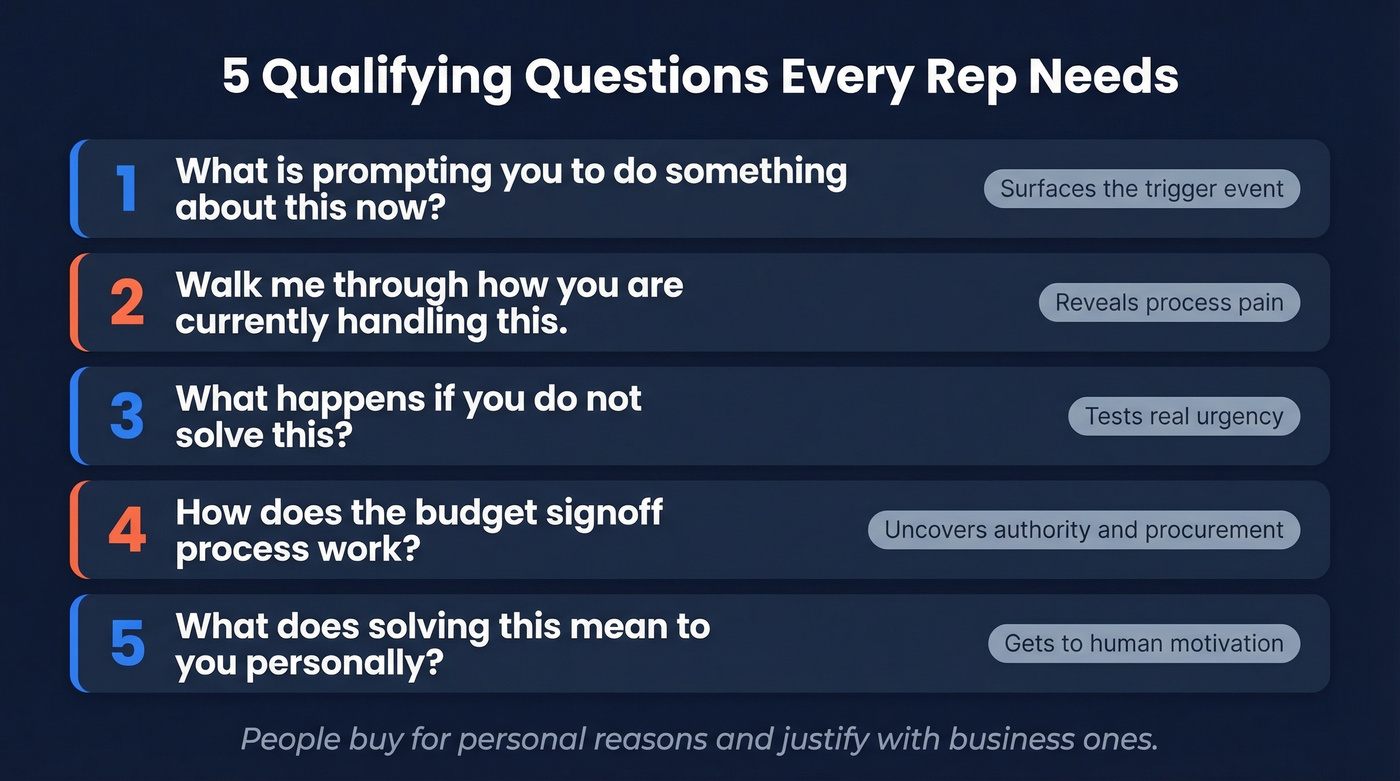
- "What's prompting you to do something about this now?" - Surfaces the trigger event.
- "Walk me through how you're currently handling this." - Reveals process pain without leading the witness.
- "What happens if you don't solve this?" - Tests real urgency vs. tire-kicking.
- "How does the budget signoff process work?" - Uncovers authority and procurement complexity in one shot.
- "What does solving this problem mean to you personally?" - Gets past the corporate answer to the human motivation.
That last one is underrated. We've watched reps skip it for years and then wonder why their champion went quiet after the second call. People buy for personal reasons and justify with business ones.
Which Qualification Framework Fits?
Consistency matters more than which framework you choose. One team reported forecast accuracy jumping from 62% to 89% after switching from BANT to MEDDIC - but the real win was that every rep started qualifying the same way. In our experience, teams that pick one framework and commit outperform teams that mix and match every quarter.
If you're rolling this out across a team, treat it like sales process optimization, not a one-off training.
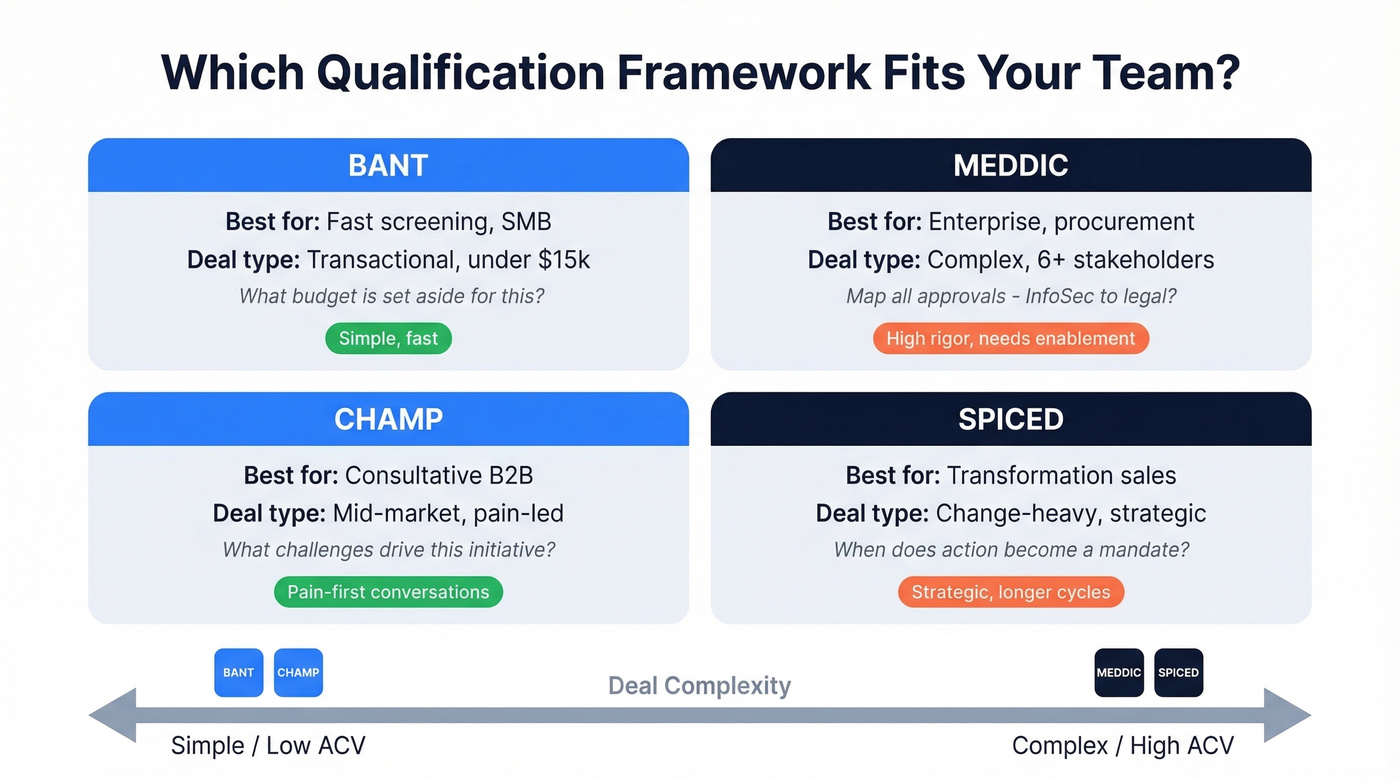
| Framework | Best For | Example Question | Deal Type |
|---|---|---|---|
| BANT | Fast screening, SMB | "What budget is set aside?" | Transactional, <$15k |
| MEDDIC | Enterprise, procurement | "Map all approvals - InfoSec to legal?" | Complex, 6+ stakeholders |
| CHAMP | Consultative B2B | "What challenges drive this initiative?" | Mid-market, pain-led |
| SPICED | Transformation sales | "When does action become a mandate?" | Change-heavy, strategic |
BANT is a starting point, not a strategy. For anything with 6-10 stakeholders involved in the buying decision, it's a pre-filter at best. MEDDIC gives you the rigor for complex enterprise deals, but you can't just hand reps an acronym and expect results - it requires real enablement. CHAMP flips the script by leading with challenges instead of budget, which produces better early conversations.
If you're going deeper on MEDDIC, use a tighter set of MEDDIC discovery questions so reps don’t wing it.
Here's the thing: if your average deal size is sub-$10k, skip MEDDIC entirely. The overhead will slow your team down more than the rigor helps. BANT plus good follow-up questions will outperform a half-implemented MEDDIC every time.
If you sell transformation, SPICED can be a better fit than budget-first frameworks.
Lead Qualification Questions by Category
Every question below includes a green-flag / red-flag signal. This is what separates qualification from interrogation - you're listening for specific tells, not just collecting answers.
Pain & Need
- "What specific problem brought you to this conversation?" Green flag: concrete, measurable pain. Red flag: vague "just exploring."
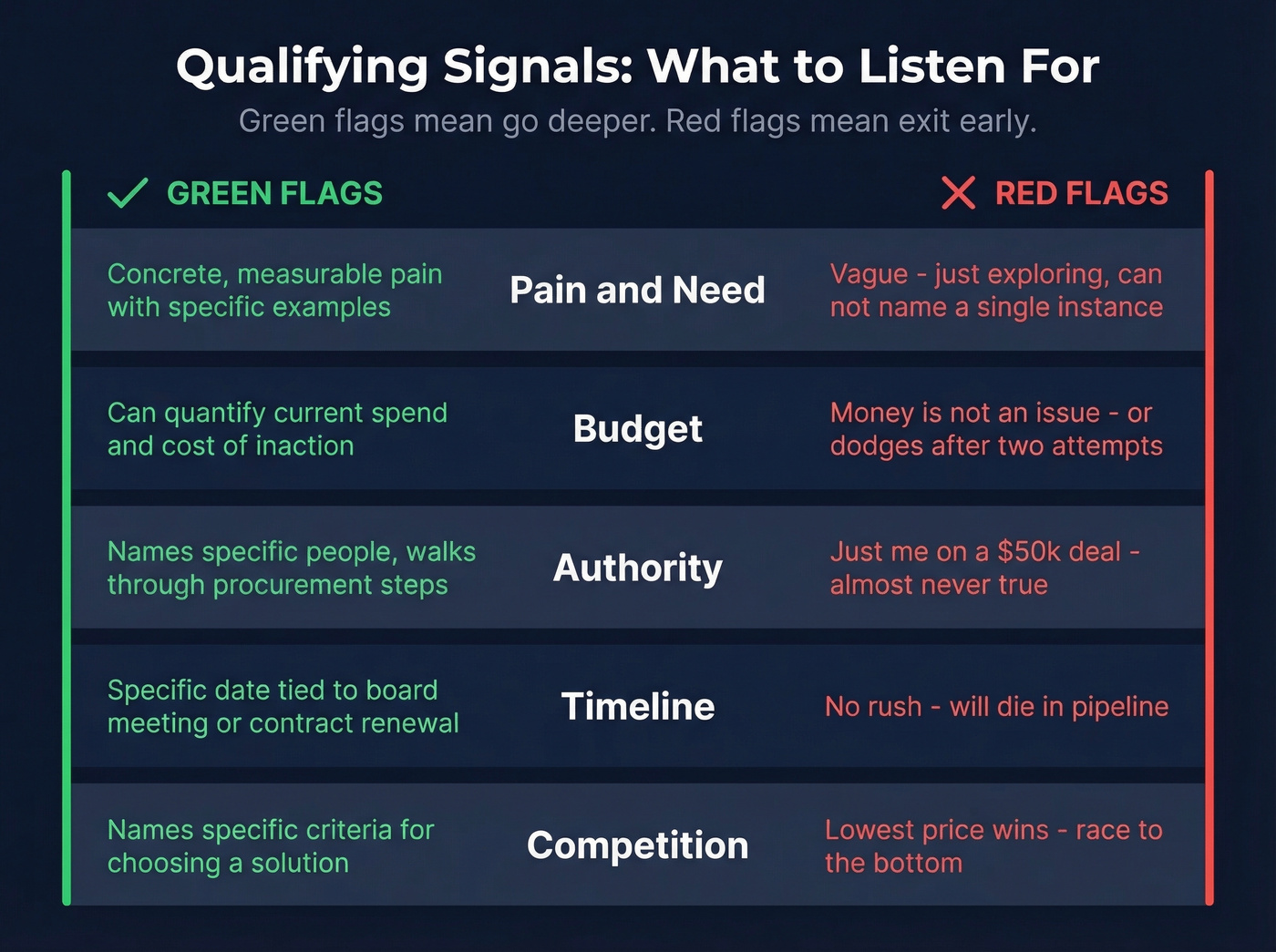
"Can you give me an example of how this causes problems day-to-day?" Green flag: a story with details. Red flag: can't name a single instance.
"What happens if you do nothing?" Green flag: real consequences - lost revenue, churn, compliance risk. Red flag: "We'd be fine, honestly."
"Have you tried to solve this before? What happened?" Green flag: they've attempted and failed, meaning deep problem understanding. Red flag: never tried, signaling low priority.
"If you didn't solve it, could you live with it?" Green flag: "No, this is critical for Q3." Red flag: "Yeah, probably." That's your exit cue.
If you want to make this measurable, pair these with a simple lead scoring model.
Budget & Resources
Budget conversations are where most reps choke. They ask "What's your budget?" and get a non-answer. The trick is anchoring in current spend, not aspirational numbers.
"What are you currently spending on this?" beats the direct budget question every time because it grounds the conversation in reality. Follow it with "What's the cost of not solving this - in dollars, hours, or headcount?" If they can quantify the pain, the business case builds itself. If they can't, it isn't built yet, and that's a signal too.
"Is there budget allocated, or would this need approval?" separates earmarked money from "we'd need to find budget" - which really means months of internal selling you didn't sign up for. And when someone says "money isn't an issue," brace yourself. The consensus on r/sales is that this phrase can still end in a request for a $20/day solution.
Authority & Decision Process
Asking "are you the decision-maker?" rarely gets you the full picture. Modern B2B deals involve 6-10 stakeholders, so try these instead:
"How does the budget signoff process work at your company?" Green flag: they walk you through procurement, legal, exec sign-off. Red flag: "I think I can just approve it" - they haven't done this before.
"Who else needs to weigh in before this moves forward?" Green flag: specific names and roles. Red flag: "Just me" on a $50k deal. Almost never true.
"Is there a champion internally who's pushing for this?" If they're not putting their own reputation on the line, they're a fan, not a champion. That distinction matters more than any org chart.
To keep stakeholder mapping consistent, document it in your CRM instead of in call notes.
Timeline & Urgency
Responding within one hour yields 7x higher odds of qualifying a lead. Speed matters on your side, but you need to gauge theirs too.
"When do you need this solved by?" only works if you follow up with "What's driving that timeline?" A specific date tied to a board meeting, contract renewal, or compliance deadline is gold. "No rush" means it'll die in pipeline. Ask about competing initiatives - "This is our only focus" is rarely true, and the honest answers tell you where you actually rank on their priority list this quarter.
If your team struggles with speed-to-lead, fix it as a sales pipeline challenge, not a rep problem.
Competitive Landscape
Don't dance around this. Ask "What else are you evaluating?" directly - the answer tells you where you stand. Follow with "What would make you choose one solution over another?" If they name specific criteria you can address, you're in the game. If the answer is "lowest price," that's a race to the bottom you probably don't want to run.
If you’re losing to “good enough” alternatives, build sales battle cards so reps can respond fast and consistently.

Your reps nailed the qualifying questions. The prospect is real, the budget is there, the timeline is tight. Now they need the direct email or mobile to reach the next stakeholder. Prospeo gives you 98% verified emails and 125M+ direct dials - so qualified deals don't stall because your team can't reach the decision-maker.
Stop losing qualified deals to bad contact data.
Cold Call vs. Discovery Call
These are fundamentally different conversations. Don't use the same questions for both.
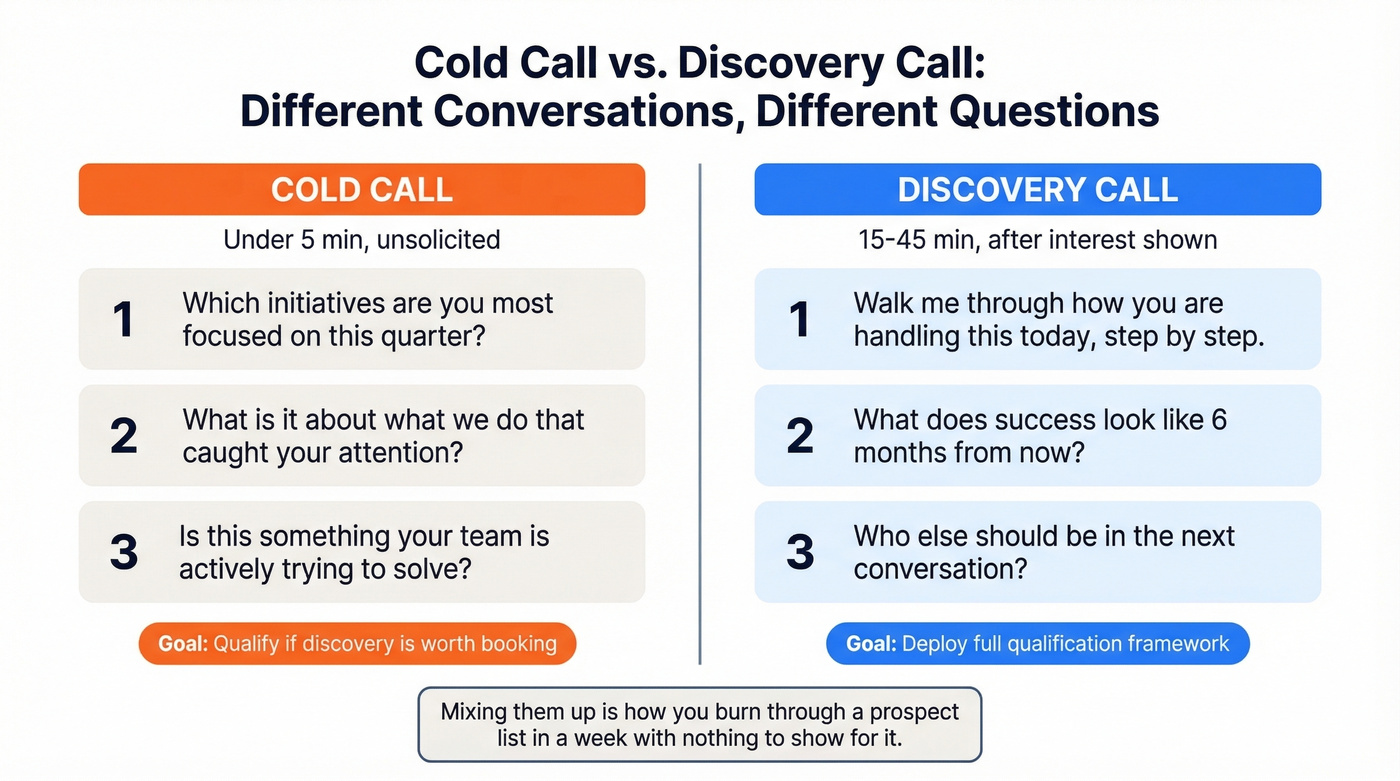
| Cold Call (under 5 min, unsolicited) | Discovery Call (15-45 min, after interest) |
|---|---|
| "Which initiatives are you most focused on this quarter?" | "Walk me through how you're handling this today, step by step." |
| "What is it about what we do that caught your attention?" | "What does success look like 6 months from now?" |
| "Is this something your team is actively trying to solve?" | "Who else should be in the next conversation?" |
Cold calls qualify whether a discovery call is worth booking. Discovery is where you deploy the full framework. Mixing them up is how you burn through a prospect list in a week with nothing to show for it.
If you need a tighter structure for the longer call, use a discovery call script instead of improvising.
Survey & Research Screeners
Not all qualification happens on calls. A UserTesting analysis of 10,000 studies found 23% of recruited participants didn't match the target criteria. Use behavioral criteria over demographics - "How many times in the past 7 days did you use this product category?" beats "What's your job title?" Stick to 3-6 screening questions for online surveys, 8-12 for interview recruiting, and limit essential criteria to 2-4 to avoid killing your sample size.
Mistakes That Kill Qualification
One of the biggest sources of bloated pipelines is having no ICP defined. If reps don't know who they're qualifying for, every lead looks viable. We've watched pipelines balloon to 200+ "opportunities" that close at 3%. It's frustrating to watch, and it's entirely preventable.
If you don’t have one written down, start with an ideal customer profile template.
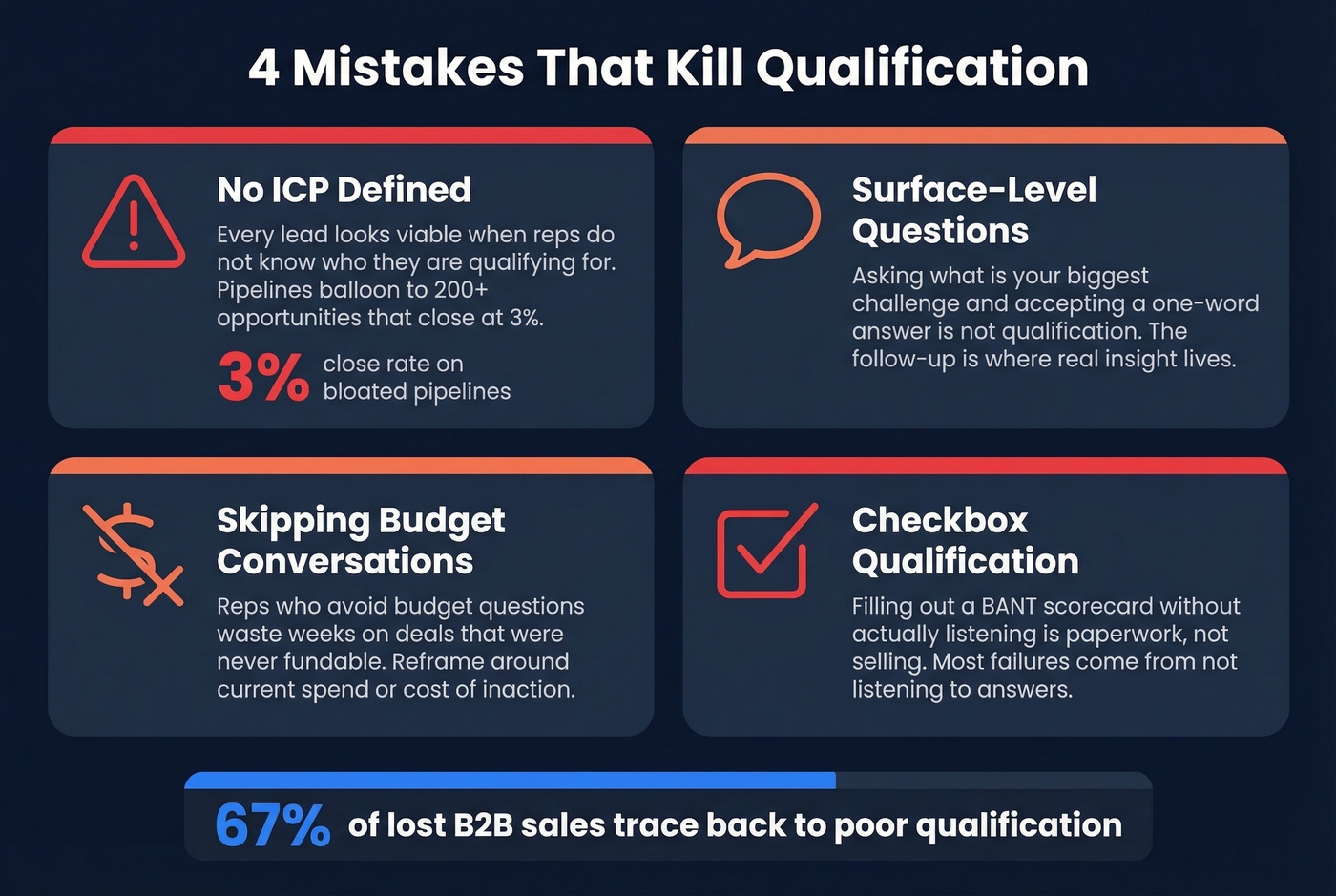
Surface-level questions without follow-up probing are nearly as damaging. Asking "what's your biggest challenge?" and accepting a one-word answer isn't qualification - the follow-up is where real insight lives. Reps who skip budget conversations waste weeks on deals that were never fundable. And treating qualification as a checkbox - filling out a BANT scorecard without actually listening - is paperwork, not selling.
Let's be honest: most qualification failures aren't about asking the wrong questions. They're about not listening to the answers, or not having the courage to disqualify early.
What to Do After You Qualify
Here's the gap nobody talks about: you've confirmed budget, mapped stakeholders, established urgency - and then the email bounces. Or you don't have a direct dial for the VP who's actually signing off. Qualification is wasted if you can't reach the person you qualified.
Prospeo covers 300M+ professionals with 98% verified email accuracy and 125M+ verified mobile numbers, refreshed every 7 days. Upload your qualified list, get verified contact data back, and push it straight into Smartlead, Instantly, or your CRM.
If you’re cleaning and completing records before outreach, use data enrichment services to keep qualification from dying in ops.
67% of lost deals come from poor qualification - but plenty more die because reps waste hours qualifying leads built on stale data. Prospeo refreshes 300M+ profiles every 7 days, so the prospect you're qualifying today actually works at that company, in that role, with that budget authority.
Qualify real buyers, not outdated records from six weeks ago.
FAQ
How many qualifying questions should I ask per call?
Five to eight. The real skill is follow-up probing - going two or three levels deep on answers that matter, not racing through a checklist. Top reps ask fewer questions but spend more time listening to each answer.
What's the difference between qualifying and discovery?
Qualifying determines fit: should we work together? Discovery uncovers context: how should we work together? In practice, they overlap heavily. The examples in this guide lean toward fit, but many double as discovery openers.
What if a prospect won't answer budget questions?
Reframe around current spend or cost of inaction - "What are you spending on this problem today?" feels less invasive than "What's your budget?" If they dodge after two attempts, note it in your CRM. It usually signals no budget or no authority to discuss it.