

The Best Remote Sales Tools for 2026: What You Actually Need
It's Monday morning. Your SDR opens HubSpot, switches to Apollo, pulls a list, pastes it into Outreach, hops on Zoom for a standup, checks Slack, logs a call in Salesforce, then realizes half the emails from Friday's sequence bounced. Sound familiar? Sales reps spend roughly a third of their time actually selling - the rest disappears into toggling between tools, fixing bad data, and doing admin work that shouldn't exist.
The problem isn't effort. It's the stack underneath - specifically, the data feeding every tool in it.
45% of sales professionals say [they're overwhelmed](https://www.salesforce.com/sales/state-of-sales/sales-statistics/) by the number of tools in their workflow. That's not a sign you need more tools. Here's what actually belongs in your stack, and what doesn't.
Our Picks (TL;DR)
If you're building a remote selling stack from scratch - or trimming one that's gotten bloated - these five tools cover about 90% of what a team actually needs.
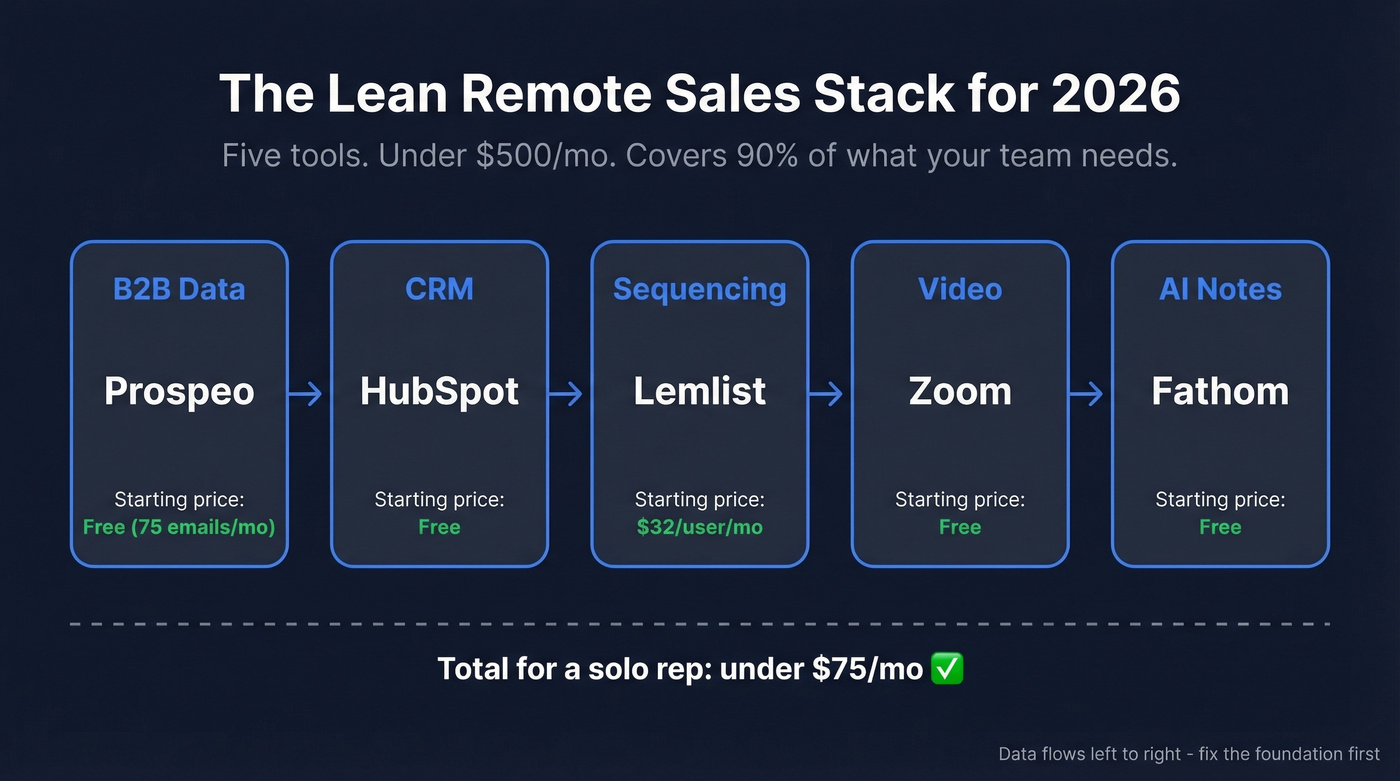
| Use Case | Tool | Starting Price |
|---|---|---|
| B2B Data | Prospeo | Free (75 emails/mo) |
| CRM | HubSpot | Free |
| Sequencing | Lemlist | $32/user/mo |
| Video | Zoom | Free |
| AI Notes | Fathom | Free |
Total cost for a solo rep or small team: under $500/mo. You can run real outbound, track deals, hold demos, and get AI-generated call summaries without touching enterprise pricing. Scale up from there only when you've maxed out what these can do.
Best Tools by Category
B2B Data & Prospecting
Every tool downstream - your sequencer, your dialer, your CRM - is only as good as the data you feed it. A 60% email accuracy rate means 40% of your sequences bounce, your domain reputation tanks, and every other tool underperforms. This is the foundation layer. Get it right first. (If you're troubleshooting bounces, see bounce rate benchmarks and fixes in our guide to email bounce rate.)
Prospeo covers 300M+ professional profiles with 98% verified email accuracy, 143M+ verified emails, 125M+ verified mobile numbers, and 30+ search filters including buyer intent, technographics, and job change signals. The 7-day data refresh cycle is rare - the industry average is 6 weeks. Intent data tracking 15,000 topics via Bombora means you can prioritize accounts actively researching your category.
At roughly $0.01 per lead, it's 90% cheaper than ZoomInfo. The results back it up: Snyk's 50-person AE team dropped their bounce rate from 35-40% to under 5% and saw AE-sourced pipeline jump 180% after switching. The free tier gives you 75 emails and 100 Chrome extension credits per month - enough to test data quality before committing a dollar.

Prospeo integrates natively with Salesforce, HubSpot, Smartlead, Instantly, Lemlist, Clay, Zapier, and Make. It's a specialist data layer, not an all-in-one suite - pair it with a dedicated sequencer like Lemlist or Reply for outbound execution. (If you're building enrichment workflows, compare options in our roundup of data enrichment services.)

Every tool in your remote stack - sequencer, dialer, CRM - underperforms when fed bad data. Prospeo's 98% email accuracy and 7-day refresh cycle mean your sequences actually land. At $0.01/email, it costs 90% less than ZoomInfo.
Fix the foundation layer and every other tool performs better.
Apollo is worth a look if you're bootstrapping and want prospecting plus sequencing in one free tool. The database covers 275M+ contacts, and paid plans start at $49/user/mo. Skip this if you care deeply about data accuracy - we've seen noticeably higher bounce rates on Apollo-sourced lists in head-to-head tests. (For more list-building tactics, see sales prospecting techniques.)
LinkedIn Sales Navigator remains a must-have for B2B teams doing social selling. Core runs ~$90/mo billed annually, ~$120/mo month-to-month. Clay ($134/mo+) is worth exploring if you're building complex enrichment workflows with waterfall logic. Hunter ($34/mo+) handles basic email finding but lacks the database depth of a full prospecting platform. One SDR on r/sales called ZoomInfo "crazy expensive" - and at ~$15k/year to start, it's hard to argue. (If you're trying to keep costs down, start with these free lead generation tools.)
CRM
HubSpot is the default starting CRM for remote teams, and for good reason. The free plan includes unlimited users and contacts - that's not a typo. When you outgrow free, paid plans start at $15-20/mo. The downside: it gets expensive fast at Professional and Enterprise tiers, and reporting depth lags behind Salesforce for complex sales motions. (If you're comparing options, see more examples of a CRM.)
Salesforce Sales Cloud starts at $25/user/mo, but realistic mid-market deployments run $75-150/user/mo once you add the modules you actually need. It's the right choice for teams with 20+ reps and complex deal stages, but it's overkill for a 5-person team - and a time sink to implement. (If you're budgeting, our breakdown of Salesforce pricing helps.)
Pipedrive ($14/user/mo) deserves a look if you want a lightweight, pipeline-visual CRM without the overhead of either option. (Related: best contact management software.)
Sales Engagement & Sequencing
Outreach is the engagement platform we'd pick for a team of 10+ reps running structured outbound. Automation alone lifts efficiency 10-15%, and the right sequencer compounds that. One practitioner on r/sales put it bluntly: there's a "clear advantage to Outreach for the level of customizability." Their AI assistant Kaia shaves 11 days off sales cycles and boosts win rates by up to 10 points on deals over $50K. Expect to pay ~$100-170/user/mo depending on your package. (If you're implementing this category, use our guide to implementing a sales engagement platform.)
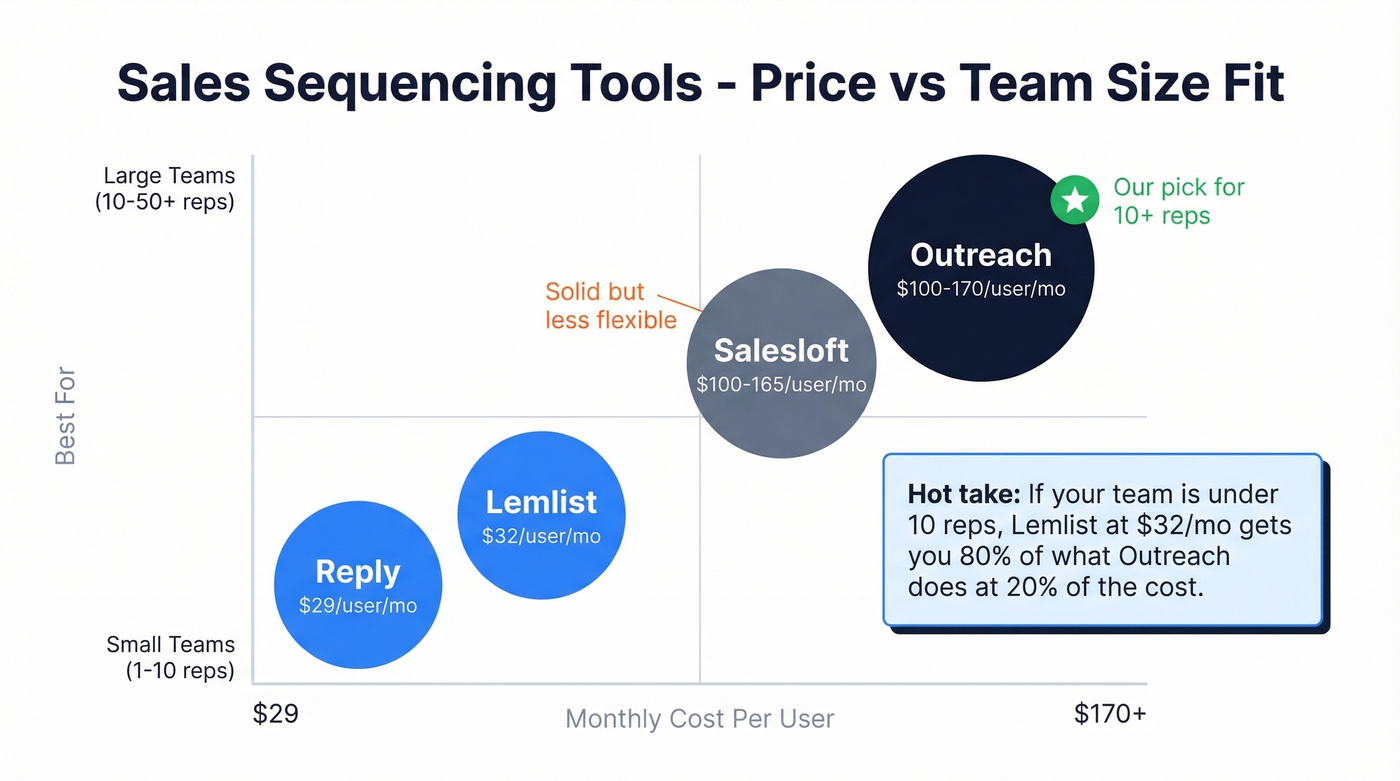
The catch? Outreach is enterprise-priced. For a 3-person team, Lemlist (from $32/user/mo) or Reply (from $29/user/mo) handle multi-channel sequences well at a fraction of the cost. Salesloft (~$100-165/user/mo) is the other enterprise option; it's solid but doesn't match Outreach's workflow flexibility in our experience. (If you're tightening follow-up, grab these sales follow-up templates.)
Dialers & Calling
Dialpad starts at $15/user/mo and handles the basics. PhoneBurner's power dialer lets reps reach up to 80 contacts per hour, which is compelling for high-volume SDR teams at ~$150/user/mo. (If you're shopping around, see our Dialpad alternatives.)
Here's the thing: one practitioner we follow recently admitted to "ripping out" an AI dialer because the complexity wasn't worth the marginal lift. Sometimes simpler is better. Fancy AI features mean nothing if you're calling wrong numbers - and that circles back to data quality again. (If you're building a repeatable motion, start with a cold calling system.)
Video Conferencing & Demos
Zoom's free tier handles 40-minute meetings, and paid plans remove the time limit. Google Meet works fine if your team already lives in Google's ecosystem. Microsoft Teams is the enterprise pick. For sales calls, the platform matters less than the connection quality - pick whichever your prospects already use. (For tighter calls, use these remote sales meeting tips.)
AI Meeting Assistants
AI note-takers are the highest-ROI virtual selling tools most remote teams aren't using yet. They reclaim 6-8 hours per week by handling transcription, action items, and CRM logging automatically.
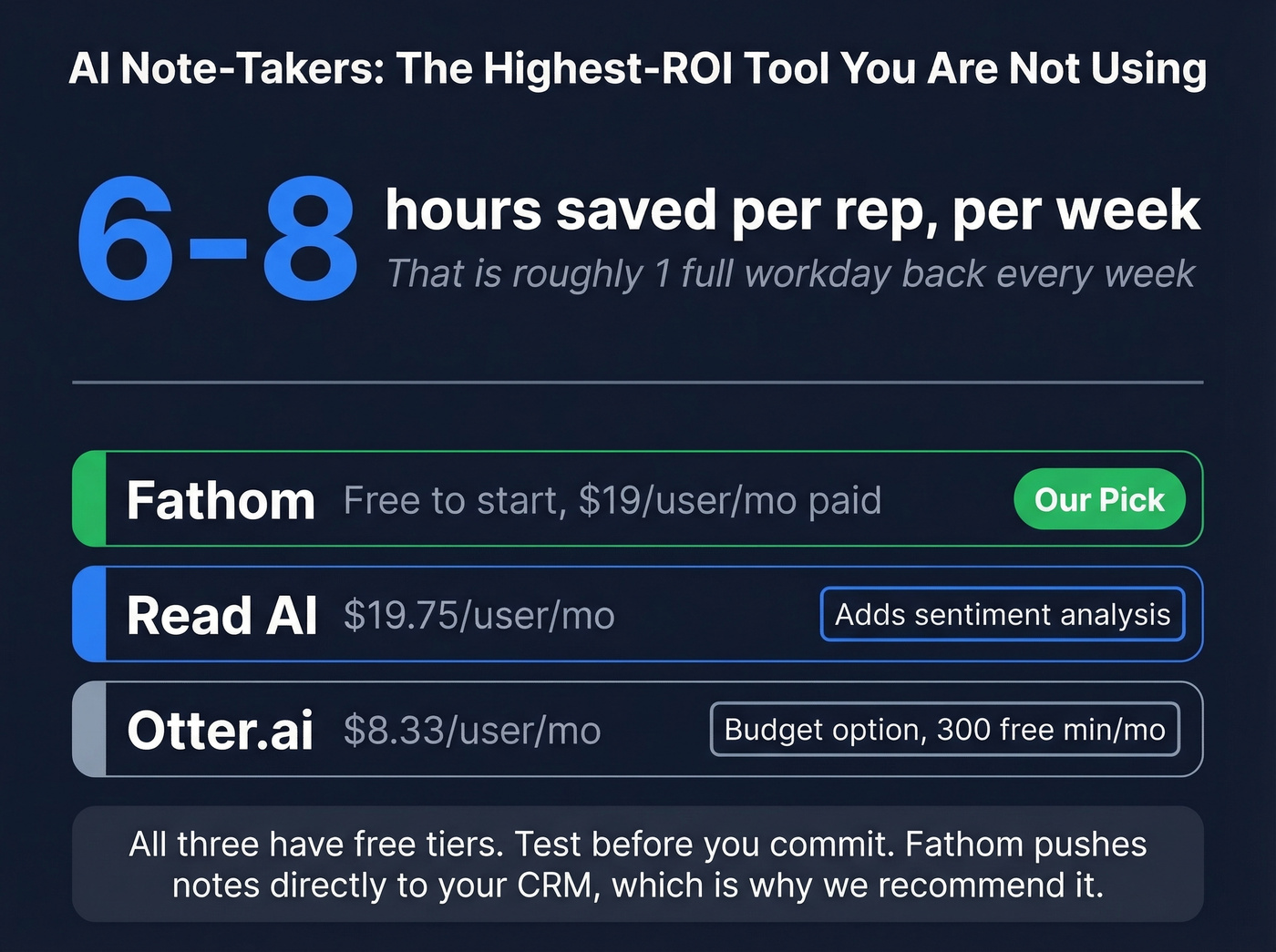
Fathom is our pick - free tier to start, $19/user/mo for paid. The summaries are sharp and it pushes notes directly to your CRM. Read AI ($19.75/user/mo) adds sentiment analysis and meeting scoring. Otter.ai ($8.33/user/mo) is the budget option with 300 free minutes per month. All three have free tiers worth testing before you commit. (More broadly, see our picks for generative AI sales tools.)
Conversation Intelligence
Gong is the gold standard - 4.8/5 on G2, with deal intelligence and coaching features that change how managers run teams. Pricing runs ~$5,000 platform fee plus $1,440/user/year. Chorus ($1,200-1,560/user/year) is cheaper but development has stagnated since the ZoomInfo acquisition. Clari ($1,200-1,500/user/year) focuses more on revenue forecasting than call coaching - different use case entirely.
Gong is worth it at 10+ reps. Below that, Fathom gets you 80% of the value for 5% of the cost.
Productivity & Communication
Slack (free tier, paid from $7.25/user/mo) and DocuSign (from $10/mo) round out most stacks. Let's be honest: Slack and Zoom aren't sales tools - they're communication tools you'd use in any role. Include them, but don't confuse them with tools that move pipeline.
We intentionally excluded video prospecting tools like Vidyard, sales content tools like Canva, and signal-based platforms like UserGems. They're useful but not core to most remote selling stacks.
Remote sales teams don't need more tools - they need fewer tools with better data underneath. Prospeo gives you 300M+ profiles, 125M+ verified mobiles, buyer intent on 15,000 topics, and native integrations with your entire stack. No contracts, no sales calls.
Build a lean remote stack that actually moves pipeline - start with 75 free emails.
Pricing at a Glance
Many tools on these lists don't publish pricing. We dug it up so you don't have to.
| Tool | Category | Starting Price | Free Tier |
|---|---|---|---|
| Prospeo | B2B Data | Free; paid from ~$39/mo | Yes |
| Apollo | Prospecting | $49/user/mo | Yes |
| Sales Navigator | Social Selling | ~$90/mo (annual) | Trial |
| Clay | Enrichment | $134/mo | No |
| HubSpot | CRM | $15-20/mo | Yes |
| Salesforce | CRM | $25/user/mo | Trial |
| Pipedrive | CRM | $14/user/mo | Trial |
| Outreach | Sequencing | ~$100/user/mo | No |
| Salesloft | Sequencing | ~$100/user/mo | No |
| Lemlist | Sequencing | $32/user/mo | Trial |
| Reply | Sequencing | $29/user/mo | Yes |
| Dialpad | Dialer | $15/user/mo | No |
| PhoneBurner | Dialer | ~$150/user/mo | No |
| Zoom | Video | Paid plans remove time limits | Yes |
| Fathom | AI Notes | $19/user/mo | Yes |
| Read AI | AI Notes | $19.75/user/mo | Yes |
| Otter.ai | AI Notes | $8.33/user/mo | Yes |
| Gong | Intelligence | ~$1,440/user/yr | No |
| Slack | Communication | $7.25/user/mo | Yes |
| DocuSign | E-Signature | $10/mo | Trial |
Stack Recommendations by Team Size
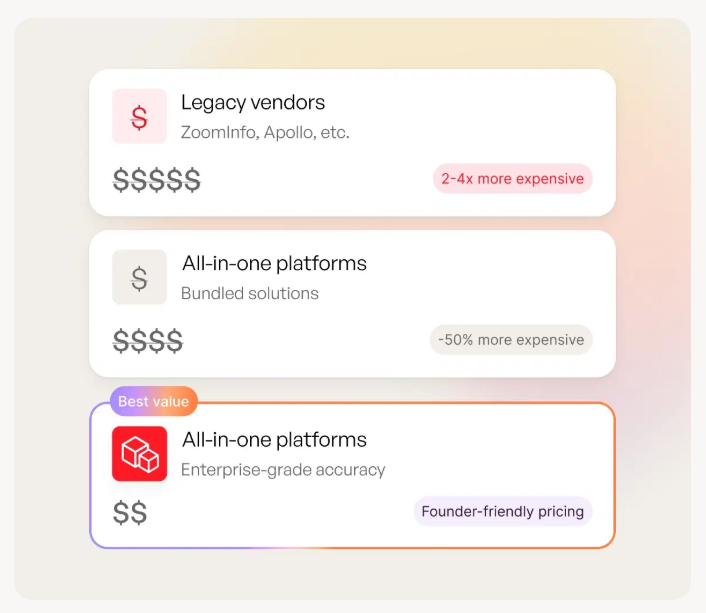
Hot take: If your average deal size is under $10K, you probably don't need ZoomInfo-level pricing. Most teams overspend on data platforms and underspend on the sequencing and coaching tools that actually convert leads into pipeline. (If you're choosing a data vendor, start with our comparison of sales prospecting databases.)
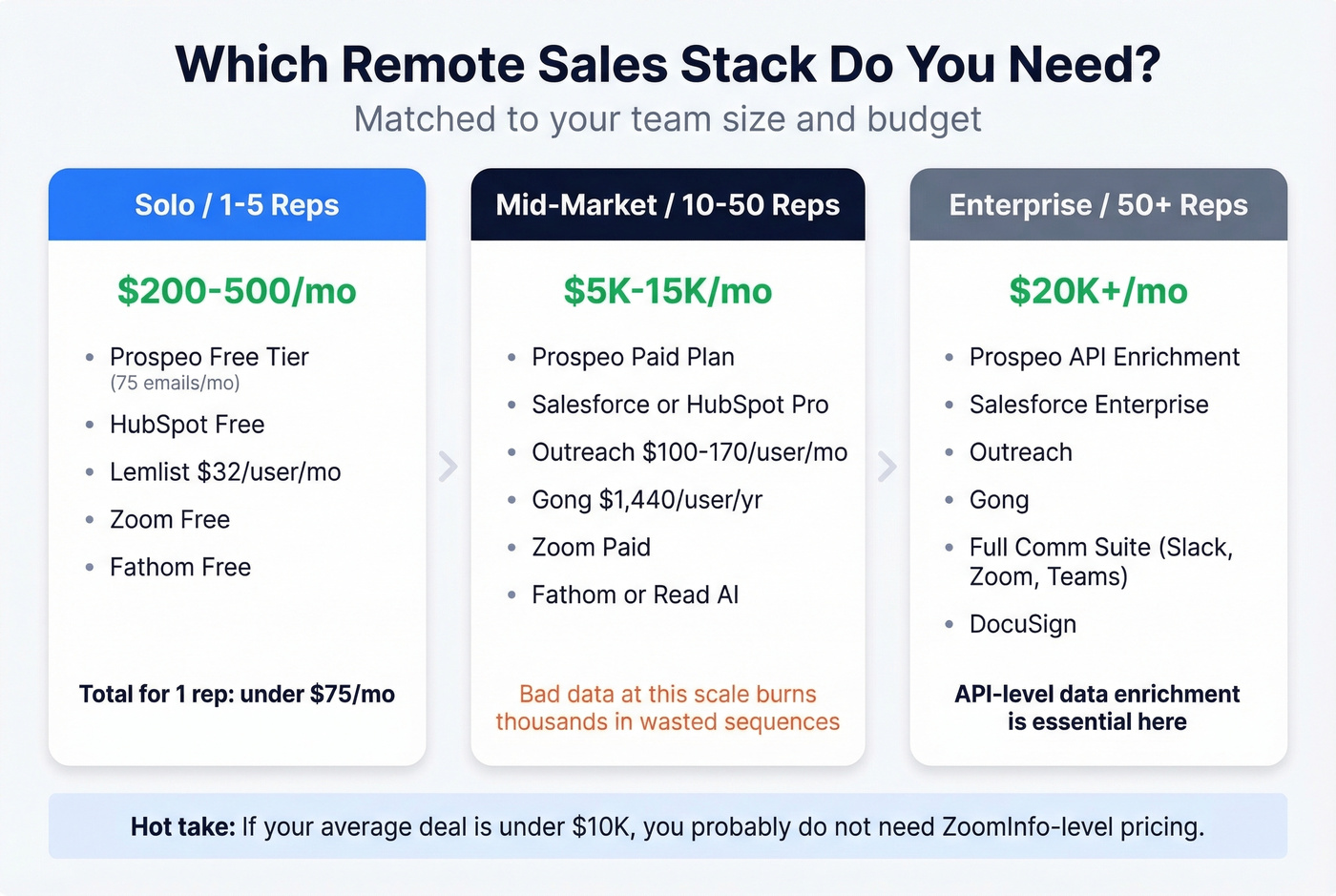
Solo founder / 1-5 reps (~$200-500/mo)
Start with free tiers across the board - HubSpot, Zoom, Fathom - and add Lemlist ($32/user/mo) for sequencing. Total for one rep: under $75/mo. Upgrade your data plan when you need more than 75 emails/month. These tools let you run a full outbound motion without enterprise budgets.
Mid-market, 10-50 reps (~$5K-15K/mo)
This is where tool selection actually matters. A bad data provider at this scale burns thousands in wasted sequences and damaged sender reputation. Meritt tripled pipeline from $100K to $300K/week after switching their data provider - that's the kind of lift a strong foundation creates. Run Salesforce or HubSpot Pro, Outreach, and Gong at this tier.
Enterprise, 50+ reps (~$20K+/mo)
Salesforce Enterprise, Outreach, Gong, and a full communication suite. API-level data enrichment becomes essential here - you need verified contacts flowing into your CRM automatically, not reps manually searching one by one.

Audit your stack twice a year. Cut redundancies first, then fill gaps in analytics and AI.
Common Mistakes to Avoid
Tool bloat. Modern AEs juggle 15+ apps daily. Every new tool adds a login, a tab, a context switch. If 45% of sales pros feel overwhelmed by their stack, the answer isn't another tool - it's fewer, better-integrated ones.
Ignoring data quality. This is the one that costs the most and gets noticed last. Bad emails burn your sending domain. Bad phone numbers waste dialer minutes. Every downstream tool underperforms when the data layer is broken. Fix this first. (If deliverability is slipping, start with our email deliverability guide.)
Buying enterprise tools for a 5-person team. A Salesforce + Outreach + Gong stack for five reps runs $3,000-5,000/mo before you've sent a single email. HubSpot free + Lemlist + Fathom does 80% of the same job for under $200/mo. Scale your tools with your team, not ahead of it.
FAQ
What remote sales tools do I need at minimum?
Four tools cover the essentials: a CRM (HubSpot free), a verified data platform (free tier), a sequencer (Lemlist from $32/mo), and video conferencing (Zoom free). Total cost under $50/mo. Add an AI note-taker like Fathom when call volume justifies it.
Are AI sales tools worth it in 2026?
Yes - 81% of sales teams already use AI, and tools like Outreach's Kaia cut sales cycles by 11 days. Focus on AI note-takers and conversation intelligence first. Rip out anything that adds complexity without clear, measurable ROI.
How much should a remote sales stack cost?
Solo or SMB: $200-500/mo. Mid-market with 10-50 reps: $5K-15K/mo. Enterprise at 50+ reps: $20K+/mo. Start lean with free tiers and upgrade only when you've maxed out what each tool can do. The most expensive tool is always the one nobody uses.
What's the biggest mistake teams make with sales tools?
Paying for data they can't trust. A 60% accuracy rate means 40% of sequences bounce, your sending domain tanks, and every downstream tool - sequencer, dialer, CRM - underperforms. Fixing the data layer first delivers the highest ROI of any stack change.