

Best Revenue Management Tools in 2026 (All Industries)
Most guides on revenue management tools cover hotels exclusively - useless if you're running a SaaS billing stack or trying to figure out why your B2B pipeline leaks revenue before deals even close.
Revenue management isn't one discipline. It's at least three: dynamic pricing for hotels and vacation rentals, subscription billing and revenue recognition for SaaS companies, and pipeline data quality for B2B sales teams. The software is completely different. The ROI math is completely different. And yet every guide lumps them together or ignores two of the three.
Billing errors alone leak 1-5% of total revenue at most SaaS companies. On $2M ARR, that's up to $100K/year walking out the door. On the B2B side, bad contact data tanks deliverability, kills domain reputation, and silently drains pipeline. These are revenue problems, and they deserve real solutions - not just a hotel pricing algorithm.
Our Picks (TL;DR)
| If You Run... | Start Here | Why |
|---|---|---|
| A hotel or vacation rental | RoomPriceGenie (independent) / IDeaS (enterprise) / PriceLabs (STR) | +19% revenue across 567 hotels in one study |
| A SaaS or subscription business | Chargebee (billing) / Salesforce Revenue Cloud (rev rec) | Stops the 1-5% billing leakage most companies don't even measure |
| A B2B sales team | Prospeo (data accuracy) / Revenue Grid (activity capture) | 98% email accuracy at ~$0.01/lead with a free tier - bad data is the #1 silent pipeline killer |
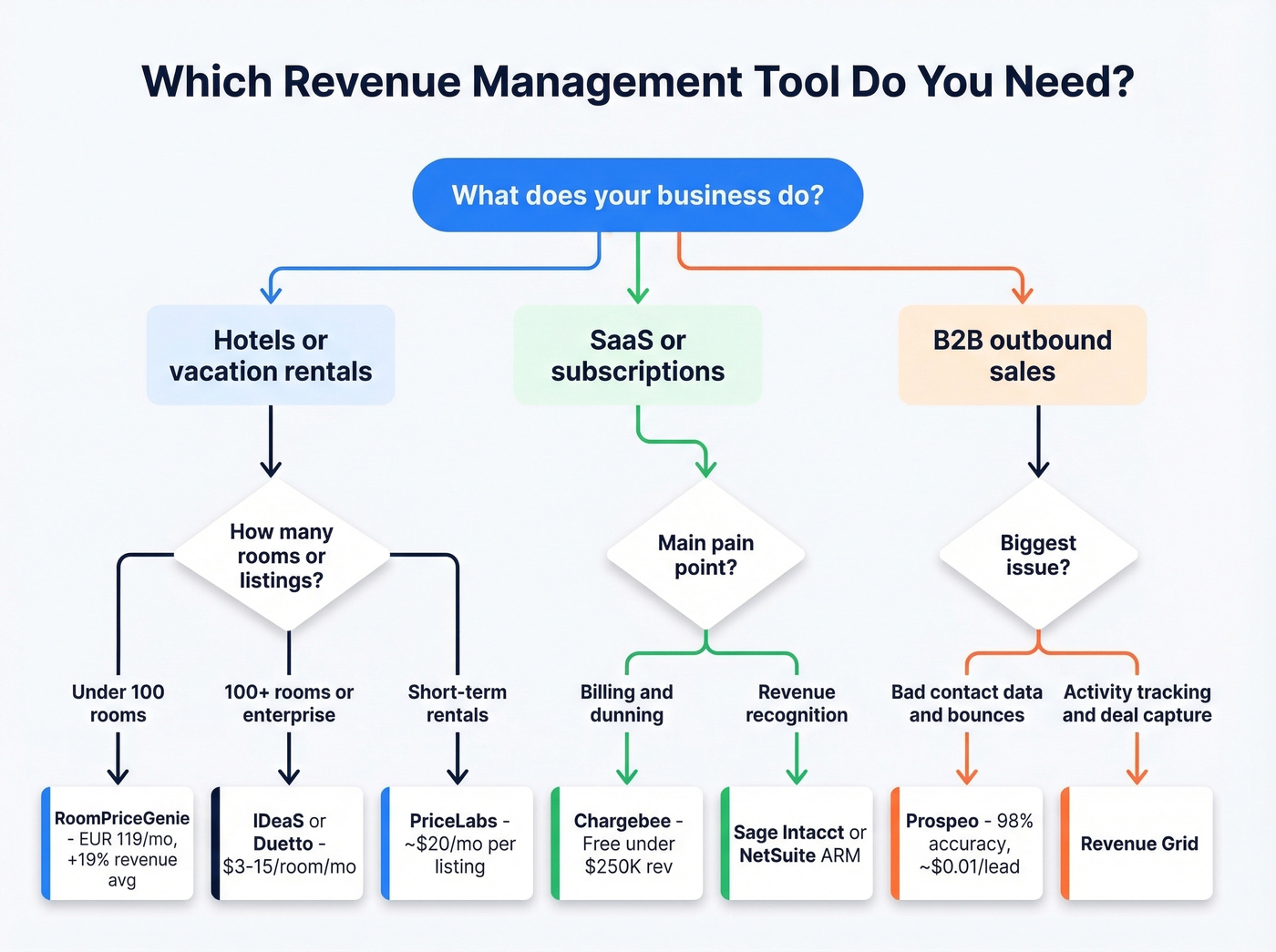
Which Category Do You Need?
Before you evaluate any tool, figure out which lane you're in. Revenue management means something different depending on your business model, and G2's category definition is broad enough to include tools that track pricing details, manage recurring and transaction revenue, handle revenue recognition, analyze discount impact, and monitor revenue per customer or contract.
If you're building a sales stack, it also helps to understand common sales pipeline challenges that quietly distort revenue forecasts.
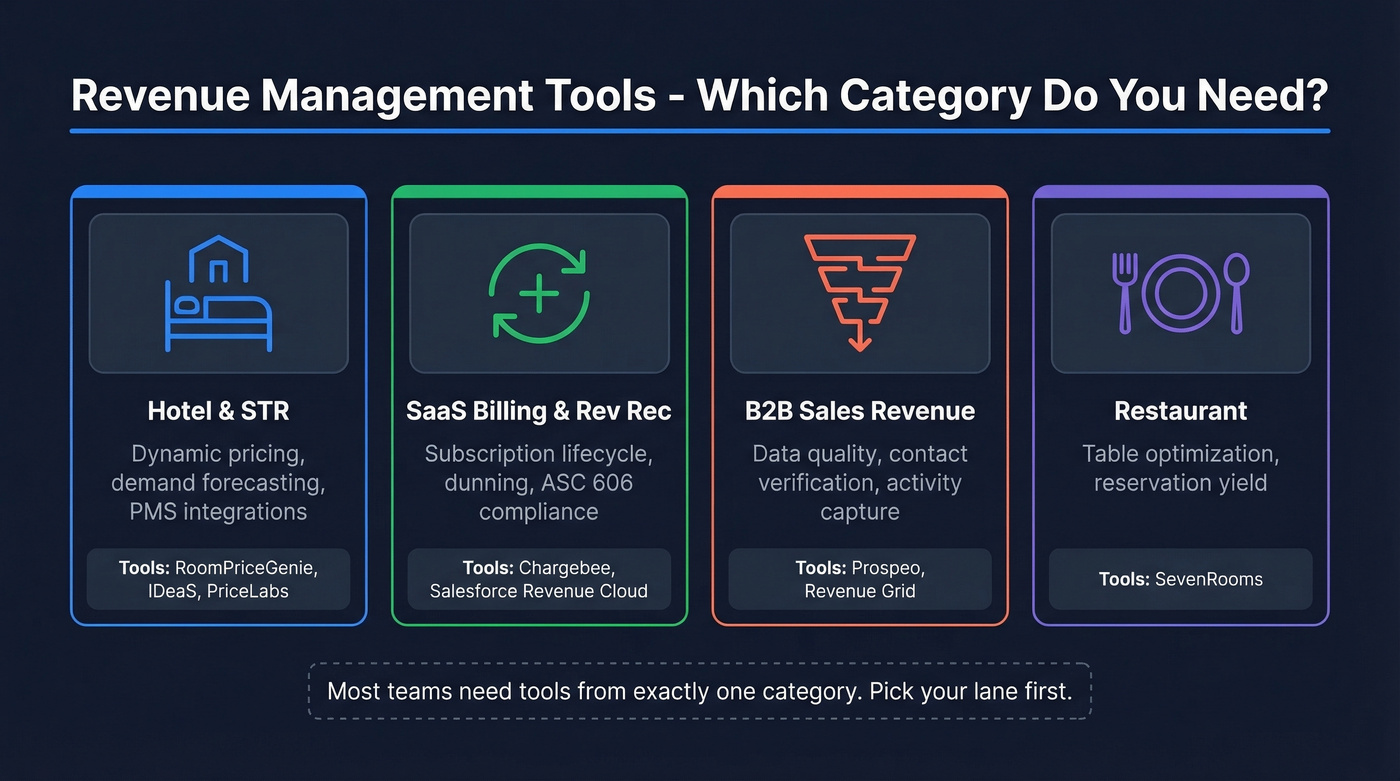
Hotel & STR Revenue Management
Dynamic pricing - adjusting room rates based on demand, seasonality, competitor rates, and booking pace. The tools here are purpose-built for hospitality and integrate with your PMS and channel manager.
SaaS Billing & Revenue Recognition
Subscription lifecycle management: recurring charges, upgrades, downgrades, dunning for failed payments, proration, multi-currency invoicing, tax compliance, and ASC 606/IFRS 15 reporting. If you're a finance team closing the books each month, this is your category.
If churn is part of your revenue leakage, a simple churn analysis framework helps you separate billing failures from product churn.
B2B Sales Revenue Tools
The upstream problem: pipeline data quality, contact verification, activity capture, and deal tracking. If your outbound team sends 2,000 emails and 340 bounce, that's a revenue management failure - you're burning domain reputation and losing deals you never even started.
If you're diagnosing bounces, start with email bounce rate benchmarks and root causes, then work backward into list quality.
Restaurant Revenue Management
A real category, but niche enough that we won't deep-dive here. If that's you, look at SevenRooms.
Most teams need tools from exactly one of these categories. A few enterprise orgs span two. Nobody needs all four.
Best Hotel & STR Pricing Software
The hospitality RMS market is mature and competitive. The right pick depends almost entirely on your property size and whether you're running hotels or short-term rentals.
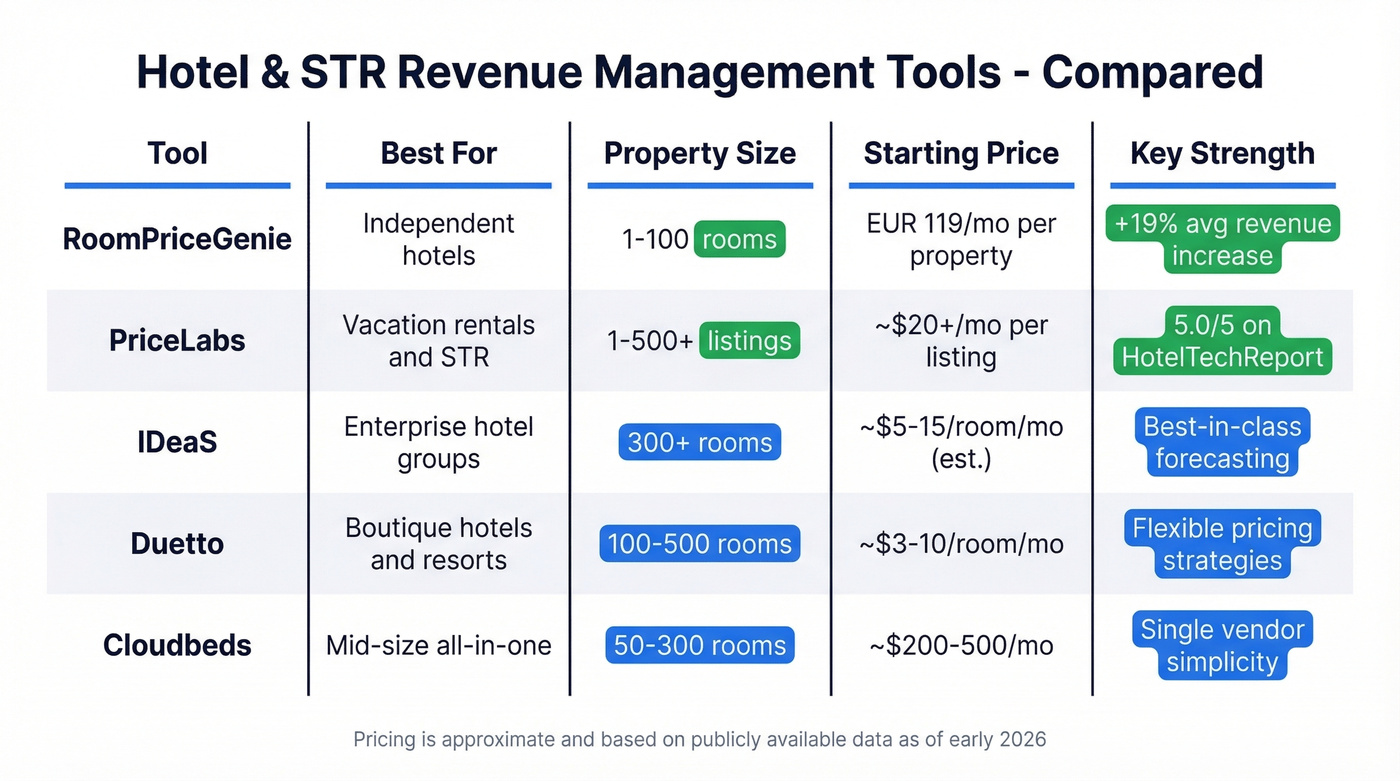
RoomPriceGenie
RoomPriceGenie is the standout for independent hotels and small chains - and one of the few hotel RMS options where concrete tier pricing is widely published online.
Use this if you run 1-100 rooms and want a system that works within days, not months. Their 567-hotel study showed +19% average revenue increase, +4% ADR, and +14% occupancy. Operators reported going from 10 hours/month on pricing to about 15 minutes. That time savings alone makes it worth the cost for small teams without a dedicated revenue manager.
Skip this if you're a 500-room resort with complex operations. You'll outgrow it.
Pricing runs EUR119/mo per property on annual billing for Starter (or EUR144 on monthly billing) up to EUR1,999/mo for Full Service with dedicated support. There's a 14-day free trial plus 50% off your first two months. Annual billing saves about 17%.
PriceLabs
PriceLabs is one of the most widely used dynamic pricing tools in the short-term rental space. They price 600,000+ properties daily across 150+ countries, and their HotelTechReport rating sits at a perfect 5.0/5 from 43 reviews. Users consistently praise the pricing precision and integrations; the main complaints center on UI polish and wanting more automation in rule-setting.
Use this if you manage vacation rentals or a portfolio of Airbnb/Vrbo listings. The market dashboards and portfolio management tools are genuinely best-in-class for STR operators.
Skip this if you're a traditional hotel - PriceLabs can work, but RoomPriceGenie or IDeaS will fit your PMS integrations better.
Pricing starts around ~$20+/mo per listing depending on volume. The 30-day free trial requires no credit card, which is the most generous trial in the category.
IDeaS Revenue Solutions
IDeaS is the enterprise default. If you're running a luxury hotel group or a 300+ room property, this is probably already on your shortlist. The system is built for enterprise-scale forecasting and complex hotel operations in a way smaller tools can't match.
Pricing isn't public, but expect roughly $5-15/room/month for mid-market properties, with enterprise contracts running significantly higher. It's overkill under 100 rooms - the implementation timeline alone (weeks to months) makes it impractical for smaller operators. For large properties, though, it's the benchmark everyone else is measured against.
Duetto
Duetto carved out a niche in boutique hotels and resorts with flexible pricing controls that go beyond fixed BAR-only approaches. That flexibility matters for properties with diverse demand patterns and segments. Pricing runs roughly $3-10/room/month depending on property size and modules. Where Duetto wins over IDeaS: flexibility for creative pricing strategies. Where IDeaS wins: raw forecasting depth and enterprise scale.
Cloudbeds
Cloudbeds is the all-in-one hotel platform play. If you're a mid-size property that doesn't want to stitch together five different vendors, it's worth a look. They offer $250 in free credit after a demo. Expect pricing in the $200-500/mo range for a mid-size property depending on modules selected.
Other hotel RMS options worth evaluating include Atomize, FLYR Hospitality, and Lighthouse (formerly OTA Insight). We didn't include deep dives on them here because they overlap heavily with IDeaS and Duetto for many buyers.
Here's the thing about hotel revenue management in practice: a lot of revenue teams still run a "PMS + RMS + spreadsheet/BI layer" workflow day-to-day, not a single all-in-one platform. The best revenue managers treat their RMS as one input, not an oracle. If you're spending more time configuring your tool than analyzing your market, you picked the wrong one.
Best SaaS & Subscription Billing Platforms
SaaS revenue management is really two problems wearing a trench coat: billing automation (collecting money correctly) and revenue recognition (reporting it correctly under ASC 606/IFRS 15). Most companies start with billing and bolt on rev rec when their auditor starts asking questions.
If you're trying to quantify the impact, start by mapping churn types with a clean what is churn definition and measurement approach.
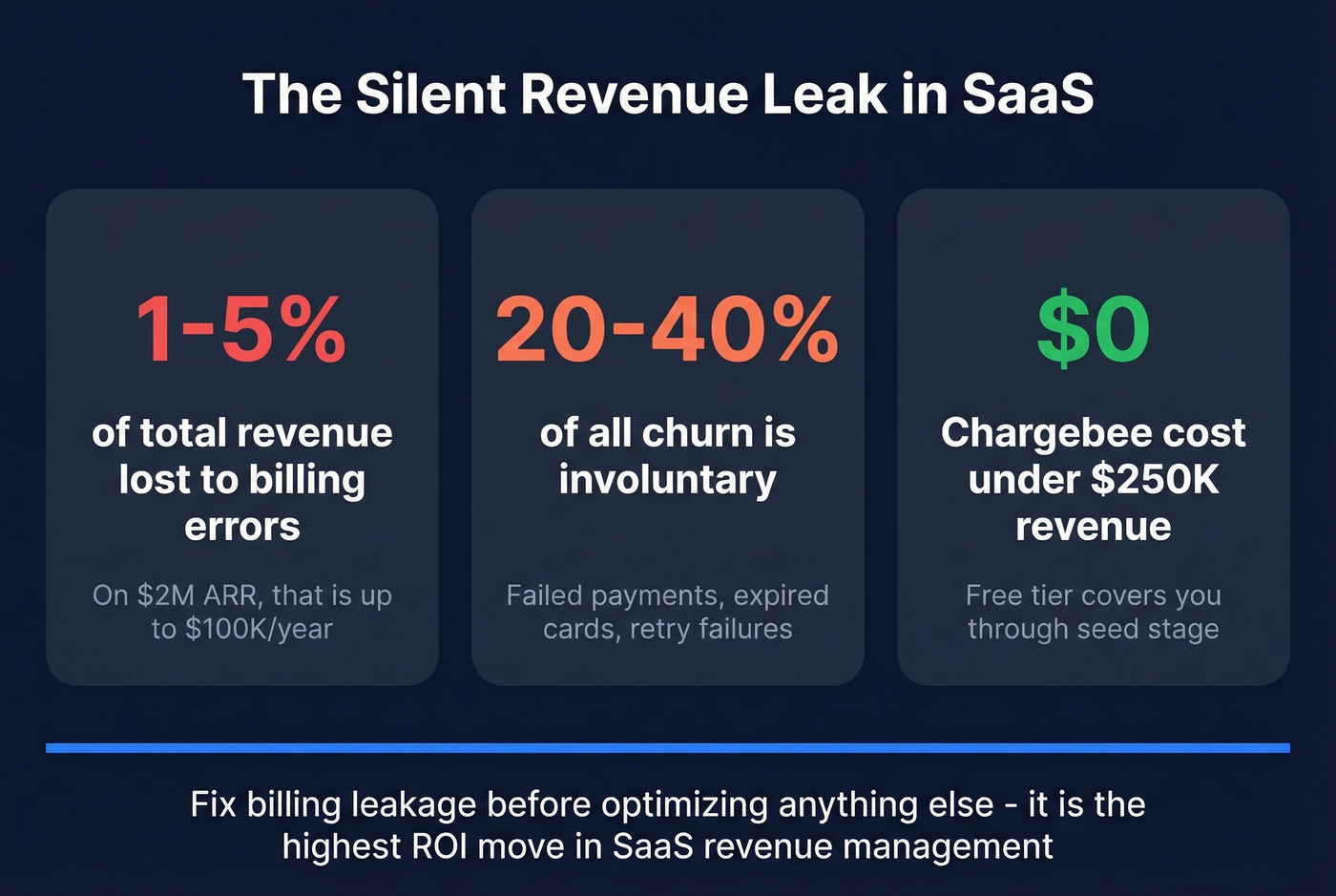
Involuntary churn - failed payments, expired cards, billing errors - accounts for 20-40% of all churn. That's revenue walking out the door because your retry logic isn't smart enough. Fix that first.
Chargebee
Chargebee is the obvious starting point for subscription businesses. It handles the full billing lifecycle - plans, trials, upgrades, downgrades, proration, dunning, and retry automation - without requiring you to build any of it in-house. Multi-currency invoicing and automated tax compliance come built in, which matters the moment you sell outside your home country.
The pricing model is genuinely startup-friendly: free for companies under $250K in revenue. Paid plans start around $249/mo and scale with your billing volume. That free tier is real and generous enough to get you through seed stage without adding a line item.
Chargebee shines with dunning and retry automation that recovers failed payments automatically. G2 reviewers consistently highlight the flexibility of plan configuration and the quality of Stripe/payment gateway integrations. Where it gets complicated: if you need full ASC 606 rev rec, you'll need their RevRec add-on or a separate tool. It's a billing-first platform, not an accounting platform.
Salesforce Revenue Cloud
Salesforce Revenue Cloud bundles CPQ, billing, and revenue recognition into one platform. It's powerful. It's also only worth considering if you're already deep in the Salesforce ecosystem.
Expect $150-300/user/month depending on modules. The native integration with Sales Cloud and Service Cloud means quotes flow into invoices flow into rev rec schedules without manual handoffs. But if you're not already on Salesforce, the implementation cost and timeline make this a non-starter. We've seen teams spend months getting Revenue Cloud configured properly. For Salesforce-native orgs, though, it eliminates the data silos that cause billing leakage.
NetSuite ARM
NetSuite's Advanced Revenue Management module handles multi-element arrangements, ASC 606 compliance, and automated revenue schedules. It scores 4.1/5 on G2 with 4,581 reviews - users praise the integration depth and customizable reporting, though the learning curve and support quality draw mixed feedback.
NetSuite starts around ~$1,000+/month for the base platform, with ARM as an add-on module. Total cost for a mid-market deployment often lands in the $2,000-4,000+/mo range. If you're in the Oracle ecosystem, it's the path of least resistance for rev rec.
Sage Intacct
Sage Intacct is the mid-market finance team's pick for revenue recognition. It handles ASC 606 compliance, multi-entity consolidation, and automated rev rec schedules with strong reporting. Expect $15,000-40,000/year depending on modules. If you've outgrown QuickBooks but don't want the weight of NetSuite, Sage Intacct hits the sweet spot.
Zenskar
Zenskar targets usage-based billing specifically - the pricing model that's eating SaaS. If you charge by API calls, seats, compute hours, or any consumption metric, Zenskar handles the metering-to-invoice pipeline. Expect pricing in the $500-2,000/mo range for mid-market deployments based on billing volume.

If 17% of your outbound emails bounce, that's not a deliverability problem - it's a revenue management failure. Prospeo's 98% email accuracy and 7-day data refresh cycle keep your pipeline clean so deals don't die before they start. At ~$0.01/lead, fixing your data costs less than one lost meeting.
Stop managing revenue downstream when the leak starts at your contact data.
Best B2B Pipeline Revenue Tools
Here's the angle most guides miss entirely: your B2B pipeline is a revenue optimization problem. When an SDR sends 2,000 emails and 340 bounce, that isn't just an annoyance - it's domain reputation damage that reduces deliverability for every future campaign. The revenue you never generate because prospects never saw your email is invisible, but it's real.
If you're building outbound, pair data quality with proven sales prospecting techniques so you’re not scaling a broken motion.
Prospeo
Prospeo is where we'd start for any B2B team that treats pipeline as a revenue problem. The database covers 300M+ professional profiles with 143M+ verified emails and 125M+ verified mobile numbers - all refreshed on a 7-day cycle, compared to the 6-week industry average.
The accuracy numbers matter: 98% email accuracy and a 30% mobile pickup rate. For context, ZoomInfo delivers 87% email accuracy and Apollo 79% in our testing - meaning 13-21% of outreach is wasted before you write a single subject line.

Search runs 30+ filters - buyer intent powered by Bombora across 15,000 topics, technographics, job changes, headcount growth, funding signals, and department-level headcount. The Chrome extension has 40,000+ users for prospecting directly from company websites and professional profiles.
The proof point that sticks: Snyk's 50-person AE team went from a 35-40% bounce rate to under 5% after switching. AE-sourced pipeline jumped 180%, generating 200+ new opportunities per month.
Pricing is dead simple: ~$0.01 per email, 10 credits per mobile number. Free tier gives you 75 verified emails and 100 Chrome extension credits per month. No contracts, no annual commitments, self-serve onboarding. Native integrations with Salesforce, HubSpot, Lemlist, Instantly, Smartlead, Clay, and Zapier.
If you’re comparing vendors, start with the broader landscape of data enrichment services and where verification fits.
Revenue Grid
Revenue Grid sits in the activity capture lane - automatically logging emails, calls, and meetings from Outlook and Gmail into Salesforce so reps don't have to. The revenue angle: if activities aren't captured, your forecast is fiction. It's a natural complement to a data accuracy platform - one fixes the input quality, the other fixes the tracking.
Pricing starts at $30/user/month for Activity Capture 360, $49/user/month for Knowledge Capture, and $149/user/month for the Ultimate tier with guided selling.
monday CRM
monday CRM is the entry-level option for small B2B teams starting from zero. Free for up to 2 seats, with paid plans at $9-$19/seat/month billed annually. It won't replace a dedicated revenue intelligence platform, but if you're a 3-person sales team that needs pipeline visibility without enterprise complexity, it gets the job done.
If you’re still deciding what “CRM” even means in practice, these examples of a CRM make the differences obvious.
Full Pricing Comparison
We couldn't find another guide on this topic that gives you a single table comparing tools across hospitality, SaaS, and B2B. The pricing ranges across these categories are so different that most writers avoid the comparison entirely. Here it is anyway.
| Tool | Category | Starting Price | Free Trial/Tier | Best For |
|---|---|---|---|---|
| RoomPriceGenie | Hotel RMS | EUR119/mo/property | 14-day trial | Independent hotels |
| PriceLabs | STR Pricing | ~$20+/mo/listing | 30-day, no CC | Vacation rentals |
| IDeaS | Hotel RMS | ~$5-15/room/mo | Demo only | Enterprise hotels |
| Duetto | Hotel RMS | ~$3-10/room/mo | Demo only | Boutique/resort |
| Cloudbeds | Hotel Platform | ~$200-500/mo | $250 free credit | All-in-one hotel ops |
| Chargebee | SaaS Billing | $0 (startups) | Free to $250K rev | Subscriptions |
| SF Revenue Cloud | Rev Rec/CPQ | ~$150-300/user/mo | Demo only | Salesforce-native orgs |
| NetSuite ARM | Rev Rec | ~$2,000+/mo total | Demo only | Oracle ecosystem |
| Zenskar | Usage Billing | ~$500-2,000/mo | Demo only | Usage-based models |
| Sage Intacct | Rev Rec | ~$15,000-40,000/yr | Demo only | Mid-market finance |
| Prospeo | B2B Data | $0 (75 emails/mo) | Free tier, no CC | Pipeline accuracy |
| Revenue Grid | Sales Activity | $30/user/mo | Demo only | Activity capture |
| monday CRM | CRM | $0 (2 seats) | Free tier | Small sales teams |
The range is dramatic - from free tiers to $40,000+/year for enterprise rev rec. Your category determines your budget more than any feature comparison ever will.
What ROI Should You Expect?
Hospitality: RoomPriceGenie's 567-property study showed +19% average revenue, +4% ADR, and +14% occupancy. Even at the EUR119/mo Starter tier, a small hotel generating EUR15,000/month in room revenue would see the tool pay for itself within the first week of that 19% lift.
SaaS: If involuntary churn is 20-40% of your total churn and billing errors leak 1-5% of revenue, a $2M ARR company is losing $20K-100K/year to problems a billing platform solves automatically. Chargebee's free tier means the ROI is technically infinite until you hit $250K in revenue.
B2B Sales: The Snyk case is the clearest benchmark - bounce rate from 35-40% down to under 5%, AE-sourced pipeline up 180%. When your data is bad, every downstream metric suffers: open rates, reply rates, meetings booked, pipeline generated. Fixing data quality at $0.01/email is the highest-leverage spend in most B2B stacks.
If you want to quantify “pipeline health” beyond anecdotes, track a few core pipeline health metrics consistently.

Mistakes That Cost More Than the Software
Confusing high occupancy with success. A hotel running 95% occupancy at rock-bottom rates is leaving money on the table. Revenue per available room (RevPAR) is the metric that matters - and some operators are now tracking Revenue Per Available Guest (RevPAG) to capture ancillary spend. Track RevPAR as your north star, not heads in beds.
Blindly following the RMS. An algorithm doesn't know about the music festival two blocks away or the construction project next door. Revenue managers who rubber-stamp every recommendation underperform those who treat AI as collaborative, not autonomous. Review algorithmic recommendations weekly with local context.
Treating revenue optimization as a silo. When pricing, marketing, and operations don't talk to each other, you get conflicting strategies - sales running discounts while revenue management raises rates. Make it a cross-functional discipline with shared dashboards.
Choosing tools that are hard to adopt. The most powerful RMS in the world is worthless if your team won't use it. We've seen enterprise tools sit unused for months because the training burden was too high. Weight ease of adoption as heavily as feature depth in your evaluation.
Ignoring data quality. This applies across every category. A hotel RMS fed bad comp-set data produces bad recommendations. A SaaS billing system with stale customer records generates failed charges. A B2B sales team with unverified emails burns domain reputation. Audit your data inputs before you optimize your outputs.
If deliverability is part of your revenue leak, use an end-to-end email deliverability guide to fix the root causes (not just the symptoms).
2026 Trends Worth Watching
The AI market hits $514.5B in 2026, up 19% year-over-year. But the interesting shift isn't the spending - it's how AI is being deployed in revenue optimization specifically.
Collaborative AI replaces "set and forget." The first generation of AI pricing tools optimized in a black box. The 2026 generation learns from operator decisions, incorporating human judgment into the model. Revenue managers become AI trainers, not just button-pushers.
Real-time pricing becomes the baseline. Daily rate updates are already outdated for competitive markets. The expectation is moving toward continuous pricing adjustments based on live demand signals, not yesterday's data.
Revenue Action Orchestration (RAO) emerges. Gartner is tracking this as a distinct space - tools that don't just analyze revenue but orchestrate actions across pricing, billing, and pipeline management. By end of 2026, an estimated 40% of enterprise apps will include task-specific AI agents.
Hybrid pricing models gain ground. Across SaaS and hospitality alike, pure subscription or pure dynamic pricing is giving way to blended models - base fees plus usage, fixed rates plus demand surcharges. The tools that handle this complexity cleanly will win.
Only 12% of CEOs report achieving both cost savings and revenue gains from AI. The tools are ahead of the implementation. Picking the right revenue management tools matters less than actually deploying them properly.
Meritt tripled their pipeline from $100K to $300K/week and cut bounce rates from 35% to under 4% - just by switching to accurate data. B2B revenue management starts with reaching real buyers. Prospeo gives you 300M+ verified profiles, 125M+ mobile numbers, and a free tier to prove it.
The cheapest revenue management tool is data that actually connects you to buyers.
FAQ
What is revenue management software?
Revenue management software helps businesses optimize pricing, billing, and revenue recognition to maximize total revenue. G2 defines the category broadly - covering pricing automation, recurring billing, rev rec allocations, discount analysis, and per-customer revenue tracking. The right tool depends entirely on whether you run hotels, SaaS, or B2B sales.
How much do these tools cost?
Costs range from free (Chargebee's startup tier, Prospeo's 75-email plan, monday CRM's 2-seat plan) to $40,000+/year for enterprise platforms like Sage Intacct or NetSuite ARM. Hotel RMS tools typically run EUR3-15/room/month. SaaS billing platforms start free and scale with revenue volume.
Can small hotels afford an RMS?
Yes. RoomPriceGenie starts at EUR119/mo per property with a 14-day free trial and 50% off the first two months. PriceLabs offers a 30-day no-credit-card trial. The RoomPriceGenie study showed +19% revenue even for small independent properties - at that lift, the tool pays for itself within days.
How does bad data hurt B2B revenue?
Unverified contact data causes email bounces that damage sender reputation, reducing deliverability for every future campaign. Snyk's team saw a 35-40% bounce rate before switching to verified data, which dropped to under 5% - and AE-sourced pipeline jumped 180%. At $0.01/email, fixing data quality is the highest-ROI line item in most outbound stacks.
How is AI changing revenue optimization in 2026?
Collaborative AI is replacing black-box automation. Instead of "set and forget" pricing, 2026 tools learn from operator decisions and incorporate human judgment into recommendations. Real-time pricing is the new baseline, and Gartner's Revenue Action Orchestration category tracks tools that orchestrate actions across pricing, billing, and pipeline in a single workflow.