

How to Build a B2B SaaS Marketing Plan With Real Numbers
You're the first marketing hire. Or maybe the second. The CEO wants a SaaS B2B marketing plan by Friday, the board deck needs pipeline projections by end of month, and you're still trying to figure out whether to spend your $3K budget on Google Ads or blog posts. Meanwhile, CAC is up 40-60% since 2023, which means the plan that worked two years ago is already underwater.
Here's a 2026 framework built on real benchmarks, not vibes - with numbers where they matter and a quarterly cadence you can actually execute.
The Short Version
- Your ICP determines everything. Pick one segment before you pick a single channel.
- Budget = 8% of ARR at the median, adjusted by stage and motion.
- Start with cold email, not ads. It validates messaging in days, not months.
- Measure CAC by channel, not blended. A blended CAC hides the channel that's bleeding money.
- Plan in quarters, not years. Annual plans are fiction by March.
Why SaaS Marketing Plans Are Different
Subscription economics change the math. You don't just acquire a customer - you rent their attention every month. If they churn, your marketing spend retroactively becomes waste. That's why retention is a marketing function in SaaS, not just a CS metric.
Two numbers frame everything. First, only 5% of B2B buyers are in-market at any given time, which means 95% of your "demand gen" is actually brand building for future pipeline. Second, expansion ARR now accounts for roughly 40% of new ARR - if your marketing plan doesn't include retention and upsell plays, it's missing nearly half the revenue opportunity.
And here's the kicker: 42% of B2B decision-makers have invited a vendor to bid after consuming thought leadership. The content you publish today fills pipeline six months from now.
Lock Your ICP Before Anything Else
The single biggest mistake we see in early-stage marketing plans is skipping ICP definition and jumping straight to channels. A practitioner on r/AskMarketing put it bluntly: they created content for "PMs and founders" broadly, got weak engagement, then switched to targeting professional service agencies specifically - and signups improved immediately.
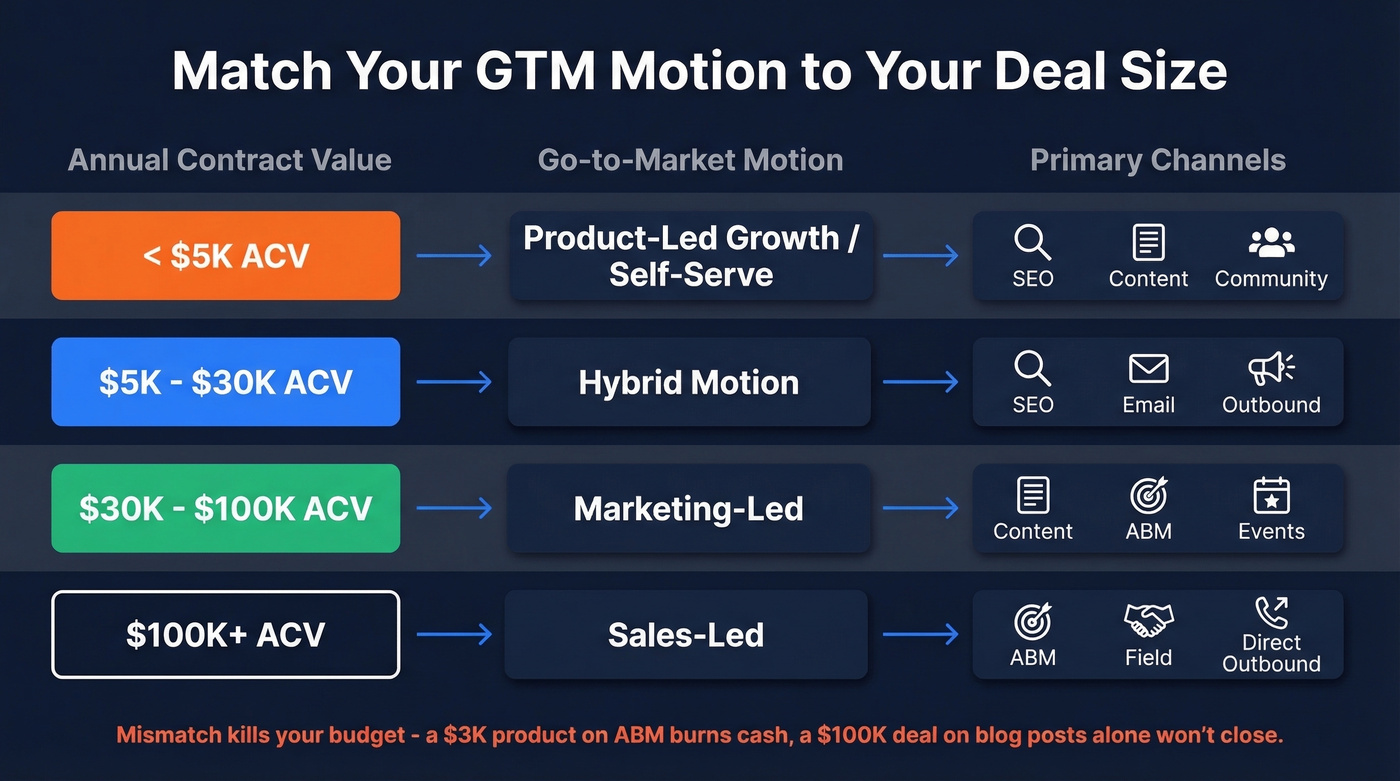
Your average contract value dictates your go-to-market motion, which dictates your channels:
| ACV Range | GTM Motion | Primary Channels |
|---|---|---|
| < $5K | Product-led growth / self-serve | SEO, content, community |
| $5K-$30K | Hybrid | SEO, email, outbound |
| $30K-$100K | Marketing-led | Content, ABM, events |
| $100K+ | Sales-led | ABM, field, direct outbound |
If you're selling a $3K/year product through ABM and field events, you'll burn cash faster than you can acquire customers. Selling six-figure contracts through blog posts alone? You'll wonder why nobody's closing. Match the motion to the deal size.
Budget Benchmarks by Stage
The SaaS Capital annual survey of 1,000+ companies puts median marketing spend at 8% of ARR. Product-led growth companies run higher - about 13% of revenue - while sales-led companies average around 9%.
Percentages are useless without absolute numbers, though:
| ARR Range | Monthly Budget | % of ARR |
|---|---|---|
| $0-$500K | $0-$2K | Founder time |
| $500K-$1M | $2K-$5K | ~8-10% |
| $1M-$2M | $5K-$15K | ~8-10% |
| $2M-$5M | $15K-$40K | ~7-9% |
At pre-seed, your budget is your time and a few tools. By the time you hit $2M ARR, you should have enough data to allocate across channels with confidence. A practical stage-based split as a starting template:
- Under $1M ARR: 40% paid search, 25% content/SEO, 15% LinkedIn ads, 20% email/retention
- $5M+ ARR: 25% paid search, 20% content/SEO, 25% LinkedIn ads, 30% email/retention

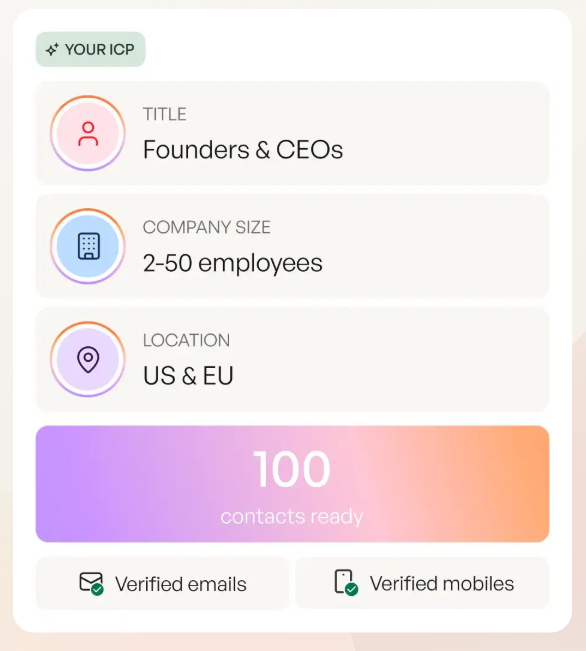
Your marketing plan says cold email first - smart. But outbound only works when the data is clean. Prospeo delivers 300M+ profiles with 98% email accuracy and a 7-day refresh cycle, so your first campaign doesn't torch your domain reputation. At $0.01/email, it costs less than a single wasted Google Ad click.
Validate your messaging in days, not months - with emails that actually land.
Choose and Sequence Your Channels
Look, most marketing plans get this wrong: they're channel lists, not sequences. Listing "SEO, paid search, webinars, content, email" tells you nothing about what to do first, second, or never. Sequencing is the actual strategy.
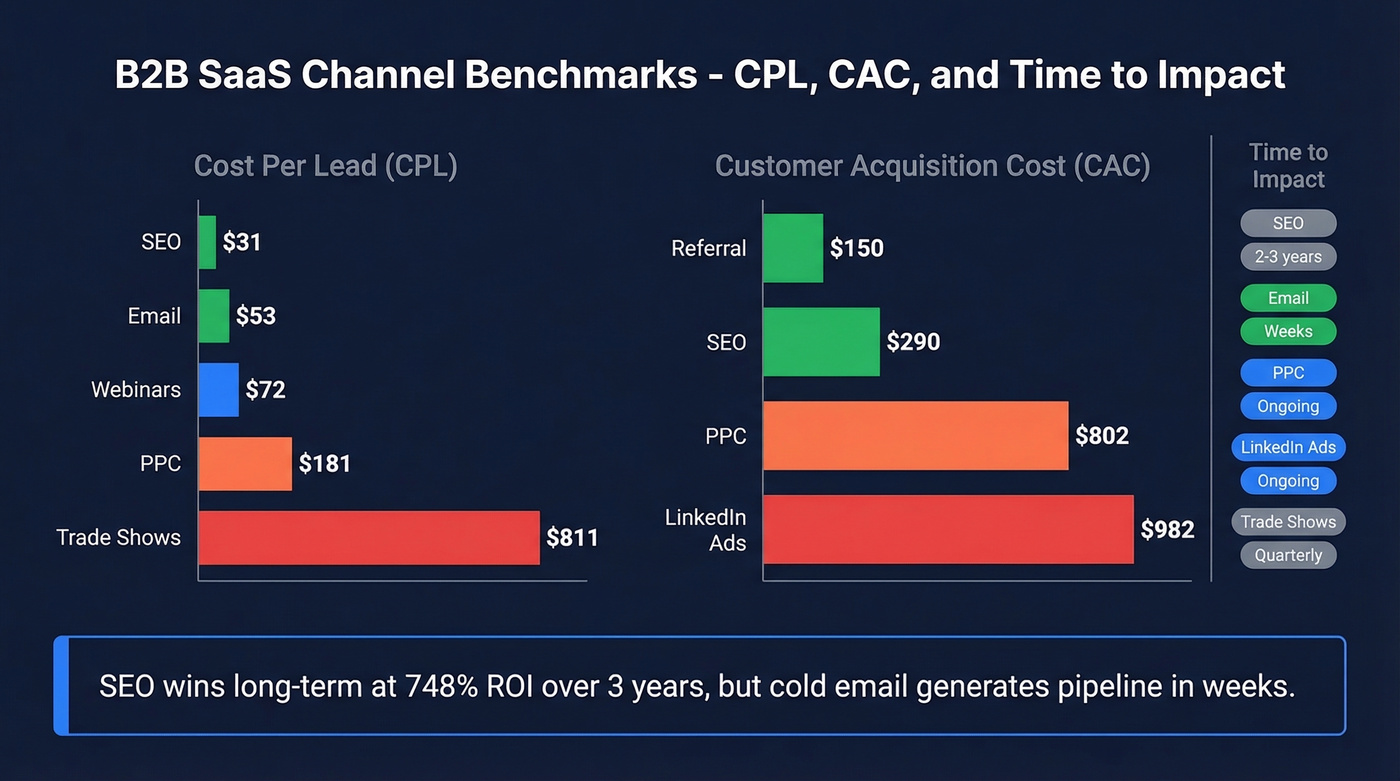
Here are benchmark CPL and CAC reference points to sanity-check your plan:
| Channel | CPL | CAC | Time to Impact |
|---|---|---|---|
| SEO | $31 | $290 | 2-3 years |
| $53 | - | Weeks | |
| Referral | - | $150 | Ongoing |
| Webinars | $72 | - | 1+ year |
| PPC | $181 | $802 | Ongoing |
| LinkedIn Ads | - | $982 | Ongoing |
| Trade Shows | $811 | - | Quarterly |
Thought leadership SEO wins the long game at 748% ROI over three years. But you can't eat compound interest while you're starving.
If your ACV sits below $8K, you probably don't need LinkedIn Ads at all. A ~$982 CAC can consume a big chunk of year-one revenue. Put that budget into cold email and SEO instead.
How to Sequence It
The consensus on r/SaaSMarketing - and we agree - is this order:
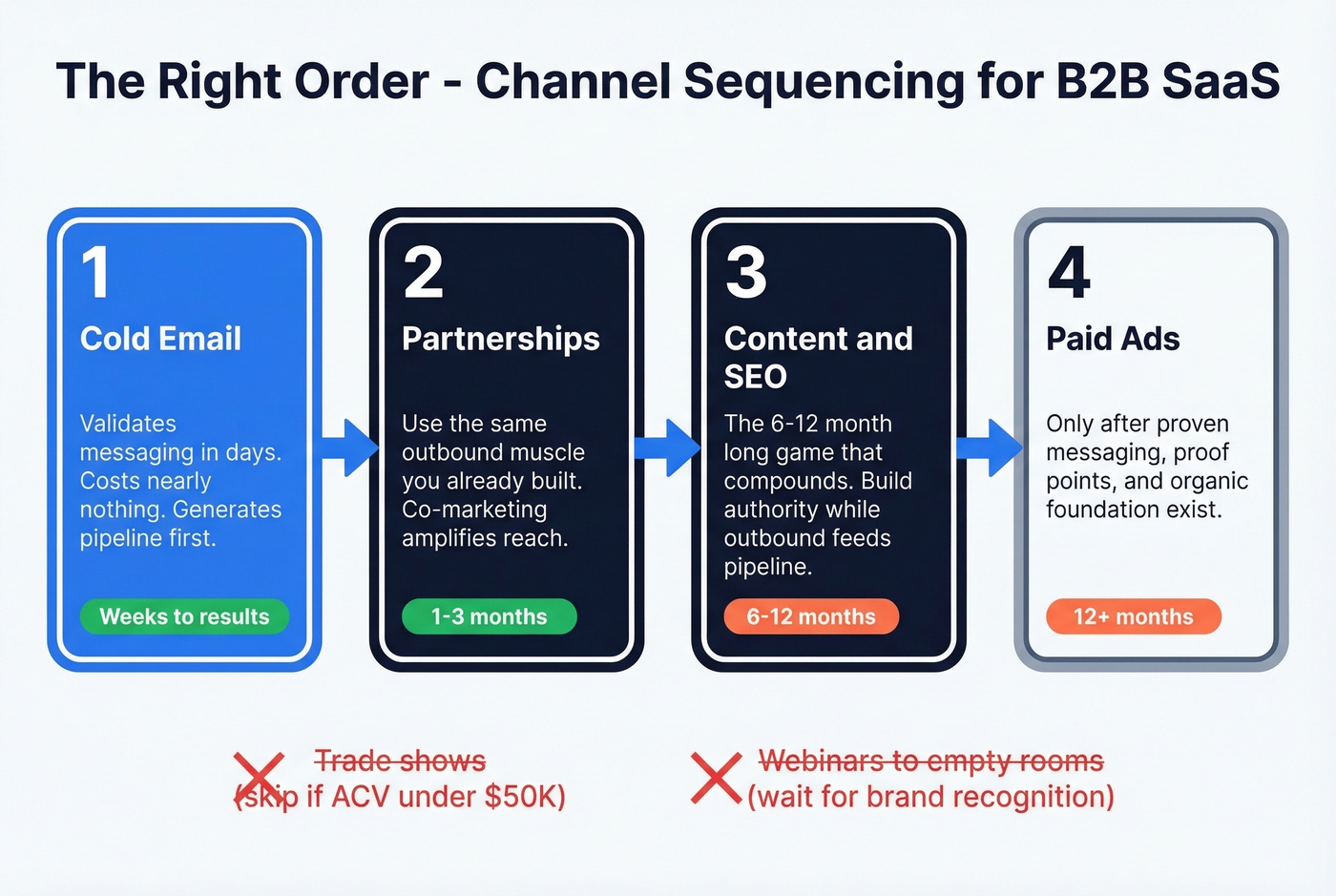
- Cold email first. Validates messaging in days. Costs almost nothing. Generates pipeline before anything else can. To run outbound effectively, you need verified contacts - not a list of guessed emails that'll tank your domain reputation on day one. Prospeo covers 300M+ professional profiles with 98% email accuracy at roughly $0.01/lead, with a free tier of 75 emails/month so you can test before committing. (If you need help building the actual sequence, start with a cold email sequence.)
- Partnerships second. Often initiated through the same cold email muscle you've already built. (Use a dedicated cold email for business partnership approach, not your sales pitch.)
- Content and SEO third. The 6-12 month long game that compounds. (If you’re still defining what “content” means for B2B, see B2B content marketing.)
- Paid ads last. Only after you've proven messaging, built proof points, and have an organic foundation.
Skip trade shows entirely if your ACV is under $50K. And webinars only work once you have enough brand recognition to fill seats - running one to a half-empty room does more harm than good.
Structure Your Plan by Quarter
Annual marketing plans are a fiction. By March, your product roadmap shifted, a competitor launched something new, or your top channel's CPL doubled. We've seen teams waste entire quarters trying to execute a 30-page annual plan that was outdated before the ink dried. A quarterly cadence keeps your SaaS B2B marketing plan grounded in reality.
| Quarter | Focus | Key Activities |
|---|---|---|
| Q1 | Awareness + pipeline | Launch outbound, seed SEO, build ICP lists |
| Q2 | Nurture + content | Scale content to 4-8 pages/month, first webinar |
| Q3 | Retention + partnerships | Customer marketing, co-marketing, case studies |
| Q4 | Conversion + planning | Optimize funnels, run experiments, plan next year |
Each quarter gets one page: the goal, primary audience, campaign theme, key tactics, and 3-5 KPIs. A 75/25 split between your primary audience and a secondary segment keeps you focused without being rigid.
KPIs That Actually Matter
The average B2B SaaS CAC is $536 per customer, and new-customer CAC is climbing ~14% year-over-year. Your plan needs to account for rising costs, not static benchmarks.
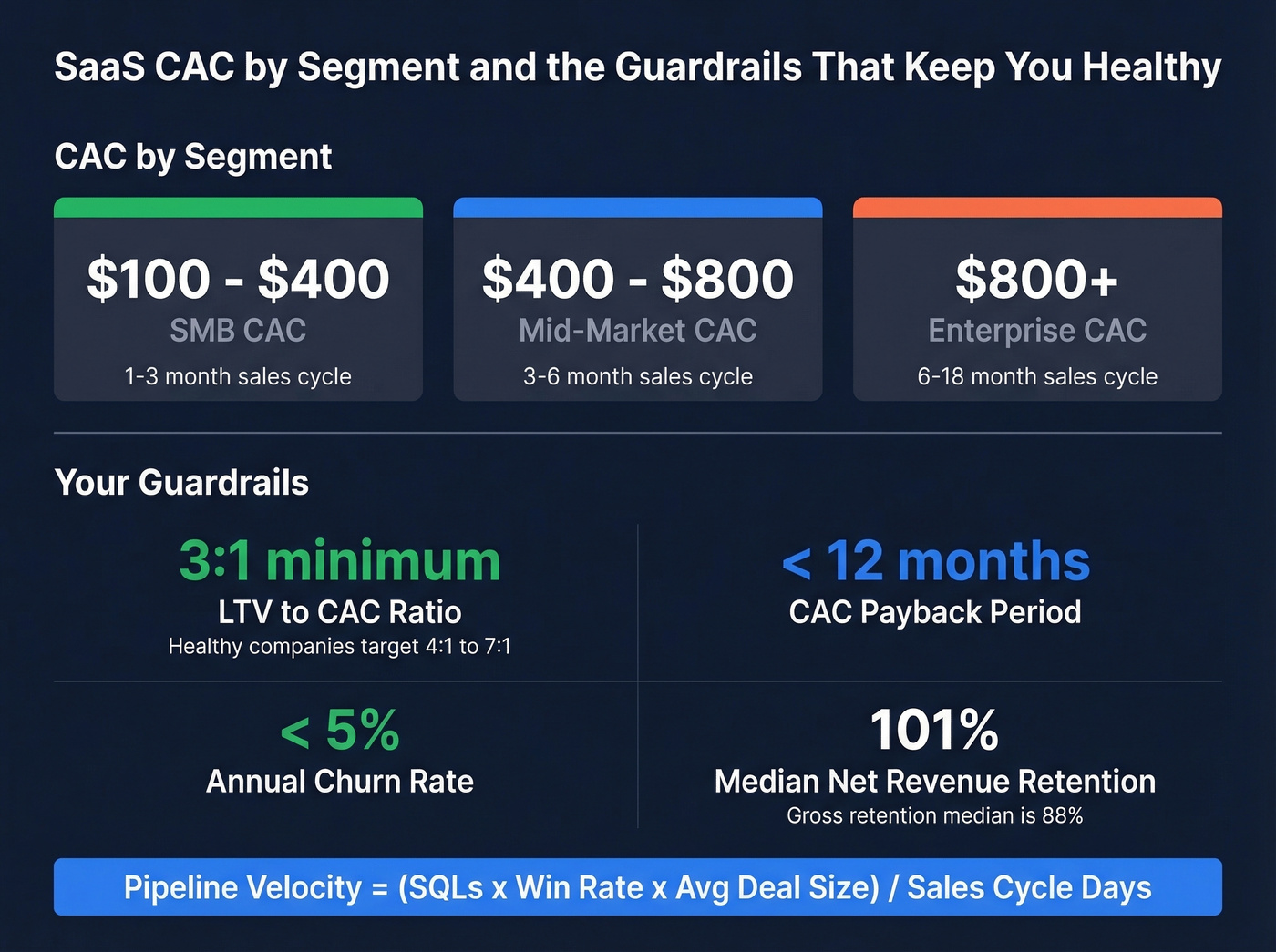
Here's how CAC breaks down by segment:
- SMB: $100-$400 with a 1-3 month sales cycle
- Mid-market: $400-$800 with a 3-6 month cycle
- Enterprise: $800+ with cycles stretching 6-18 months
Your guardrails: LTV:CAC of at least 3:1 (healthy companies target 4:1-7:1), CAC payback under 12 months, and annual churn below 5%. Current median benchmarks show net revenue retention at 101% and gross revenue retention at 88% - if you're below those, fix retention before you pour more into acquisition. That's not optional advice. It's math. (If you need a retention diagnostic, start with churn analysis.)
Track pipeline velocity as your operational metric: (SQLs x Win Rate x Average Deal Size) / Sales Cycle in Days. This single formula tells you whether your marketing is actually accelerating revenue or just generating activity that makes dashboards look busy. (To pressure-test your funnel, use a B2B sales funnel template.)
Mistakes That Kill the Plan
Building a website before nailing positioning. Your site is a container for your message. If the message is wrong, a beautiful site just broadcasts the wrong thing faster. (Use a real B2B brand positioning process first.)
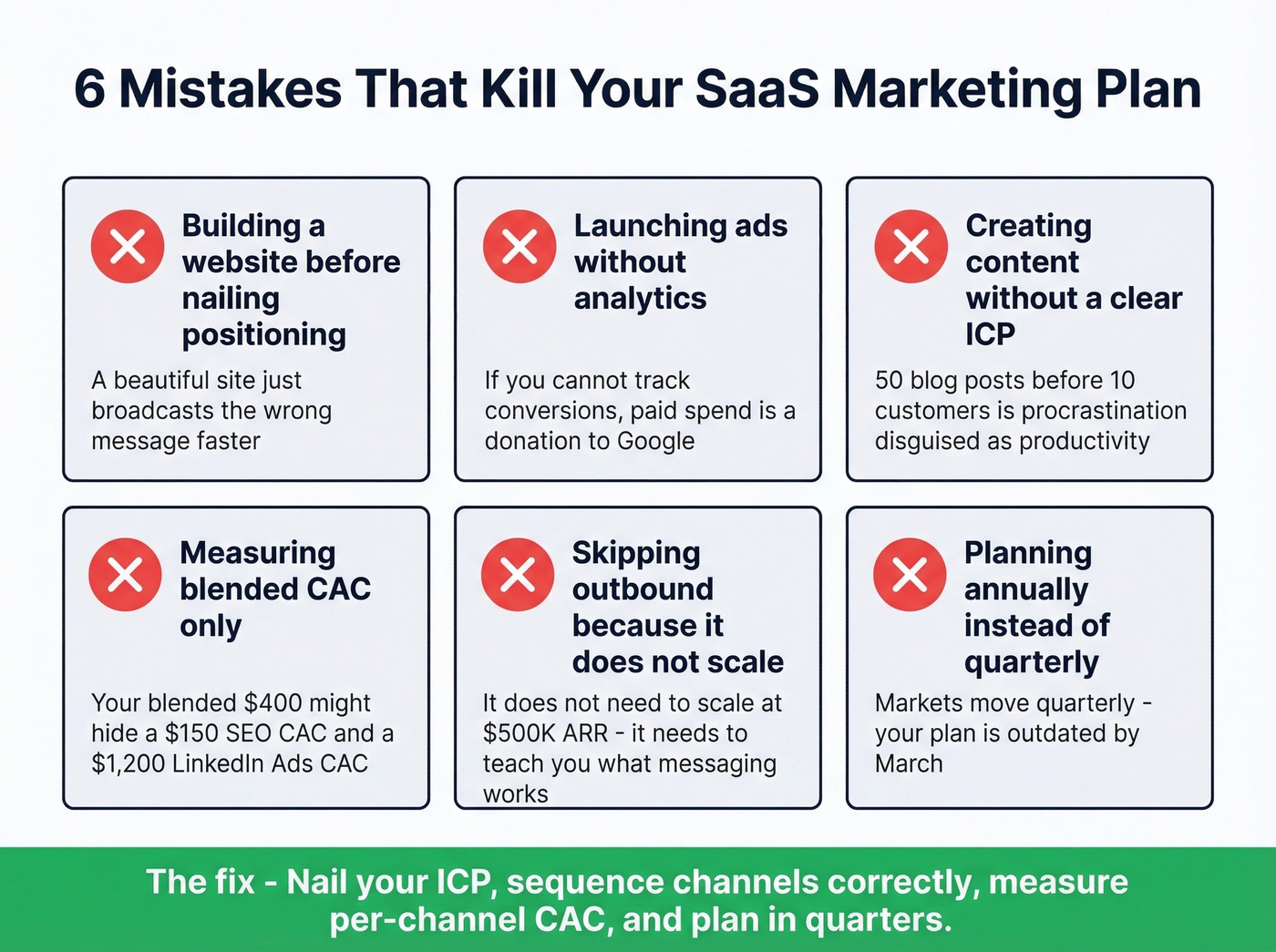
Launching ads without analytics. If you can't track what converts, paid spend is a donation to Google.
Creating content without a clear ICP. Publishing 50 blog posts before you have 10 customers is procrastination disguised as productivity. The r/AskMarketing lesson applies everywhere: niche beats broad at every stage. (If you need a starting point, use an ideal customer profile template.)
Measuring blended CAC. Your blended $400 might be hiding a $150 SEO CAC and a $1,200 LinkedIn Ads CAC. Kill the expensive channel or fix it. (If you want the full breakdown, see cost to acquire customer.)
Skipping outbound because "it doesn't scale." It doesn't need to scale at $500K ARR. It needs to generate 10 customers and teach you what messaging works. I've watched founders burn six months on a content engine before talking to a single prospect directly - don't be that person.
Planning annually. Markets move quarterly. Your plan should too.
CAC is up 60% and blended metrics hide the bleeding. Every channel in your SaaS marketing plan needs to earn its budget. Prospeo gives you verified emails and direct dials to reach decision-makers without the $982 LinkedIn Ads CAC - with a free tier of 75 emails/month to prove ROI before you spend a dollar.
Stop subsidizing bad data. Build pipeline at $0.01 per verified lead.
FAQ
How much should a B2B SaaS company spend on marketing?
Median spend is 8% of ARR based on the SaaS Capital survey of 1,000+ companies. Product-led companies spend ~13%, sales-led ~9%. At under $1M ARR, expect $0-$5K/month and scale proportionally from there.
What's the best first channel for early-stage SaaS?
Cold email. It validates messaging in days, costs almost nothing, and generates pipeline before SEO or content can compound. Start with 50-100 targeted prospects per week using a verified data source to keep bounce rates under 4%.
How long does SEO take to pay off for SaaS?
Expect 6-12 months before meaningful traffic and 2-3 years for full compounding. The 748% three-year ROI is real, but you need pipeline from outbound and partnerships while you wait for organic to build.
What KPIs should a SaaS marketing plan track?
Track CAC by channel (not blended), LTV:CAC ratio (target 3:1 minimum), CAC payback period (under 12 months), pipeline velocity, and net revenue retention. The average B2B SaaS CAC is $536 and rising 14% annually - plan for cost increases, not flat benchmarks.