

SaaS Leads: The Data-Backed Guide to Generating Leads That Actually Convert
79% of marketing leads never convert into sales. That's not a rounding error - that's your SDR team's entire week, wasted on contacts who were never going to buy. The problem isn't volume. It's that most SaaS teams optimize for more leads when they should be optimizing for better ones.
The failure modes are predictable: a vague ICP that matches half the Fortune 5000, unverified contact data that torches your domain reputation, and follow-up times measured in hours instead of minutes. Every SaaS team hits at least one of these walls. Most hit all three simultaneously.
What You Need (Quick Version)
- Tight ICP definition. Companies with well-defined ICPs are 68% more likely to close deals. Use an Ideal Customer Profile rubric so your targeting doesn't drift.
- Verified data before every send. The average B2B SaaS CPL is $237 blended - you can't afford to burn that on bounced emails. Track and control email bounce rate like a core revenue metric.
- Hybrid inbound + outbound motion. Companies running both see 2x faster revenue growth than those betting on a single channel.
One more number worth memorizing: responding to inbound leads within five minutes increases conversion by up to 9x. Most teams take hours.
What Are SaaS Leads, Really?
A SaaS lead is anyone who's shown enough signal - behavioral, demographic, or intent-based - that your sales or marketing team should engage them. But the taxonomy matters because it determines how you staff, score, and sequence.
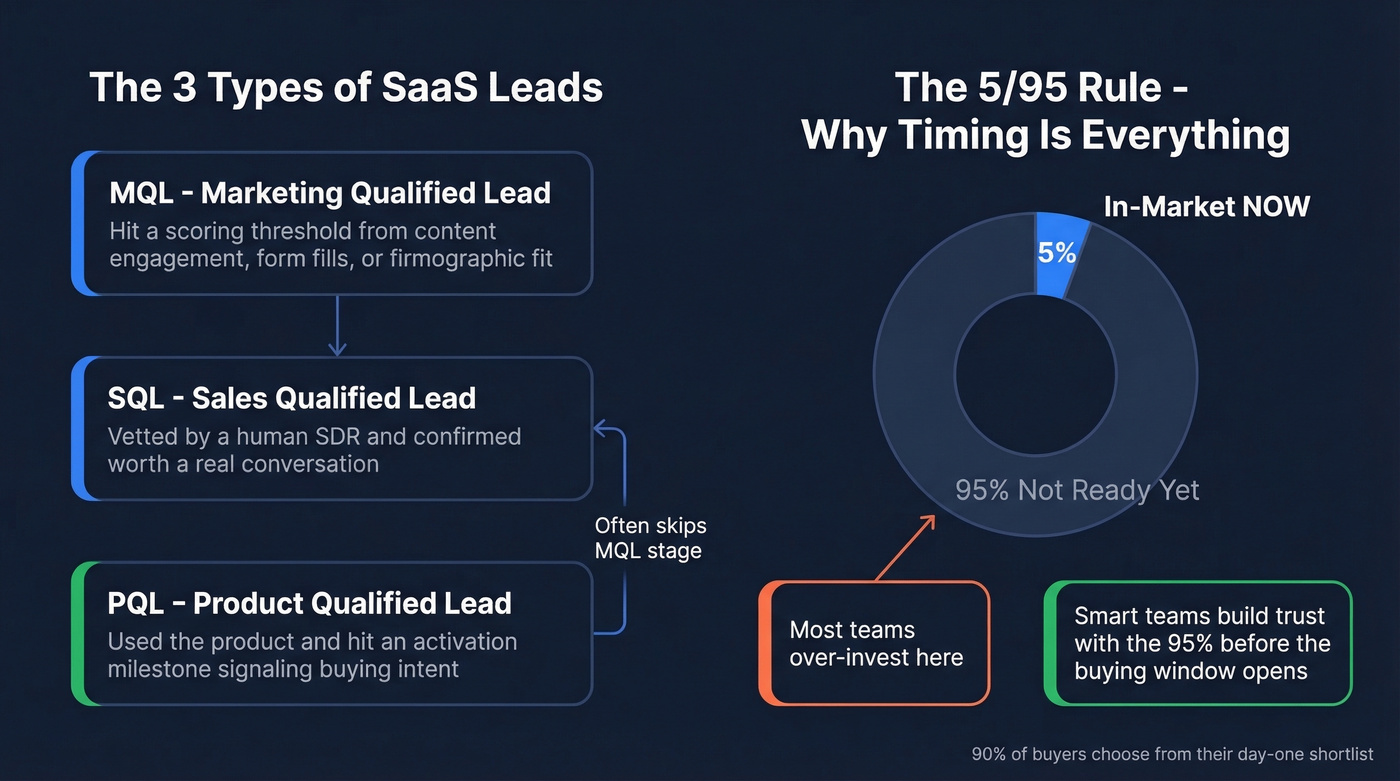
MQLs hit a scoring threshold based on content engagement, form fills, or firmographic fit. SQLs have been vetted by a human - usually an SDR - and confirmed as worth a conversation. PQLs are unique to product-led companies: they've used the product and hit an activation milestone that signals buying intent.
Here's the strategic frame that changes how you think about all three. Research summarized by the B2B Institute and Bain shows that roughly 5% of your total addressable market is actively in-market at any given time. The other 95% isn't ready to buy - yet. And 80-90% of B2B buyers already have a vendor shortlist before they ever talk to sales. About 90% end up choosing from that day-one list.
The implication is brutal: if you're not on the shortlist before the buying window opens, you're fighting for scraps. That's why demand shaping - building trust with the 95% - matters just as much as demand capture. Most teams over-invest in capturing the 5% and ignore the rest entirely.
B2B SaaS Lead Benchmarks
Cost Per Lead
| Acquisition Type | Avg CPL |
|---|---|
| Paid | $310 |
| Organic | $164 |
| Blended | $237 |
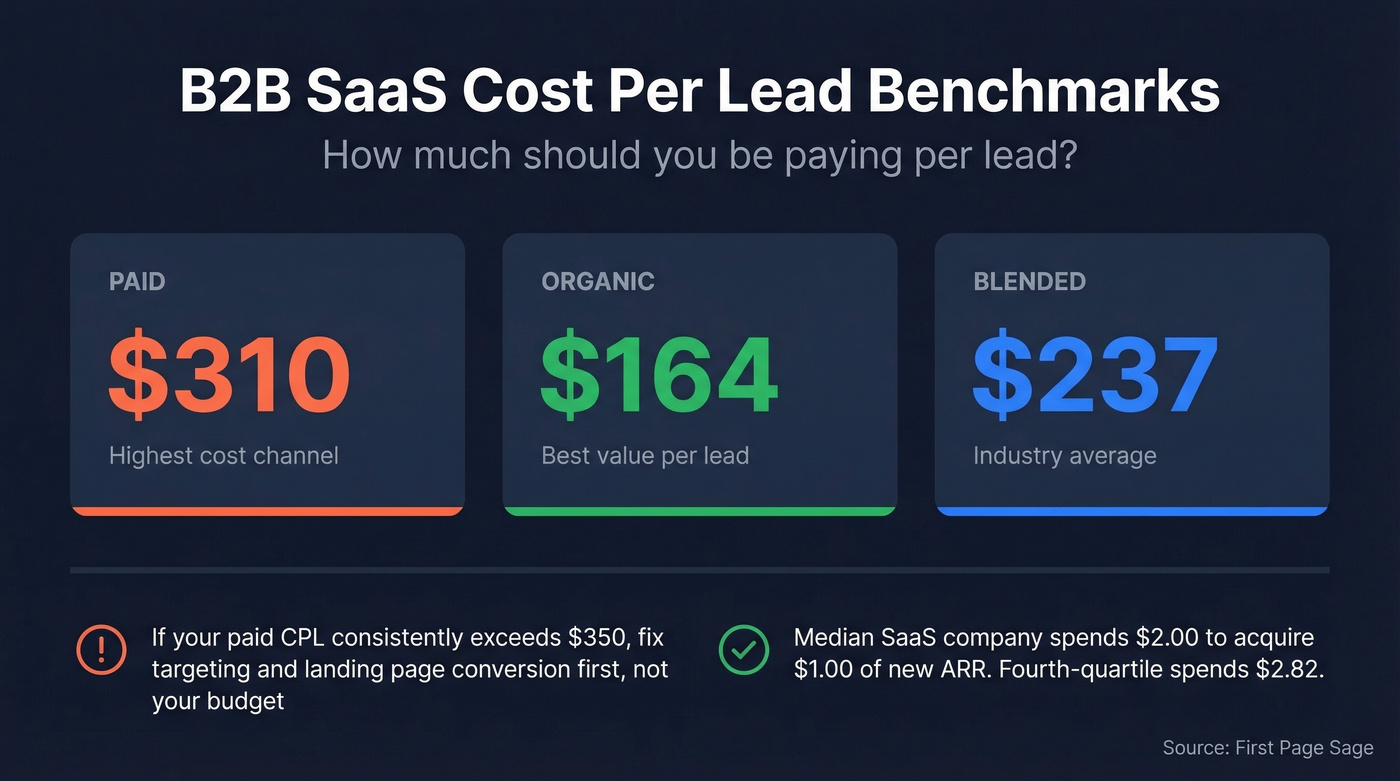
Data from First Page Sage. If your paid CPL consistently exceeds $350, fix your targeting and landing page conversion rate first - not your budget.
Full-Funnel Conversion Rates
| Channel | Visitor-to-Lead | Lead-to-MQL | MQL-to-SQL | SQL-to-Opp | Opp-to-Close |
|---|---|---|---|---|---|
| SEO | 2.10% | 41% | 51% | 49% | 36% |
| PPC | 0.70% | 36% | 26% | 38% | 35% |
| 2.20% | 38% | 30% | 41% | 39% | |
| 1.30% | 43% | 46% | 48% | 32% | |
| Webinar | 0.90% | 44% | 39% | 42% | 40% |
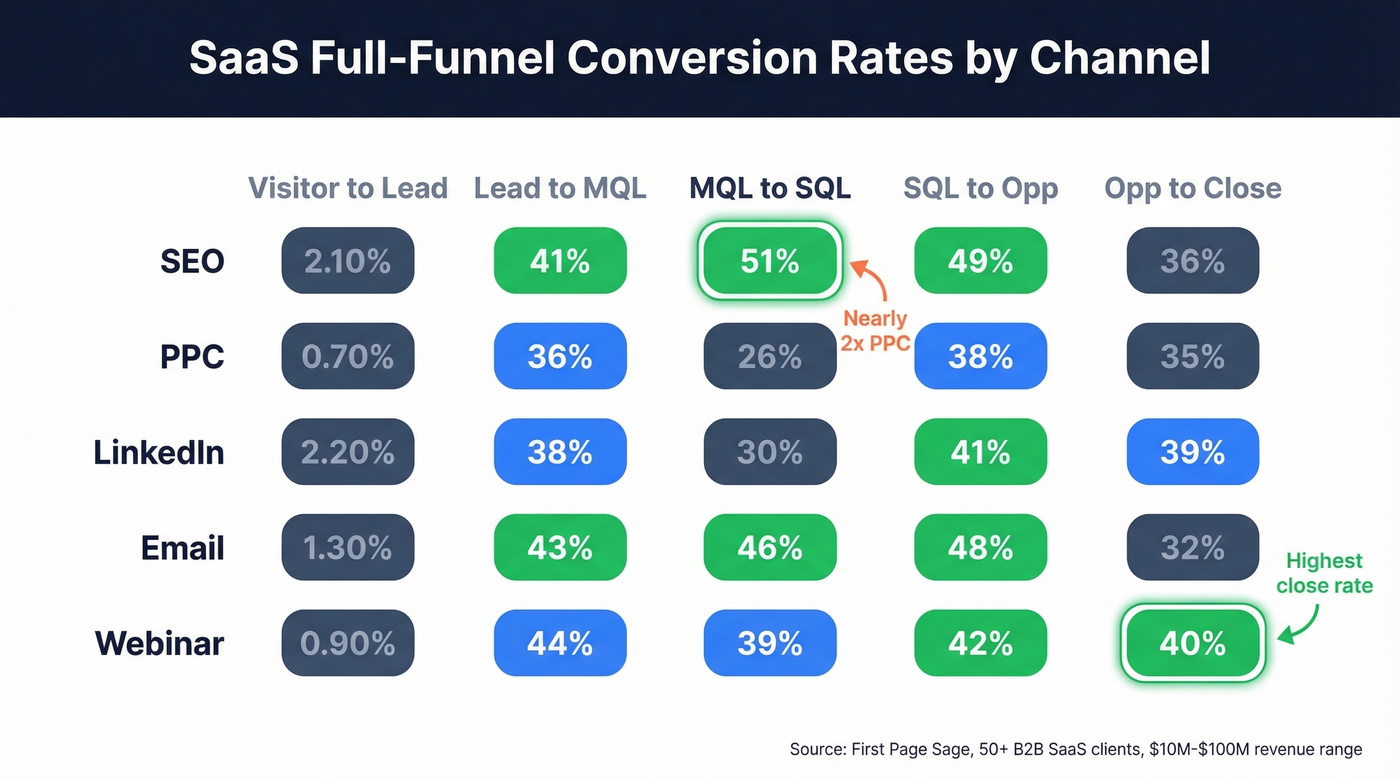
Based on First Page Sage SaaS conversion benchmarks across 50+ B2B SaaS clients in the $10M-$100M revenue range.
SEO has the highest MQL-to-SQL conversion at 51% - nearly double PPC's 26%. Organic visitors arrive with higher intent. But PPC and LinkedIn close at comparable rates once you reach opportunity stage, which tells you the top-of-funnel filtering is where PPC bleeds money.
On the trial and freemium side, CRM products convert trial-to-paid at 29%, while enterprise software sits around 18.6%. Freemium models cast a wider net but convert at much lower rates - that 3.4% CRM freemium-to-paid number means you need massive top-of-funnel volume to make the math work.
For CAC context, the median SaaS company spends $2.00 to acquire $1.00 of new ARR. Fourth-quartile performers spend $2.82. If your ratio is worse than that, you've got a unit economics problem that no amount of lead volume will fix.
Three SaaS Lead Generation Motions
Inbound: SEO, Content, Webinars
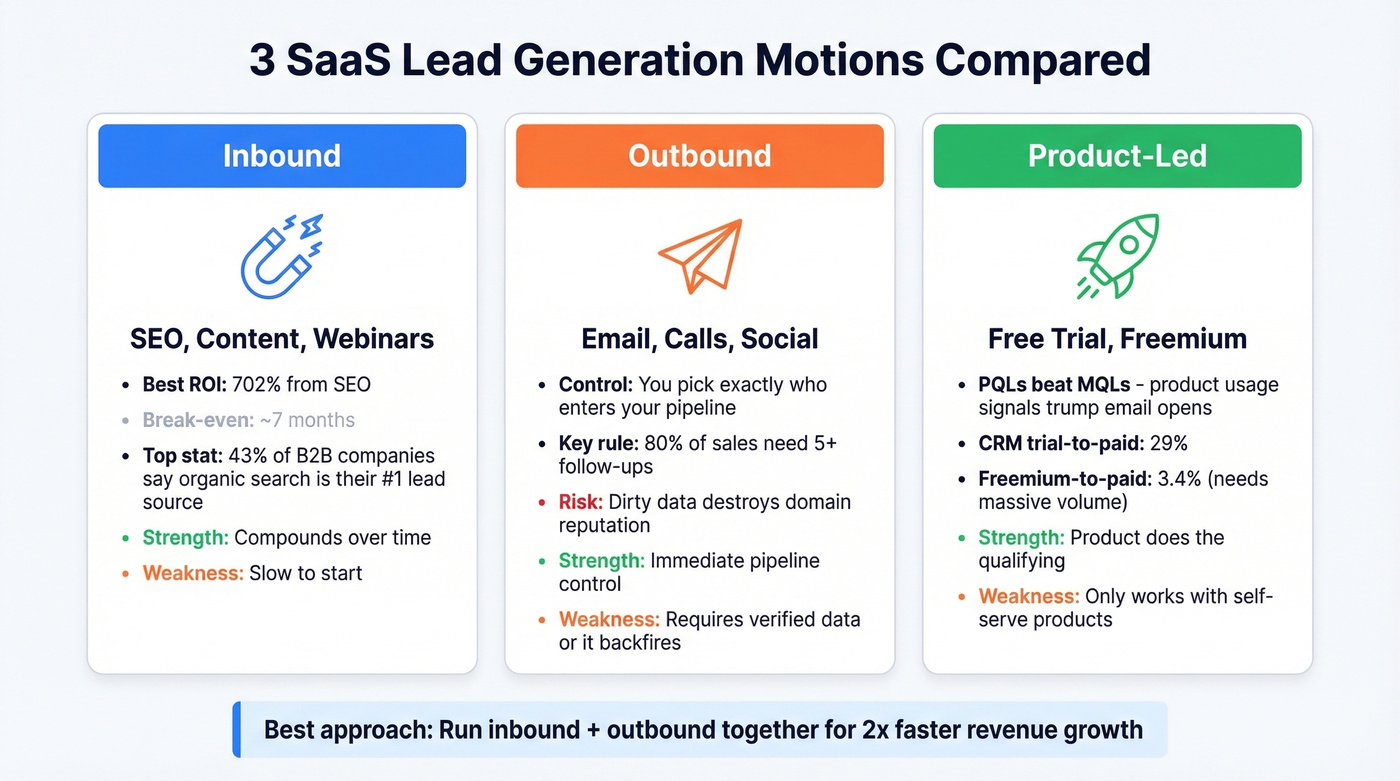
Inbound is the compounding engine. SEO delivers an estimated 702% ROI with a roughly 7-month break-even, and 43.4% of B2B companies in a 108-company survey cited organic search as their leading source of new leads. If you want a deeper breakdown, see SEO sales leads.
The highest-leverage inbound play right now is bottom-of-funnel content. A B2B FinTech company published three BoFu blog posts - comparisons, alternatives pages, and head-to-head reviews - and generated 24 high-intent leads without a dollar in ad spend. These aren't top-of-funnel "what is X" readers. They're buyers actively comparing solutions.
Webinars deserve attention too. The visitor-to-lead rate is just 0.9%, but the opportunity-to-close rate hits 40% - the highest of any channel in the benchmark data. Webinar leads are expensive to generate but disproportionately likely to buy. We've seen teams treat webinars as a top-of-funnel play and wonder why the ROI looks bad; the real value shows up two stages later.
Outbound: Email, Calls, Social
Outbound gives you something inbound can't: control over exactly who enters your pipeline and when. But it's also where most teams destroy their domain reputation before they generate a single meeting.
Here's a scenario that plays out constantly. A team exports 5,000 contacts from Apollo, loads them into a sequencer, and fires off emails. Four hundred bounce. The domain takes a deliverability hit. Reply rates crater. The team blames "cold email is dead" when the real problem was dirty data. We've watched this happen dozens of times.
The consensus across r/sales and outbound communities on Reddit is clear: omnichannel sequencing - email plus calls plus social touches - is the default playbook. But the sequencing only works if the data underneath is clean. Verify every contact with a dedicated tool before it enters any sequence. (If you need a framework, start with email deliverability basics.)
The persistence math matters too. 48% of reps stop after a single touch, but 80% of sales require five or more follow-ups. If your sequences cap at three steps, you're quitting before the game starts. Use proven sales follow-up templates to keep touches consistent without sounding robotic.
Product-Led: Free Trial and Freemium
PLG flips the funnel. Instead of qualifying leads through forms and SDR calls, you let the product do the qualifying. A PQL - someone who's hit a meaningful activation milestone inside your product - is fundamentally different from an MQL who downloaded a whitepaper.
If you're running PLG, your lead scoring model needs to weight product usage signals - feature adoption, time in app, collaboration invites - over marketing engagement. A user who's invited three teammates matters more than one who opened five emails. Skip this motion entirely if your product doesn't have a self-serve experience; bolting freemium onto a product that requires implementation support just creates expensive support tickets.
Using Intent Signals for SaaS Sales Leads
Most outbound teams prospect based on static firmographics: industry, headcount, revenue. That's table stakes. The teams booking the most meetings in 2026 layer intent data on top - identifying companies actively researching topics related to their solution before reaching out. (More on identifying buying signals.)
The workflow is straightforward. Filter your target accounts by intent topics relevant to your product, then cross-reference with job role and company growth signals like new headcount or recent funding. The accounts showing active research intent get prioritized in your sequences; the rest go into nurture. This approach is especially effective for enterprise SaaS leads, where deal cycles are longer and targeting precision matters more.
Intent-based outbound consistently outperforms spray-and-pray on reply rates. The reason is simple: you're reaching people who are already thinking about the problem you solve.

You just read that 79% of marketing leads never convert - and dirty data is the #1 accelerant. Prospeo's 5-step email verification delivers 98% accuracy, so your SDRs spend time on real buyers, not bounced addresses. At $0.01 per email with a 7-day data refresh, your SaaS outbound runs on contacts that are actually current.
Stop torching your domain reputation on stale data.
Generating Leads Without Burning Your Domain
This is where theory meets execution. Here's the workflow that protects your sender reputation while generating pipeline.
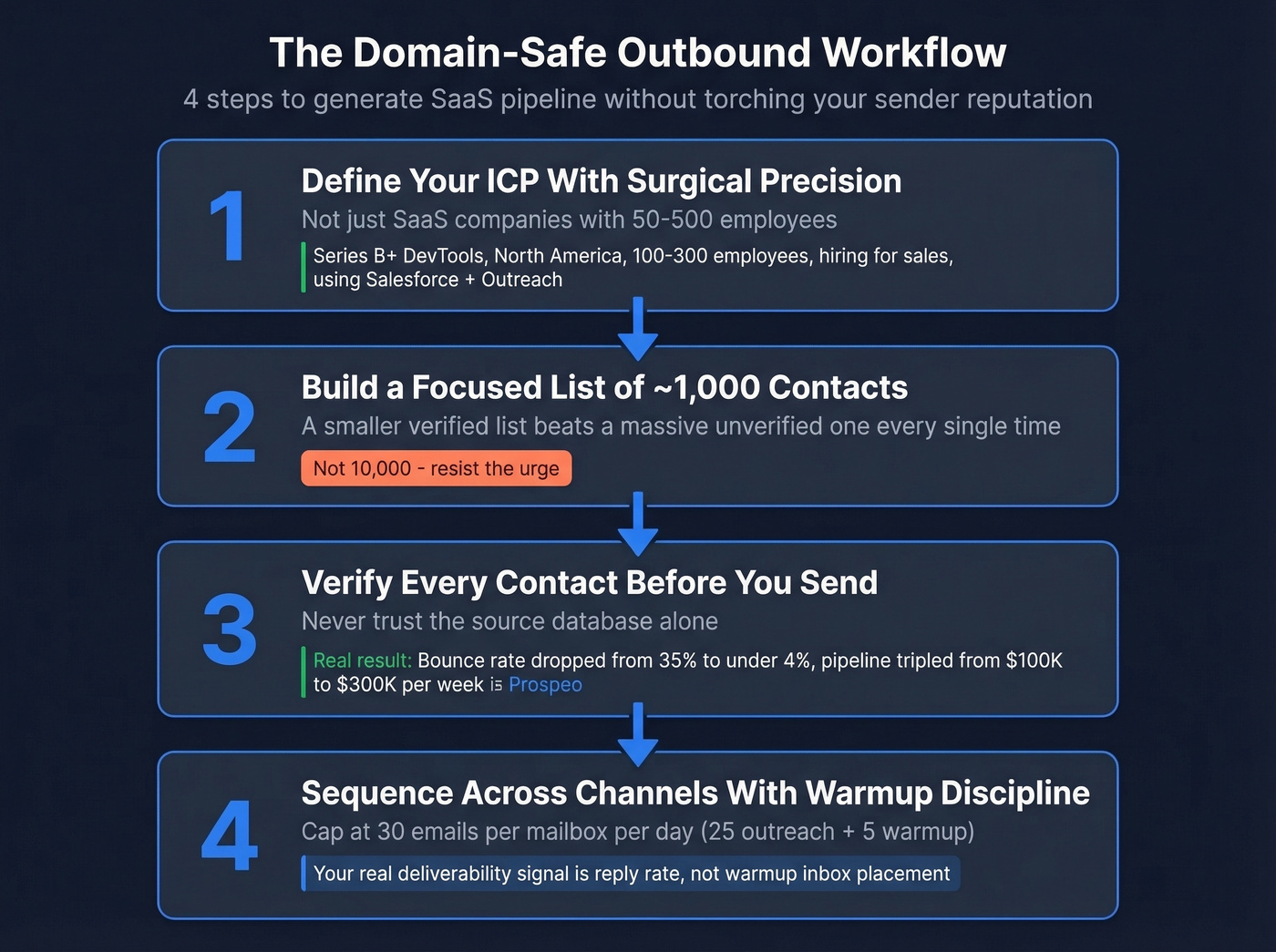
Step 1: Define your ICP with surgical precision. Not "SaaS companies with 50-500 employees." Think: "Series B+ DevTools companies in North America, 100-300 employees, hiring for sales roles, using Salesforce and Outreach." The tighter the filter, the higher the reply rate.
Step 2: Build a focused list. Target around 1,000 contacts, not 10,000. A smaller, verified list will outperform a massive unverified one every time. If you're building lists from multiple sources, a data enrichment pass helps keep fields consistent.
Step 3: Verify everything before you send. Never trust the source database alone. Apollo is a jack-of-all-trades - useful as a starting database and sequencer, but its data is user-populated and not independently verified. If you skip verification, bounce rates spike and your domain reputation takes the hit.
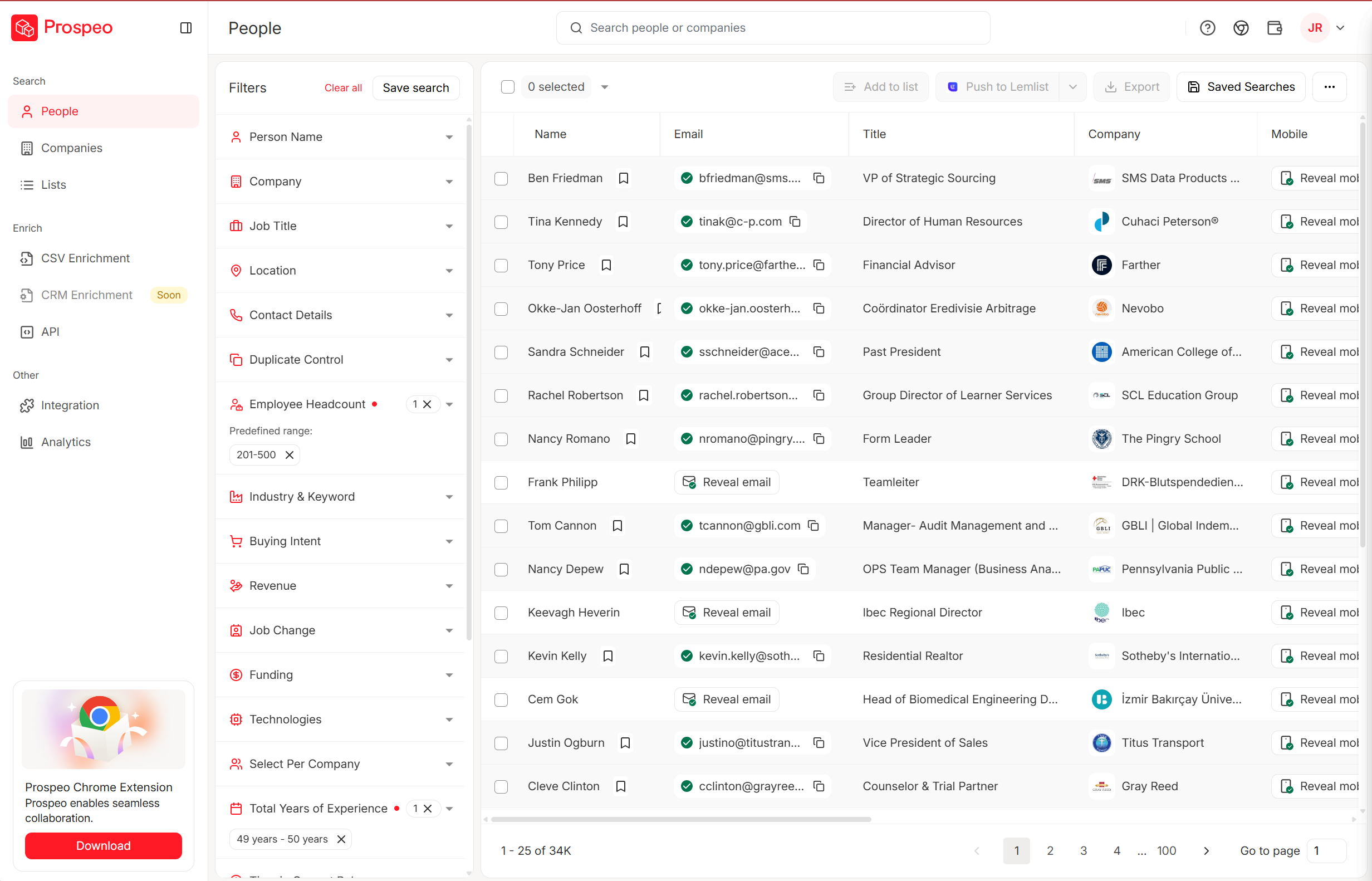
Prospeo handles this step. With 143M+ verified emails at 98% accuracy and a 7-day refresh cycle, you're not sending to contacts who changed jobs last month. The Chrome extension lets you verify contacts directly from any website or CRM, and 125M+ verified mobile numbers with a 30% pickup rate give your SDRs a real phone channel when email alone isn't cutting through. Real-world results back this up: Meritt dropped their bounce rate from 35% to under 4% and tripled pipeline from $100K to $300K per week.
Step 4: Sequence across channels with warmup discipline. Cap total sends at 30 per mailbox per day - 25 outreach emails plus 5 warmup. If you're doing cold outbound at scale, open and click tracking often hurts deliverability. Test with a seed list and watch reply rates before enabling it. For safe limits and ramp schedules, follow an email velocity playbook.
Warmup tools fake engagement. They're useful for establishing a new domain, but your real deliverability signal is reply rate, not warmup inbox placement.
Qualifying Leads: What to Ask
Generating leads is half the battle. Qualifying them fast is the other half. Here's a lightweight framework that works for most SaaS sales motions. If you want a full script bank, use these discovery questions.
Budget and authority. "Who else is involved in evaluating tools like this?" tells you more than "Are you the decision-maker?" - which nobody answers honestly anyway.
Timeline and trigger. "What changed that made you start looking?" reveals urgency. A team evaluating because of a board mandate moves faster than one doing "general research."
Current stack and pain. "What are you using today, and what's breaking?" identifies both competitive displacement opportunities and the specific pain your demo should address.
Success criteria. "If you switched, what would need to be true in 90 days for this to be a win?" This question alone disqualifies more bad-fit leads than any scoring model.
Let's be honest - skip the rigid BANT or MEDDICC frameworks on first touch. They're interrogation scripts disguised as qualification. Use conversational questions that surface the same information without making the prospect feel like they're filling out a form.
The Five-Minute Response Window
Responding within five minutes increases conversion by up to 9x. This isn't a nice-to-have - it's the single highest-leverage operational improvement most SaaS teams can make.
Build a routing SLA that answers three questions: Who owns the lead in the first five minutes? What channel do they use to respond? What happens if the owner doesn't respond in time?
The simplest setup: inbound leads route to a round-robin queue in your CRM. If the assigned rep doesn't engage within five minutes, the lead escalates to a backup. Use Zapier or native CRM workflows to trigger Slack alerts on form submission. No lead should sit untouched for more than ten minutes during business hours.
Here's the thing: if your average deal size is under $15K, speed-to-lead matters more than lead scoring. A fast response to a mediocre lead beats a slow response to a perfect one. The prospect who just filled out your form is thinking about your product right now. In thirty minutes, they'll be thinking about lunch.
Buying Leads vs. Building In-House
A lot of people searching for SaaS leads want to skip the build and just buy pipeline. That tells you something about how painful the ramp-up feels.
Here's when outsourcing makes sense, and when it doesn't.
Outsource if you need pipeline in the next 30 days, you don't have an SDR team, or you're testing a new market segment before committing headcount. Expect to pay $3,000-$8,000/month for an outsourced SDR, or $150-$300 per qualified meeting from a lead gen agency. Some vendors charge per lead ($50-$150 for a "marketing qualified" contact), but the quality variance is enormous.
Build in-house if you want compounding returns, need deep product knowledge in conversations, or plan to scale past $5M ARR. A full-time SDR costs $75K-$120K loaded, but they learn your ICP, refine messaging in real time, and build institutional knowledge that no outsourced team replicates. In our experience, the in-house team starts outperforming outsourced within about six months - the crossover point where domain expertise compounds faster than the agency's playbook can keep up.
The hybrid path works too: outsource for the first 90 days while you hire and ramp an internal team. Just make sure you own the data and the domain - never let an agency send from your primary domain.
The SaaS Lead Generation Tech Stack
| Tool | Category | Starting Price | Best For |
|---|---|---|---|
| Prospeo | Data & Verification | Free (75/mo), ~$0.01/email | Verified emails, dials, intent, enrichment |
| Apollo.io | Database & Sequencing | Free; from $49/user/mo | All-in-one starting point |
| Clay | Enrichment & Workflows | From $134/mo (2K credits) | Waterfall enrichment |
| HubSpot | CRM & Marketing | Free CRM; paid plans vary | Inbound lead management |
| Lemlist | Cold Email Sequencing | Paid plans vary | Personalized sequences |
| La Growth Machine | Multichannel Outreach | EUR 50-150/mo per identity | Email + social + calls |
| Ahrefs | SEO & Content | Paid plans vary | BoFu keyword research |
| Zapier | Workflow Automation | Free; from $19.99/mo | Connect tools without code |
If you're only going to add one tool to your existing stack, make it a verification layer. Bad data is the single biggest pipeline killer in outbound - bigger than messaging, bigger than targeting, bigger than send volume. Everything downstream of a bounced email gets worse.
Seven Mistakes Killing Your Pipeline
Overgeneralized ICP. If your targeting criteria fit 50,000 companies, you don't have an ICP - you have a market. Narrow to 3-5 firmographic and behavioral filters. Revisit quarterly based on closed-won analysis.
Sending to unverified lists. Two bad campaigns and your domain reputation is cooked for months. Verify every contact externally, suppress catch-all domains, and re-verify before each campaign.
Features-over-benefits messaging. Nobody cares that you have "AI-powered analytics." They care that you'll cut their reporting time from four hours to twenty minutes. Rewrite every email around the prospect's problem, not your product's capabilities.
No lead scoring or qualification framework. Without scoring, your SDRs waste time on leads that were never going to convert - and the good ones go cold while they wait. Start with a simple point system: firmographic fit + behavioral signals + intent data. Iterate monthly. If you need a starting model, use a lead scoring framework.
Slow follow-up. Every minute you wait, the lead gets colder. Implement a five-minute routing SLA with automated escalation.
Stopping after one touch. 48% of reps give up after a single attempt. 80% of sales require five or more follow-ups. Build 7-10 step sequences across email, phone, and social. Front-load the first three touches within 48 hours.
Measuring volume instead of quality. If 79% of your leads never convert, generating 20% more of them isn't a strategy - it's a more expensive version of the same problem. Track lead-to-revenue, not lead count. Report on SQL and opportunity creation, not MQL volume. Teams that want more pipeline should focus on improving conversion rates before scaling volume.

Running omnichannel sequences without verified mobiles is running half a playbook. Prospeo gives you 125M+ verified mobile numbers with a 30% pickup rate - plus 30 filters like buyer intent, technographics, and headcount growth to nail your ICP before the first dial. One team tripled pipeline from $100K to $300K/week and dropped bounce rates under 4%.
Reach the 5% who are in-market before your competitors do.
FAQ
What's a good cost per lead for SaaS?
The average B2B SaaS CPL is $237 blended - $310 for paid channels and $164 for organic. If your paid CPL exceeds $350, revisit targeting and landing page conversion before increasing budget. Organic channels take longer to build but deliver leads at nearly half the cost.
Should SaaS companies use inbound or outbound?
Both. Companies using a hybrid approach see 2x faster revenue growth. SEO ROI runs around 702% but takes months to compound, while outbound gives you control over who enters your pipeline this week. Start outbound for immediate pipeline, invest in inbound for long-term efficiency.
How do I stop outbound emails from bouncing?
Never send to unverified contacts. Run every list through a dedicated verification tool before sending. Remove catch-all domains, disable open tracking during warmup, and cap sends at 25-30 per mailbox per day. Teams that add a verification step consistently see bounce rates drop below 4%.
What's the difference between MQLs, SQLs, and PQLs?
MQLs hit a scoring threshold based on marketing engagement and firmographic fit. SQLs have been vetted by a human and confirmed as worth a sales conversation. PQLs are unique to product-led companies - they've used the product and hit an activation milestone that signals buying intent. PQLs typically convert at the highest rate because the product has already done the selling.
How do you source enterprise SaaS leads?
Layer intent data with firmographic filters to identify large accounts actively researching your category, then run multi-threaded outbound - reaching multiple stakeholders within the same organization. Longer sales cycles mean your nurture sequences need more touchpoints and higher-value content like ROI calculators and industry-specific case studies.