

Sales and CS Alignment: The Playbook That Goes Beyond "Communicate More"
Your AE just closed a $40K annual deal. Champagne emoji in Slack. Six weeks later, the customer hasn't deployed, the champion left the company, and CS is staring down a churn risk they inherited - not created. The AE? Already working next quarter's pipeline.
This isn't a communication problem. It's a structural one. And fixing sales and CS alignment requires structural solutions.
Companies with high alignment across customer-facing functions report 2.4x higher revenue growth and 2x higher profitability than those without it, according to Forrester research. Everyone knows alignment matters. Almost nobody builds the operational scaffolding to make it stick.
What You Need (Quick Version)
If you're short on time, here's the priority stack:
- Fix comp plans first. Add a retention or NRR component - even 10-15% - to AE variable comp. Incentives shape behavior more than any process document ever will.
- Build a real handoff checklist. Not a Slack message. A structured template with stakeholder names, success criteria, and contract context.
- Create a weekly joint review cadence. A shared dashboard reviewed in 15 minutes catches churn signals and expansion opportunities before they become QBR surprises.
Everything else is optimization on top of these three.
Why Misalignment Happens
The root cause isn't that Sales and CS "don't talk enough." It's that they're compensated to want different things. Three structural failures drive almost every breakdown.
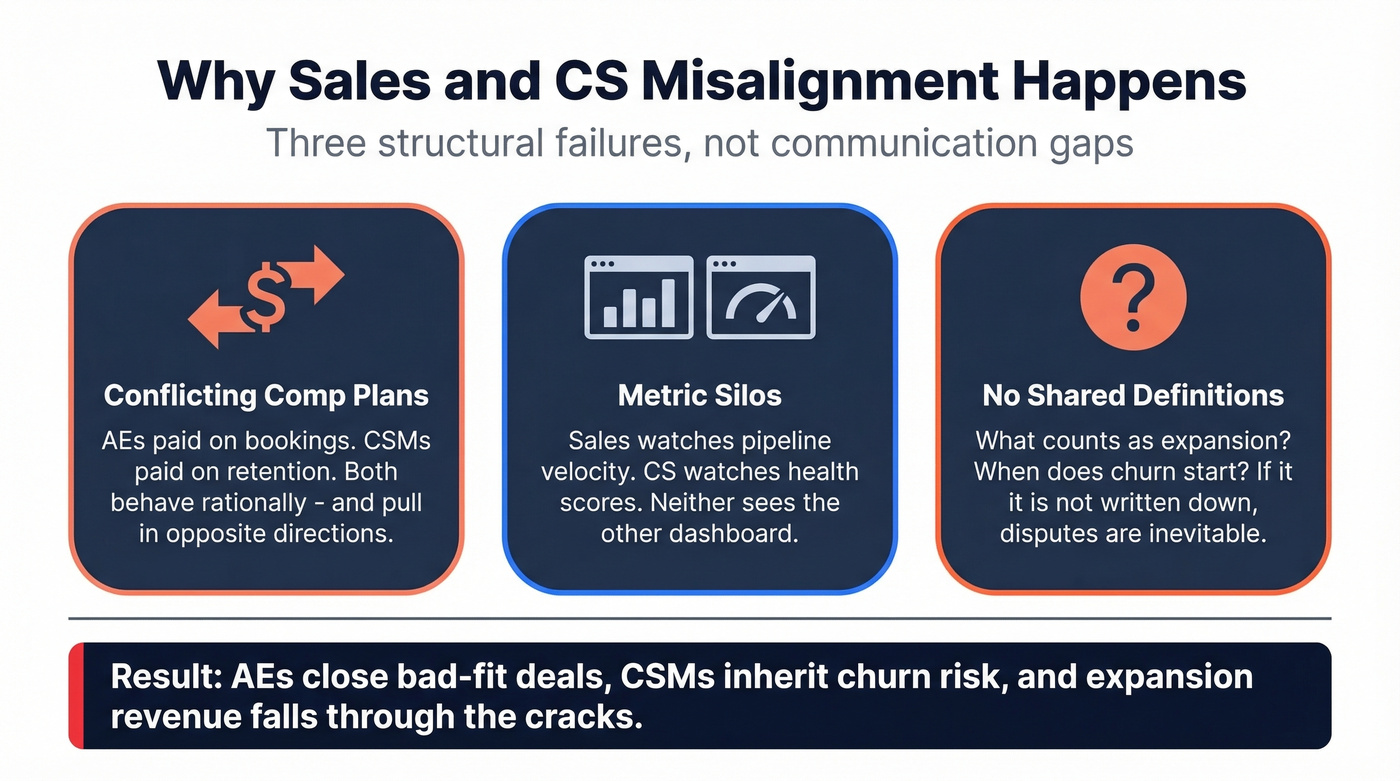
Conflicting comp plans. AEs get paid on bookings. CSMs get paid on retention. The predictable result? As one CS practitioner described on Reddit, AEs sell bad-fit business that tanks CS outcomes - and they won't fight cancellations if they believe they can win the account back later and get paid again. Both sides are behaving rationally within their incentive structure, which is exactly what makes it impossible to fix with a meeting cadence alone.
Metric silos. Sales watches pipeline velocity and bookings. CS watches retention, NRR, health scores, and adoption signals. Neither team sees the other's dashboard, so neither adjusts behavior based on downstream impact. Rising CAC, uneven pipeline quality, missed expansion - these are symptoms of teams optimizing locally while the company bleeds revenue.
No shared definition of "good." What counts as expansion? What's a cross-sell vs. an upsell? When does churn officially start? If these definitions aren't written down and agreed upon, disputes are inevitable. And Marketing - the third leg of the revenue alignment stool - often compounds the problem by generating leads that don't match the ICP Sales qualifies or the customer profile CS can retain. Until you align marketing, sales, and customer success around a unified ICP and shared definitions, incentives will always win over good intentions.
Comp Plans That Drive Alignment
Tie a portion of AE variable comp to customer success measures. Korn Ferry's guidance on adding customer success measures to sales incentives recommends tying incentive pay to customer satisfaction or customer behavior data, and using broader team or district measures with a smaller share of pay when individual attribution is messy.
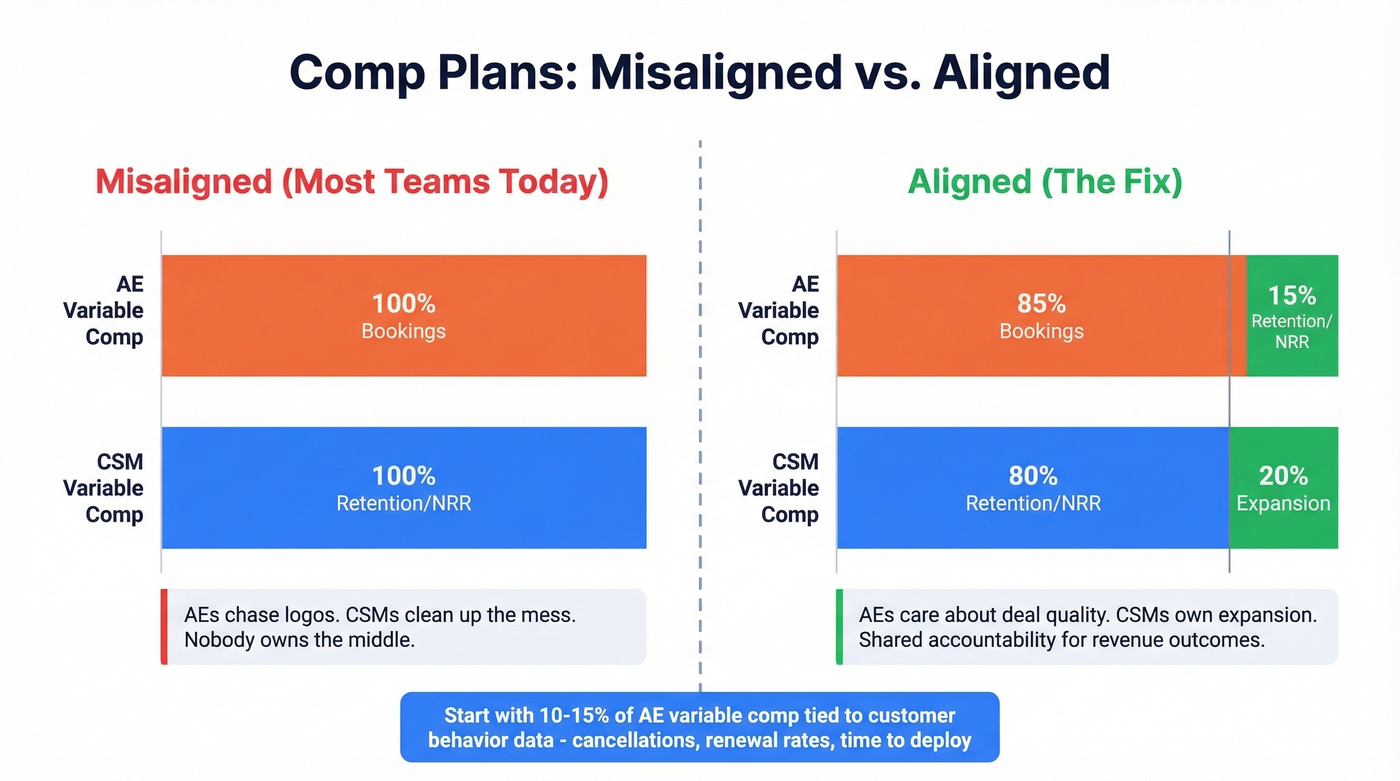
A practical starting point: 10-15% of AE variable comp tied to a retention or NRR metric. Use customer behavior data as signals - cancellations, renewal rates, time-to-deploy. These are less subjective than satisfaction surveys and harder to game. When individual attribution gets murky (and it usually does), apply the metric at the team or district level.
Also do this: Build a no-go list informed by CS data. Not all churn is bad - some deals should never have closed. CS knows which customer profiles consistently fail. Feed that back into Sales qualification criteria so AEs stop chasing logos that'll churn in six months. (If you need a starting point, use an Ideal Customer Profile scoring rubric.)
Skip this if you're early-stage: Don't try to make AE and CSM comp plans identical. They shouldn't be. The debate isn't about matching metrics - it's about shared responsibility for revenue outcomes across the customer lifecycle. Sales should care about deal quality and long-term value. CS should own NRR and expansion. The overlap is where alignment lives.

Bad data breaks alignment faster than bad process. When CSMs inherit bounced emails and dead phone numbers from Sales, the customer relationship starts in a hole. Prospeo's 98% verified emails and 125M+ direct dials mean your handoff checklist actually connects people.
Stop handing off dead contacts. Start handing off verified ones.
The Sales-to-CS Handoff Checklist
Most handoffs are a Slack message with a contact name and a "they're excited!" The customer then gets asked the same questions they already answered during the sales cycle. That creates what Gainsight calls "instantaneous mood deflation" - and it's entirely preventable.
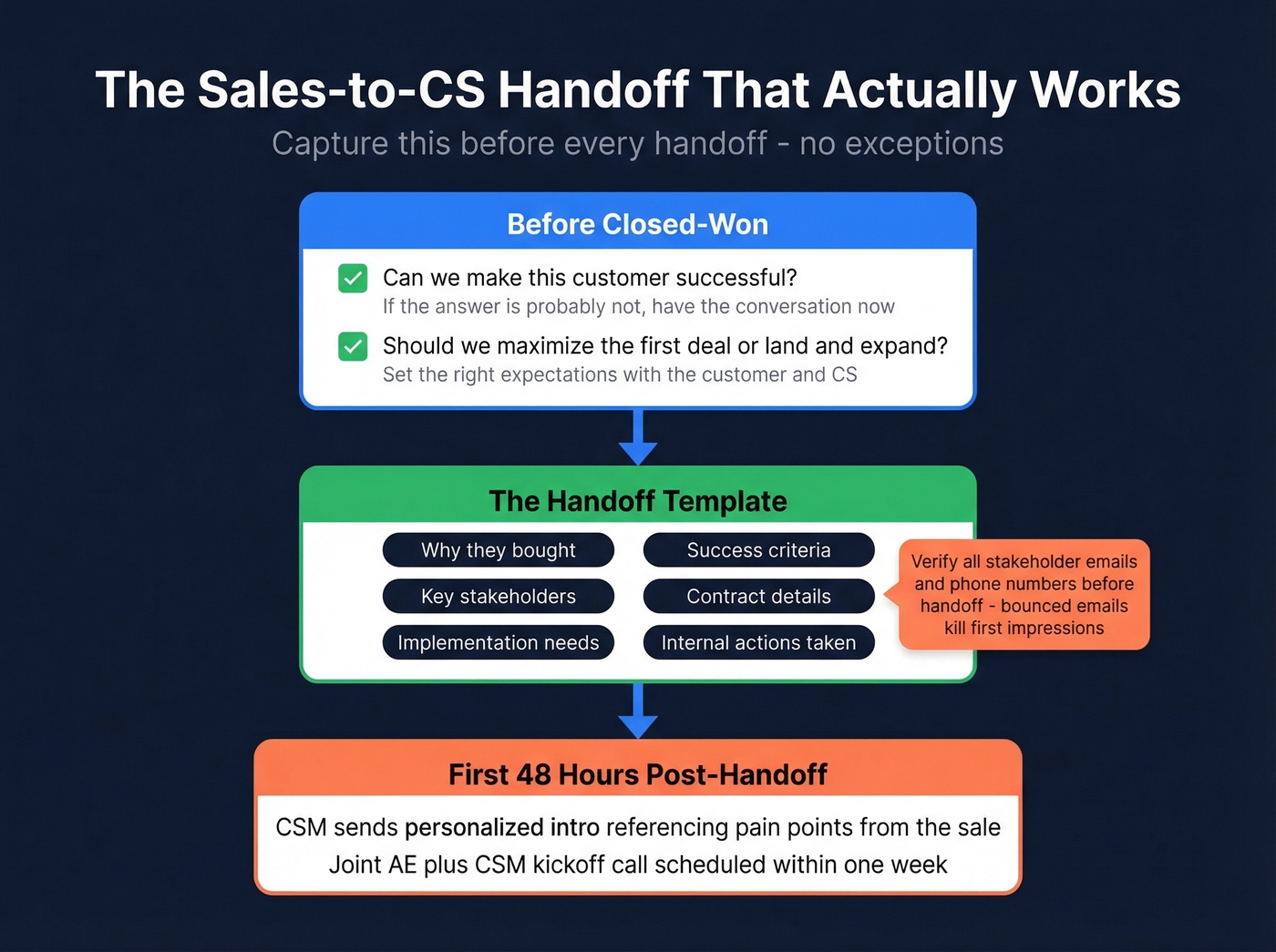
A good handoff doesn't require a four-page form. It requires the minimum viable information, captured consistently. Here's a template based on the Customer Success Collective framework:
| Field | What to Capture |
|---|---|
| Why they bought | Core pain, trigger event |
| Success criteria | What "working" looks like |
| Key stakeholders | Champion, buyer, users |
| Service tier | Expected support level |
| Contract details | Plan, terms, unique configs |
| Implementation needs | Integrations, timeline |
| Internal actions | Materials shared, intro sent |
Before the handoff, the AE should answer two questions: Can we make this customer successful? and Should we maximize the first deal, or land smaller and expand? If the answer to the first question is "probably not," that's a conversation worth having before closed-won, not after. Sales must also know the service tier the customer will receive so expectations are set correctly during the sale - not corrected after it.

One detail that gets overlooked: verify stakeholder contact data before the handoff. We've seen CSMs waste their entire first week chasing bounced emails and dead phone numbers because nobody checked the data from the sales cycle. Prospeo's email finder verifies emails in real time with 98% accuracy, so your CSM's first outreach actually lands. (If you want more options, compare data enrichment services before you standardize your stack.)
Day-to-Day Collaboration
RACI for Expansion Motions
Ownership ambiguity kills expansion revenue. When both Sales and CS think the other team is handling a renewal, nobody handles it. A RACI framework eliminates the guesswork.
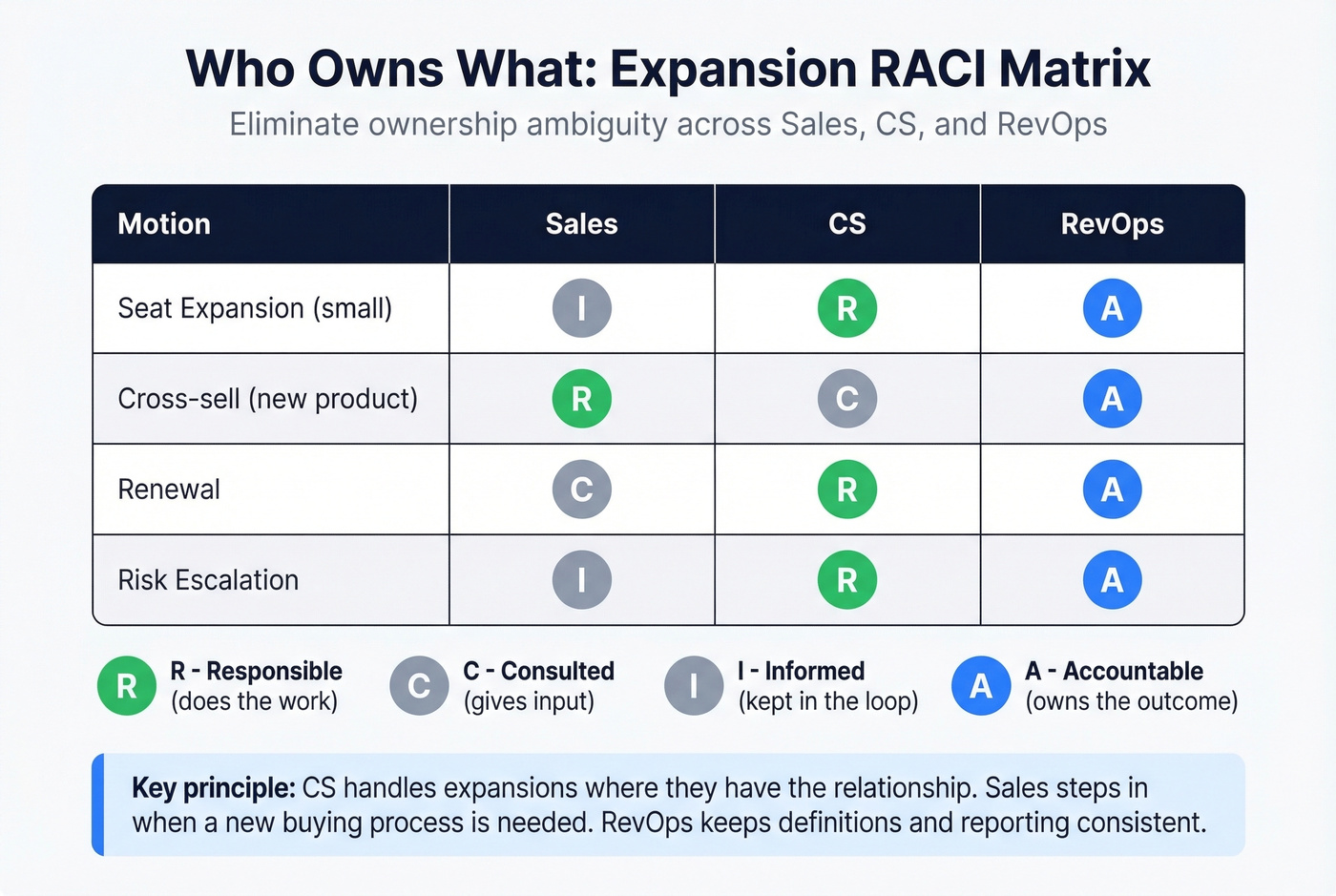
Use RACI to match ownership to deal complexity: CS handles small seat bumps where they already have the relationship, and Sales steps in for larger cross-sells that require a new buying process. RevOps keeps definitions, routing, and reporting consistent. (This is where a strong RevOps Manager function pays for itself.)
| Motion | Sales | CS | RevOps |
|---|---|---|---|
| Seat expansion (small) | Informed | Responsible | Accountable |
| Cross-sell (new product) | Responsible | Consulted | Accountable |
| Renewal | Consulted | Responsible | Accountable |
| Risk escalation | Informed | Responsible | Accountable |
Standardize your definitions of expansion, churn, and upsell - write them down, share them, and revisit them quarterly. If you need a clean taxonomy, start with Upsell vs Cross-Sell in SaaS.
Pods, Dashboards, and Cadence
The operating rhythm matters as much as the org chart.
Cross-functional pods with stable AE+CSM pairings work best when revisited biannually. Pair them with a weekly joint dashboard review - 15 minutes, not a full QBR - surfacing NRR, expansion pipeline, and risk signals. In our experience, the teams that actually run this weekly review catch churn signals 3-4 weeks earlier than those running biweekly syncs. (If your QBRs are still chaotic, align on QBR questions to ask ahead of time.)
CS-sourced lead tracking is where most revenue operations teams drop the ball. Log expansion signals in your CSP, sync to CRM, and attribute them in pipeline reviews. If CS isn't getting credit for sourced revenue, they'll stop surfacing it. Simple as that. (This is also why pipeline health should include expansion and risk, not just new business.)
For strategic accounts, joint account plans are non-negotiable. Some enterprise buying groups have 13+ members involved in renewal decisions. Joint plans can help close deals up to 50% faster with existing accounts. Waystar reduced churn by 20% after implementing cross-functional alignment processes like these - proof that the operating model pays for itself.
Here's the thing: most teams don't have an alignment problem. They have an accountability problem. If nobody's job depends on the handoff going well, the handoff won't go well. Comp changes, RACI charts, and pod structures all serve one purpose - making alignment someone's actual responsibility, not everyone's vague aspiration.
Anti-Patterns That Kill Alignment
These failure modes repeat across dozens of teams we've studied. They're predictable, which means they're preventable.
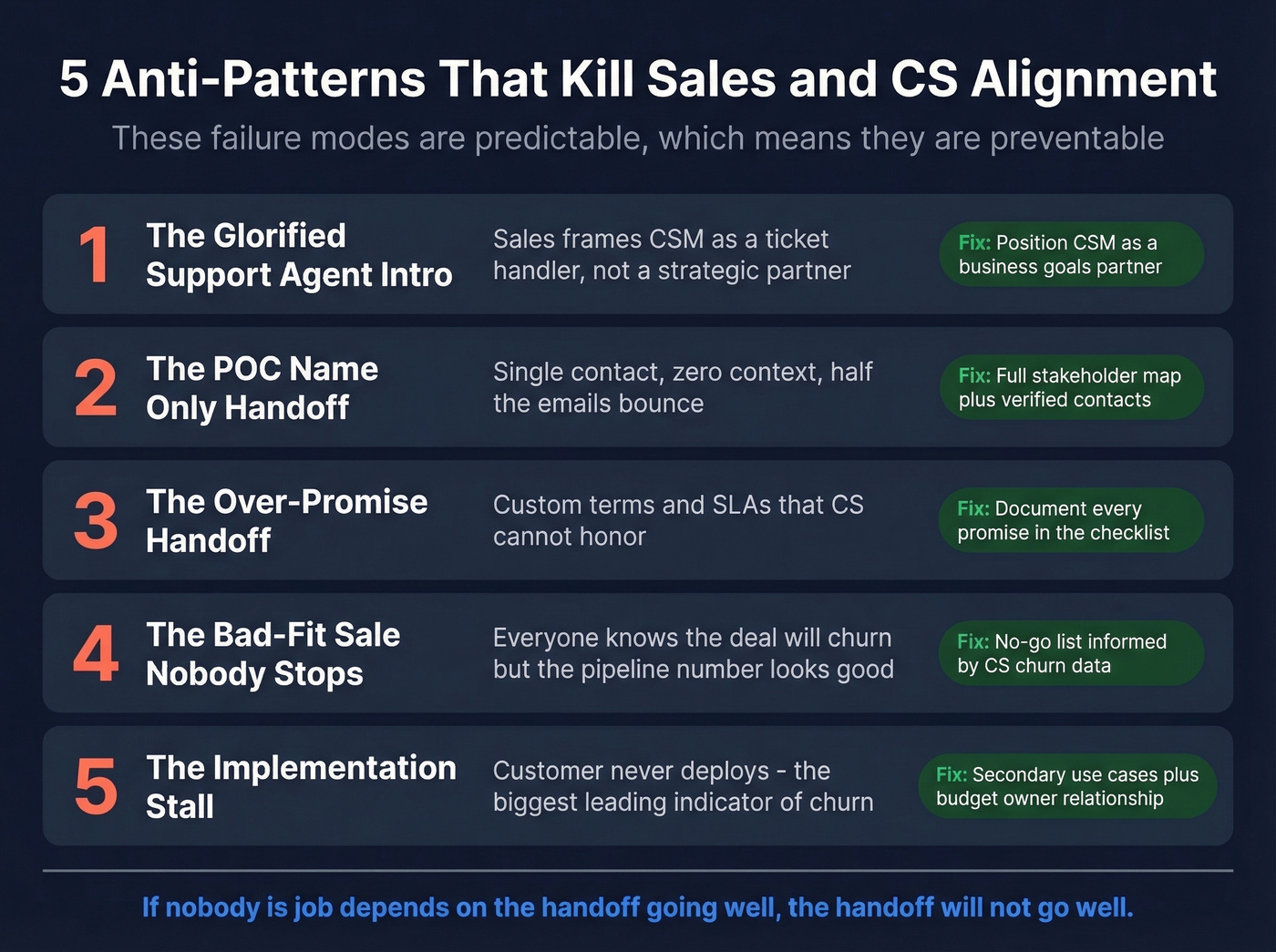
The "glorified support agent" intro. Sales frames the CSM as someone who'll handle tickets. The customer never sees CS as a strategic partner. Fix: Sales positions the CSM as the person who'll help them hit their business goals - not the person who answers when things break.
The "POC name only" handoff. Sales passes a single contact with zero strategic context. No stakeholder map, no success criteria, no notes on what was promised. Half the emails bounce, the direct dials are dead, and your CSM's first outreach fails before it starts. Keep contact records fresh with a data enrichment tool that refreshes on a 7-day cycle - stale records from the sales cycle silently kill post-sale relationships. (If you're building a broader stack, start with contact management software basics.)
The over-promise handoff. Sales commits to custom terms, refund policies, or SLAs that CS can't honor. The customer's first CS interaction becomes a correction instead of a kickoff. Every promise made during the sales cycle should be documented in the handoff checklist - no exceptions.
The bad-fit sale nobody stops. Everyone - AE, manager, CS - knows the deal is a poor fit. But the AE gets paid anyway, and the pipeline number looks good this quarter. The customer churns in four months. The fix isn't just comp alignment; it's building a culture where walking away from a bad deal is celebrated, not punished. (If you want to quantify the damage, run a simple churn analysis by segment and source.)
The implementation stall nobody escalates. The biggest leading indicator of churn is a customer not deploying. Common causes: champion departure, org restructuring, security team wasn't looped in during the sales cycle. Mitigation: maintain a relationship with the budget owner post-sale, and keep secondary simpler use cases ready to deliver time-to-value while the primary rollout stalls.
Aligning Marketing With Sales and CS
Most playbooks focus on the Sales-CS handoff and ignore Marketing entirely. That's a mistake.
The success plan should be a living document with actionable tasks, defined responsibilities, and clear goals - updated at every QBR, not just the first one. When you align marketing and customer success around shared ICP definitions and lifecycle messaging, the entire revenue team benefits from higher-quality leads entering the funnel and better-fit customers reaching CS. If your success plan isn't being referenced in weekly pod reviews, it's not a plan - it's an artifact. (This is also where marketing enablement keeps messaging consistent across the lifecycle.)
Let's bring this full circle. The three priorities from the top - fix comp, build the handoff, review together weekly - are the foundation. When you anchor sales and CS alignment around those fundamentals, everything else in this playbook reinforces them. Start there. Build outward.
Expansion revenue dies when CS can't reach the right stakeholders. Prospeo enriches your CRM with 50+ data points per contact - refreshed every 7 days - so your CSMs always have current emails and direct dials for champions, buyers, and decision-makers.
Give your CS team the data to actually drive NRR.
FAQ
What's the single most impactful change for alignment?
Add a retention or NRR component - even 10-15% - to AE variable comp. Comp plan changes start shifting behavior within one quarter, making this the highest-leverage move for any revenue leader.
Who should own the Sales-to-CS handoff?
The AE owns completing the checklist; the CSM confirms they have what they need. A CS Ops leader audits handoff quality monthly. This three-way ownership ensures accountability without creating bottlenecks.
How often should Sales and CS review shared metrics?
Weekly. A 15-minute dashboard review surfacing NRR, expansion pipeline, and health scores catches churn risks and upsell signals before they become QBR surprises. Biweekly is too slow for fast-moving accounts.
What tools help keep handoff data accurate?
Prospeo's enrichment API refreshes contact records every 7 days and returns 50+ data points per contact at a 92% match rate. Pair it with your CRM to auto-verify stakeholder emails and direct dials before the CSM's first outreach.
How do you get Marketing involved?
Start by aligning all three teams around a single ICP definition and shared revenue goals. Marketing should see CS retention data to understand which lead sources produce customers that stick - not just customers that close.