

Sales and Marketing Assessment: 2026 Guide
A bad sales hire can cost $35,000-$75,000 once you add recruiting time, onboarding, and the months you spend waiting for real pipeline. Then comes the slow burn: roughly 210 days before a rep's fully ramped and consistently hitting quota.
A misaligned go-to-market setup bleeds money more quietly, and it usually lasts longer because nobody "owns" the problem. A sales and marketing assessment can fix either situation, but only if you're clear about which one you're running.
Let's break this down: there are really two assessments hiding under the same name.
What a Sales and Marketing Assessment Covers
People use "sales and marketing assessment" to mean two different things:
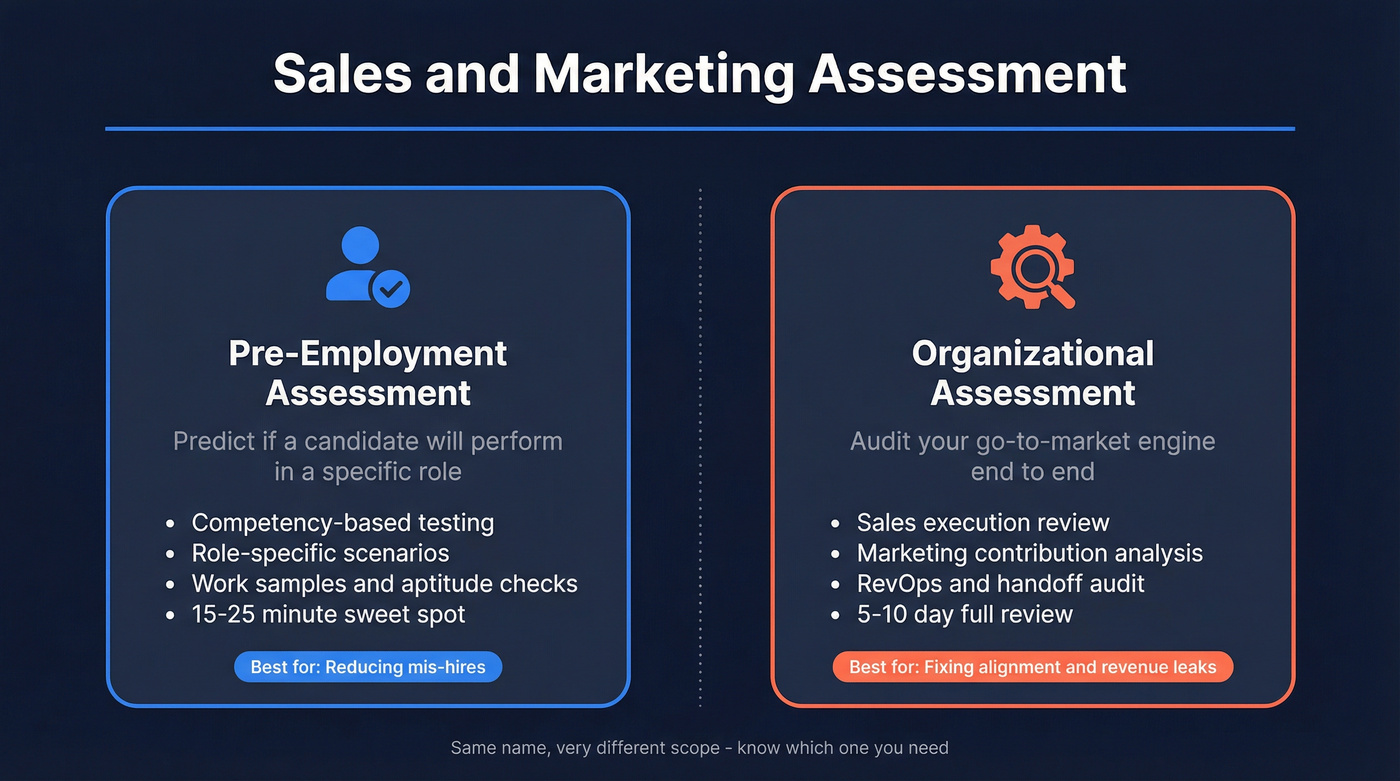
- A pre-employment assessment: a structured evaluation that predicts whether a candidate will perform in a specific sales or marketing role.
- An organizational assessment: a practical audit of how your revenue engine works end to end, including sales execution, marketing contribution, RevOps plumbing, and the handoffs in between.
The phrase "sales and marketing gap analysis" usually points to the second one. It's the process of finding the specific disconnects between what marketing produces and what sales can convert, then putting a number on the damage (lost pipeline, wasted spend, longer cycles, lower win rates).
Pre-employment testing is mainstream now: over 82% of U.S. enterprises use some form of assessment, and the market's projected to grow from $3.1B in 2026 to $6.7B by 2034. The organizational side is less standardized, but it's the one that tends to move revenue faster once you're past the "we just need more leads" phase.
Pre-Employment Assessments (Hiring)
What the best assessments measure
The best sales assessments don't try to guess personality. They measure job-relevant competencies and the behaviors that show up on calls, in follow-ups, and in negotiation.
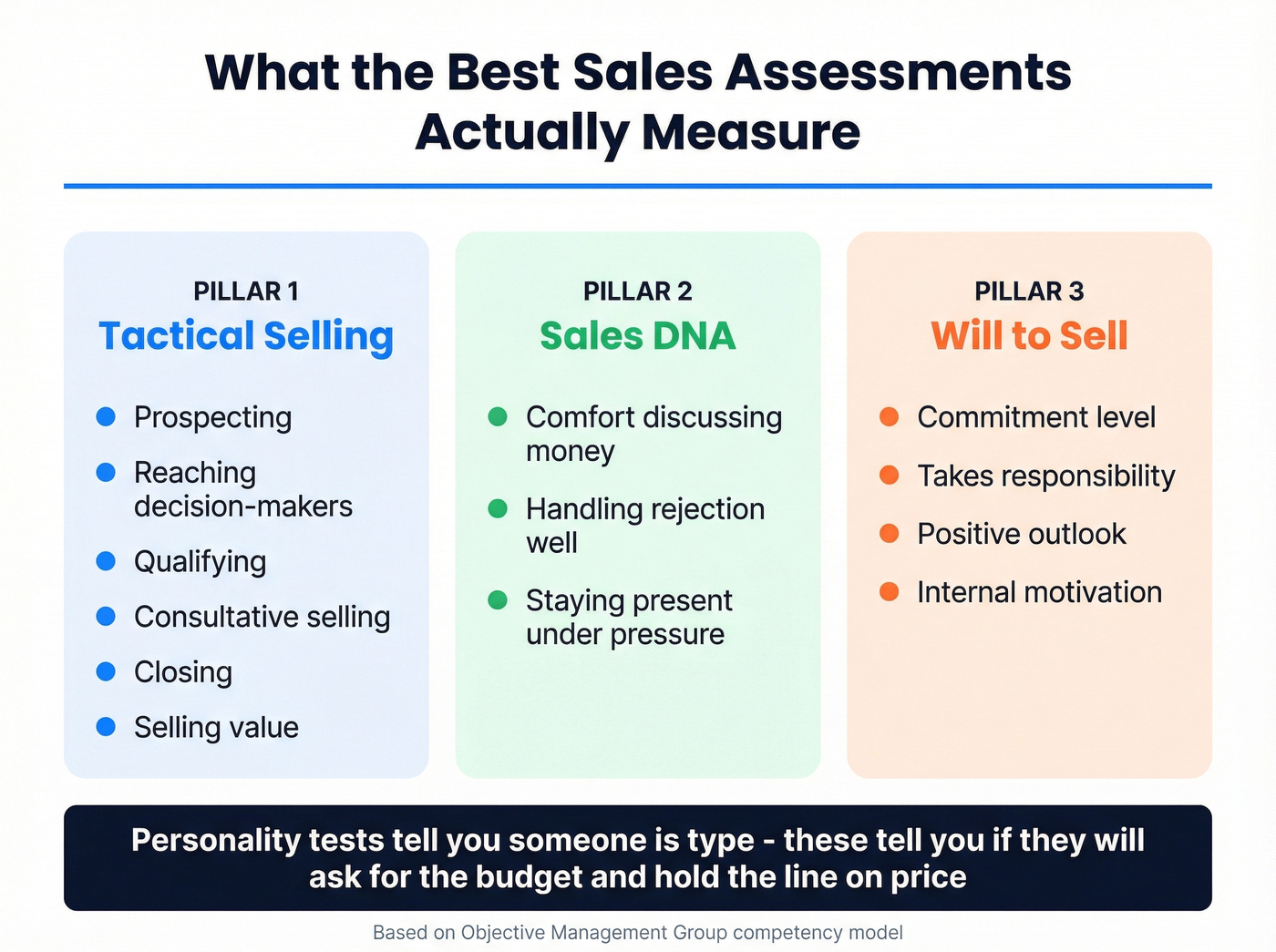
A strong reference point is Objective Management Group's evaluation methodology, which groups sales competency into:
- Tactical Selling: prospecting, reaching decision-makers, qualifying, consultative selling, closing, selling value (see sales prospecting for modern tactics)
- Sales DNA: comfort talking about money, handling rejection, staying present in tense conversations (related: resilience in sales)
- Will to Sell: commitment, responsibility, outlook, motivation
That's why a generic personality inventory falls flat. It can tell you someone's "type." It can't tell you whether they'll ask for the budget, hold the line on price, or recover after a brutal week of no-shows.
Formats that actually work
In our experience, the most predictive hiring setups mix a few elements instead of betting everything on one test:
- Role-specific scenarios (objection handling, discovery, prioritization)
- Work samples (write the follow-up email, build a mini campaign brief, outline a call plan) - use proven sales follow-up templates
- Aptitude checks (basic reasoning and problem solving, not trick questions)
- Structured scoring with a rubric, so you're not just rewarding confidence
Keep it tight. A 15-25 minute assessment is a sweet spot for signal without wrecking your funnel, and it lines up with the broader shift toward skills-first hiring (72% of employers now prioritize skills over certificates).
The candidate experience problem (and why it matters)
Here's the thing: the best candidates leave first.
We've watched this play out repeatedly. A senior rep on Reddit (12 years in the seat) described getting a timed, pencil-and-paper test with spelling questions and "Suzie has 10 apples" math. Their word for it was "insulting." Other threads on r/sales complain about hour-long personality inventories before a single human conversation, or "assignments" that are basically a full 90-day plan dressed up as an interview step.
Real talk: that's not assessment. That's friction. And sometimes it's free consulting.
If your process puts a 100-question personality test between a candidate and their first real conversation, you're not filtering for quality. You're filtering out everyone who has options.
Quick comparison: hiring vs go-to-market audit
| Pre-Employment Assessment | Organizational Assessment | |
|---|---|---|
| Purpose | Predict candidate performance in a specific role | Audit go-to-market health and revenue leakage |
| Scope | One role, one person | Sales + marketing + RevOps system |
| Typical duration | 15-25 minutes (plus structured interview) | 5-10 days for a full review |
| Best for | Reducing mis-hires and bias | Fixing alignment, process, and data issues |
| Good starting point | OMG competency model | PeopleWorks 10-area model |

Every go-to-market audit eventually hits the same wall: your team can't convert pipeline if contact data is wrong. Prospeo delivers 98% email accuracy and 125M+ verified mobile numbers on a 7-day refresh cycle - so the gaps your assessment uncovers don't stay open.
Stop auditing broken data. Start building pipeline that converts.
Organizational Assessments (Go-to-market audit)
The 10-area framework (a solid blueprint)
PeopleWorks' sales and marketing assessment is one of the more complete public frameworks we've seen. It reviews ten elements across three buckets:
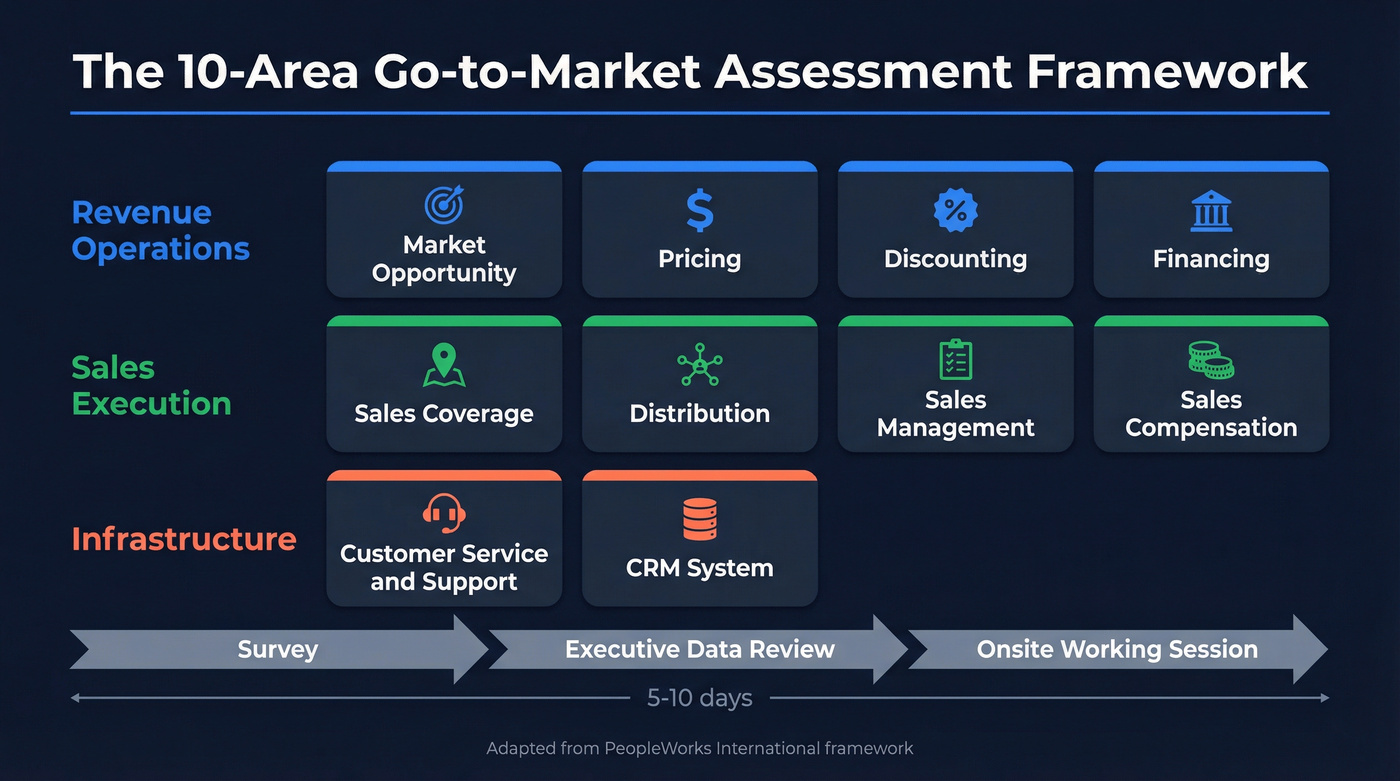
- Revenue operations: market opportunity, pricing, discounting, financing
- Sales execution: sales coverage, distribution, sales management, sales compensation (see sales execution)
- Infrastructure: customer service/support, CRM system (related: examples of a CRM)
Their approach combines a survey, executive data review, and an onsite working session over 5-10 days. Even if you never hire them, the structure is useful: it forces you to look at the whole machine instead of arguing about one broken gear.
How to measure sales and marketing alignment (without vibes)
If you want a practical scorecard, Demand Metric's sales-marketing alignment tool is a good baseline. It covers relationships, metrics, lead generation, culture, systems, and messaging, and it's been downloaded thousands of times for a reason: it's concrete enough to run in a real company.
Where teams usually fail isn't "strategy." It's definitions.
We've seen orgs with smart people and strong intent get stuck for quarters because they never wrote down what counts as a qualified lead, what "accepted" means, and how fast sales has to act. Once those definitions drift, every dashboard becomes a debate, and the debate becomes an excuse.
To make the alignment scorecard actionable, tie it to numbers you can track weekly: CPL, CAC, pipeline created, pipeline velocity, stage conversion, and win rate by source. If you want a tighter KPI set, start with funnel metrics. If you can't connect marketing activity to pipeline movement, you're not doing alignment. You're doing reporting theater.
From gap analysis to a gap plan
A sales and marketing gap analysis is only useful if it ends with a plan that survives contact with the calendar.
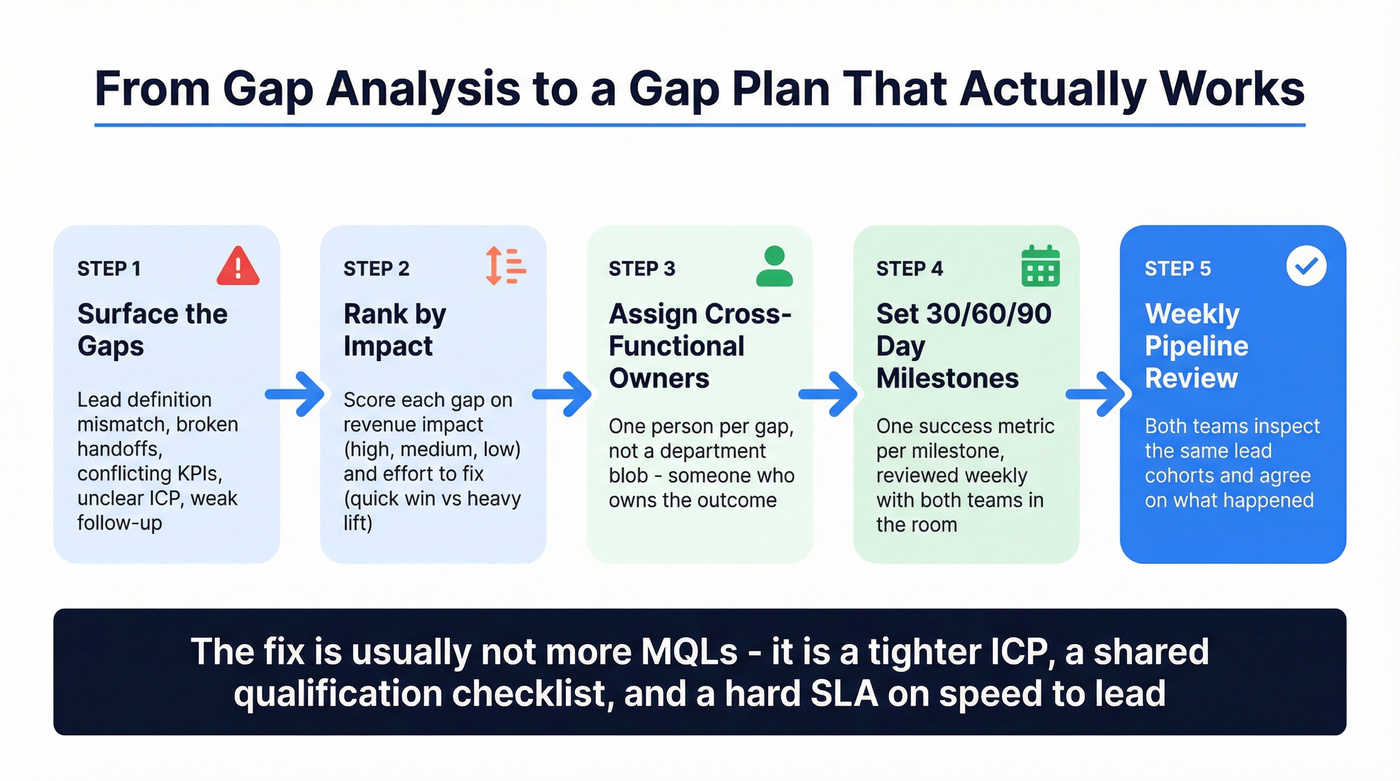
When the assessment surfaces gaps (lead definition mismatch, broken handoffs, conflicting KPIs, unclear ICP, weak follow-up discipline), rank them by revenue impact and effort. Then assign a cross-functional owner for each fix, not "sales" or "marketing" as a blob, and set 30/60/90-day milestones with a single success metric per milestone (template: 30-60-90 day plan for sales reps).
One scenario we see a lot: marketing hits its lead number, sales says the leads are junk, and RevOps tries to referee with dashboards that nobody trusts. The fix usually isn't "more MQLs." It's a tighter ICP, a shared qualification checklist, and a hard SLA on speed-to-lead, plus a weekly review where both teams look at the same cohort of leads and agree on what happened.
The metric most assessments miss: data accuracy
Look, most frameworks cover strategy, comp, and process. Almost none start with the boring question that decides whether your conclusions are even real: is your CRM contact data accurate?
If emails bounce, your deliverability tanks and your conversion rates lie. If phone numbers are wrong, connect rates look like a rep problem when it's actually a data problem. And if records are stale, attribution turns into fiction because the "right person" changed roles three months ago.
This is one place where tools matter. Prospeo helps teams keep inputs clean with 98% verified email accuracy and a 7-day data refresh cycle across 300M+ professional profiles, so your assessment isn't built on outdated contacts and dead inboxes. If you're pressure-testing vendors, start with data enrichment services and then map the impact to pipeline health.
For more on assessment design and validity, the EEOC's guidance on employment tests is worth reading, and the U.S. Department of Labor's overview of skills-based hiring is a useful reference when you're aligning hiring steps with job requirements.
Five mistakes that ruin assessments
- Using outdated metrics. Counting activity (calls, emails) without weighting outcomes (meetings held, stage conversion, deal velocity, retention). (More: sales activities examples)
- Running generic tests. An enterprise AE and an SDR shouldn't take the same assessment. Neither should a demand gen manager and a product marketer.
- Letting interviews stay unstructured. Without a rubric, people hire for "confidence" and "likability," then act surprised when the rep can't run discovery.
- Ignoring coachability. In complex B2B deals with 6-10 stakeholders, emotional control and learning speed matter as much as closing technique.
- Putting an assessment wall before human contact. Put a 15-minute recruiter screen first. Always.
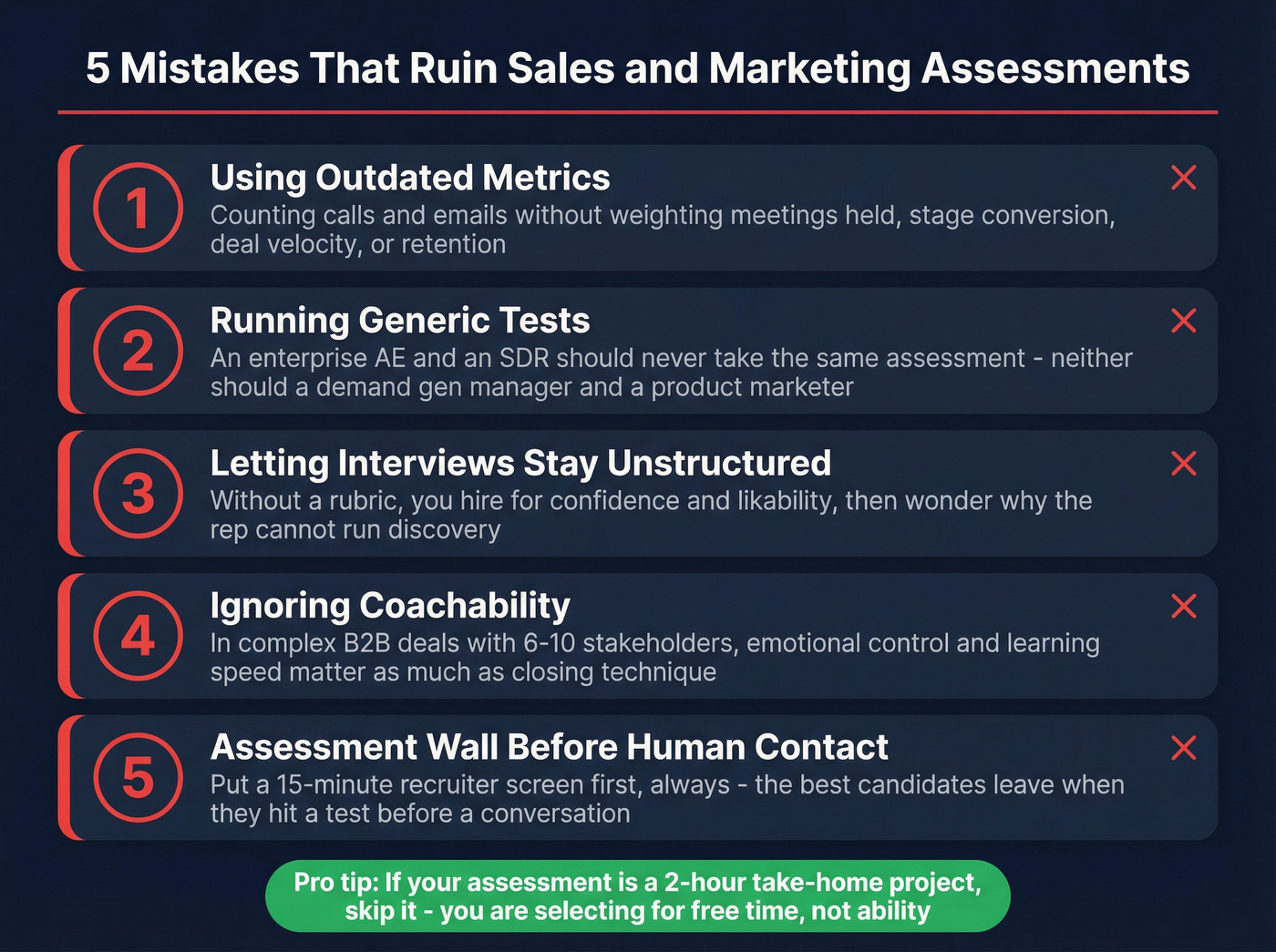
One more opinionated note: if your "assessment" is a two-hour take-home project, skip it. You'll mostly select for people with extra time, not people who can do the job.
Misaligned sales and marketing teams waste months arguing over lead quality. When your ICP data is verified across 300M+ profiles with 30+ filters - intent, technographics, headcount growth - the debate ends and pipeline moves. At $0.01 per email, fixing your data layer costs less than one bad hire.
Turn your gap analysis into a growth plan with data you can trust.
FAQ
What's the difference between a sales assessment and a personality test?
A sales assessment measures job-relevant competencies like prospecting, objection handling, discovery, and closing. A personality test measures preferences and doesn't predict quota attainment. Use competency-based assessments built for the role; OMG's framework is a strong benchmark.
How long should a pre-employment sales assessment take?
15-25 minutes. Longer assessments increase drop-off, especially before any human conversation. Short, role-specific evaluations with structured scoring beat marathon personality inventories.
How do I assess sales and marketing alignment?
Use a scorecard that covers relationships, metrics, lead generation, systems, and messaging. Demand Metric's tool is a solid starting point. Then pressure-test it with shared KPIs, agreed lead definitions, and a weekly pipeline review where both teams inspect the same lead cohorts. Before you trust any downstream metric, make sure your CRM contact data is accurate.
What are the most common signs sales and marketing are misaligned?
Sales ignores marketing-sourced leads, marketing can't show pipeline contribution, teams disagree on what "qualified" means, and every missed target turns into finger-pointing. A formal assessment forces those issues into the open and lets you prioritize fixes by revenue impact instead of gut feel.