

25+ Sales Closing Statements for Every Scenario
The demo went great. The prospect nodded at all the right moments, asked smart questions, even laughed at your joke about their current vendor. Then came the five words that kill momentum: "Let me discuss with my team."
Now you're staring at a blank follow-up email, cursor blinking. [96% of prospects](https://www.hubspot.com/marketing-statistics) already researched you before that call happened, [71% prefer researching on their own](https://blog.hubspot.com/sales/sales-statistics) over talking to a rep, and the average win rate across industries sits at just 47%. The right sales closing statements can save that deal. The wrong ones - or none at all - let it die in someone's inbox.
The Quick Version
The most versatile closing line: "What needs to happen before we can move forward?" It works on calls, in emails, and in enterprise deals with six stakeholders.
Three categories to master: diagnostic questions that confirm fit, timeline closes that create momentum, and recap closes that mirror the prospect's own words back to them.
Here's the thing - you don't need 30 closing phrases. You need five and the discipline to deploy them at the right moment. Timing beats volume every time.
What Makes a Close Work
Closing doesn't happen in one moment at the end. It's a sequence that starts the moment you confirm fit. Understanding how to close a sales call means recognizing that the close is built across the entire conversation, not bolted on at the finish.
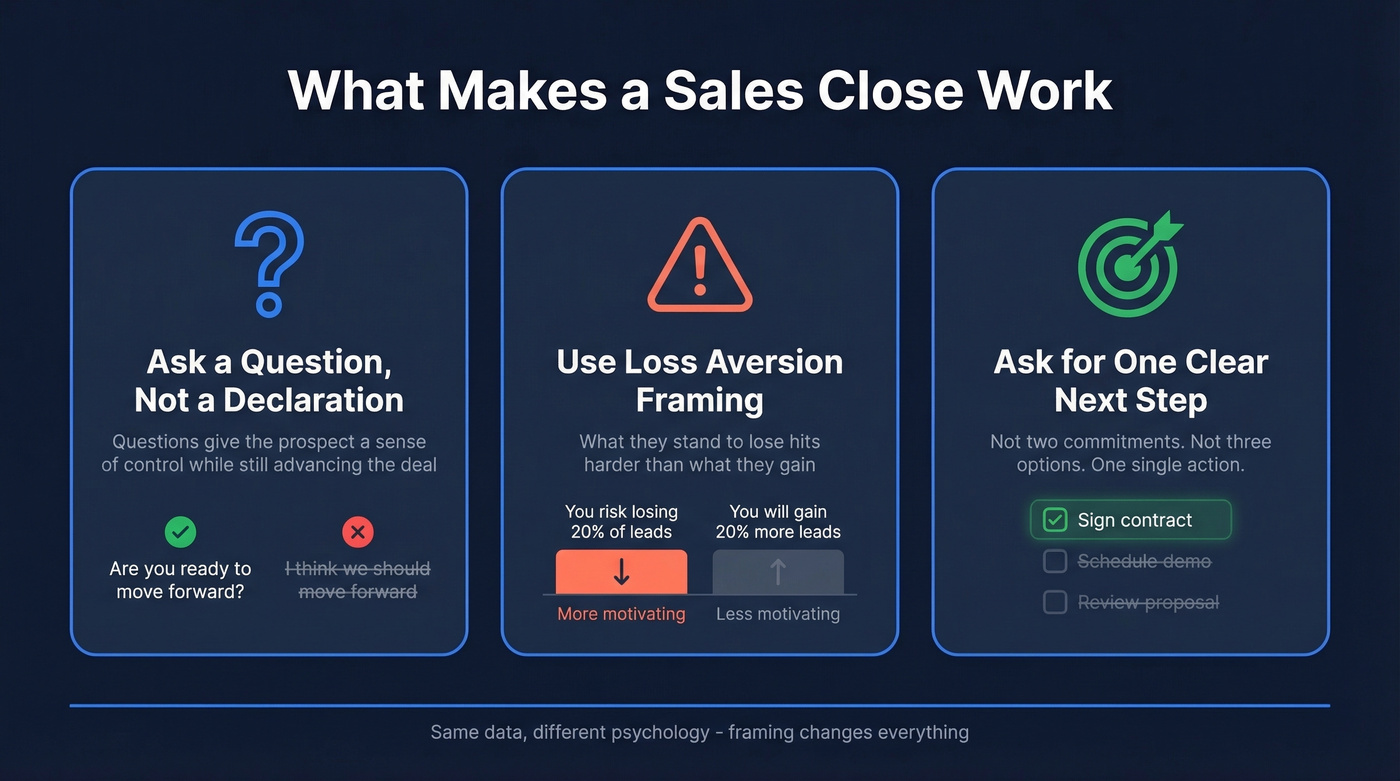
Effective closing language shares three traits. First, it's a question, not a declaration. "Are you ready to move forward?" outperforms "I think we should move forward" because questions hand the prospect a sense of control while still advancing the deal. Second, it [uses loss aversion] - framing around what the prospect stands to lose hits harder than framing around what they'll gain. "Without this solution, you risk losing 20% of your leads" is more motivating than "you'll gain 20% more leads," according to [research on deal psychology](https://www.pnas.org/doi/10.1073/pnas.2202700119) from InfoProLearning. Same data, different psychology.
Third, it asks for one clear next step. Not two. One commitment.
25+ Examples by Scenario
Diagnostic Closes (Confirm Fit)
These come first. Before you ask for anything, confirm the problem is actually solved.
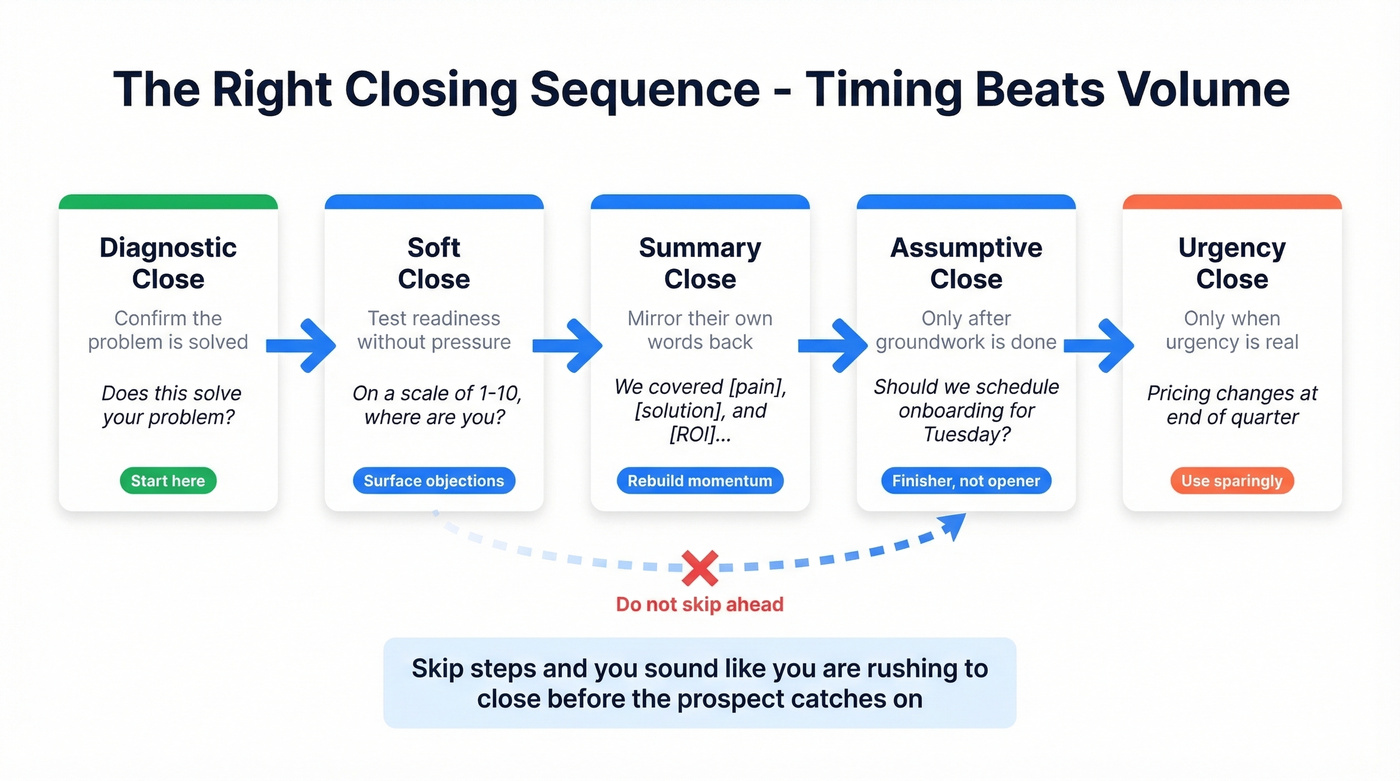
- "Does this solve your problem?"
- "Which of your needs does this address?"
- "Have I provided enough information in order for you to make a decision?"
That last one comes from a thread on r/sales and it's deceptively powerful. Here's what it sounds like mid-conversation:
Rep: "So we'd automate the entire handoff from marketing to your SDR team. Have I provided enough information in order for you to make a decision?" Prospect: "Mostly - I still need to understand the integration timeline." Rep: "Let's cover that right now."
It shifts the frame from "buy this" to "do you have what you need?" - a much easier question for a prospect to answer honestly.
Soft Closes (Test Readiness)
Soft closes probe without forcing a binary yes or no. They surface hidden objections before those objections become deal-killers - an essential skill for closing the call without alienating the buyer.
- "If I could do this for $X, would that be within your budget?"
- "Is there any reason this wouldn't meet your needs?"
- "On a scale of 1-10, where are you on moving forward? What would make it a 10?"
The scale question is underrated. It gives the prospect permission to say "I'm at a 7" - and then you get to ask what's missing.
Assumptive Closes
- "Which payment option do you prefer?"
- "Should we schedule onboarding for Tuesday or Thursday?"
- "I'll send the agreement over this afternoon - does that work?"
Let's be honest: the assumptive close is overrated as a standalone tactic. It only works when you've already done the diagnostic and soft-close groundwork. Skip those steps and jump straight to "which plan do you want?" and you'll sound like you're rushing to close before the prospect catches on. Use it as a finisher, not an opener.
Urgency Closes
- "Pricing changes at end of quarter - locking in now saves you $X."
- "Your competitor signed last week; the implementation slot fills up fast."
Only use urgency when it's real. Manufactured scarcity destroys credibility. If your urgency is genuine - a real price increase, a real capacity constraint - say so transparently. If it's not, skip this category entirely.
Summary / Recap Closes
- "So you're looking to expand in six months, and our solution scales securely - ready to move forward?"
- "We've covered [pain point], [solution], and [ROI]. What's the next step on your end?"
Mirror the prospect's own words. If they said "we're bleeding leads," say "bleeding leads" back to them, not "experiencing suboptimal conversion rates." Recap closes work especially well after long evaluation cycles where the prospect has lost track of their own buying reasons, because a strong recap ties the entire conversation together by reflecting the prospect's language and priorities back in a way that makes the decision feel obvious.
Email Closing Lines
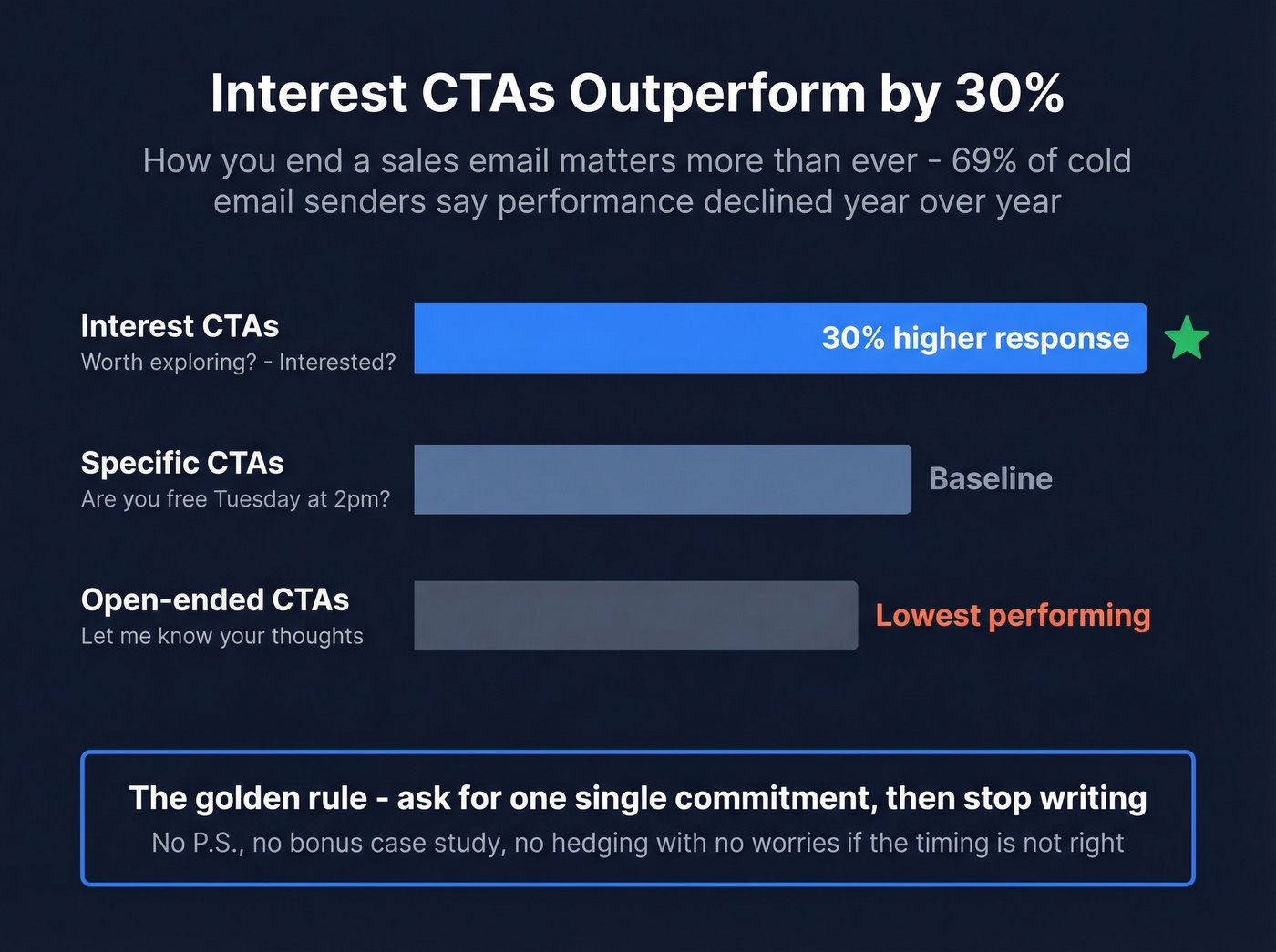
This is where most reps fumble. Remember that blank email from the intro? 69% of cold email senders report performance has declined year over year, which means CTA choice matters more than ever.
- "Worth exploring?"
- "Do you see any reason not to proceed?"
- "Who else should review the agreement?"
- "What needs to happen before we can proceed?"
- "Would you like me to send the agreement now?"
Interest CTAs outperform specific and open-ended CTAs by 30%. "Worth exploring?" and "interested?" sell the conversation, not the meeting. That's the right frame for email.
The golden rule: ask for one single commitment, then stop writing. Don't add a P.S., don't throw in "also, here's a case study," don't hedge with "no worries if the timing isn't right." After the closing question, the email ends.
If you're staring at that follow-up, tighten your follow-up email and use a clean subject line from our guide to good email openers.
B2B / Enterprise Closes
Enterprise deals don't close in a single conversation. You're not closing one person - you're arming your champion with language to close internally.
- "Is there anything else stopping us from moving forward?"
- "Should we route this to procurement for vendor setup?"
- "What does your internal approval timeline look like?"
- "I can't help you until you commit - but once you commit, I won't let you fail."
That last line, also from r/sales, reframes commitment as the starting line, not the finish line. Here's how it plays in a multi-stakeholder deal:
Champion: "I'm bought in, but I need to get my VP on board." Rep: "What does your internal approval timeline look like? I'll build you a one-page summary with the ROI numbers so you have everything you need for that conversation."
In our experience, the reps who close enterprise deals fastest aren't the ones with the best lines - they're the ones who arm their champion with a pre-packaged internal pitch. We've watched teams cut their close cycle by weeks just by sending a two-slide "here's what to tell your CFO" deck after the second call.
If you're selling into larger orgs, pair these lines with a repeatable enterprise sales process and a tighter playbook for closing enterprise deals.

The best closing statement in the world won't save a deal if your email bounces. Prospeo delivers 98% verified email accuracy with a 7-day refresh cycle - so your follow-up actually lands in the inbox that matters.
Stop perfecting your close and start reaching real buyers.
Phrases That Kill Deals
"Let me know when you'll be able to decide." You've handed the prospect all the power and none of the urgency. As Shari Levitin puts it, this is doormat behavior, not selling.
Dropping your price the moment they push back. You've just confirmed you were overcharging. Defend value first. Always. (If discount pressure is a pattern, build a real objection handling framework instead of improvising.)
Answering surface-level excuses instead of isolating the real objection. If the prospect says "we need to think about it," don't respond to the excuse - ask what specifically they need to think about.
Hard closing when the prospect is worried. Huthwaite's research on complex sales shows that pressure applied to a concerned buyer makes them step back and delay. Switch to a diagnostic question. Surface the concern before you push for commitment.
Closing Benchmarks Worth Knowing
Close ratios vary wildly by industry: finance sits at 19%, computer software at 22%, business and industrial at 27%. Benchmark within your vertical - not against some generic "top performers close 30%" stat.
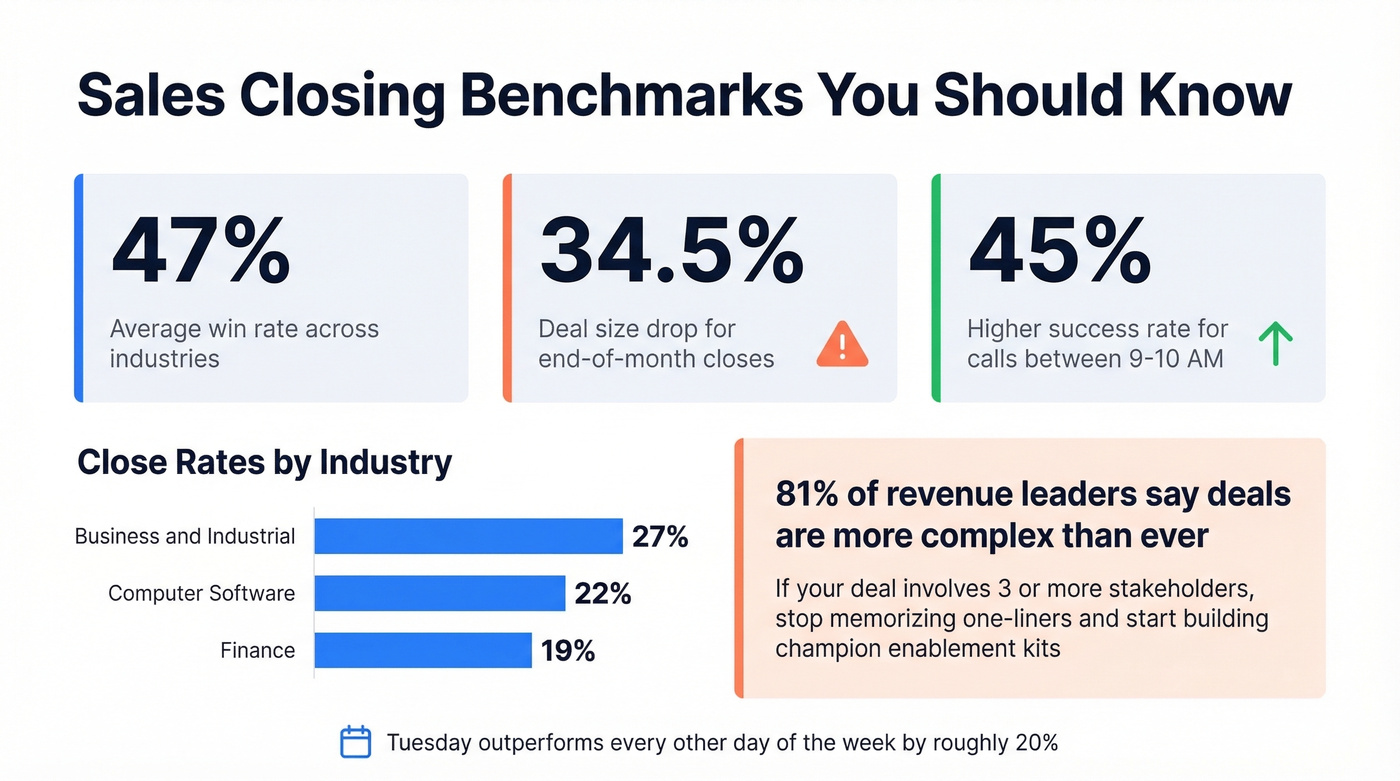
The end-of-month trap is real. Reps close 3x more deals in the final days of the month, but deal size drops 34.5%. That's a lot of discounting to hit quota. Timing matters more than most reps think - calls between 9-10 a.m. have a 45% higher success rate, and Tuesday outperforms every other day by roughly 20%.
If you want to track this properly, start with your close rates and the core sales cycle metrics that explain why deals slip.
81% of revenue leaders say deals are more complex than ever. That complexity is why most closing advice fails - it assumes a single decision-maker and a two-call cycle. If your average deal involves three or more stakeholders, stop memorizing clever one-liners and start building champion enablement kits. The close happens in a room you're not in.
How to Close More Sales Calls
If you want to improve your call closing rate, focus on three levers before you ever touch your script.
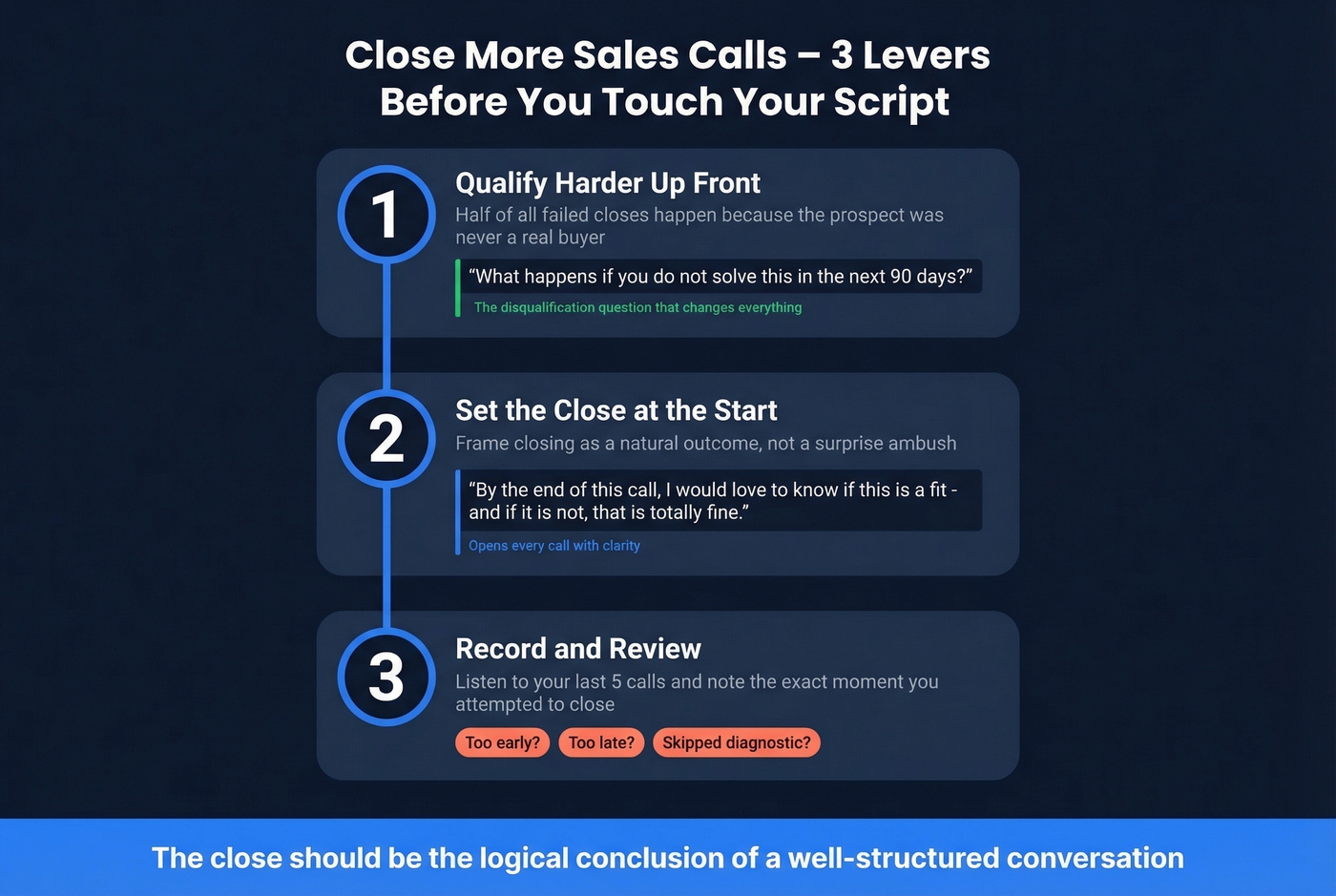
Qualify harder up front. Half of all failed closes happen because the prospect was never a real buyer. Disqualify early so you can invest closing energy where it counts. We've found that teams who add a single disqualification question to their discovery call - "What happens if you don't solve this in the next 90 days?" - see their close rates jump because they stop wasting cycles on tire-kickers. (If you want more options, pull from these discovery questions and MEDDPICC questions.)
Set the close at the start of the call. Open with "By the end of this call, I'd love to know if this is a fit - and if it's not, that's totally fine." This frames closing as a natural outcome, not a surprise ambush.
Record and review. Listen to your last five calls and note the exact moment you attempted to close. Were you too early? Too late? Did you skip the diagnostic entirely? Your closing language only lands when the timing is right. Skip this step if you're already reviewing calls weekly with your manager - but if you're not, it's the single highest-ROI habit you can build.
The reps who consistently close at higher rates aren't using secret phrases. They're running a repeatable process that makes the close the logical conclusion of a well-structured conversation. If you need a simple structure, start with a 4-step sales process.
Verify Before You Close
None of these sales closing statements matter if your email bounces or the phone number rings a fax machine. 48% of sales teams report bounce rates between 2-5%, and 15% exceed 6%. We've seen teams obsess over email copy while sending to lists where a third of the contacts have moved on.
Prospeo delivers 98% verified email accuracy with a 7-day data refresh cycle, plus 125M+ verified mobile numbers with a 30% pickup rate. The free tier gives you 75 emails plus 100 Chrome extension credits per month - enough to test whether your current list is actually reaching anyone. If you're comparing tools, start with our breakdown of email verification software.

Enterprise deals need direct access to decision-makers, not gatekeepers. Prospeo gives you 125M+ verified mobile numbers with a 30% pickup rate - so when you arm your champion, you can also reach the VP directly.
Close multi-stakeholder deals faster with direct dials that actually connect.
FAQ
What's the difference between a closing statement and a closing technique?
A closing technique is the strategy - assumptive, urgency, summary. A closing statement is the exact sentence you say or write to execute that strategy. This article gives you 25+ ready-to-use lines organized by scenario: diagnostic, soft, assumptive, urgency, recap, email, and enterprise.
How many closing attempts should I make?
Top performers make 2-3 attempts per deal cycle across different channels. After three with no movement, stop closing and switch to a diagnostic question - something is blocking the deal that you haven't surfaced yet.
How do I close calls more effectively?
Record your calls and identify where conversations stall. Most reps lose deals not because they lack the right words, but because they attempt to close before confirming fit. Master diagnostic and soft closes first, then layer in assumptive and urgency closes once you've earned the right to ask.
How do I make sure closing emails actually get delivered?
Start with verified contact data. Bad data wastes your best closing language. Tools like Prospeo verify emails in real time with 98% accuracy and refresh records every 7 days, so your closing message hits the inbox instead of bouncing.