

The 4-Step Sales Process That Actually Closes Deals
The problem with most sales processes isn't missing steps - it's too many steps. Companies with a formal sales process generate 28% higher revenue growth, but that doesn't mean more stages equals more revenue. One practitioner on r/EntrepreneurRideAlong watched their close rate drop from 28% to 19% after their company expanded from a 3-step process to 6 steps. More steps, more drop-off points, fewer deals.
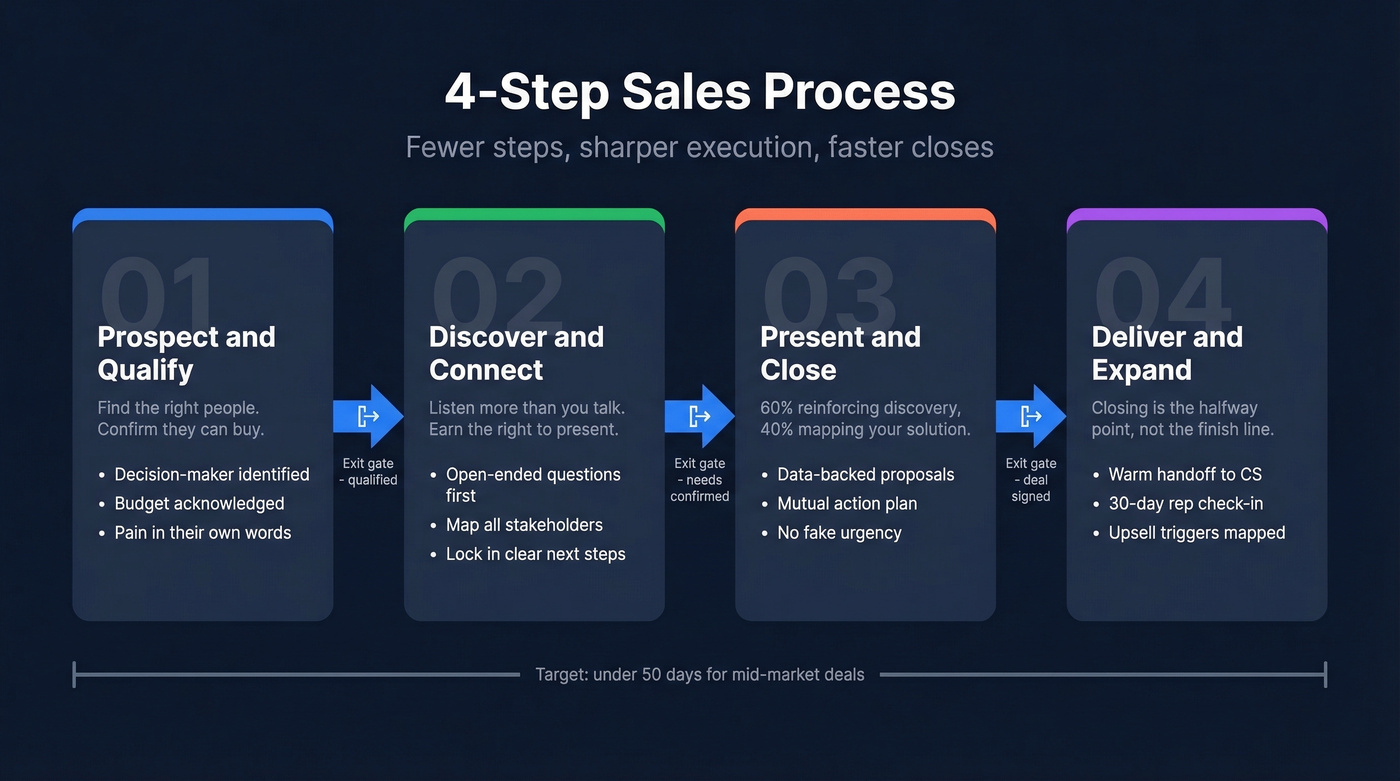
The 4-step sales process that works: Prospect & Qualify, Discover & Connect, Present & Close, Deliver & Expand. No filler stages. Below you'll find benchmarks for each stage, the mistakes that kill deals at every step, and the CRM setup that keeps your pipeline clean.
Why 4 Steps Beat 7
That same Reddit thread includes a before-and-after that's hard to argue with. One team ran 7 steps over 12 weeks with a 19% close rate. They stripped it to 3 core steps - qualification call, combined demo/proposal, and decision call - and hit a 37% close rate in 3 weeks. Nearly double the wins in a quarter of the time.
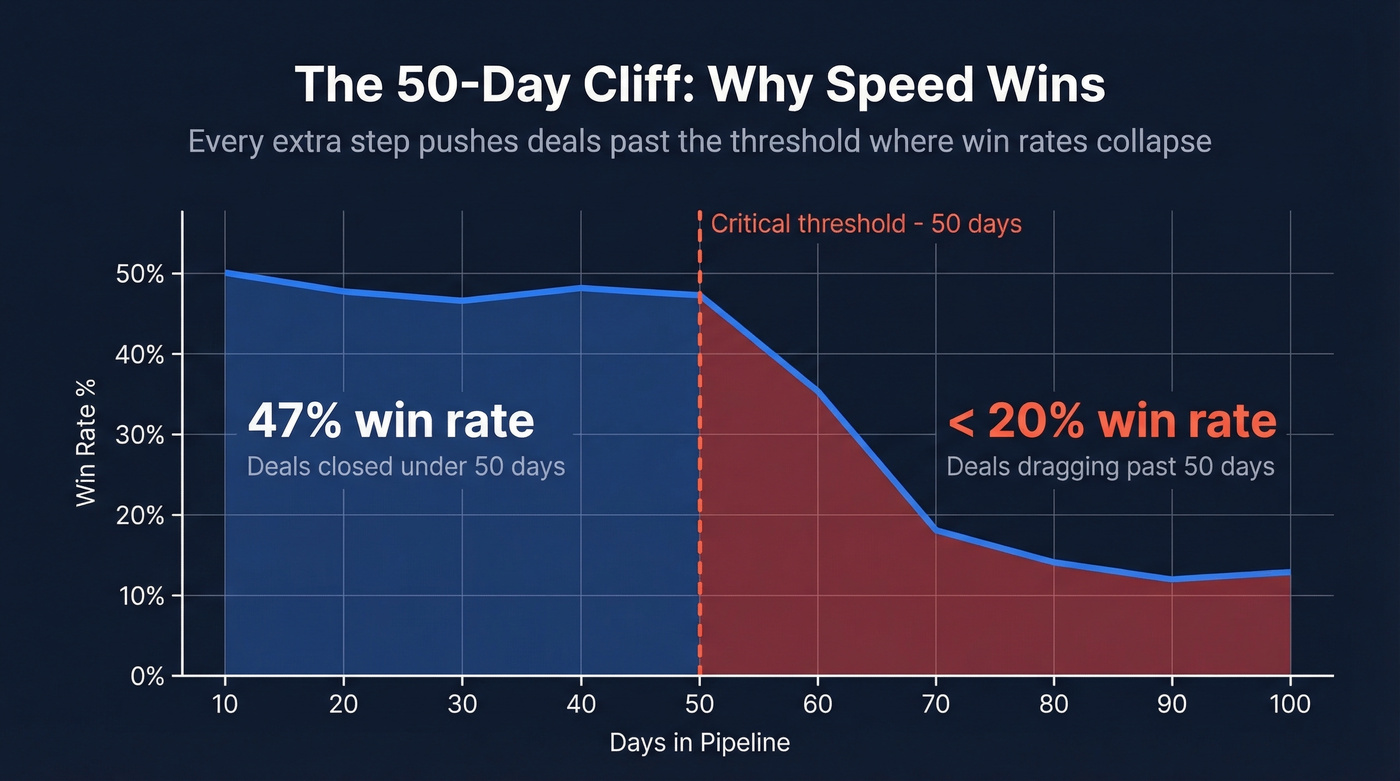
This isn't just anecdotal. Outreach's data analysis shows a brutal win-rate decay curve: deals closed within 50 days carry a 47% win rate. Push past that threshold and win rates drop below 20%. Every unnecessary step you add extends your cycle and shoves more deals past that cliff.
Here's the thing: 81% of revenue leaders say deals are more complex than ever. The answer to complexity isn't more process - it's sharper process. Each additional stage isn't just a calendar delay. It's another meeting to schedule, another stakeholder to lose, another week where a competitor can swoop in. A four-step framework keeps you under that 50-day threshold for most mid-market deals while still covering every critical selling motion.
We've seen this play out firsthand. Teams don't need a better sales process - they need fewer steps and better data going into step one. Companies spend a fortune on methodology training when the real problem is that a huge chunk of their pipeline emails are bouncing.
Process vs. Methodology
Quick distinction that trips people up: a sales process is the sequence of steps your team follows. A sales methodology is the philosophy that informs how you execute those steps.
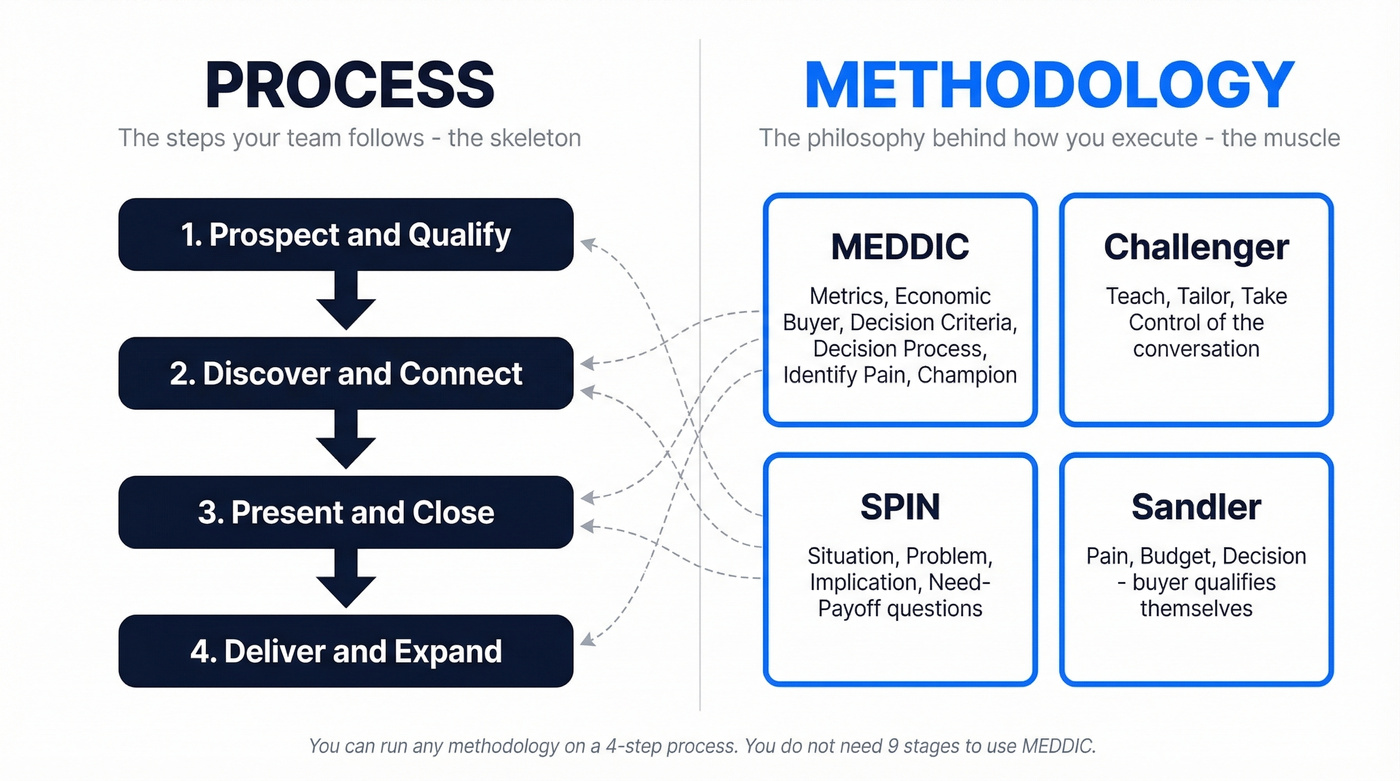
MEDDIC, Challenger, SPIN, Sandler - these are methodologies. They layer onto your process. You can run a four-step process with MEDDIC qualification at step one and Challenger framing at step three. The process is the skeleton; the methodology is the muscle. Don't confuse them, and don't let a methodology vendor convince you that you need their 9-stage process to use their framework.

Step 1 is where 67% of lost deals originate - and bad data is the root cause. Prospeo's 300M+ profiles with 98% email accuracy and 7-day refresh cycle mean your reps spend zero time chasing dead inboxes and all their time qualifying real buyers.
Stop losing deals before the first call even happens.
The Four Stages
Step 1 - Prospect & Qualify
This is where most deals are won or lost, and it happens before you ever get on a call. 96% of prospects research your company before engaging with a rep, and 71% prefer doing that research independently. By the time someone takes your meeting, they've already formed an opinion. Your job at this stage is to make sure you're reaching the right people - and that they're actually qualified to buy.
Industry estimates suggest roughly 67% of lost sales trace back to inadequate qualification. Reps skip this step because it feels like friction, but it's the highest-leverage activity in your entire pipeline. For transactional deals under $15k, BANT works fine. For enterprise, use MEDDIC or ANUM (Authority, Need, Urgency, Money) - they force you to map the buying committee early.
Exit criteria before moving to Step 2:
- Confirmed decision-maker or champion identified
- Budget range acknowledged, even loosely
- Timeline exists - they're not "just exploring" indefinitely
- Pain point articulated in the prospect's own words
The data quality problem is real here: 69% of cold email senders report performance declined year-over-year due to spam filtering. Your process fails at step one if your emails bounce or land in spam. Prospeo's 5-step verification with catch-all handling and spam-trap removal gives you 98% email accuracy across 300M+ professional profiles on a 7-day refresh cycle, so you're reaching real decision-makers, not dead inboxes.

The most common mistake at this stage? Talking to the wrong stakeholders. We've seen teams burn entire quarters nurturing someone who can't sign off on the deal. Qualify the person, not just the company.
If you want to tighten this stage further, start with a clear Ideal Customer Profile and a simple lead scoring model your reps will actually use.
Step 2 - Discover & Connect
Discovery is where you earn the right to present. The biggest mistake reps make here is talking too much. Your listening-to-talking ratio should heavily favor listening - open-ended questions first, then probing deeper based on what you hear.
A good discovery call hits five beats: warm-up and context-setting, open-ended questions about their current state, deeper probing on impact and urgency, sharing relevant value, and locking in clear next steps. Skip any of these and you'll find yourself presenting to someone who hasn't told you what they actually need.
If you need a tighter structure, pull from a proven set of discovery questions or a ready-to-run discovery call script.
The HBR case study on Framework IT illustrates this well. They improved win rates by mapping stakeholders early and finding that deals involving multiple C-level contacts closed at significantly higher rates. They shifted from competing on price bids to framing conversations around ROI criteria - a discovery-stage decision that changed everything downstream.
If your prospect needs a glossary to understand your discovery questions, you've already lost them. Speak their language, not yours.
Step 3 - Present & Close
Most presentations are too long, too feature-heavy, and too focused on what the product does instead of what the buyer gets.
The best closers we've worked with spend 60% of the presentation reinforcing what they learned in discovery and 40% showing how their solution maps to those specific pain points. Bryan Vasquez, Head of Sales at LinkBuilder.io, replaced urgency-based CTAs with data-backed proposals and tailored value maps - win rate up 20% over two quarters. No fake scarcity, no "this price expires Friday" nonsense. Just clear evidence that the solution solves the problem.
If your demos are dragging, use a tighter product demo checklist and upgrade your sales deck storytelling so the narrative does the heavy lifting.
Build a mutual action plan with 3-5 steps that makes the path to close predictable for everyone involved. Buying committees don't like surprises. A shared timeline with clear milestones - technical review, legal review, sign-off - removes ambiguity and keeps deals from stalling.
Use this approach when you're selling to committees of 3+ stakeholders where consensus matters more than a single champion's enthusiasm. Skip the hard close if your prospect has already told you they're ready. Pushing a formal close sequence on a buyer who's already said yes creates friction and can actually introduce doubt. Don't overcomplicate a deal that wants to close.
One more thing: don't lead with discounts. The moment you anchor on price, every future negotiation starts from that number. Lead with value. Discount only when you've exhausted the value conversation.
Step 4 - Deliver & Expand
The best teams treat closing as the halfway point.
What happens after the signature determines whether you get a renewal, an expansion, or a churn notice in 12 months. Post-sale handoff needs to be airtight. The rep who closed the deal should introduce the customer success team personally, transfer context about the buyer's goals and pain points, and stay loosely involved through the first 30 days. Dropping a customer into onboarding with zero context is how you create buyer's remorse.
Post-close checklist:
- Warm handoff to CS/onboarding with deal context documented
- 30-day check-in from the original rep
- Quarterly business review cadence established
- Upsell/cross-sell triggers identified: new team members, new use cases, contract anniversary
Treating the close as the finish line is the most expensive mistake in sales. The easiest revenue you'll ever generate comes from customers who already trust you.
If you want to systematize expansion, build a simple QBR cadence and track retention with a clean renewal rate definition.
Benchmarks by Pipeline Stage
Here's what "good" looks like, compiled from Digital Bloom's pipeline benchmarks and Outreach's data:
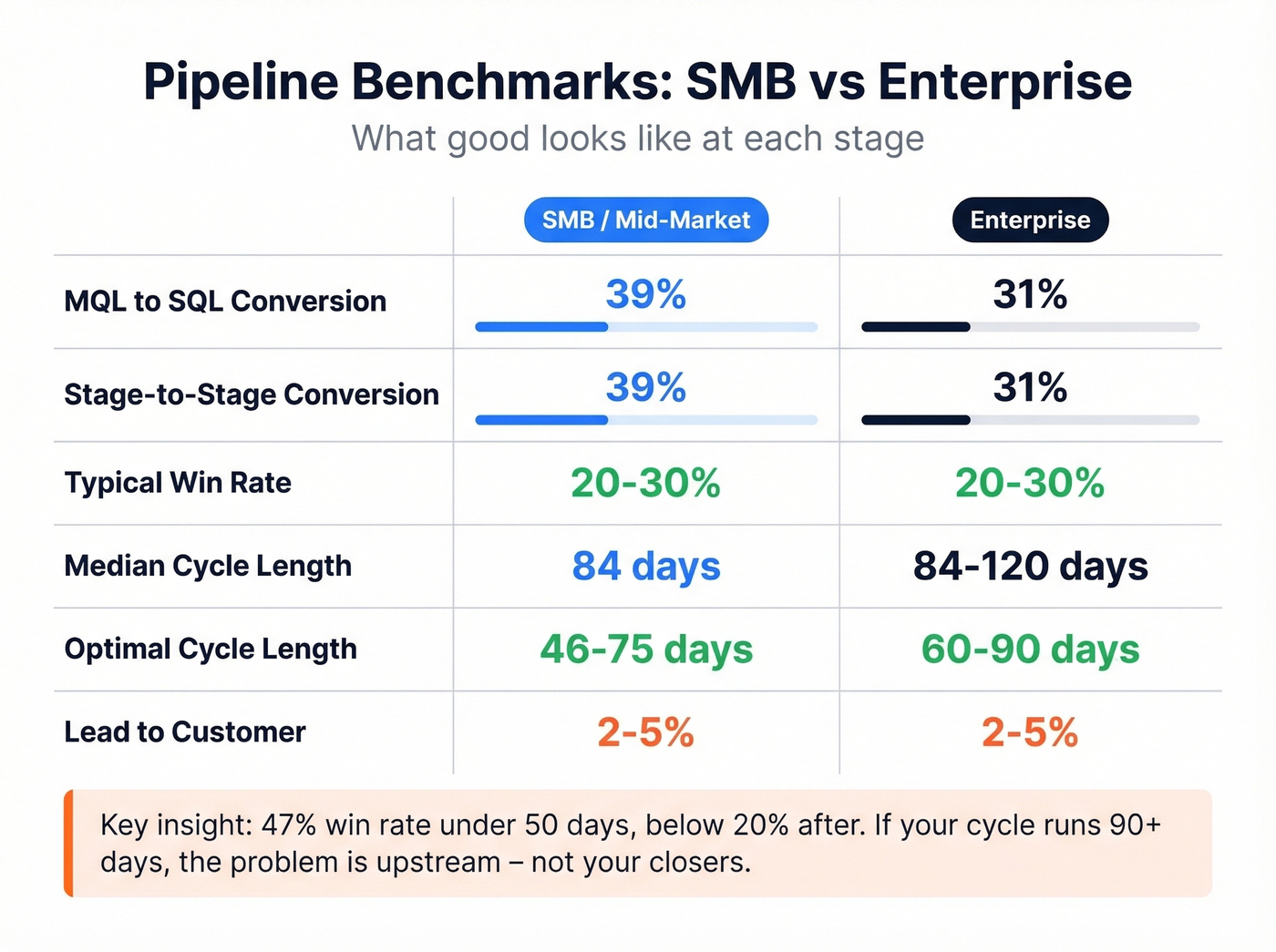
| Metric | SMB/Mid-Market | Enterprise |
|---|---|---|
| MQL to SQL | 39% | 31% |
| Stage-to-Stage Conversion | 39% | 31% |
| Typical Win Rate | 20-30% | 20-30% |
| Median Cycle | 84 days | 84-120 days |
| Optimal Cycle | 46-75 days | 60-90 days |
| Lead to Customer | 2-5% | 2-5% |
The 50-day threshold is worth memorizing: 47% win rate under 50 days, below 20% after. If your median cycle is running 90+ days, the problem isn't your closers - it's upstream. Either you're qualifying poorly or your discovery isn't creating enough urgency to move deals forward.
To pressure-test your numbers, compare against current sales pipeline benchmarks and monitor ongoing pipeline health.
CRM Setup for Four Stages
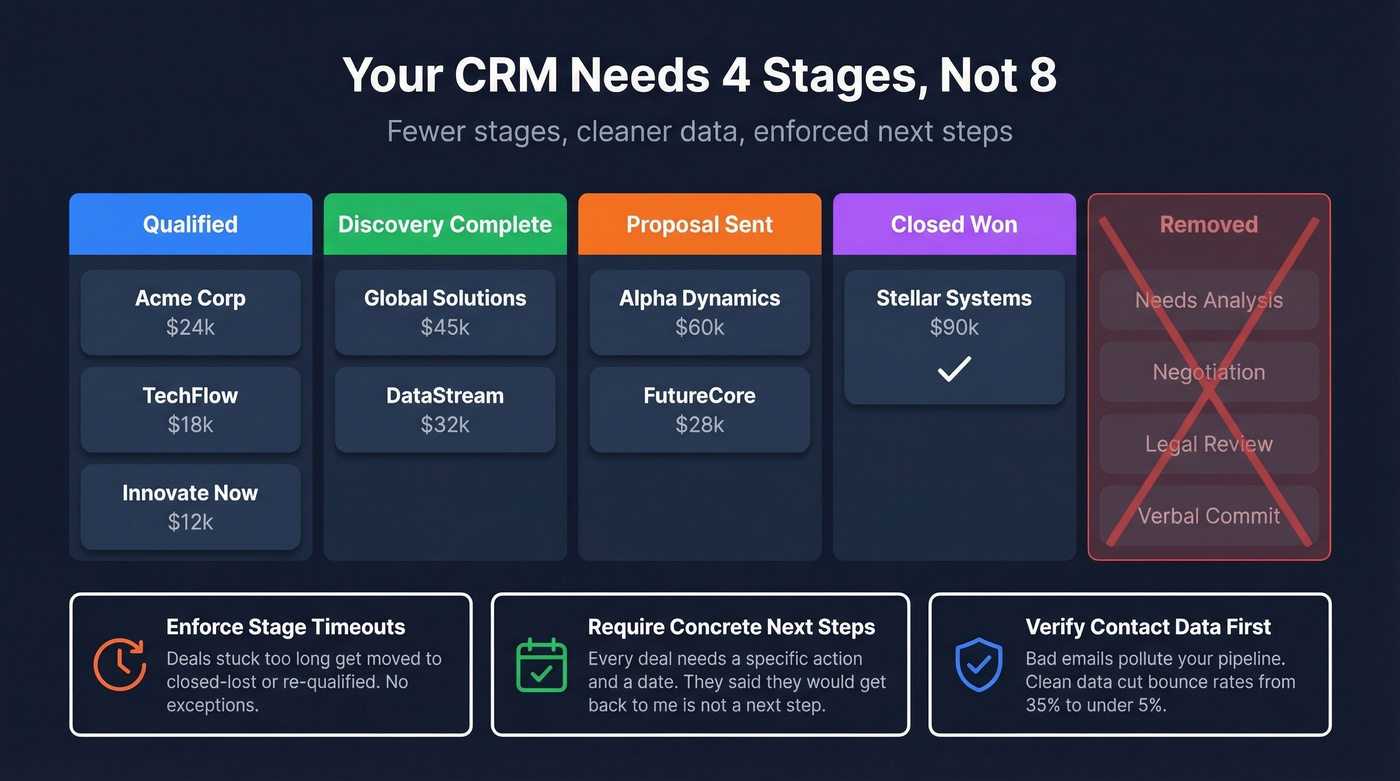
If your CRM has 8 pipeline stages, delete half today. Map exactly four stages that mirror this framework: Qualified, Discovery Complete, Proposal Sent, Closed. Every deal should sit in one of those four buckets, and every deal needs a documented next step with a date.
Three pipeline hygiene rules that actually matter:
Enforce stage timeouts. Any deal sitting in the same stage for too long gets moved to closed-lost or re-qualified. No exceptions. This alone will make your forecast dramatically more accurate. (If forecasting is a pain, consider dedicated sales forecasting solutions.)
Require concrete next steps. If a rep can't tell you the next action and when it's happening, the deal isn't real. "They said they'd get back to me" isn't a next step. A date on the calendar is.
Verify contact data before it enters your pipeline. Bad emails and wrong numbers pollute your stages and waste rep time. Teams like Snyk cut bounce rates from 35-40% to under 5% after cleaning up their contact data, generating 200+ new opportunities per month. Whether you're running Salesforce, HubSpot, or anything else, the principle is the same: fewer stages, cleaner data, enforced next steps. Complexity in your CRM doesn't make you more sophisticated. It makes your forecast less accurate.
If bounce is a recurring issue, start by tracking your email bounce rate and fixing root causes with an email deliverability guide.
Fewer steps only work if every step connects you to real decision-makers. Prospeo gives you 30+ filters - job title, buyer intent, headcount growth, funding - so your 4-step process starts with qualified prospects, not guesswork. At $0.01 per verified email, the math beats every alternative.
Reach the right stakeholders the first time, every time.
FAQ
What's the difference between a sales process and a sales cycle?
A sales process is the repeatable sequence of steps your team follows to move a deal from prospect to close. A sales cycle is the time a specific deal takes to move through those steps. Process is the framework you design; cycle is the clock you measure. You optimize the process to shorten the cycle.
How many steps should a sales process have?
Four is the sweet spot for most B2B teams. Practitioner data consistently shows that adding steps beyond four increases cycle time and creates drop-off points without improving win rates. One team saw close rates jump from 19% to 37% after cutting from 7 stages to 3 core steps. Start with four - don't add a fifth until data proves you need one.
How do I know if my sales process is working?
Track three numbers: win rate (healthy is 20-30%), average cycle length (optimal is 46-75 days for mid-market), and MQL-to-SQL conversion (31-39% is a strong benchmark). If any metric is off, the bottleneck tells you which step to fix. For prospecting issues specifically, bounce rates above 5% signal your Step 1 contact data needs an upgrade.