

What Is a Sales Company? Types, Examples & Tools (2026)
You've got $2M in seed funding, 18 months of runway, and zero pipeline. You need a sales company - but that term covers five completely different things, and picking the wrong one burns months you can't get back.
Outsourced SDR firms, sales training consultants, SaaS enablement platforms, recruiting agencies, manufacturer's reps - they all call themselves "sales companies." Let's untangle the mess so you can figure out which type you actually need, how to evaluate them, and what technology separates the best sales organizations from the ones hemorrhaging cash on bad data and broken processes.
Quick Navigation
Looking to join one? Skip to the section on best companies to work for. Focus on quota attainment rates and tool investment, not ping-pong tables.
Looking to hire one? The outsourced sales firms section breaks down pricing models and what to ask before signing. Expect $5,000-15,000/month.
Looking to build or fix one? Start with the technology stack and data quality sections. The single biggest lever is your data foundation - get that wrong and every dollar you spend on engagement tools, CRM seats, and headcount is partially wasted.
What Is a Sales Company?
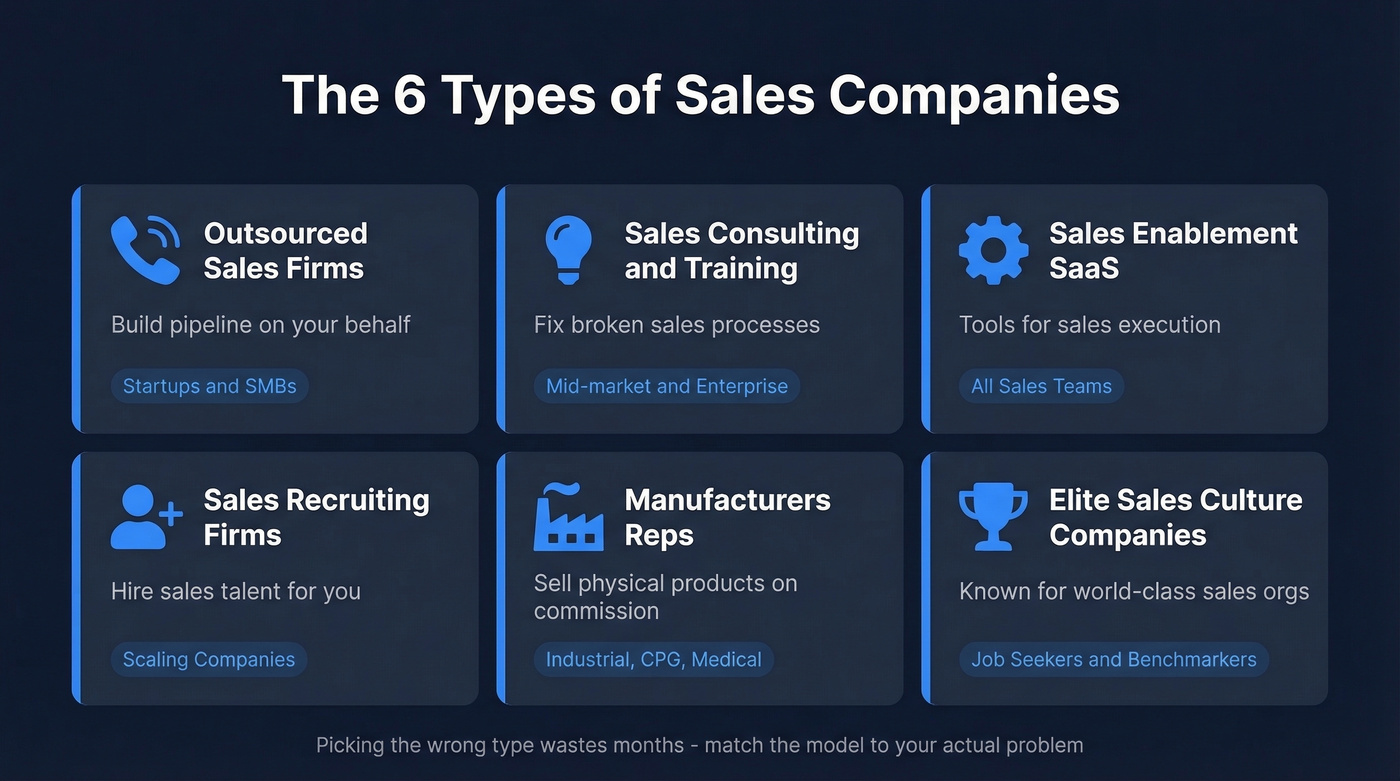
A sales company is any organization whose primary function - or primary revenue driver - is selling products, services, or expertise to other businesses or consumers. In practice, the term covers six distinct business models that serve very different buyers.
The confusion exists because the phrase means whatever the person using it needs it to mean. A VP of Sales evaluating outsourced SDR firms and a recent grad hunting for a high-OTE role have completely different needs. Here's the taxonomy:
| Type | What They Do | Who They Serve |
|---|---|---|
| Outsourced Sales Firms | Build pipeline on your behalf | Startups, SMBs without SDR teams |
| Sales Consulting & Training | Fix broken sales processes | Mid-market and enterprise orgs |
| Sales Enablement SaaS | Provide tools for sales execution | All sales teams |
| Sales Recruiting Firms | Hire sales talent for you | Companies scaling headcount |
| Manufacturer's Reps | Sell physical products on commission | Industrial, CPG, medical |
| Elite Sales Culture Cos | Companies known for great sales orgs | Job seekers, benchmarkers |
Types of Sales Companies
Outsourced Sales Firms
Use this if you need pipeline yesterday and don't have the time, budget, or expertise to hire and ramp an in-house SDR team. Firms like CIENCE, Martal Group, SalesRoads, and memoryBlue specialize in this - they provide dedicated reps who prospect, qualify, and book meetings on your behalf.
If you're comparing vendors, it helps to understand modern sales prospecting techniques so you can spot fluff vs. real process.
Skip this if you already have 5+ SDRs and your problem is conversion, not top-of-funnel volume. Outsourced firms fill the pipeline; they're less effective at fixing what happens after the meeting gets booked.
Pricing varies widely. Expect $5,000-15,000/month as a base retainer plus performance fees, or $3,000-8,000/month for a dedicated SDR model. The best firms are transparent about their tech stack, bounce rates, and connect rates. The worst ones hand you a scraped spreadsheet and call it pipeline. The consensus on r/sales is blunt about this - the most common complaint about outsourced firms is that they deliver "leads" with 30%+ bounce rates, which torches your domain reputation.
If you're seeing bounces spike, start with email bounce rate benchmarks and fixes before you scale volume.
Sales Consulting & Training
This is the "teach a man to fish" model. Sandler Training, Challenger, RAIN Group, and The Sales Company (Debbie Mrazek's firm) all operate here. They don't make calls for you - they train your existing team to make better ones.
Typical pricing: $2,000-5,000 per rep for multi-day workshops, or $50,000-200,000+ for enterprise-wide engagements with ongoing coaching. The best consulting firms diagnose before they prescribe. If someone pitches you a methodology before understanding your sales cycle, that's a red flag. And no amount of MEDDIC training fixes a team dialing wrong numbers 40% of the time - if your problem is data or tooling, training won't solve it.
If you're rebuilding the fundamentals, a structured sales process optimization pass usually beats “new methodology” whiplash.
Sales Enablement & Technology
The SaaS layer that powers modern sales execution breaks into three sub-layers.
CRM handles pipeline management. Salesforce typically runs ~$25-$330/user/month depending on edition; HubSpot has a free tier and paid Sales Hub plans start around ~$20-$100+/user/month. Engagement tools like Outreach and Salesloft handle sequencing, multi-channel cadences, and task management at ~$100+/user/month. Conversation intelligence from Gong and Chorus records, transcribes, and analyzes sales calls at similar price points.
If you’re mapping your stack, start with a shortlist of examples of a CRM so you don’t overbuy too early.
The mistake most companies make is buying all three layers before investing in the data that feeds them.
Sales Recruiting Firms
Sales Talent Inc. runs an NPS of +93.75% versus the recruiting industry average of +36%. Betts Recruiting and Treeline Inc. are strong in tech sales specifically. Fees typically run 20-25% of first-year OTE, which makes sense when you're hiring 3+ quota-carrying reps in 90 days but is hard to justify for a single hire.
If you’re scaling headcount fast, pair recruiting with a clear 30-60-90 Day Plan for Sales Reps so ramp doesn’t become your bottleneck.
Manufacturer's Representatives
Commission-based organizations that represent multiple manufacturers within a specific industry - industrial equipment, CPG, medical devices. They sell on your behalf for 5-15% commission without taking inventory ownership. It's the oldest model in this category and still thrives where relationships and territory knowledge matter more than technology.
Companies Known for Elite Sales Cultures
Salesforce, Cisco, MongoDB, and Sprout Social consistently appear on "best sales companies to work for" lists - and for good reason. What separates them isn't perks. It's enablement investment, realistic quota setting, structured ramp programs, and genuine tool budgets that give reps a fighting chance.
Best Sales Companies to Work For
Most "best sales companies" lists rank by Glassdoor ratings and free lunch programs. That's useless if you're trying to figure out where you'll actually hit quota.
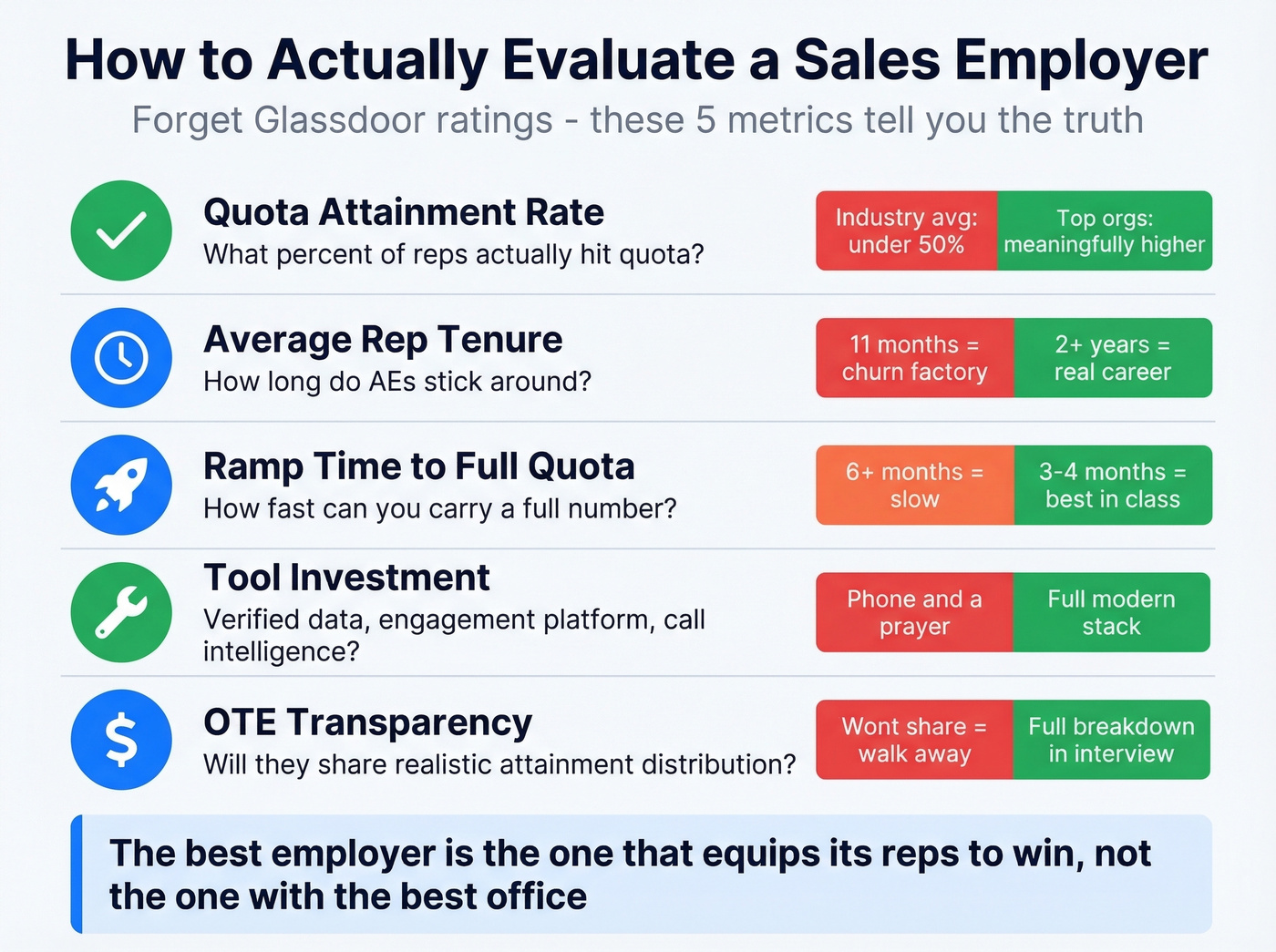
Here's what actually matters when evaluating an employer:
- Quota attainment rates: What percentage of reps hit quota? Industry average is often under 50%. Top orgs push meaningfully higher.
- Rep tenure: If the average AE stays 11 months, that's a churn factory, not a career.
- Ramp time: How long before you carry a full quota? Best-in-class is around 3-4 months.
- Tool investment: Does the company give reps access to verified data, a real engagement platform, and conversation intelligence? Or are they handing you a phone and a prayer?
- OTE transparency: If they won't share the realistic OTE split and attainment distribution during the interview, walk away.
If you’re evaluating comp, make sure you understand OTE in sales so you can sanity-check offers.
Built In's 2026 list is a reasonable starting point, but dig deeper.
Large enterprise: Salesforce, Google Cloud, Cisco. Massive TAM, real career paths, and the kind of structured enablement that actually helps reps ramp.
High-growth: Sprout Social, Arrive Logistics, MongoDB. These companies invest heavily in sales infrastructure and tend to promote from within.
SMB/startup: Look for companies that invest in data quality and tooling even at small scale. A 20-person startup that gives reps verified contact data and a proper sequencer will outperform a 200-person org running on spreadsheets and guesswork every single time.
Here's the thing most people won't say out loud: the "best" employer is the one that equips its reps to win, not the one with the best office. A company can have great culture and terrible sales infrastructure. Reps at those companies burn out faster because they spend hours every week on manual prospecting that should be automated.

The article says it plainly: outsourced firms delivering 30%+ bounce rates torch your domain. Prospeo's 5-step verification delivers 98% email accuracy and under 4% bounce rates - the same data foundation that helped Snyk's 50 AEs generate 200+ new opportunities per month.
Stop paying sales companies to burn your domain with bad data.
How to Evaluate a Sales Company
Hiring an Outsourced Firm
Ask these questions before signing anything:
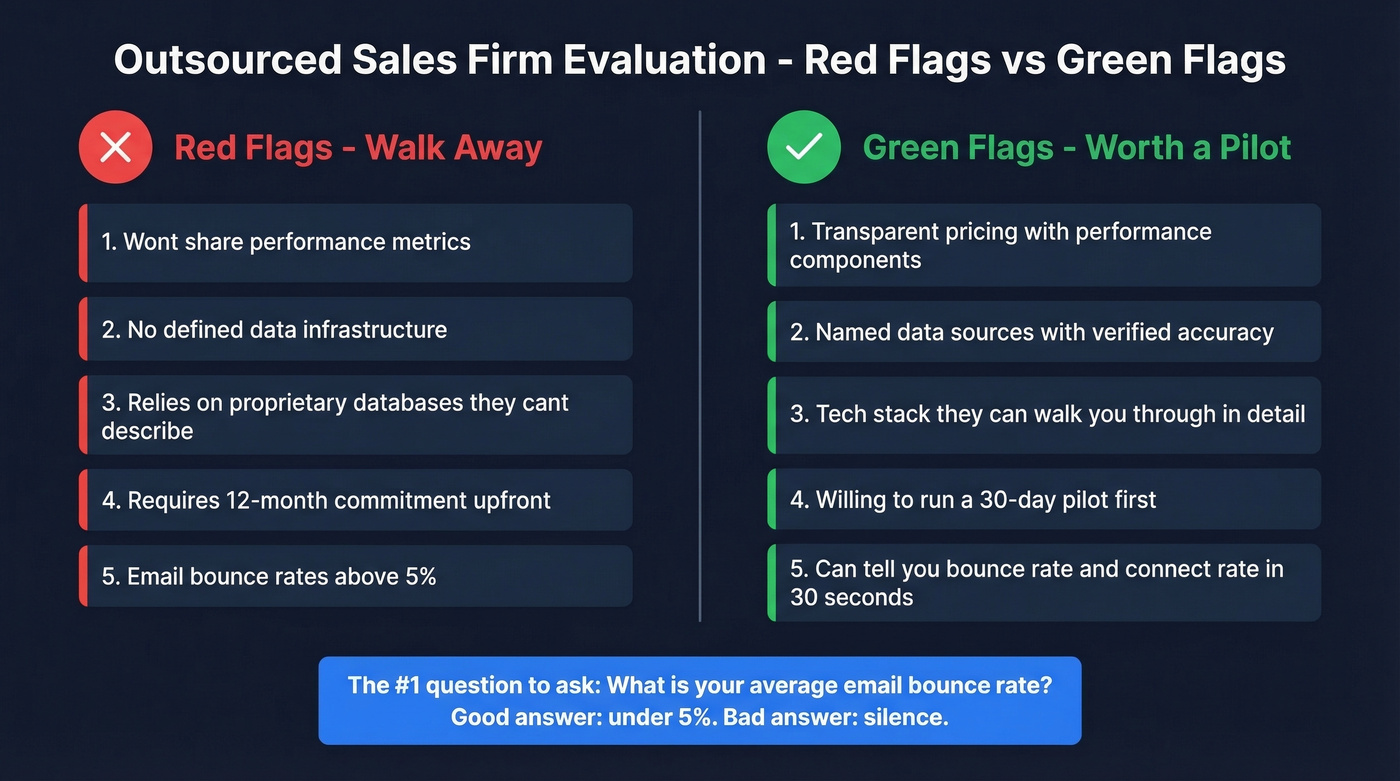
- What's your average email bounce rate? Anything above 5% means stale data.
- What's your connect rate on cold calls? Good firms hit 15-20%.
- What data platform do you use for contact sourcing? Firms running on verified data with 98%+ email accuracy outperform those guessing with purchased lists that decay fast.
- Can you share a sample campaign report from a similar client?
- What's the average time to first qualified meeting?

Red flags: Won't share performance metrics. No defined data infrastructure. Relies on "proprietary databases" they can't describe. Pricing that requires a 12-month commitment upfront.
Green flags: Transparent pricing with performance components. Named data sources. A tech stack they can walk you through. Willingness to run a 30-day pilot.
Any outsourced firm that can't tell you their bounce rate and connect rate within 30 seconds of being asked is guessing. You're paying them not to guess.
Joining as an Employee
Ask about quota attainment distribution (not just average OTE), what tools you'll have access to on day one, and how long the average ramp takes. Request to speak with a current rep at the same level you'd be joining.
Partnering or Reselling
Focus on margin structure, deal registration protection, and whether the company's sales team will compete with you on the same accounts. Channel conflict kills partnerships faster than bad margins.
Tech Stack Behind Top Sales Companies
Every high-performing sales organization runs on five layers. Most over-invest in CRM and engagement but dramatically under-invest in data quality - the layer that determines whether everything above it works.
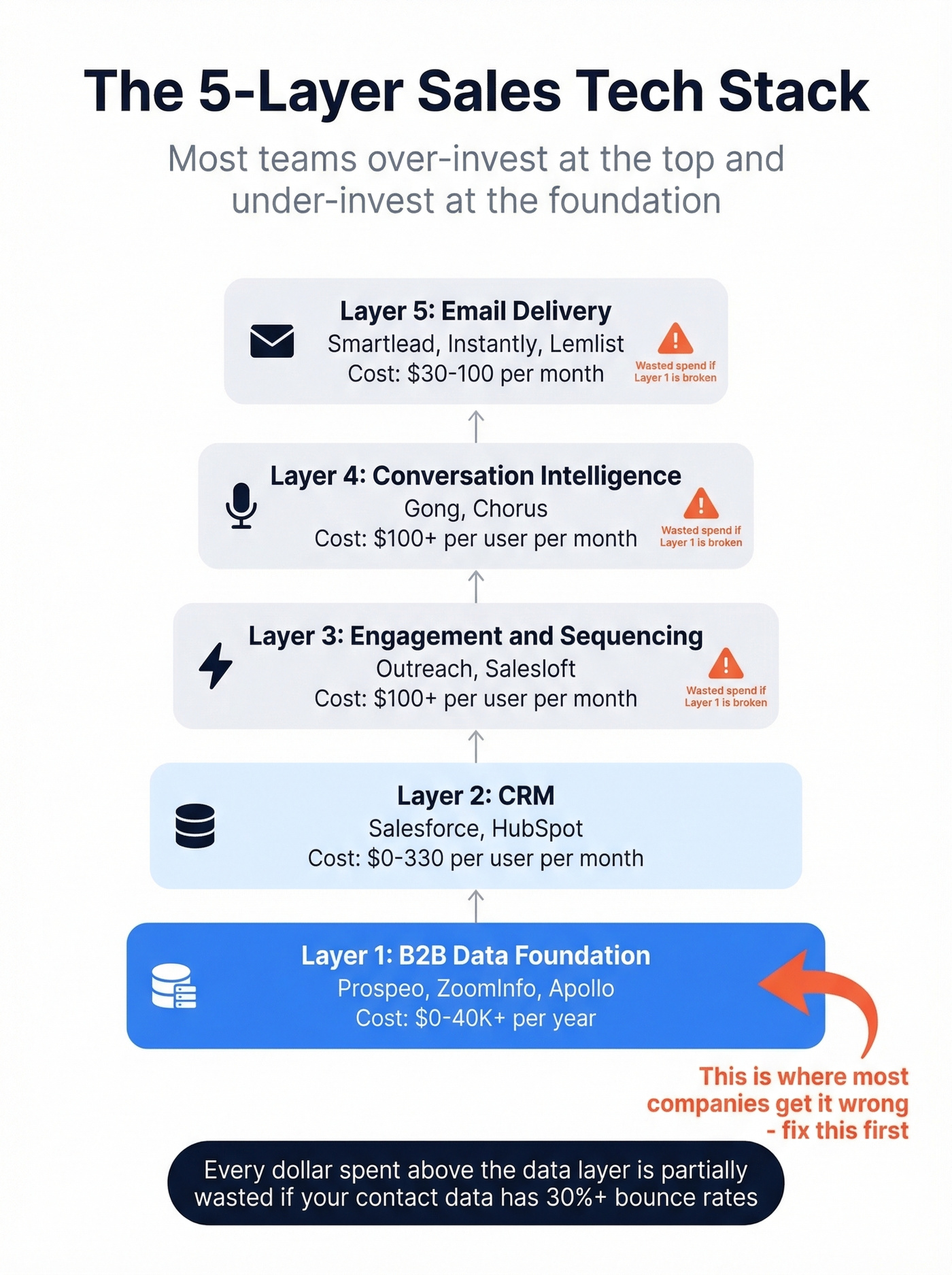
| Layer | Purpose | Top Tools | Cost Range |
|---|---|---|---|
| CRM | Pipeline mgmt | Salesforce, HubSpot | $0-330/user/mo |
| B2B Data | Verified contacts | Prospeo, ZoomInfo, Apollo | $0-40K+/yr |
| Engagement | Sequencing | Outreach, Salesloft | $100+/user/mo |
| Intelligence | Call coaching | Gong, Chorus | $100+/user/mo |
| Delivery | Email sending | Smartlead, Instantly, Lemlist | $30-100/mo |
If you’re building this out, a curated list of SDR tools helps you avoid overlapping spend.
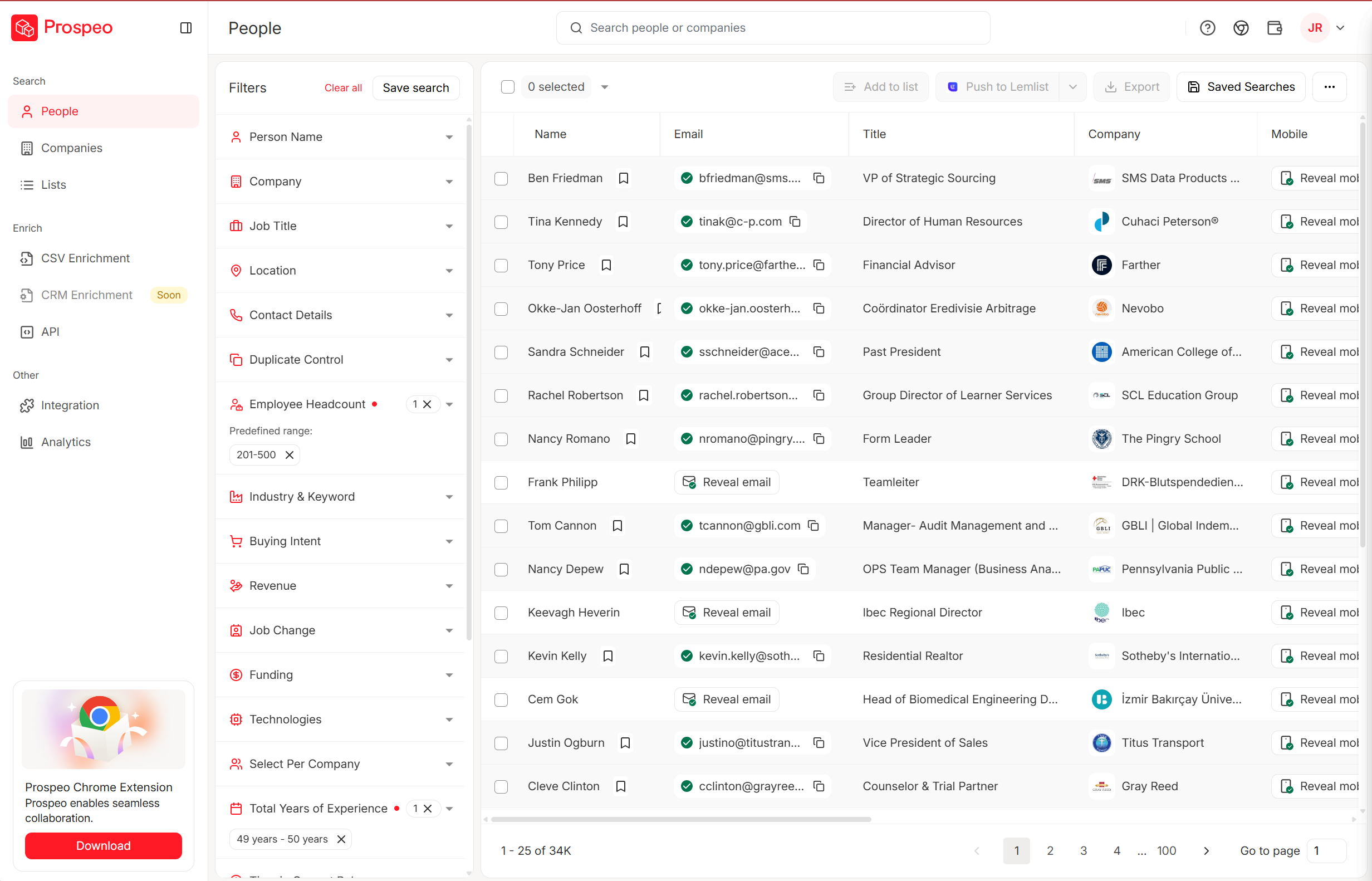
The data layer is where most organizations get it wrong. We've tested the major platforms extensively, and the cost and performance differences are dramatic.
Prospeo sits at the foundation with 300M+ professional profiles, 143M+ verified emails, and 125M+ verified mobile numbers. The 30+ search filters - buyer intent, technographics, job changes, headcount growth, funding signals - let you build targeted lists without guesswork, and a 7-day data refresh cycle means you're not calling people who left the company six weeks ago. It runs roughly $0.01 per lead with a free tier.
If you need to fill gaps in your CRM, compare data enrichment services before you commit to a long contract.
ZoomInfo - the enterprise default - runs $15,000-40,000+/year. It still wins on US database depth for enterprise accounts and the breadth of its GTM platform. Where it loses: email accuracy (87% vs. 98%), mobile pickup rates (12.5% vs. 30%), data freshness, and cost. Apollo offers a generous free tier and paid plans starting around ~$49/user/month, but its email accuracy sits at 79%, which means you're burning deliverability on every campaign.
In our experience, teams using verified data at 98% accuracy book 26% more meetings than those on ZoomInfo and 35% more than Apollo users. For most organizations that need reliable contact data without a $40K annual commitment, the math is straightforward.
Data Quality Makes or Breaks Everything
Your SDR team makes 200 dials today. They get 12 connects. Of those 12, maybe 3 turn into conversations worth having. That's a 1.5% conversion rate from dial to meaningful conversation - and most sales leaders look at that number and think "we need better reps."
They don't. They need better data.
When 30-40% of your phone numbers are wrong and 15-20% of your emails bounce, you're running a lottery, not a sales operation. Unlike rep skill, data quality is fixable overnight.
If you’re diagnosing deliverability, use an email deliverability guide to isolate whether the issue is list quality, domain setup, or sending behavior.
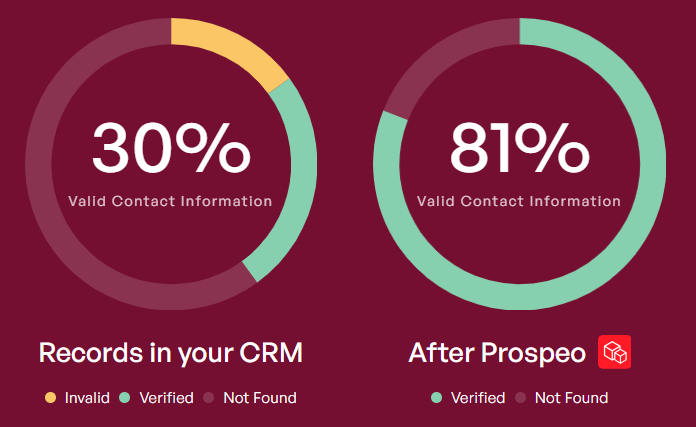
Snyk had 50 AEs each spending 4-6 hours per week prospecting with a 35-40% bounce rate. After fixing their data infrastructure, bounce rates dropped to under 5%, AE-sourced pipeline jumped 180%, and the team generated 200+ new opportunities per month. Same reps. Different data.
Meritt went from $100K to $300K in weekly pipeline. Bounce rate dropped from 35% to under 4%. Connect rates tripled to 20-25%.
We've seen this pattern over and over - teams blame reps, blame messaging, blame market timing, when the actual problem is that a third of their contact records are garbage. Fix the data layer first. Everything else gets easier.
Building or fixing a sales org? The single biggest lever is your data foundation. Prospeo gives your team 300M+ profiles, 125M+ verified mobiles, and 30+ filters - including buyer intent and technographics - at $0.01 per email. No contracts, no sales calls required.
Give your sales team enterprise-grade data without the enterprise price tag.
How to Build a Sales Company from Scratch
Stop looking for "a sales company." Start building a sales system.
The companies that scale fastest in 2026 don't outsource their entire function or hire 10 reps on day one. They assemble a stack, validate it with data, and then scale what works. Here's the sequence:
Define your ICP first. Not "mid-market SaaS companies" - that's too broad. Get specific: VP of Engineering at Series B infrastructure companies with 50-200 employees using AWS. The tighter your ICP, the better your data targeting works.
If you want a repeatable way to document it, use an ideal customer profile template.
Build your data infrastructure before anything else. You need verified contacts before you need a CRM, an engagement platform, or a dialer. Start with a free data tier to validate your ICP before committing to enterprise tools.
Choose your outreach channels. Cold email, cold call, or both. Most early-stage companies start with email because it scales without headcount.
Hire or outsource SDRs - but only after the system works. If your bounce rate is under 5% and your reply rate is above 3%, you've validated the system. Now add people.
Measure bounce rate and connect rate before pipeline metrics. If those leading indicators are broken, pipeline numbers are meaningless.
Stack Optimize built from $0 to $1M ARR by getting the data foundation right first - deliverability above 94%, bounce rates under 3%, zero domain flags. GreyScout doubled their team from 2 to 5 reps and saw pipeline jump 140% - bounce rate dropped from 38% to under 4%, and rep ramp time was cut from 8-10 weeks to 4. The pattern is consistent: data first, people second.
FAQ
What does a sales company do?
A sales company generates revenue by selling products, services, or expertise - either its own or on behalf of clients. The six main types are outsourced SDR firms, consulting firms, SaaS enablement platforms, recruiting firms, manufacturer's reps, and companies known for elite sales cultures.
How much does an outsourced sales firm cost?
Outsourced firms typically charge $5,000-15,000/month as a base retainer plus performance fees. Dedicated SDR models run $3,000-8,000/month per rep. Always ask what's included - some firms bundle data costs, others charge extra for verified contacts.
What technology do the best sales companies use?
Top organizations run a five-layer stack: CRM, verified B2B data, engagement tool, conversation intelligence, and email delivery infrastructure. The data layer is where accuracy varies most - from 79% to 98% depending on the platform - making that choice critical to campaign performance.
How do I know if a sales company is any good?
Ask for three numbers: email bounce rate (should be under 5%), cold call connect rate (good firms hit 15-20%), and quota attainment rate. If they can't share those metrics within 30 seconds, that tells you everything you need to know.
What's the difference between a sales agency and a consulting firm?
A sales agency executes outreach on your behalf - making calls, sending emails, booking meetings. A consulting firm trains your existing team to do it better. Agencies substitute for headcount; consultants develop the headcount you already have.