

The Data-Backed Sales Conversation Playbook
Ten articles tell you to "build rapport" and "listen more." Zero tell you what percentage of the call you should actually be talking, how that number shifts between a cold call and a negotiation, or what happens to your close rate when you blow past it. Reps spend roughly 30% of their time actually selling - the rest is admin, prep, and chasing bad data. When you finally get a prospect on the phone, you can't afford to wing your sales conversation.
Three Numbers Every Rep Should Memorize
43/57 talk-to-listen ratio. Across 1.8 million analyzed opportunities, top-performing reps talk 43% of the time and listen 57%. But here's the part most people miss - it's not about hitting that exact split. It's about consistency. High performers maintain a stable ratio whether they win or lose.
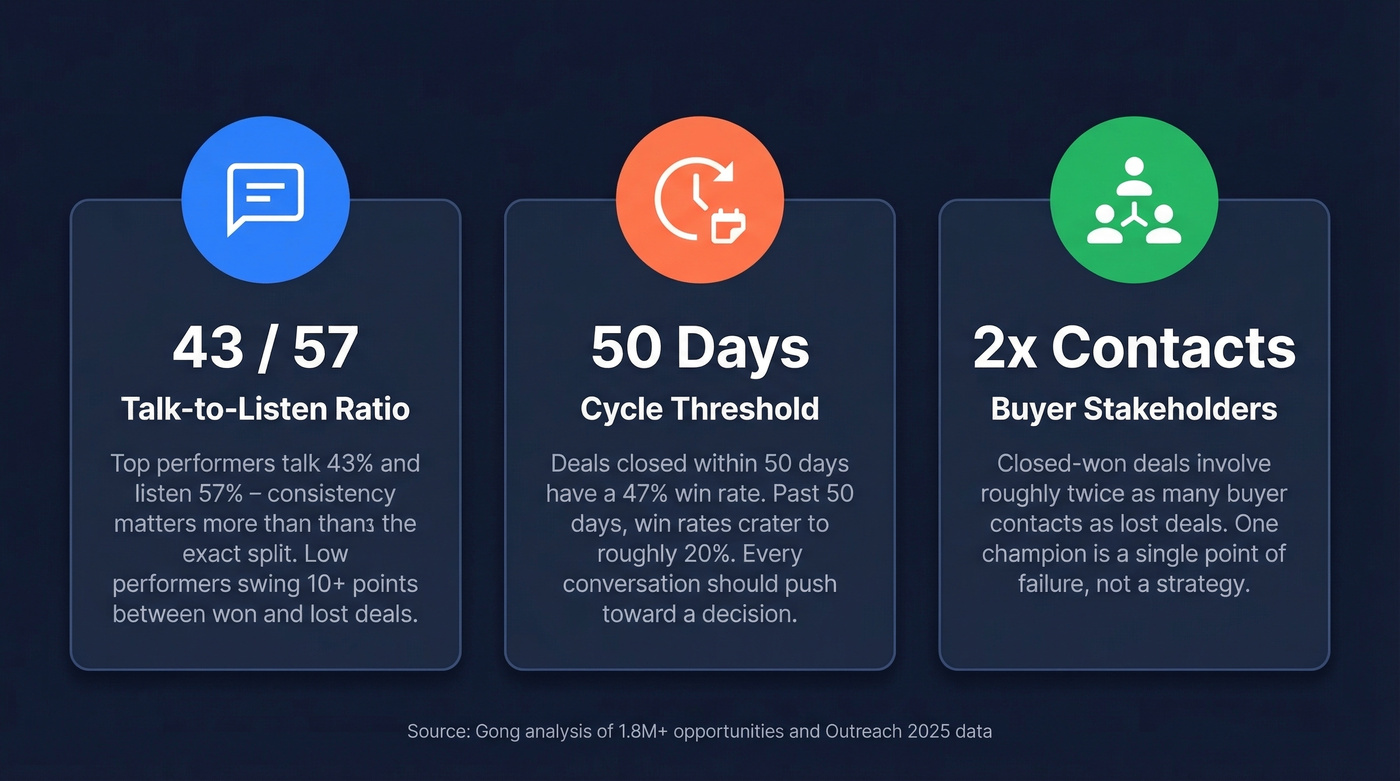
Low performers swing roughly 10 percentage points: 54% talk time on won deals ballooning to 64% on lost ones. The inconsistency is the tell, not the number itself. We've seen this pattern across our own team's calls too - the 43/57 ratio is a starting point, not gospel.
50-day cycle threshold. Opportunities closed within 50 days carry a 47% win rate. Drag past that mark and win rates crater to ~20%. Every interaction you have should push toward a decision within that window - not stalling, not "circling back next quarter." If you want a tighter end-to-end view, map this to your sales process and stage exit criteria.
2x buyer contacts. That same 1.8 million opportunity dataset found that closed-won deals involve roughly twice as many buyer contacts as lost deals. You're not having one conversation with a single stakeholder. You're having five, ten, seventeen - across the entire buying committee. This is the core of team selling.
Stage-by-Stage Sales Conversation Structure
The ideal talk-to-listen ratio isn't static. It shifts depending on where you are in the deal:
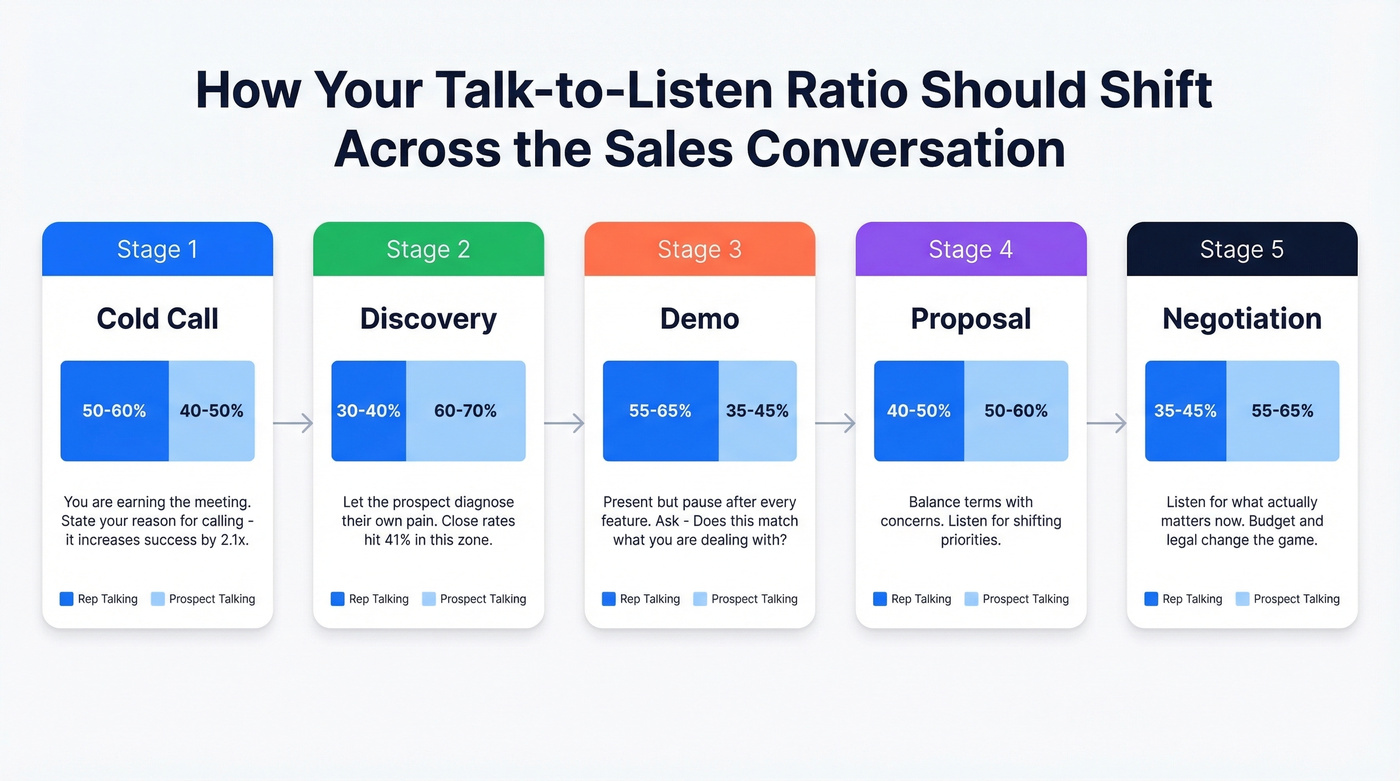
| Stage | Rep Talk Target | Why |
|---|---|---|
| Cold call | 50-60% | You're earning the meeting |
| Discovery | 30-40% | Let the prospect diagnose |
| Demo | 55-65% | Present, but pause for reactions |
| Proposal review | 40-50% | Balance terms with concerns |
| Negotiation | 35-45% | Listen for what matters most |
Cold Call / First Contact
Here's a script that works before we talk about why:
"I'll be brief. In three minutes, I can share how we help [specific outcome relevant to their role]. Does that sound fair?"
That line respects their time, signals value, and asks for a micro-commitment. No rapport-building fluff, no "Is this a good time?" - just a clear reason to keep listening. If you want more openers like this, pull from these talk tracks.
Cold calls are the one stage where you should talk more than you listen. Target 50-60%. Gong's benchmark for successful cold calls is about 55% talk / 45% listen, and successful cold calls average 5 minutes 50 seconds versus 3:14 for failed ones. Opening with "Did I catch you at a bad time?" drops success by 40%. Stating the reason for your call increases success by 2.1x. For a full system (not just a script), see this cold calling system.
Discovery Call
Here's the thing: discovery is where 80% of deals are actually won or lost. Everything after is confirmation. Yet this is where most reps blow it by talking too much - when reps talk 38-46% of the time, close rates hit 41%, but when talk time climbs above 65%, close rates collapse to 14%. That's a 3x gap from a single behavioral shift.
The most common complaint on sales forums: reps rehearse their pitch but never rehearse their questions. These four cover most discovery scenarios:
- "Can you walk me through your current process for [problem area]?"
- "How does this challenge impact your team's quarterly KPIs?"
- "What does success look like for you in the next six months?"
- "If you had to quantify the impact in time, money, or missed opportunities - what would that number be?"
Question four is the one most reps skip. It forces the prospect to attach a dollar figure to their pain, which makes your ROI concrete instead of abstract. Question three flips the frame from pain to aspiration - buyers respond to both, and the combination gives you ammunition for every subsequent conversation with the buying committee. If you need a deeper bank of prompts, use these discovery questions.
Demo / Presentation
Deals are 127% more likely to close when video is used at any point in the sales process. Win rates run 94% higher when the seller has their camera on. If you're doing demos camera-off, you're leaving money on the table for no reason.
Talk time climbs to 55-65% during demos because you're presenting. But the reps who treat demos as monologues lose. Feature-dumping is one of the most common reasons deals stall. Pause after every major feature and ask "Does this match what you're dealing with?" - not at the end, after every section. If you want a tighter structure, use a product demo checklist.
Negotiation and Close
Your priorities shift once budget, legal, and procurement get involved - and they rarely match what the prospect said in discovery. Drop your talk time to 35-45% and listen for what actually matters now.
Remember the 50-day threshold. Deals supported by Outreach Kaia close 11 days faster on average. Mentioning competitors early increases your odds of winning by 32%. Don't avoid the competition conversation. Own it. If you want a clean framework for price/terms, use an anchor in negotiation.
Before the Conversation - Data and Prep
You spent 20 minutes prepping for a cold call. You dial the number. It's disconnected. The contact left four months ago.
B2B data decays at roughly 2.1% per month - about 22.5% annually. And 91% of cold outreach emails get zero response - bad data makes that worse. Cold calling nearly doubles email reply rates - 3.44% versus 1.81% - even without a live connect. But none of that works if the phone number is wrong and the email bounces. 80% of sales require five or more touchpoints, and 44% of reps give up after just one follow-up. Every dead number burns a touchpoint you can't afford to waste.
Before you rehearse your opener, verify the contact. Prospeo runs real-time email and mobile verification on a 7-day refresh cycle with 98% email accuracy and 125M+ verified mobile numbers. Whatever tool you use, don't skip this step - the best sales conversation in the world doesn't matter if you're dialing a dead line. (If you’re comparing vendors, start with these data enrichment services.)


You need 2x more buyer contacts to close deals - but 22.5% of B2B data decays every year. Prospeo gives you 300M+ profiles with 98% email accuracy and 125M+ verified mobiles, refreshed every 7 days so your prep time leads to real conversations, not dead lines.
Stop burning touchpoints on stale data. Start every call with verified contact info.
80% of sales require five or more touchpoints. Each bounced email or disconnected number wastes one you can't get back. Prospeo's 7-day data refresh and 30% mobile pickup rate mean your multi-threaded outreach actually reaches the buying committee.
Reach every stakeholder on the first attempt - at $0.01 per verified email.
Multi-Threading - One Conversation Isn't Enough
Your discovery call went great - the prospect was engaged, asked smart questions, even mentioned timeline. Then they ghosted. Two weeks later, they signed with a competitor who brought their VP of Engineering into the second meeting.
Closed-won deals involve roughly 2x as many buyer contacts as lost deals. On deals over $50K, multi-threading boosts win rates by 130%. Selling teams on won deals are 67% larger than on lost deals. If you're single-threading a deal above $50K, you're gambling - one champion isn't a strategy, it's a single point of failure. As one r/sales thread put it: "Your champion gets overruled, and you never even knew the real decision-maker existed."
Let's be honest - most reps know they should multi-thread. The problem is finding verified contact info for the rest of the buying committee fast enough to matter. That's where your data layer earns its keep. This is also where account-based selling stops being theory and starts being operational.
Mistakes That Kill Deals
These anti-patterns have data behind them:
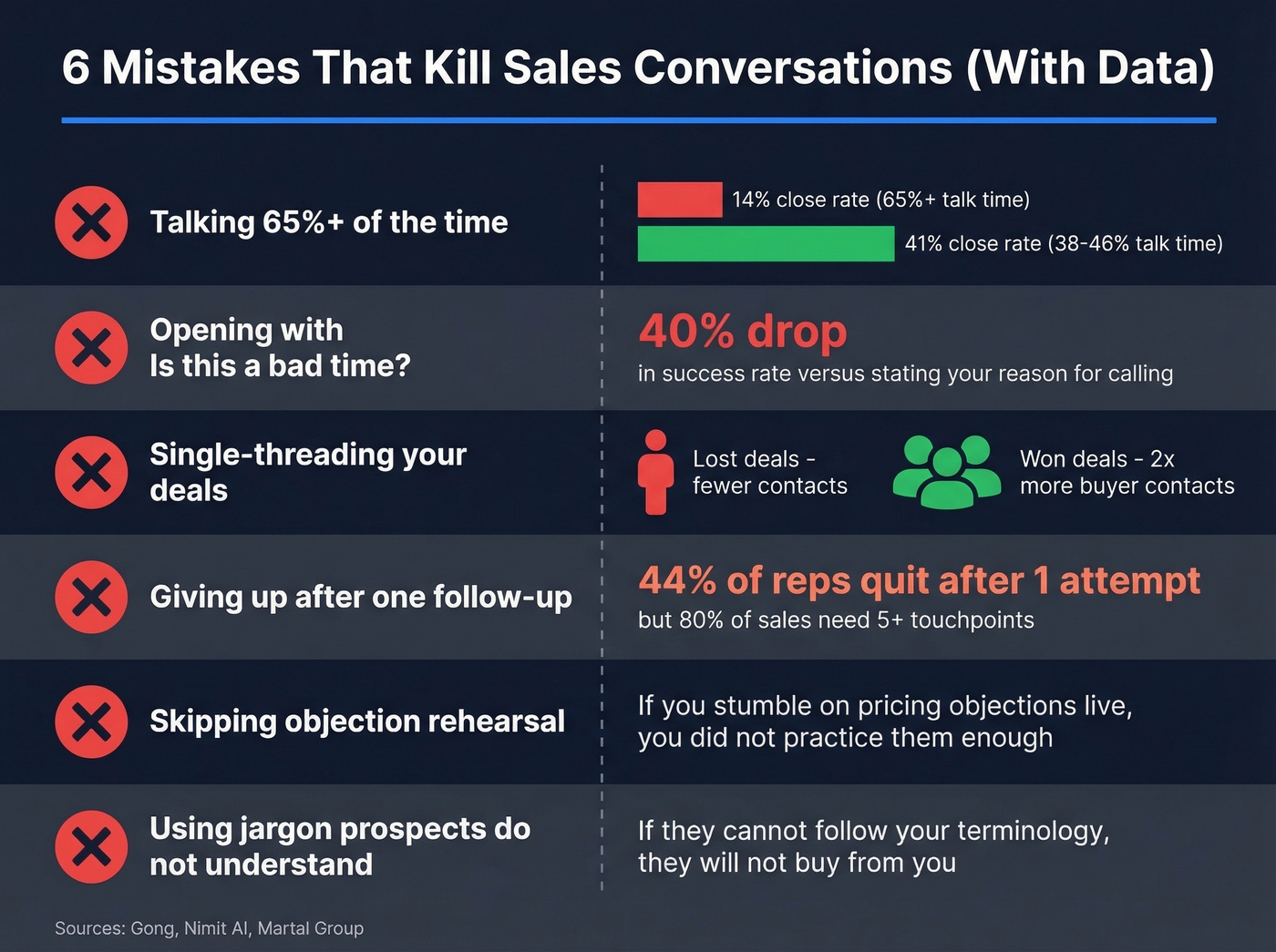
- Talking 65%+ of the time - close rate drops to 14% versus 41% in the optimal zone
- Opening with "Is this a bad time?" - 40% success drop, 0.9% booking rate
- Single-threading deals - won deals have 2x the buyer contacts of lost ones
- Giving up after one follow-up - 44% of reps do this, despite 80% of sales requiring five or more touchpoints
- Skipping objection prep - if you stumble on pricing objections, you didn't rehearse them
- Using jargon the prospect doesn't understand - if they can't follow your terminology, they won't buy
If follow-up is where your deals die, keep a set of sales follow-up templates ready before you need them.
Conversation Intelligence Tools
Sellers who frequently use AI generate 77% more revenue than those who don't - across 7.1 million opportunities analyzed. Yet only 26% of sales teams use conversation intelligence to track call metrics. That gap is where the advantage lives.
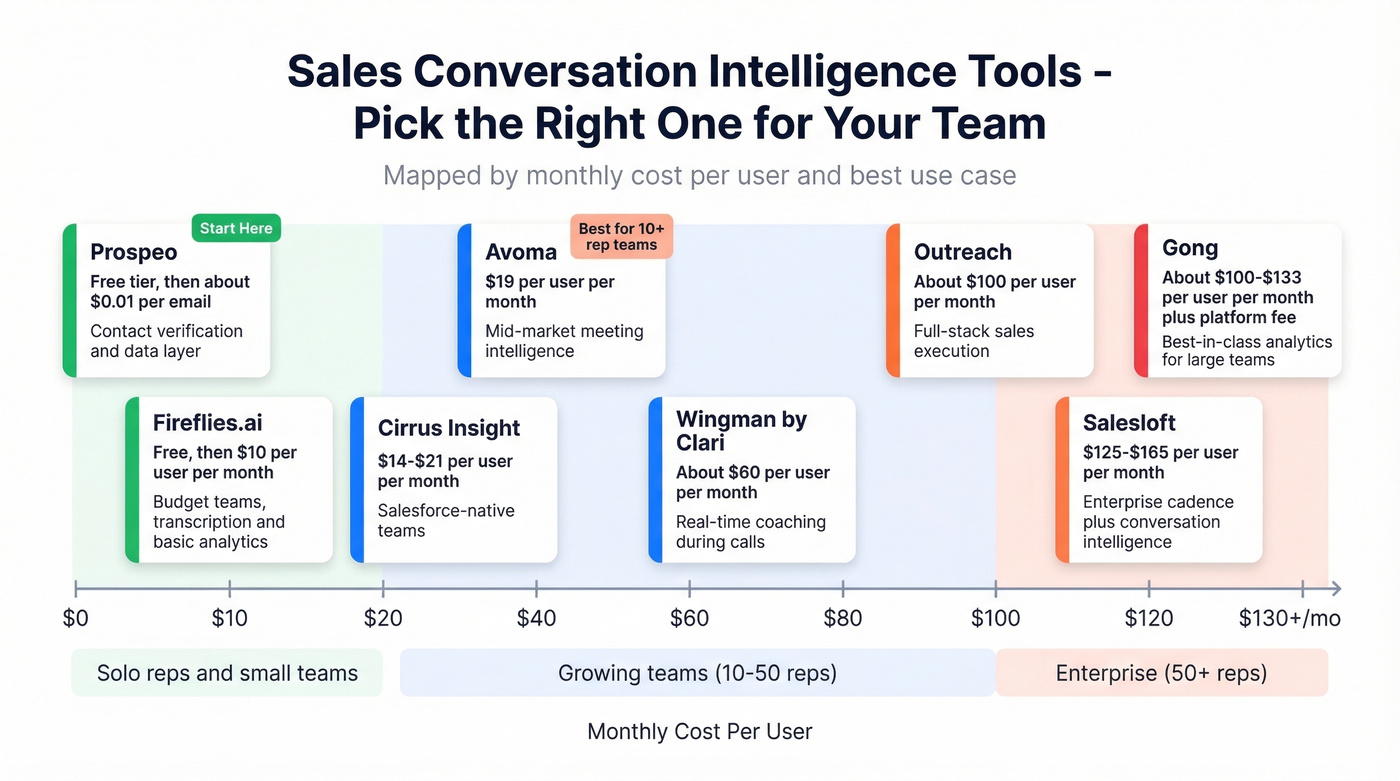
Real talk: If your average deal size is under $15K, you don't need a $1,600/user/year conversation intelligence platform. Start with Fireflies.ai's free tier for transcription and basic analytics, pair it with verified contact data, and invest the savings in more at-bats. Skip Avoma if you're under 10 reps - it usually doesn't pay off until you have coaching infrastructure to act on the insights. If you’re building your stack from scratch, start with a shortlist of SDR tools.
| Tool | Starting Price | Best For |
|---|---|---|
| Prospeo | Free tier; ~$0.01/email | Contact verification + data layer |
| Fireflies.ai | Free; $10/user/mo | Budget teams, transcription |
| Avoma | $19/user/mo | Mid-market meeting intel |
| Cirrus Insight | $14-$21/user/mo | Salesforce-native teams |
| Wingman (Clari) | ~$60/user/mo | Real-time coaching |
| Outreach | ~$100/user/mo | Full-stack sales execution |
| Salesloft | $125-$165/user/mo | Enterprise cadence + CI |
| Gong | ~$1,200-$1,600/user/yr + platform fee | Best-in-class analytics |
FAQ
What's the Ideal Talk-to-Listen Ratio?
The benchmark is 43% talk / 57% listen on discovery calls, based on analysis of 1.8M+ opportunities. Cold calls warrant 50-60% talk time, while negotiation drops to 35-45%. Consistency matters more than hitting an exact number.
How Long Should a Sales Call Last?
Successful cold calls average 5:50 versus 3:14 for failed ones. Beyond cold calls, the key metric isn't duration but deal velocity - opportunities closed within 50 days carry a 47% win rate; past that mark, roughly 20%.
How Do You Build a Winning Sales Conversation?
Winning calls share three traits: a clear structure matched to the deal stage, questions that surface quantifiable pain, and multi-threading across the buying committee. Nail those fundamentals and the close rate follows.
What Tools Help With Sales Conversation Prep?
For contact verification, Prospeo's free tier covers 75 emails and 100 extension credits per month with 98% email accuracy. Pair it with Fireflies.ai for call transcription and Gong or Clari Wingman for real-time coaching if your deal sizes justify the spend.
How Do You Start Without Sounding Scripted?
Avoid "Did I catch you at a bad time?" - it drops success by 40%. State why you're calling, which increases success by 2.1x. Lead with a specific outcome relevant to the prospect's role. As one r/sales commenter put it: "Have conversations, not presentations."