

Sales Conversation Examples That Actually Work (2026)
Most "sales conversation examples" online aren't conversations at all - they're 50 open-ended questions in a bulleted list and a pitch for conversation intelligence software. That's a quiz, not a dialogue.
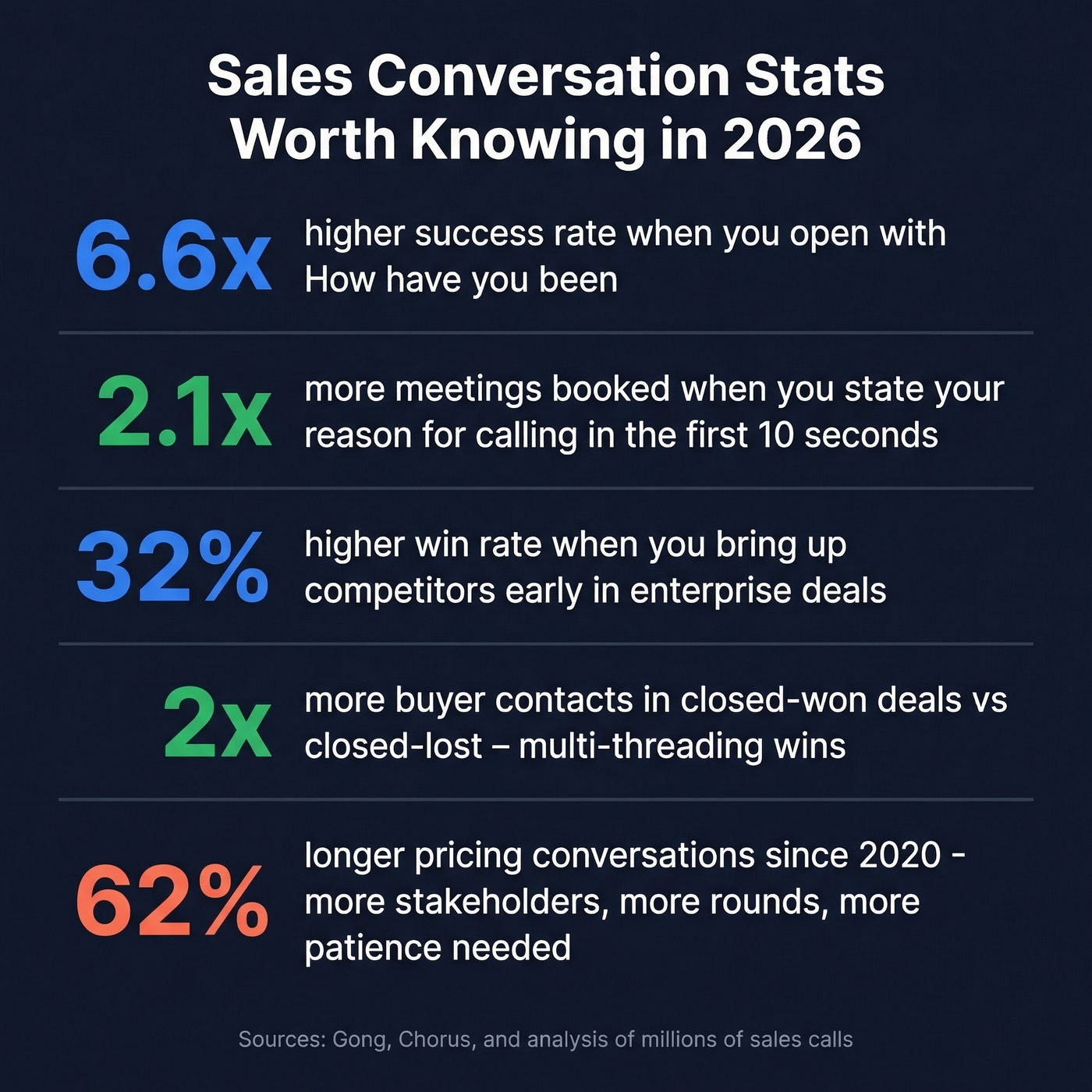
Here's what actually matters: analysis of millions of sales calls shows the best discovery calls run a 43/57 talk-to-listen ratio. Not 70/30. Not "just ask questions." A real conversation where the rep talks a little under half the time - but says the right things at the right moments. These patterns work across industries. The signal changes, but the structure holds.
Let's look at what those moments sound like.
The Quick Version
Three skills that separate top performers:
- State your reason for calling within the first 10 seconds (2.1x higher success rate)
- Ask about impact, not just pain ("What happens if nothing changes?")
- Bring up competitors early - don't wait for the prospect to do it (32% higher win rate in enterprise deals)
The stat that reframes everything: Reps who opened cold calls with "How have you been?" hit a 6.6x higher success rate than baseline. Meanwhile, "Did I catch you at a bad time?" craters success to 0.9% - a 40% drop from average. Warmth beats cleverness, and the wrong opener is worse than no opener at all.
The contrarian thesis: Stop memorizing scripts. Start memorizing transitions - how to move from rapport to pain, from objection to question, from pricing to commitment. That's where deals are won or lost.
What the Data Says About Sales Calls
Most "talk ratio" advice online cites a vague 70/30 rule. The real numbers tell a different story.
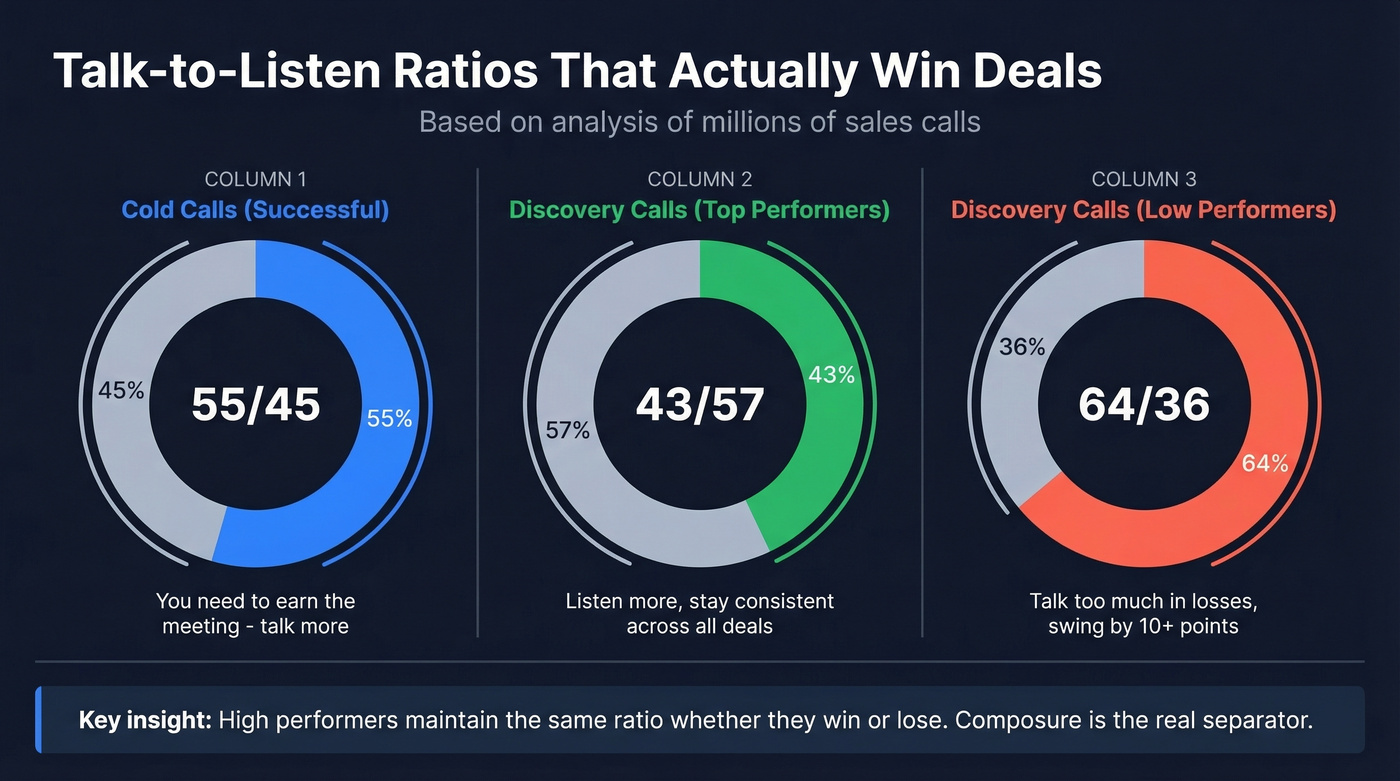
On cold calls, successful reps actually talk more than they listen: 55% talk, 45% listen. You've got 30 seconds to earn a meeting - you need to deliver a reason to stay on the line. Unsuccessful cold calls flip to 42/58. Reps who go passive on cold calls lose control of the conversation before it starts.
Discovery calls are the opposite. The 43/57 ratio holds - top performers listen more than they talk. But the real separator isn't the ratio itself. It's consistency. Low performers swing by roughly 10 percentage points between won and lost deals (54% talk in wins vs 64% in losses). High performers stay steady regardless of outcome. We've seen this pattern across every team we've worked with: the reps who maintain composure in losing deals are the same ones who win more often.
Beyond individual calls, the data on multi-threading is striking. Analysis of 1.8M opportunities found closed-won deals have 2x as many buyer contacts as closed-lost. For deals over $50K, multi-threading boosts win rates by 130%, and looping in a sales engineer lifts win rates by up to 30%. Your conversation skills matter - but so does having conversations with the right number of people. (If you want a deeper framework, see team selling.)
One more stat worth knowing: cold calling nearly doubles email reply rates (3.44% vs 1.81%). Calls and emails aren't separate channels. They're a system. If you're tightening the email side too, use these sales follow-up templates.
Cold Call Conversation Example
You're 12 dials into your call block. Every number's been dead or voicemail. Then one rings.
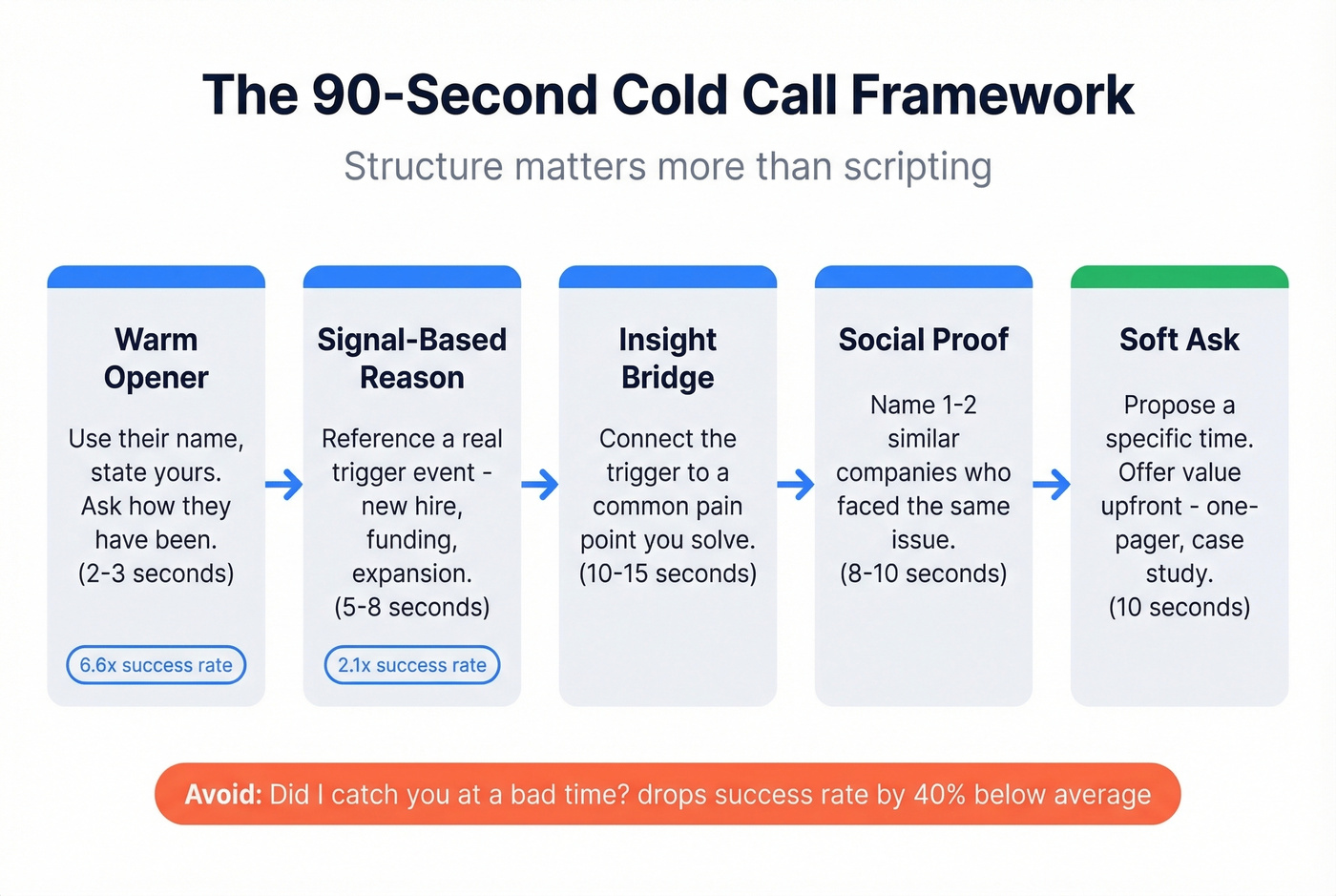
Rep: "Hey Sarah, this is Mike from Actera. How've you been?"
Sarah: "Uh, fine - who is this?"
Rep: "Mike, from Actera. I'll be quick - the reason I'm calling is I saw you just brought on a new VP of Engineering last month. When companies scale their eng team that fast, we usually see the security review backlog triple. Is that hitting your desk yet?"
Sarah: "I mean... yeah, actually. Onboarding's been a nightmare."
Rep: "That tracks. We work with a few Series B infrastructure companies going through the same thing - Dataline and Vectrix both hit that wall around month three post-hire. I don't want to pitch you cold. Would it make sense to grab 20 minutes Thursday so I can show you what they did? Worst case, you steal an idea."
Sarah: "Thursday's packed. What about next Tuesday?"
Rep: "Tuesday works. I'll send a calendar invite with a one-pager so you can see if it's even worth your time before we talk. Sound good?"
Sarah: "Sure, send it over."
Rep: "Done. Talk Tuesday, Sarah."
Notice what happened. The rep stated the reason for calling immediately (2.1x success rate), used a signal-based opener tied to a real event, and transitioned from trigger to insight to social proof to ask in under 90 seconds. No feature dump. No "Do you have five minutes?" Structure matters more than scripting - the rep followed a framework but adapted every line to the prospect's situation. For more frameworks like this, see talk track examples.
When you hit voicemail: Leave one. Analysis of 300M+ cold calls found that leaving a voicemail lifts subsequent email reply rates from 2.73% to 5.87%. That's more than double. A 15-second voicemail - name, signal, one sentence - turns a missed call into a multi-channel touch.
Here's the thing most reps miss: half those "dead numbers" aren't about your script. They're about your data. If 30-50% of your dial block is ringing disconnected lines, wrong numbers, and generic switchboards, you don't have a skills problem - you have a data problem. Prospeo's 125M+ verified mobiles carry a 30% pickup rate, so more of your dials actually connect to a human. (If you're building a repeatable outbound motion, start with a cold calling system.)
Discovery Call Example
We've all had the "great call that went nowhere." Forty-five minutes of rapport, the prospect seemed engaged, you hung up feeling good - and then silence. No reply to the recap email. No next meeting.
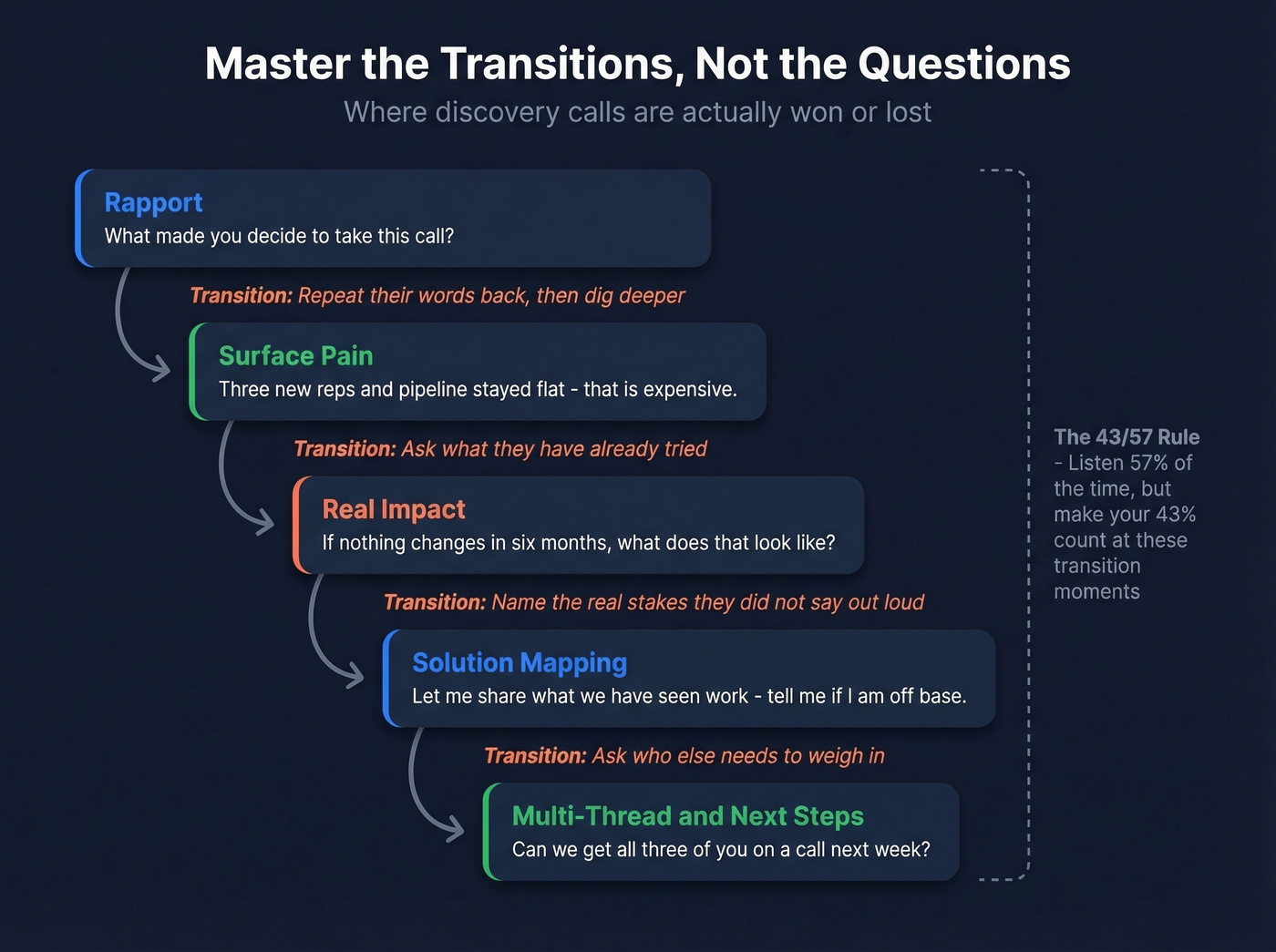
The fix isn't asking better questions. It's nailing the transitions between phases. If you want a full bank of prompts, use these discovery questions.
Rep: "Thanks for making time, Jordan. Before we get into it - what's going on in your world that made you decide to take this call?"
This question, a staple in r/sales practitioner threads, forces the prospect to articulate their own motivation.
Jordan: "Honestly, our outbound numbers are tanking. We hired three new SDRs last quarter and pipeline didn't move."
Rep: "Three new reps and pipeline stayed flat - that's expensive. What have you already tried to fix it?"
Jordan: "We switched sequencing tools. Rewrote the scripts. Did a two-day training."
Rep: "And none of that changed the numbers. Let me ask this differently - if nothing changes in the next six months, what does that look like for your team?"
Jordan: "Honestly? We probably lose at least one of those SDRs. And my VP is already asking questions about the ROI on the hires."
Rep: "So it's not just a pipeline problem - it's a headcount justification problem. That changes the urgency."
Naming the real stakes is the move here. The prospect said "pipeline." The actual problem is job security.
Jordan: "Yeah, that's fair."
Rep: "Let me share what we've seen work for teams in a similar spot - and you tell me if it resonates or if I'm off base. ... [solution walkthrough] ... Does that map to what you're dealing with?"
Jordan: "Most of it, yeah. The enrichment piece is interesting."
Rep: "Good. Who else should be involved before we go further? I don't want to build momentum with you and then have it stall because someone else needs to weigh in."
Jordan: "Probably my VP of Sales and our RevOps lead."
Rep: "Makes sense. Can we get all three of you on a call next week? I'll prep a short deck specific to your numbers so we're not wasting anyone's time."
Every transition is deliberate: rapport to pain to impact to solution to next steps. Whether you use Gap Selling, Sandler, or SPIN, the underlying logic is the same - understand the prospect's current state vs future state before you pitch anything. If you want the full end-to-end flow, see the steps to close a sale.

Half your call block dies before your script gets a chance. Prospeo gives you 125M+ verified mobile numbers with a 30% pickup rate - so more dials connect to real humans, not dead lines.
Fix your data problem and your conversations fix themselves.
Handling Objections
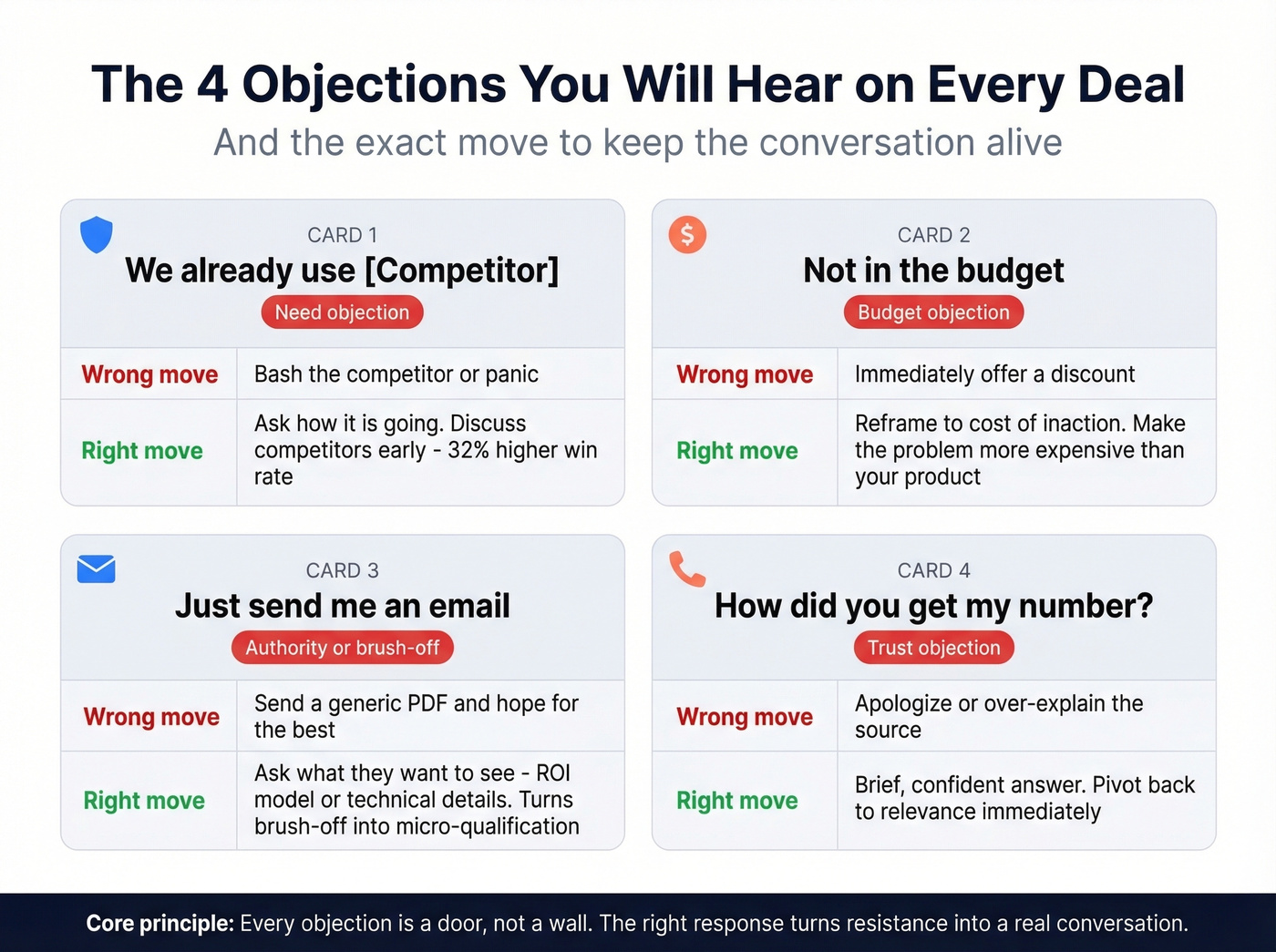
These four objections map loosely to the classic BANT categories - Budget, Authority, Need, and Timeline. Here's how to handle each without losing momentum. If this is a recurring issue on your team, use this guide to reduce sales objection rate.
"We're already using [competitor]"
Prospect: "We're already using Vendex for this."
Rep: "Good - that tells me you've already bought into solving this problem. How are you finding them on the data accuracy side?"
Don't bash the competitor. Ask how it's going. Gong's research shows discussing competitors early boosts win rates by 32% in enterprise deals.
Prospect: "It's... fine. Some issues with bounce rates."
Rep: "That's the number one thing we hear from teams switching. Would it be worth a 15-minute comparison? I can show you a side-by-side on your actual target accounts."
"Not in the budget"
Prospect: "This isn't in the budget right now."
Rep: "Totally get it. Quick question - what's the cost of the problem you described earlier? You mentioned three SDRs with flat pipeline. If each one costs you $80K loaded, that's $240K a year producing nothing. Our annual cost is a fraction of one of those salaries."
Reframe from cost to cost-of-inaction. Budget objections are almost never about the number - they're about perceived value.
"Just send me an email"
Prospect: "Can you just send me something?"
Rep: "Happy to. So I send you something relevant instead of generic, what's the biggest thing you'd want to see - the ROI model or the technical integration piece?"
This turns a brush-off into a micro-qualification. If they answer, they're engaged. If they say "whatever," you know it's a dead lead. The consensus on r/sales: the "just send me an email" objection is actually a gift - it tells you whether the prospect has any real interest at all.
"How did you get my number?"
Prospect: "How did you get this number?"
Rep: "From a B2B contact database - same way most sales teams find direct lines. I wouldn't have called if I didn't think this was relevant to you. You just expanded your SDR team by three - is outbound performance something you're actively working on?"
Brief, confident, pivot back to relevance. Apologizing or over-explaining kills momentum.
Negotiation and Closing
Pricing conversations have gotten 62% longer since 2020. More stakeholders, more scrutiny, more rounds. Here's what a healthy negotiation sounds like. (For a deeper tactic, see anchor in negotiation.)
Rep: "Based on everything we've discussed, the annual plan for your team of eight comes to $42,000. That includes onboarding and dedicated support for the first 90 days."
Prospect: "That's higher than we expected. Can you do anything on price?"
Rep: "I can look at a few options. Before I do - what would you need to see to recommend this internally?"
This is champion-building language. You're not negotiating price yet. You're understanding what the champion needs to sell it.
Prospect: "Honestly, if I could show a projected ROI and maybe a shorter initial commitment, that would help."
Rep: "I can build a custom ROI model based on your current numbers - the three SDRs, your pipeline targets, your current cost per meeting. On commitment, we can do a six-month pilot at a slightly adjusted rate. Would that give you enough to bring to your VP?"
Prospect: "Yeah, that would work."
Rep: "Great. Let's get your VP and RevOps lead on the next call - I'll have the ROI model ready. Can you intro me via email today so I can send the prep materials directly?"
Prospect: "I'll send the intro this afternoon."
Rep: "Perfect. I'll have everything over within an hour of that intro."
The rep made a concession (shorter commitment) but tied it to a specific next step (VP meeting with ROI model). Every concession should buy you access to another stakeholder or a commitment to move forward.
Look - if your deal size is under $15K annually, you probably don't need a multi-round negotiation at all. The deals that stall on pricing at that level usually stall because the champion doesn't believe in the value enough to fight for it internally. Fix the discovery call, and the negotiation handles itself.
Conversation Health Check
After any call, run through these three diagnostics:
- Buyer engagement - Did the prospect ask you questions, or just answer yours? One-way Q&A means you're interrogating, not conversing.
- Stakeholder coverage - Do you know who else needs to say yes? If not, you left a gap that'll kill the deal later.
- Timeline credibility - Did the prospect commit to a specific next date, or give you a vague "let's reconnect soon"? Only the first one counts.
Common Mistakes (With Fixes)
Talking Through the Pitch
Bad: Rep: "So we have three tiers - Starter, Growth, and Enterprise. Starter gives you 500 credits, Growth gives you 2,000, and Enterprise is unlimited. Most teams start with Growth because..." Prospect: (mentally checked out at "three tiers")
Fixed: Rep: "Based on your team size and the volume you mentioned, Growth is the right fit. Here's why - you said you need about 1,500 contacts a month. Growth covers that with room to scale. Does that match what you're thinking?"
Stop presenting options and start recommending. Prospects don't want a menu - they want your expert opinion.
Interrogation Mode
Bad: Rep: "What's your budget? Who's the decision-maker? What's your timeline? Are you evaluating other vendors?"
Fixed: Rep: "You mentioned the VP needs to sign off - what does their evaluation process usually look like? I want to make sure we're building this around how your team actually buys."
Same information gathered, completely different energy. In our experience, interrogation mode kills more deals than any single objection - over-qualifying alienates real buyers who were ready to move forward.
No Next Step
Bad: Rep: "This was really helpful. I'll send over some materials and we can reconnect soon." Prospect: "Sounds good." (Never responds again.)
Fixed: Rep: "This was great. Let's lock in next Tuesday at 2pm to walk through the proposal with your VP. I'll send a calendar invite now - does that work?"
If you don't leave a call with a specific date and time for the next conversation, you didn't close the call. You just had a nice chat. If your recaps aren’t getting replies, use a sales meeting follow-up email template.
Before the Conversation Starts
None of these sales conversation examples matter if the number doesn't ring.
A lot of teams waste 30-50% of their dial block on disconnected lines, wrong numbers, and generic switchboards. You can't practice transitions if you never get past "hello." Prospeo's database covers 125M+ verified mobile numbers with a 30% pickup rate across all regions, and email accuracy sits at 98% with data refreshing every seven days instead of the industry-standard six weeks. Meritt tripled their connect rate to 20-25% after switching. The free tier gives you 75 email lookups a month plus 100 Chrome extension credits, with no contract - enough to test whether your current data is actually the bottleneck. If you're evaluating providers, start with these data enrichment services and sales prospecting databases.
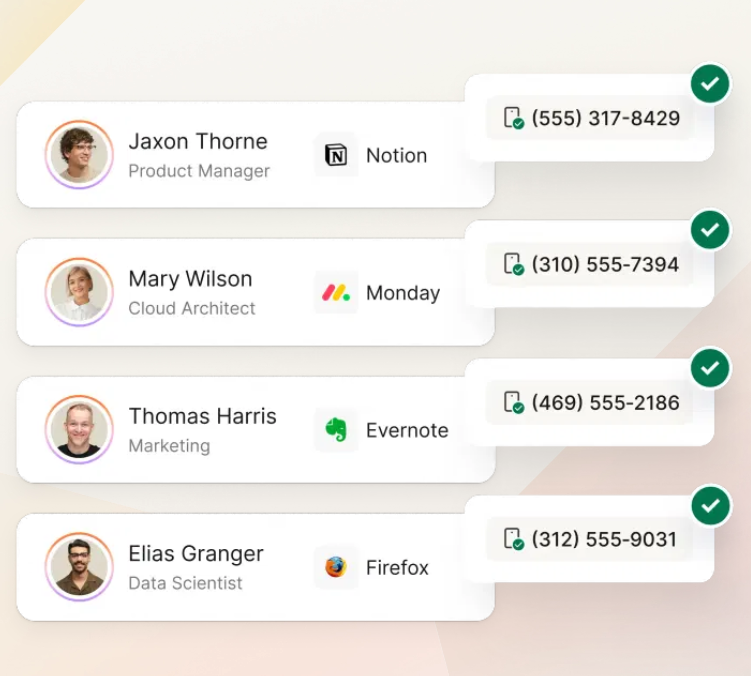
Multi-threading wins deals, but only if you have contact data for the full buying committee. Prospeo's 300M+ profiles and 98% email accuracy mean you reach every stakeholder - not just the one who picked up.
Stop single-threading deals because you only have one contact.
FAQ
What's the best way to start a sales conversation?
State your reason for calling within 10 seconds - this doubles your success rate. Pair it with a signal-based opener (a funding round, a new hire, a product launch) so the prospect knows why you're calling them specifically, not just working down a list.
How do I handle "I'm not interested" on a cold call?
Acknowledge it, then pivot: "Totally fair - quick question before I let you go: how are you currently handling [specific pain point]?" If they engage, you've earned 30 more seconds. If they don't, move on cleanly - forcing it burns the contact permanently.
How do I make sure I'm calling verified numbers?
Use a B2B contact data provider that refreshes records weekly, not monthly. Bad data wastes 30-50% of many teams' dial time. Weekly refresh cycles and multi-step verification processes are the baseline you should expect from any provider in 2026.
What talk-to-listen ratio should I aim for?
On cold calls, aim for 55/45 (you talk slightly more to earn attention). On discovery calls, flip to 43/57 - listen more than you speak. The key metric isn't the exact ratio but consistency: top performers maintain the same balance whether they win or lose the deal.