

Sales Deck Best Practices That Actually Close Deals
Your CFO is sitting in an airport lounge, skimming a deck someone forwarded her. No rep on the call. No context beyond the slides. If your deck can't sell in that moment, it's not a deck - it's a crutch.
61% of B2B buyers now prefer a rep-free buying experience entirely. Forrester reports the average B2B purchase involves 13 stakeholders - most of whom will never meet you. And 41% already have a preferred vendor before formal evaluation begins. Your deck has to work without you in the room, or it doesn't work at all.
Sales Deck vs. Pitch Deck
A pitch deck sparks belief. A sales deck drives commitment. Pitch decks are early-relationship, story-driven, high-level. Sales decks are later-stage, buyer-focused, and built to anticipate skepticism.
Use a sales-heavy deck too early and you feel pushy. Use a pitch-style deck in a late-stage deal and you feel vague - like you're dodging the hard questions the buying committee actually has. Getting this wrong is one of the fastest ways to kill a deal that was otherwise moving in the right direction.
If you want a deeper breakdown of narrative vs. conversion structure, start with story-driven sales decks.
The 3-Act Slide Structure
The best sales decks follow a three-act structure. Not because it's clever, but because it mirrors how decisions actually get made: understand the stakes, evaluate the solution, trust the proof.
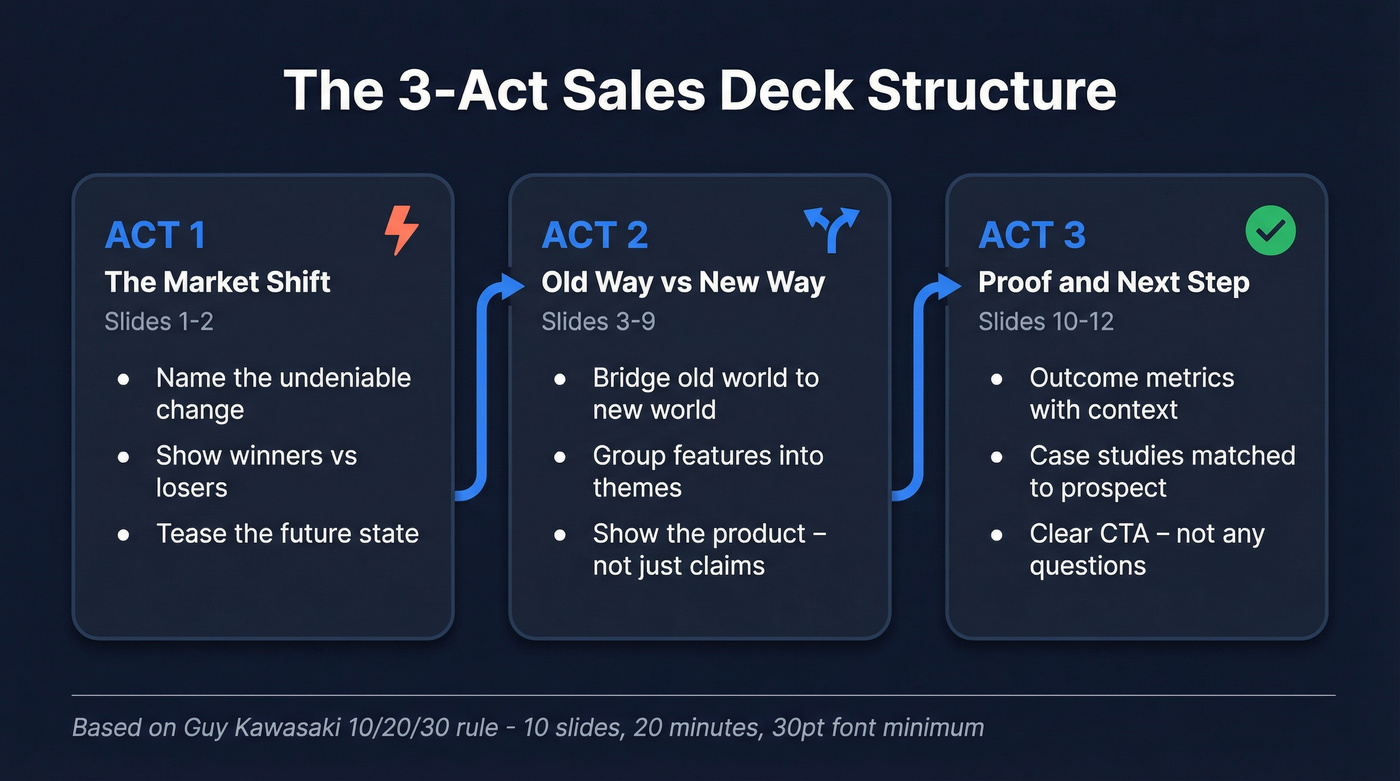
Act 1 - The Market Shift (Slides 1-2)
Don't open with your product. Don't open with "the problem." Open with a shift - something undeniable happening in the buyer's world.
Andy Raskin's narrative framework explains why: starting with "the problem" puts prospects on the defensive, while starting with a market shift invites them to discuss impact and opportunity. Name the change, show there'll be winners and losers, and tease the future state your product enables - before you ever mention the product itself. If the room hasn't leaned forward by slide two, no amount of feature slides will save you.
Act 2 - Old Way vs. New Way (Slides 3-9)
With attention earned, introduce your product as the bridge between the old way and the new way - not as a feature list. Group capabilities into themes. Align pricing to value. Show architecture and stack fit.
One rule most decks violate: one idea per slide. Cramming problem, solution, and market size onto a single slide is how you lose people.
Here's the angle most decks miss entirely. Every benefit you claim without showing the actual interface creates an "imagination tax" on the buyer - they have to picture what you mean instead of seeing it. We've started advising teams to replace at least two claim slides with annotated product screenshots. The conversion difference is noticeable.
If your deck is paired with a live walkthrough, use a product demo checklist to keep the flow tight.
Act 3 - Proof and Next Step (Slides 10-12)
Traction without context is useless. "10,000 users" means nothing. "10,000 users with 23% MoM growth and $47 ARPU" tells a story. Lead with outcome metrics, then logos and case studies that match the prospect's industry or company size.
End with a clear CTA. Not "any questions?" - an actual next step: a pilot timeline, a mutual action plan, a specific date for technical review. Guy Kawasaki's 10/20/30 rule is a useful guardrail here. Ten slides, 20 minutes, 30-point font minimum. The spirit is right - keep it tight enough that you have time left for conversation.
If you’re building a repeatable close motion, map the deck to your steps to close a sale.
Design for the Buying Committee
With 13 stakeholders involved in the average B2B purchase, your deck has to work like a forwardable document - something that gets screenshotted and discussed in rooms you'll never enter. 86% of B2B purchases stall. Your deck needs to serve every stakeholder or it serves none.
| Buying Role | What They Need |
|---|---|
| Economic Buyer | ROI, TCO, strategic fit |
| Technical Buyer | Architecture, integrations, security |
| Champion | The narrative they can retell |
| End User | Workflow impact, ease of use |
| Legal/Compliance | Certifications, data handling |
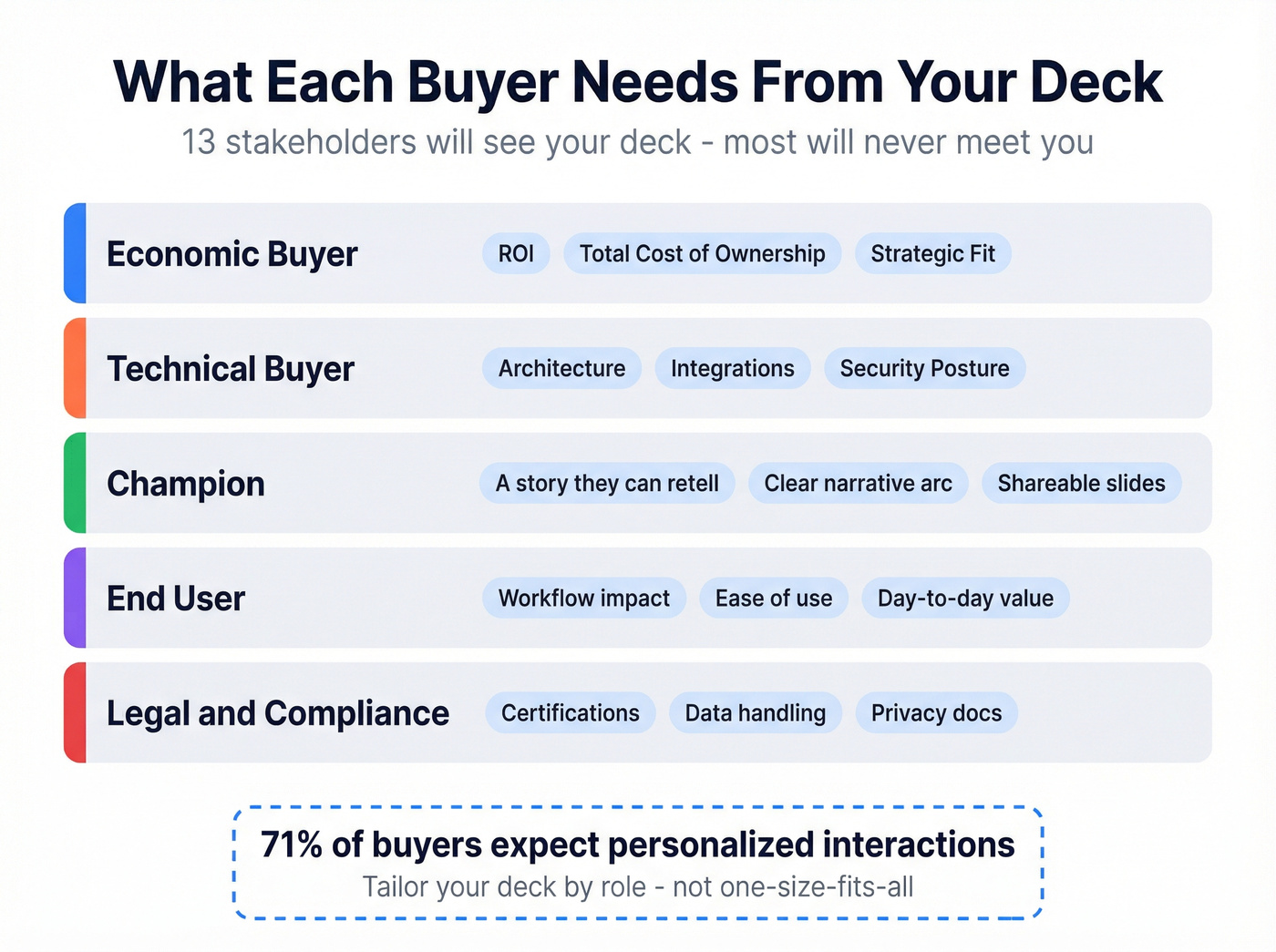
71% of buyers expect personalized interactions, and 76% get frustrated when they don't get them. Tailoring your deck by stakeholder role isn't a nice-to-have - it's table stakes.
If you’re running a true committee motion, align this with account-based selling best practices and a clear ideal customer profile.
Here's the thing, though: none of this matters if your deck bounces before it's read. We've seen teams spend weeks on a presentation and then send it to an email list that hasn't been cleaned in six months. Bounce rates of 30-40% that tank domain reputation and waste every hour spent on those slides. Before you send a deck to 13 stakeholders, verify every email. Prospeo handles this with 98% email accuracy and a 7-day data refresh cycle, so you're not sending to addresses that went dead last quarter.
If you’re seeing deliverability issues, start with email bounce rate and the full email deliverability guide.

You just spent weeks perfecting a 12-slide deck for a 13-person buying committee. Don't let it bounce. Prospeo verifies emails at 98% accuracy with a 7-day refresh cycle, so every stakeholder on your send list is reachable - not a dead address from last quarter.
Fix the list before you send the deck.
Sales Deck Design Rules
Accessibility isn't optional - it's how you make sure your deck works for the VP reading on a phone at 11 PM.
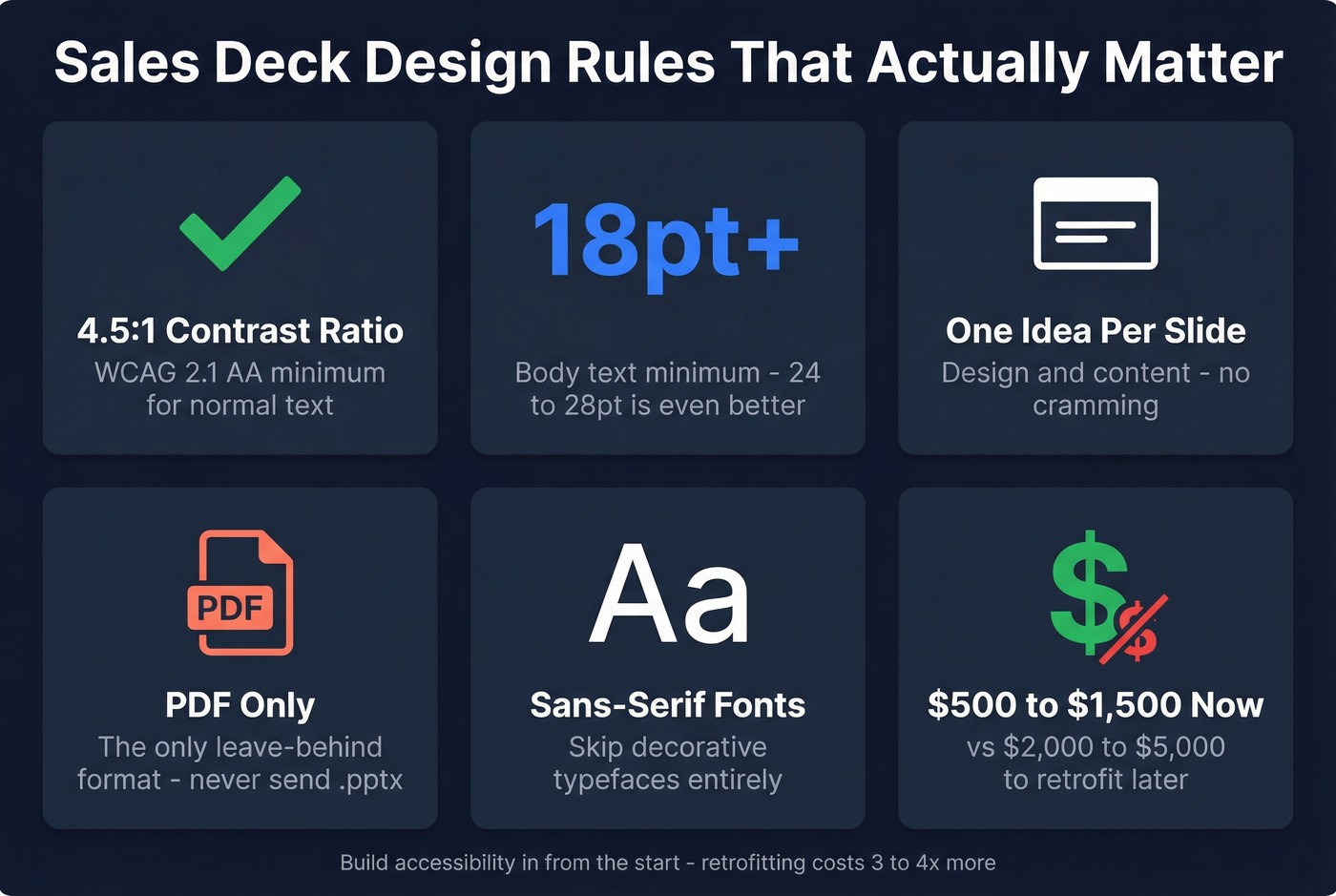
- WCAG 2.1 AA baseline: 4.5:1 contrast ratio for normal text, 3:1 for large text
- Body text at 18pt minimum (24-28pt is even better for readability). As one pitch-deck reviewer on r/Entrepreneur put it, "font size 10 is illegal." They're not wrong.
- Use sans-serif fonts. Skip the decorative typefaces.
- One idea per slide - design and content.
- PDF is the only leave-behind format. Don't send a .pptx that renders differently on every machine.
Accessible design costs $500-$1,500 upfront. Retrofitting later runs $2,000-$5,000. Build it right the first time.
If your deck is part of a broader outbound motion, pair it with proven sales prospecting techniques.
The Appendix Strategy
Keep your main deck to 10-12 slides. Everything else - technical deep dives, competitive comparisons, security docs, detailed pricing, implementation timelines - goes in the appendix.
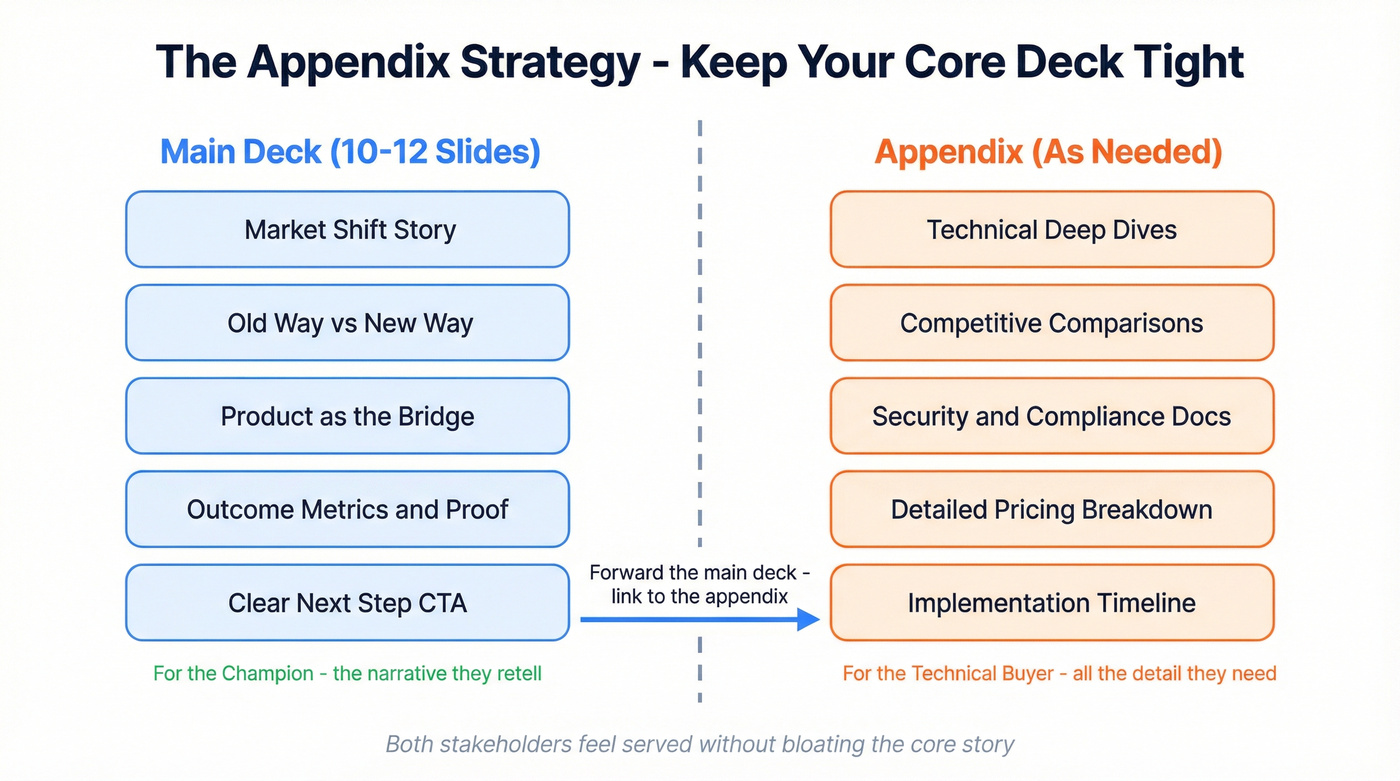
The champion gets the narrative. The technical buyer gets the appendix. Both feel served. This split is one of the most underrated presentation tactics we've come across: it keeps your core story tight while giving detail-hungry stakeholders everything they need without bloating the main flow.
To support competitive slides without derailing the story, build lightweight sales battle cards.
Keep Your Deck Current
The biggest deck problem isn't design - it's decay. Marketing builds the deck, sales rebuilds it in the field, and within a quarter nobody knows which version is current.
The fix is co-creation: marketing owns the template and data, sales owns the field feedback loop. Neither side builds in isolation. Set maintenance triggers - update when a product ships, when a competitor repositions, or when you hear the same objection three times. A/B test versions by industry and persona, and track forward rates through your enablement platform. If nobody's forwarding your deck, the deck isn't working.
If you want a system for keeping messaging aligned across teams, use a marketing enablement approach.
Let's be honest about something most teams get backwards: they over-invest in deck design and under-invest in deck distribution. A B+ deck sent to verified, well-targeted contacts will outperform an A+ deck blasted to a stale list every single time. Fix the list first.
A great sales deck needs the right audience. Prospeo's 300M+ profiles with 30+ filters - buyer intent, job changes, technographics - let you build the exact buying committee your deck was designed for. At $0.01 per email, targeting 13 stakeholders costs less than a cup of coffee.
Stop perfecting slides and start reaching the right people.
FAQ
How many slides should a sales deck have?
Aim for 10-12 in the main flow. Guy Kawasaki's 10/20/30 rule is a useful guardrail - 10 slides, 20 minutes, 30-point minimum font. Everything else goes in the appendix. The real test: do you have time left for conversation when the slides are done?
What's the difference between a sales deck and a pitch deck?
A pitch deck sparks belief early - high-level, story-driven, focused on vision. A sales deck drives commitment later with use cases, outcomes, and proof. Using the wrong format at the wrong stage kills deals faster than bad design.
How do I make sure my deck reaches the full buying committee?
With 13 stakeholders involved, your deck must be forwardable - PDF format, readable without narration - and sent to verified contacts. A bounced email to a key decision-maker can stall the entire deal, so verify addresses before you send. Prospeo's 98% email accuracy and 7-day refresh cycle are built for exactly this.
Should I customize my deck for every industry?
Not a completely different deck - but swap the case study, adjust the market-shift slide to reference industry-specific trends, and tailor ROI metrics to what that buying committee actually measures. The three-act structure stays the same. The details inside each act shift.