

Sales Email Tips Backed by 16.5M Emails (Not the Same Recycled Advice)
Reply rates dropped 15% last year. Across 16.5M cold emails analyzed by Belkins, the average reply rate fell from 6.8% to 5.8%. That's not a blip - it's a trend.
Here's the thing: every other guide will tell you to fix your copy. They're mostly wrong. Most teams we talk to are writing decent emails that land in spam folders, hit dead addresses, or get buried under 200 other pitches. The fundamentals haven't changed, but the bar for execution has risen sharply, and the gap between teams who nail the basics and teams who don't is widening fast. Let's start with the thing that actually matters - not subject lines, but infrastructure, list quality, and format.
Fix These Three Things Today
If you only have ten minutes:
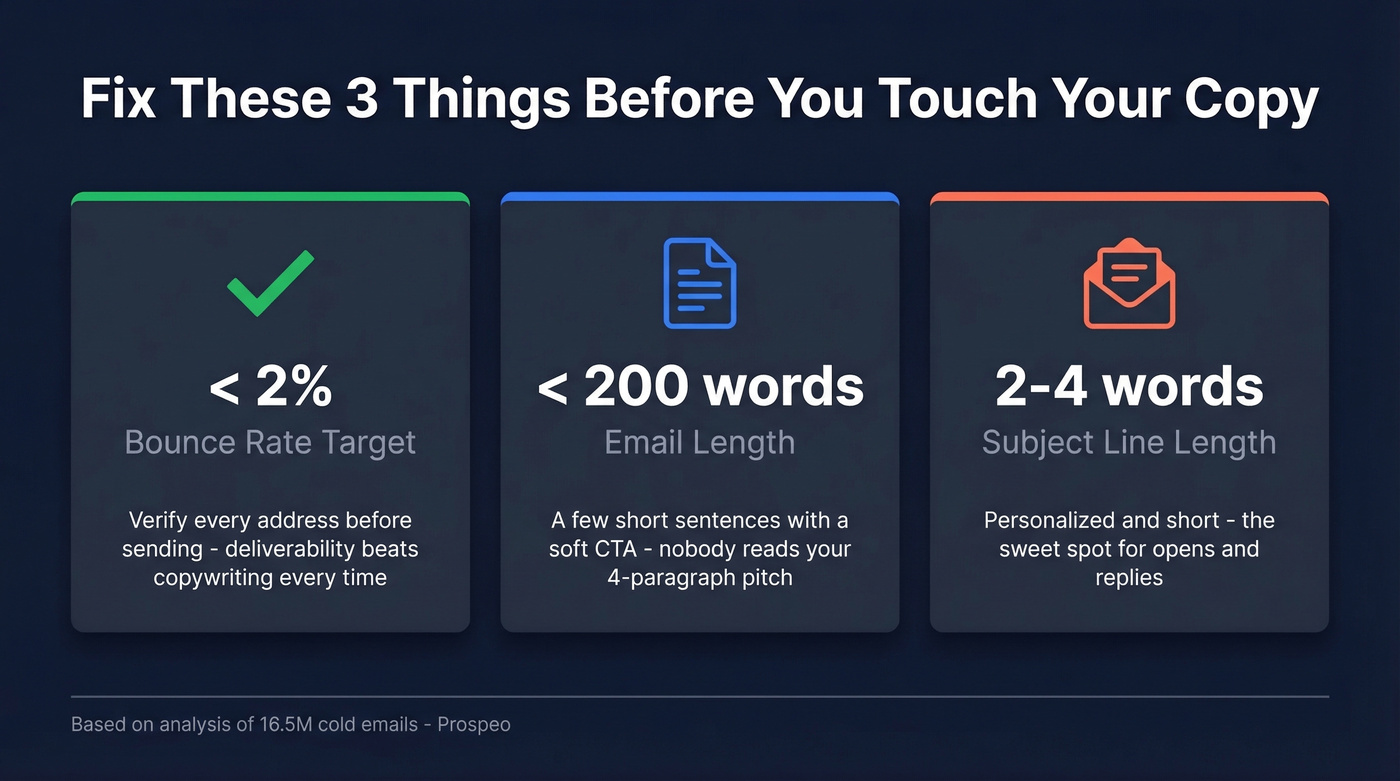
- Verify your list so bounces stay under 2%. Deliverability matters more than copywriting.
- Keep cold emails tight - under 200 words, ideally a few short sentences, with a soft CTA. Nobody reads your four-paragraph pitch.
- Use a 2-4 word personalized subject line. That's the sweet spot for opens and replies.
Hit those three and you're already ahead of most outbound teams running sequences right now.
Fix Your Deliverability First
A perfectly written email that lands in spam gets zero replies. No amount of copywriting wizardry matters if your messages never reach the inbox.
One Reddit case study tells the story clearly. A founder watched reply rates crater from 8% to 3% over 18 months. The fix wasn't rewriting emails - it was rebuilding infrastructure. They dropped bounce rates from 11% to under 2%, scaled from 3 domains to 7, capped each inbox at about 26 sends per day, and reply rates climbed back to 6%.
The non-negotiable checklist:
- SPF, DKIM, DMARC - set up all three. No exceptions.
- Cap sending at 20 emails or fewer per inbox per day. (More on safe email velocity if you're scaling.)
- Turn off open tracking pixels. The 16.5M-email dataset found roughly 3% higher response rates without them.
- Warm up new inboxes slowly - 5-10 per day for weeks 1-2, ramping to 50 per day max by week 7+.
Verify every address before sending. We use Prospeo's 5-step verification internally - catch-all handling, spam-trap removal, honeypot filtering - and it keeps bounce rates under 2% with 98% email accuracy on a 7-day refresh cycle, so you're never sending to addresses that went stale three months ago. (If you want the full checklist, see our email deliverability guide.)

Subject Lines That Get Opens
Across 5.5M tested emails, personalized subject lines hit 46% open rates and 7% reply rates. Without personalization: 35% opens, 3% replies. That's a 133% reply rate lift from the subject line alone.
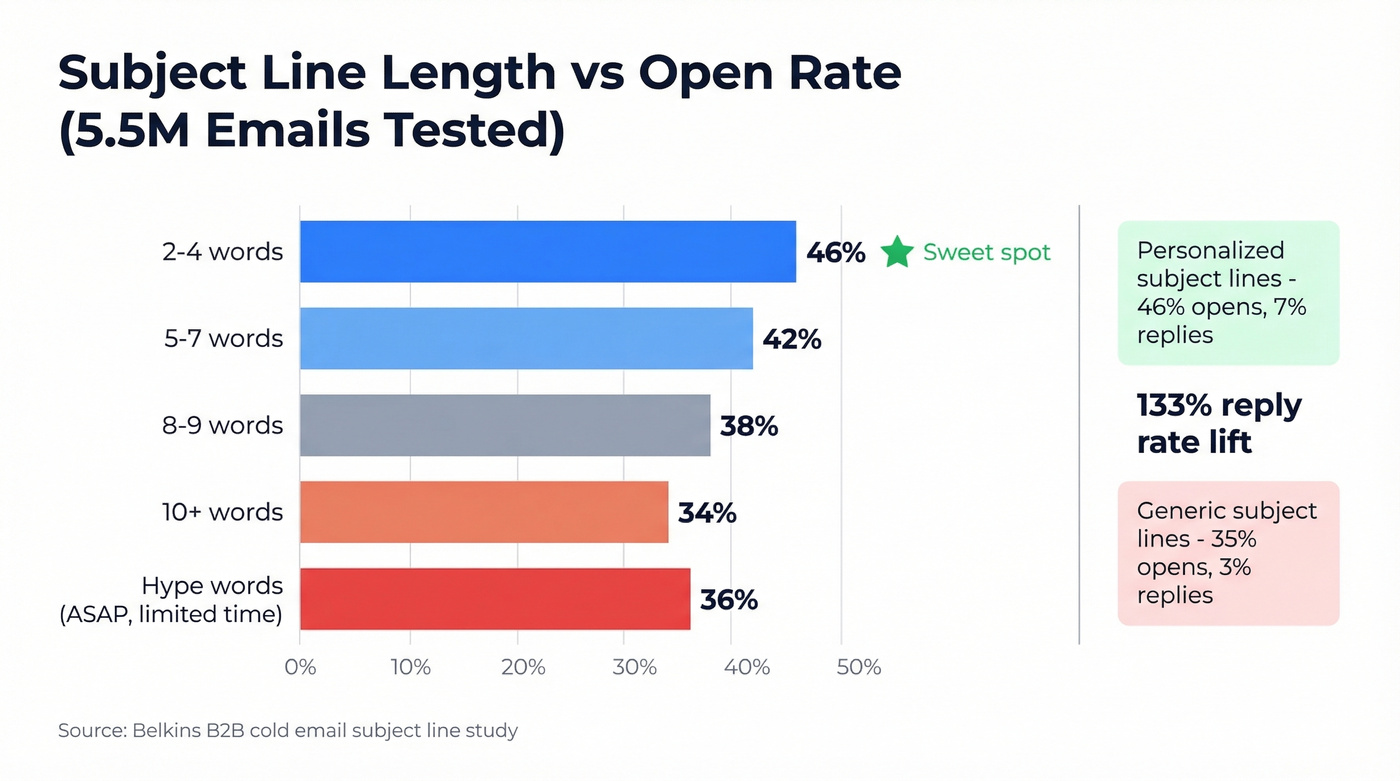
The sweet spot is 2-4 words - 46% open rate. Performance drops steadily past 7 words, and 10-word subject lines bottomed out at 34%. Question-format subject lines matched that 46% peak. Hype and urgency words ("ASAP," "limited time," generic greetings) dragged opens below 36%.
One tactic worth stealing: the <> subject line pattern. Instead of "Partnership opportunity" (under 19% opens), try something like "Morgan <> Kaspr" - it mimics an internal thread and cuts through inbox noise. We've seen this work especially well when the prospect's first name is included. (If you need more ideas, pull from these cold email subject line examples.)

You just read that bounce rates above 2% kill deliverability. Prospeo's 5-step verification - catch-all handling, spam-trap removal, honeypot filtering - delivers 98% email accuracy on a 7-day refresh cycle. No stale addresses tanking your domain reputation.
Stop writing great emails to dead inboxes.
How to Write Emails That Get Replies
Belkins' benchmark data shows shorter emails win overall (under 200 words), with 6-8 sentences performing best in their dataset. In practice, a lot of operators go even shorter.
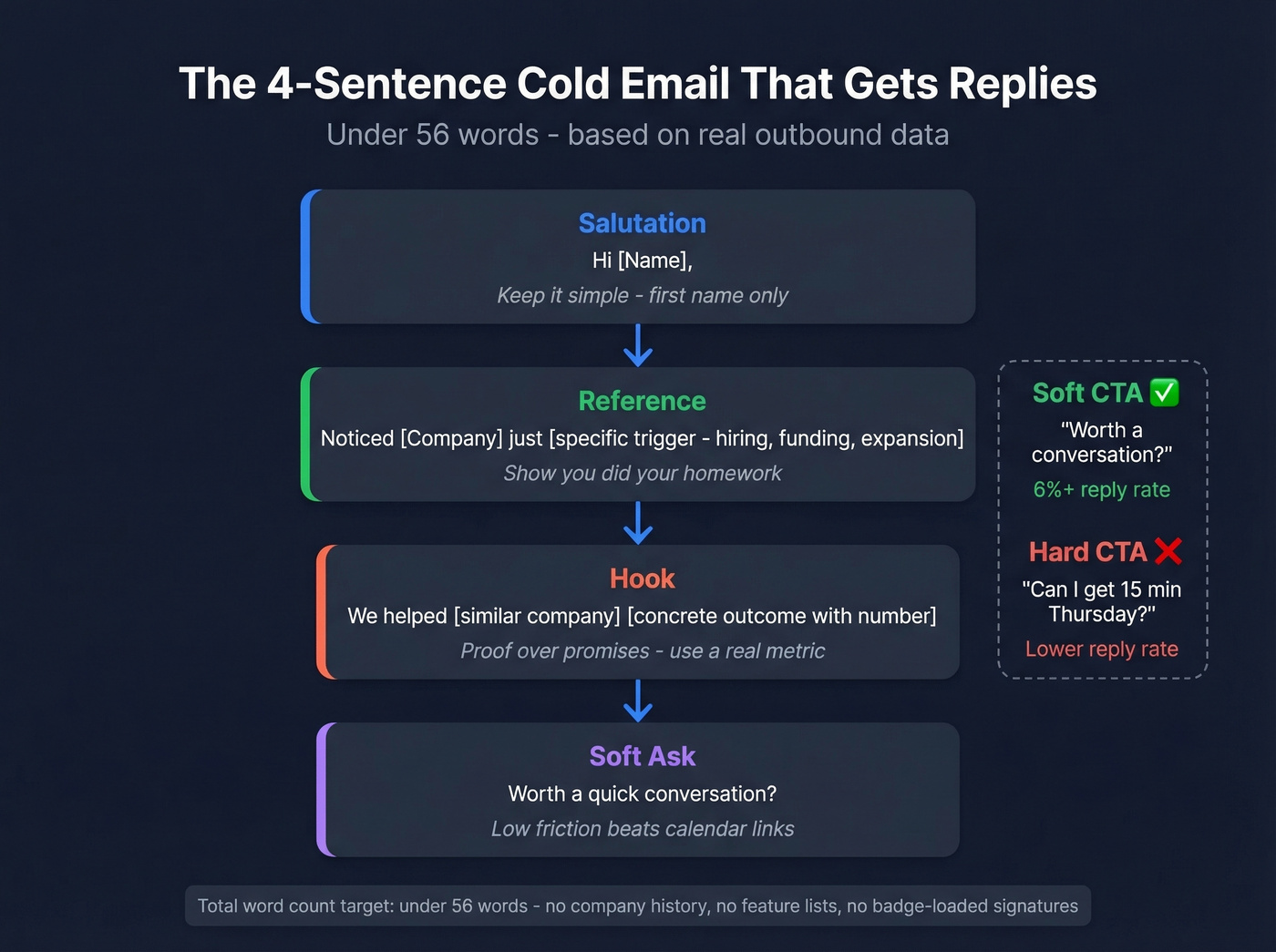
One founder cut emails from 141 words to under 56 as reply rates recovered from 3% to 6%. A Reddit practitioner breakdown nails the format: four sentences max following the salutation, reference, hook, ask framework.
Soft CTAs outperform hard meeting asks. "Worth a conversation?" beats "Can I get 15 minutes on your calendar Thursday?" every time. You're lowering the friction to reply. (More on structuring the ask in our email call to action guide.)
A 47-word template that follows the format:
Hi [Name], noticed [Company] just [specific trigger - hiring, funding, expansion]. Teams in [their space] typically [specific pain point you solve]. We helped [similar company] [concrete outcome with number]. Worth a quick conversation?
That's it. No company history, no feature list, no badge-loaded signature. Many guides emphasize polish and formality, but in cold outreach, brevity and relevance beat eloquence every time. (If you're building a full sequence, start with this B2B cold email sequence framework.)
When to Send
The timing data is genuinely conflicting, and I'd rather show you that than pretend there's one right answer.
| Dataset | Best Day | Best Time | Reply Rate | Sample Size |
|---|---|---|---|---|
| 16.5M cold emails | Thursday | 8-11 PM | 6.87% (best day) / 6.52% (peak window) | 16.5M emails |
| Siege Media | Monday | 6-9 AM PST | 2.8% | 85K emails |
| MailerLite | Friday | 8-11 AM / 8-9 PM | N/A (marketing) | 2.1M campaigns |
The takeaway isn't "send Thursday at 9 PM." Opens cluster in the morning, clicks happen in the evening, and your audience might behave differently than either dataset. Run a two-week split between morning and evening sends, then let your own data decide. One often-overlooked guideline: avoid sending during major holidays and the week between Christmas and New Year's - open rates crater and you risk looking tone-deaf. (For a deeper breakdown, see best time to send cold emails.)
For teams running multi-language outreach across regions, timing gets even more complex. Stagger sends by timezone and localize your day-of-week strategy based on regional norms.
Follow-Up Strategy That Protects Your Domain
A single email had the highest reply rate at 8.4%. That's the most counterintuitive stat in the entire dataset - and it should change how you think about sequences. Adding a third email dropped replies by up to 20%. Four or more emails more than tripled unsubscribe and spam complaint risk.
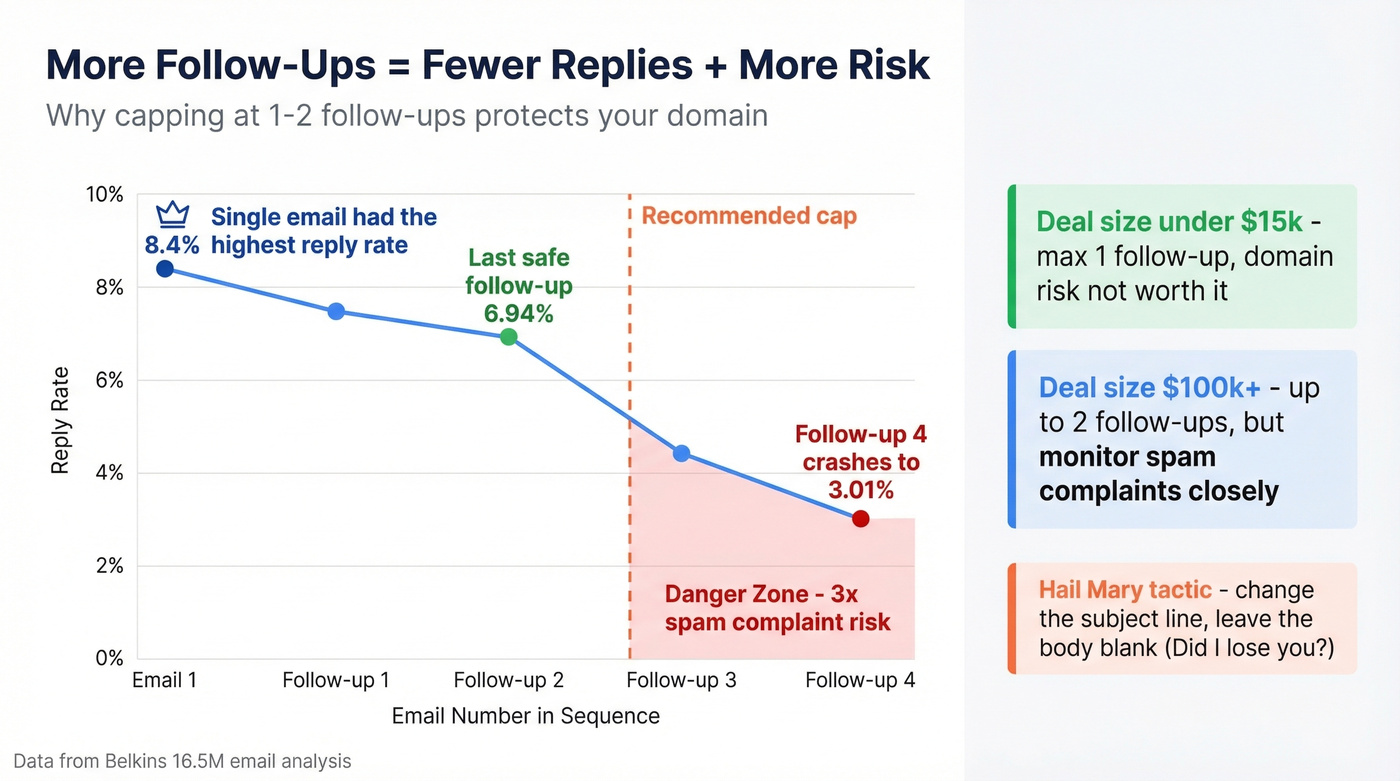
In our experience, sequences longer than 2 follow-ups rarely justify the domain risk. Founders respond best at follow-up #2 (6.94% reply rate) then crash to 3.01% by follow-up #4. Enterprise contacts ghost quickly and punish persistence even faster. (If you want plug-and-play copy, use these cold email follow-up templates.)
Hot take: if your deal size is under $15k, you probably don't need more than one follow-up. The math doesn't support burning domain reputation for a deal that size. Cap at 1-2 follow-ups. If you need a Hail Mary, try the "Did I lose you?" tactic - change the subject line, leave the body blank. And if a mutual connection makes an intro, respond within 24 hours with a short, specific message that mirrors the format above.
Skip the five-touch sequences entirely unless you're selling six-figure contracts. Any guide recommending them should come with a domain health warning.
Mistakes That Tank Replies
These guidelines are just as much about what to avoid:
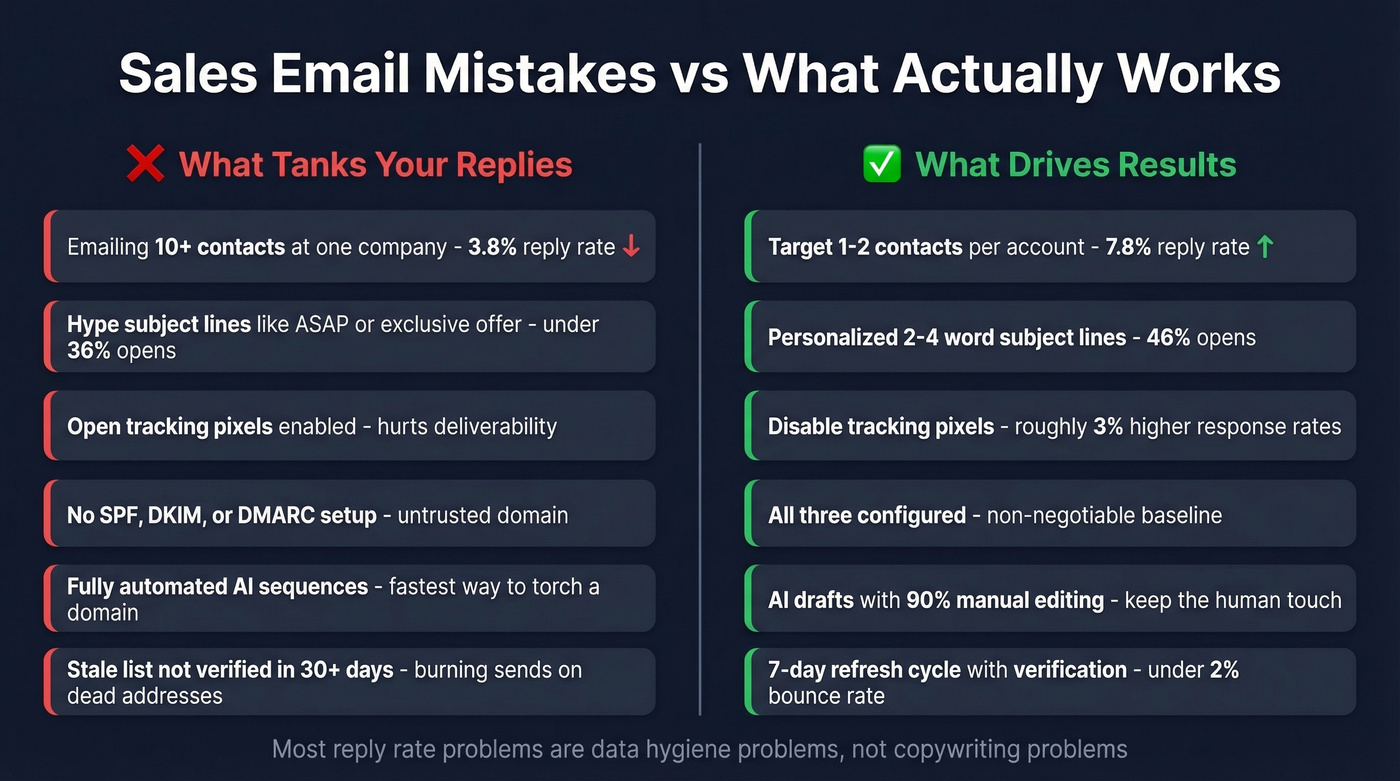
- Over-targeting the same company. Emailing 10+ contacts at one account drops reply rates to 3.8%. Stick to 1-2 contacts (7.8%).
- Hype words in subject lines. "ASAP," "exclusive offer," "Hello, friend" - all drag opens below 36%. (More examples in subject lines that get opened.)
- Open tracking pixels. They hurt deliverability more than the data is worth.
- No email authentication. If SPF, DKIM, and DMARC aren't configured, you're sending from an untrusted domain. Full stop. (If you're troubleshooting, start with how to verify DKIM is working.)
- Automation without personalization. AI-generated emails still need about 90% manual editing to not sound robotic. The consensus on r/sales is that fully automated sequences are the fastest way to torch a domain in 2026. (If you're using AI anyway, follow this AI cold email outreach playbook.)
- Stale data. If your list hasn't been verified in the last 30 days, you're burning sends on dead addresses. A 7-day refresh cycle is the baseline you should expect from any data provider.
- Treating outbound like marketing blasts. The key difference is intent: marketing emails nurture at scale, while effective sales outreach focuses on one-to-one relevance and a single clear ask.
Let's be honest - most reply rate problems aren't copywriting problems. They're data hygiene problems. Fix the foundation, keep your emails short and specific, and the replies follow.
Short, personalized emails to the right person at the right time - that's the formula. Prospeo gives you 300M+ verified contacts with 30+ filters including buyer intent, job changes, and technographics so every send hits a real decision-maker. At $0.01 per email, bad data is no longer an excuse.
Send fewer emails. Reach more buyers. Start with 75 free credits.