

The Sales Enablement Guide That Protects Selling Time in 2026
Your reps spend roughly 25% of their time actually selling. The rest vanishes into internal meetings, enablement sessions, CRM hygiene, and Slack threads that should've been an email. Most enablement programs make this worse - they pile on more calendar blocks in the name of "helping." This guide is built around one principle: protecting the time reps need to close deals.
What Sales Enablement Actually Is
Sales enablement helps sellers generate new revenue. Content, training, coaching, tools - all of it serves one purpose: making it easier for reps to close deals. The moment enablement optimizes for process compliance instead of revenue, it's broken.
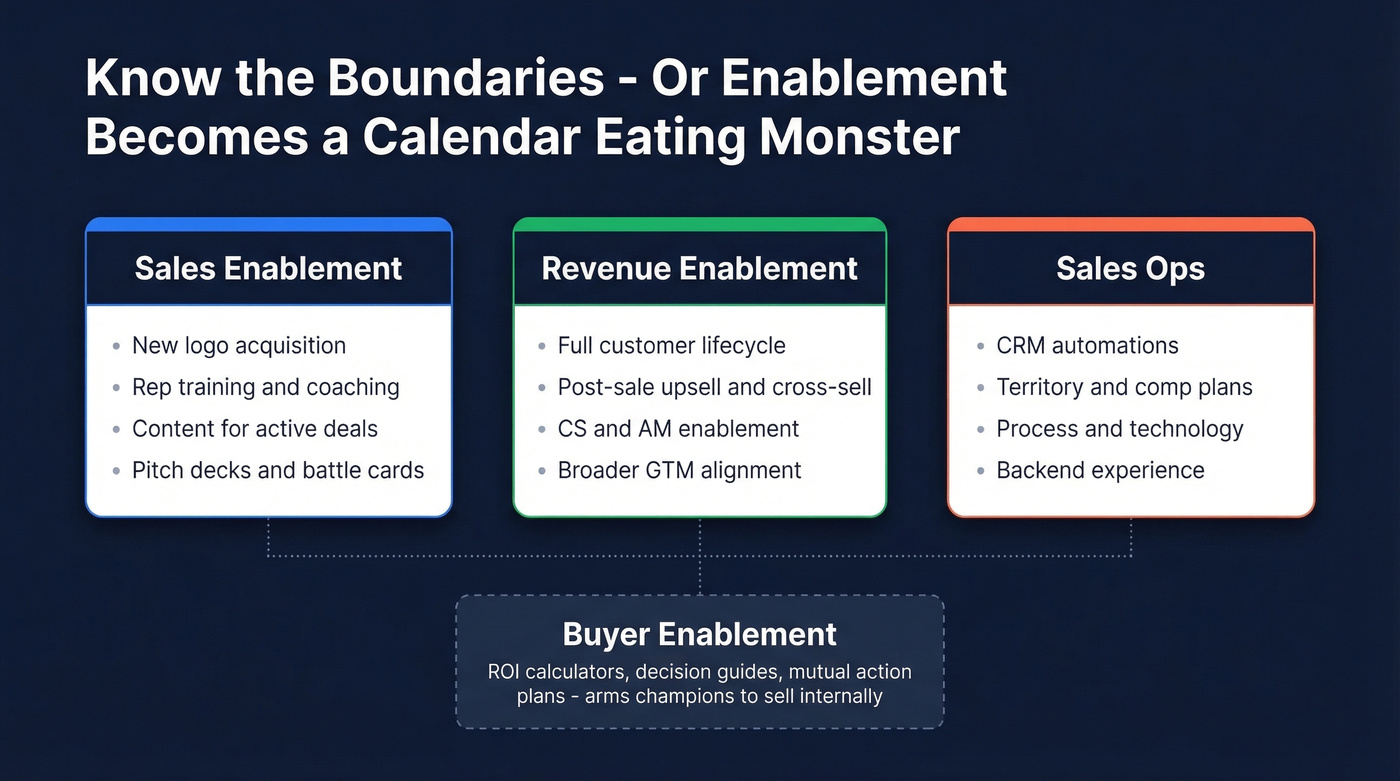
A quick scope distinction worth nailing down early: sales enablement focuses on helping sales teams win new logos. Revenue enablement is broader, covering all revenue-facing teams across the full lifecycle including post-sale upsell and cross-sell. Sales ops handles processes, technology, and the backend experience - CRM automations, territories, comp plans. Conflating these terms is how enablement balloons into a calendar-eating monster that nobody asked for. There's also a growing trend toward buyer enablement - ROI calculators, decision guides, mutual action plans that arm champions to sell internally - but don't let that dilute your core mission.
Three Takeaways If You Read Nothing Else
- Cap mandatory enablement at ~10 hours/year. Everything else runs async. This forces ruthless prioritization.
- Measure with cohort testing, not attendance. Compare quota attainment and win rates for reps who completed a program vs. those who didn't.
- Fix data quality first. Every hour spent chasing bounced emails or dead numbers never comes back. (If you're rebuilding your data layer, start with data quality basics.)

The Problem Nobody Talks About
The #1 complaint about enablement on r/sales isn't bad content - it's stolen selling time. One thread describes 2-3 enablement video calls per week, each running 1-3 hours, well past SKO season. Stack those on top of forecast calls, regional syncs, and 1:1s, and you've burned 20-25% of the week before a rep ever talks to a prospect.
Here's the thing: enablement is supposed to improve the selling-time ratio. Instead, most programs add more mandatory trainings, more "quick syncs" that run 45 minutes, more sessions on filling out close plans in Salesforce. Senior reps feel it hardest. They don't need another walkthrough of MEDDPICC - they need their calendar back. (If your team is tightening qualification, use a dedicated MEDDIC playbook.)
Building an Enablement Operating Model
The fix isn't better content. It's better governance. Start with an enablement charter - a document defining what enablement will and won't do, who it reports to, and how requests get prioritized. (If enablement is getting swallowed by process, align it with sales operations and RevOps ownership early.)
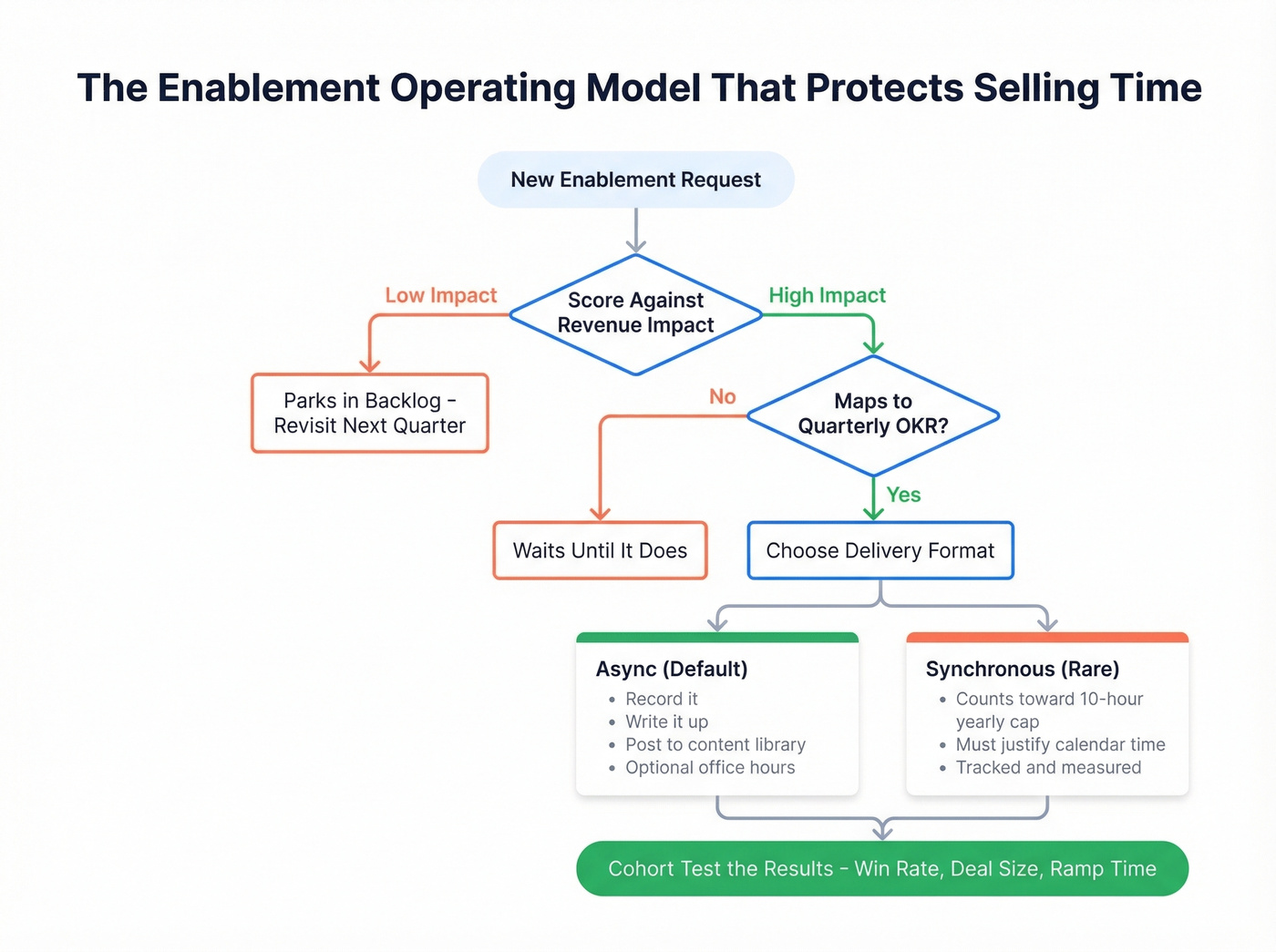
The non-negotiables:
- Intake criteria. Score every request against revenue impact. No more reactive request-taking from every VP with an idea.
- Async-first delivery. Record it. Write it up. Post it in the content library. Hold optional office hours - not mandatory calls.
- A yearly training cap. Ten hours of mandatory, synchronous training per year. Everything else is self-serve.
- Boundaries tied to OKRs. If a request doesn't map to a quarterly objective, it waits.
Capping training hours sounds radical, but it's the only mechanism that forces prioritization. When you have unlimited calendar access, everything feels important. When you have ten hours, only the highest-impact programs survive. We've seen teams adopt this constraint and immediately kill three recurring meetings that nobody could justify once they had to compete for limited slots. (To keep onboarding tight, borrow a 30-60-90 structure.)

Every bounced email is stolen selling time. Prospeo delivers 98% email accuracy with a 7-day refresh cycle, so reps spend their limited hours talking to real buyers - not cleaning lists.
Fix your data quality and give reps their calendars back.
30-Day Onboarding Plan
New AEs should deliver a credible pitch within 30 days. If it takes 60-90, your onboarding is broken.
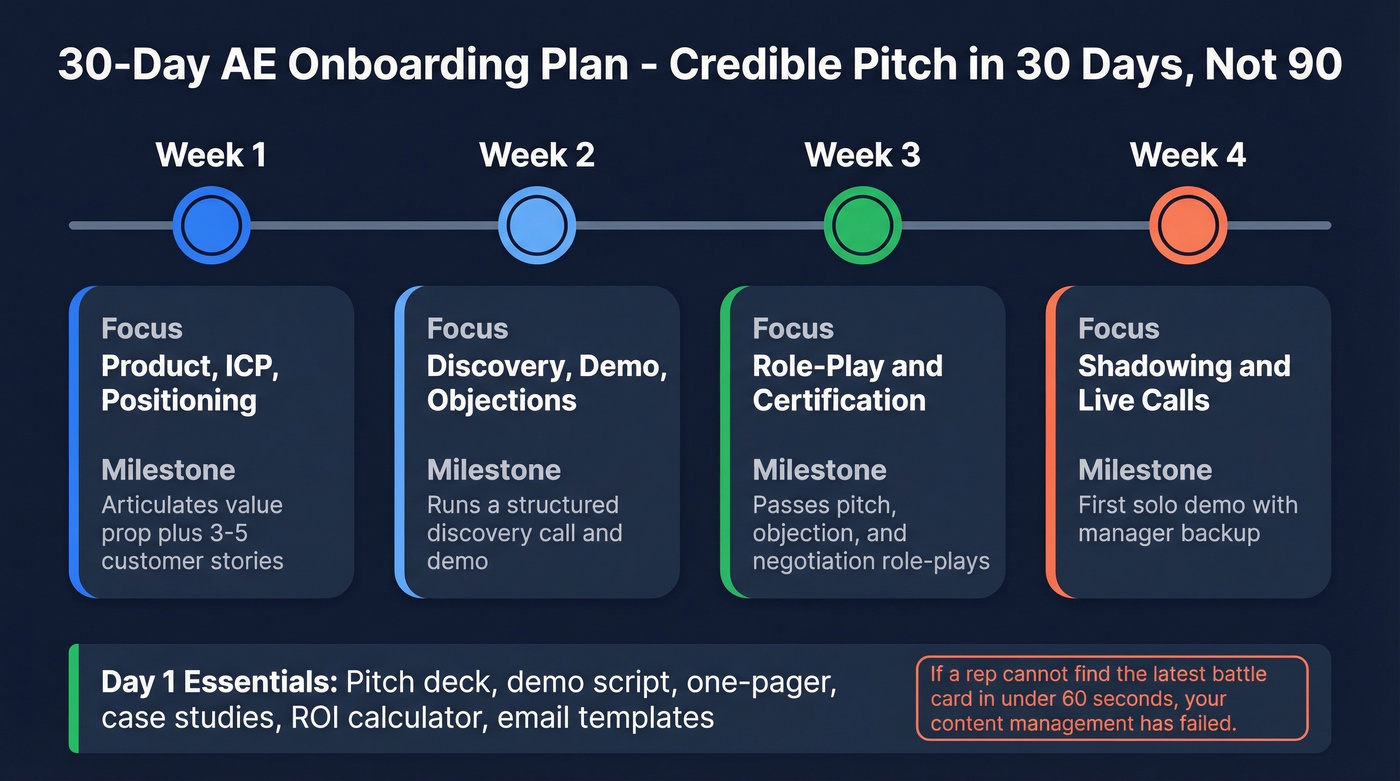
| Week | Focus | Milestone |
|---|---|---|
| 1 | Product, ICP, positioning | Articulates value prop + 3-5 customer stories |
| 2 | Discovery, demo, objections | Runs a structured discovery call and demo |
| 3 | Role-play + certification | Passes pitch, objection, and negotiation role-plays |
| 4 | Shadowing + live calls | First solo demo with manager backup |
Core assets every new rep needs on day one: pitch deck, demo script, one-pager, case studies, ROI calculator, and email templates. If a rep can't find the latest battle card in under 60 seconds, your content management has failed. Target ranges: win rate +5-10% YoY, cycle time down 10-20%. (If you need a fast baseline for messaging, pull from sample elevator pitches.)
Measuring Enablement ROI
30.3% of enablement practitioners say their metrics only minimally reflect enablement's actual value. That's because most teams measure attendance and stop there.
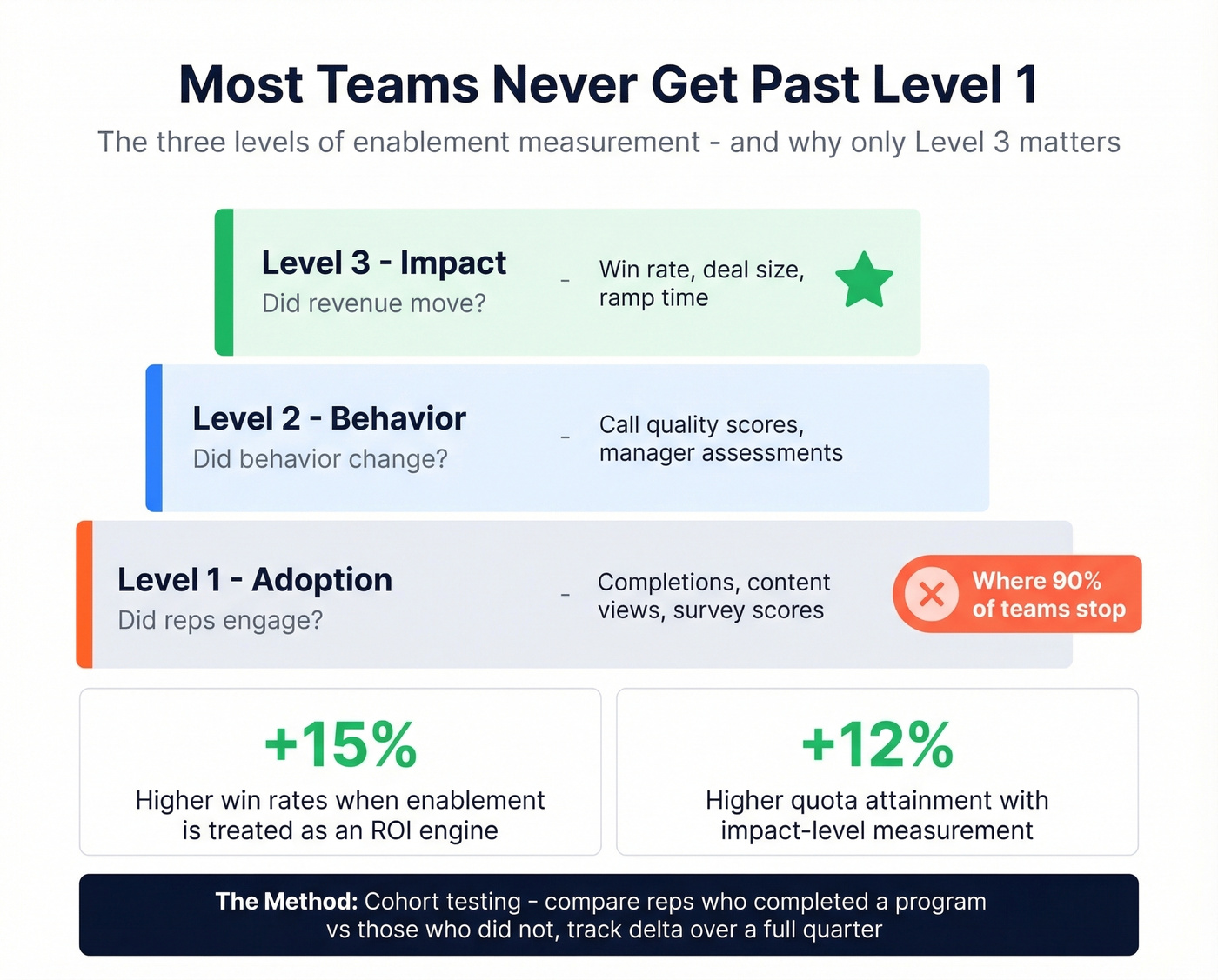
| Level | What You Measure | Examples |
|---|---|---|
| 1: Adoption | Did reps engage? | Completions, content views, survey scores |
| 2: Behavior | Did behavior change? | Call quality scores, manager assessments |
| 3: Impact | Did revenue move? | Win rate, deal size, ramp time |
Most teams never get past Level 1. Organizations that treat enablement as an ROI engine see 15% higher win rates and 12% higher quota attainment. Cohort testing is the default method: compare the numbers of reps who completed a program against those who didn't, then track the delta over a full quarter. Not perfect attribution, but infinitely better than counting logins. (If you want to tie enablement to outcomes, track pipeline health alongside adoption.)
Mistakes That Get Enablement Defunded
Do this: Deliver a quick win in the first 60 days - shorten onboarding ramp, improve one conversion rate, fix one broken workflow.
Don't do this: Lead with a 6-month strategic roadmap nobody asked for. Only 10% of large-scale B2B orgs are "very effective" at driving GTM initiatives. The other 90% are measuring the wrong things or measuring nothing at all.
We've watched enablement teams get defunded in under a year when they lead with roadmaps instead of results. Here's the attribution trap nobody warns you about: training happens in Q1, but the revenue impact shows up in Q3. If you can't bridge that gap with leading indicators - call quality scores, pipeline velocity, content usage rates - leadership will cut your budget before the results arrive. Most sales enablement books cover strategy frameworks in depth, but they rarely address this timing gap between investment and measurable return. (This is where sales leadership alignment matters more than another tool.)
Enablement Tech Stack for 2026
By 2026, 90% of companies have implemented AI or plan to. Teams using AI for sales training are 35% more likely to increase deal size, and early adopters saw 30%+ improvement in win rates. But Bain gets something right that most vendors won't tell you: meaningful gains require reimagining end-to-end sales processes, not layering AI on top of broken workflows. If your data is fragmented, AI just automates the mess faster.
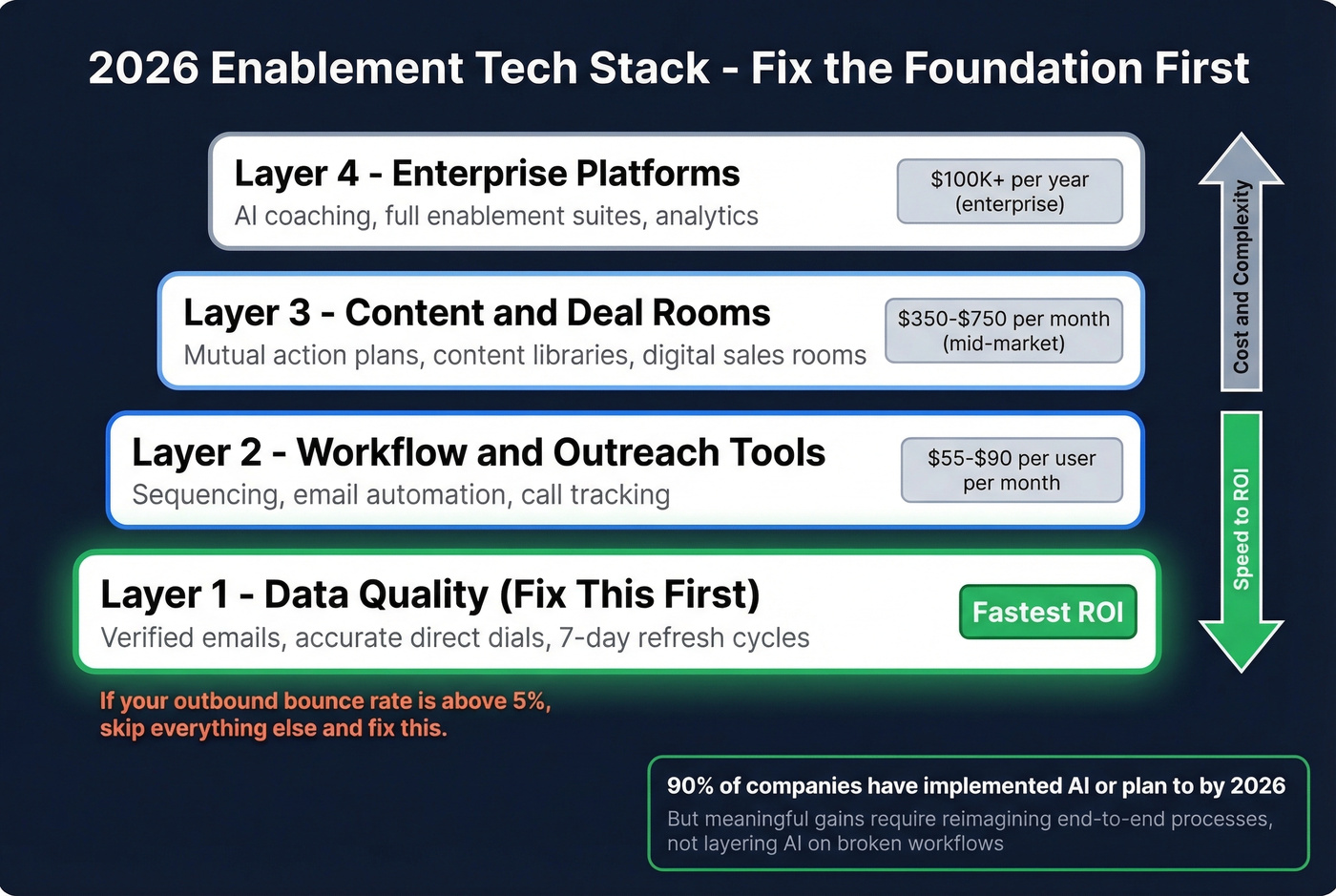
Pricing benchmarks: Enterprise platforms like Seismic run $100K+/year. Mid-market tools like Dock start at $350-$750/month. Workflow tools like Reply run $55-$90/user/month.
Let's be honest about something: the enablement tool that delivers the fastest ROI isn't a content platform or a coaching tool. It's fixing your data layer. Reps burning hours on bounced emails and disconnected numbers is an enablement failure that no training content will solve. At Snyk, 50 AEs were prospecting 4-6 hours per week with bounce rates of 35-40%. After switching to Prospeo's verified contact data with its 7-day refresh cycle, bounce rates dropped under 5% and AE-sourced pipeline jumped 180%. That's the kind of enablement win that shows up in the next board deck. The free tier - 75 emails plus 100 Chrome extension credits per month - is enough to audit your current list quality and see the gap for yourself. (If you're diagnosing outreach issues, start with email bounce rate benchmarks.)
Skip the AI coaching tools if your outbound bounce rate is above 5%. Fix the data first. Everything else compounds on top of clean contacts. (Then scale with repeatable sales prospecting techniques.)
You capped enablement at 10 hours/year - now cap the time reps waste on bad contact data. Prospeo's 300M+ verified profiles, 125M+ direct dials, and 30+ search filters mean reps find the right buyer in seconds, not hours.
Stop enabling process. Start enabling pipeline.
FAQ
Who should own sales enablement?
Enablement reports to the CRO or VP Sales. Without a direct line to revenue leadership, enablement becomes reactive and tactical. If it reports into marketing or HR, expect persistent misalignment with quota-carrying teams.
How do you measure enablement ROI?
Cohort testing: compare quota attainment and win rates for reps who completed a program vs. those who didn't. Track adoption first, then behavior change, then business impact over a full quarter to account for lag.
What's the fastest enablement win for outbound teams?
Fix data quality. Verified emails and accurate direct dials eliminate bounced outreach and give reps immediate selling time back. Teams like Snyk cut bounce rates from 35-40% to under 5% within weeks of cleaning up their contact data.
How many hours of mandatory training should reps get per year?
Cap synchronous, mandatory enablement at roughly 10 hours per year. Deliver everything else async - recorded walkthroughs, written playbooks, searchable content libraries. This protects selling time while still driving skill development.