

Sales Engagement Platforms in 2026: What They Cost, What They Do, and How to Choose
A RevOps lead we know ran a three-tool bake-off last quarter. The "best" sales engagement platform created 4,000 duplicate contacts in Salesforce within five days. The cheapest one had better phone connect rates. The category was valued at $7.4 billion in 2022 and is projected to reach nearly $30 billion by 2032 - but spending more doesn't mean selling more.
Quick version:
- Enterprise teams (100+ reps): Salesloft or Outreach. Budget $100K+/year and negotiate hard.
- Mid-market (20-100 reps): HubSpot Sales Hub if you're already on HubSpot CRM.
- SMBs and agencies (<20 reps): Apollo or Instantly paired with a verified data layer. Skip the enterprise tools entirely.
Whichever platform you pick, your sequences are only as good as the data feeding them.
What Is a Sales Engagement Platform?
At its simplest, sales engagement refers to every interaction between a seller and a buyer throughout the deal cycle - emails, calls, social touches, meetings. A sales engagement platform (SEP) is how reps execute that outreach at scale, combining multichannel communication with automated workflows, AI-driven guidance, and activity sync back to your CRM. Gartner now calls this category "Revenue Action Orchestration." Vendors like Gong call it an "operating system for revenue teams." That's marketing. At its core, a SEP is an execution layer that sits between your data and your CRM, coordinating outreach across the entire deal cycle.
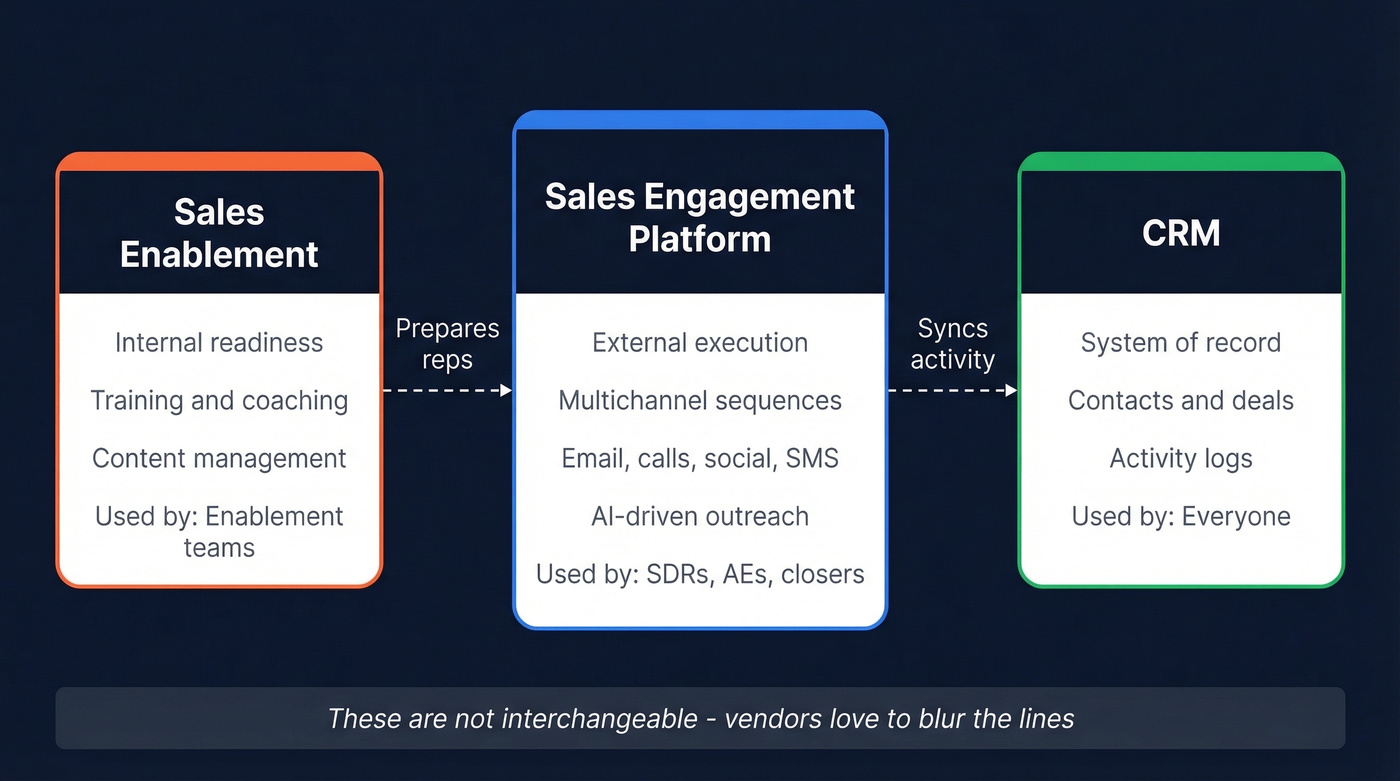
The terminology gets confusing fast. This table clears it up:
| Sales Engagement | Sales Enablement | CRM | |
|---|---|---|---|
| Focus | External execution | Internal readiness | System of record |
| What it does | Sequences, multichannel outreach, analytics | Training, content, coaching | Stores contacts, deals, activity logs |
| Who uses it | SDRs, AEs, closers | Enablement teams, managers | Everyone |
| Examples | Outreach, Salesloft, Apollo | Highspot, Seismic, Gong | Salesforce, HubSpot |
Engagement is how reps interact with prospects. Enablement is how you prepare reps to have those interactions. Your CRM records what happened. Most teams need all three working together, but they're not interchangeable - and vendors love to blur the lines.
Why This Category Exists
Sales reps spend 60% of their time on non-selling tasks. Data entry, toggling between tabs, manually logging calls, copy-pasting email templates. Meanwhile, 73% of B2B buyers actively avoid sellers who send irrelevant outreach.
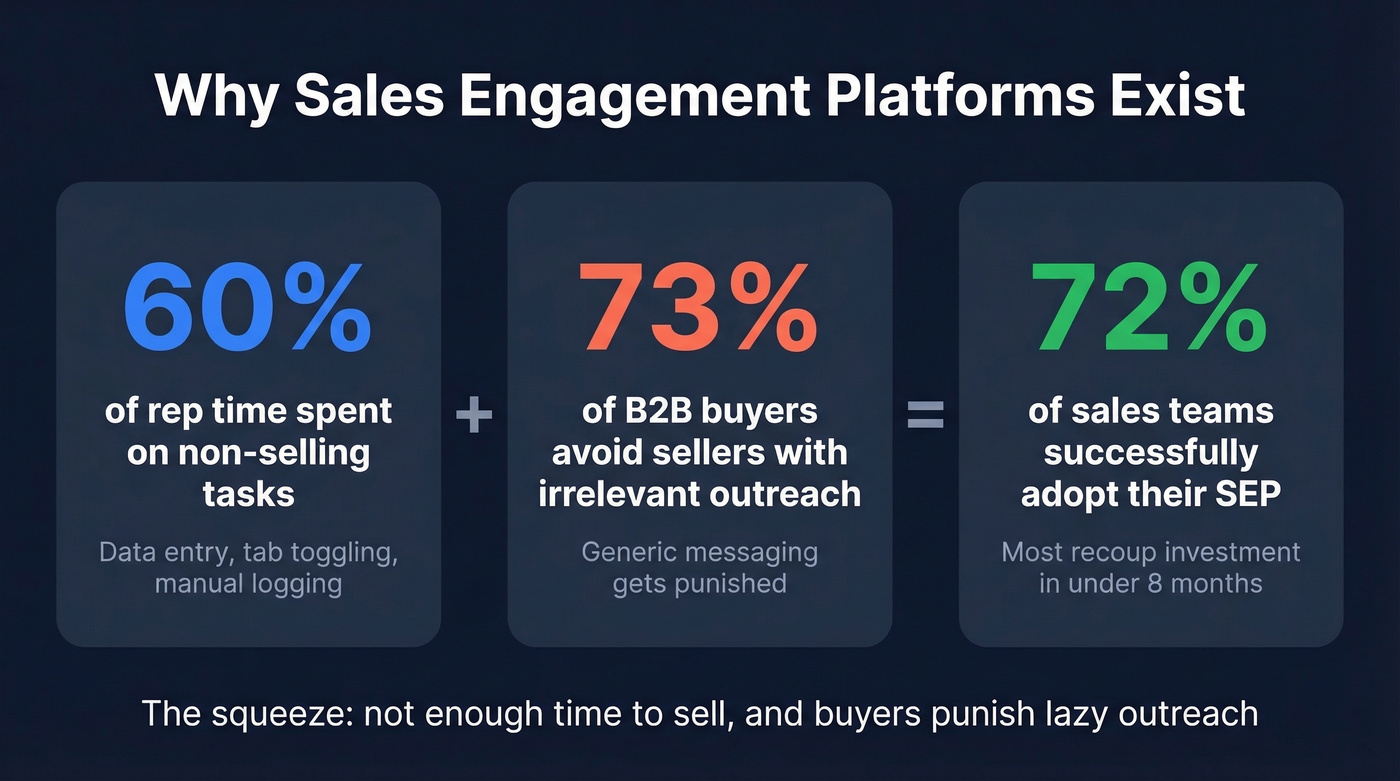
That's the squeeze: reps don't have enough time to sell, and when they do reach out, buyers punish generic messaging. These platforms automate the mechanical work - scheduling follow-ups, rotating channels, logging touches - so reps can focus on personalizing the moments that actually matter. G2 data shows 72% of sales teams successfully adopt their SEP, and most teams recoup their investment in under eight months.
The real question isn't whether you need one. It's which tool, at what price, and with what data underneath it.
Core Features to Evaluate
Not every SEP does everything well. Here's what actually moves pipeline, roughly in order of impact:
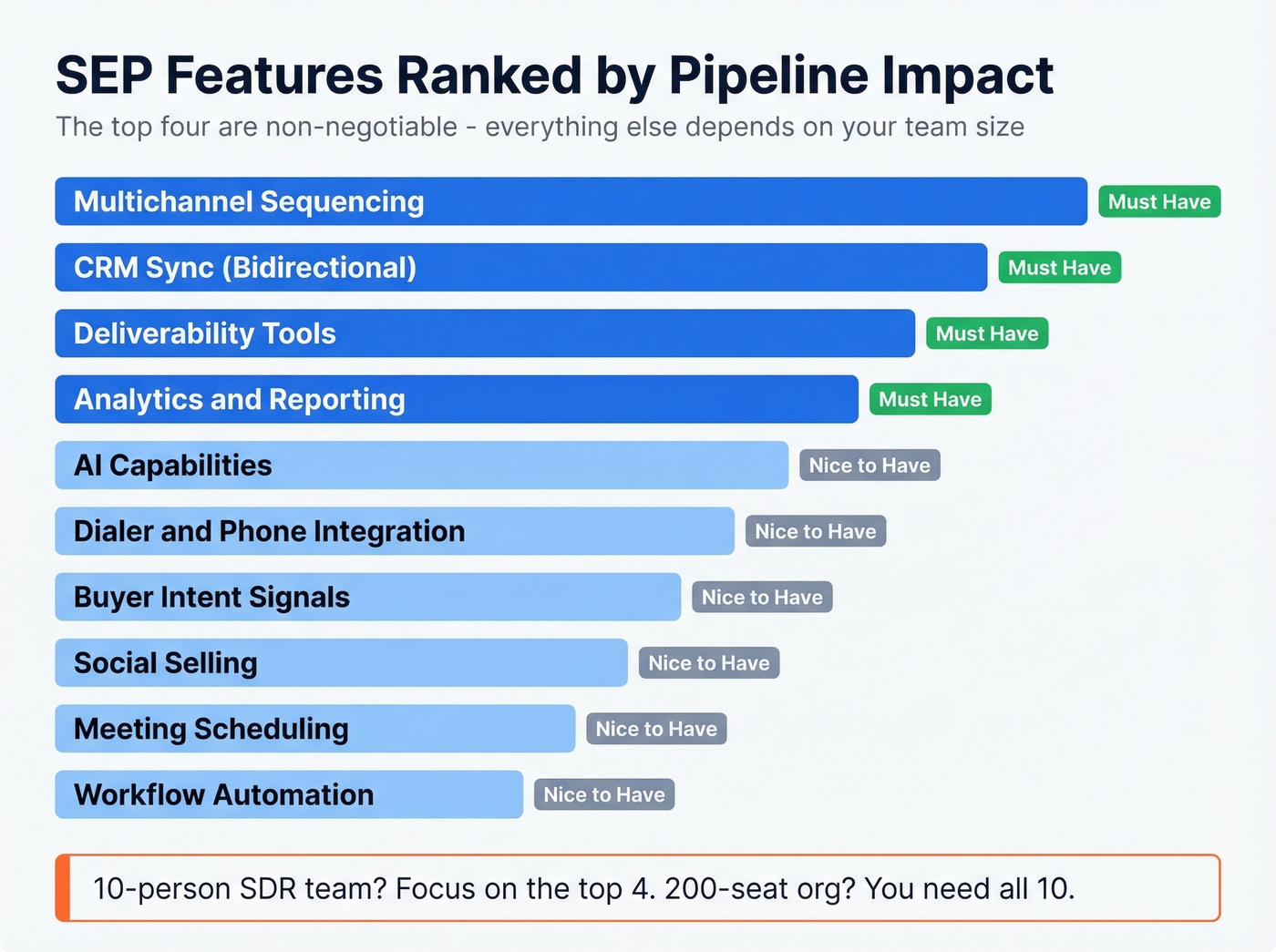
- Multichannel sequencing - Email, phone, social, and SMS steps in a single cadence. If it's email-only, it's not a real engagement tool.
- CRM sync - Bidirectional, real-time sync with Salesforce or HubSpot. One-way sync creates data nightmares.
- Deliverability tools - Domain warming, bounce detection, send-time optimization. Table stakes now. (If you're troubleshooting inboxing, start with an email deliverability audit.)
- Analytics and reporting - Step-level performance, rep activity dashboards, A/B testing. You can't optimize what you can't measure.
- AI capabilities - Email generation, call summaries, next-best-action suggestions. Quality varies wildly between vendors.
- Dialer / phone integration - Built-in or native VoIP. Check whether it's included or an add-on; this is where hidden costs live. (If you're building a calling motion, use a repeatable cold calling system.)
- Buyer intent signals - Knowing who's in-market before you sequence them changes everything about prioritization. (See identifying buying signals.)
- Social selling - Native social touches within cadences, not just email and phone.
- Meeting scheduling - Calendar integration, round-robin routing, automated booking links.
- Workflow automation - Trigger-based actions, lead routing, task creation.
The first four are non-negotiable. Everything else depends on your workflow and team size. A 10-person SDR team doesn't need enterprise workflow automation. A 200-seat org can't survive without it.
What These Platforms Actually Cost
Let's talk real numbers. Outreach and Salesloft don't publish pricing, which is frustrating - but community benchmarks and negotiation data give us a clear picture.
| Tool | Starting Price | ~50-Seat Annual Cost | Contract | Key Add-Ons |
|---|---|---|---|---|
| Outreach | ~$100-$140/user/mo | ~$60K-$84K (list) | Annual | Modules $20-50/user/mo |
| Salesloft | ~$180/user/mo | ~$108K (list) | Annual | Dialer $7,500/yr (25 users) |
| Apollo | $49/user/mo | ~$29K-$71K/yr | Monthly available | Credits expire monthly |
| HubSpot Sales Hub | $100/user/mo | ~$60K | Annual | Enterprise: $150/user/mo |
| Gong | ~$1,600/user/yr | ~$80K + platform fee | Annual | Platform fee $5K-$50K/yr |
| ZoomInfo Sales | Custom (enterprise) | ~$90K-$150K | Annual | Data credits extra |
| Instantly | ~$30/1K contacts/mo | Varies by volume | Monthly | Separate data costs |
| Salesforce SE | $50/user/mo | ~$30K | Annual | Requires Sales Cloud |
| Reply.io | ~$53/1K contacts/mo | Varies by volume | Monthly | - |
Hidden Costs That Blow Budgets
The sticker price is never the real price. Outreach implementation runs $5,000-$25,000 depending on complexity. Salesloft's dialer add-on costs $7,500/year for just 25 users, and their Bionic Chatbot is another $10,000/year. Apollo's credits expire every billing cycle - if you don't use them, you lose them.
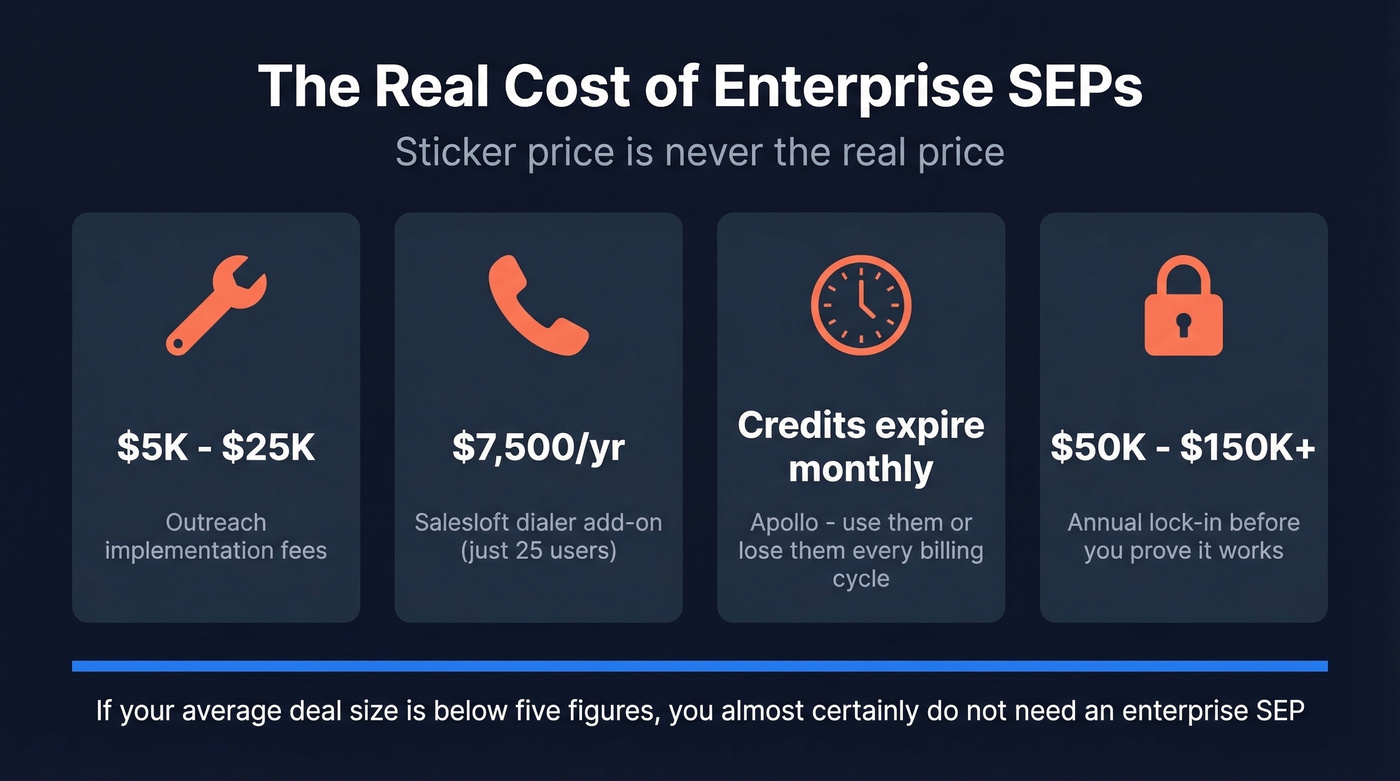
Annual contract lock-in is standard for Outreach and typical for enterprise tools like Salesloft and ZoomInfo. That means you're committing $50K-$150K+ before you've proven the tool works for your team. Always push for a pilot period before signing a full annual deal. (If you want a negotiation framework, use an anchor in negotiation and set a clear walk away point.)
Here's the thing: if your average deal size sits below five figures, you almost certainly don't need an enterprise SEP. A $200/month stack of lightweight tools will outperform a $100K/year platform that your reps half-adopt because it's too complex.

Every sales engagement platform on this list runs on data - and bad data is the fastest way to burn your domain and waste your budget. Prospeo feeds your sequences with 98% verified emails, 125M+ direct dials, and buyer intent signals across 15,000 topics. At $0.01 per email, your data layer costs less than one Outreach seat.
Stop paying six figures for a SEP and feeding it garbage data.
Best Platforms for 2026
Outreach
Use it if you're an enterprise team (50+ reps) that needs deep sequencing, multi-step cadences across channels, and granular analytics. Outreach's workflow engine is one of the most powerful in the category, and its Gartner Peer Insights rating of 4.5 stars across 185 ratings reflects that depth. The base Engage module runs $100-$140/user/month, but most teams end up adding Meet, Deal, or Forecast modules at $20-$50/user/month each. A fully loaded 50-seat deployment can hit $100K+ before implementation fees. Negotiate 15-35% off list, and get implementation fee waivers in writing on multi-year deals. (If you're rolling this out, follow a structured implementing a sales engagement platform plan.)
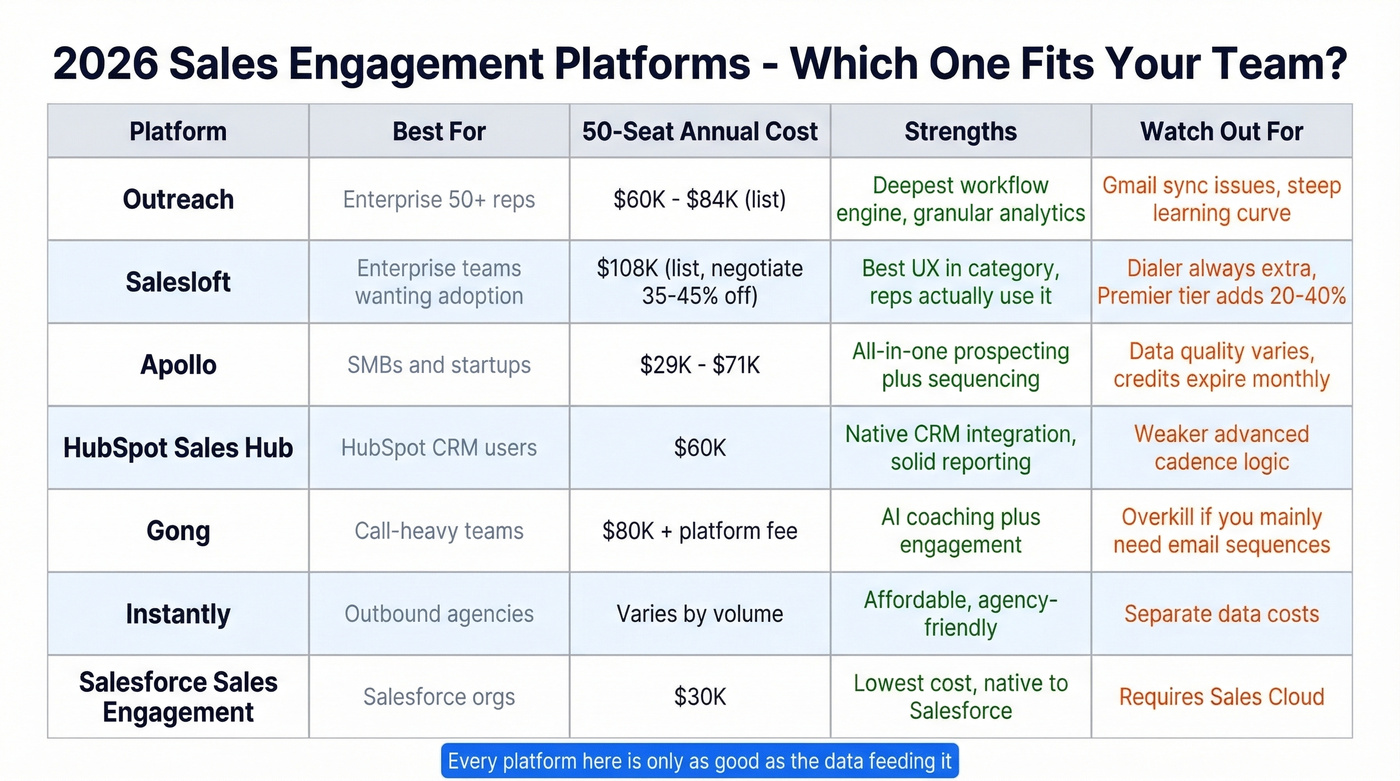
Skip it if you're under 25 seats, need fast implementation, or run Gmail-heavy workflows. Reddit practitioners flag Gmail sync issues - sent emails sometimes can't be viewed, and the UX has rough edges that frustrate reps used to simpler tools. The learning curve is steep, so expect 2-4 weeks before reps are fully productive.

SalesLoft
Salesloft is the platform teams actually enjoy using. Its Gartner rating of 4.4 across 284 ratings speaks to broad adoption, and the cadence builder is genuinely intuitive. If your biggest risk is reps not adopting the tool, Salesloft reduces that friction better than anyone else in the category.
The catch is price. Salesloft Advanced lists at ~$180/user/month - for 50 seats, that's $108,000/year before add-ons. Vendr data shows 35-45% discounts are typical with negotiation, bringing effective cost to ~$125/user/month. The dialer is always extra, and Premier tier (which adds forecasting) runs 20-40% above Advanced. Bundle everything before you sign. Adding modules later always costs more.

Apollo.io
Apollo gives you prospecting, sequencing, and data in one platform for $49/user/month. The free tier (50 credits, 2 sequences) lets you test before committing. For startups and SMBs that can't justify $50K+ on separate tools, it's the most accessible entry point in the category. (If you're still building your outbound motion, start with these sales prospecting techniques.)
The tradeoff is quality. The consensus on r/sales is that Apollo is a "jack of all trades, master of none." The data is user-populated rather than independently verified, which means accuracy degrades fast outside common ICPs. Apollo's dialer runs on Twilio VoIP numbers that practitioners report are frequently flagged as spam, and the email tracking infrastructure can actually hurt deliverability - experienced outbound teams recommend keeping Apollo lists tight around ~1,000 ICPs rather than blasting broadly.
The credit system is the other cost driver. Credits expire every billing cycle, and consumption varies based on your ICP and geography. A team on the Professional plan ($79/user/month) that burns through mobile reveals and enrichment credits can easily double their effective cost. Get credit rollover in writing if you can.
HubSpot Sales Hub
HubSpot Sales Hub is the obvious pick for teams already running HubSpot CRM. At $100/user/month (Professional) or $150/user/month (Enterprise), it's not cheap - but you avoid the integration headaches that plague standalone SEPs. The sequencing is solid, the reporting ties directly into your CRM data, and Gartner rates it 4.4 across 97 ratings. (If you're comparing CRMs, see examples of a CRM.)
Where it falls short compared to Outreach or Salesloft: advanced cadence logic, multi-threading across buying committees, and phone-heavy workflows. If your sales motion is primarily email-driven and your CRM is already HubSpot, stop looking.
Gong
Gong started as conversation intelligence and is repositioning as a full engagement platform. The pricing reflects its enterprise roots: a platform fee of $5,000-$50,000/year plus $1,050-$1,600/user/year depending on volume. For teams that live on calls and need AI-powered coaching alongside sequencing, Gong's combination is unique. But if you primarily need email sequencing and multichannel cadences, you're paying for capabilities you won't use. Gong is a conversation platform that added engagement features - not the other way around.
Clari (4.3 stars, 310 ratings on Gartner) occupies similar territory, focusing on revenue intelligence and forecasting. Neither replaces a dedicated sequencing tool, but both add a layer of deal intelligence that pure SEPs lack.
Instantly
Instantly is the tool outbound agencies love. Starting at ~$30/1,000 contacts per month with unlimited email accounts, it's built for cold email at scale. The warmup infrastructure is solid, the UI is dead simple, and you can be sending within hours.
What it doesn't include: a built-in database or phone dialer. Pair it with a dedicated data verification tool - sending unverified emails through Instantly defeats the purpose of its deliverability features. (If you're scaling volume, watch your email velocity and stay under safe thresholds.)
Salesforce Sales Engagement
At $50/user/month, Salesforce's native engagement tool is the cheapest option on this list - but it requires a Sales Cloud subscription underneath it. Microsoft Dynamics 365 Sales offers similar native engagement features for teams in the Microsoft ecosystem. If you're already deep in either platform, native tools eliminate integration complexity entirely. For everyone else, they're too limited to justify the CRM dependency.
Reply.io and ZoomInfo Sales
Reply.io offers multichannel sequences starting at ~$53/1,000 active contacts per month. It's a solid mid-market alternative with email, phone, and social touches in a single workflow - not as deep as Outreach or Salesloft, but significantly cheaper and faster to implement.
ZoomInfo bundles engagement features with its massive contact database, making it the closest thing to a true all-in-one for enterprise teams. Expect $90K-$150K/year for a 50-seat deployment with data credits. The data is strong for North American contacts, but contracts are rigid, and the engagement features aren't as deep as dedicated SEPs. Most teams that buy ZoomInfo still end up running a separate sequencing tool alongside it.
The Data Layer Most Teams Ignore
We see this scenario constantly: an SDR team launches sequences through Outreach or Salesloft, and within two weeks their bounce rate hits 30%. Their domain reputation tanks. Emails land in spam. The sequences were fine - the data underneath them was garbage.
This is one of the most expensive mistakes in outbound sales, and it's entirely preventable. Your SEP is an execution engine. It sends what you tell it to send, to whoever you tell it to send to. If 20% of those email addresses are invalid, you're not just wasting sequences - you're actively damaging your sender reputation. Once that reputation drops, even your good emails stop reaching inboxes. (If you're diagnosing this, start with email bounce rate benchmarks and fixes.)
Outreach and Salesloft don't include contact data at all. Apollo bundles data, but accuracy is inconsistent. ZoomInfo has strong data but locks you into expensive annual contracts. That's why a dedicated data verification layer matters regardless of which SEP you choose. (If you're evaluating vendors, compare data enrichment services and how they handle refresh + verification.)
Prospeo sits underneath your engagement platform as the data quality foundation - 98% email accuracy, a 7-day refresh cycle versus the six-week industry average, and 125M+ verified mobile numbers with a 30% pickup rate. It integrates natively with Outreach, Salesloft, HubSpot, Salesforce, Instantly, and Lemlist, so verified contacts flow directly into your cadences without manual exports.
Snyk's team of 50 AEs was running a 35-40% bounce rate before switching their data layer. After moving to Prospeo, bounces dropped under 5% and AE-sourced pipeline jumped 180%. That's not a platform problem. It's a data problem that no SEP can fix on its own.
That RevOps lead's 4,000-duplicate nightmare? It starts with dirty data, not bad software. Prospeo's 7-day refresh cycle, 5-step verification, and native integrations with Salesforce, HubSpot, Instantly, and Smartlead mean your engagement platform gets clean contacts from day one - with automatic deduplication built in.
Fix your data before you fix your sequences.
How to Choose by Team Size
Enterprise (100+ reps) - Salesloft or Outreach as your sequencing engine, Gong for conversation intelligence, and a dedicated data verification layer to protect domain reputation at scale. Budget $150K-$250K/year total. Implementation alone takes 4-8 weeks, so factor that into your timeline.
Mid-market (20-100 reps) - HubSpot Sales Hub if you're already on HubSpot CRM. Salesloft Advanced if you need more sophisticated cadence logic. Either way, verify your data before loading it - a 10% bounce rate at this volume is enough to trigger spam filters.
SMB and startups (<20 reps) - Skip the enterprise tools entirely. Pair a lightweight sending tool like Apollo or Instantly with a verified data layer for a fraction of enterprise pricing. You'll get better data accuracy and spend under $200/month total instead of $50K+/year.
Outbound agencies - Instantly or Smartlead for sending infrastructure, plus verified contact data across client campaigns. Agencies can't afford domain flags on client accounts. One bad list can cost you the relationship.
Negotiating Your Contract
Enterprise SEP pricing is a negotiation, not a price tag. We've watched teams save 30-40% just by walking in prepared. These tactics work:
- Benchmark before you call. Salesloft Advanced lists at ~$180/user/month, but 35-45% discounts are standard. Outreach discounts run 15-35%. Walk in knowing these numbers.
- Bundle add-ons before signing. Dialer, chatbot, forecasting - get them quoted as part of the initial deal. Adding modules post-signature always costs more.
- Push for monthly billing or quarterly opt-outs. Most vendors default to annual. Some will offer quarterly exit clauses on multi-year deals if you ask.
- Get implementation fee waivers in writing. On multi-year commitments, implementation fees ($5K-$25K for Outreach) should be negotiable.
- Demand credit rollover. On Apollo or any credit-based platform, unused credits that expire monthly are a hidden tax. Get rollover language in your contract.
- Request a pilot period. 30-60 days with a subset of reps before committing the full team. Any vendor that refuses a pilot isn't confident in their own product.
FAQ
What's the difference between sales engagement and sales enablement?
Sales engagement covers external execution - sequences, multichannel outreach, and analytics that help reps interact with prospects. Sales enablement covers internal readiness - training, content management, and coaching. Your CRM is the system of record underneath both. Most teams need all three working together, but they solve different problems.
Are there free sales engagement tools?
Apollo offers a free tier with 50 credits and 2 sequences. HubSpot has a free CRM with basic email tracking. Prospeo provides 75 verified emails per month on its free plan, covering the data layer. For serious outbound, expect to pay - but lightweight tools like Instantly start at ~$30/month, far cheaper than enterprise alternatives.
Do I need a separate data provider with my SEP?
Outreach and Salesloft don't include contact data at all. Apollo bundles data, but accuracy is inconsistent since it's user-populated. A dedicated verification tool with 98% email accuracy and a weekly refresh cycle ensures your sequences run on clean data - bad contacts tank deliverability no matter how good your platform is.
What are sales engagement platforms best suited for?
They're best suited for teams running repeatable outbound motions across multiple channels. If your reps send more than 50 touches per day across email, phone, and social, a dedicated SEP automates the mechanical work and keeps every interaction logged in your CRM. Teams with fewer than five reps or purely inbound motions can often get by with native CRM tools.
How long does it take to see ROI?
Most teams recover their investment in under eight months. The biggest variable isn't the platform - it's data quality and sequence design. Clean data and relevant messaging accelerate ROI. Bad data delays it indefinitely and can actively damage your sender reputation in the process.