

The 10 Best Sales Generator Tools in 2026
You sent 200 cold emails last week. 47 bounced. Three got replies - one was "please remove me from your list." That's not a pipeline problem. It's a tooling problem.
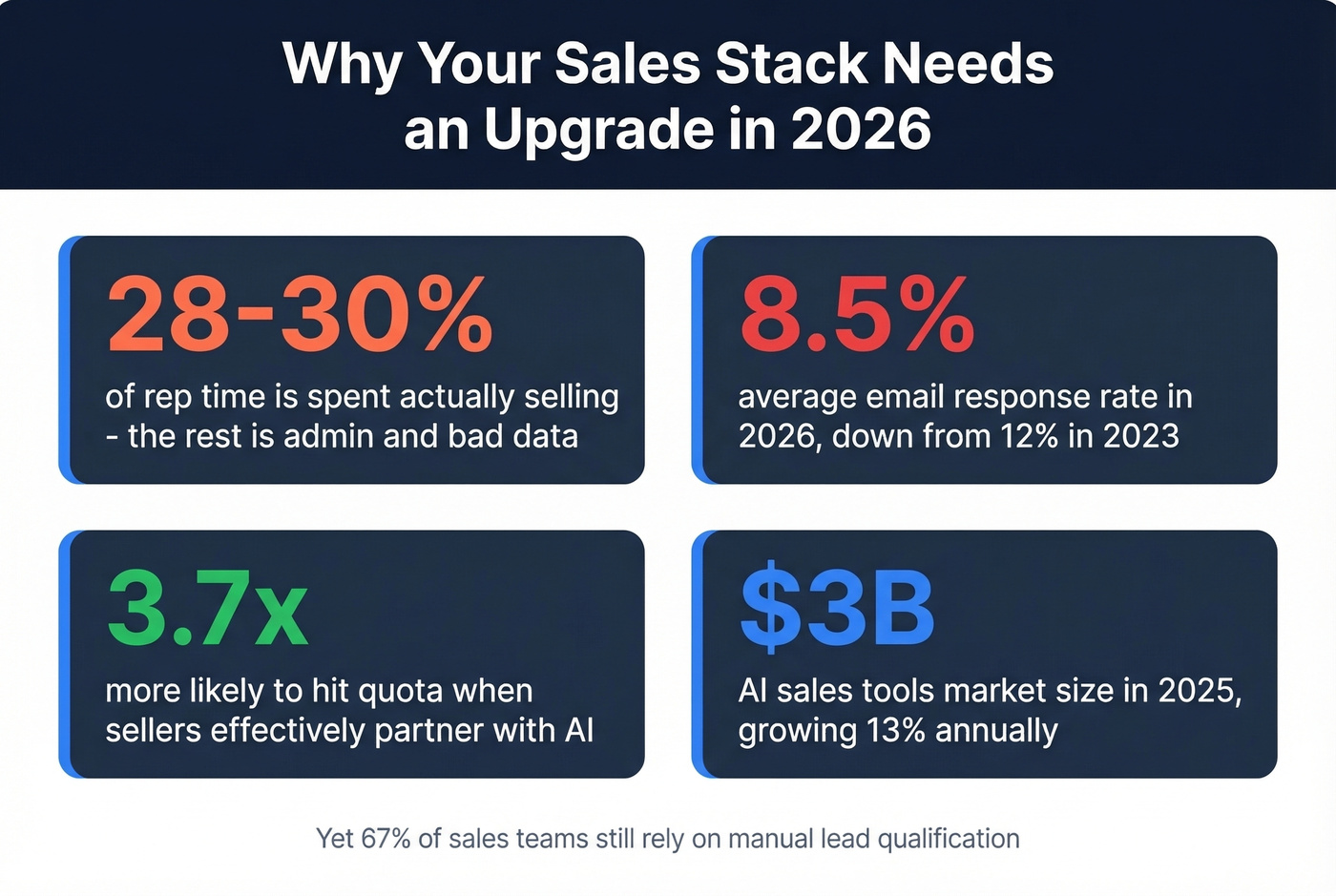
Reps spend just 28-30% of their time actually selling, and the rest vanishes into admin, research, and fixing bad data. Average email response rates have dropped to 8.5% in 2026, down from 12% in 2023. The leads are harder to reach, the channels are noisier, and the tools that worked two years ago aren't cutting it. With AI-equipped SDRs now contacting 200+ prospects per day versus 50-60 manually, teams without the right sales generator are bringing a knife to a drone fight.
Our Picks (TL;DR)
| Use Case | Tool | Why | Starting Price |
|---|---|---|---|
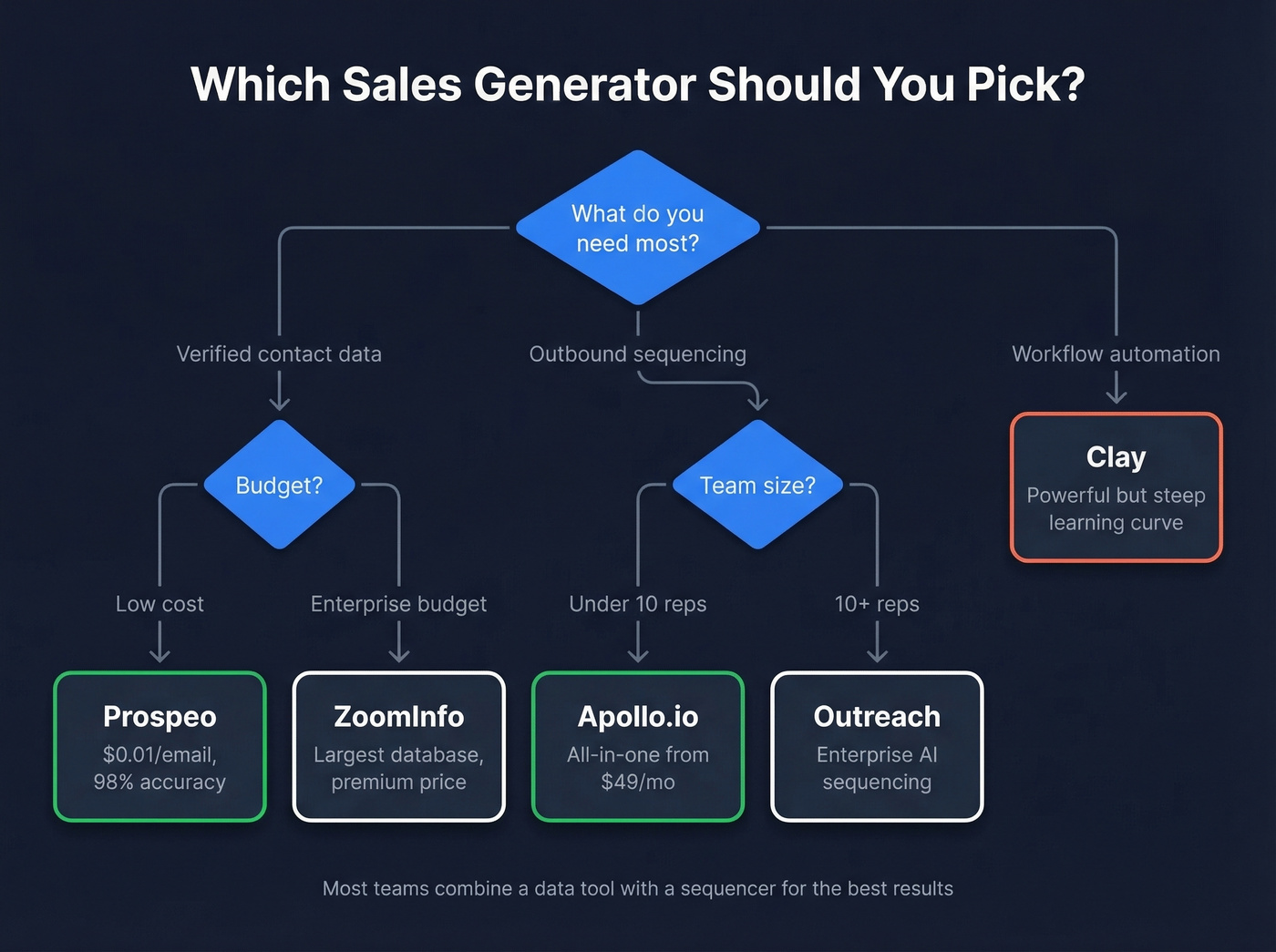
| Best data accuracy | Prospeo | 98% email accuracy, 30% mobile pickup rate, 7-day refresh | Free / ~$0.01/email |
| Best budget all-in-one | Apollo.io | 275M contacts + sequencing | Free / $49/user/mo |
| Best for HubSpot teams | HubSpot Sales Hub | Native CRM integration | $50/user/mo |
| Best enterprise sequencing | Outreach | AI deals close 11 days faster | ~$100-150/user/mo |
| Best for automation nerds | Clay | Powerful enrichment workflows | $134/mo |
What Is a Sales Generator?
"Sales generator" is an umbrella term, and that's part of the problem. ClickFunnels uses it to mean AI that writes sales scripts and funnels. Reddit users mean lead gen tools. Enterprise buyers mean full-stack revenue platforms. The term covers at least four distinct categories:
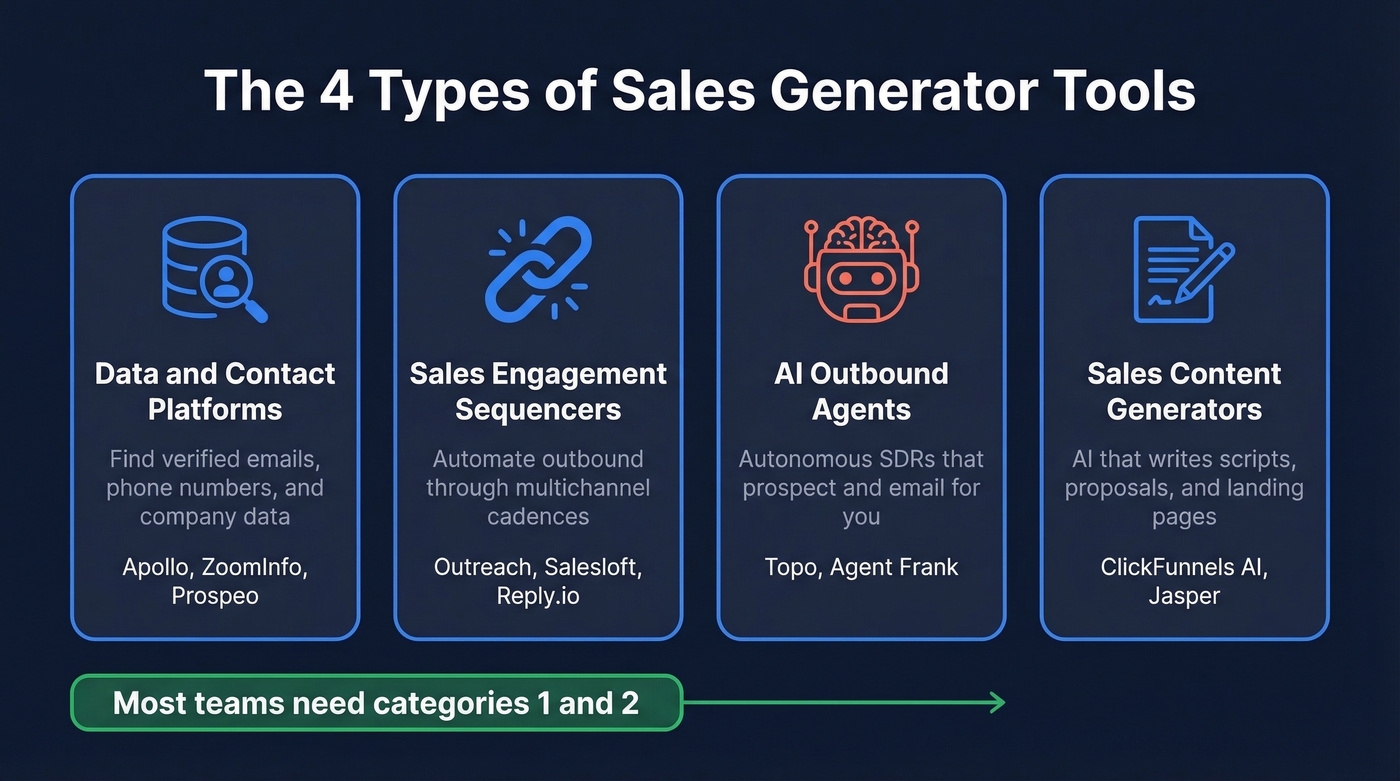
- Data and contact platforms - tools that find verified emails, phone numbers, and company data (Apollo, ZoomInfo)
- Sales engagement sequencers - tools that automate outbound through multichannel cadences (Outreach, Salesloft, Reply.io)
- AI outbound agents - autonomous SDR services that prospect and email on your behalf (Topo, Salesforge's Agent Frank)
- Sales content generators - AI that writes scripts, proposals, and landing pages (a different beast entirely)
Most teams searching for a sales generator need something from categories one and two. The AI sales tools market hit $3B in 2025 and is growing around 13% annually, yet 67% of sales teams still rely on manual processes for lead qualification. Sellers who effectively partner with AI are 3.7x more likely to meet quota - but the gap between what's available and what teams actually deploy remains massive.
The category you pick matters more than the specific tool. A team that needs verified contact data shouldn't be evaluating sequencing platforms, and vice versa. The list below covers all four categories, but we've weighted it toward data and engagement tools - that's where the search intent lands.
The 10 Best Sales Generator Tools
1. Prospeo - Best for Data Accuracy
Prospeo's database covers 300M+ professional profiles, 143M+ verified emails, and 125M+ verified mobile numbers with a 30% pickup rate - roughly 2.4x ZoomInfo and 2.7x Apollo on mobile pickup. Email accuracy sits at 98%, powered by a proprietary 5-step verification process with catch-all handling, spam-trap removal, and honeypot filtering. Data refreshes every 7 days versus the 6-week industry average.
If you're comparing providers, start with B2B company data coverage and refresh cadence before you look at UI features.
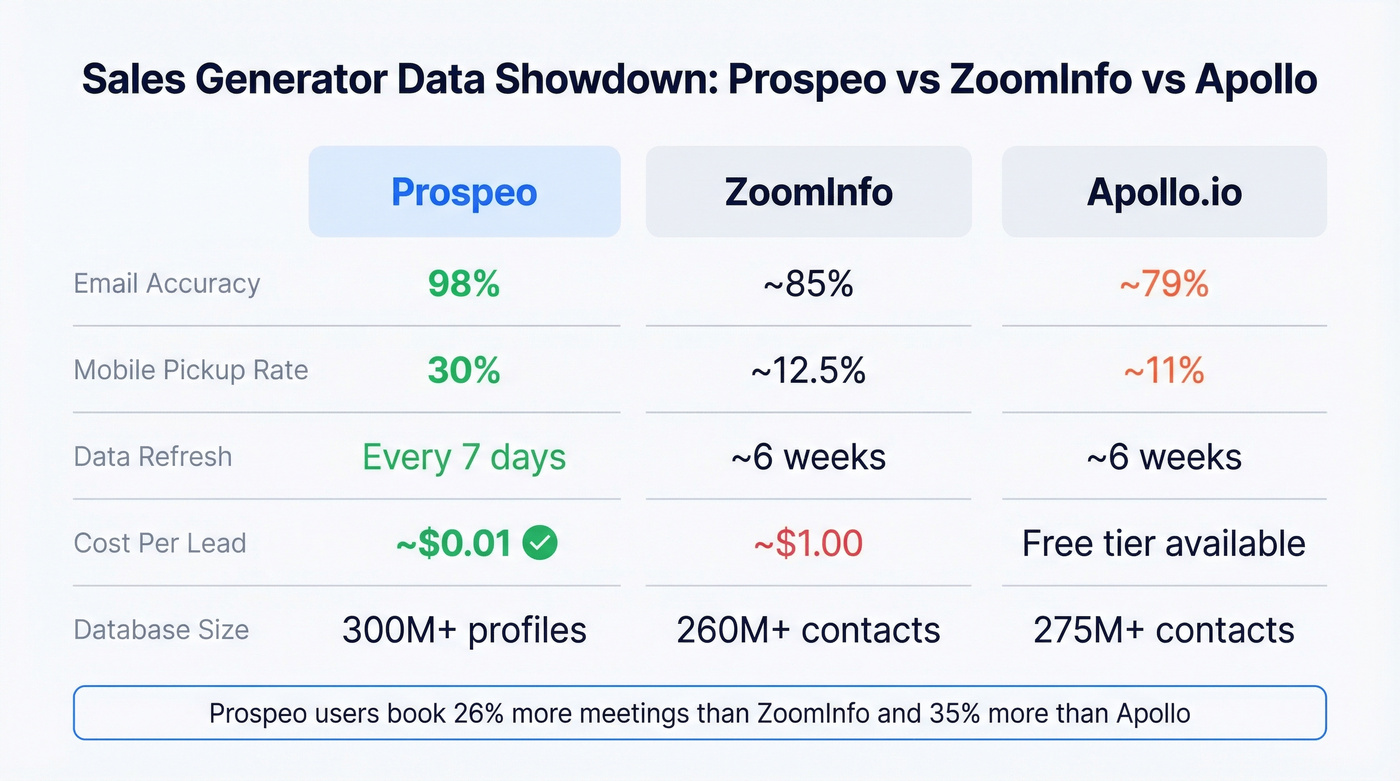
The search interface offers 30+ filters including buyer intent data via 15,000 Bombora topics, technographics, job changes, headcount growth, and funding rounds. The Chrome extension works on company websites, professional profiles, and CRMs. Native integrations push contacts straight into Salesforce, HubSpot, Smartlead, Instantly, Lemlist, and Clay. Teams using Prospeo book 26% more meetings than ZoomInfo users and 35% more than Apollo users.
Here's a real example: Snyk's 50 AEs cut bounce rates from 35-40% down to under 5%, and AE-sourced pipeline jumped 180% - generating 200+ new opportunities per month.

Pricing: Free tier gives you 75 verified emails + 100 Chrome extension credits per month. Paid plans run about $0.01 per email - roughly 90% cheaper than ZoomInfo's ~$1/lead - with no contracts.
Use this if: You need verified contact data that won't destroy your sender reputation. Pair it with a sequencer like Outreach or Instantly for the full workflow. If you want a deeper dive on cleaning lists, see data enrichment.
2. Apollo.io - Best Budget All-in-One
Apollo is the obvious starting point for SMB teams that want prospecting and sequencing in one platform. The database covers 275M+ contacts, there's a generous free plan, and paid tiers start at $49/user/month. You get built-in email sequences, a dialer, and basic intent signals without buying separate tools.
The tradeoff is data quality. Apollo's email accuracy runs around 79% - workable for small volumes, but at scale you'll see far more invalid addresses than with a dedicated verification-first provider. For a Series A team running lean, Apollo's all-in-one convenience outweighs the accuracy gap. For teams doing serious volume, verify Apollo contacts through a dedicated data tool before sending.
If you're building a full outbound stack, it helps to map Apollo against other outbound lead generation tools before you commit.
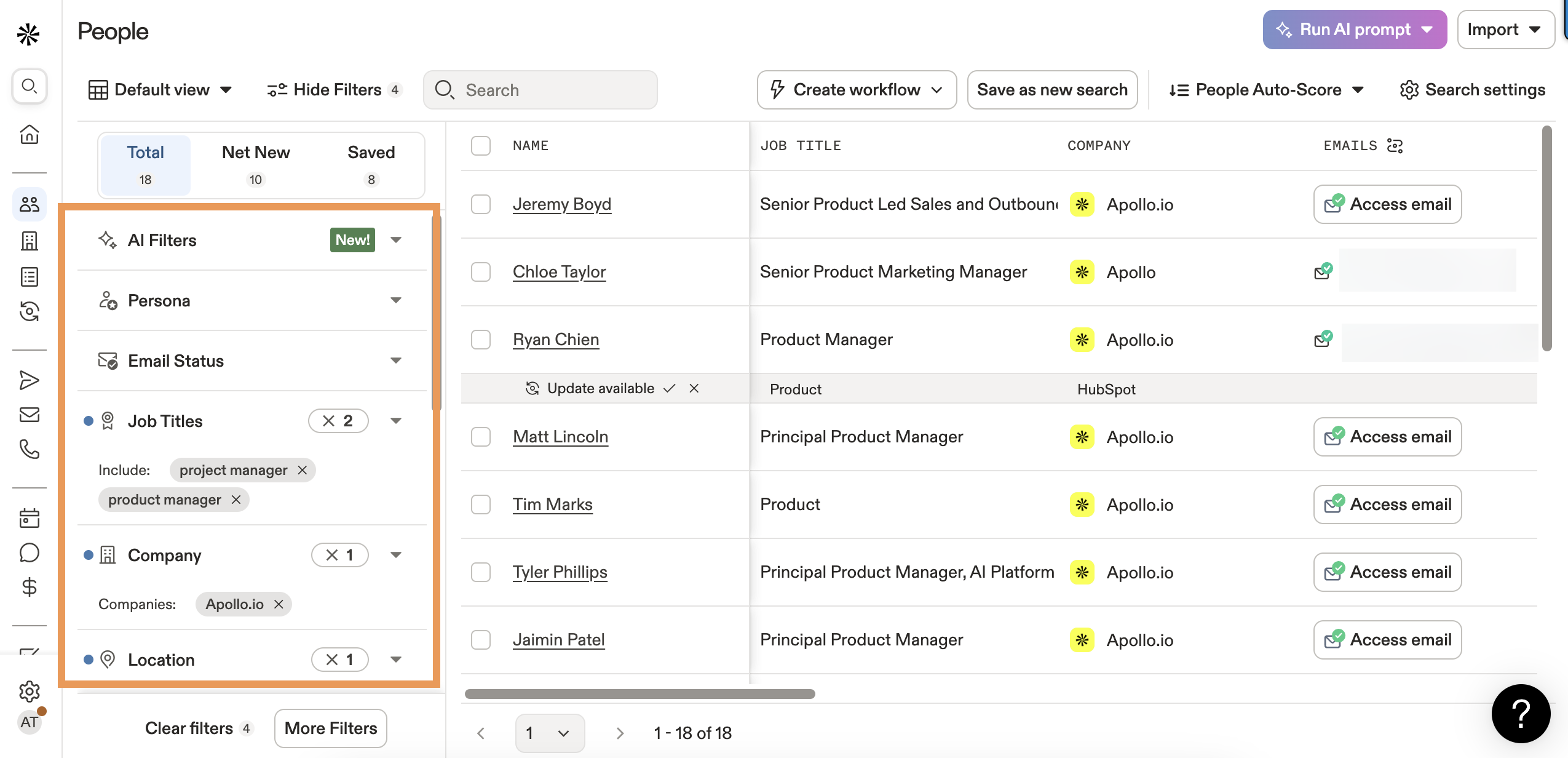
Pricing: Free plan available. Paid from $49/user/month (Basic), scaling to $99+ for Professional.
Use this if: You're an early-stage team that needs one tool for prospecting, sequencing, and basic CRM - and your send volumes are moderate.
Skip this if: You're sending at scale and can't afford high bounce rates. The cost savings evaporate when your domain gets flagged.
3. HubSpot Sales Hub - Best for HubSpot Teams
If your CRM is HubSpot, Sales Hub is the path of least resistance. Email tracking, meeting scheduling, deal pipelines, playbooks, and sequences all live inside the same interface your reps already use. No integration headaches, no syncing delays, no duplicate records from a third-party tool pushing data in.
Starter runs $50/user/month. Professional jumps to roughly $450/month for 5 users, which includes automation workflows, custom reporting, and forecasting. The contact database isn't HubSpot's strength - you'll still want a dedicated data provider feeding contacts into the CRM. Where HubSpot wins is workflow depth for teams already embedded in the ecosystem.
If you're still deciding on a CRM, compare a few examples of a CRM before you lock in.
Pricing: Starter from $50/user/month. Professional ~$450/month for 5 users. Enterprise: talk to sales.
Use this if: Your team lives in HubSpot and you want sequences, tracking, and pipeline management without adding another vendor.
Skip this if: You're not already on HubSpot. Migrating CRMs just for Sales Hub isn't worth the pain.
4. Outreach - Best Enterprise Sequencing
Outreach is the enterprise standard for sales engagement. Deals where reps use Outreach's AI tools close 11 days faster on average. Opportunities closed within 50 days hit a 47% win rate; beyond that threshold, win rates drop to 20% or lower. Their AI cuts research and personalization time by 90%, which matters when your SDRs are running 200+ prospect touches per day.
The platform covers multichannel sequences, conversation intelligence, deal management, and forecasting. It's genuinely powerful - and genuinely expensive. Outreach doesn't publish pricing. Expect $100-150/user/month on an annual contract, with minimums that often push total cost into the $30-50K/year range for teams in the 20-30 seat range.
If you're planning rollout, read up on implementing a sales engagement platform before you buy seats.

Pricing: Custom. Estimate ~$100-150/user/month, annual contracts.
Use this if: You're running a 10+ person sales team and need enterprise-grade sequencing with AI assist and conversation intelligence.
Skip this if: You're a 3-person team. The implementation overhead and cost don't make sense below a certain headcount.
Quick orientation before we continue: The four tools above are Tier 1 - full-featured platforms that anchor most sales stacks. The next six are more specialized. Some are enterprise alternatives, some are budget plays, and some solve a single problem extremely well. Pick based on the gap in your current stack, not feature count.
5. SalesLoft - Enterprise Alternative
Salesloft competes directly with Outreach as a revenue orchestration platform: engagement, conversation intelligence, deal management, and revenue intelligence bundled together. The feature sets are close enough that the decision usually comes down to UX preference and existing integrations.
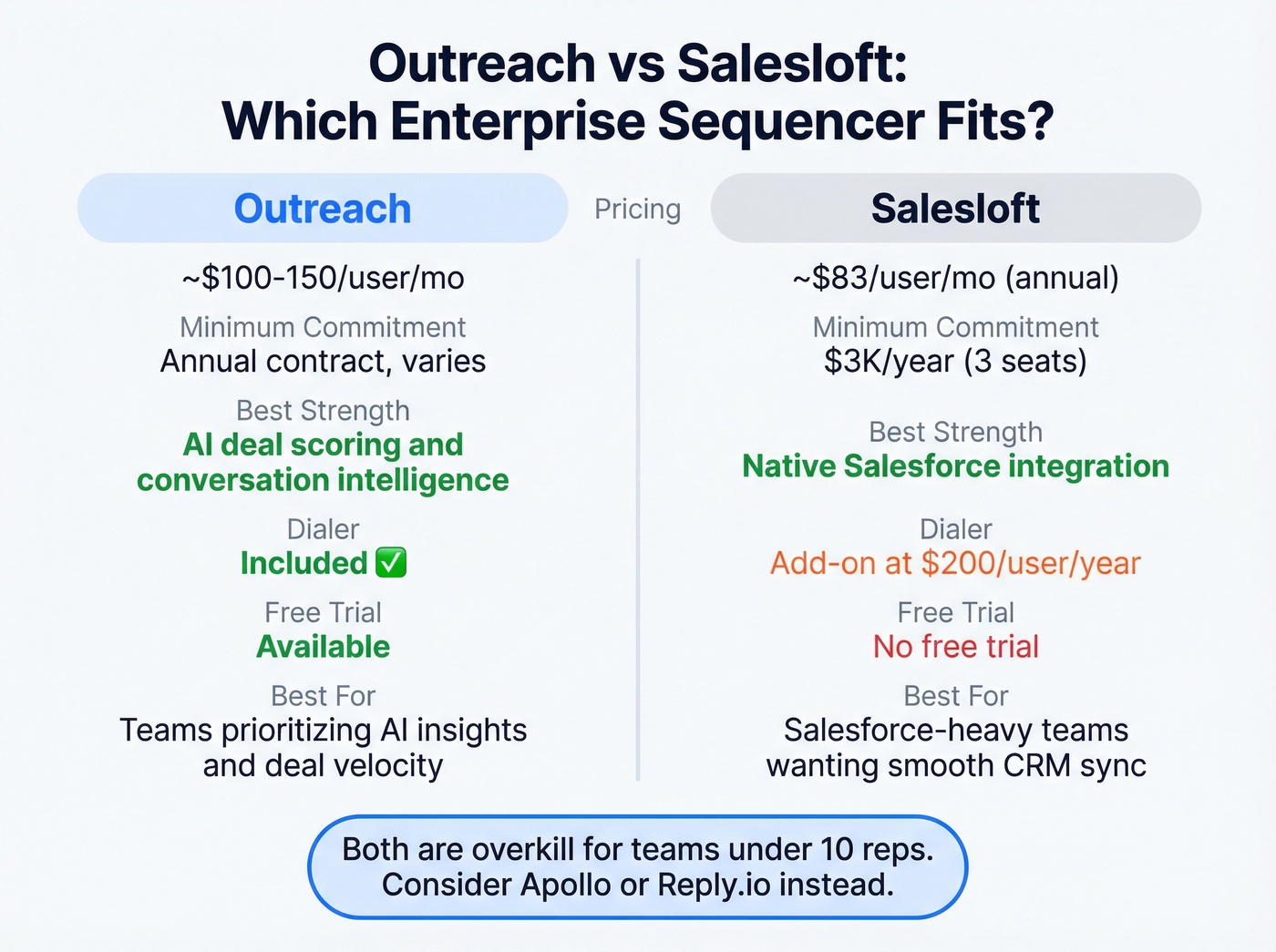
Salesloft won't show you pricing until you book a demo - there's no free trial either. Expect roughly $1,000/user/year with a 3-seat minimum, so you're looking at $3,000/year minimum commitment. The dialer is an add-on at $200/user/year. Two-year contracts knock about 14% off per-user cost.
Pricing: ~$1,000/user/year, 3-seat minimum. Dialer add-on $200/user/year.
The Outreach vs. Salesloft decision: If your team already uses Salesforce heavily, Salesloft's native integration tends to be smoother. If you prioritize conversation intelligence and AI deal scoring, Outreach has a slight edge. Both are overkill for teams under 10 reps.
6. Clay - Best for Automation Workflows
Clay is the tool that RevOps engineers love and everyone else finds bewildering. It's a workflow builder for lead enrichment, ICP scoring, and automated outreach - think spreadsheet meets API orchestration.
Reddit sentiment captures it well. Users on r/gtmengineering describe "hidden logic" and interfaces that aren't "super intuitive," while power users on r/sales rave about building ICP grading formulas, AI-personalized outreach, and enrichment flows triggered by Slack forms. If you don't think in workflows and APIs, skip it. If you do, Clay is one of the most powerful tools on this list.
If you're trying to estimate real usage costs, see Clay list building.
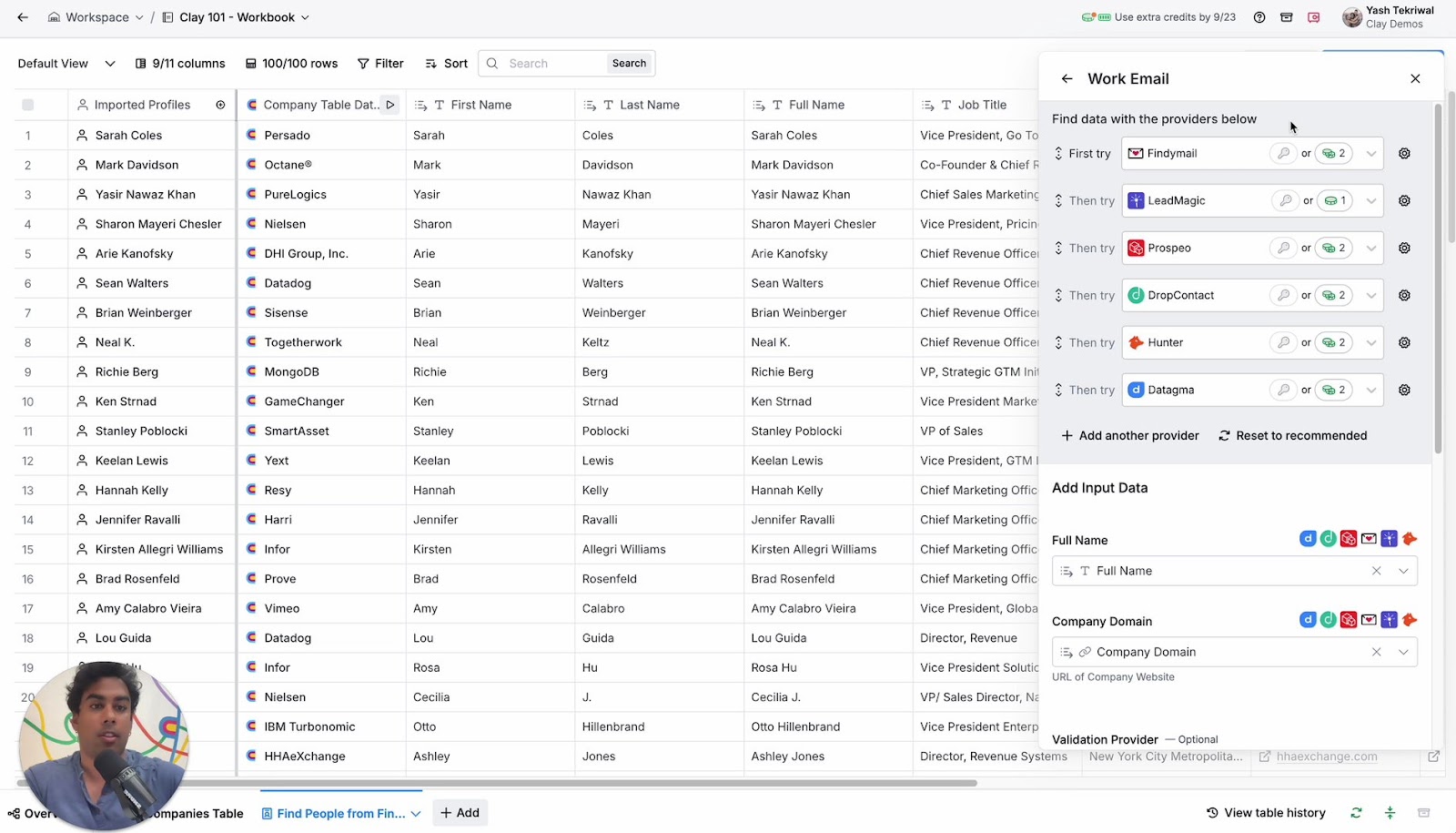
Pricing: From $134/month (credit-based). Costs scale with usage and stack up fast when running multiple workflows.
7. Salesforge - Budget Outbound
Salesforge is built for teams that need volume outbound without enterprise pricing. The Pro plan runs $48/month for 1,000 active contacts and 5,000 emails. Growth bumps to $96/month with 10,000 contacts, 50,000 emails, and unlimited mailboxes. The AI SDR add-on (Agent Frank) costs $599/month billed quarterly - steep for an add-on, but still a fraction of a human SDR's ~$139K/year fully loaded cost.
Pricing: Pro $48/mo. Growth $96/mo. AI SDR add-on $599/mo.
8. Reply.io - Mid-Market Multichannel
Reply.io sits in the middle ground between budget outbound tools and enterprise platforms. Starting at $500/month, you get multichannel sequences spanning email, phone, and social touches. The platform handles deliverability basics like warm-up and rotation, and the UI is more approachable than Clay or Outreach. A solid pick for mid-market teams that have outgrown Apollo's built-in sequences but aren't ready for Outreach pricing.
If follow-up is your bottleneck, pair your sequencer with proven sales follow-up templates.
Pricing: From $500/month.
9. Warmly - Website Visitor Intent
Warmly identifies anonymous website visitors and triggers real-time outreach based on intent signals. Starting at $10,000/year, it's best for teams with significant web traffic who want to convert browsers into pipeline. Niche, but effective if inbound is a major channel for you.
Pricing: From $10,000/year.
10. Topo - Managed AI SDR Service
Topo runs outbound for you - a managed AI SDR service starting at $750/month, positioned as roughly 10x cheaper than a fully loaded human SDR. Worth exploring if you want to generate leads automatically without hiring, but you're handing over control of your messaging and brand voice. For teams that care deeply about tone and positioning, that tradeoff can sting.
Pricing: From $750/month.

Your sales generator stack is worthless if half your emails bounce. Prospeo's 300M+ profiles hit 98% email accuracy with a 7-day refresh cycle - so every contact you pull is current, verified, and ready to convert.
Stop generating leads that bounce. Start generating pipeline.
Snyk's 50 AEs dropped bounce rates from 35% to under 5% and added 200+ new opportunities per month. At $0.01 per email - 90% cheaper than ZoomInfo - Prospeo is the sales generator that pays for itself on day one.
Book 26% more meetings than ZoomInfo users. The data proves it.
Pricing Comparison Table
| Tool | Starting Price | Free Tier? | Model | Best For |
|---|---|---|---|---|
| Prospeo | ~$0.01/email | Yes (75 emails/mo) | Credit-based | Data accuracy |
| Apollo.io | $49/user/mo | Yes | Per-seat | Budget all-in-one |
| HubSpot Sales Hub | $50/user/mo | No | Per-seat + tier | HubSpot teams |
| Salesforge | $48/mo | No | Tiered | Budget outbound |
| Clay | $134/mo | Limited | Credit-based | Automation workflows |
| Reply.io | $500/mo | No | Tiered | Mid-market multichannel |
| Topo | $750/mo | No | Managed service | Hands-off outbound |
| Salesloft | ~$1,000/user/yr | No | Per-seat, annual | Enterprise engagement |
| Outreach | ~$100-150/user/mo | No | Per-seat, annual | Enterprise sequencing |
| Warmly | $10,000/yr | No | Annual contract | Visitor intent |
| ZoomInfo | $15-40K/yr | No | Per-seat + modules | Enterprise reference |
| 6sense | *~$123,711/yr avg** | No | Enterprise contract | Enterprise reference |
\6sense figure is average contract value, not starting price.*
The spread is massive. A free tier at one end; six-figure contracts at the other. Most SMB teams land in the $50-500/month range. If you're spending more than that, make sure you're actually using the features you're paying for.
Let's be honest: ZoomInfo is still the most data-rich enterprise platform. But most teams don't need all-in-one. If your average deal size is under $15K, you're typically better off with a specialized data tool and a separate sequencer - you'll get better accuracy, lower cost, and faster time-to-value.
How to Choose the Right Tool
Data Accuracy
This is the foundation. A tool that sends emails to dead addresses generates spam complaints, not revenue - and 79% of marketing leads never convert partly because of bad data upstream. Teams using advanced automation see 23% higher win rates, but only when the underlying data is clean. Ask every vendor about their verification process, refresh cycle, and bounce rate guarantees before anything else.
If you're auditing list quality, start with email bounce rate benchmarks and root causes.
Multichannel Capability
B2B buyers now engage across 10 channels before purchase, up from 5 in 2016. Your tool stack needs to support email, phone, and social touches at minimum. Omnichannel engagement drives 18.96% engagement rates versus 5.4% for single-channel. If your current stack only does email, you're leaving pipeline on the table.
Deliverability Infrastructure
The best sequence in the world doesn't matter if it lands in spam. Evaluate whether a tool handles domain warming, SPF/DKIM/DMARC authentication, and mailbox rotation. Reply.io and Salesforge build this in. If yours doesn't, you'll need a separate deliverability layer - and that's another $100-300/month you didn't budget for.
For the technical checklist, use an email deliverability guide before you scale volume.
CRM Integration Depth
A tool that doesn't sync cleanly with your CRM creates duplicate records, stale data, and angry ops teams. We've seen bake-offs where the "best database" lost because it created 4,000 duplicate contacts in Salesforce in the first week. Look for bi-directional sync, field mapping, and deduplication logic. Up to 70% of CRM data becomes outdated each year without active enrichment.
Pricing Transparency
If a vendor won't show you pricing until you sit through a demo, that's a signal. It usually means the price is high enough that they need a sales conversation to justify it. Tools with transparent pricing let you evaluate cost before booking a call. Salesloft and Outreach don't publish pricing. Factor in the time cost of procurement cycles when comparing.
Time-to-Value
How long until your first rep sends their first sequence? Enterprise platforms like Outreach and Salesloft can take weeks to implement properly. Self-serve tools get you running in hours. For teams under 20 reps, implementation speed often matters more than feature depth. The best tool is the one your team actually uses within the first week - not the one gathering dust during a six-week rollout.
Questions to Ask Before You Buy
Before you sit through a single demo, have these ready:
- What are your data sources and how often do they refresh? "Proprietary" isn't an answer. Push for specifics.
- How deep does AI personalization go beyond merge fields? If the answer is "we insert first name and company," that's 2015 technology.
- How do you measure ROI beyond open rates? Opens are vanity metrics. You need pipeline attribution.
- What human oversight is required for AI features? Fully autonomous AI outreach sounds great until it sends something embarrassing to your biggest prospect.
- What's the realistic onboarding timeline? "Same day" and "6-8 weeks" are both real answers depending on the tool. Know which one you're signing up for.
- What happens to my data if I cancel? Export options, data portability, and contract lock-in terms matter more than most buyers realize.
Mistakes That Kill Your Pipeline
Sending to unverified lists is the most expensive mistake in outbound. Bad emails tank your domain reputation, which tanks deliverability for every future campaign. Verify before you send - always. The average B2B buyer needs 8+ touchpoints before responding, and you can't reach touchpoint eight if your domain is blacklisted at touchpoint one.
If you're tightening your outbound process, use these sales prospecting techniques to improve targeting before you increase volume.
Skipping lead qualification turns outbound into spam. If you're blasting 5,000 contacts without ICP filtering, you're optimizing for activity metrics, not pipeline. Getting the right contacts matters more than getting more contacts.
No follow-up system means you're buying lottery tickets, not running outreach. Build sequences with 5-8 touches across channels. Tools like Outreach, Reply.io, and Salesforge exist specifically because manual follow-up doesn't scale.
Over-tooling is the silent budget killer. Here's the thing: you need 2-3 tools that work together, not 10 that overlap. A data platform for contacts, a sequencer for outreach, and a CRM for pipeline tracking. That's the stack. Everything else is optimization on top of a working foundation.
FAQ
What does a sales generator actually do?
It's an umbrella term covering four categories: data platforms that find contact information, engagement sequencers that automate outreach, AI outbound agents that prospect autonomously, and content generators that write sales copy. Most teams need a data platform paired with a sequencer - not all four.
How much do these tools cost?
The range spans from free to ~$123K/year for enterprise platforms like 6sense. Most SMB teams spend $50-500/month. The biggest cost driver is per-seat pricing - a 10-person team on Outreach can easily hit $12-18K/year.
What's the most important feature to evaluate?
Data accuracy. Every downstream metric - reply rates, meetings booked, pipeline generated - depends on reaching real people at valid addresses. A tool with 98% email accuracy and basic sequencing will outperform one with 79% accuracy and AI-powered everything.
Can I start with a free tool?
Yes. Apollo offers a free plan with limited credits, and Prospeo gives 75 verified emails plus 100 Chrome extension credits per month with no credit card required. Free tiers are genuinely useful for testing workflows and validating data quality before committing budget.
Do I need multiple tools or just one?
Most teams need 2-3: a data platform for finding and verifying contacts, a sequencer for running multichannel outreach, and a CRM for tracking pipeline. All-in-one tools like Apollo try to cover all three, but specialized tools typically outperform at each layer. Start with data quality - everything else depends on it.