

Sales Goals for Sales Reps That Aren't Pulled From Thin Air
Only 47% of sales reps consistently hit quota. In some orgs, that number is far worse - one Reddit thread had a rep reporting just 7% of peers making President's Club. When more than half your team misses, the "chopping block" anxiety is real, but the problem usually isn't effort. It's the goals themselves - set without capacity math, territory context, or honest benchmarks.
Pick Three Goals, Not Fifteen
Stop setting 15 goals. Pick three:
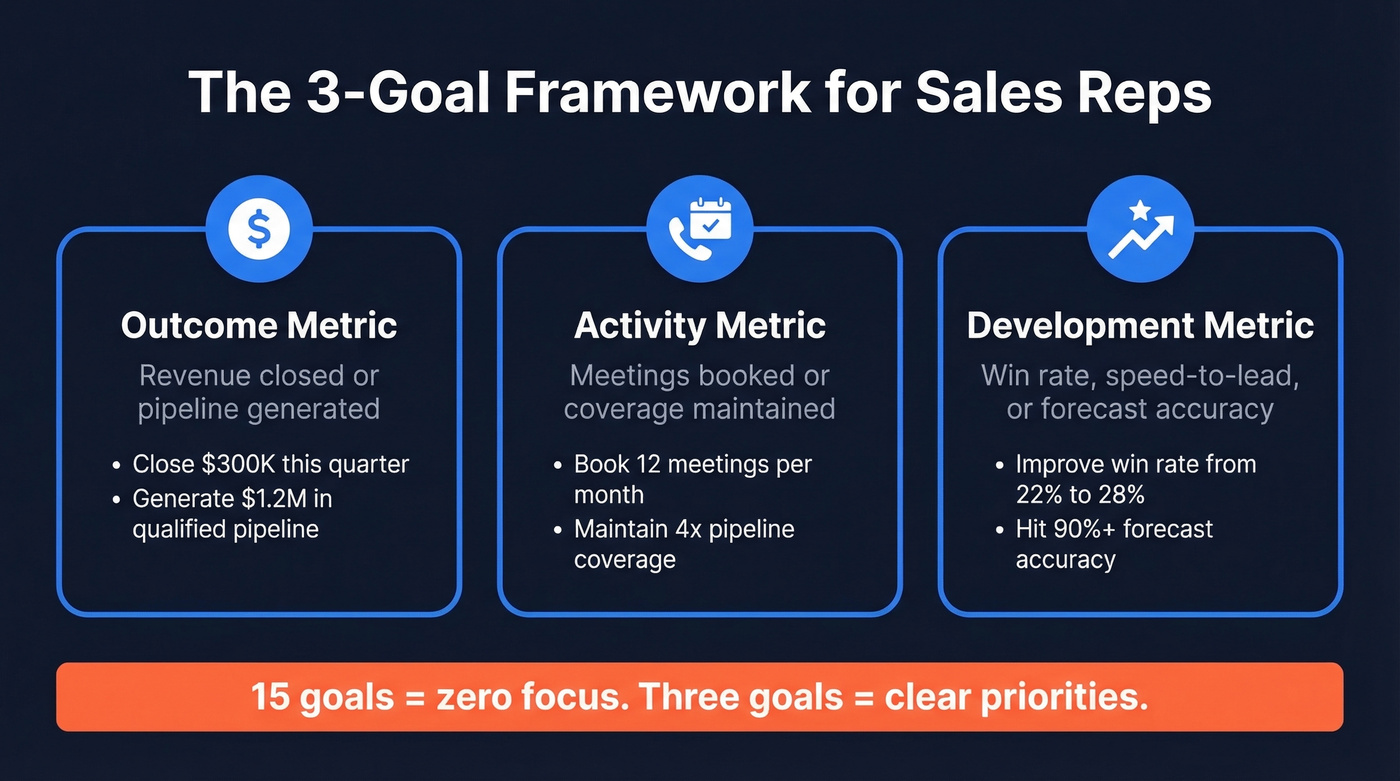
- One outcome metric - revenue closed or pipeline generated
- One activity metric - meetings booked or pipeline coverage maintained
- One development metric - win rate improvement, speed-to-lead, or forecast accuracy
Yes, goals should be specific and measurable. But the SMART framework is table stakes, not a strategy. Use the benchmarks below to calibrate by role. And here's the uncomfortable truth: if fewer than 50% of your reps are hitting quota, the problem is the quota, not the reps.
Benchmarks by Role
SDR / BDR Goals
SDR goals live and die on activity volume and conversion quality. Here's what the data shows, pulled from benchmarks across 900+ B2B SaaS companies:
| Metric | Median | Top Quartile | Elite (Top 10%) |
|---|---|---|---|
| Meetings/month | 8-10 | 12-15 | 18+ |
| Calls/day | 40-50 | 70-80 | 80+ |
| Emails/day | 20-40 | 45-55 | 55+ |
| Total activities/day | 80-100 | 140-170 | 170+ |
Cold call conversion to meeting runs 2-3.5%, cold email reply rates sit around 5.1%, and multi-touch sequences convert at 4-7% - meaningfully better than any single channel alone.
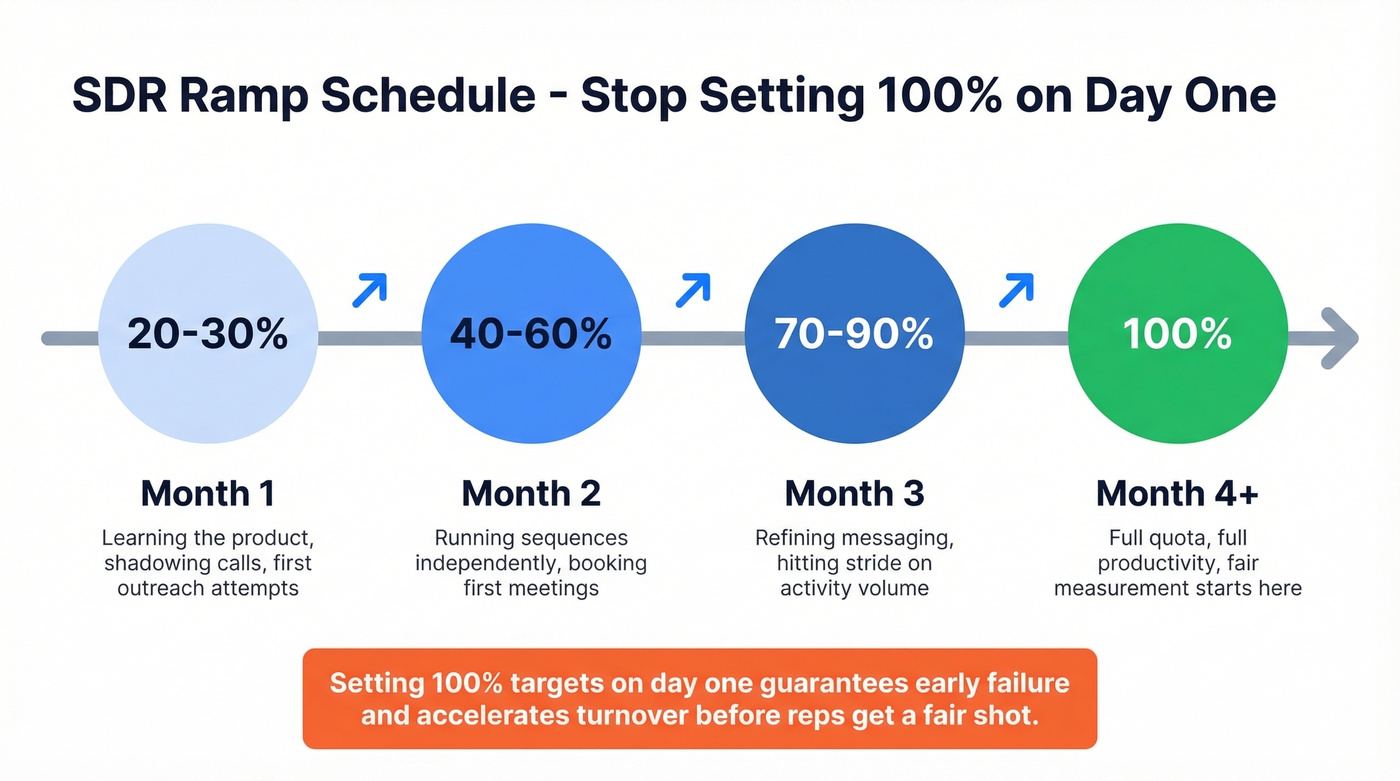
For ramp: Month 1 at 20-30% of full quota, Month 2 at 40-60%, Month 3 at 70-90%, Month 4+ at 100%. Setting 100% targets on day one guarantees early failure and accelerates turnover before reps ever get a fair shot. (If you want a structure for ramp goals, use a 30-60-90 day plan to set expectations.)
One detail that gets overlooked: 58% of SDRs juggle 75+ accounts per quarter. Activity goals only convert to pipeline when your contact data is accurate. If 35% of your emails bounce, your 100-activity target is really a 65-activity target. Prospeo's 98% email accuracy and 7-day data refresh cycle close that gap so every dial and email reaches a real person. (If bounce is a recurring issue, start with email bounce rate benchmarks and fixes.)

AE Goals
AE targets shift from activity volume to deal quality and revenue outcomes. Inside sales reps focus on higher velocity and shorter cycles, while enterprise AEs optimize for fewer, larger deals:
| Metric | Inside Sales | Mid-Market AE | Enterprise AE |
|---|---|---|---|
| Quota | ~$50K/month | ~$750K/quarter | $2-3M/year |
| Win rate improvement | 25 to 30% | 22 to 28% | 18 to 25% |
| Pipeline coverage | 3-4x | 4x | 4-5x |
| Cycle time reduction | 25 to 15 days | 45 to 30 days | 120 to 90 days |
| Forecast accuracy | 85%+ | 90%+ | 90%+ |
Development goals matter just as much as the revenue number. Multi-threading - getting 3+ stakeholders engaged in 75%+ of deals - is one of the strongest predictors of close rates. Demo no-show reduction below 10% is another high-leverage target most teams ignore entirely. (If you need a tighter definition of what to measure, map it to funnel metrics instead of gut feel.)
Account Manager Goals
AM goals center on retention and expansion, not net-new pipeline:
- Target CLV increases of 13-18% year-over-year
- Set explicit churn reduction targets by segment
- Track NPS quarterly
- Assign expansion revenue goals (~$50K in upsell via QBRs)
Not glamorous. But this is where compounding growth lives.
Mistakes That Tank Morale
Most quota failures aren't rep failures. They're leadership failures disguised as performance problems.
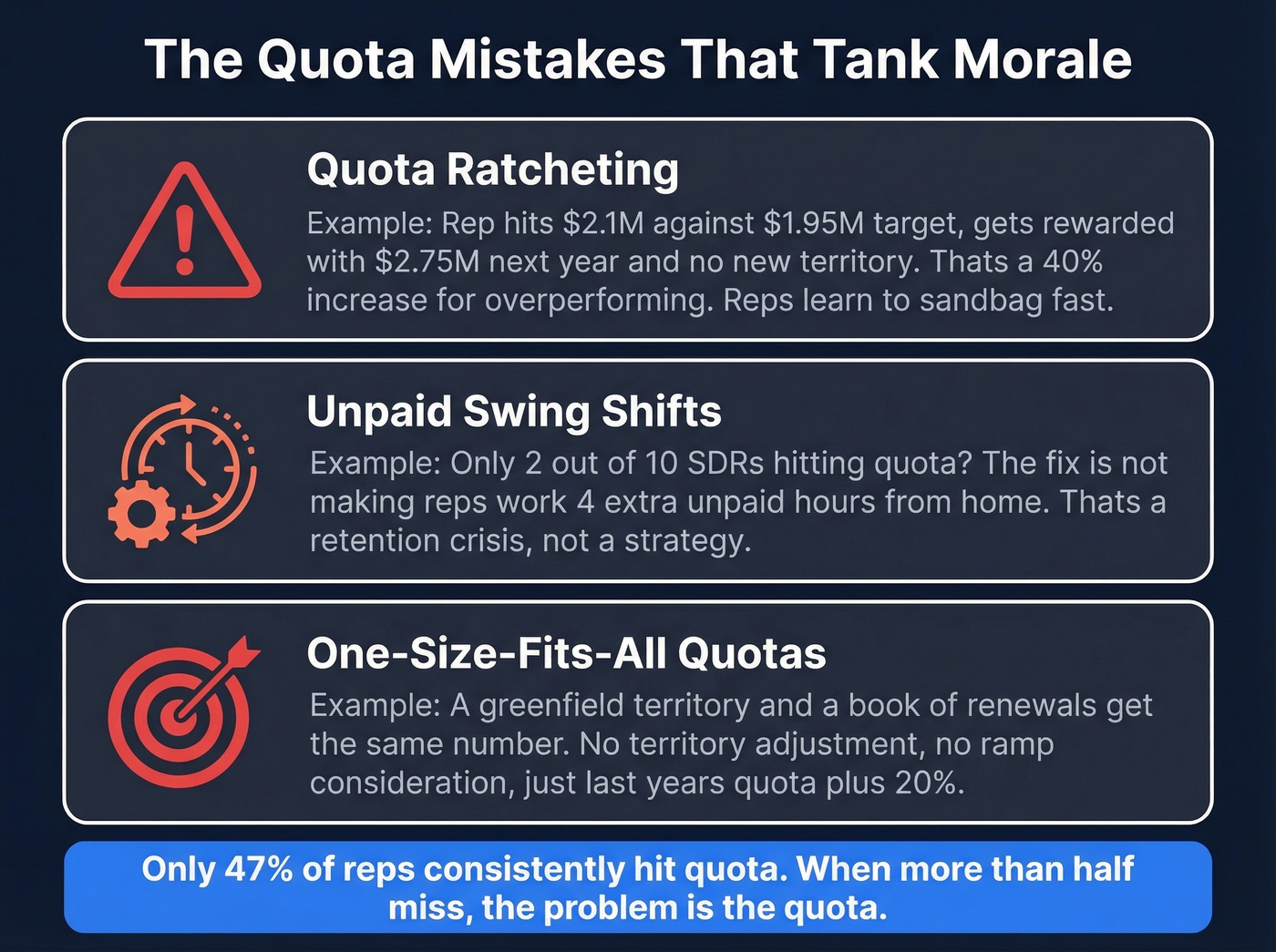
The clearest example is quota ratcheting. One rep on r/sales described hitting $2.1M against a $1.95M target - then getting handed a $2.75M target the next year with no new territory. That's a 40% increase as a "reward" for overperformance. Reps learn to sandbag fast.
We see another pattern constantly: companies where only 2 out of 10 SDRs hit their number, and the solution is unpaid "swing shifts" - work 8 hours, then do another 4 from home for free. That's not a goal-setting strategy. That's a retention crisis.
The most common structural mistakes, per Everstage's framework: treating activity metrics as end goals (calls made doesn't equal pipeline created), using generic quotas without territory adjustments, and focusing exclusively on revenue while ignoring leading indicators. Different stakeholders view goals differently - managers care about pipeline coverage, VPs care about forecast accuracy, reps care about path to OTE. If your targets don't account for all three perspectives, you're measuring effort against an unfair yardstick. (This is also where sales leadership either earns trust or burns it.)

You just saw the math: SDRs need 3,200+ dials to generate $300K in pipeline. But if your contact data is stale, a third of those dials hit dead ends. Prospeo's 98% email accuracy and 7-day refresh cycle mean every activity counts - so your reps actually have a fair shot at the goals you set.
Stop punishing reps for bad data. Give them contacts that connect.
Reverse-Engineer From Pipeline Math
Good goals work backwards from revenue. Let's break this down with a real example.
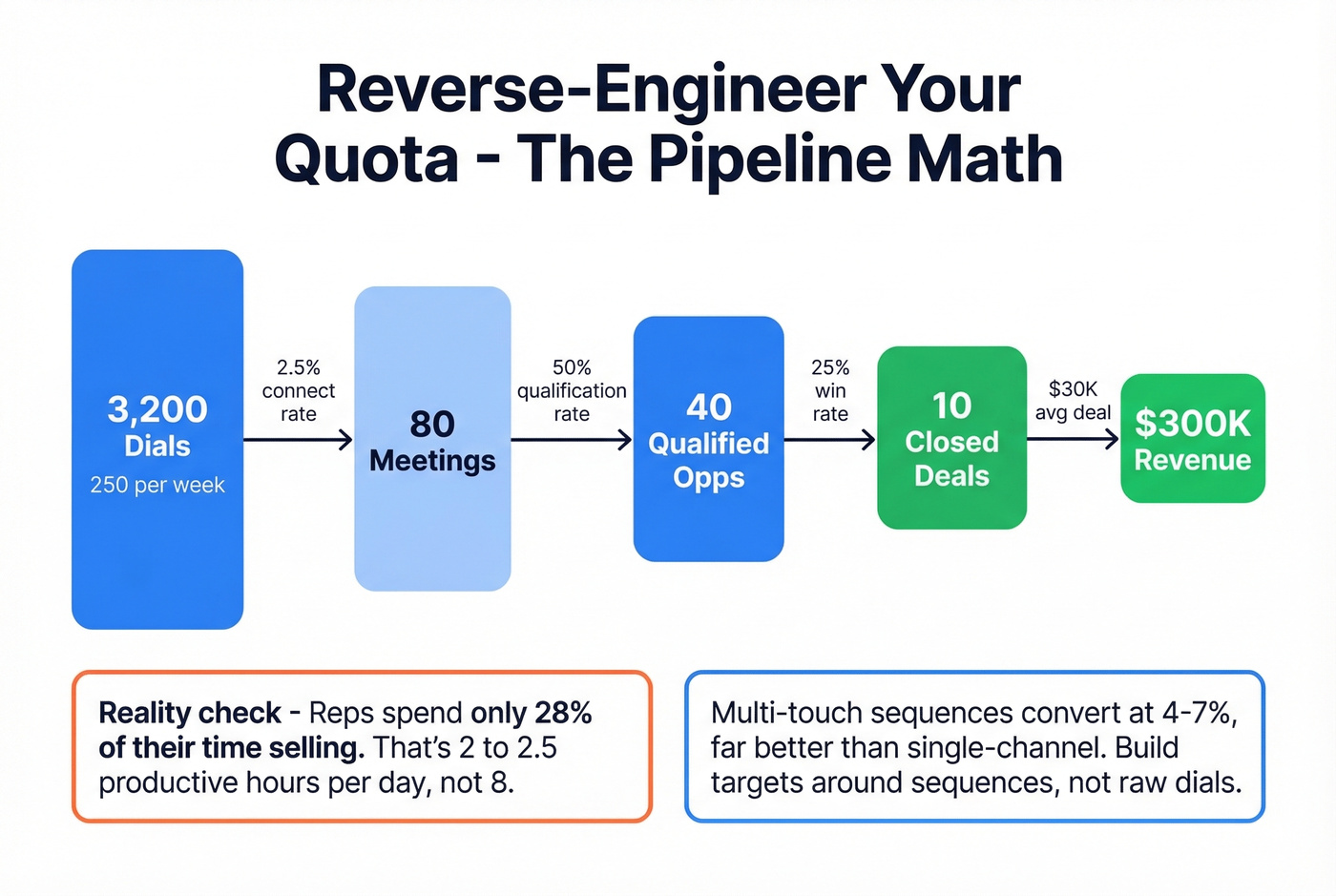
Say your AE needs to close $300K this quarter with a 25% win rate. That means $1.2M in qualified pipeline (4x coverage). If the average deal is $30K, that's 40 qualified opportunities. If SDRs convert meetings to qualified opps at 50%, you need 80 meetings. At a 2.5% connect-to-meeting rate, your SDRs need roughly 3,200 dials - about 250 per week across the quarter.
Now layer in the reality that reps spend only 28% of their time actually selling. Your capacity math needs to account for 2-2.5 productive selling hours per day, not 8. In our experience, teams that do this math backwards close the gap between quota and attainment within two quarters. Multi-touch sequences at 4-7% conversion are far more efficient than single-channel outreach - build activity targets around sequences, not raw dials. This pipeline-first approach is especially critical for B2B sales goals, where longer cycles and multiple decision-makers make accurate forecasting non-negotiable.
Connect Goals to Comp
Goals without a realistic path to earnings are decorative.
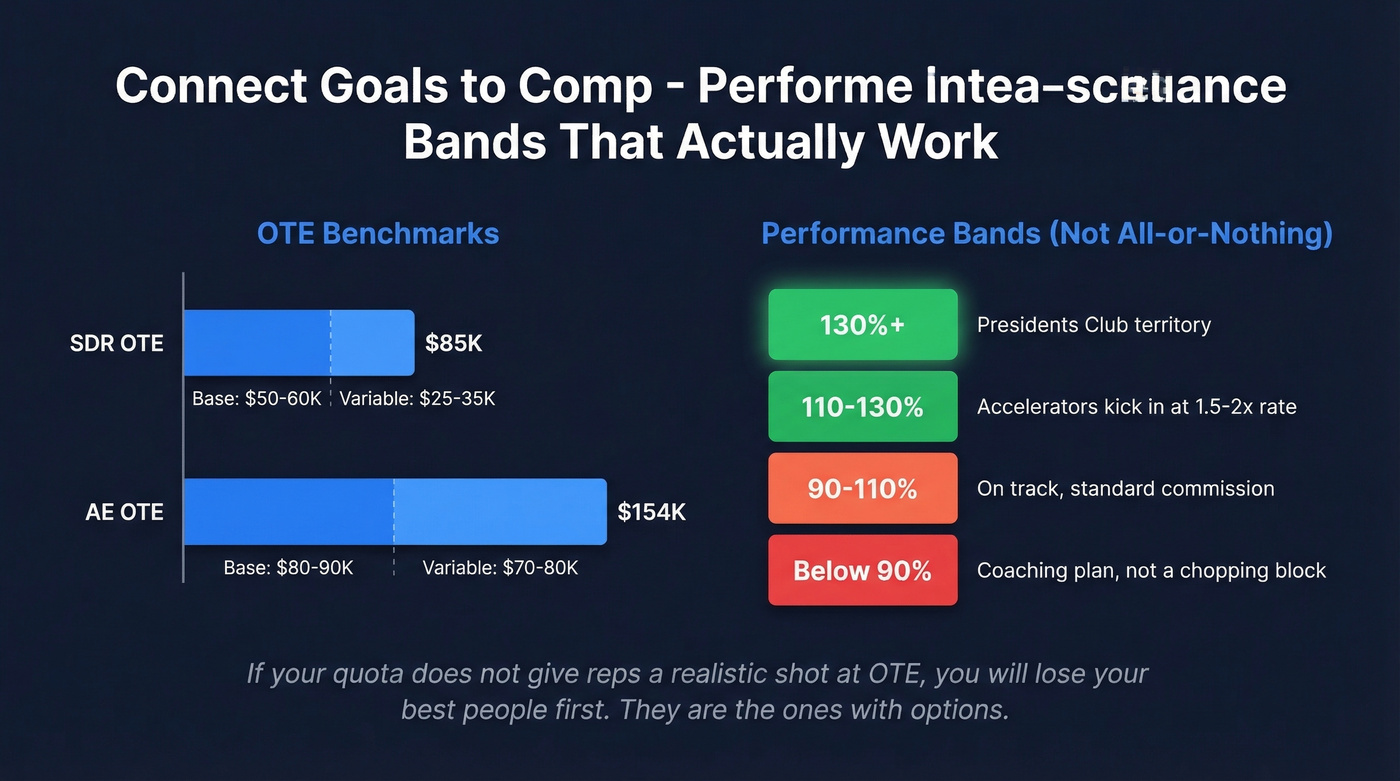
SDR OTE runs about $85K (base around $50-60K). AE OTE averages $154K. If your quota doesn't give reps a realistic shot at OTE, you'll lose your best people first - they're the ones with options. (If you want to sanity-check OTE assumptions, use an OTE in sales benchmark.)
Accelerators matter: 1.5-2x commission rates once a rep crosses 120% attainment. Consider performance bands rather than single-point quotas - a rep hitting 90-110% is "on track," 110-130% triggers accelerators, and 130%+ earns President's Club. This reduces the all-or-nothing anxiety that drives sandbagging. And coaching sessions shouldn't feel like getting beaten up with data. Use goals as a development framework, not a surveillance tool.
How AI Changes Goals in 2026
That 28% selling time stat is an opportunity, not a life sentence. When a quarter of a rep's day goes to data entry and another fifth to manual research, AI tools reclaim massive chunks of capacity. AI adopters are seeing roughly 30% productivity boosts, which means activity targets that seemed impossible two years ago are now within reach.
Here's the thing, though: AI is only as good as the data feeding it. Automated sequences targeting stale emails just burn your domain faster. We've seen teams reclaim 10+ hours per rep per week by pairing AI workflows with verified, fresh contact data - accurate emails, confirmed mobiles, and current role and company information instead of records that are weeks or months old. (If you're building this into your outbound motion, start with AI cold email outreach and sequence management.)
My hot take: most teams don't need to raise quotas in 2026. They need to give reps better data and fewer admin tasks, then watch the same goals become achievable for the first time.
Activity goals only work when every email and dial reaches a real person. Teams using Prospeo see bounce rates drop from 35% to under 4% - turning the same activity volume into 3x more pipeline. At $0.01 per verified email, accurate data costs less than one missed quota.
Your quota math assumes good data. Make sure you actually have it.
FAQ
What's the difference between a goal, a quota, and an OKR?
A quota is a specific numeric target tied to a time period - $750K this quarter. A sales goal is a broader strategic outcome, like expanding into mid-market accounts. An OKR pairs an objective with measurable key results, which works well for development goals that don't fit neatly into quota structures. Most reps deal with all three simultaneously.
How many goals should a rep have?
Three. One outcome metric (revenue or pipeline generated), one activity metric (meetings booked or pipeline coverage), and one development metric (win rate, speed-to-lead, or forecast accuracy). Fifteen goals means zero focus - reps optimize for whatever's easiest to game.
What's a realistic meeting target for SDRs?
Industry median is 8-10 meetings per month. Top-quartile SDRs book 12-15, and elite performers hit 18+. These numbers assume clean contact data and multi-channel sequences - if a third of your emails bounce, even a great SDR's numbers will look mediocre.
How should targets change during ramp?
Standard ramp runs Month 1 at 20-30% of full quota, Month 2 at 40-60%, Month 3 at 70-90%, and Month 4+ at 100%. Most reps reach full productivity in 3-4 months. Setting 100% targets on day one guarantees early failure and accelerates turnover.
What's the biggest quota-setting mistake?
Treating every territory, segment, and tenure level the same. A rep working a greenfield territory needs different targets than one inheriting a book of renewals. The math should factor in territory potential, ramp stage, and historical conversion rates - not just last year's number plus 20%.