

Sales Growth Strategies: The Benchmark-Driven Playbook for 2026
Your pipeline says 1.8x coverage. Your board wants 3x. Your reps are running 12 different "strategies" they picked up from LinkedIn posts, and none of them are compounding. The problem isn't a lack of tactics - it's a lack of focus backed by actual numbers.
Here's what we've seen over and over: teams that execute three things well outperform teams juggling ten half-baked plays. So that's the structure of this playbook - formulas, benchmarks, and a sequenced plan you can run in 90 days.
Quick Wins vs. Sustainable Growth
Most teams confuse fast fixes with a real growth strategy. Both matter, but they serve different purposes:
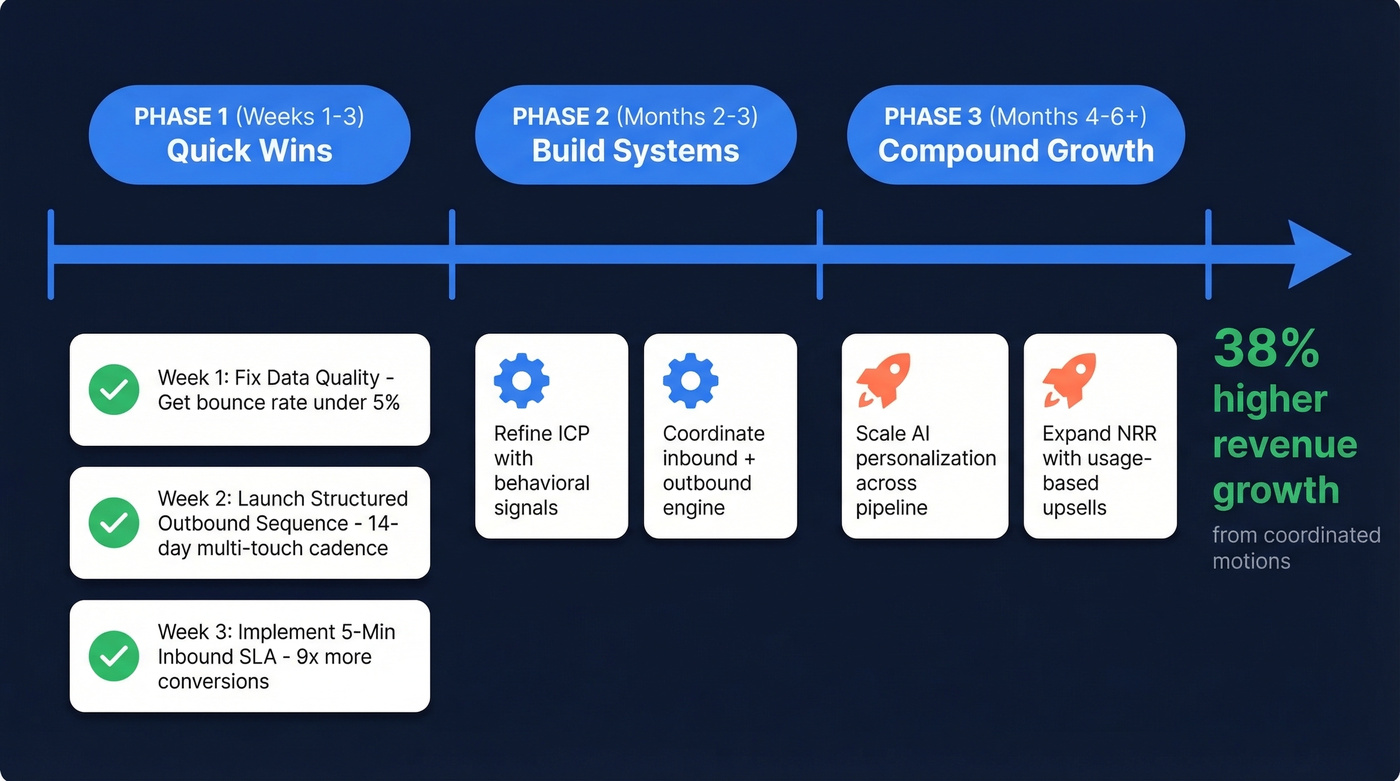
| Quick Wins (Weeks 1-3) | Sustainable Growth (Months 2-6+) | |
|---|---|---|
| Focus | Remove friction from existing motions | Build compounding systems |
| Examples | Fix data quality, 5-min inbound SLA, structured sequences | ICP refinement, hybrid engine, NRR expansion |
| Risk | Gains plateau without systems | Slow to show results without quick wins funding patience |
Start with the quick wins. They buy you credibility and budget to invest in the sustainable plays.
Three fastest-impact moves:
- Fix your data quality (Week 1). If your bounce rate is above 5%, deliverability is your #1 priority. Swap your list source, verify everything, and watch deliverability recover fast. (If you need benchmarks and fixes, start with bounce rate and deliverability.)
- Launch a structured outbound sequence (Week 2). Not "send more emails." A pain-first, multi-touch cadence with BANT qualification checkpoints mapped from Day 1 through Day 14.
- Implement a 5-minute inbound response SLA (Week 3). Responding within 5 minutes increases conversions up to 9x. Most teams respond in hours. This is free money.
Run those three for 90 days before adding anything else.
What Is Sales Growth?
Sales growth quantifies a business's increase in revenue over a specific period. Simple formula:
Sales Growth % = ((Current Period Revenue - Prior Period Revenue) / Prior Period Revenue) x 100
Close $420K this quarter versus $350K last quarter? That's 20% quarterly growth.
For multi-year comparisons, use the Annual Sales Growth Rate:
ASGR = ((End Revenue / Start Revenue) ^ (1 / Number of Years) - 1) x 100
A company that grew from $1M to $2.5M over 3 years has an ASGR of roughly 35.7% - the compound rate, which is much more honest than cherry-picking your best quarter. Track monthly rolling figures to spot trends before they show up in quarterly reviews. The teams that catch a slowdown in month two are the ones that actually hit annual targets.
What Good Growth Looks Like
"Are we growing fast enough?" The answer is always stage- and sector-dependent. But we can get specific.
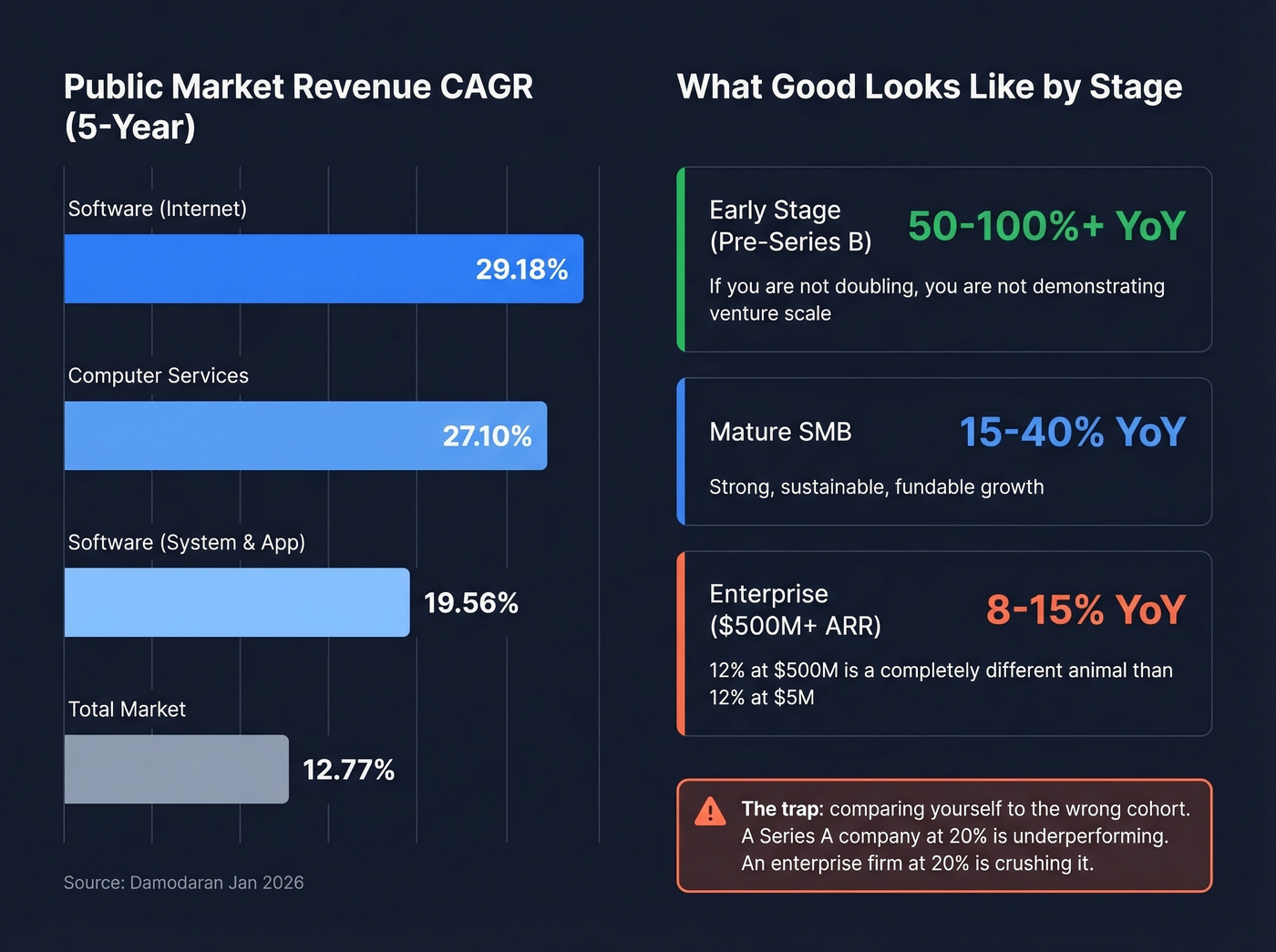
Damodaran's January 2026 dataset gives us public-market benchmarks across thousands of firms:
| Sector | Firms | 5-Year Revenue CAGR |
|---|---|---|
| Software (System & App) | 309 | 19.56% |
| Software (Internet) | 29 | 29.18% |
| Computer Services | 64 | 27.10% |
| Retail (General) | 23 | 9.92% |
| Total Market | 5,994 | 12.77% |
These are public-company numbers, so they skew mature. Stage-based heuristics look different. Early-stage startups pre-Series B should target 50-100%+ YoY off a small base - if you're not doubling, you're not demonstrating venture-scale potential. Mature SMBs doing 15-40% YoY are strong. Enterprise companies in the single digits to low teens are normal; 12% growth at $500M ARR is a completely different animal than 12% at $5M.
The trap is comparing yourself to the wrong cohort. A Series A SaaS company growing at 20% isn't "solid" - it's underperforming. An enterprise services firm growing at 20% is crushing it.
Let's be honest: most Series A companies obsess over new logo acquisition when their real problem is an LTV:CAC ratio closer to 2:1 than 3:1. If your unit economics are broken, growing faster just means losing money faster. Fix the foundation before you scale the motion.

You just read that bounce rates above 5% kill deliverability. Prospeo's 5-step verification delivers 98% email accuracy - teams using it cut bounce rates from 35%+ to under 4% and tripled pipeline in weeks.
Stop scaling broken data. Start with emails that actually land.
Core Strategies That Drive Revenue
Fix Your Unit Economics First
Before you pour money into pipeline, know what a customer actually costs you and what they're worth. Too many teams scale a broken model, and this is especially dangerous for bootstrapped operations where every dollar has to earn its keep. (If you want a clean definition and formulas, see CAC.)
| Metric | Benchmark |
|---|---|
| B2B SaaS CAC | $1,200/customer |
| Financial Services CAC | $2,167-$4,056 |
| Retail/eCom CAC | ~$50 |
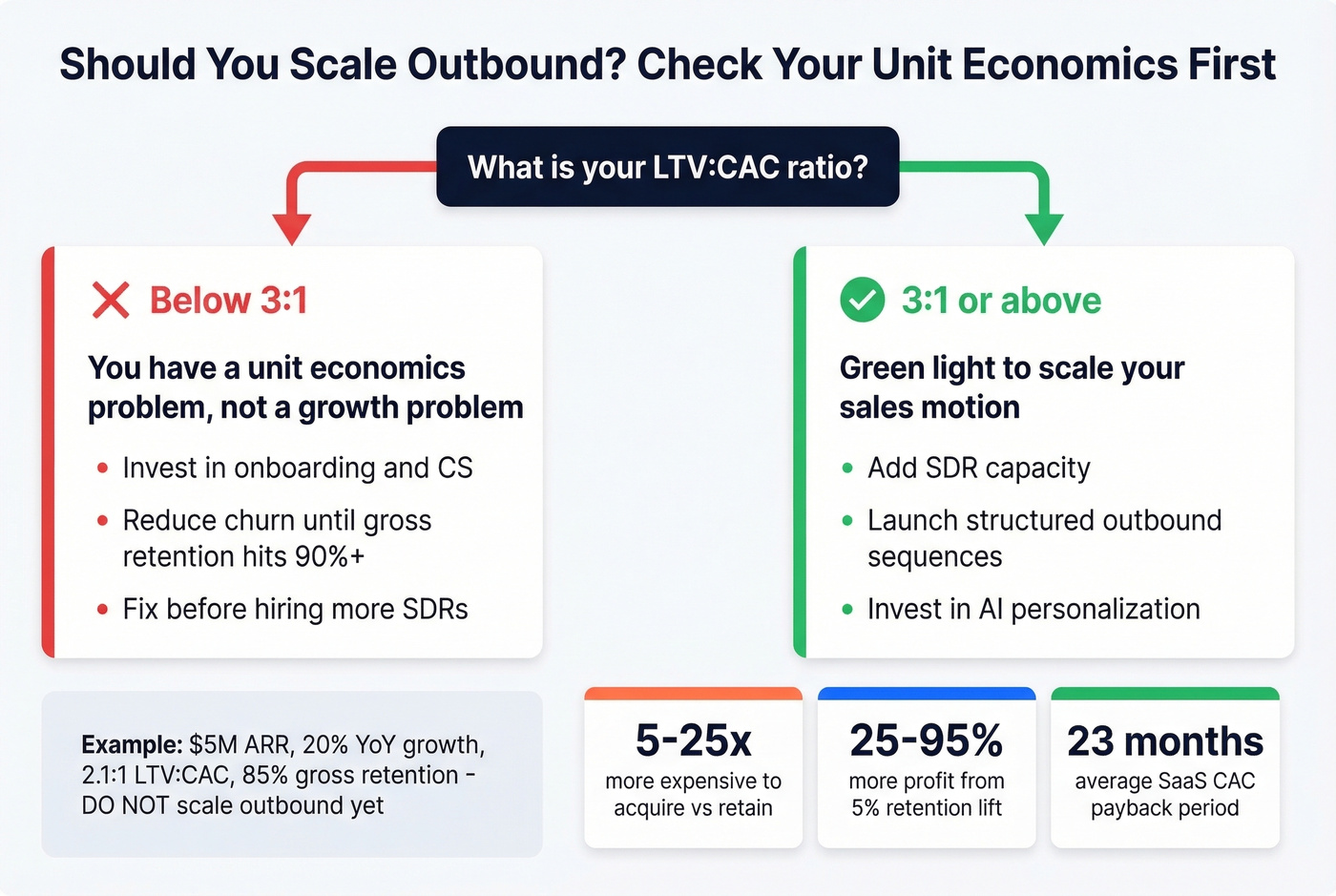
| LTV:CAC Target | 3:1 (Series A bar) |
| SaaS CAC Payback | ~23 months avg |
The retention math is even starker. A 5% increase in retention drives 25-95% more profit. Acquiring a new customer costs 5-25x more than retaining an existing one. Existing customers are 60-70% likely to buy again versus 20% for new prospects. If your LTV:CAC ratio is below 3:1, you don't have a growth problem - you have a unit economics problem.
Here's a worked example: a $5M ARR SaaS company growing at 20% YoY with a 2.1:1 LTV:CAC and 85% gross retention. That team shouldn't be hiring more SDRs. They should be investing in onboarding, CS, and reducing churn until LTV:CAC hits 3:1. Only then does scaling outbound make sense. Otherwise, every new customer costs more than they're worth.
Define Your ICP With Precision
A vague ICP ("mid-market SaaS companies") produces vague results. A precise ICP produces pipeline. Build yours across four dimensions: firmographics like industry, headcount, revenue, geography, and funding stage; technographics covering current stack and competitor tools installed; intent signals such as active research, relevant job postings, and recent funding; and pain indicators including hiring surges, tech stack changes, and leadership turnover.
The distinction between demographic ICP and behavioral ICP matters. Demographic tells you who could buy. Behavioral tells you who's ready to buy. Layer intent data on top of firmographics, and your outbound hit rate jumps dramatically - teams often book more meetings by cutting the list and targeting harder, because they stop spraying and start focusing. (Use an ideal customer profile template and tighten your firmographic filters.)
Build a Hybrid Inbound + Outbound Engine
The inbound-vs-outbound debate is over. You need both, and they need to feed each other.
Inbound leads convert at up to 14.6% versus 1.7% for outbound, and inbound costs roughly 60% less per lead. But inbound takes 6-18 months to build, while outbound can produce qualified meetings in 30-60 days. The real power is integration: teams running coordinated inbound and outbound motions see up to 38% higher revenue growth than teams siloing the two. Content drives awareness, outbound targets the companies engaging with that content, and inbound SLAs ensure no warm lead goes cold.
Multichannel sequences combining email, social, and calls yield 40% better engagement than single-channel approaches. The 5-minute response window isn't aspirational - it's the difference between 9x conversions and a dead lead.
Run a Structured Outbound Sequence
80% of outbound deals require 5+ touches. One email doesn't cut it. Here's a proven 14-day cadence:
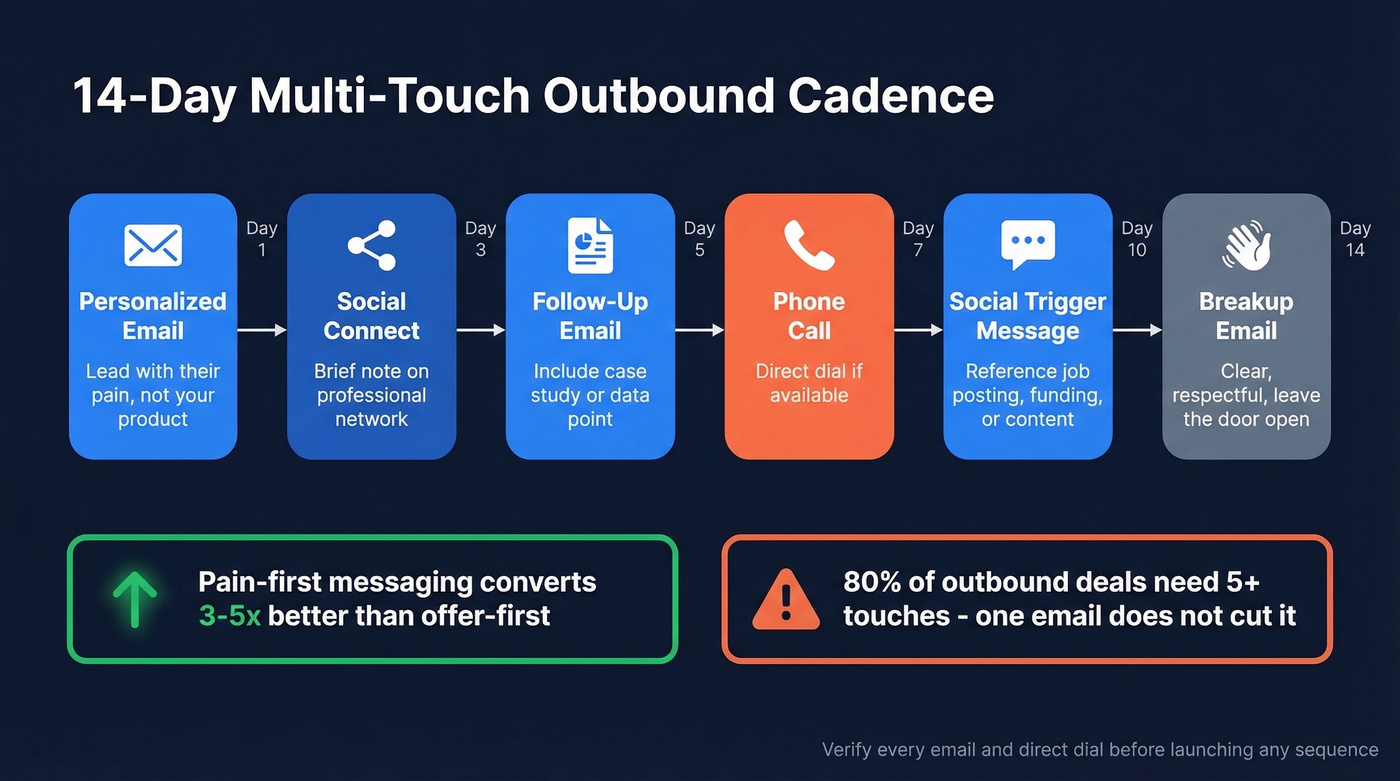
- Day 1: Personalized email - lead with their pain, not your product
- Day 3: Connection request on a professional network with a brief note
- Day 5: Follow-up email with a relevant case study or data point
- Day 7: Phone call - direct dial if you have it, main line if you don't
- Day 10: Social message referencing a specific trigger like a job posting, funding round, or content they published
- Day 14: Breakup email - clear, respectful, leaves the door open
Pain-first messaging converts at 3-5x the rate of offer-first messaging. "I noticed you're hiring 4 SDRs - scaling outbound with bad data is brutal" lands harder than "We have the best email verification tool." Build BANT qualification checkpoints into every conversation. Don't book a demo with someone who can't buy.
And verify every email and direct dial before launching any sequence. Bad data kills outbound before messaging even gets a chance. (If you need copy, steal from these sales follow-up templates.)
Invest in Data Quality as Infrastructure
Look, if 20%+ of your emails bounce, your sequences are dead, your domain reputation tanks, and your AI tools optimize on garbage. Data quality isn't a nice-to-have - it's infrastructure. (If you're evaluating vendors, compare data enrichment services.)
The proof is in production results. Meritt, an outbound agency, was running a 35% bounce rate before cleaning up their data. After switching to Prospeo, bounce dropped to under 4%, and their pipeline grew from $100K to $300K per week. That's not a marginal improvement - that's a different business.
Every strategy in this article - outbound sequences, AI personalization, hybrid engines - depends on reaching the right person at a valid address. Bad data is the silent killer of pipeline momentum, and it's the cheapest problem to fix.
Use AI to Compress Your Sales Cycle
McKinsey's 2025 State of AI survey found that 88% of organizations now use AI regularly, up from 78% a year prior. But only 39% report any EBIT impact, and most say it's less than 5% of EBIT. Meanwhile, 62% of organizations are experimenting with AI agents, and 23% are already scaling agentic systems. The opportunity is early, which means the teams that figure it out now build a compounding advantage.
For a sales team, the highest-ROI AI applications aren't exotic. Prioritize pipeline by scoring deals on engagement signals and fit data. Personalize the first touch at scale - AI can draft a pain-first email referencing a prospect's recent job posting or tech stack change in seconds. Auto-enrich your CRM so reps stop manually researching accounts. Revenue increases from AI are most commonly reported in marketing and sales use cases, and that tracks - sales workflows are repetitive, data-rich, and high-volume, which is exactly where AI shines. (For practical workflows, see generative AI sales tools.)
Retain and Expand Existing Customers
Acquiring a new customer costs 5-25x more than retaining one. That stat gets repeated so often it's lost its punch, but the math hasn't changed.
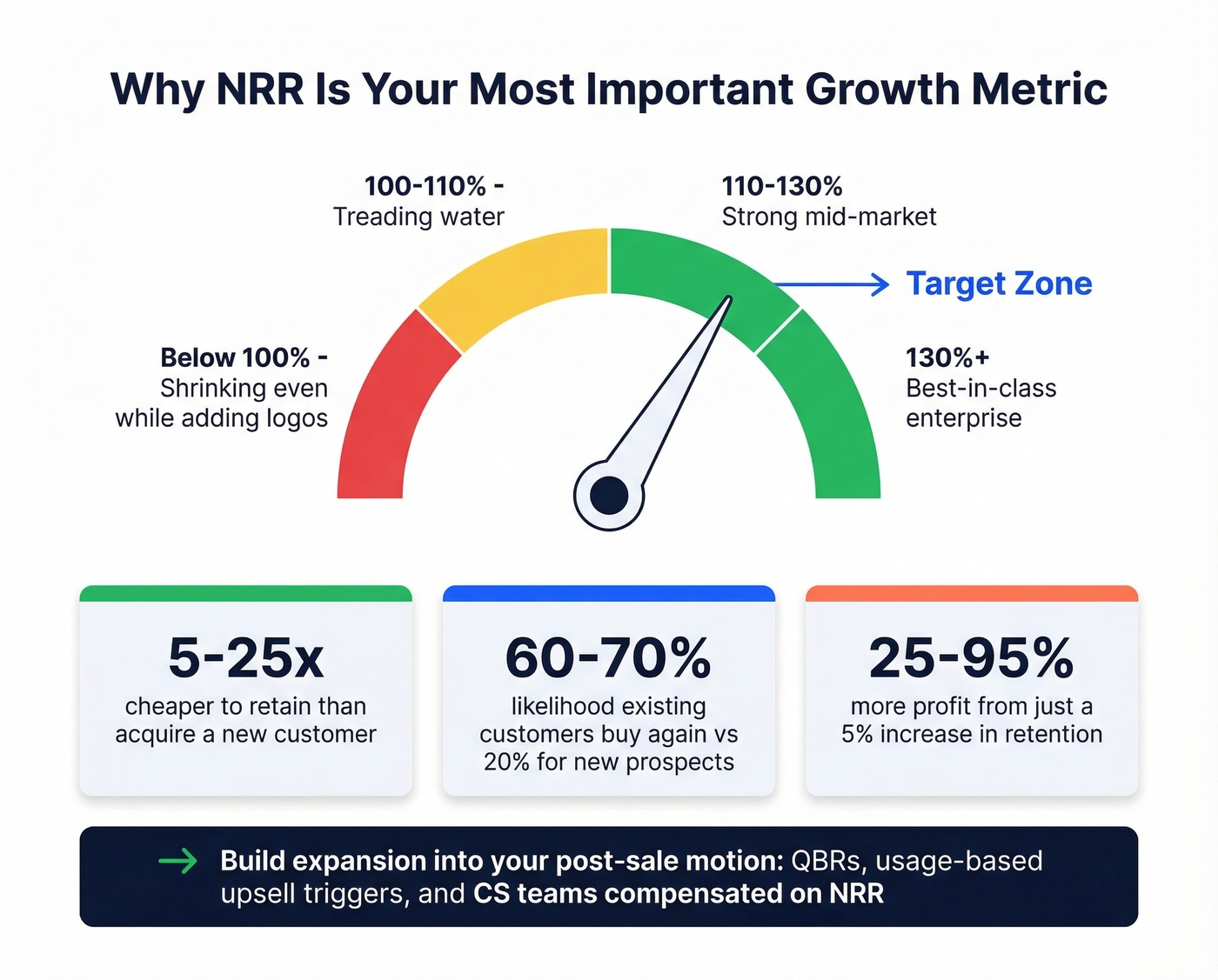
Net Revenue Retention separates good SaaS companies from great ones. Strong mid-market NRR runs 110-130%. Best-in-class enterprise companies hit 130%+. If your NRR is below 100%, you're shrinking even as you add new logos - and no amount of outbound will outrun that.
Build expansion into your post-sale motion: quarterly business reviews, usage-based triggers for upsell, and a CS team compensated on NRR, not just retention. For teams at high-growth companies, expansion revenue is often the fastest path to hitting aggressive targets because the trust is already established and the sales cycle is a fraction of new-logo deals. (If you're diagnosing leakage, start with churn analysis.)
Train Your Team in the Flow of Work
Most sales training fails because it happens in a vacuum - a two-day offsite that everyone forgets by Thursday. The consensus on r/salestechniques is clear: "learning in the flow of work" beats classroom sessions every time. That means micro-training delivered inside Slack, Teams, or the tools reps already live in. When done right, completion rates hit 90%+, and one team reported a 120% lift in AI adoption using translated micro-learning modules.
Match your methodology to your deal complexity. Transactional sales benefit from tight scripts, objection handling, and speed-to-lead. Mid-market deals respond to SPIN selling - Situation, Problem, Implication, Need-payoff. Enterprise cycles often need challenger-style approaches where reps teach, tailor, and take control. Forcing a single methodology across all deal sizes wastes entire quarters. We've seen it happen repeatedly. (To operationalize it, use sales training tips.)
Growth Killers to Avoid
These are the patterns that silently destroy momentum. We've watched teams make every one of them:
- Building without demand. If nobody's asking for it, nobody's buying it. Validate before you build.
- Delaying sales until "later." Sales should begin the day the MVP is ready. Waiting for the "perfect" product is how startups die.
- Ignoring LTV:CAC. Scaling a motion where you spend $3 to earn $1 doesn't get better with volume. It gets worse.
- Perfectionism before launch. Ship the sequence. Ship the campaign. Iterate based on data, not assumptions.
- Slow execution and weak iteration loops. The team that runs 4 experiments per month beats the team that runs 1 per quarter, every time.
- Burning capital without an ROI plan. Every dollar spent on growth should have a hypothesis attached. "We'll figure out ROI later" is how you run out of runway.
Skip the "growth hack" mentality entirely. If someone pitches you a tactic that doesn't connect to one of the core strategies above, it's a distraction.
How to Measure Sales Growth
You can drown in metrics. Focus on what actually moves decisions, segmented by motion:
| Metric | New Logo Target | Expansion Target |
|---|---|---|
| Pipeline Coverage | 3-5x quarterly goal | 2-3x quarterly goal |
| Win Rate | Track by segment | Track by segment |
| Forecast Accuracy | +/-10% variance | +/-10% variance |
For activity KPIs, set clear daily targets: 50 dials/day is a common outbound benchmark, paired with email volume and conversations tracked. The ratio of dials-to-conversations tells you whether your data is good - if you're connecting on fewer than 5% of dials, your phone numbers are stale, and that's a data quality problem, not an effort problem.
Beyond pipeline, track time-to-value post-close. TTV is a strong predictor of churn and NRR. If customers don't see value within the first 30-60 days, they're already mentally churning. Win rate by stage conversion shows you where deals die - discovery-to-demo or demo-to-proposal each require a different fix.
Segment everything by SMB, mid-market, and enterprise. A 40% win rate in SMB and a 15% win rate in enterprise aren't comparable - they're different businesses with different benchmarks. Blending them into one number hides the signal. (If you want a tighter KPI set, use pipeline health.)
Behavioral ICP targeting requires intent data, technographics, and verified contact info in one place. Prospeo gives you 30+ filters - including Bombora intent across 15,000 topics - layered on 300M+ profiles refreshed every 7 days.
Cut your list in half. Double your meetings. That's precision ICP targeting.
FAQ
What is a good sales growth rate?
Software companies average a 19.56% five-year CAGR per Damodaran's January 2026 data. Early-stage startups typically target 50-100%+ YoY, while mature SMBs aim for 15-40%. Use your sector's public-market benchmark as a floor, then adjust for company stage and deal size.
How do you calculate sales growth?
Sales Growth % = ((Current Period Revenue - Prior Period Revenue) / Prior Period Revenue) x 100. Track monthly and quarterly to catch trends before annual reviews surface them. For multi-year comparisons, use the compound annual growth rate formula instead.
What are the best sales growth strategies for 2026?
The highest-impact strategies center on three pillars: fixing unit economics before scaling, building a hybrid inbound-outbound engine, and investing in data quality as infrastructure. Layer AI personalization and structured outbound sequences on top once the foundation is solid.
What's the fastest way to increase sales?
Fix your data quality, launch a structured 14-day outbound sequence, and implement a 5-minute inbound response SLA. These three moves show measurable results within 2-3 weeks because they remove friction from motions you're already running.
How does data quality affect pipeline growth?
Bad contact data causes bounces, kills domain reputation, and wastes rep time on dead leads. Meritt cut their bounce rate from 35% to under 4% after switching to verified data, tripling pipeline from $100K to $300K per week. Clean data is the cheapest growth lever most teams ignore.