

How to Write a Sales Introduction Email That Actually Gets Replies
61% of decision-makers prefer cold email over other channels. Yet 71% ignore the ones they receive because they're irrelevant. The gap between those two numbers is where most sales introduction email strategies fall apart - not because the medium is broken, but because the execution is.
You spent 45 minutes researching a prospect, wrote a sharp opening line, personalized the value prop, nailed the CTA - and the email bounced. Or worse, it landed in spam and you never knew. Most guides hand you templates and wish you luck. Templates are half the equation. The other half - deliverability, data quality, list hygiene - determines whether your intro email reaches a human being at all.
The Short Version
Your intro email is 50% copy, 50% infrastructure. If your deliverability is broken, no template will save you. A 5.8% reply rate is normal across 16.5M cold emails. Six to eight sentences is the sweet spot. One CTA only. And before you send anything, verify your list, warm your domain, and authenticate with SPF/DKIM/DMARC. Skip any of those and you're burning money.
What "Good" Looks Like in 2026
Let's calibrate expectations, because anyone promising 20%+ reply rates at scale is either lying or sending 50 emails a month.
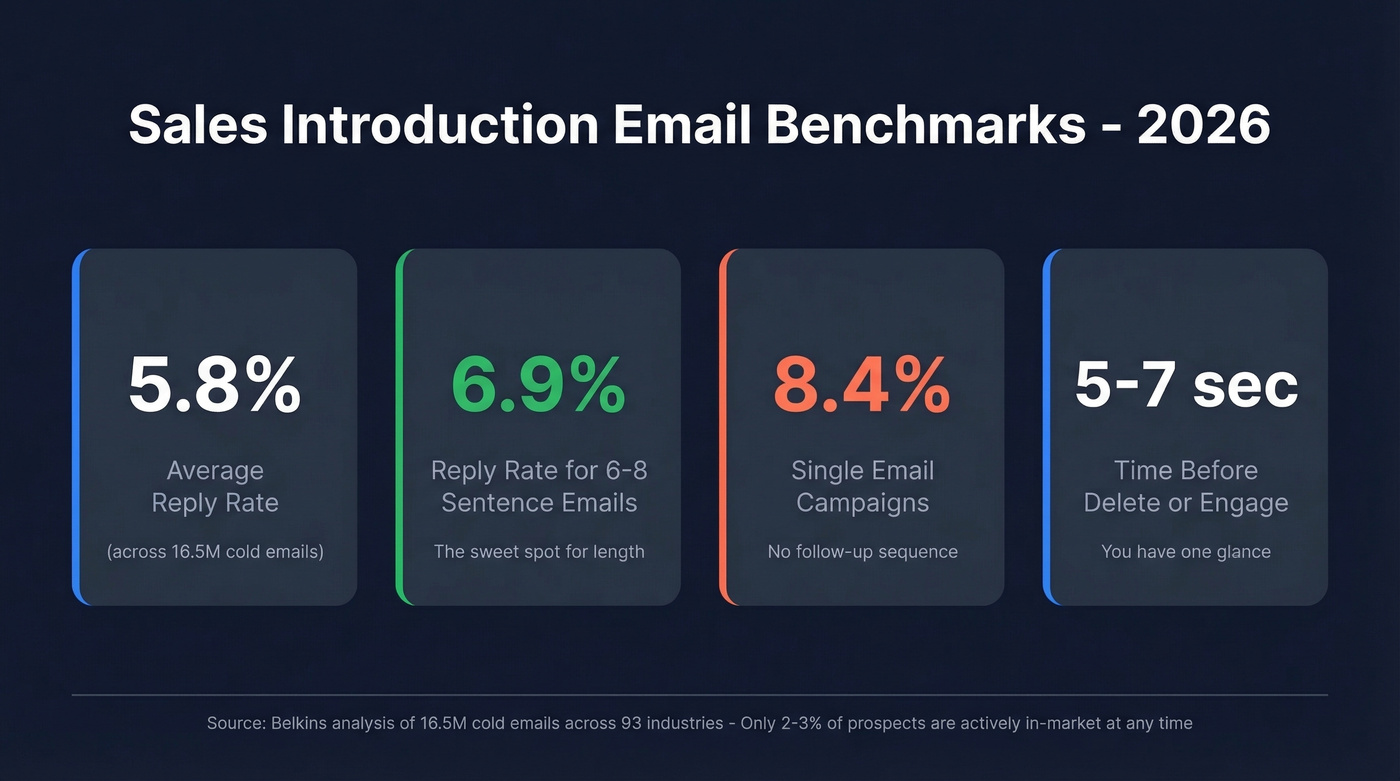
Belkins analyzed 16.5M cold emails across 93 business domains and found the average reply rate landed at 5.8% - down from 6.8% the year prior, a 15% year-over-year drop. B2B email outreach is getting harder, not easier. The data on email length is clear: messages with 6-8 sentences hit a 6.9% reply rate, the highest of any bracket. Anything under 200 words outperforms longer emails, and your prospect gives you 5-7 seconds before deciding to delete or engage.
Here's a number that surprised us: single-email campaigns - no follow-up sequence, just one shot - pulled an 8.4% reply rate. That doesn't mean you should skip follow-ups entirely. It means the first email carries most of the weight, and getting that first impression right matters more than building a 7-touch cadence.
Only 2-3% of your prospects are actively in-market at any given time. Your intro email is often planting a seed, not closing a deal.
How to Write a Sales Introduction Email
Subject Line
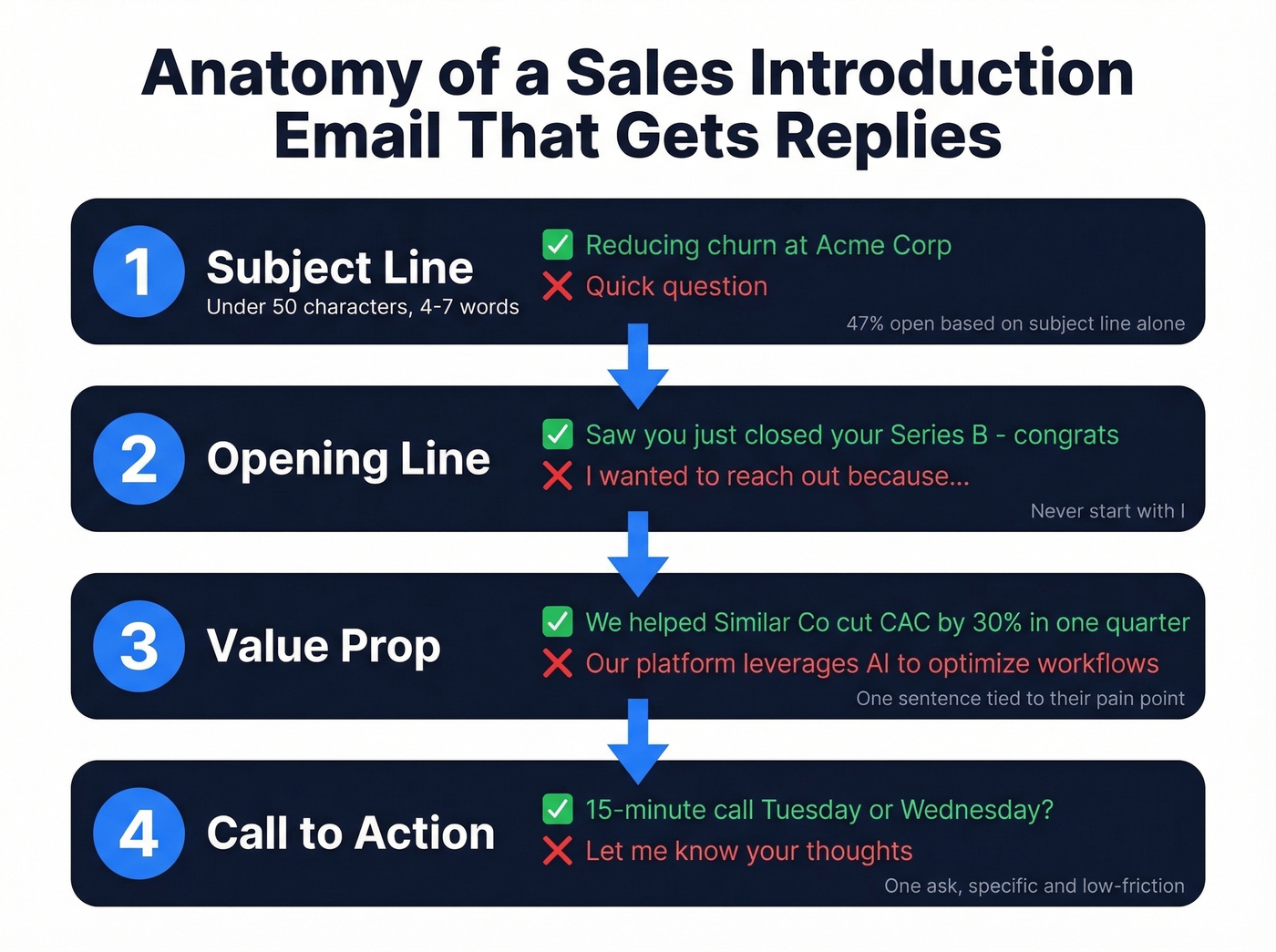
Your subject line is the gatekeeper. 47% of recipients open emails based on the subject line alone.
Keep it under 50 characters, 4-7 words. Personalized subject lines get opened more, but "personalized" doesn't mean {first_name} merge tags - it means relevance. Reference their company, their role, or a specific challenge they're facing. The consensus on r/coldemail is that "Quick question" and "Hey {fname}" are burned out. Everyone's using them. Your subject line should feel like it came from a colleague, not a sequence. If you need inspiration, borrow patterns from proven subject line frameworks.
Opening Line
Never start with "I." Your prospect doesn't care about you yet.
Anchor your opening to something specific: a trigger event, a company announcement, a pain point you've observed in their industry. "Saw you just closed your Series B - congrats" works because it proves you did 30 seconds of homework. "I wanted to reach out because..." works for nobody. Those first ten words are where most sales introduction emails lose the reader.
Value Proposition
One sentence. Tie it to a pain point, not a feature list. Selling to SaaS companies? Talk about CAC or churn. E-commerce? Conversion rates or LTV. The value prop should make your prospect think "this person understands my problem" - not "this person wants to demo their product." Industry-specific language signals credibility faster than any template ever will. If you want a deeper framework, start with email copywriting.
The CTA
One ask. Specific and low-friction.
"15-minute call Tuesday or Wednesday?" beats "let me know your thoughts" every time. Vague CTAs give your prospect an easy out - they think about it for half a second, then archive. Emails with a single clear CTA consistently outperform emails with multiple asks. For more examples, see email call to action.
Personalization That Actually Works
There are three tiers of personalization, and most reps stop at the wrong one.
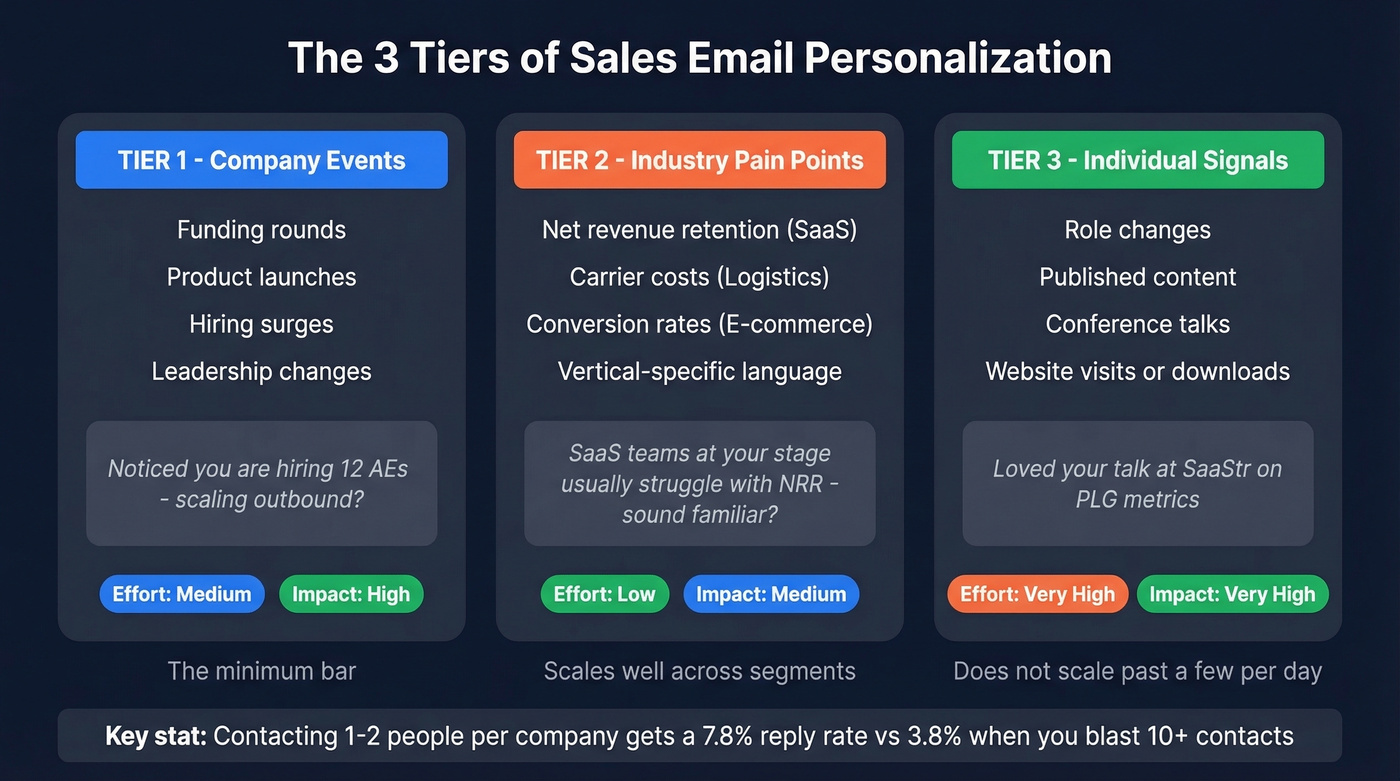
Tier 1 - Company events. Funding rounds, product launches, expansion announcements, leadership changes. "Noticed you're hiring 12 AEs - scaling outbound?" lands because it's specific and timely. This is the minimum bar for personalization that moves the needle.
Tier 2 - Industry pain points. Less personalized to the individual, but still sharp. SaaS companies worry about net revenue retention. Logistics companies worry about carrier costs. Speak their language and you'll stand out from the generic "I help companies like yours grow revenue" crowd.
Tier 3 - Individual signals. Role changes, published content, conference talks. This is the highest-effort personalization and it works - but it doesn't scale past a handful of emails per day. If your stack tracks website visitors or content downloads, those are the highest-intent buyer signals you can reference in trigger-based outreach. (If you want to systematize this, build around identifying buying signals.)
Reply rates drop when your segmented list exceeds 100 people with identical copy. Contacting 1-2 people per company yields a 7.8% reply rate versus 3.8% when you blast 10+ contacts at the same org. Tight targeting beats volume every time.
A warning on over-personalization: referencing someone's vacation photos or their kid's soccer game isn't personalization. It's creepy. The average business professional receives 120+ emails a day. Yours needs to feel relevant, not surveillance-grade.
Templates That Convert
You don't need 55 templates. You need a few great ones that you customize per prospect. Here are six that cover the scenarios you'll actually encounter - aim for 3-5 sentences in the body. If you want more options for later touches, use these sales follow-up templates.
Cold Outreach (No Prior Contact)
Subject: Reducing [specific metric] at {{company}}
Hi {{first_name}},
{{Company}} is scaling fast - which usually means [specific pain point] becomes a bottleneck. We helped [similar company] cut that by 30% in one quarter.
Worth a 15-minute call Thursday?
The specific metric reference proves you've done research, and the time-bound CTA reduces decision friction.
Trigger Event (Funding, Hiring, Product Launch)
Subject: Congrats on the Series B
Hi {{first_name}},
Saw the funding news - congrats. The next 90 days usually bring a hiring sprint and a scramble to scale pipeline. That's exactly where we help.
Open to a quick call next week?
Leading with a genuine congratulation creates goodwill. Tying your value to their immediate next challenge makes the ask feel timely rather than random.
Mutual Connection / Referral
Subject: {{mutual contact}} suggested I reach out
Hi {{first_name}},
{{Mutual contact}} mentioned you're rethinking [specific initiative] and thought we should connect. We worked with their team on something similar - happy to share what worked.
Does Tuesday or Wednesday work for 15 minutes?
The mutual connection does the credibility work for you. Offering to share results rather than pitch a product lowers resistance.
Competitor Displacement
Subject: Switching from {{competitor}}?
Hi {{first_name}},
A few teams in [their industry] have moved off {{competitor}} this year, mostly because of [specific limitation]. We've made the migration smooth for companies like [reference customer].
Worth exploring? I can walk you through the differences in 15 minutes.
Naming the competitor signals you understand their current stack. "A few teams" creates social proof without sounding like a press release.
Social Proof Lead
Subject: {{similar company}} hit [result] in [timeframe]
Hi {{first_name}},
Their setup looks a lot like yours - same vertical, similar team size. Happy to share how they did it.
Quick call this week?
The result lives in the subject line where it drives opens. The ultra-short body respects the prospect's time and lets curiosity do the selling.
Re-Engagement (Gone Cold)
Subject: Still relevant?
Hi {{first_name}},
We talked in [month] about [topic]. [New development or updated result] made me think it's worth revisiting. If timing's better now, I'm around this week.
Two sentences. No guilt-tripping, no "just circling back." The brevity signals confidence - you're not begging, you're offering.

You just read that 71% of decision-makers ignore irrelevant cold emails - but irrelevance isn't just bad copy. It's emailing the wrong person, at a dead address, with stale data. Prospeo's 300M+ profiles refresh every 7 days with 98% email accuracy, so your sales introduction email reaches a real human every time.
Stop crafting perfect intro emails that bounce. Fix the data first.
The Deliverability Checklist
This is the section most guides skip, and it's the reason most intro emails fail silently. Your copy can be perfect. If it lands in spam, nobody reads it.
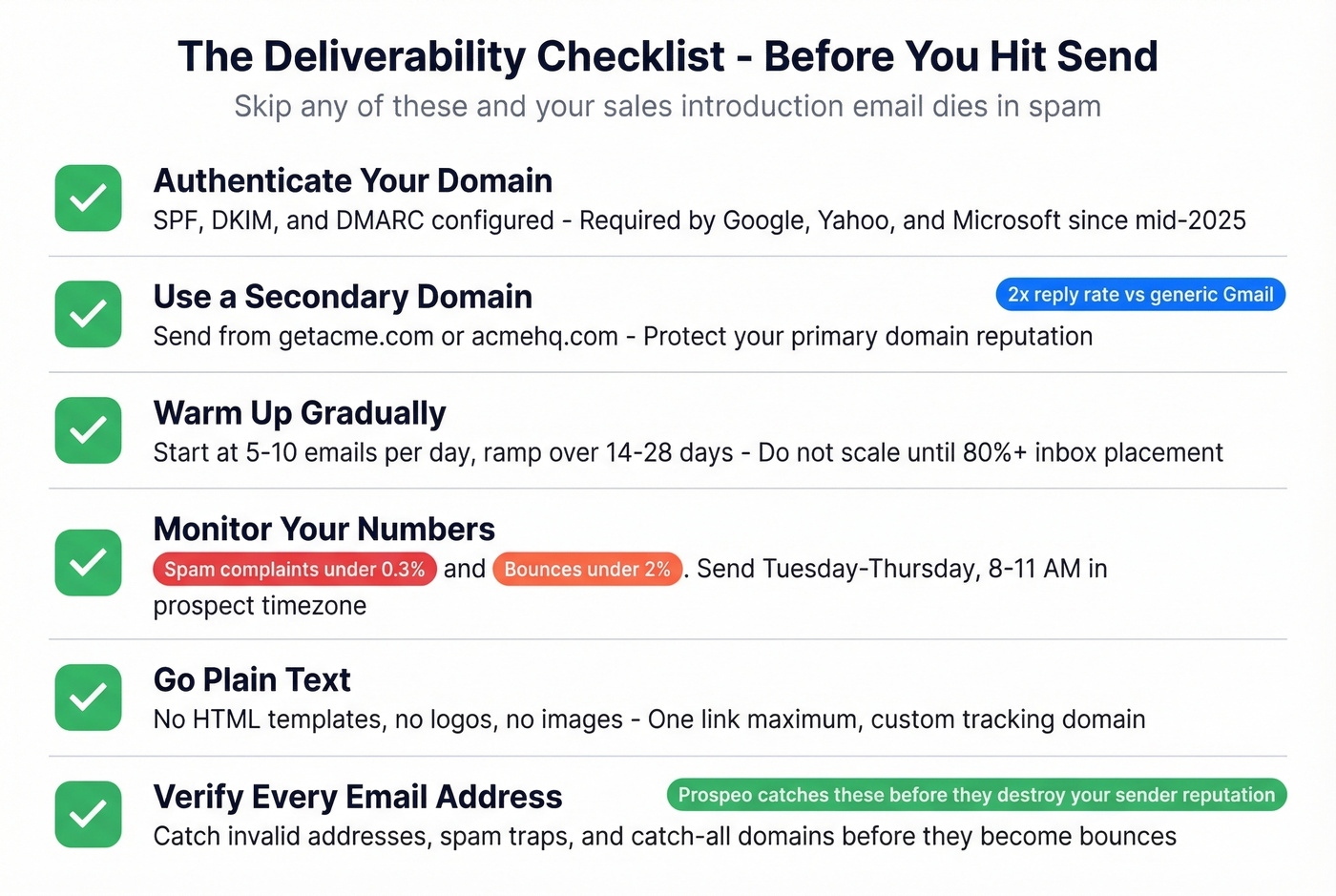
Domain authentication is non-negotiable. SPF, DKIM, and DMARC must be configured before you send a single cold email. Since mid-2025, Google, Yahoo, and Microsoft enforce bulk sender rules including these protocols plus one-click unsubscribe per RFC 8058. If you need a full walkthrough, start with an email deliverability guide.
Use a secondary domain. Never send cold outreach from your primary business domain. Set up variations like getacme.com or acmehq.com. If your cold domain gets flagged, your main domain stays clean. Emails from custom domains get almost twice the reply rate compared to generic Gmail addresses.
Warm up properly. Start at 5-10 emails per day and ramp gradually over 14-28 days. Keep warmup running even after you start production sends. The r/coldemail crowd will tell you warmup is painful but necessary - they're right. Don't scale until you're hitting 80%+ inbox placement on seed tests. (If you're building a stack, compare unlimited email warmup options.)
Keep your numbers clean. Spam complaints must stay under 0.3%. Bounces under 2%. One bad send can tank your domain reputation for weeks. Send Tuesday through Thursday, 8-11 AM in the prospect's timezone for the best inbox placement. If you're unsure about safe sending limits, use email velocity as your guardrails.
Plain text wins. Skip the HTML templates, logos, and images. One link maximum. Use a custom tracking domain - shared tracking domains inherit other senders' reputation problems. Here’s how a tracking domain works.
Verify every address before it enters your sequence. Prospeo catches invalid addresses, spam traps, and catch-all domains before they become bounces - the kind of bounces that destroy your sender reputation overnight. If you’re troubleshooting, start with email bounce rate.
The Data Quality Problem Nobody Talks About
Here's a scenario we've seen play out dozens of times: a rep spends 45 minutes researching a prospect, writes a genuinely personalized intro email, hits send - and it bounces. The email address was wrong. Or it belonged to a former employee. Or it was a catch-all domain that silently ate the message.
Now multiply that across a team of 10 reps sending 50 emails a day.
Bad data doesn't just waste time. It actively damages your domain reputation. Every bounce pushes you closer to the spam folder for everyone on your list. We've watched teams spend months optimizing subject lines and CTAs when the real problem was that 15% of their list was dead on arrival.
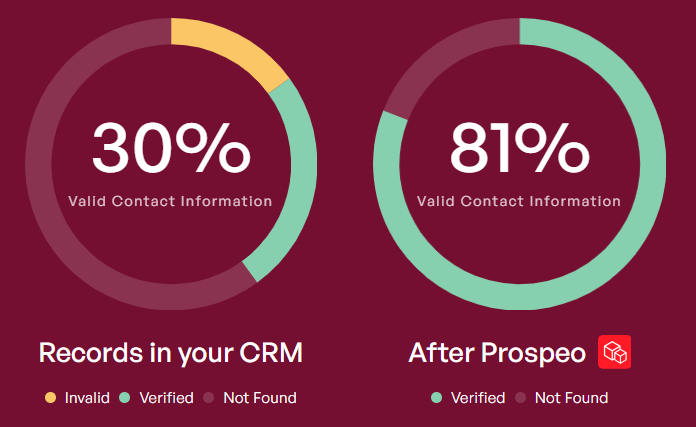
Prospeo's 5-step verification handles this before you ever hit send - running every address through catch-all detection, spam-trap removal, and honeypot filtering to deliver 98% email accuracy on verified addresses. Data refreshes every 7 days, which matters because the industry average is 6 weeks. People change jobs fast. Six-week-old data is already decaying. If you’re evaluating vendors, compare data enrichment services.
That accuracy shows up in real results. Meritt switched to Prospeo and watched their bounce rate drop from 35% to under 4%. Their sales pipeline tripled from $100K to $300K per week. That's not a template improvement - that's a data quality improvement.
Look, if your bounce rate is above 5%, stop tweaking your subject lines. Your data is the problem, not your copy. Fix the list first, then optimize the message.
Contacting 1-2 people per company gets a 7.8% reply rate. That only works when you reach the right 1-2 people. Prospeo's 30+ filters - buyer intent, job changes, headcount growth, technographics - let you pinpoint the exact decision-maker worth your best sales introduction email.
Find the right prospect before you write the first word.
Follow-Up Strategy
Your first follow-up is the most valuable email in your sequence. Reply rates soar by up to 49% after that first nudge. After that, diminishing returns hit hard. If you want a full sequencing framework, use a B2B cold email sequence.
By the third email, reply rates drop 20%. By the fifth, they're down 55% compared to earlier touches. Meanwhile, spam complaints climb from 0.5% on email one to 1.6% by email four. You're not just getting ignored - you're actively hurting your deliverability.
Our recommendation: one to two follow-ups, spaced 2-3 days apart. That's it. If someone hasn't responded after three touches, they're either not interested or your targeting was off. Adding emails four through seven won't fix either problem. Skip the 12-step cadence your sales enablement vendor is selling you.
Mistakes That Kill Your Intro Email
Sending from your primary domain. One spam complaint wave and your entire company's email reputation is compromised. Always use a secondary domain for cold outreach.
HTML templates with images and logos. They look professional. They also trigger spam filters. Plain text emails consistently outperform designed templates in cold outreach - we've tested this across multiple campaigns and the difference isn't subtle.
Vague or multiple CTAs. "Let me know if you're interested or if you'd like to see a demo or if you want to chat sometime" gives your prospect three reasons to do nothing. One specific ask.
Blasting large unsegmented lists. Campaigns targeting 50 or fewer recipients hit a 5.8% reply rate. Lists of 1,000+ drop to 2.1%. Tight segments win.
Skipping email verification. Every bounced email signals to inbox providers that you're not a legitimate sender. Verify before you send. Always.
Using shared tracking domains. Your deliverability is only as good as the worst sender on your shared domain. Set up a custom tracking domain - it takes 10 minutes and saves months of reputation damage.
FAQ
How long should a sales introduction email be?
Six to eight sentences, under 200 words. Across 16.5M cold emails analyzed by Belkins, this length hits a 6.9% reply rate - the highest of any bracket. Your prospect gives you 5-7 seconds before deciding to engage or delete.
What's the best time to send an intro email?
Tuesday through Thursday, 8-11 AM in the prospect's timezone. Monday inboxes are flooded and Friday attention is gone. Mid-morning midweek consistently delivers the highest open and reply rates.
How many follow-ups should I send?
One to two. The first follow-up lifts replies by up to 49%, but by the third email reply rates drop 20% and spam complaints triple. Past two follow-ups, you're hurting deliverability more than helping pipeline.
How do I keep my sales email out of spam?
Authenticate your domain with SPF, DKIM, and DMARC. Warm up for 14-28 days before sending at volume. Verify every email address before it enters your sequence. Keep bounces under 2% and complaints under 0.3%.
Should I use a template or write from scratch?
Start with a template, then customize 2-3 lines per prospect. Pure templates stop working when your list exceeds 100 people with identical copy. The framework saves time; the customization drives replies.