

Sales Introduction Email Examples That Actually Get Replies
You sent 500 intro emails last month and got 4 replies. Here's the thing - the problem probably isn't your copy. It's your data and infrastructure. One practitioner on r/Entrepreneur cut their emails from 141 words to 56, verified every address, and watched reply rates double from 3% to 6%. The average office worker receives 120+ emails daily, and the 2026 average reply rate sits at 3.43%. Elite campaigns hit 10%+. Every sales introduction email example below is built to close that gap - but only if your sending foundation is solid first.
2026 Benchmarks for Intro Emails
Instantly analyzed billions of cold email interactions and published their 2026 benchmark report. GMass data across thousands of campaigns confirms the range: 1%-5% is typical, with personalized emails generating more than double the replies.
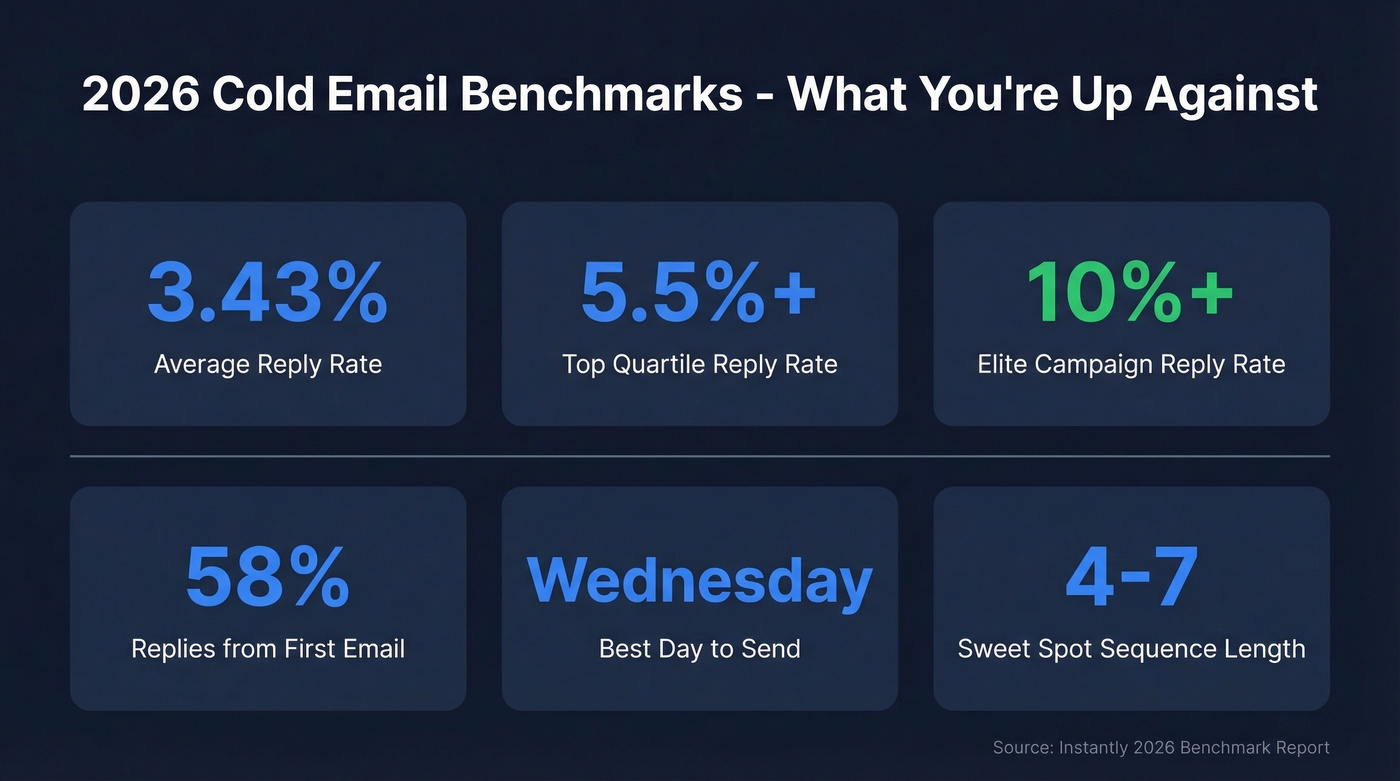
| Metric | Number |
|---|---|
| Avg reply rate | 3.43% |
| Top quartile | 5.5%+ |
| Elite campaigns | 10%+ |
| Replies from Step 1 | 58% |
| Best day to send | Wednesday |
| Sweet spot sequence | 4-7 touches |
58% of all replies come from the first email. Your intro email isn't a throwaway - it's doing most of the heavy lifting. Tuesday and Wednesday are peak reply days, with Wednesday highest. Friday generates the most auto-replies and the fewest real conversations.
Subject Lines That Get Opened
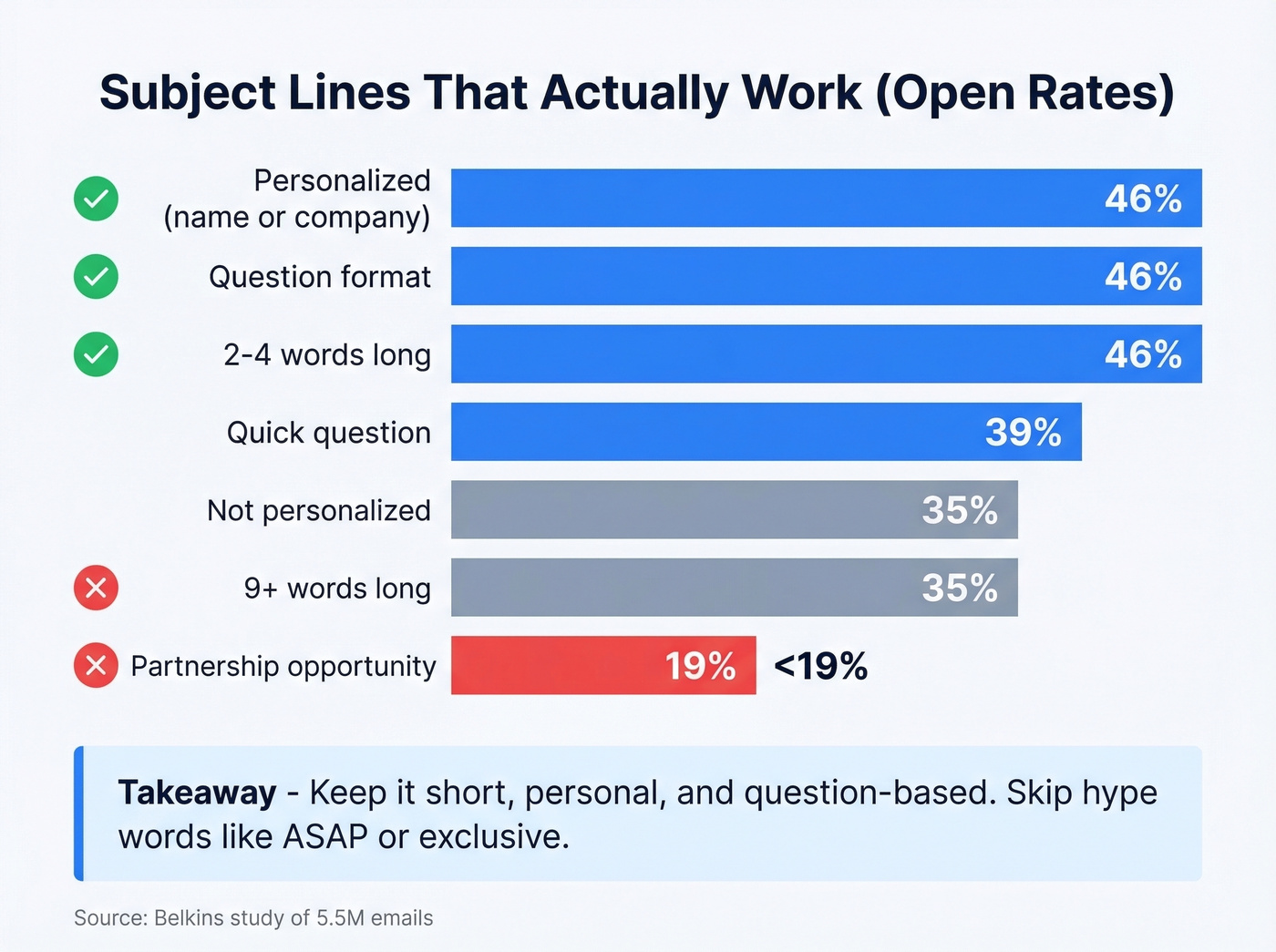
A Belkins study of 5.5 million emails replaces guesswork with real numbers:
| Subject Line Type | Open Rate | Reply Rate |
|---|---|---|
| Personalized (name/company) | 46% | 7% |
| Not personalized | 35% | 3% |
| Question format | 46% | - |
| 2-4 words | 46% | - |
| 9+ words | 35% | - |
| "Quick question" | 39% | - |
| "Partnership opportunity" | <19% | - |
Short, personalized, question-based subject lines dominate. Marketing hype words - "ASAP," "exclusive," "limited time" - drag opens below 36%.
Keep subject lines in the 2-4 word range, include the prospect's name or company, and stay under 50 characters for mobile. Skip numbers in subject lines (27% opens, worse than without) and anything that sounds like a mass blast. For more options, pull from these email subject line examples.
Anatomy of a High-Converting Intro Email
The best-performing campaigns keep emails under 80 words. That Reddit practitioner who cut from 141 to 56 words didn't just shorten - they restructured around the prospect's problem instead of their own product.
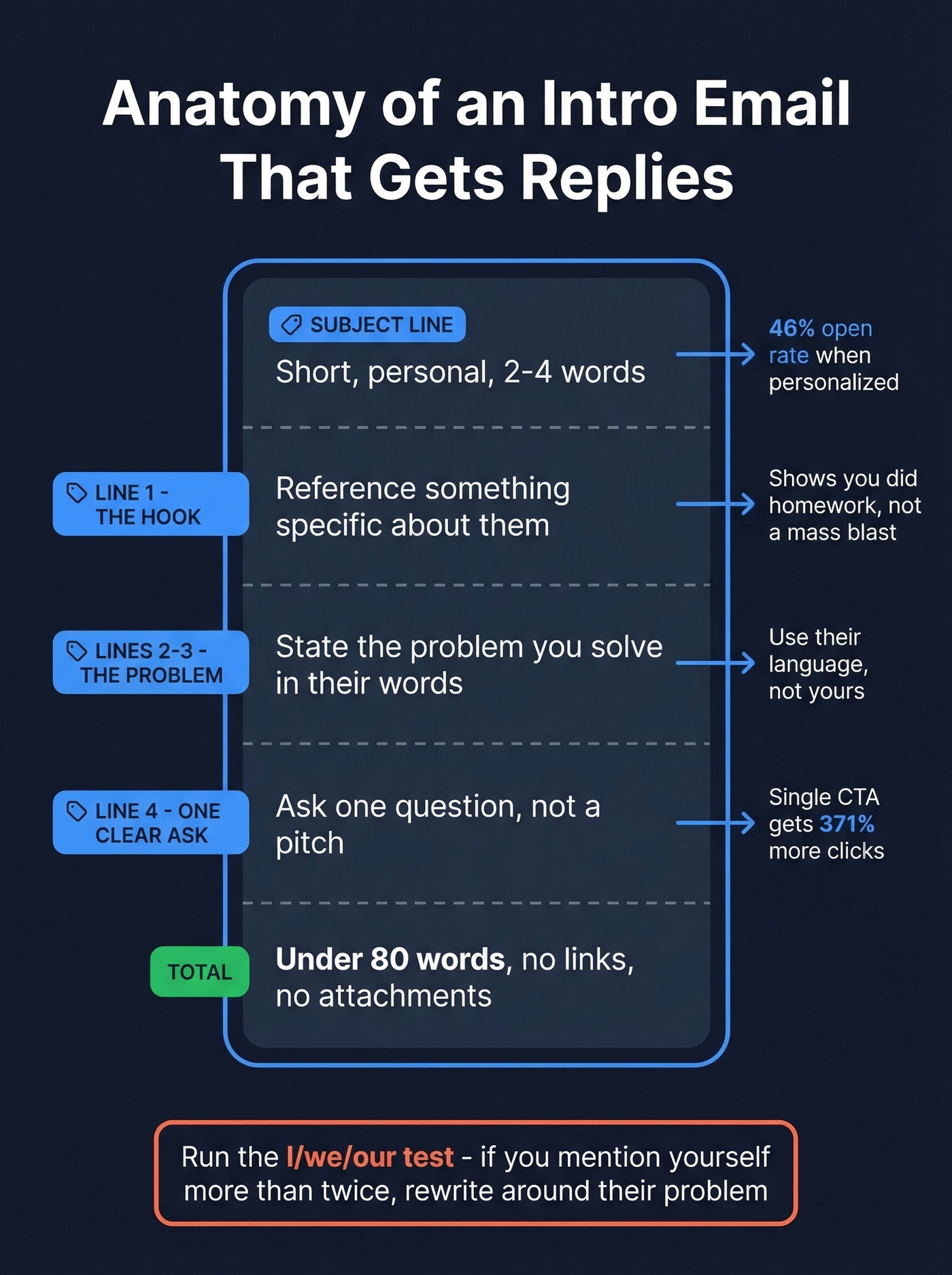
The structure that works: Line 1 references something specific about the prospect. Lines 2-3 state the problem you solve in their language. Line 4 asks one clear question - not a pitch, not a calendar link. Total: under 80 words, no links or attachments, two-sentence paragraphs max.
Run the "I/we/our" test on every draft. If you mention yourself more than twice, rewrite around their problem. If you want a deeper framework, use this email copywriting guide.

Every sales introduction email example above assumes one thing: the email actually reaches a real inbox. Bad data kills reply rates before your copy gets a chance. Prospeo's 98% verified emails on a 7-day refresh cycle mean your intro emails land - not bounce.
Stop perfecting copy that bounces. Fix your data first.
10 Sales Introduction Email Examples
Most teams obsess over template wording when the real difference-maker is targeting and data quality. A mediocre email sent to the right person with a verified address will outperform a brilliant email sent to a dead inbox every single time. We've seen this play out across hundreds of campaigns. If you're still building your outbound motion, start with these sales prospecting techniques.
Cold Outreach - Top of Funnel
Template 1: Problem-Focused
Subject: {{first_name}}, quick question
Hi {{first_name}},
You handle {{responsibility}} at {{company}} - so I'm guessing {{specific pain point}} comes up a lot.
We help teams like yours {{outcome}} without {{common objection}}. {{Client name}} cut their {{metric}} by {{number}} in {{timeframe}}.
Worth a 15-min call this week?
Leads with their problem, not your product. The "I'm guessing" framing feels human, not scripted.
Template 2: Value-First
Subject: {{company}}'s {{metric}}
Hi {{first_name}},
Noticed {{company}} is {{observation - hiring, expanding, launching}}. When that happens, most {{title}}s run into {{problem}}.
We built {{product/feature}} specifically for that. Happy to share how {{similar company}} handled it.
Interested?
Shows you did homework. One-word CTA reduces friction.
Template 3: Case Study Lead
Most cold emails bury social proof in the body. Flip the structure and lead with it:
Subject: How {{similar company}} fixed {{problem}}
Hi {{first_name}},
{{Similar company}} was dealing with {{problem}} - {{specific detail}}. We helped them {{result}} in {{timeframe}}.
Your team at {{company}} looks like it's hitting the same wall. Want to see what they did differently?
The framework from r/sales - "We worked with [client] to do [thing] and they saw [result]" - consistently books meetings because the subject line does double duty as social proof. To build a full sequence around this, use a B2B cold email sequence.
Warm / Referral - Mid-Funnel
Warm introductions convert at 4x the rate of cold outreach. The connector's name in the subject line is your best open-rate hack.
Template 4: Mutual Connection
Subject: {{connector name}} suggested we connect
Hi {{first_name}},
{{Connector}} mentioned you're working on {{initiative}} and thought we should talk. We help {{title}}s at companies like {{company}} with {{specific outcome}}.
Would a quick call next week make sense?
Template 5: Ask-for-Intel
Subject: Quick favor, {{first_name}}
Hi {{first_name}},
I'm trying to understand how {{company}} handles {{process}}. {{Connector}} said you'd be the right person to ask.
Not selling anything - just trying to learn. Would you have 10 minutes this week?
Asking for information instead of a meeting lowers the bar and surfaces pain points for a stronger follow-up.
Trigger-Based - Buying Window
Template 6: Job Change
Subject: Congrats on the new role
Hi {{first_name}},
Saw you just joined {{company}} as {{title}} - congrats. New roles usually mean inherited tools and fresh priorities.
We help {{title}}s get {{outcome}} in the first 90 days. Worth a quick chat?
Template 7: Funding Event
Subject: {{company}}'s round
Hi {{first_name}},
Congrats on the {{Series X}}. When companies raise at this stage, {{common challenge}} usually becomes urgent fast.
We helped {{similar company}} solve that before it slowed them down. Want to hear how?
Funding is a clear buying signal. The prospect knows they need to scale - you're offering a shortcut. If you want to operationalize this, see how to track sales triggers.
Re-engagement - Stalled Pipeline
Template 8 vs. Template 9 - Two approaches to revival:
| New Rep Handoff | Re-engagement | |
|---|---|---|
| Subject | Taking over from {{previous rep}} | Still relevant, {{first_name}}? |
| Tone | Professional, continuity-focused | Casual, low-pressure |
| Best for | Territory changes, account handoffs | 3-6 month stalled conversations |
| Key line | "Anything changed on your end since then?" | "If not, no worries." |
The handoff email acknowledges relationship history. The re-engagement email gives an easy out - which paradoxically increases replies. For more variations, use these sales follow-up templates and this handoff email template guide.
The "Feels Like a Reply" Follow-Up
Template 10: Step 2 Nudge
Subject: Re: {{original subject line}}
Hey {{first_name}} - just bumping this up. Figured it got buried.
Still curious if {{problem}} is something you're dealing with. Happy to share what we're seeing work for {{industry}} teams right now.
Send 3-4 days after your first email. Instantly's data shows Step 2 emails that mimic a real reply thread outperform formal follow-ups by roughly 30%. If you're unsure about timing, follow when should i follow up on an email.
Infrastructure That Makes Templates Work
The best template in the world bounces off a dead email address. That same Reddit user watched their bounce rate drop from 11% to under 2% just by verifying every address before sending. Their total stack cost: ~$420/month generating 16 qualified leads, roughly $26 per lead.
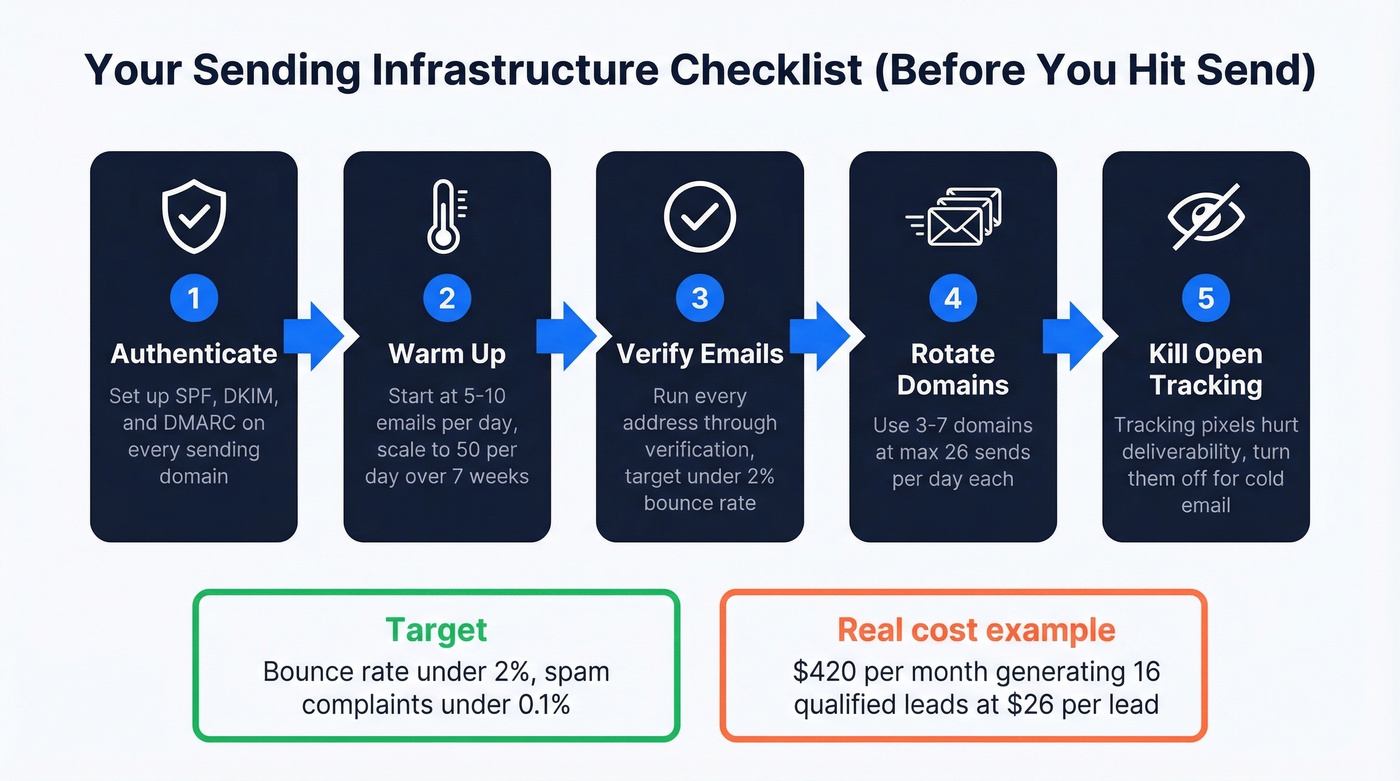
Set up SPF, DKIM, and DMARC on every sending domain. Warm up at 5-10 emails/day, scaling to 50/day per inbox over 7 weeks. Use 3-7 domains at max 26 sends/day each. Keep bounce rate under 2% and spam complaints under 0.1%. If you need the full technical checklist, use this email deliverability guide and these SPF record examples.
Let's be honest about something most guides won't tell you: turn off open tracking on cold email. Tracking pixels hurt deliverability. The metric you're measuring is actively sabotaging your results. (More detail: email tracking pixels.)
The fastest way to clean your list is to run it through Prospeo's email verification. The 5-step verification process with catch-all handling and spam-trap removal delivers 98% accuracy across 143M+ verified addresses. The free tier gives you 75 verifications per month to test it - skip this step if you're already running a verification tool you trust and seeing bounce rates under 2%.
Trigger-based emails like job changes and funding events only work if you catch the signal in time. Prospeo refreshes 300M+ profiles every 7 days and tracks buyer intent across 15,000 topics - so your intro email hits the right person in the right buying window.
Send the right intro email to the right person at the right moment.
Mistakes That Kill Reply Rates
Emails with a single CTA increase click-through by up to 371% compared to multiple asks. One question, one action. That's it. Over 60% of emails are opened on mobile, so if yours looks like a wall of text on a phone, it's getting deleted before the second sentence.
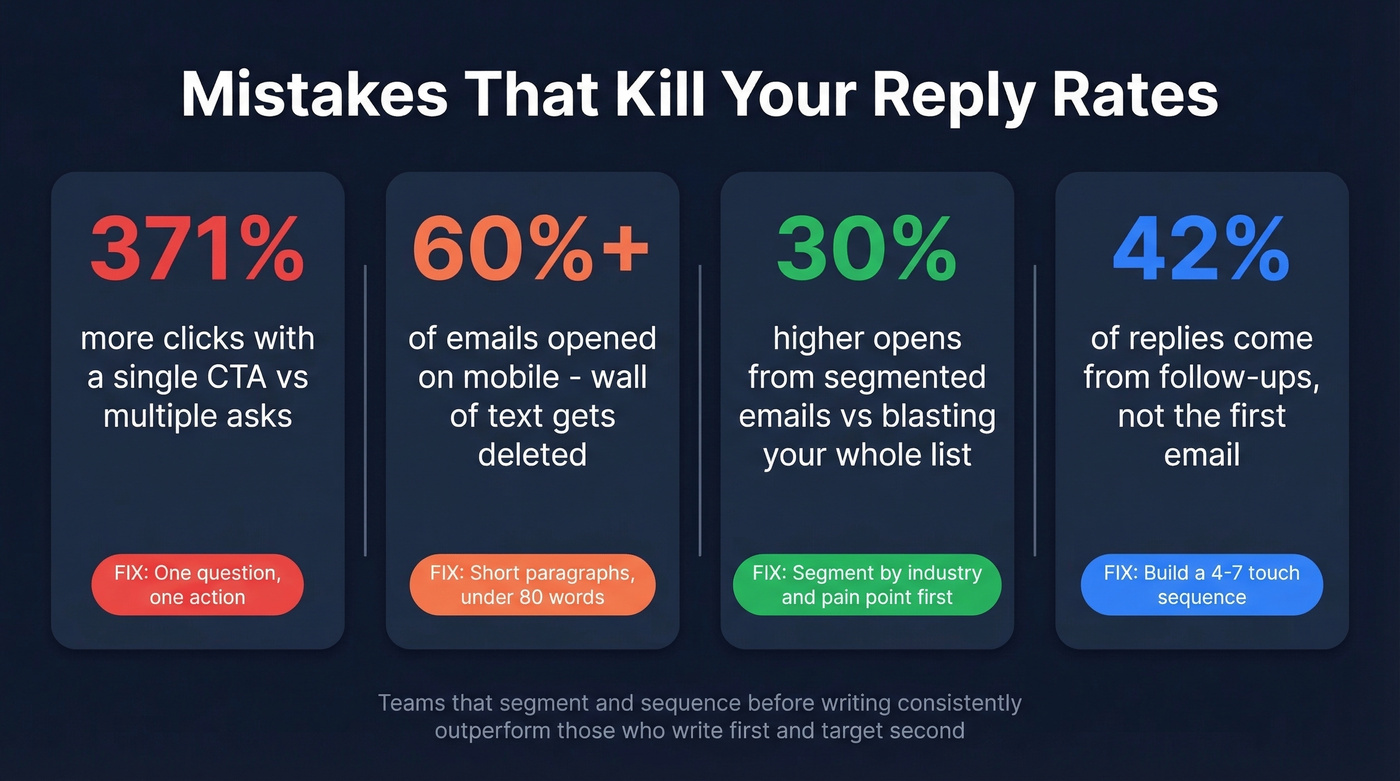
Segmented emails see 30% higher opens and 50% more click-throughs. Blasting the same template to your entire list is the fastest way to train spam filters against you. And if you're sending one email and moving on, you're leaving 42% of your results on the table - follow-ups capture nearly half of all replies. In our experience, the teams that segment by industry and pain point before writing a single word consistently outperform those who write first and target second. If you're tightening targeting, start with an ideal customer profile.
Legal Compliance
CAN-SPAM applies to all commercial messages, including B2B. Penalties run up to $53,088 per violating email.
- No misleading "From" names or subject lines
- Include a valid physical postal address
- Provide a clear opt-out mechanism
- Honor opt-out requests within 10 business days
Since May 2025, Google, Yahoo, and Microsoft enforce bulk sender rules requiring SPF/DKIM/DMARC authentication, one-click unsubscribe headers, and spam complaint rates under 0.3%. If you're sending to EU prospects, GDPR adds consent and legitimate-interest requirements. Build compliance in from day one - it's not optional, and the penalties aren't theoretical.
FAQ
How long should a sales intro email be?
Under 80 words. One practitioner cut to 56 words and doubled reply rates - three short paragraphs max. Every high-performing intro email follows this tight, prospect-focused format.
What's a good reply rate for cold intro emails?
The 2026 average is 3.43% across all industries. Top performers hit 5.5%+, and elite campaigns with verified data and strong personalization exceed 10%.
Should I include links in my first email?
No. Links in your first cold email hurt deliverability because spam filters flag them. Save links for follow-ups after a prospect replies or engages.
How many follow-ups should I send?
Four to seven touchpoints is the sweet spot. 58% of replies come from email one, but follow-ups capture the other 42%. Stopping after one message leaves nearly half your results behind.
How do I find verified emails for my prospect list?
Use a verification tool before sending any campaign. Prospeo's email finder covers 143M+ verified addresses at 98% accuracy with a free tier of 75 credits per month - enough to test before committing. Pair it with tools like Hunter or NeverBounce to compare results.