

Every Sales Job Title Explained: Hierarchy, Salaries, and Career Paths
You're scrolling job boards and seeing SDR, BDR, Inside Sales Rep, Account Development Rep, and Sales Associate - all posted by companies of roughly the same size, all describing roughly the same job. Over 13 million professionals work in sales across the US, and it feels like there are almost as many titles to sort through. The confusion isn't just annoying. It costs job seekers time, it costs hiring managers qualified candidates, and it makes org design harder than it needs to be.
Only 32% of people view sales as a trustworthy profession, yet 88% of buyers engage when they see the salesperson as a trusted advisor. The title matters less than the credibility behind it - but the right title opens the door.
Most "complete lists" you'll find online are alphabetical dumps of 200 titles with zero context. What actually matters is the 15-20 roles that exist at most companies, what they pay, and how they connect. Let's break that down.
Quick Reference: Five Core Roles
| Title | What They Do | OTE Range |
|---|---|---|
| SDR/BDR | Generate pipeline | $60K-$100K |
| Account Executive | Close deals | $110K-$350K+ |
| Account Manager | Retain & expand accounts | $80K-$120K |
| Sales Manager | Coach reps, own team quota | $200K-$280K |
| VP of Sales | Set strategy, own the number | $300K-$500K+ |
Below: every title by level, salary data, industry variations, and how to actually find people in these roles.
How Sales Hierarchies Work
Sales titles fall into four tiers: entry-level, mid-level, senior, and executive. Within each tier, there's a fork - the individual contributor (IC) track and the management track. An enterprise AE making $300K+ is on the IC track. A sales manager making $250K is on the management track. Neither is "above" the other; they're parallel paths with different skill sets.
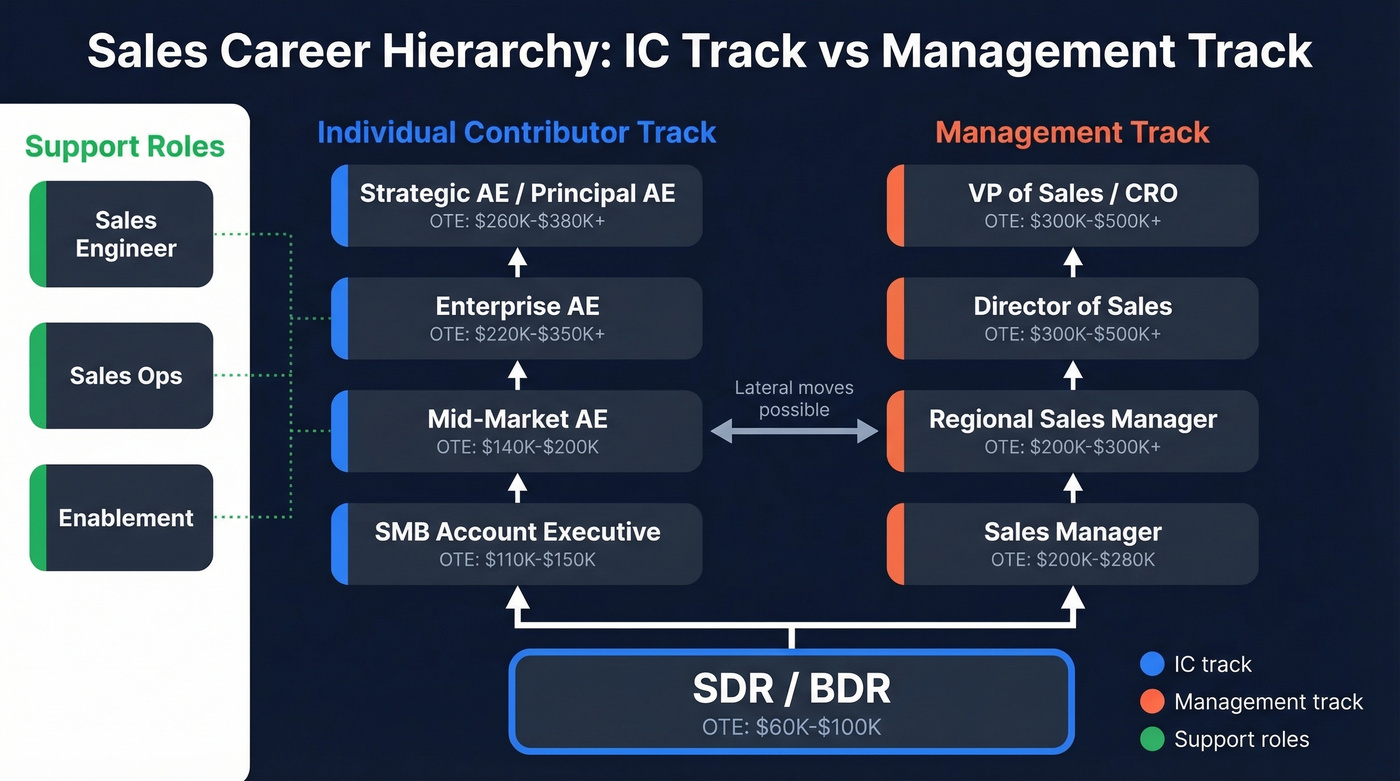
Here's the thing: titles vary wildly by company stage. A "Director of Sales" at a 12-person startup is doing SDR work, closing deals, and building the playbook from scratch. A Director of Sales at Salesforce manages 40 reps and hasn't cold-called anyone in a decade. Same title, completely different job. Always read the job description, not just the title.
Entry-Level Sales Roles
SDR & BDR
Sales Development Representatives and Business Development Representatives are the engine room of most B2B sales orgs. They're responsible for pipeline generation - booking meetings that AEs close. Average SDR tenure is 1.5 years with a 3+ month ramp, which tells you everything about the intensity of the role.
SDR base pay runs $45K-$65K, with OTE of $60K-$90K (often $70K-$100K in SaaS). BDRs land slightly higher at $50K-$70K base and $70K-$100K OTE. In hot SaaS hubs, top performers can reach $120K+. The most common next step is AE, but the timeline ranges from 12 to 24 months depending on company stage and performance.
Inside Sales Rep & Outside Sales Rep
Inside sales reps work phones and email - they handle inbound inquiries and close transactional deals without leaving the office. Think of them as the hybrid between an SDR and an AE for lower-ticket products. Base runs $40K-$60K, OTE $60K-$90K.
Outside sales reps are the road warriors. They're in the field, running face-to-face meetings, managing territory relationships, and handling longer sales cycles. The travel premium shows up in comp: base $55K-$80K, OTE $90K-$150K+.
Sales Coordinator & Associate
These are the true entry points - often the first rung for people breaking into sales without prior experience. Sales coordinators handle CRM hygiene, scheduling, proposal support, and reporting. Sales associates work in retail or transactional environments with lighter quota pressure.
Both roles pay in the $35K-$55K range and serve as springboards into SDR or AE tracks. For what it's worth, coordinator roles build more transferable B2B skills, while associate roles build customer-facing confidence faster.
SDR vs BDR: What's Actually Different?
Ask ten companies and you'll get ten answers. The Sales Enablement Collective puts it exactly that way.
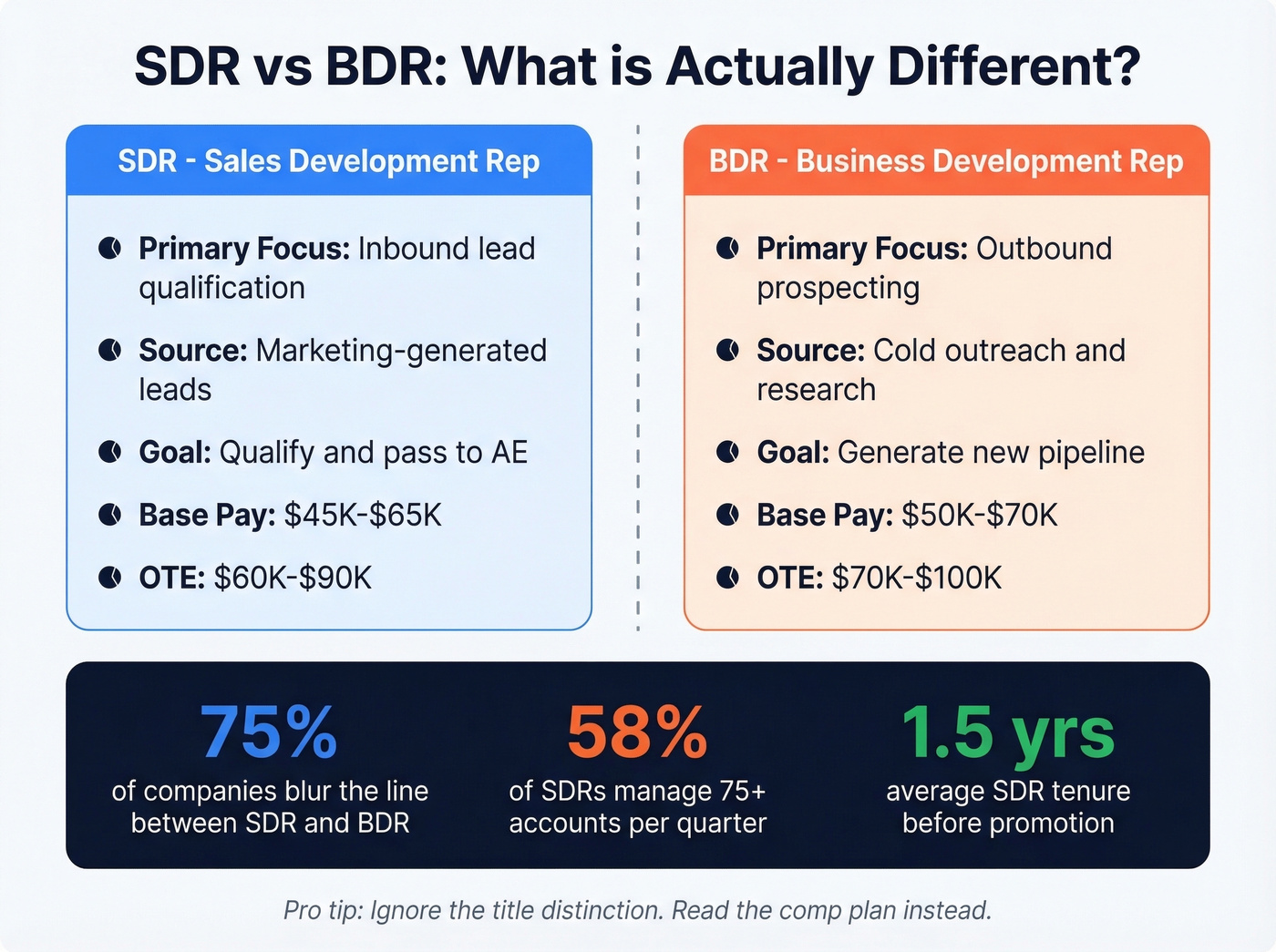
The textbook distinction: SDRs qualify inbound leads (marketing-generated), BDRs do outbound prospecting (cold outreach). In practice, only about 25% of companies maintain this split. Nearly half use blended roles where the same person handles both inbound and outbound. Many companies just pick one title and use it for everything.
What's consistent is the workload. 58% of SDRs manage more than 75 accounts per quarter, which means most are juggling outbound sequences, inbound follow-up, and CRM updates simultaneously. Inside sales reps differ because they close small deals themselves rather than handing off to an AE.
If you're a job seeker, ignore the SDR/BDR distinction and read the comp plan. If you're a hiring manager, pick one title and be consistent. The market doesn't care which one you choose.
Mid-Level Sales Positions
Account Executive (by Segment)
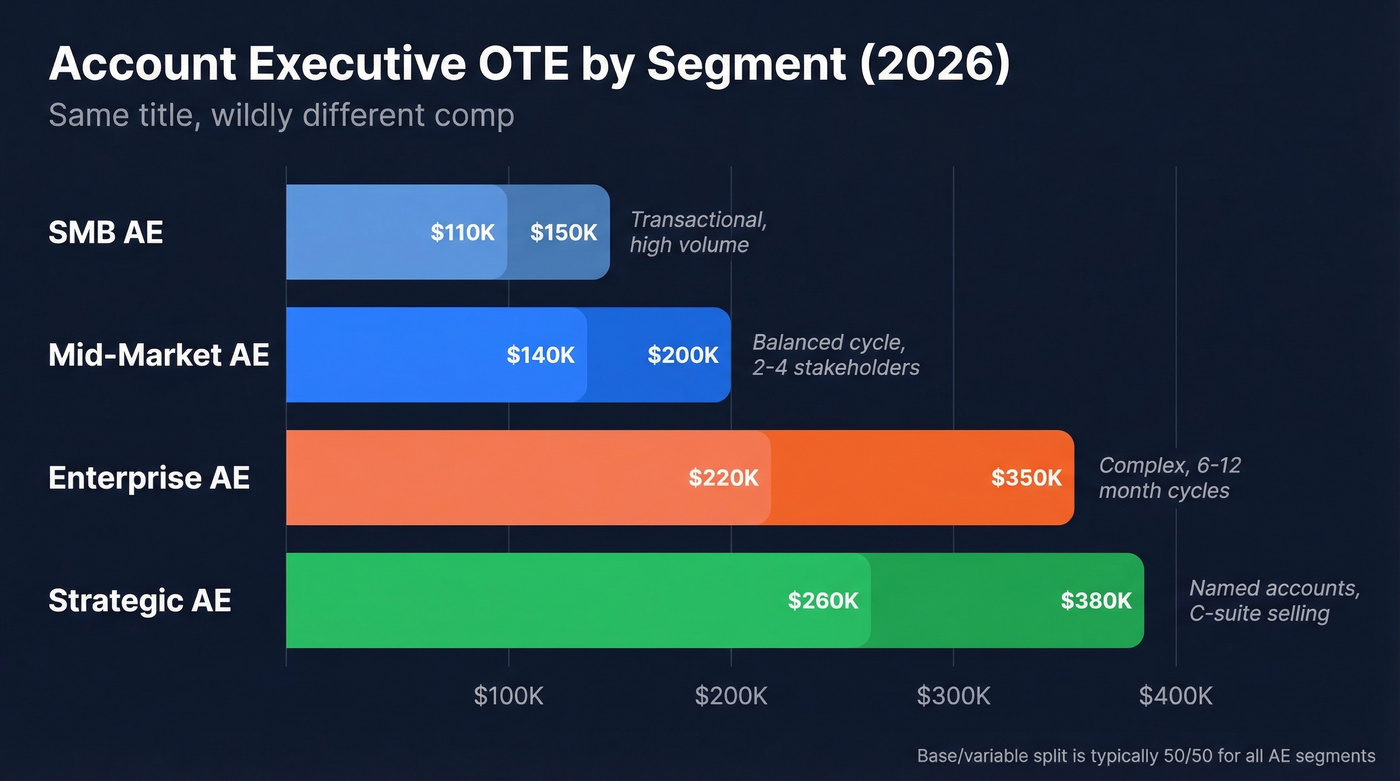
The AE role is where comp gets interesting - and where segmentation matters most. The same "Account Executive" title can mean wildly different things depending on the customer segment:
| Segment | Base Range | OTE Range |
|---|---|---|
| SMB AE | $55K-$75K | $110K-$150K |
| Mid-Market AE | $70K-$100K | $140K-$200K |
| Enterprise AE | $100K-$150K | $220K-$350K+ |
| Strategic AE | $120K-$170K | $260K-$380K+ |
Median enterprise AE OTE sits around $270K, and some companies report $500K+ median OTE for enterprise AEs. The jump from SMB to enterprise isn't just a pay bump - it's a fundamentally different selling motion with longer cycles, more stakeholders, and bigger consequences for everyone involved.
Account Manager & CSM
Account Managers own the post-sale relationship and are responsible for renewals, upsells, and cross-sells. OTE runs $80K-$120K with a heavier base weighting than AEs - typically 70/30 or 80/20.
Customer Success Managers overlap significantly but skew toward adoption, health scores, and churn prevention. CSM OTE lands at $85K-$130K. The line between AM and CSM is blurry at most companies. Some orgs combine them; others split them with AMs owning revenue targets and CSMs owning product adoption metrics.
If you're building this function, it helps to understand churn and track your renewal rate by segment.
Sales Engineer
Sales Engineers are the technical backbone of complex deals. They run demos, build proof-of-concept environments, handle technical objections, and translate product capabilities into business outcomes. OTE runs $160K-$230K with a higher base ratio - often 75/25 or 80/20, sometimes tied to team attainment rather than individual quota.
We've seen firsthand how a great SE shortens deal cycles by weeks and increases win rates by double digits. If you're technical and considering sales, this is the highest-leverage entry point. It's also, in our opinion, the most underpaid role relative to impact.
Territory & Channel Manager
Territory Managers own a geographic region end-to-end, combining hunting and farming responsibilities. They're common in manufacturing, medical devices, and field sales orgs. Channel/Partner Managers manage relationships with resellers, VARs, and integration partners - they sell through others rather than directly. Both roles land in the $100K-$180K OTE range depending on industry and territory size.
Senior & Executive Sales Job Titles
Sales Manager & Regional Manager
Sales Managers are first-line leaders - they coach reps, run forecasts, and own team quota. OTE runs $200K-$280K. Demand for this role has surged, with sales manager postings up 149.3% year-over-year as companies scale their go-to-market teams.
Regional Sales Managers oversee multiple territories or offices within a geography. Base runs $120K-$170K with OTE of $200K-$300K+. They bridge frontline managers and directors, and it's often the proving ground for future VP candidates.
If you're stepping into leadership, strong sales forecasting habits matter more than your title.
Director, VP, and C-Suite
Directors of Sales manage managers and own a segment or region. VPs and SVPs of Sales own the entire revenue number and report to the CEO or CRO. At a public company, 30-50% of total comp at this level comes from RSUs. At a startup, equity could be worth $0 or $2M - there's no way to know at offer stage.
The Chief Revenue Officer (CRO) sits at the top, owning all revenue-generating functions - sales, marketing, customer success, and sometimes partnerships. The Chief Sales Officer (CSO) is narrower, focused purely on the sales organization. Both carry total comp heavily weighted toward equity and bonuses, with base plus variable plus equity pushing OTE to $300K-$500K+.
Sales Ops, RevOps, and Enablement
These roles don't carry quota but are critical to sales performance. Sales Ops Managers handle forecasting, territory planning, and CRM administration. RevOps Managers take a broader view across the full revenue lifecycle. Sales Enablement Managers own training, content, and tool adoption.
Comp ranges from $70K-$150K depending on seniority and company size. RevOps has been the fastest-growing of the three, driven by companies consolidating their tech stacks and wanting a single owner for the data layer.
If you're hiring here, it's worth reading what a RevOps Manager actually owns day-to-day, and how a Sales Enablement Manager impacts ramp time.

Knowing every sales title is step one. Step two is finding the right person behind it. Prospeo's 30+ search filters let you target by exact job title, seniority level, department size, and company stage - across 300M+ verified profiles.
Stop memorizing titles. Start reaching the people who hold them.
Full Salary Table for 2026
OTE means On-Target Earnings - base salary plus variable compensation at 100% quota attainment. It's not guaranteed income. Before accepting any offer, ask what percentage of the team actually hits quota and what median attainment looks like. A $150K OTE where 30% of reps hit plan is very different from $120K OTE where 70% do.
For a deeper breakdown of how OTE is calculated, see OTE in Sales.
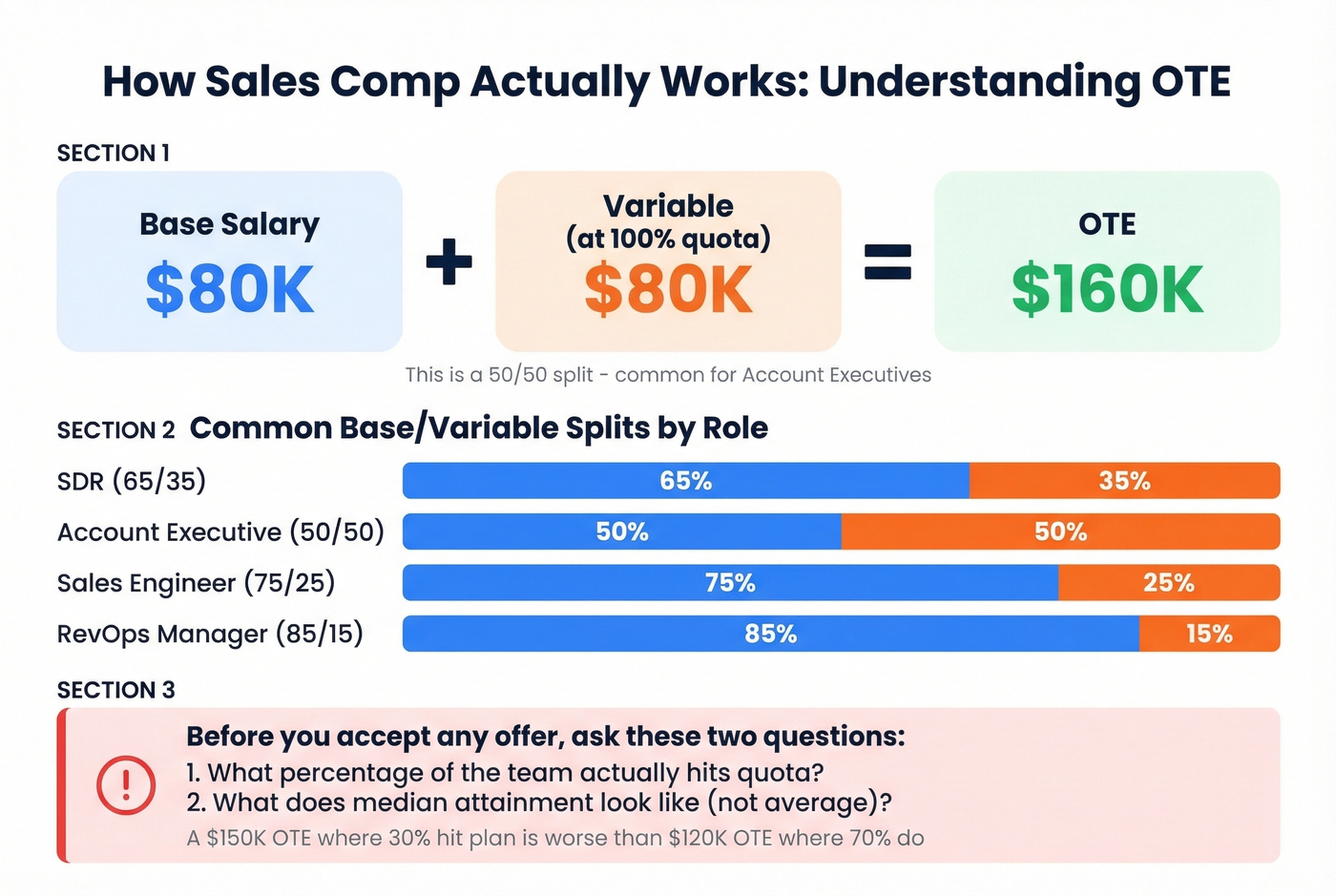
Most sales roles follow a base/variable split. Entry-level roles run 60/40 to 70/30. Senior IC roles can go 50/50. Management and executive roles often include accelerators that pay 2-3x the normal commission rate above quota.
| Title | Base Range | OTE Range | Typical Split |
|---|---|---|---|
| SDR | $45K-$65K | $60K-$90K | 65/35 |
| BDR | $50K-$70K | $70K-$100K | 65/35 |
| Inside Sales Rep | $40K-$60K | $60K-$90K | 60/40 |
| Outside Sales Rep | $55K-$80K | $90K-$150K+ | 55/45 |
| SMB AE | $55K-$75K | $110K-$150K | 50/50 |
| Mid-Market AE | $70K-$100K | $140K-$200K | 50/50 |
| Enterprise AE | $100K-$150K | $220K-$350K+ | 50/50 |
| Account Manager | $60K-$90K | $80K-$120K | 70/30 |
| CSM | $65K-$95K | $85K-$130K | 75/25 |
| Sales Engineer | $110K-$160K | $160K-$230K | 75/25 |
| Sales Manager | $120K-$170K | $200K-$280K | 60/40 |
| Regional Sales Manager | $120K-$170K | $200K-$300K+ | 60/40 |
| Director of Sales | $150K-$200K | $300K-$500K+ | 60/40 |
| VP/SVP of Sales | $180K-$250K | $300K-$500K+ | Varies + equity |
| CRO/CSO | $200K-$300K | $300K-$500K+ | Varies + equity |
| RevOps/Enablement Manager | $80K-$120K | $90K-$150K | 85/15 |
| Sales Ops Analyst | $65K-$95K | $70K-$110K | 90/10 |
How Titles Vary by Industry
SaaS & Tech
SaaS companies follow the most standardized naming convention: SDR -> AE -> CSM, with Sales Engineers supporting complex deals. Titles are predictable, the SDR/AE handoff model is nearly universal, and comp skews higher than other industries - especially at venture-backed companies competing for talent.
Manufacturing & Industrial
Manufacturing naming conventions look completely different. Territory Sales Managers own geographic regions end-to-end. Technical Sales Engineers need deep product knowledge and engineering credibility. Key Account Managers protect a small portfolio of high-revenue accounts. Business Development Managers are pure hunters focused on new logo acquisition.
One warning from recruiting firms: using a generic "Sales Representative" title for complex industrial roles undersells the position and repels experienced candidates. Title inflation works the other way too - calling someone a "Director" without director-level comp will cost you credibility fast.
Retail & Financial Services
Retail sales hierarchies run Store Manager -> District Manager -> Regional VP, with comp heavily weighted toward base salary plus bonuses rather than commission.
Financial services uses its own vocabulary entirely: Relationship Managers, Wealth Advisors, Private Bankers, and Financial Consultants. The typical progression runs Financial Advisor -> Senior Advisor -> Managing Director, with comp structures that blend salary, AUM-based fees, and production bonuses. The underlying sales skills mirror B2B, but the titles signal industry credibility to clients - using SaaS-style role names in financial services is a fast way to lose trust.
How Titles Vary by Company Stage
At a seed-stage startup, your "Head of Sales" is doing SDR work in the morning, running demos at lunch, and building the CRM workflow at night. They're an SDR, AE, sales manager, and RevOps team rolled into one person with a generous title.
By Series B, specialization kicks in. You'll see dedicated SDRs, a small AE team, maybe a sales manager. The titles start to mean something. By the time a company hits enterprise scale, you might see 15+ distinct roles with clear reporting lines, segmentation by deal size, and separate IC and management tracks.
A frustration we hear constantly from startup hires: "My title says Director but I'm doing IC work." This is the startup title inflation problem in action. When evaluating candidates or opportunities, always index on what the person actually does - not what the title says. Skip the title and ask for the org chart, the comp plan, and the quota number. Those three things tell you more than any job posting ever will.
Sales Team Structure Models
How you organize your sales team determines which titles you need. Here are the four dominant models:
Assembly line is the most common in SaaS: SDR generates pipeline -> AE closes -> AM/CSM manages post-sale. Clear handoffs, clear titles, clear metrics. It scales well but creates friction at each handoff point.
What if your team is too small for handoffs? That's where the pod model comes in. It groups an SDR, AE, and CSM into a small team that owns accounts end-to-end. Fewer handoffs and better customer experience, but harder to scale past 30-40 reps.
The island model gives each rep full ownership from prospecting to close to renewal. You'll see this in SMB sales and early-stage companies where hiring an SDR team doesn't make economic sense yet. Titles are simpler because one person does everything.
Then there's the hunter-farmer split. Hunters (AEs) chase new logos while farmers (AMs) grow existing accounts. Clean separation of skills, but it requires careful territory rules to avoid conflicts over who "owns" an account when a new division at an existing customer wants to buy.
Sales orgs have undergone an average of four transformations, and only 11% say they can drive commercial success during a transformation. Picking the right structure - and the right positions to match - matters more than most leaders realize.
If you're redesigning your org, it helps to track pipeline health and fix common sales pipeline challenges before you reshuffle titles.
Emerging Roles in 2026
The AI wave is creating roles that didn't exist two years ago. Global sales job postings grew 31.9% year-over-year, and many of the new positions sit at the intersection of sales and AI operations.
| Emerging Title | Pay Range |
|---|---|
| Revenue Intelligence Architect | $130K-$210K |
| AI Sales Automation Orchestrator | $100K-$170K |
| Agentic Sales Manager | $120K-$190K |
| AI Prospecting Engineer | $95K-$155K |
| Predictive RevOps Manager | $110K-$180K |
| Chief AI Revenue Officer | $200K-$350K |
These roles reflect a broader shift. Gartner predicts 75% of B2B purchases will move to digital platforms by 2027, which means the sales org of 2028 will look very different from today's. The companies hiring Revenue Intelligence Architects and Predictive RevOps Managers now are betting that AI-augmented selling isn't a trend - it's the new baseline.
How to Find People in Any Sales Role
Understanding the title landscape is step one. Step two is actually reaching these people - whether you're hiring, selling to them, or building a prospect list.
The fastest path is filtering by exact job title, seniority level, and department in a sales prospecting database. Prospeo lets you do exactly that across 300M+ professional profiles with 30+ search filters, so you can pull a list of every VP of Sales at SaaS companies with 50-200 employees in North America and get 98% verified emails and direct mobile numbers attached. Data refreshes every seven days, which matters when you're targeting people in high-turnover roles like SDRs.

For hiring managers, try this before posting a job: map who holds these titles at competitor companies. You'll learn what titles your market actually uses, what comp looks like, and who might be open to a conversation. It takes 20 minutes and saves weeks of guesswork.
If you're building outbound lists, start with an ideal customer profile and a repeatable set of sales prospecting techniques.
Hiring SDRs? Selling to VPs of Sales? Whether you're building an org chart or prospecting into one, you need verified contact data - not stale LinkedIn exports. Prospeo delivers 98% accurate emails at $0.01 each, refreshed every 7 days.
Every title on this list is searchable in Prospeo right now.
FAQ
What's the highest-paying sales title?
Chief Revenue Officer (CRO) tops the hierarchy at $300K-$500K+ OTE with significant equity. That said, top enterprise AEs at public SaaS companies routinely out-earn their CRO on a cash basis, with some clearing $500K+ in variable comp alone.
What's the difference between SDR and BDR?
By convention, SDRs qualify inbound leads while BDRs handle outbound prospecting. In practice, only about 25% of companies maintain this distinction - most use the titles interchangeably. Focus on the comp plan and daily activities, not the three-letter acronym.
What's the typical sales career path?
The standard path runs SDR/BDR -> AE -> Senior AE -> Sales Manager -> Director -> VP of Sales -> CRO. The IC track - SDR -> AE -> Enterprise AE -> Strategic AE - often pays more than the management track at equivalent seniority levels, especially at top-performing companies.
Do sales job titles vary by industry?
Significantly. SaaS follows the SDR/AE/CSM convention. Manufacturing uses Territory Sales Manager, Technical Sales Engineer, and Key Account Manager. Financial services uses Relationship Manager and Wealth Advisor. Using the wrong industry terminology in a job posting can cost you qualified candidates who filter by specific role names.
How do I find people with specific sales titles?
Use a B2B database that lets you filter by exact job title, seniority, and department. Prospeo covers 300M+ profiles with verified contact data - export the list with emails and mobile numbers, then push directly to your CRM or sequencer. There's a free tier with 75 credits per month, no contracts required.