

B2B Sales Leads: What Actually Works in 2026 (With Benchmarks)
The average B2B buying cycle runs 10.1 months. The winning vendor lands on the buyer's shortlist on Day One 95% of the time. If you're still treating B2B sales leads as a volume game - blasting 10,000 contacts and hoping 50 respond - you're playing the wrong sport entirely.
Here's what the data says about generating business leads that convert, what they cost, and which tools and strategies earn their keep.
The B2B Buying Reality
The buying journey is 61% complete before a prospect talks to any vendor. And 92% of buyers already have at least one vendor in mind when they start evaluating - 41% have a preferred vendor before formal evaluation even begins.
The game isn't "generate more leads." It's "be on the shortlist before the buyer knows they're buying." That means showing up early with relevant content, intent signals, and verified contact data - not just a bigger database.
Here's the thing: if your average deal size sits below $10K, you probably don't need a $30K/year data platform. A verified data tool, an intent layer, and a sending tool like Instantly or Smartlead will get you 80% of the way there for around $200/month.
What B2B Leads Actually Cost
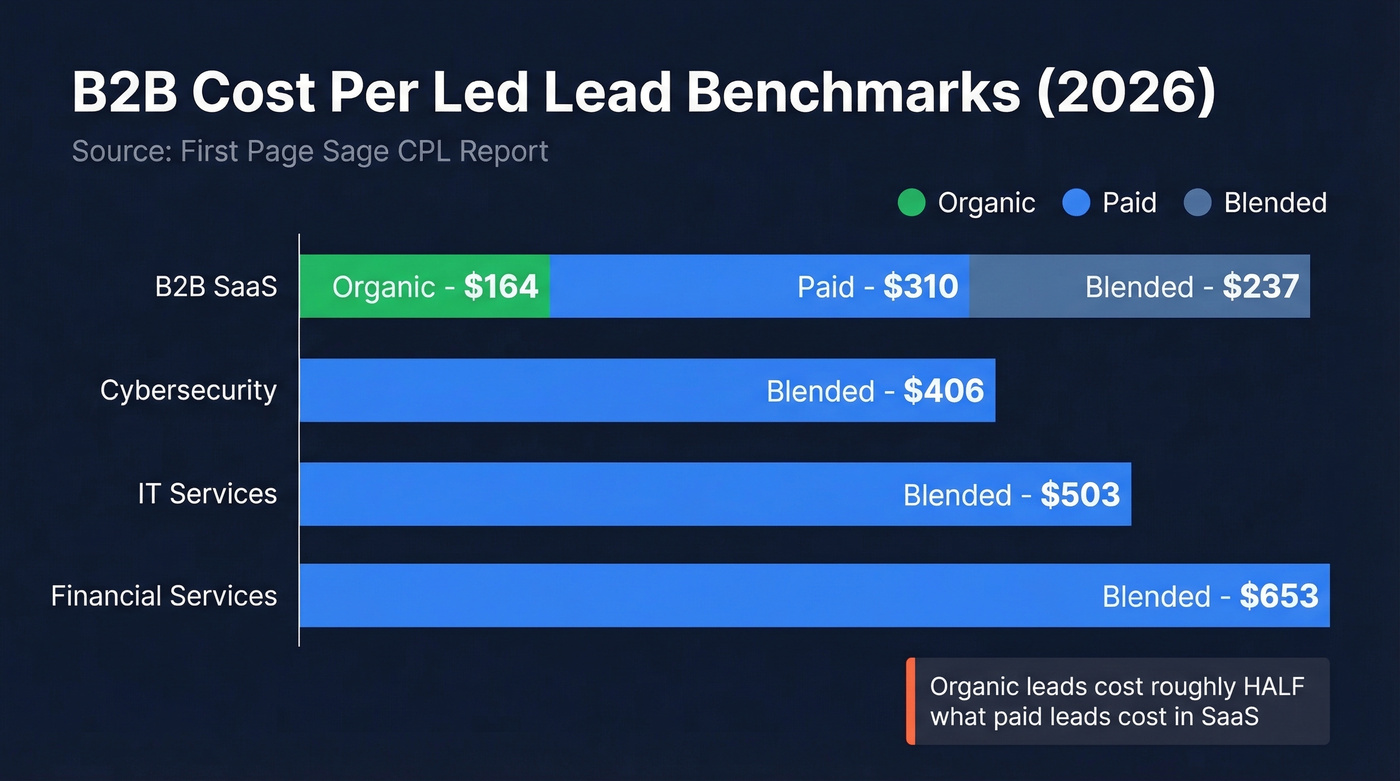
First Page Sage's 2026 CPL report breaks down cost per lead across industries:
| Industry | Paid CPL | Organic CPL | Blended CPL |
|---|---|---|---|
| B2B SaaS | $310 | $164 | $237 |
| Cybersecurity | - | - | $406 |
| IT Services | - | - | $503 |
| Financial Svcs | - | - | $653 |
Two things jump out. Organic leads cost roughly half what paid leads cost in SaaS. And website conversion rates are brutally low - SaaS sites average 1.1%, and even Salesforce converts less than 5% of its traffic into qualified leads. If your site converts at 1.1%, that's not a failure. That's the benchmark.
You can't just buy your way to pipeline. Paid channels get expensive fast, and inbound takes months to compound. The teams winning right now blend both and obsess over data quality to make every dollar count.
The Data Quality Crisis
The #1 complaint on r/b2bmarketing isn't about strategy. It's about data.
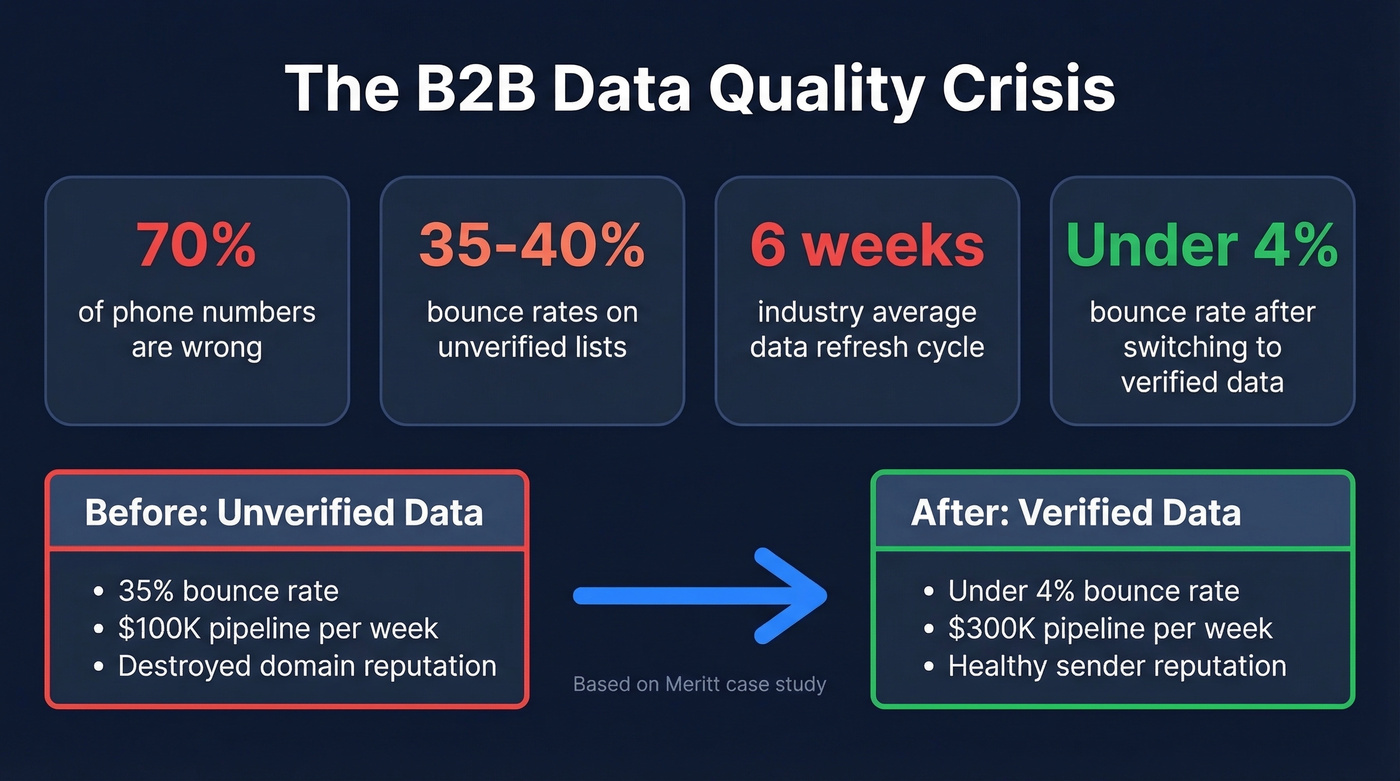
The same Apollo and ZoomInfo exports are hitting the same prospects across hundreds of competing teams. Phone numbers are 70% wrong. Contact lists are polluted with generic inboxes - info@, support@, hello@ - that never reach a decision-maker. We've seen teams running bounce rates of 35-40% on their first sequences because they trusted "verified" data that wasn't actually verified. That destroys domain reputation, tanks deliverability, and wastes months of pipeline building.
Meritt experienced exactly this - bounce rates above 35% - before switching to a verified data provider and cutting that number to under 4%, tripling their pipeline from $100K to $300K per week. Bad data doesn't just hurt deliverability. It poisons your entire lead pipeline. Reps waste hours chasing contacts who left the company six months ago, and your CRM fills with dead records that skew every report you pull.

The article above shows bounce rates of 35-40% destroying domain reputation and pipeline. Prospeo's 5-step verification delivers 98% email accuracy with a 7-day data refresh - not the 6-week industry average. Meritt cut their bounce rate from 35% to under 4% and tripled pipeline to $300K/week.
Stop paying for dead leads. Verify before you send.
Strategies That Generate Quality Leads
You don't need 32 tactics. You need three or four that you execute well. (If you want a broader menu, start with these sales prospecting techniques.)
Cold Email (That Doesn't Suck)
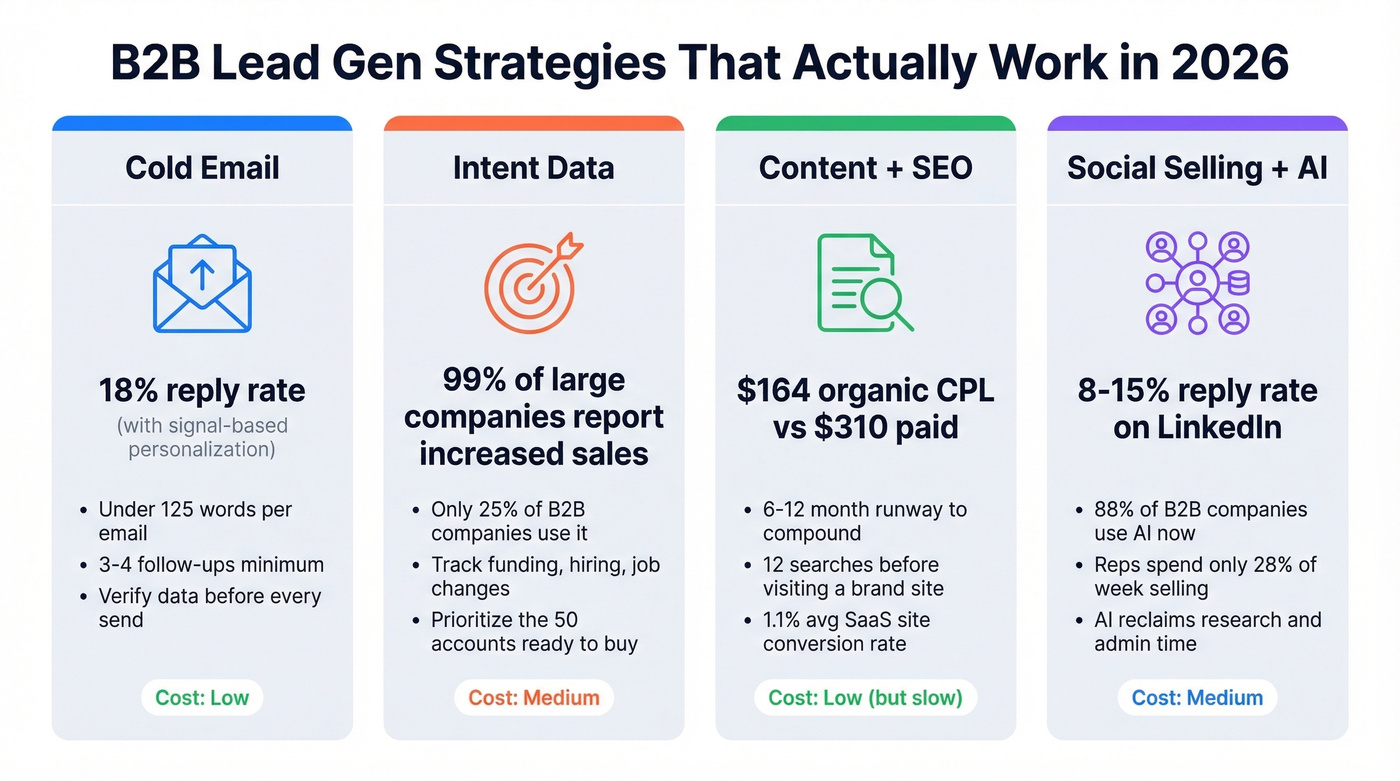
The average cold email reply rate is 3.43%. Signal-based personalization - referencing a prospect's recent funding round, a job change, or competitor content engagement - pushes reply rates to 18%. That's a 5x gap between generic and personalized.
What the best programs get right: emails under 125 words, at least 3-4 follow-ups (70% of reps stop after one email, but 42% of replies come from follow-ups), SPF/DKIM/DMARC authentication, and verified data before every send. Bad data destroys domain reputation faster than bad copy ever will. If you're troubleshooting bounces, start with email bounce rate benchmarks and fixes.
Intent Data
Only 25% of B2B companies use intent data. Yet 99% of large companies that do report increased sales. That's a staggering adoption gap, and it's the single biggest untapped lever for most outbound teams we talk to.
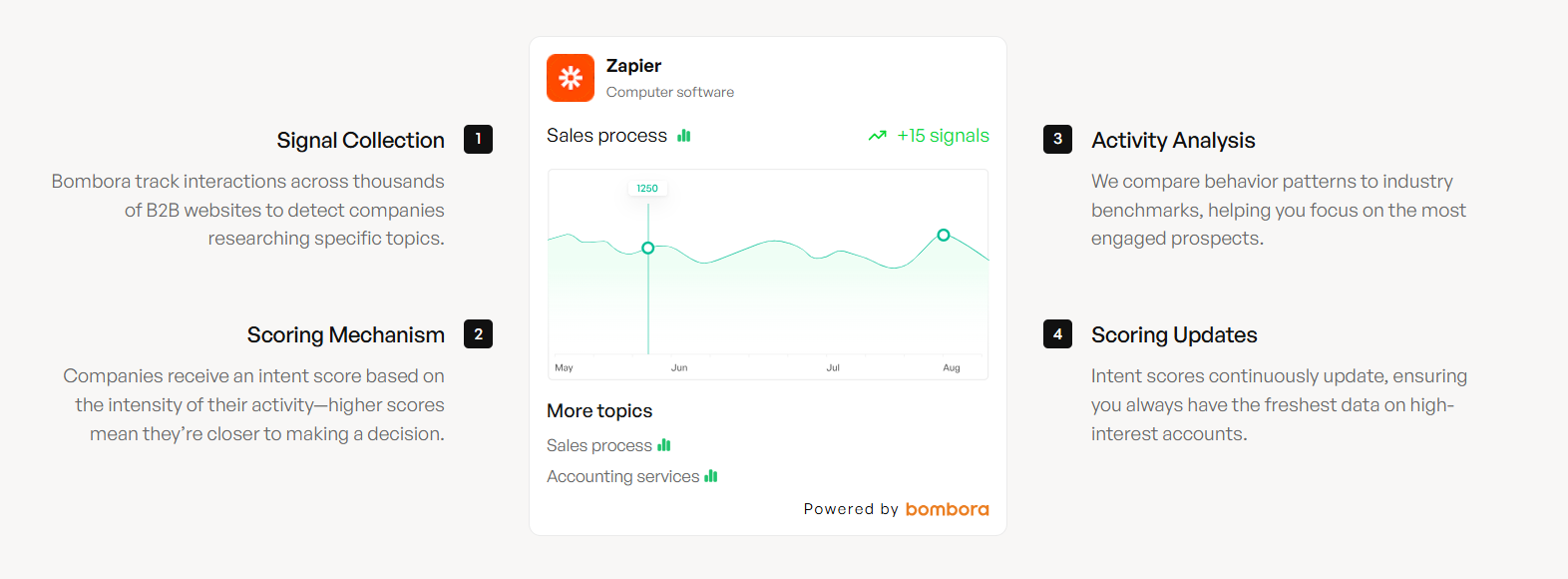
Intent data tells you who's actively researching your category right now. The signals that matter most: funding rounds, hiring for roles your product supports, job changes in target accounts, and competitor content engagement. With buying committees running 6-10 stakeholders, you need to multi-thread - and intent signals tell you which accounts to prioritize. For small teams with limited outbound capacity, intent is the difference between spraying 1,000 emails and targeting the 50 accounts most likely to buy this quarter. To operationalize it, use a simple lead scoring model.
Content + SEO (The Long Game)
Organic CPL runs $164 versus $310 for paid in B2B SaaS - roughly half the cost. But it requires a 6-12 month runway before it compounds. The math is simple: if you're converting 1.1% of visitors and need 100 leads per month, you need around 9,000 unique visitors. Buyers conduct 12 online searches before visiting a specific brand's website, so the compounding payoff is real - patience is non-negotiable. For a tighter playbook, see SEO sales leads.
Social Selling + AI Prospecting
Social selling works when it's systematic. Build targeted lists using Sales Navigator ($99/month), send personalized connection requests referencing something specific, and follow up 3-4 times with value-adds. Realistic reply rates: 8-15%. If you need copy you can ship today, use these sales follow-up templates.
On the AI side, 88% of B2B companies now use AI for prospecting. Gartner projected 80% of B2B sales interactions would occur in AI-powered digital channels by 2026 - and we're there. Reps currently spend only 28% of their week actually selling. AI tools reclaim the rest by automating research, list building, email drafting, and lead scoring, and teams using AI for lead scoring see 20-30% higher conversion rates. If you're building an AI-assisted outbound motion, start with AI cold email outreach.
AI doesn't replace the rep. It replaces the 4 hours of tab-switching and manual research that kills momentum between conversations.
B2B Sales Lead Tools (With Real Pricing)
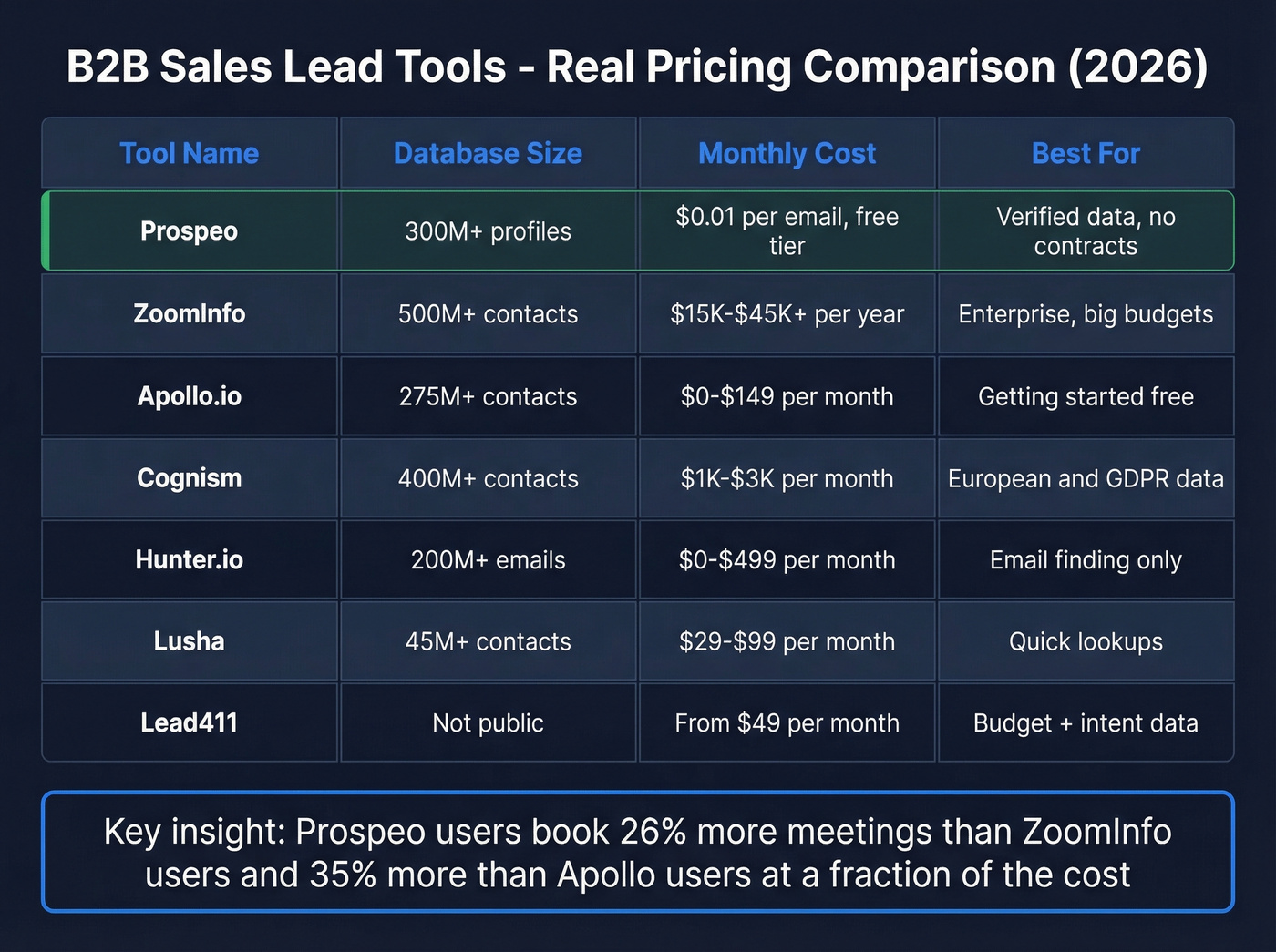
| Tool | Database Size | Pricing | Best For |
|---|---|---|---|
| Prospeo | 300M+ profiles | Free tier; ~$0.01/email | Verified data, no contracts |
| ZoomInfo | 500M+ contacts | $15K-$45K+/yr | Enterprise, big budgets |
| Apollo.io | 275M+ contacts | $0-$149/mo | Getting started free |
| Cognism | 400M+ contacts | ~$1K-$3K/mo | European / GDPR data |
| Hunter.io | 200M+ emails | $0-$499/mo | Email finding only |
| Lusha | 45M+ contacts | $29-$99/mo | Quick lookups |
| Lead411 | Not public | From $49/mo | Budget + intent data |
Prospeo
In our bake-offs, teams using Prospeo book 26% more meetings than ZoomInfo users and 35% more than Apollo users. The 300M+ profile database delivers 98% email accuracy through a 5-step verification process with catch-all handling, spam-trap removal, and honeypot filtering. Data refreshes every 7 days versus the 6-week industry average.

Search filters cover buyer intent across 15,000 Bombora topics, technographics, job changes, headcount growth, and funding events. The Chrome extension (40,000+ users) pulls verified contact data from any website or CRM in one click. At roughly $0.01 per email versus ZoomInfo's ~$0.60-$1.00 per credit, the economics aren't close. Snyk's 50-person AE team went from 35-40% bounce rates to under 5%, generating 200+ new opportunities per month. Self-serve, no contracts, free tier available.
ZoomInfo
Use this if you're an enterprise team with 20+ reps, a dedicated RevOps function, and a budget north of $30K/year. ZoomInfo's depth in the US market is unmatched, and the platform's workflow tools justify the price at scale.
Skip this if you're a team of 5-10 reps or a Series A company. Professional tier starts at $15,000-$18,000/year, Advanced runs $22,000-$28,000, and Elite hits $35,000-$45,000+. Annual contracts only. Renewals typically increase 10-20%. Discounts of 30-65% are common if you negotiate hard.
Apollo.io
Apollo is the obvious starting point for teams with zero budget. The free tier is genuinely usable, and paid plans run $0-$149/month. The 275M+ contact database is massive.
The tradeoff: data quality drops at scale. We've run bake-offs where Apollo's bounce rates climbed past 15% on larger exports, and the consensus on r/sales is that overused lists are a real problem. For learning outbound mechanics, Apollo is hard to beat. For scaling a serious pipeline operation, you'll outgrow it.
Cognism
Cognism is the pick for teams selling into Europe. GDPR-compliant from the ground up, with phone-verified mobile numbers in EMEA that actually connect. The 400M+ database is strong in the UK, DACH, and Nordics. Custom pricing runs ~$1,000-$3,000/month.
Where Cognism wins over ZoomInfo: EMEA compliance and mobile verification. Where ZoomInfo still wins: US depth and workflow breadth.
Hunter.io, Lusha, and Lead411
Hunter does one thing well: finding email addresses. The 200M+ email database is solid for domain-level lookups, with plans scaling to $499/month. No phone numbers, no intent data - it's a complement to your primary tool, not a replacement. If you're comparing options, see our Hunter alternatives.
Lusha offers quick lookups for individual contacts at $29-$99/month per user. Fast Chrome extension, limited database size. Not built for scale. Lead411 starts at $49/month with a 7-day free trial and the ability to test up to 50 direct-dial mobile phone numbers or verified email addresses.
You just saw the CPL benchmarks - $237 blended in SaaS, $503 in IT. At $0.01 per verified email with 30+ filters including buyer intent, technographics, and funding signals, Prospeo lets you build targeted lead lists that actually convert. Teams book 26% more meetings than ZoomInfo users and 35% more than Apollo users.
Build your first verified lead list in under 5 minutes.
Why Your Lead Gen Is Failing
If pipeline feels broken, it's usually a systems problem, not a strategy problem. Start by auditing your lead generation workflow end-to-end.
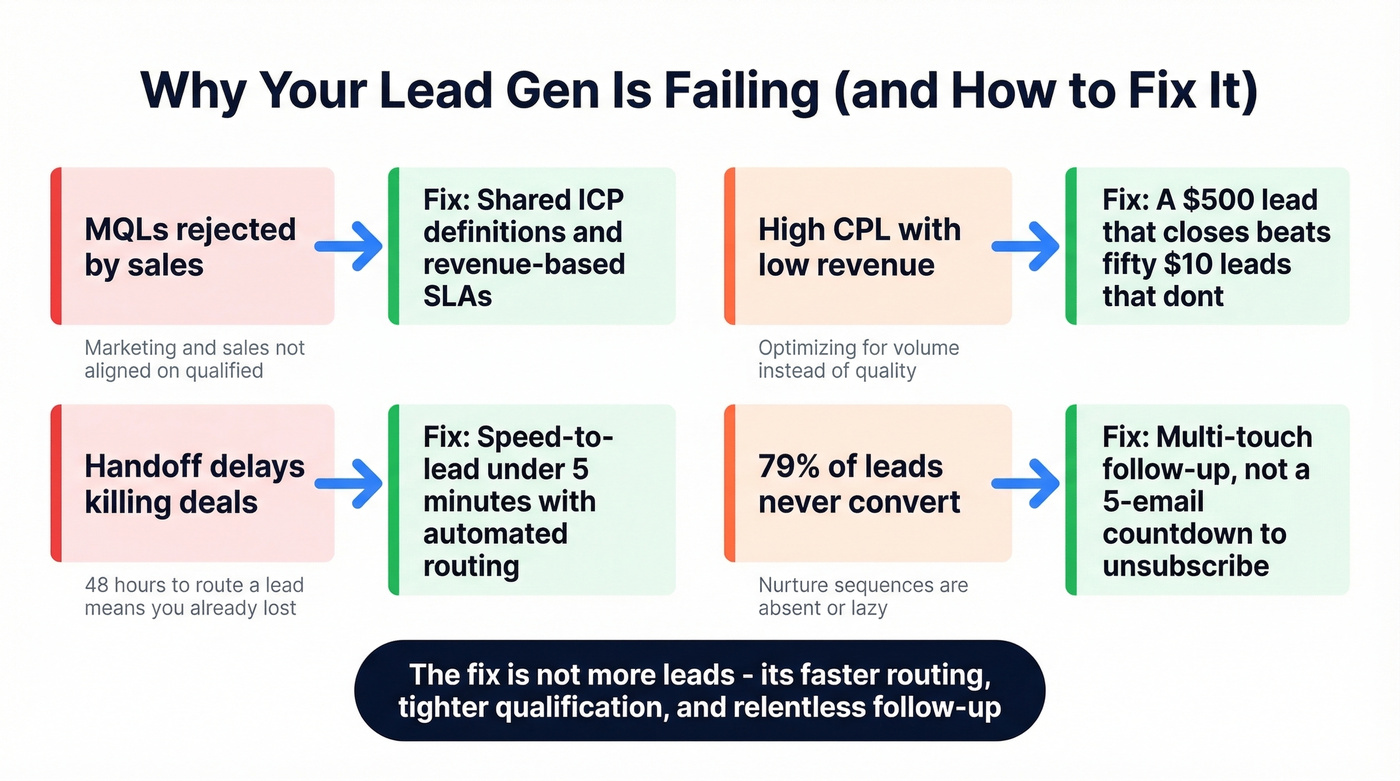
MQLs rejected by sales means marketing and sales aren't aligned on what "qualified" means. Fix this with shared ICP definitions and revenue-based SLAs. High CPL with low revenue means you're optimizing for lead volume instead of quality - a $500 lead that closes is cheaper than fifty $10 leads that don't. If you need a baseline, use this ideal customer profile template.
Handoff delays kill deals. If it takes 48 hours to route a lead to a rep, you've already lost. And 79% of marketing leads never convert into sales, primarily because nurture sequences are either absent or lazy. A 5-email drip isn't nurture. It's a countdown to unsubscribe.
The fix isn't more leads. It's faster routing, tighter qualification, and relentless follow-up on the leads you already have. Companies that nail speed-to-lead and multi-touch follow-up routinely cut customer acquisition costs by 30-40% within 12-18 months. If you're measuring impact, track lead generation metrics alongside pipeline.
FAQ
What's the difference between MQLs and SQLs?
An MQL has engaged with your content and fits your ICP. An SQL has confirmed budget, authority, need, and timeline through a sales conversation. Typical MQL-to-SQL conversion runs 10-30%, depending on how tightly marketing qualifies inbound interest.
How much should B2B leads cost?
B2B SaaS averages $237 blended CPL; financial services can exceed $650. Benchmark against your deal size - $500 per lead is cheap for $50K contracts, expensive for sub-$5K deals.
What's a good cold email reply rate?
The 2026 average is 3.43%. Signal-based personalization pushes it to 18%. Below 2%, check your data quality and list targeting before rewriting copy.
What's a good free tool for finding B2B sales leads?
Prospeo's free tier includes 75 verified emails and 100 Chrome extension credits per month - enough to run real outbound campaigns. Apollo.io also offers a usable free plan, though bounce rates climb on larger exports. Hunter gives 25 free searches monthly but lacks phone numbers and intent data.
Is intent data worth it for small teams?
Yes - only 25% of B2B companies use intent data, but ROI is near-universal among adopters. For a 5-person team, it's the difference between spraying 1,000 emails and targeting the 50 accounts actively buying this quarter.