

The SaaS Sales Manager Guide: Pay, KPIs, Tools & Career Path
Your VP just asked you to take over the mid-market team. Eight reps, a $4.2M quarterly target, and a pipeline thinner than anyone's admitting. Congratulations - you're now a sales manager in SaaS.
The job isn't closing deals anymore. It's coaching, forecasting, hiring, and firing. It's figuring out why three reps missed quota last month - one has a pipeline problem, one has a closing problem, and one has an attitude problem - and handling each differently by Friday. The role means leading a team of reps selling subscription software, but job descriptions undersell what actually matters: you're a performance multiplier. Your reps' numbers are your numbers.
The Quick Version
- Average comp: $148K-$160K, up to $229K in Seattle.
- The role is coaching, forecasting, and hiring - not closing. If you love closing, you'll hate this job.
- Key KPIs: win rate 21%, quota attainment 43.14%, ramp time 3.2 months. If your team's below these, you've got work to do.
- Fix your team's data quality first. Bad contact data kills pipeline before strategy matters.
Salary & Compensation in 2026
SaaS sales management pays well, but the spread is enormous depending on where you sit and how long you've been doing it.
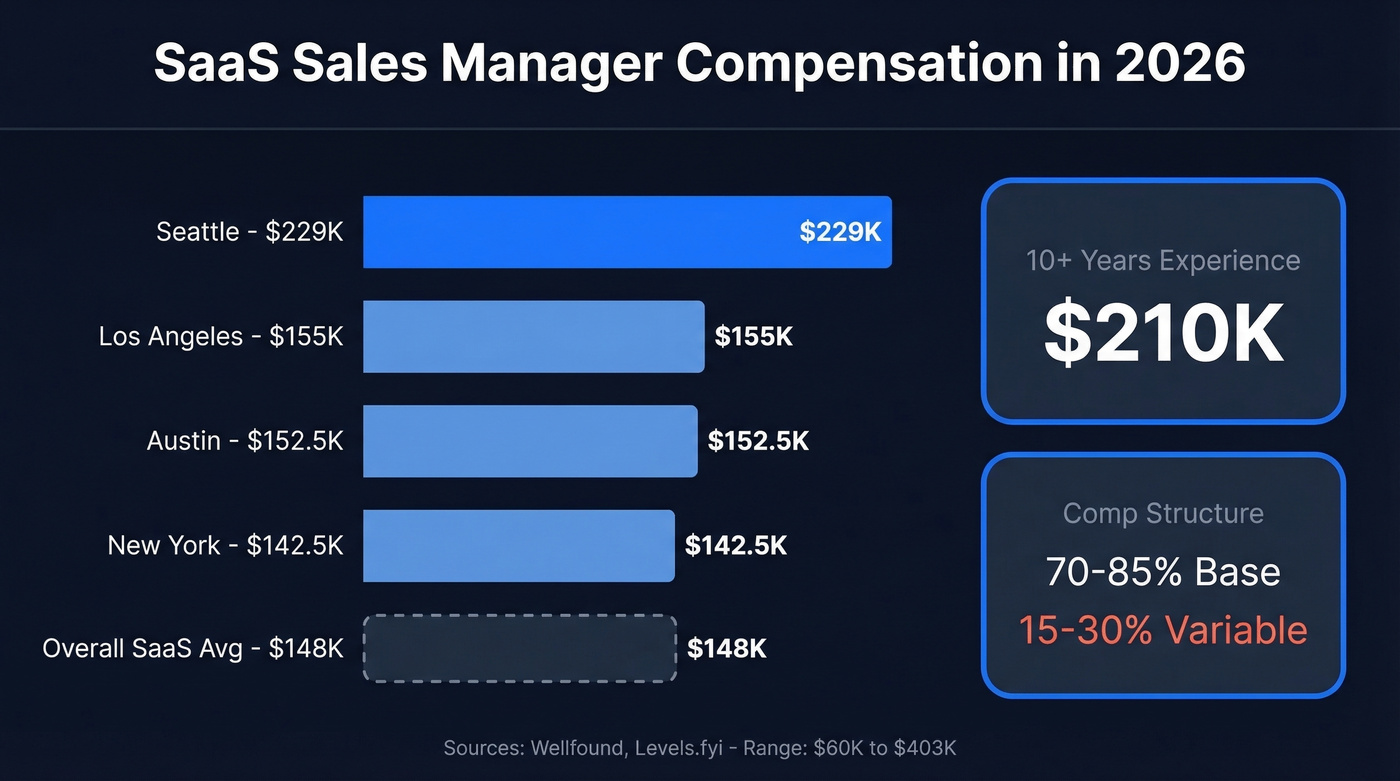
| Segment | Avg Comp |
|---|---|
| Overall (SaaS) | $148K ($60K-$403K range) |
| Seattle | $229K |
| Los Angeles | $155K |
| Austin | $152.5K |
| New York | $142.5K |
| 10+ yrs experience | $210K |
That Wellfound data skews toward startups. Levels.fyi puts the aggregate at $160K across SaaS sales roles, which tracks with what we see in the market.
Comp structure typically runs 70-85% base, 15-30% variable. At a Series B company, expect something like $110K base plus $30-40K variable tied to team quota attainment. Enterprise-focused managers at later-stage companies push well past $200K OTE. The variable ties to team bookings, not individual deals - which is exactly why the IC-to-manager transition feels so disorienting. You can't outwork a bad quarter anymore.
Day-to-Day Responsibilities
Every article about this role reads like a job board listing. Here's where your time actually goes:
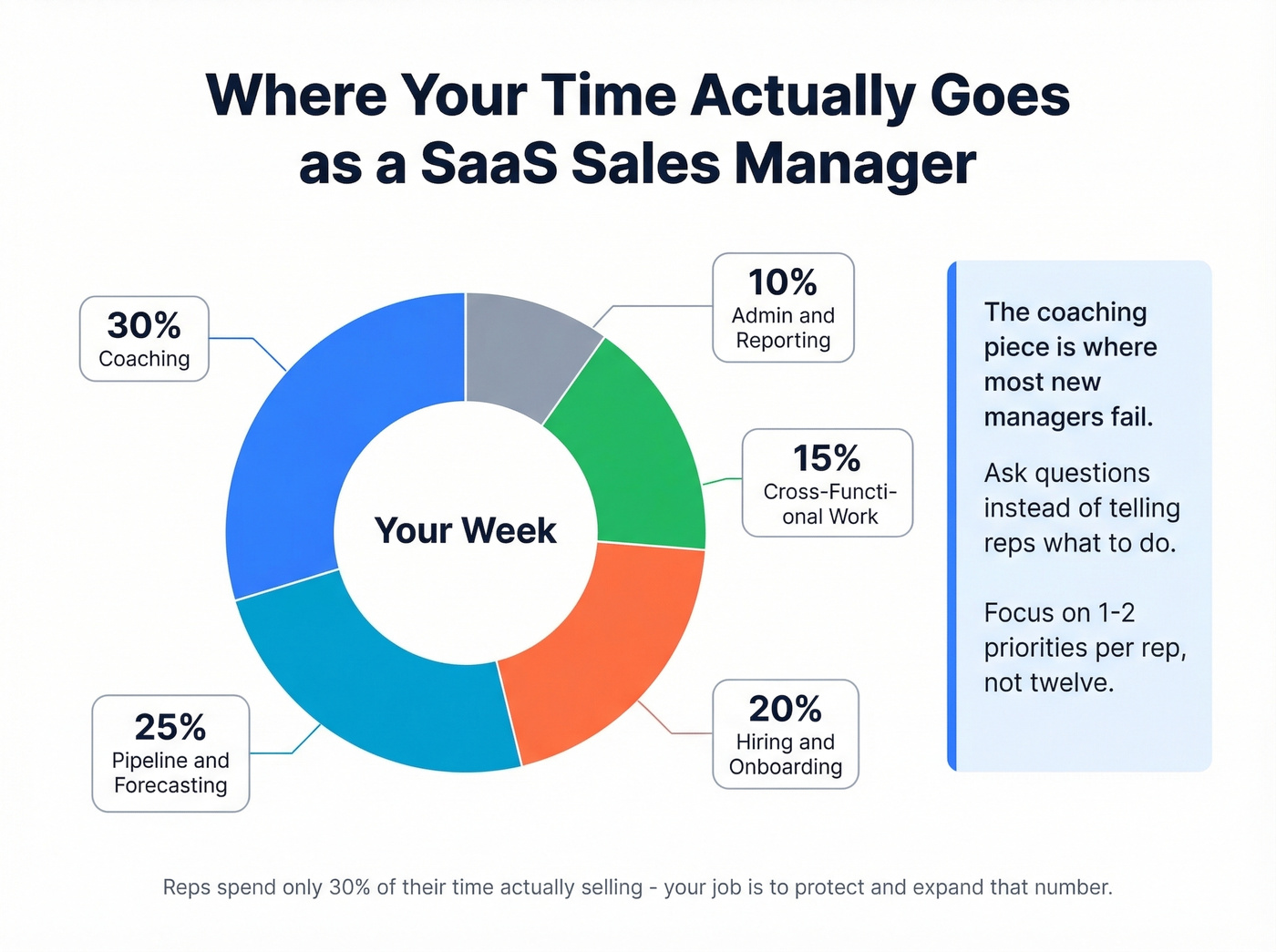
- 30% coaching - 1:1s, deal reviews, call shadowing
- 25% pipeline & forecasting
- 20% hiring & onboarding
- 15% cross-functional work with marketing, product, and CS
- 10% admin & reporting
The coaching piece is where most new managers fail. The instinct is to tell reps what to do, especially when you were a top closer. Resist it.
Ask questions instead. Focus on one or two priorities per rep, not twelve. And define the difference between a joint sales call where you're helping close and a coaching call where you observe and debrief after. Conflating the two confuses reps and undermines both objectives. We've seen first-time managers try to "save" every deal on joint calls, which teaches the rep nothing except that their manager will always swoop in.
Reps spend only 30% of their time actually selling. Your job is to protect that 30% and expand it by removing admin friction, providing clean data, and keeping revenue-irrelevant meetings off their calendars. New managers are often surprised by how much of the job becomes spreadsheets, dashboards, and forecast calls. That's the gig.

You said it yourself: reps spend only 30% of their time selling. Bad contact data makes that number worse. Prospeo gives your team 300M+ profiles with 98% email accuracy on a 7-day refresh - at $0.01/lead. One manager at Snyk saw AE-sourced pipeline jump 180% after switching.
Stop letting bounced emails eat your team's selling time.
KPIs Every Manager Owns
84% of sales reps missed quota last year. Let's be honest: that's not a rep problem. That's a management problem.
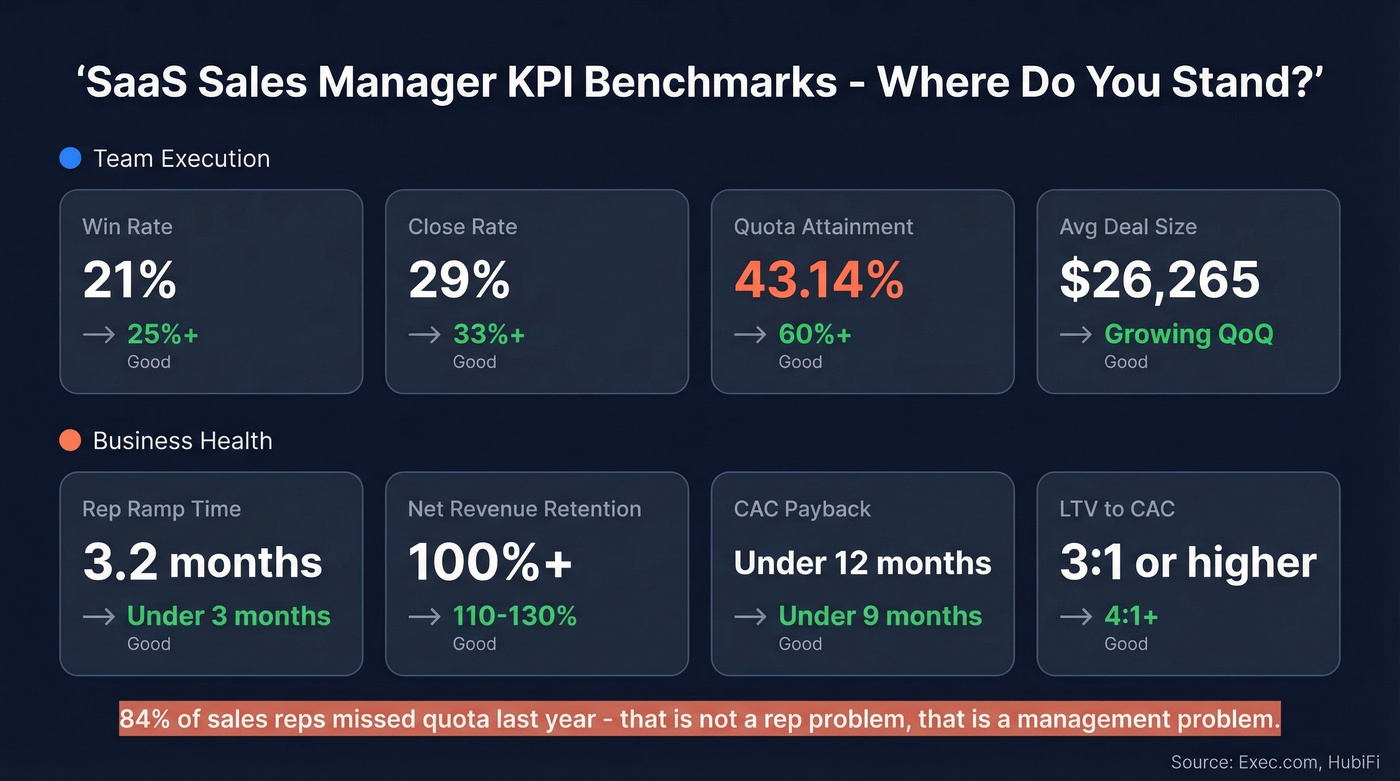
| Metric | Current Benchmark | Good Looks Like |
|---|---|---|
| Win rate) | 21% | 25%+ |
| Close rate | 29% | 33%+ |
| Quota attainment | 43.14% | 60%+ |
| Avg deal size | $26,265 | Growing QoQ |
| Rep ramp time | 3.2 months | Under 3 months |
| NRR | 100%+ | 110-130% |
| CAC payback | <12 months | <9 months |
| LTV:CAC | ≥3:1 | 4:1+ |
The top half is your team's execution. The bottom half - NRR, CAC payback, LTV:CAC - is the business health layer your VP and board care about. You don't own those metrics directly, but you influence them through deal quality, discount discipline, and customer fit.
One more benchmark worth enforcing: responding to inbound leads within five minutes increases engagement likelihood 9x. Build that into your team's SLA.
If your win rate sits below 21%, you've got a coaching problem. If quota attainment is under 43%, you've got a pipeline or hiring problem. Diagnose before you prescribe. If you need a tighter diagnostic, use a pipeline health checklist before you change comp plans or territories.
The Tech Stack
A SaaS sales manager needs four categories covered well - not twenty tools.
CRM: Salesforce ($25-$300/user/mo) or HubSpot (free CRM, Sales Hub from ~$20/user/mo). Salesforce wins on customization; HubSpot wins on speed to value. Teams using CRM effectively see 12% higher quota attainment. If you're standardizing your stack, it helps to align on examples of a CRM and what “good usage” actually means.
Prospecting & Data: This is where most teams leak pipeline. Your reps need verified contact data, not a database full of bounced emails that torches your domain reputation. Prospeo covers 300M+ professional profiles with 98% email accuracy on a 7-day refresh cycle, plus 125M+ verified mobile numbers - at roughly $0.01/lead. Apollo offers a solid free tier with paid plans from ~$49/user/mo. ZoomInfo starts around ~$15K/year and scales fast. If you're evaluating vendors, start with data enrichment services and best B2B company data comparisons.

Engagement: Outreach or Salesloft, both $100-$150/user/mo. Pick one, standardize, enforce usage. If your sequences are underperforming, tighten your sequence management rules and refresh your sales follow-up templates.
Conversation Intelligence: Gong at ~$100-$150/user/mo. The closest thing to being on every call without actually being on every call.
Here's the thing: if your average deal size is under $10K, you don't need ZoomInfo-level data spend. A self-serve tool with verified contacts and a sequencer will outperform a bloated enterprise stack your reps half-use. The consensus on r/sales backs this up - most mid-market teams are over-tooled and under-trained on what they already have. If outbound is the bottleneck, revisit your sales prospecting techniques before buying another tool.
Mistakes That Get You Fired
1. Assuming everyone works like you. Your top-performer playbook doesn't transfer. Build systems and weekly KPI structures instead.
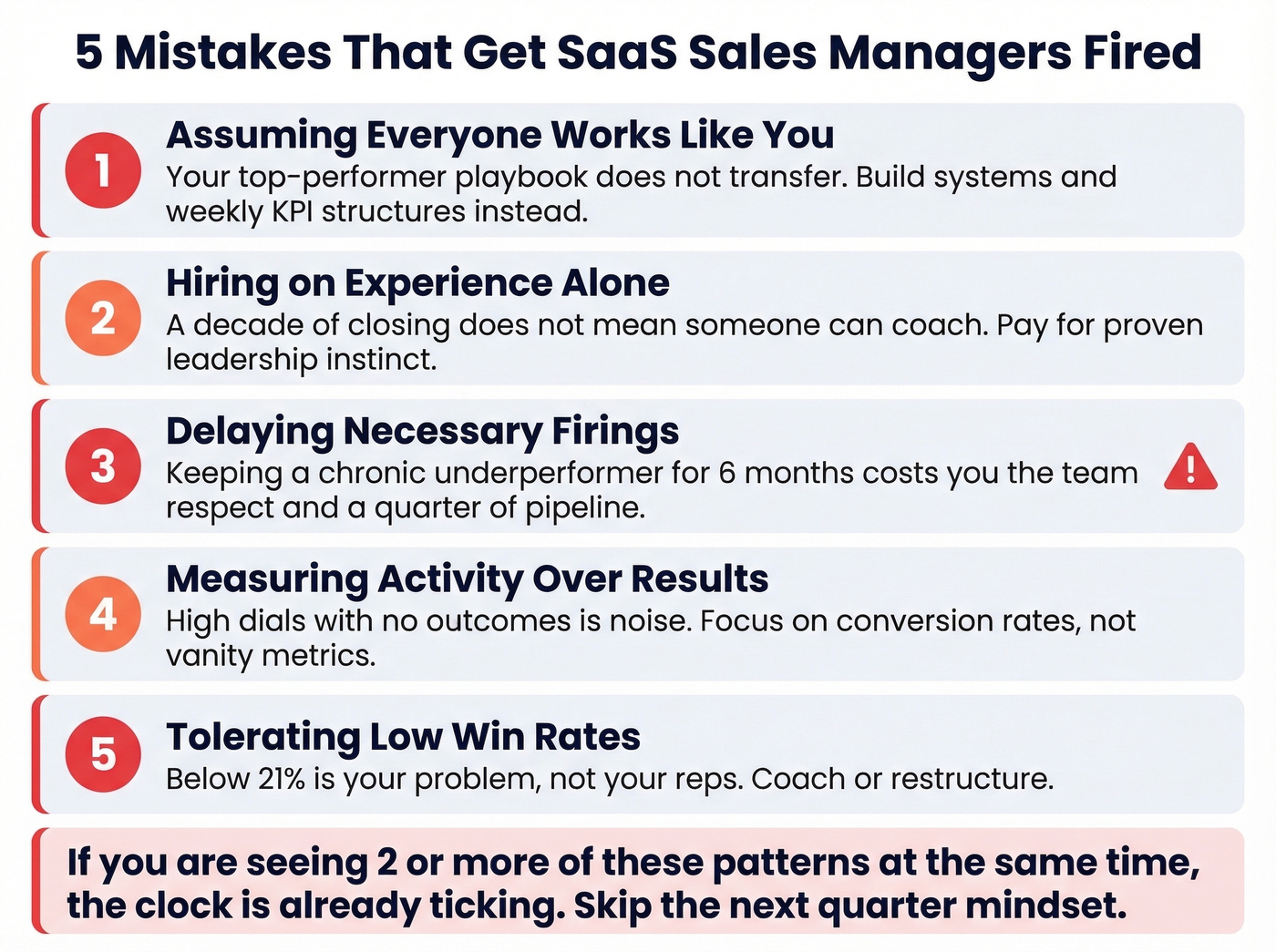
2. Hiring on experience alone. A decade of closing doesn't mean someone can coach. Pay for proven leadership instinct.
3. Delaying necessary firings. Keeping a chronic underperformer for six months costs you the team's respect and a quarter of pipeline. We've watched managers agonize over this for two full quarters, and the damage compounds every week - other reps see the double standard and check out.
4. Measuring activity over results. High dials with no outcomes is noise. Focus on conversion rates, not vanity metrics. If you need a cleaner definition of “productive,” align on sales activities examples that map to pipeline stages.
5. Tolerating low win rates. Below 21% is your problem, not your reps'. Coach or restructure.
Skip the "I'll fix it next quarter" mindset. If you're seeing two or more of these patterns simultaneously, the clock is already ticking. If the pipeline is the root cause, work through the most common sales pipeline challenges before you overhaul the team.
Career Path: IC to CRO
The typical ladder: SDR → AE → Sales Manager (~$150K OTE) → Director (~$200K) → VP of Sales (~$275K+) → CRO ($350K+ with equity).
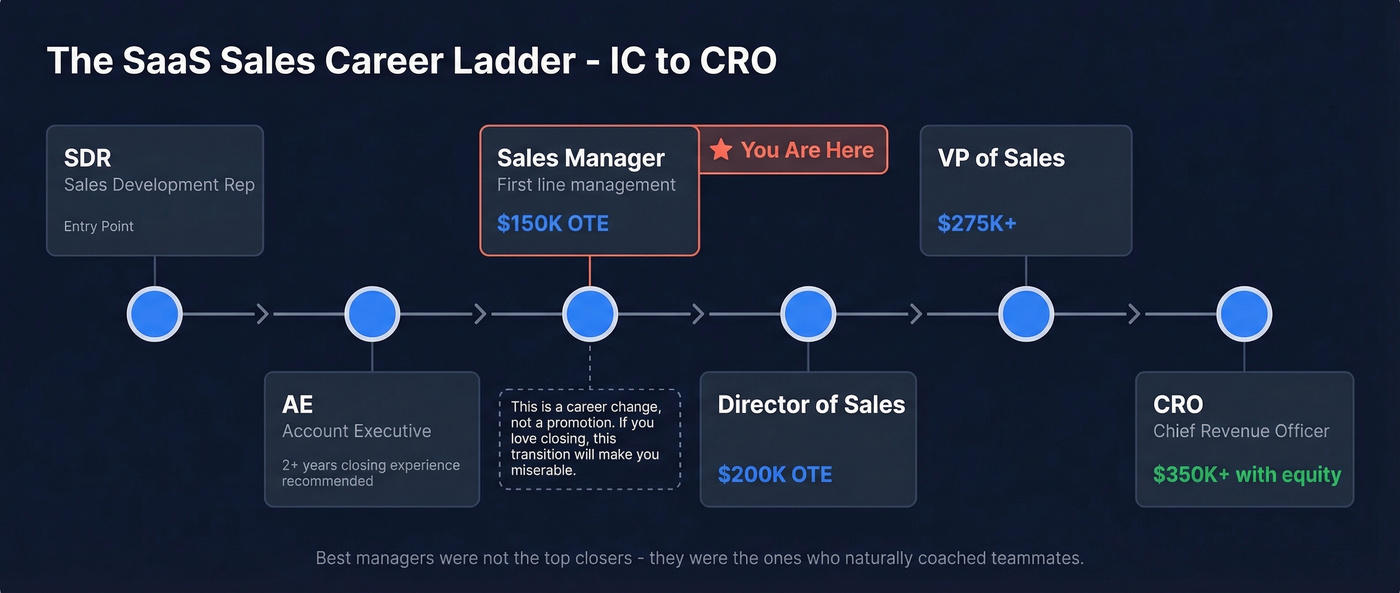
You don't need five years of AE experience to manage. You need two years of closing and a genuine obsession with making other people better. The best managers we've worked with weren't the top closers - they were the ones who naturally debriefed calls with teammates and got frustrated when peers didn't improve. That instinct matters more than tenure. If you're building a ramp plan for new hires, borrow a proven 30-60-90 day plan for sales reps.
Management isn't a promotion. It's a career change. If you love the thrill of closing, managing a SaaS sales team will make you miserable.
If your team's win rate is below 21%, the problem might start before the first call. Reps dialing dead numbers and emailing bounced addresses never get the at-bats they need. Prospeo delivers 125M+ verified mobiles with a 30% pickup rate and 98% accurate emails - so your reps actually reach decision-makers.
Give your eight reps data that connects them to real buyers.
FAQ
Should I stay an IC or move into management?
If you love closing, stay an IC - top enterprise AEs out-earn most managers. If you love coaching and building systems, make the jump, but get two years of closing experience first for credibility. The comp ceiling is higher in management long-term, but the daily work is completely different.
What sales methodologies should a SaaS sales manager know?
MEDDIC for enterprise, Challenger for mid-market, SPICED for discovery-heavy motions. Pick one, train the team, enforce it in pipeline reviews. Methodology without enforcement is just a slide deck.
What tools does a SaaS sales manager need?
A CRM, a verified data provider, a sequencing tool, and conversation intelligence - four categories, four tools. Pair Salesforce or HubSpot with a data provider like Prospeo, a sequencer like Outreach, and Gong for call coaching.
How long does it take to ramp as a new manager?
Most first-time managers need 3-6 months to hit stride. Expect the first quarter to feel chaotic - you're learning your team's strengths, inheriting pipeline you didn't build, and adjusting forecasts you didn't set. By quarter two, you should own the rhythm.