

Sales Objection Responses That Actually Work - According to 67,149 Sales Meetings
Gong's call analysis points to something uncomfortable: reps don't lose deals because they lack clever sales objection responses. They lose because they talk over the objection, answer the wrong concern, and never uncover the real blocker. The behavior is the problem, not the scripts.
Reps spend 60% of their time on non-selling tasks. When you finally get a prospect on the phone, fumbling the objection is an expensive mistake. Memorizing 50 rebuttals won't help. The best at handling objections ask better questions, pause longer, and talk less.
Quick Reference
- Pause 3 seconds after hearing the objection. Top performers let silence do the work.
- Lead with a question, not a rebuttal: "Can you help me understand what's behind that?" (More: open-ended questions.)
- The first objection is almost never the real one. Surface-level pushback is a smoke screen - dig before you respond.
- A lot of "not interested" objections happen because you reached the wrong person. Fix your data before your talk track. If your CRM is full of contacts who left three months ago, that's not a selling problem.
What Top Performers Do Differently
An analysis of 67,149 sales meetings from a database of 5M+ recorded calls reveals a structural gap between top performers and everyone else.
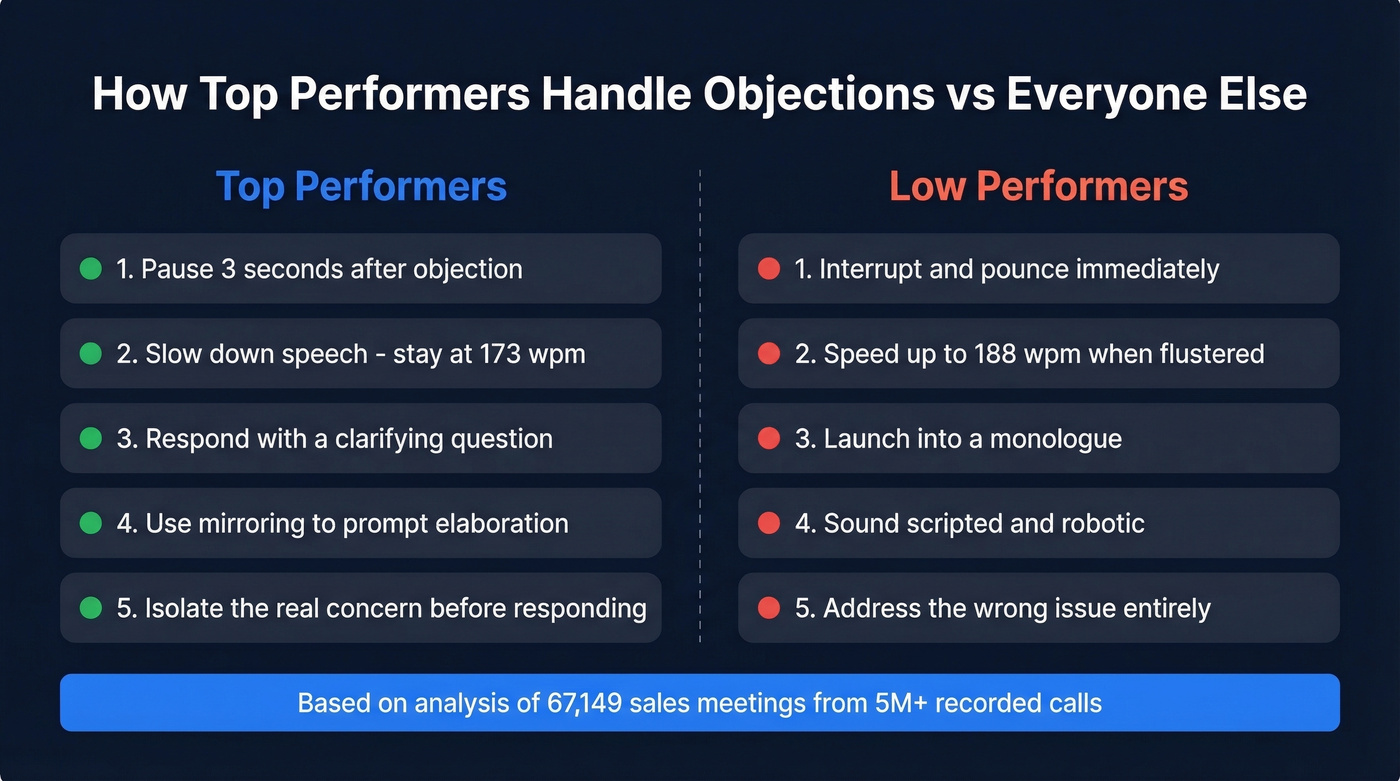
Top reps pause after an objection. Low performers interrupt and pounce. Average talking speed in a sales conversation is 173 words per minute - struggling reps accelerate to 188 wpm when flustered. Top reps slow down. That deceleration signals confidence and gives the buyer space to elaborate.
Successful reps respond with a question to clarify. Low performers launch into a monologue addressing the wrong issue entirely, burning through rapport they spent the first five minutes building. Mirroring - repeating the buyer's last few words with an upward tone - is one of the most effective techniques for prompting elaboration without sounding scripted.
Two more patterns worth internalizing. Don't ask "why" - it puts buyers on defense. Replace "Why do you feel that way?" with "What's driving that concern?" And use permission-based transitions: "Can I bounce a few thoughts off of you?" consistently outperforms phrasing that triggers defensiveness.
Not every pushback is an objection. Some are obstructions - excuses to end the conversation, not genuine concerns. Objections deserve exploration; obstructions deserve qualification questions. Before crafting a response, isolate the concern: "If we could solve that, is there anything else standing in the way?" (If you want a deeper process, see handling objections in the selling process.)
The Numbers Behind Great Calls
A 2026 analysis of 326,000 sales calls adds more texture:
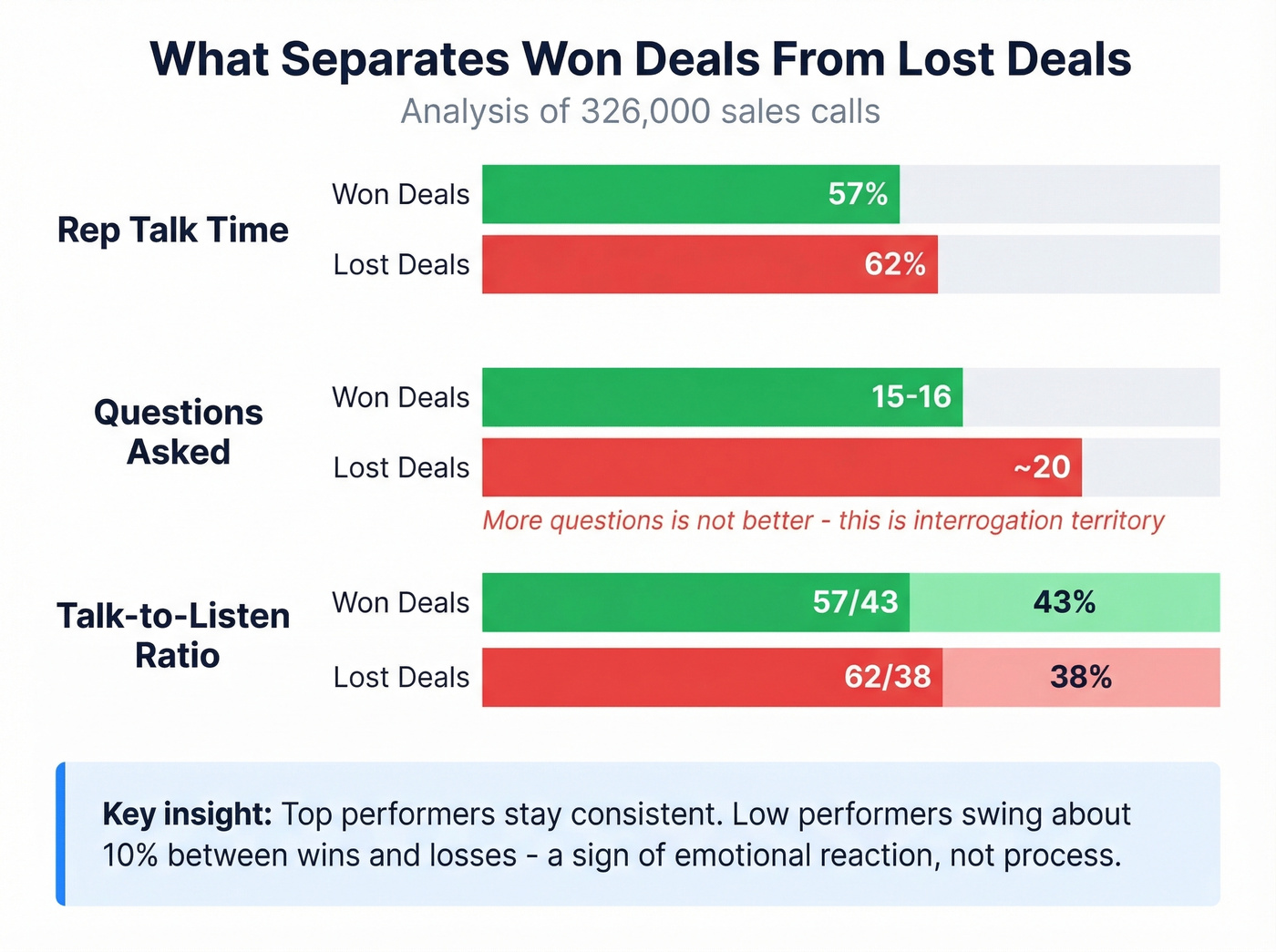
| Metric | Won Deals | Lost Deals |
|---|---|---|
| Rep talk time | 57% | 62% |
| Questions asked | 15-16 | ~20 |
| Talk-to-listen ratio | 57/43 | 62/38 |
More questions isn't better. Lost deals averaged ~20 questions - that's interrogation territory. Won deals averaged 15-16 well-placed ones. Top performers also stay consistent: their talk ratio doesn't swing wildly between wins and losses. Low performers swing ~10% between outcomes, a sign they're reacting emotionally rather than executing a process.
Responses by Objection Category
As Richard Harris puts it: "Nobody wants to be 'handled.'" An objection means the buyer is still engaged. Silence is worse. (For a longer list of scripts, see most common sales objections.)
One pre-handling technique that works across all categories: early in discovery, ask "When you take this back to your team, who's the most skeptical person - and what might they push back on?" This surfaces objections before they become roadblocks. (You can also borrow from these good discovery questions.)
Budget Objections
"It's too expensive." Don't defend the price - reframe around ROI. "Totally fair. What are you comparing it to?" Then: "If the ROI math worked, would budget be flexible?" Most buyers realize they're comparing sticker prices, not value delivered. (More examples: price objection handling examples.)
"We don't have budget right now." This is timing disguised as budget. "Got it - is this a 'not this quarter' situation, or is there genuinely no line item? If the need is real, I can help you build the business case for next cycle."
"Your competitor is cheaper."
Do this: "They might be. What are you getting from them?" Pause. Let them list features. Then: "Which of those are you actually using?"
Don't do this: Immediately match the price or trash the competitor. You'll devalue your product and train the buyer to negotiate harder every time.
Authority Objections
"I need to check with my boss." "Makes total sense. What do you think their biggest concern will be?" This turns you into an ally - don't push for a meeting with the boss. Arm your champion with the right framing instead. (Related: how to work an internal champion.)
"I'm not the decision-maker." "Appreciate the honesty. Who else would need to weigh in, and what would they care about most?" (If this comes up constantly, revisit your decision making in sales map.)
Need Objections
"We're not interested." The most common smoke screen. A cold-call micro-commitment works well here: "I can explain what we do in two minutes. If it's not relevant, I won't call again." This lowers the stakes enough to keep the conversation alive.
If they still decline: "Fair enough - can I ask what you're currently doing for [problem area]? If it's working, I'll leave you alone."
"We already use [competitor]."
Two words: "How's that going?" Then wait. If they're happy, you'll hear it. If they hesitate, you've found your opening.
"Just send me some info." Here's the thing - what they really mean is "end this call." Don't send a generic PDF. "Happy to - what specifically would be most useful? That way I don't waste your time with a deck you'll never open." This forces them to articulate what they actually care about, or admit they're brushing you off.
Timing and Trust Objections
"Call me next quarter." "Absolutely. What's happening next quarter that makes the timing better?" If there's a real trigger - budget cycle, new hire, contract renewal - book a specific date. If it's a brush-off, you'll know immediately.
"I need to think about it." Almost always a smoke screen for a specific concern they haven't voiced. "Of course. What's the main thing you're weighing?" Don't let them leave without naming it.
"I've never heard of you." "That's fair - we're not the biggest name in the space. We work with [2-3 recognizable customers]. What would help you feel confident enough to take a closer look?" Trust objections require social proof, not feature lists.
"We tried something like this before and it didn't work." "What happened?" Then listen. Their past failure is your roadmap - the approach you take is different because [specific difference], and that specificity is what earns the second chance.
Sometimes the right response is to walk away. If the financial buyer isn't convinced and there's no internal champion, your time is better spent on the next deal.
Mistakes That Kill Deals
Five anti-patterns that consistently tank conversations:
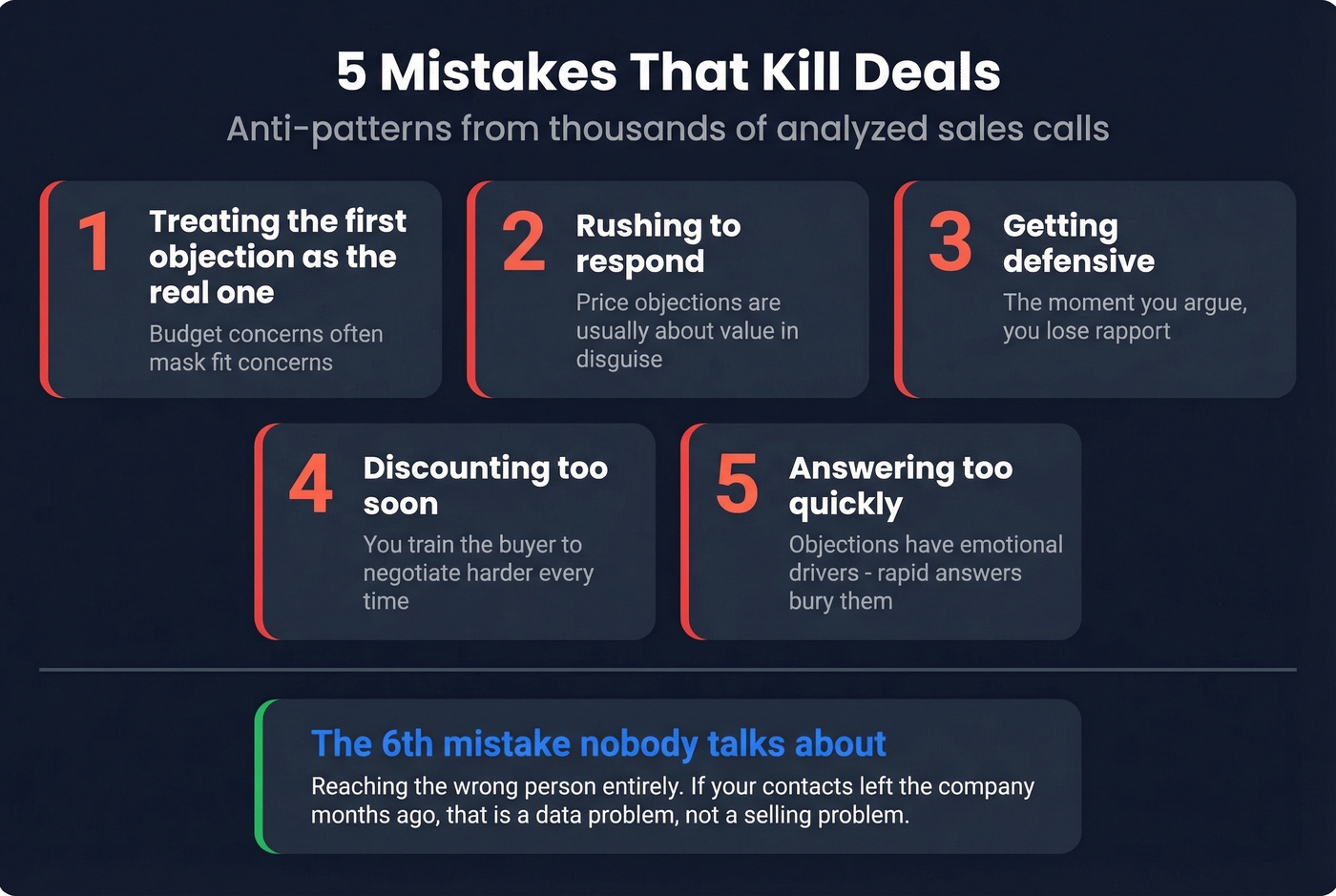
- Treating the first objection as the real one. Budget concerns often mask fit concerns. Always dig with a clarifying question before responding.
- Rushing to respond. Price objections are frequently about durability, fit, or value in disguise. Pause. Ask what's behind it.
- Getting defensive. The moment you argue, you've lost rapport. Acknowledge, then redirect.
- Discounting too soon. Leading with a discount trains the buyer to negotiate harder. Lead with ROI first.
- Answering too quickly. Objections often have emotional drivers - fear of change, fear of making the wrong decision. Open-ended questions surface these. Rapid-fire answers bury them.
There's a sixth mistake nobody talks about: reaching the wrong person entirely. If your CRM is full of contacts who left the company four months ago, "I'm not the right person" isn't an objection - it's a data problem. We've seen teams using Prospeo cut bounce rates from 35% to under 4% simply by switching to verified contact data with a 7-day refresh cycle. That eliminates an entire category of pushback before the call starts.

"I'm not the decision-maker" kills more deals than any pricing objection. Prospeo's 300M+ profiles with 30+ filters - including department headcount, job title, and seniority - let you reach the actual buyer before you ever pick up the phone.
Stop perfecting rebuttals for the wrong person. Start with the right contact.
Email vs. Call Objections
On a call, objection handling is reactive - you hear the concern, you respond in real time. The LAER framework (Listen, Acknowledge, Explore, Respond) works well because it forces understanding before answering. Learning to respond to objections in real time is a skill built through repetition, not memorization. (If you're building a repeatable motion, start with sales cadence templates.)
In email, objection handling is preemptive. You address concerns before the prospect raises them. Zig Ziglar's five obstacles - no need, no money, no hurry, no desire, no trust - are a useful framework for structuring follow-up sequences. Each email should tackle one obstacle rather than repeating "just checking in." A well-designed 4-5 touch sequence systematically dismantles each one, and every "just checking in" email is a wasted opportunity to pre-handle a specific objection. When you reply to prospect pushback in writing, specificity beats generic reassurance every time. (Examples: email sequence examples.)
Frameworks for Prevention
Three frameworks reduce objections before they surface - not by scripting better answers, but by changing what gets discussed in discovery.
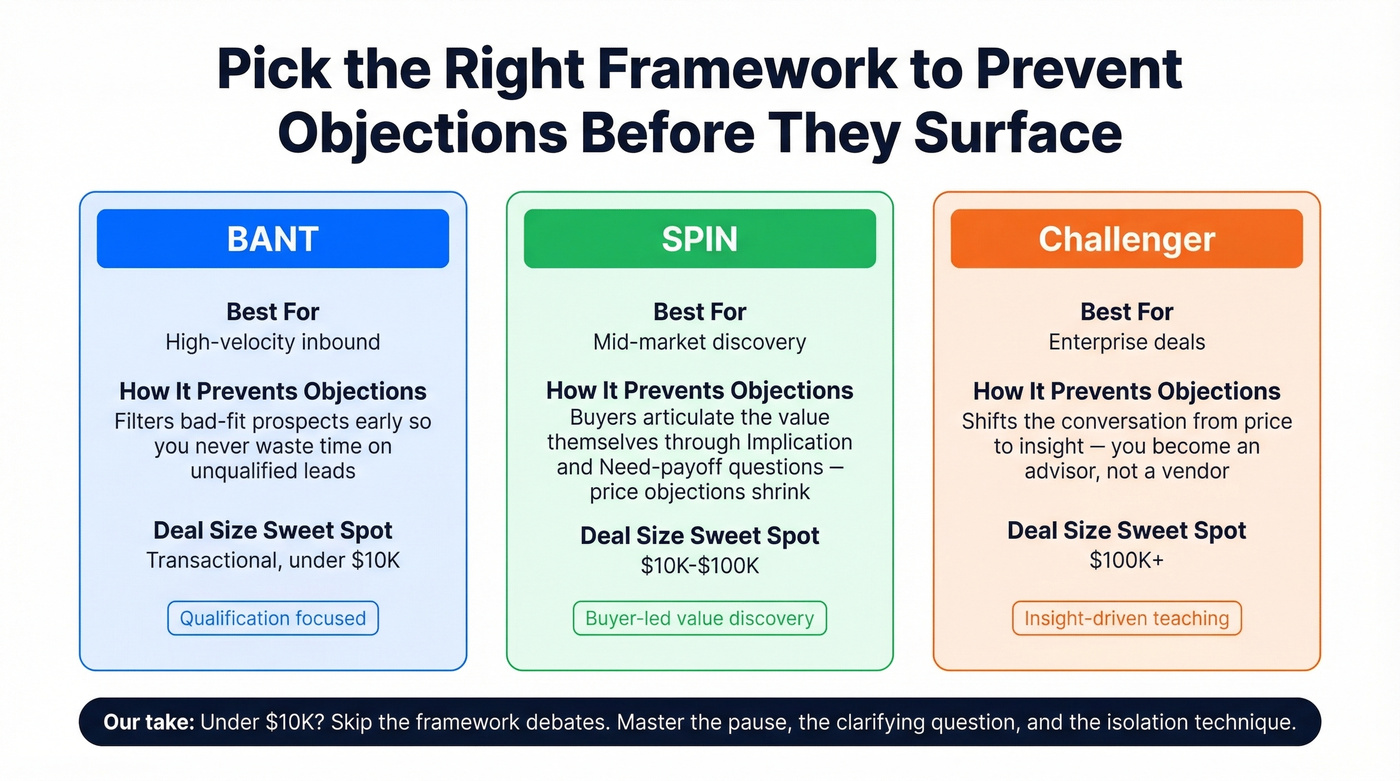
| Framework | Best For | How It Prevents Objections |
|---|---|---|
| BANT | High-velocity inbound | Filters bad-fit prospects early |
| SPIN | Mid-market discovery | Buyers articulate value themselves |
| Challenger | Enterprise deals | Shifts conversation from price |
SPIN's power is in the Implication and Need-payoff questions. When a buyer articulates the cost of inaction themselves, price objections shrink. Challenger works differently - by teaching the prospect something new about their own business, you shift from vendor to advisor. (More: SPIN selling.)
Don't overthink framework selection. Pick one, get good at it, and adapt.
Our take: If your deal size is under $10K, you probably don't need a formal framework at all. Master the pause, the clarifying question, and the isolation technique from Section 2. Skip the framework debates on r/sales - they're mostly academic for transactional deals.
Practice With AI Roleplay
Sellers who practiced role-playing before live calls saw 20-45% higher win rates according to research in the Journal of Marketing Education. 43% of enablement leaders now use AI-powered roleplay for coaching. Reps who rehearse rebuttals in simulated scenarios handle real objections with noticeably more confidence. (To drill the basics, use a daily cold call practice routine.)
The category breaks into three buckets: conversation intelligence tools that diagnose what happened, roleplay platforms like Hyperbound (~$50-100/user/mo) and Second Nature (~$40-80/user/mo) that create practice scenarios with AI feedback, and coaching platforms like Mindtickle (~$30-60/user/mo) that tie it together. Even ChatGPT with a well-crafted prompt can simulate objection scenarios for free - we've used it ourselves for quick practice runs. The insight-to-practice loop matters most: analyze real calls, identify weak spots, practice, repeat.
Start With Better Data
Let's be honest - bad data creates objections before the conversation starts. Wrong person, outdated title, dead phone number. These aren't selling problems. (If you're seeing systemic issues, audit your lead generation mistakes.)
Prospeo covers 300M+ professional profiles with 98% email accuracy and a 7-day refresh cycle, compared to the 6-week industry average. Reps reach the right person with a working email and a direct dial that actually rings. The free tier gives you 75 verified emails per month with no contract and no sales call required.
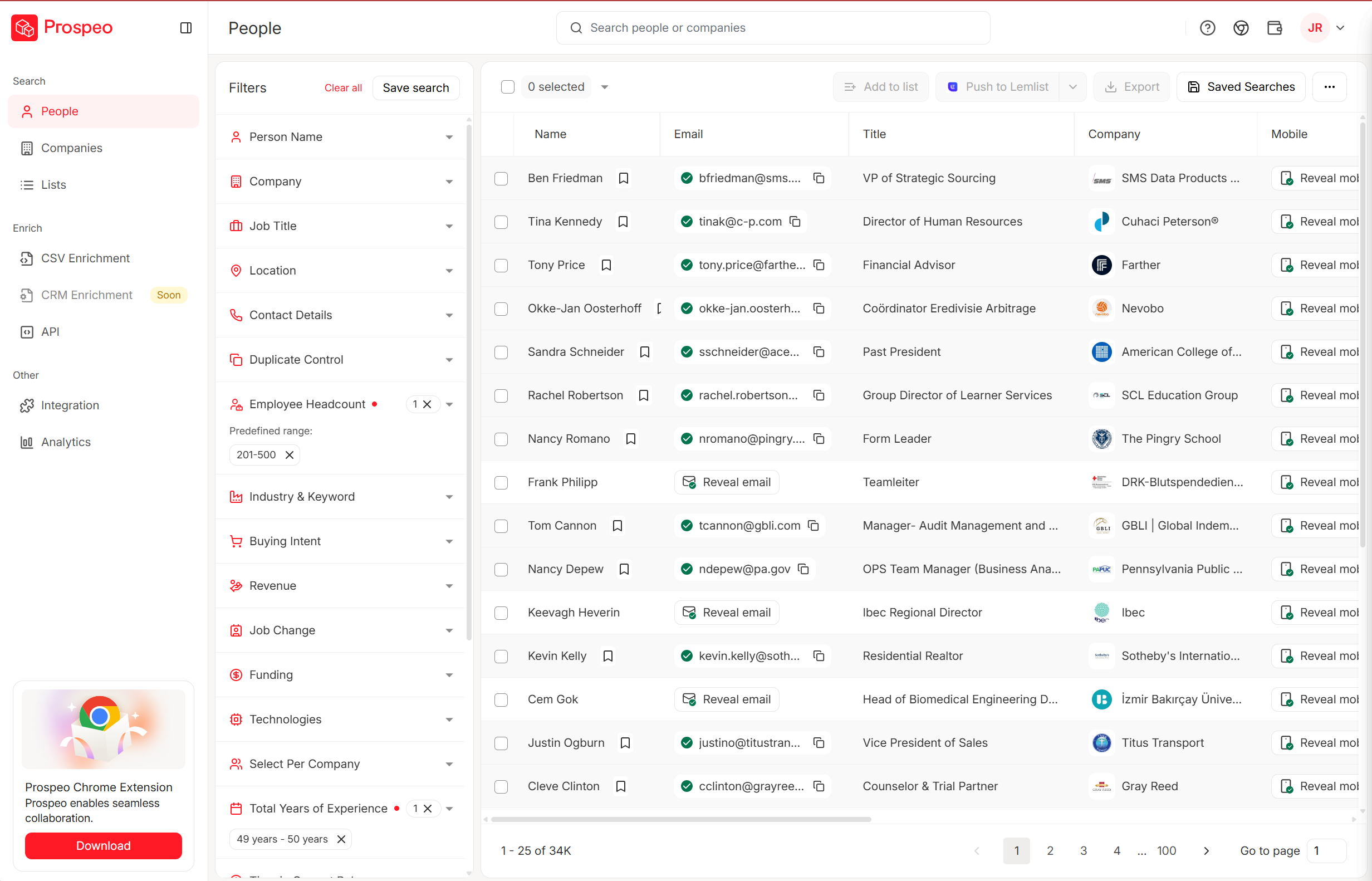
Your talk track won't save you if 35% of your emails bounce and half your contacts left the company months ago. Prospeo refreshes data every 7 days and delivers 98% email accuracy - so every objection you handle is with a real, reachable buyer.
Great objection handling starts with data that actually connects you to real buyers.
FAQ
What are the most effective sales objection responses?
Reframe around ROI instead of defending price - "Compared to what?" forces specificity and shifts the conversation. Call analysis of 67K meetings shows top reps slow down and ask a clarifying question rather than launching into a rebuttal. If the value case is strong, price concerns usually resolve once the buyer sees the math.
How many rebuttals should a rep prepare?
Focus on five categories - budget, authority, need, timing, and trust - rather than memorizing 50 scripts. Master the pause-and-question technique and you can handle any variation within those categories. Fifteen well-practiced responses beat a hundred memorized ones.
Can bad prospect data cause more objections?
Yes - "I'm not the right person" and "how did you get my number?" are data problems, not selling problems. A 7-day data refresh cycle and verified contact info help reps reach the right person the first time, eliminating an entire category of pushback before the call starts.
What's the difference between an objection and a brush-off?
An objection is a genuine concern worth exploring ("the price seems high for our budget cycle"). A brush-off is an excuse to end the conversation ("just send me some info"). Test with an isolation question: "If we solved that, is there anything else?" Real objections survive isolation; brush-offs collapse under it.