

Sales Operations Specialist: Role, Salary, and How to Get Hired in 2026
It's Monday morning. The VP of Sales needs a pipeline forecast by noon, three reps are complaining about lead routing, and someone just imported 2,000 contacts with no phone numbers into Salesforce. The person who fixes all of this - before lunch - is the sales operations specialist.
What You Need (Quick Version)
What is it? A sales operations specialist designs, maintains, and optimizes the systems, processes, and data that let a sales team actually sell.
What does it pay? Total comp typically ranges from $69K to $111K (Glassdoor's most likely range), with PayScale showing total pay from $48K to $87K. Median total pay sits around $87K per Glassdoor, with top-tier tech companies paying well above $150K.
How do you get in? Salesforce Admin certification, Excel/SQL proficiency, and a genuine understanding of the sales process. Former SDRs and BDRs who love data have a real edge over candidates with generic business degrees.
What Does This Role Actually Do?
The concept of sales operations traces back to J. Patrick Kelly at Xerox in the 1970s. Kelly's insight was simple: salespeople should sell, and someone else should handle the operational machinery that makes selling possible. That idea hasn't changed. The complexity of the machinery has.
The role centers on optimizing sales processes, managing the tech stack, enforcing data quality, and translating raw pipeline data into decisions leadership can act on. This isn't an administrative position. When up to 70% of B2B reps miss quota, the problem usually isn't effort - it's broken processes, dirty data, and tools that don't talk to each other. Sales ops exists to fix that.
The numbers back this up: industry research cited by Revenue.io attributes data-driven sales operations with 15% higher quota attainment and 20% faster sales cycles. By 2026, data-driven B2B sales organizations are projected to outpace those relying on gut instinct by a wide margin. The role isn't a nice-to-have. It's the difference between a sales org that scales and one that stalls.
Sales Ops vs. RevOps vs. Enablement
These three roles get conflated constantly, and the confusion costs people in interviews.
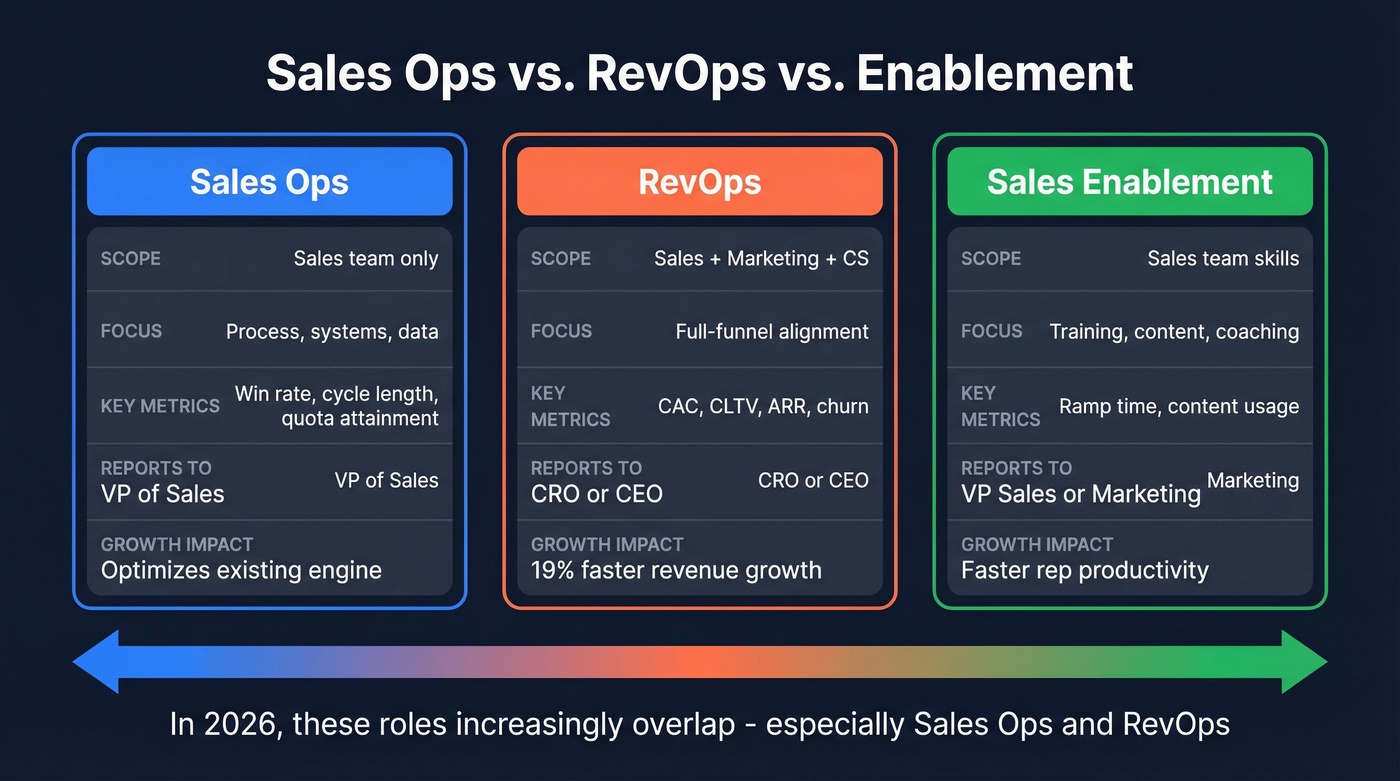
| Sales Ops | RevOps | Sales Enablement | |
|---|---|---|---|
| Scope | Sales team only | Sales + Marketing + CS | Sales team skills |
| Focus | Process, systems, data | Full-funnel alignment | Training, content, tools |
| Key metrics | Win rate, cycle length, quota attainment | CAC, CLTV, ARR, churn | Ramp time, content usage |
| Reports to | Head of Sales / VP Sales | CRO / CEO | VP Sales or Marketing |
The practical reality in 2026 is that the "specialist" title is increasingly absorbed into RevOps functions. Forrester research found that organizations with aligned revenue operations see 19% faster revenue growth and 15% higher profitability. If you're job hunting, don't ignore RevOps postings - they often want the exact same skill set. (If you want the next rung up, compare this role to a RevOps manager.)
Core Responsibilities
The day-to-day varies by company size, but the work clusters into five categories.
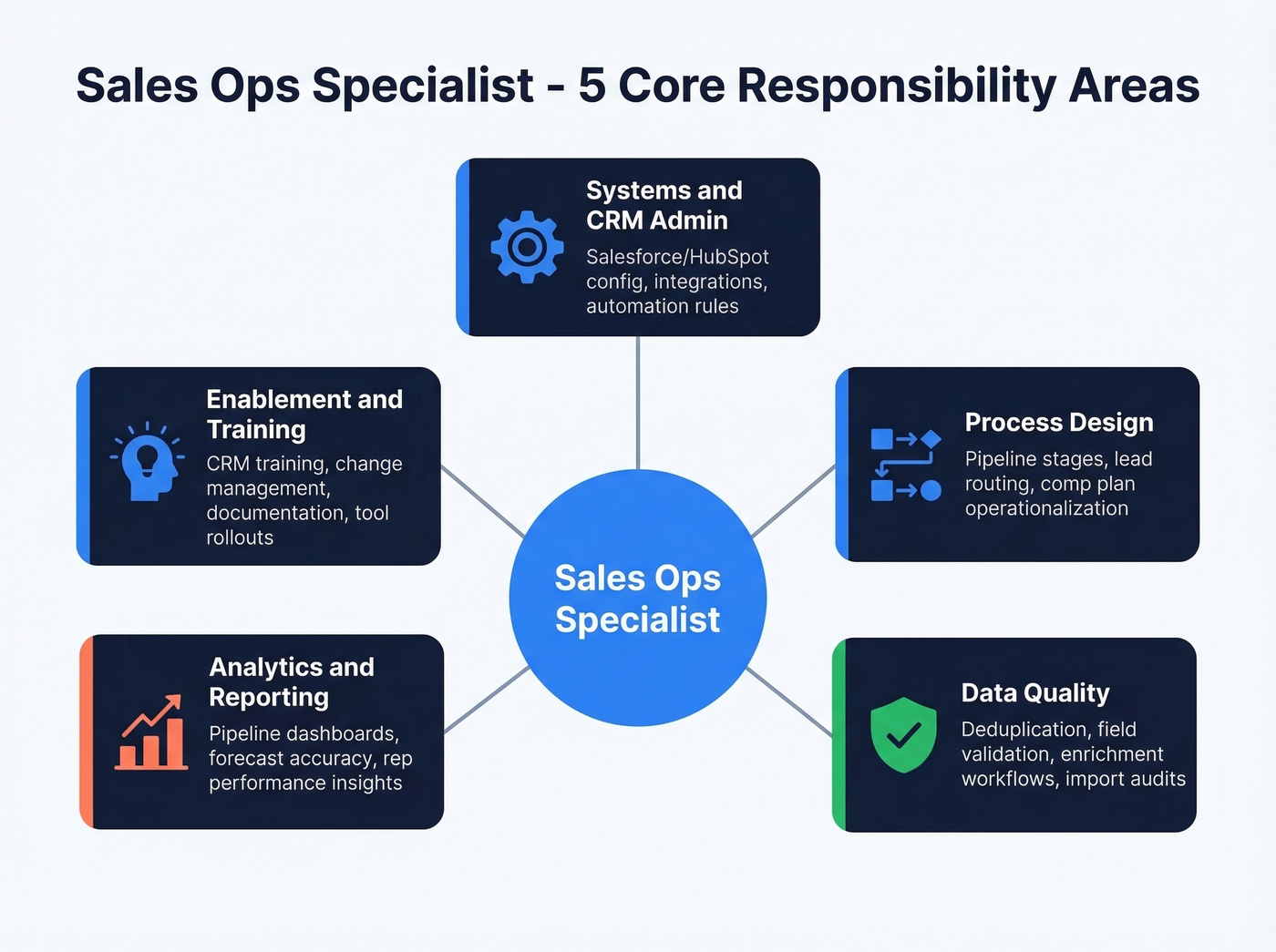
Systems & CRM Administration
You own Salesforce or HubSpot configuration - fields, workflows, automation rules, permissions. You manage integrations between CRM and engagement tools like Outreach and Salesloft. And you troubleshoot broken automations before they cascade into pipeline chaos.
Process Design & Optimization
Define pipeline stages and exit criteria. Build and refine lead routing rules, including ICP-plus-intent-based routing that prioritizes high-fit accounts showing buying signals. Operationalize comp plans so reps can actually understand their payouts.
Data Quality & Governance
Enforce data hygiene standards through deduplication, field validation, and enrichment workflows. Audit contact and account data on a regular cadence. Manage list imports and make sure nothing dirty hits the CRM - because once bad data gets in, it poisons everything downstream. (If you’re building this out, a dedicated lead status framework helps keep routing and reporting consistent.)
Analytics & Reporting
Build dashboards for pipeline health, forecast accuracy, and rep performance. Deliver the Monday-morning forecast with numbers leadership can trust. Translate data into recommendations, not just charts.
Enablement & Training
Train reps on CRM usage, new tools, and updated processes. Maintain internal documentation and sales content repositories. Run change management when you roll out a new tool or workflow. Nobody warns you about this part, but it's where most ops projects succeed or die.
A Day in the Life
Here's the thing: what you actually do all day depends on whether you're at a 50-person startup or a 5,000-person enterprise.
| Activity | SMB | Enterprise |
|---|---|---|
| CRM admin & fixes | ~30% | ~20% |
| Reporting & dashboards | ~25% | ~15% |
| Process design | ~20% | ~25% |
| Analytics & forecasting | ~10% | ~20% |
| Enablement & training | ~15% | ~10% |
| Cross-functional projects | - | ~10% |
At smaller companies, you're the entire ops function. You'll spend more time in the CRM fixing things and pulling ad hoc reports. At enterprise scale, you specialize - maybe you own forecasting, or territory planning, or tool administration - and you spend significantly more time in cross-functional meetings aligning with marketing ops and CS ops. We've talked to specialists at both ends of the spectrum, and the startup version of this role builds broader skills faster, while the enterprise version builds deeper expertise in a narrower domain.
Skills That Get You Hired
Technical Skills
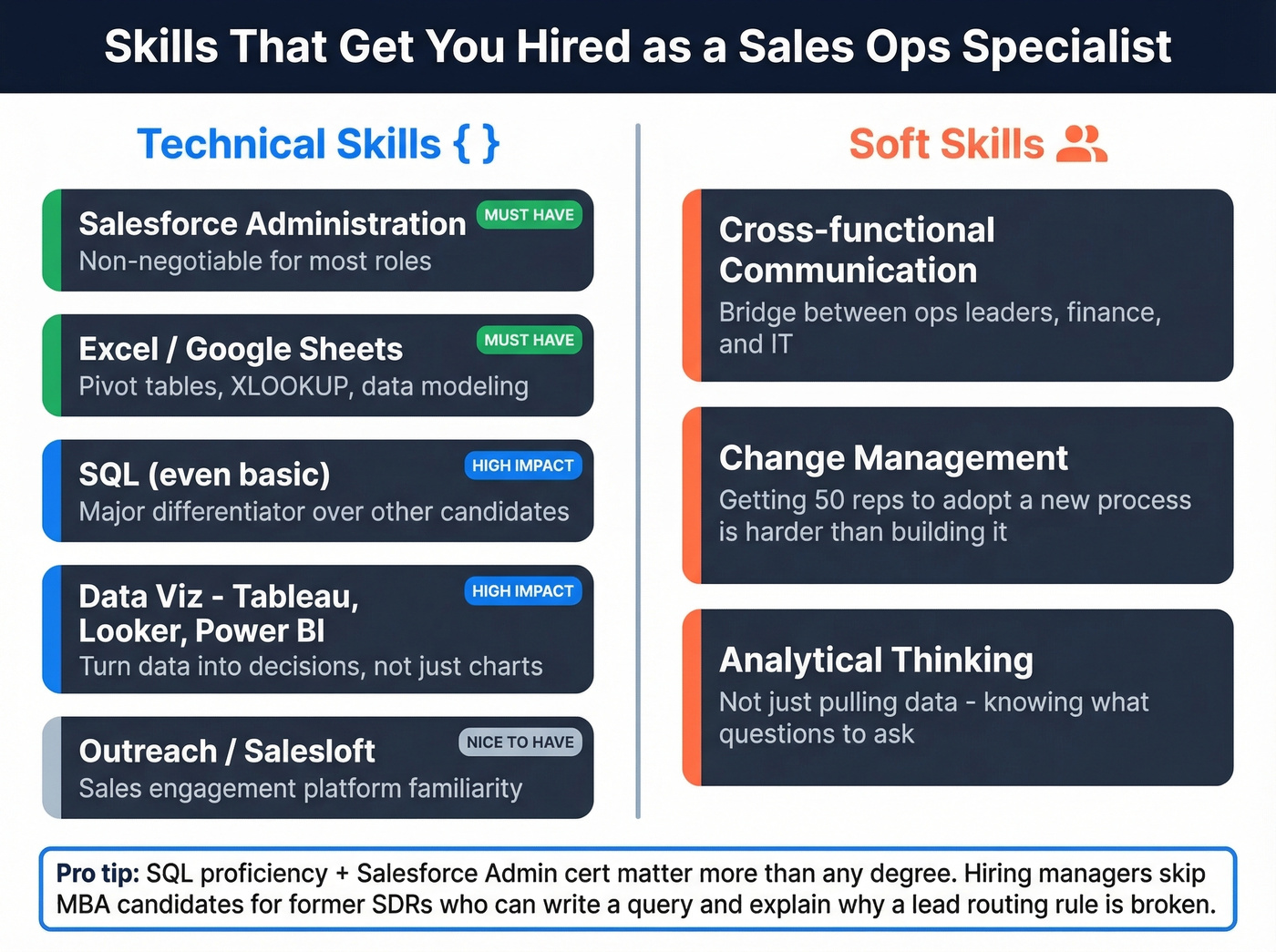
- Salesforce administration - non-negotiable for most roles
- Excel / Google Sheets at an advanced level, including pivot tables, XLOOKUP, and data modeling
- SQL, even basic querying, which is a major differentiator
- Data visualization with Tableau, Looker, or Power BI
- Familiarity with sales engagement platforms like Outreach and Salesloft
Soft Skills
- Cross-functional communication - you're the bridge between ops leaders, finance, and IT
- Change management - getting 50 reps to adopt a new process is harder than building it
- Analytical thinking - not just pulling data, but knowing what questions to ask
SQL proficiency and a Salesforce Admin certification matter more than any degree for this role. We've seen hiring managers skip over MBA candidates in favor of former SDRs who can write a SQL query and explain why a lead routing rule is broken. The degree checks a box. The skills get you hired.
The Sales Ops Tech Stack
85% of sales leaders plan to consolidate their tech stacks over the next two years. The best ops professionals cut tools, not add them. If your team is running more than eight sales tools, you don't have a stack - you have a junk drawer. We've audited dozens of ops setups, and the teams closing deals fastest run lean.
| Tool | Category | Starting Price | Notes |
|---|---|---|---|
| Salesforce | CRM | Custom | Industry default |
| HubSpot | CRM | Free | Strong for SMB |
| Apollo | Prospecting + Data | Free | Good free tier |
| Prospeo | Data Enrichment | Free (75 emails/mo) | 98% email accuracy, 7-day refresh |
| Outreach | Sales Engagement | Custom | Enterprise-focused |
| Salesloft | Sales Engagement | Custom | Strong coaching features |
| Gong | Revenue Intelligence | Custom | Conversation analytics |
| Clari | Forecasting | Custom | Pipeline visibility |
| Chili Piper | Scheduling/Routing | $45/month | Lead routing + booking |
| ZoomInfo | Data Platform | ~$15K-40K/yr | Broad US database |
| LeanData | Lead Routing | ~$25K-50K/yr | Enterprise lead-to-account matching |

Data enrichment is the foundation of everything else in this stack. Your CRM is only as good as the data inside it, and every downstream process - lead routing, territory assignment, forecasting - breaks when contact data is stale or wrong. If you're evaluating vendors, start with a shortlist of data enrichment services. At roughly $0.01 per email compared to $1 per lead at ZoomInfo, Prospeo handles enrichment at a price point that doesn't require a budget fight, with a 7-day data refresh cycle versus the six-week industry average.

Data quality is the #1 headache for every sales operations specialist. Prospeo's 5-step verification delivers 98% email accuracy, 125M+ verified mobiles, and a 7-day refresh cycle - so the data hitting your CRM is clean before you even have to audit it.
Stop deduplicating dirty imports. Start with data that's already verified.
KPIs Every Ops Specialist Tracks
If you can't measure it, you can't fix it.
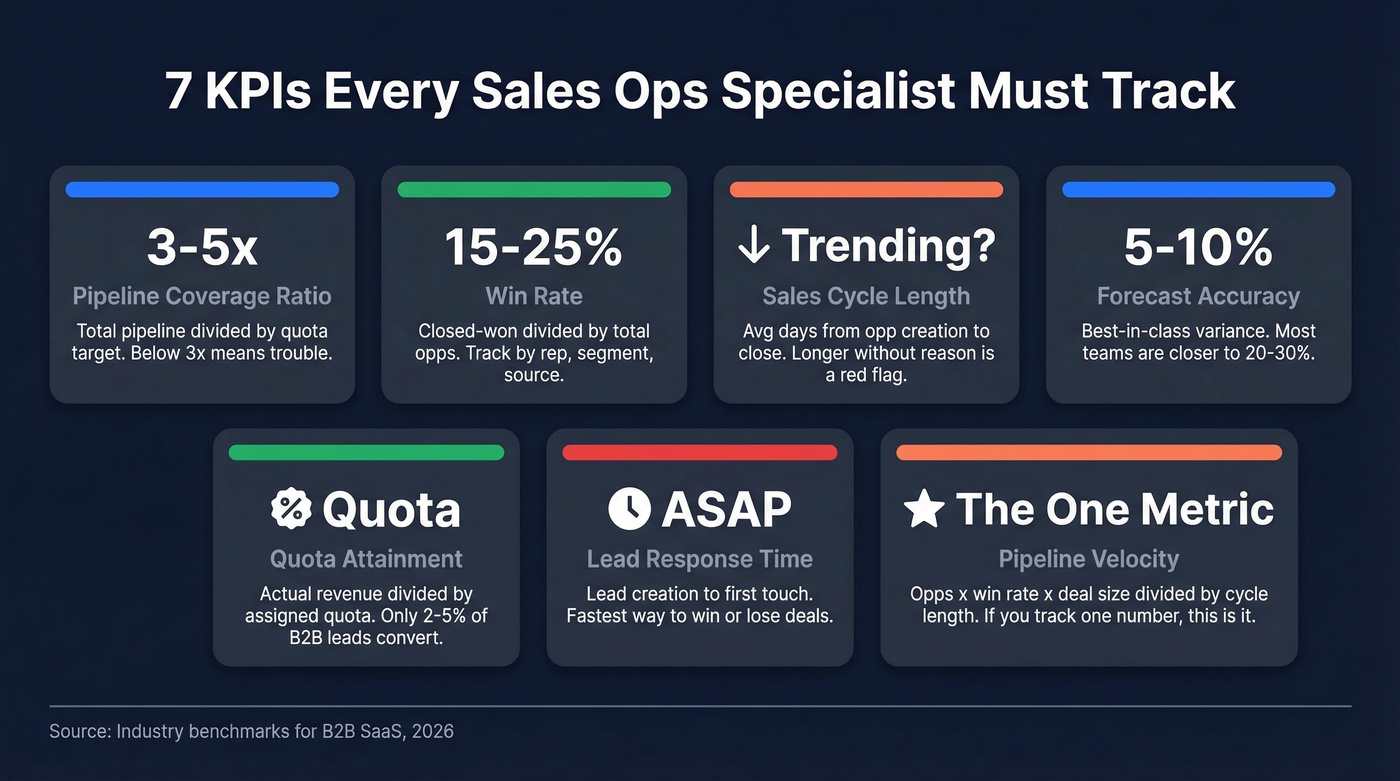
Pipeline Coverage Ratio - Total pipeline value divided by quota target. Benchmark: 3-5x. Below 3x and you're flying blind; above 5x and your pipeline is probably full of dead deals.
Win Rate - Closed-won divided by total opportunities. Healthy B2B win rates run 15-25%. Track by rep, segment, and source.
Sales Cycle Length - Average days from opportunity creation to close. If it's trending longer without a strategic reason, that's a red flag.
Forecast Accuracy - Forecasted minus actual, divided by actual. Best-in-class teams hit within 5-10% variance. Most are closer to 20-30%. (If you’re choosing tooling here, compare sales forecasting solutions by workflow fit, not brand.)
Quota Attainment - Actual revenue divided by assigned quota, times 100. When only 2-5% of B2B leads convert into paying customers, this tells you whether your funnel math works.
Lead Response Time - Time from lead creation to first rep touch. One of the fastest ways to win or lose deals in high-velocity funnels, and exactly where routing and automation either pay off or fall apart.
Pipeline Velocity - Opportunities times win rate times average deal size, divided by cycle length. This is the single metric that ties everything together. If you only track one number, make it this one. (For a deeper benchmark set, see sales operations metrics.)
Salary Breakdown
Salary data varies across sources because different platforms measure different things.
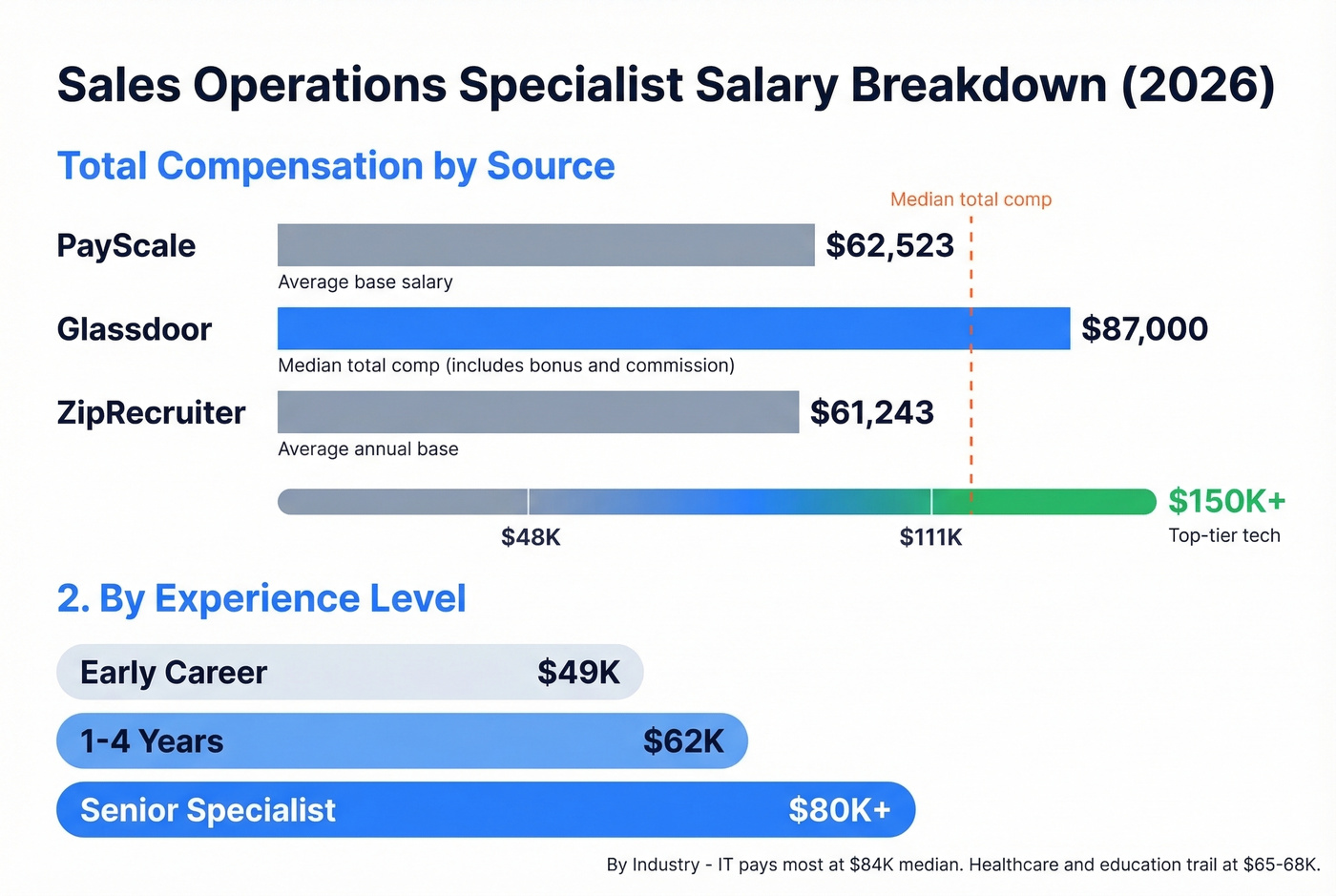
| Source | Metric | Amount |
|---|---|---|
| PayScale | Avg base | $62,523 |
| Glassdoor | Median total | $87,000 |
| ZipRecruiter | Avg annual | $61,243 |
PayScale and ZipRecruiter report base salary, which clusters around $61-63K. Glassdoor's $87K median includes bonuses and commissions - variable comp adds $13K-$24K per year on top of base. If you see a SERP snippet quoting bottom-percentile hourly figures, that's pulling from the lowest end of the ZipRecruiter distribution. The 25th percentile is $51.5K; the 90th percentile is $81K in base alone.
By experience: Early career averages around $49K total comp. At 1-4 years, that jumps to roughly $62K. Senior specialists push past $80K.
By industry: IT pays the most at a median of $84K total. Healthcare, education, and manufacturing trail at $65-68K.
By location: Scotts Valley, CA leads at $79K average, followed by Kirkland, WA and San Francisco. Remote roles are increasingly common but often benchmarked to HQ location.
The outliers: Google pays sales ops specialists $153K-$232K total comp. Apple runs $107K-$171K. These are real numbers, but they're Big Tech comp structures meeting an ops title - not representative of the broader market.
Career Path
Specialist ($48K-$70K) → Senior Specialist ($65K-$90K) → Manager ($85K-$120K) → Director ($120K-$160K) → VP of Sales Ops / CRO ($160K-$250K+)
One of the most common frustrations in Sales Ops communities is career ambiguity after the first year or two. The vertical path leads to management and eventually VP-level roles where you're shaping go-to-market strategy. But lateral moves are equally viable: product management, data analytics, and RevOps leadership all pull heavily from sales ops backgrounds. The CRM architecture, data modeling, and cross-functional communication skills you build transfer directly. (If you’re mapping the next step, compare responsibilities with a Sales Ops Manager.)
Let's be honest - the "specialist" title undersells what this role actually is. You're making strategic decisions about process, data, and technology that directly impact revenue. If you're a former SDR or BDR who fell in love with process and data instead of closing, lean into it. The career ceiling is higher than most people realize.
How AI Is Changing the Role in 2026
78% of organizations now use AI in at least one business function, up from 55% in 2023. Gartner projects that by 2027, 95% of seller research workflows will begin with AI. For sales ops, this isn't a threat - it's a massive expansion of what the role can do.
Here's what's already reshaping day-to-day work:
Predictive pipeline health. AI models flag at-risk deals before reps notice, giving ops teams time to intervene with coaching or resource reallocation. (This overlaps heavily with predictive analytics in sales.)
Automated lead scoring. This replaces manual scoring models that nobody trusts anyway, using behavioral signals and firmographic data to rank leads in real time. (If you want the operational version, start with lead scoring.)
Conversation intelligence. Tools like Gong analyze calls and surface coaching insights that ops teams feed into enablement programs - turning qualitative data into something you can actually act on.
Data enrichment automation. Instead of manual list cleaning, enrichment APIs run continuously, turning what used to be a weekly grind into a background process.
Companies using AI in sales have seen up to a 50% increase in leads and appointments. The role is shifting from "CRM admin who pulls reports" to something closer to an AI operations manager - someone who configures, monitors, and optimizes the automated systems running the sales organization.
If you're building enrichment workflows and managing list imports, you need a source that won't poison your pipeline. Prospeo returns 50+ data points per contact at a 92% match rate - at $0.01 per email, not $1. That's the kind of stack consolidation sales ops leaders actually want.
Cut your enrichment costs by 90% without sacrificing accuracy.
Certifications Worth Getting
The consensus on r/sales is skepticism about certifications, and it's partially warranted - no cert replaces hands-on experience. But three are genuinely worth the time.
Salesforce Administrator Certification. The gold standard. Most sales ops roles list it as preferred or required. Study time: 4-8 weeks if you're already using Salesforce daily.
HubSpot Revenue Operations Certification. Free, and valuable if you're targeting SMB or mid-market companies. It covers the full RevOps framework, which is where the market is heading.
SQL / BI Certification. Google Data Analytics or Tableau certifications differentiate you for analytics-heavy roles. If you can write queries that answer business questions without waiting for a data team, you're instantly more valuable. Skip this one if you're targeting companies under 100 employees - they'll care more about your Salesforce chops.
How to Prepare for Interviews
Interview anxiety for this role is real - the scope is so broad that candidates don't know what to study. Hiring managers typically test four areas.
CRM & Systems - "Walk me through how you'd audit and optimize our Salesforce instance for a scaling team." This tests whether you think systematically about CRM architecture, not just click buttons.
Analytics & Forecasting - "Design an executive dashboard - what three metrics go on it and why?" They're testing your ability to prioritize metrics and communicate data to non-technical stakeholders.
Process Design - "Define pipeline stages and exit criteria for our sales motion." This reveals whether you think in systems or just react to problems.
Change Management - "How do you enforce data hygiene standards when reps resist?" This separates specialists from future managers. If you can articulate how you get buy-in from people who don't report to you, you'll stand out.
Prepare a portfolio: a dashboard you built, a process you redesigned, a data quality problem you solved. I once watched a candidate pull up a before-and-after of a lead routing workflow they'd rebuilt - the hiring manager made an offer that afternoon. Concrete stories beat abstract frameworks every time.
Sales Operations Specialist FAQ
Is sales operations a good career?
Yes - total comp ranges from $69K to $111K at the specialist level, with clear progression to director and VP roles paying $160K+. Skills transfer directly to RevOps leadership, product management, and data analytics, making it one of the strongest entry points into revenue strategy.
What's the difference between a specialist and an analyst?
A specialist focuses on process and systems - CRM administration, workflow design, enablement. An analyst leans toward data - dashboards, forecasting models, performance analyses. Many companies use the titles interchangeably. Read the job description, not the title.
Do you need a degree?
No. Most hiring managers prioritize Salesforce proficiency, Excel/SQL skills, and sales process understanding over formal education. A Salesforce Admin certification carries more weight than a business degree in most interviews.
What tools should I learn first?
Salesforce or HubSpot for CRM, a sales engagement tool like Outreach or Salesloft, Excel/SQL for reporting, and a data enrichment platform to understand how contact data flows into the CRM. Knowing when to cut a tool matters as much as knowing how to use one.
How long does it take to become a sales operations manager?
Typically 2-4 years as a specialist or analyst. The timeline compresses at startups where you're the only ops person and stretches at enterprise companies with larger, more specialized teams.