

Sales Optimization: The Data-Backed Guide to Fixing What's Actually Broken
Only 43% of sales professionals hit quota last year, according to RepVue. Win rates dropped 18% compared to 2022, and sales cycles stretched 38% compared to 2021 - both tracked by Ebsta. Reps still spend roughly 25-30% of their time actually selling (25% per Bain, about 30% per Salesforce data compiled by Everstage). The rest vanishes into admin, research, and CRM hygiene.
Here's what that looks like in practice: your funnel appears healthy at the top, but SQL quality is quietly collapsing. Marketing hands off leads that sales doesn't trust. Reps waste hours chasing contacts who changed jobs six weeks ago. Meanwhile, 17% of reps generate 81% of revenue, and turnover has climbed from 22% to 36%. These aren't soft trends - they're structural failures. And every one of them is a lever you can pull.
But you have to diagnose before you prescribe. Most teams skip straight to buying another tool.
The Quick Version
If you've only got five minutes:
- Benchmark your funnel stage-by-stage against the conversion rates below and find your biggest drop-off. For most teams, it's MQL-to-SQL - only 15% of MQLs typically convert. (If you need a deeper baseline, use these sales pipeline benchmarks.)
- Fix data quality first. If your emails bounce at 20%+ and your mobile numbers are dead, no process change downstream matters. Use verified data with a fast refresh cycle. (More on email bounce rate and what “good” looks like.)
- Deploy AI on specific tasks - call summaries, prospect research, follow-up drafts - only after your process is clean. Automating a broken workflow just breaks it faster. (See generative AI sales tools for what’s actually useful.)
What Sales Optimization Actually Means
Most "sales optimization" content is a tips list. Add urgency to your close. Follow up faster. Smile when you dial. That's not optimization - that's advice your manager gives during a ride-along.
Real optimization is an operating system. Blue Ridge Partners draws a useful distinction between "self-directed" sales orgs - where every rep freelances their own process - and "company-directed" ones, where the best behaviors are codified, measured, and enforced. The shift from self-directed to company-directed is what separates teams that grow predictably from teams that depend on a few heroes.
If your deals average under $15K, you probably don't need a $30K/year tech stack. You need clean data, a defined process, and reps who follow it. The infrastructure matters more than the tooling. (If you want the adjacent framework, this is sales process optimization.)
Funnel Benchmarks: Find Your Bottleneck
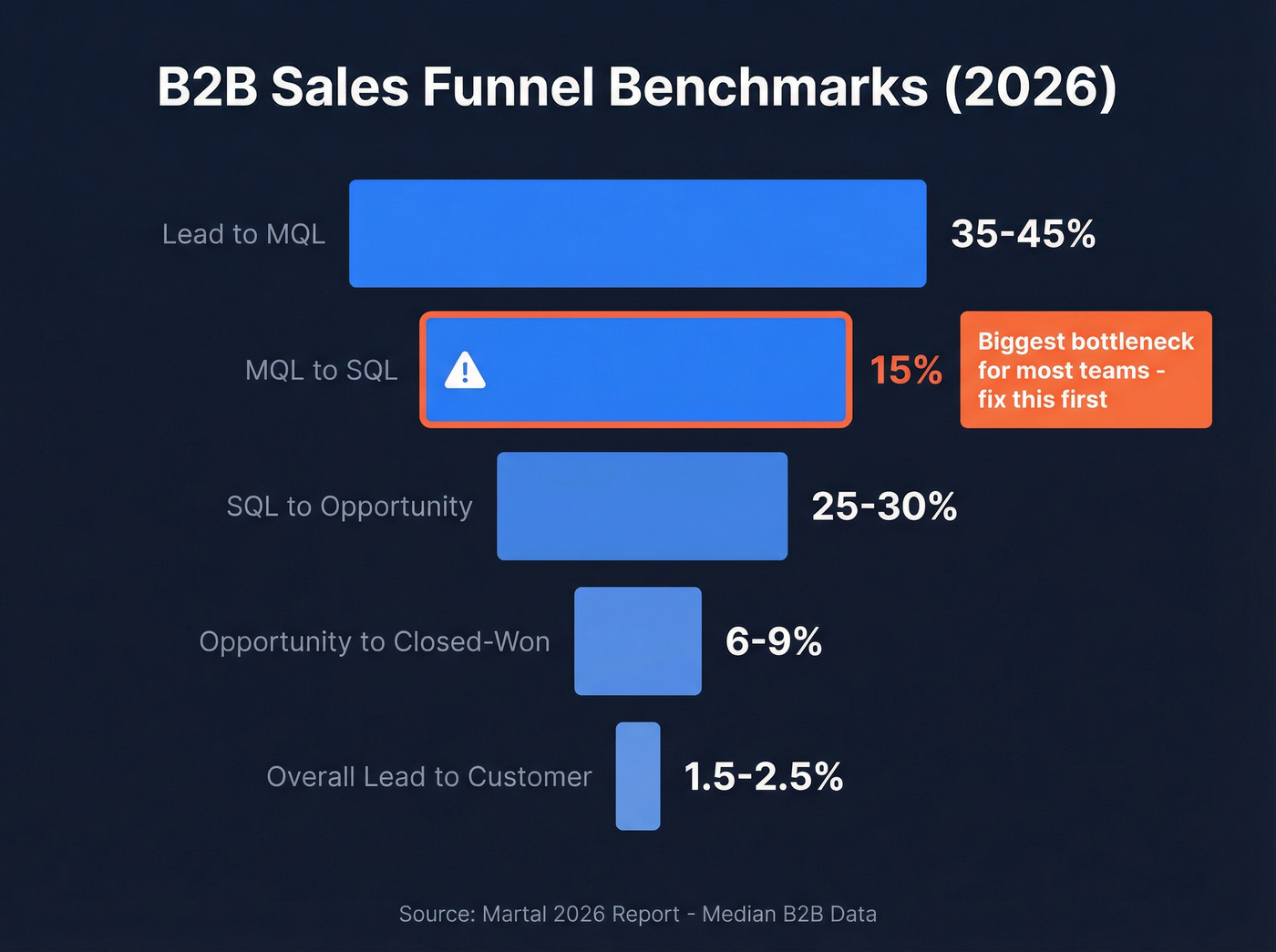
You can't fix what you haven't measured. Here are stage-by-stage conversion benchmarks from Martal's 2026 report reflecting median data. Fill in your own numbers and find the gap. (For a broader view of what to track, use funnel metrics.)
| Stage | Benchmark | Your Number |
|---|---|---|
| Lead to MQL | 35-45% | ___ |
| MQL to SQL | 15% | ___ |
| SQL to Opportunity | 25-30% | ___ |
| Opp to Closed-Won | 6-9% | ___ |
| Overall B2B conversion rate | 2-5% (median 2.9%) | ___ |
| Overall Lead to Customer | 1.5-2.5% | ___ |
Industry variance is wide. Legal services convert at 7.4%, B2B e-commerce hovers around 1.8%, and SaaS spans 1.1-7.0%. (More context: sales conversion rate.)
The biggest bottleneck for most organizations is MQL-to-SQL at just 15%. That's where marketing hands off leads that sales doesn't trust, qualification criteria are misaligned, and pipeline evaporates. If your rate is below that, fix it before you touch your close rate.

Pipeline Velocity Formula
Pipeline velocity captures how much revenue moves through your pipeline per day. It's the single metric that ties all four levers together:
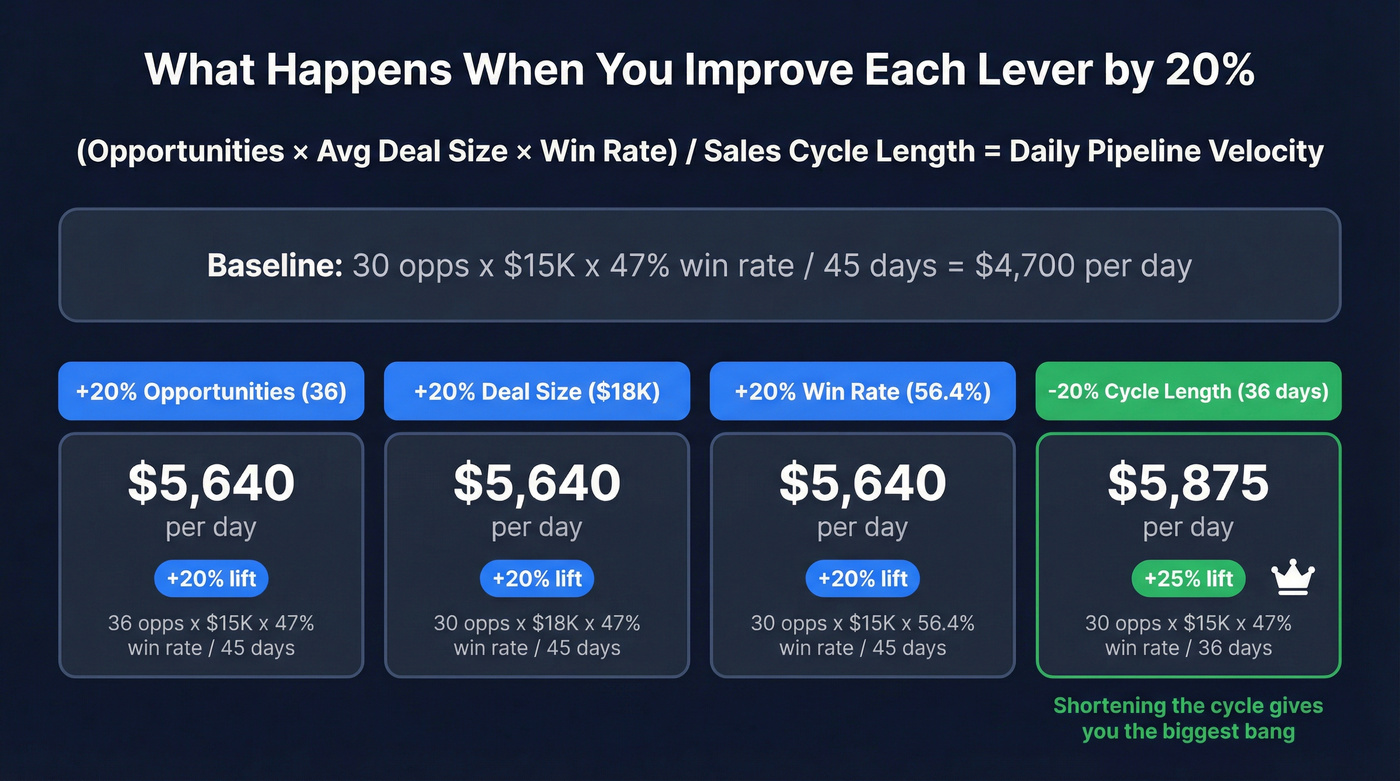
(Opportunities x Avg Deal Size x Win Rate) / Sales Cycle Length = Daily Pipeline Velocity
Example: 30 opportunities x $15,000 x 47% win rate / 45 days = $4,700/day (~$141,000/month).
Now look at what happens when you improve each lever by 20%:
| Lever Improved | New Velocity | Lift |
|---|---|---|
| +20% opportunities (36) | $5,640/day | +20% |
| +20% deal size ($18K) | $5,640/day | +20% |
| +20% win rate (56.4%) | $5,640/day | +20% |
| -20% cycle (36 days) | $5,875/day | +25% |
Shortening the cycle gives you the biggest bang. Every day shaved compounds across every deal in the pipeline. (If you want the definition + examples, see this Pipeline velocity formula.)
Diagnostic Worksheet: Pull These From Your CRM
Before you read further, grab these numbers. You'll need them to identify which lever matters most for your team:
- Bounce rate on outbound emails (last 30 days)
- MQL-to-SQL conversion rate (last quarter)
- Average days from opportunity creation to close (won and lost, separately)
- Number of stakeholders contacted per closed-won deal vs. closed-lost
- Discount rate on won deals vs. list price
- Rep activity volume in the pre-opportunity phase (accounts touched, contacts engaged)
If you can't pull even three of these, your CRM hygiene is the first problem to solve. (This ties directly to sales operations metrics.)
Strategies That Actually Move Revenue
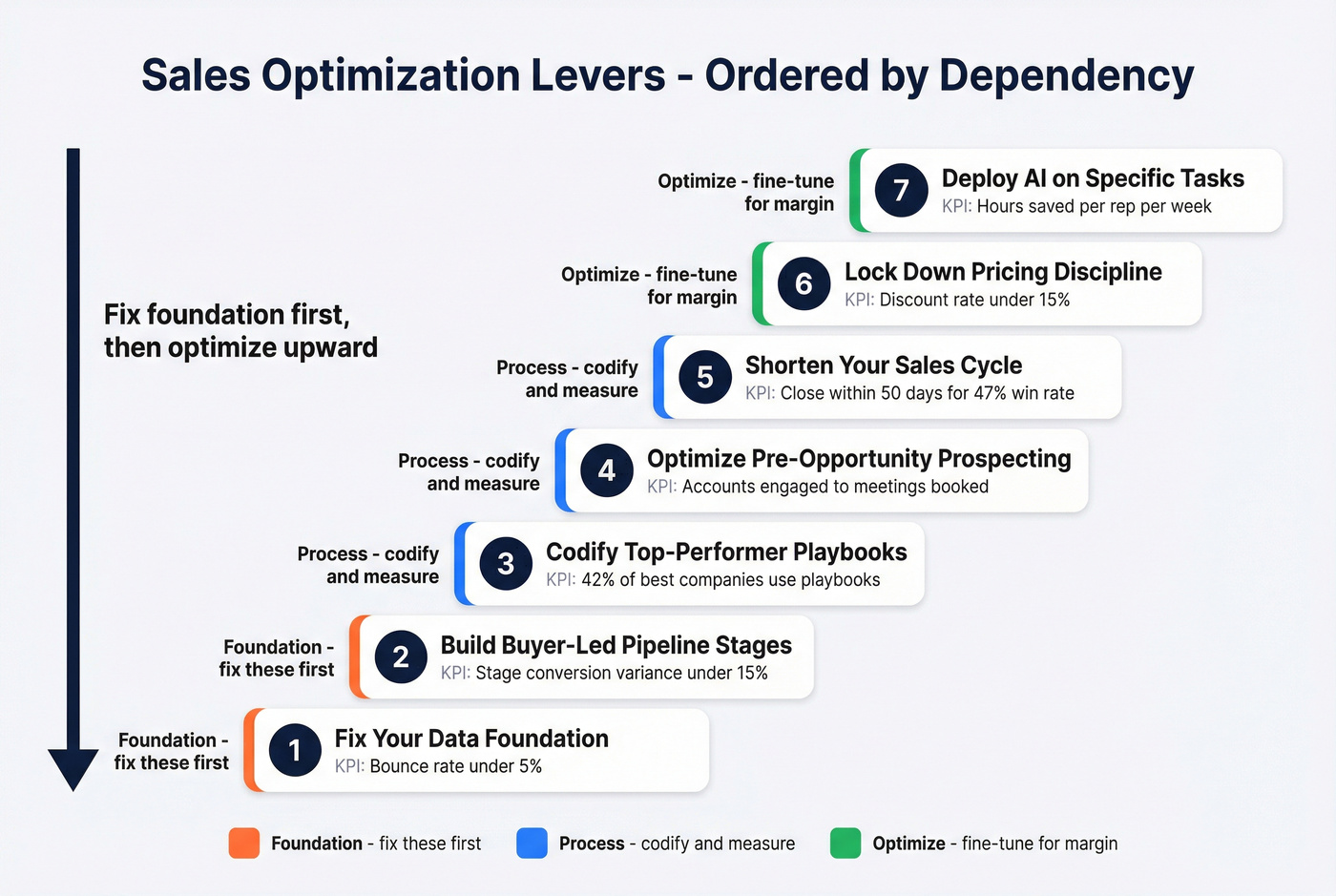
Benchmarks tell you where you're losing deals. These eight levers tell you what to do about it. They're ordered by dependency - fix the foundation before you optimize the roof.
Lever 1: Fix Your Data Foundation
KPI to watch: Email bounce rate (target: under 5%)
What does "refresh" actually mean? Every 7 days, email deliverability is re-verified and role/company signals are updated - so your sequences don't hit dead inboxes or target people who changed jobs last month. Most databases refresh on a 4-6 week cycle, which means a lot of lists are already stale by the time you build them. (If you’re evaluating vendors, start with data enrichment services.)
Implementation step: Audit your current bounce rate. Pull your last 1,000 outbound sends and calculate the hard bounce percentage. If it's above 5%, your data is actively damaging your domain reputation. (Related: email deliverability guide.)
Lever 2: Build Buyer-Led Pipeline Stages
KPI to watch: Stage-to-stage conversion consistency (variance under 15% month-over-month)
Most CRM pipelines are built around what reps do: "Demo sent," "Proposal delivered," "Follow-up call." These stages tell you nothing about whether the buyer is actually progressing.
Flip it. Build stages around buyer actions: "Buyer confirmed budget," "Buyer introduced technical evaluator," "Buyer shared internal timeline." IMPACT's exit criteria framework is the clearest model here - each stage needs explicit conditions that must be true before a deal advances. What evidence do you have that the buyer moved forward? If you can't answer that, the deal hasn't actually progressed.
Implementation step: Map your current pipeline stages. For each one, write the buyer action that proves progression. If you can't define one, that stage is a rep activity label, not a pipeline stage. Merge or replace it.
Lever 3: Codify Top-Performer Playbooks
KPI to watch: Playbook adoption rate (% of reps using prescribed sequences per stage)
42% of best-in-class companies use sales playbooks versus just 14% of laggards. Meanwhile, 70% of reps say their sales process has gotten more complex year over year. The gap between "what top performers do intuitively" and "what everyone else guesses at" is where most revenue disappears.
The fix isn't a 90-page PDF nobody reads. It's a living document that maps your methodology to the buyer's journey, codifies the specific plays that work for each deal stage, and gets updated quarterly based on what's actually closing. Think of it less as a manual and more as a decision tree that gets smarter every quarter. (If you’re building enablement around this, see sales enablement manager.)
Implementation step: Shadow your top 3 reps for a week. Document their actual behavior at each stage - what they send, when they multi-thread, how they handle objections. Turn those patterns into stage-specific plays and test adoption with the middle 60% of your team.
Lever 4: Optimize Pre-Opportunity Prospecting
KPI to watch: Accounts engaged to meetings booked ratio
A recurring frustration on r/SalesOperations: most analytics and tooling focus on Opportunity-to-Close, but there's almost no infrastructure for the pre-opportunity phase. SDRs spending hours on manual research. Account engagement that's invisible until an opportunity is created. Prospecting activity that nobody measures systematically. (If you need a menu of tactics, use these sales prospecting techniques.)
If you're only optimizing from opportunity creation forward, you're ignoring the entire top of your funnel. In our experience, teams that start tracking pre-opportunity metrics - accounts touched, contacts engaged per account, meetings booked per 100 contacts - find their biggest efficiency gains within the first month.
Implementation step: Create a pre-opportunity dashboard in your CRM. Track three metrics weekly: total accounts touched, multi-threaded accounts (2+ contacts engaged), and meeting conversion rate per channel.
Lever 5: Shorten Your Sales Cycle
KPI to watch: Median days to close (won deals)
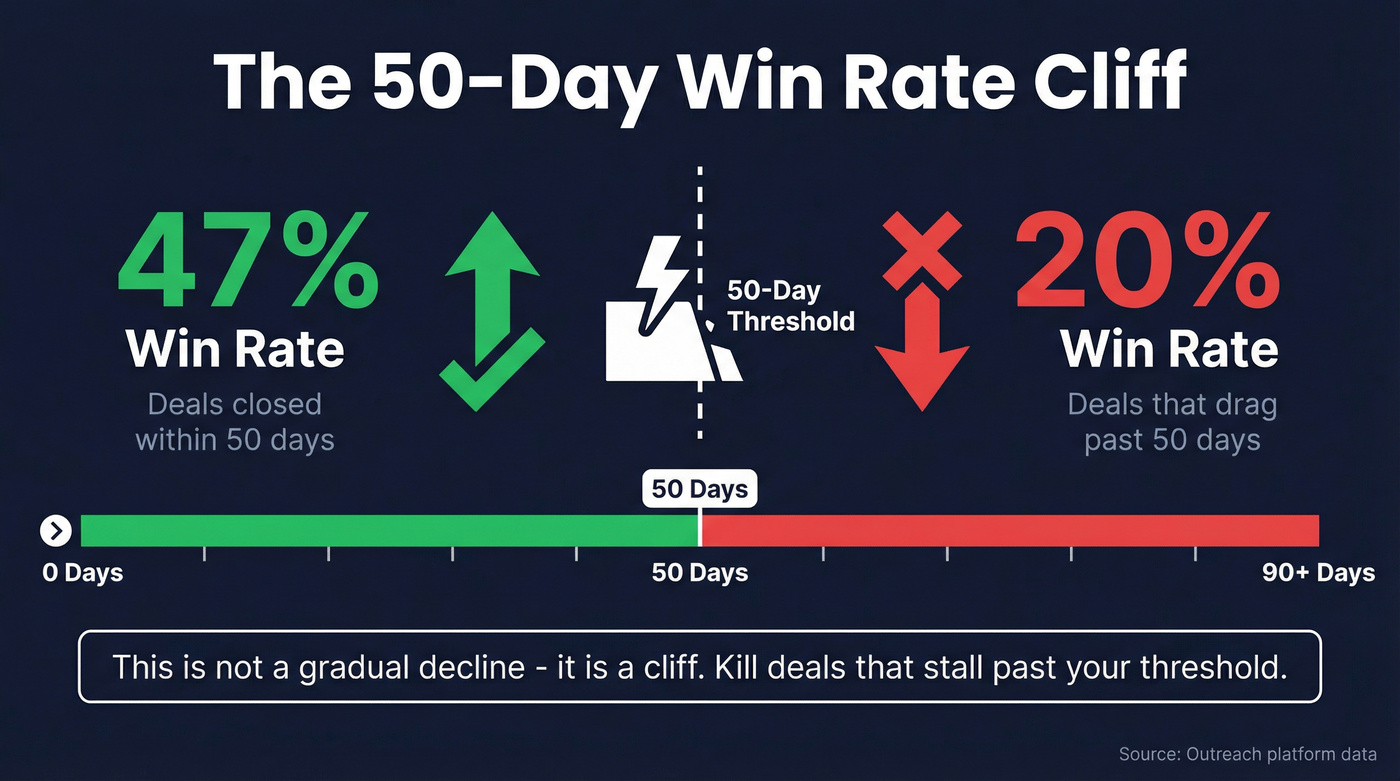
Outreach's platform data shows a stark threshold: opportunities closed within 50 days have a 47% win rate. Beyond 50 days, win rates drop to roughly 20%. That's not a gradual decline - it's a cliff.
Martal reports that buying committees now average ~13 stakeholders, and roughly 80% of buyer interactions happen digitally. Multi-threading isn't optional - it's the only way to keep deals from stalling while you wait for one champion to socialize your proposal internally. Send pre-call content that eliminates basic discovery questions. And kill deals that stall past your threshold instead of letting them inflate your pipeline.
Implementation step: Calculate your current median cycle length for won vs. lost deals. Set a hard threshold at the 75th percentile of your won-deal cycle. Any deal that crosses it gets a mandatory "commit or kill" review.
Lever 6: Lock Down Pricing Discipline
KPI to watch: Average discount rate on closed-won deals
This lever gets ignored in most optimization guides, but it's one of the fastest ways to protect margin and shorten cycles. If every rep can offer 20% off without approval, you don't have a pricing strategy. You have a suggestion.
CPQ friction is another silent cycle killer. If generating a custom quote takes 3 days because it needs VP approval and finance sign-off, you've just added 3 days to every deal. Streamline approval workflows, set clear price fences by deal size and segment, and track discount rates as aggressively as you track win rates.
Implementation step: Pull your last quarter's closed-won deals and calculate the average discount from list price. If it's above 15%, you have a governance problem. Define three discount tiers with clear approval authorities and enforce them in your CPQ tool.
Lever 7: Deploy AI on Specific Tasks
KPI to watch: Hours saved per rep per week on non-selling tasks
AI isn't a strategy. It's a set of tools that amplify specific tasks. The teams seeing real results use AI for prospect research (LivePerson cut research time from 20 minutes to 2 minutes per prospect), call summaries, follow-up draft generation, and deal-risk flagging. (If follow-ups are the bottleneck, see best AI for automating sales follow-ups.)
Bain's 2026 analysis is blunt: applying AI to existing processes yields only "micro-productivity." Real gains require end-to-end process redesign first, then automation. Redesign the workflow, then let AI accelerate it. Not the other way around.
Implementation step: Pick one high-frequency, low-judgment task like post-call summary writing. Deploy an AI tool for that single task. Measure time saved per rep per week for 30 days before expanding scope.
Lever 8: Align Sales and Marketing on Funnel Metrics
KPI to watch: MQL-to-SQL conversion rate (shared ownership)
Remember that MQL-to-SQL conversion rate of 15%? That's a shared problem. If sales and marketing can't agree on what qualifies as an MQL, what disqualifies one, and who's accountable for the handoff, you'll keep losing leads at the biggest bottleneck in your funnel.
The fix is deceptively simple: shared definitions, a joint dashboard, and a monthly review where both teams own the MQL-to-SQL number together. No finger-pointing. Just math.
Implementation step: Schedule a single meeting with your marketing counterpart. Define three MQL disqualification criteria together. Track the MQL-to-SQL rate weekly on a shared dashboard for one quarter.
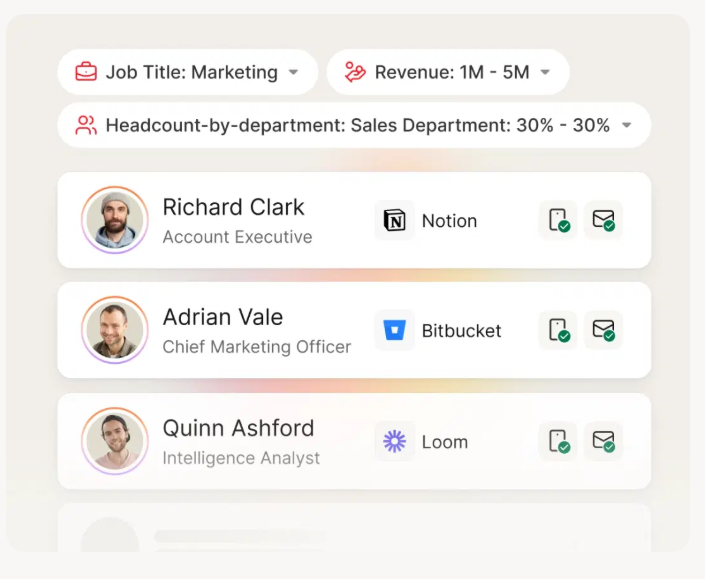

You just read that email bounce rates above 5% damage your domain reputation. Prospeo's 5-step verification delivers 98% email accuracy on 143M+ verified addresses - refreshed every 7 days, not every 6 weeks. At $0.01 per email, fixing your data foundation costs less than one lost deal.
Stop optimizing on top of stale data. Fix the foundation first.
What AI Actually Does for Sales Teams
Let's separate the hype from the numbers. Sellers who effectively partner with AI are 3.7x more likely to meet quota, per Gartner. AI adoption among sales reps nearly doubled in a single year - from 24% to 43%, according to HubSpot's State of AI report - and 56% of sales professionals now use AI tools daily, per LinkedIn's latest data.
The hybrid AI-SDR model is where the real action is. 45% of high-performing teams have adopted it, blending AI-driven research and personalization with human judgment on messaging and relationship building. Among teams using AI SDR tools, 100% report saving time on prospecting, with 40% saving 4-7 hours per week.
Concrete results from named deployments: LivePerson reduced per-prospect research from 20 minutes to 2 minutes and saw a 35% lift in engagement rates. Teams using Outreach's Kaia conversation intelligence close deals 11 days faster on average, with a 10 percentage-point win-rate improvement on deals over $50K.
But we've seen teams throw AI at everything and get nothing. I watched it happen three times in the last year alone. The pattern is always the same: they automate a broken process, get faster at doing the wrong thing, and blame the tool. AI is a multiplier. If you multiply zero, you still get zero.
Case Studies With Actual Numbers
SaaS Funnel Optimization (Revenue Doubled)
A SaaS company called TuBoost ran a systematic funnel optimization - no new tools, no new traffic, just stage-by-stage bottleneck hunting and testing.
| Metric | Before | After |
|---|---|---|
| Visitor to Signup | 11% | 16% |
| Signup to Trial | 41% | 55% |
| Trial to Paid | 18% | 25% |
| Monthly Revenue | $8,140 | $16,280 |
The changes were surgical. Landing page copy shifted from features to outcomes ("Save 4+ hours weekly"), with video testimonials added. The email sequence went from 3 emails over 2 weeks to 7 emails over 10 days, layering value, social proof, and urgency. Trial-to-paid improved through guided onboarding and personal outreach on day 3. Revenue doubled without increasing traffic by a single visitor.
Industrial Services Revitalization (5x EBITDA ROI)
A PE-owned industrial services company brought in Fahrenheit Advisors for a 16-week sales revitalization. The scope covered value proposition redefinition, territory restructuring, sales management realignment, full pipeline process buildout, and new reporting tools for cadence, activity, margin variance, and quote management.
The result: approximately 5x ROI on reported EBITDA, with project costs recovered in under 3 months. No new technology platform. No AI. Just process infrastructure built from scratch.
How to Optimize Your B2B Sales Process in 90 Days
Most teams try to fix everything at once and end up fixing nothing. Here's a structured cadence that sequences the work so each phase builds on the last.
Weeks 1-2: Baseline and diagnose. Pull the diagnostic worksheet numbers above. Identify your single biggest funnel drop-off. Audit your email bounce rate and data freshness.
Weeks 3-4: Fix data and definitions. Clean your contact database. Align with marketing on MQL/SQL definitions. Redefine pipeline stages around buyer actions with explicit exit criteria.
Weeks 5-8: Run two experiments. Pick two levers from the list above - one top-of-funnel (like prospecting workflow), one mid-funnel (like multi-threading cadence). Run controlled tests with clear success metrics. Sample size matters: don't declare a winner on 30 sends.
Weeks 9-12: Scale winners and update playbooks. Roll the winning experiments into your playbook. Update CRM stage definitions if needed. Set the baseline for your next 90-day cycle. (If you want a rep-level version of this cadence, use a 30-60-90 day plan for sales reps.)
This isn't a one-time project. The best sales orgs run this loop continuously, and each cycle compounds on the last.
Five Mistakes That Waste Your Quarter
Automating broken processes. Bain's research is clear - AI applied to bad workflows just produces bad outcomes faster. Redesign first, then automate.
Optimizing without stage-specific KPIs. "Improve conversion" means nothing. Which stage? By how much? Measured how? Without stage-level metrics, you're guessing.
Ignoring frontline rep feedback. The people doing the work know where the friction is. JuzSolutions flags this as one of the most common process-optimization failures: teams that redesign workflows without SDR and AE input end up with low adoption and new problems.
Focusing only on Opportunity-to-Close. The pre-opportunity phase is where most pipeline dies, and it's the least measured part of most funnels.
Building on stale data. Your forecasts, your targeting, your sequences - they're all downstream of data quality. As one data science thread on Reddit put it: "your historical data is biased by every bad decision you've already made." Clean the inputs before you trust the outputs.
Recommended Tech Stack
You don't need 15 tools. You need four categories covered well. Skip any category where your current solution is working - adding tools to a broken process just adds complexity.
| Category | Tool | Price Range | Skip This If... |
|---|---|---|---|
| CRM | Salesforce | $25-300/user/mo | You're under 10 reps (HubSpot free is enough) |
| CRM | HubSpot | Free-$150/user/mo | You need deep customization (go Salesforce) |
| Data & Verification | Prospeo | Free tier; ~$0.01/email | Your bounce rate is already under 3% |
| Conversation Intel | Gong | ~$100-150/user/mo | You don't coach reps weekly (the data will rot) |
| Sales Engagement | Outreach | ~$100-130/user/mo | Your team is under 5 reps (use HubSpot sequences) |
| BI & Reporting | CRM native dashboards | Included | - |
Pipeline velocity depends on reaching real buyers fast. Prospeo gives you 300M+ profiles with 30+ filters - buyer intent, technographics, job changes, headcount growth - so you build pipeline with contacts who are actually in-seat and in-market. Teams using Prospeo book 26% more meetings than ZoomInfo users.
Shorten your sales cycle by reaching the right people on day one.
FAQ
What's a good B2B sales conversion rate?
The median B2B conversion rate is 2.9%, with a typical range of 2-5%. Legal services average 7.4%, B2B SaaS ranges from 1.1-7.0%, and e-commerce sits around 1.8%. Always benchmark against your specific vertical rather than a universal number.
How long does sales optimization take to show results?
Expect 8-16 weeks for meaningful, measurable impact based on case study data. Quick wins like fixing data quality or plugging your biggest funnel drop-off can show results within weeks. Structural changes - playbook rollouts, territory restructuring - take a full quarter to compound.
What's the single most important metric to track?
Pipeline velocity. It combines opportunities, average deal size, win rate, and cycle length into one number representing daily revenue throughput. Shortening cycle length by 20% yields a 25% velocity lift, the biggest gain of any single lever.
Can AI replace sales reps in 2026?
No. AI multiplies specific tasks: research, call summaries, follow-up drafts, deal-risk scoring. Reps who effectively partner with AI are 3.7x more likely to hit quota per Gartner, but human judgment on relationships and deal strategy isn't going anywhere. 45% of high-performing teams use a hybrid model.
How do I fix bad sales data that's hurting deliverability?
Audit your bounce rate first - anything above 5% is damaging your domain reputation and pipeline. Switch to a verified data platform with a weekly refresh cycle. Prospeo's free tier (75 emails + 100 Chrome extension credits/month) lets you benchmark accuracy against your current provider before committing.