

Sales Pipeline Automation: Recipes, Tools, and What Actually Works in 2026
A RevOps lead we know ran a pipeline audit last quarter. Reps were spending four hours a day on data entry, follow-up scheduling, and lead routing - and exactly zero of that showed up in the forecast. The pipeline wasn't broken. It was just manual.
Sales pipeline automation is how you fix that.
What You Need (Quick Version)
Sales reps spend 33% of their time actually selling. The other 67% is admin, follow-ups, and process overhead. Pipeline management automation claws that time back.
You don't need a dozen tools. You need three layers, connected properly:
- A CRM with workflow automation - HubSpot for most teams, Pipedrive if you want simplicity.
- A verified data provider - so your automations don't run on garbage contacts (see data provider options).
- An orchestration layer - Zapier or Make to connect everything without code.
Here's the stat that should drive urgency: deals closed within 50 days have a 47% win rate. After 50 days, that drops to 20% or lower. Every manual handoff that adds a day to your cycle is money left on the table.
What Pipeline Automation Actually Is
Pipeline automation is the systematic elimination of manual handoffs between pipeline stages. It's not "set it and forget it" - it's trigger-based logic that moves deals forward without waiting for a human to remember.
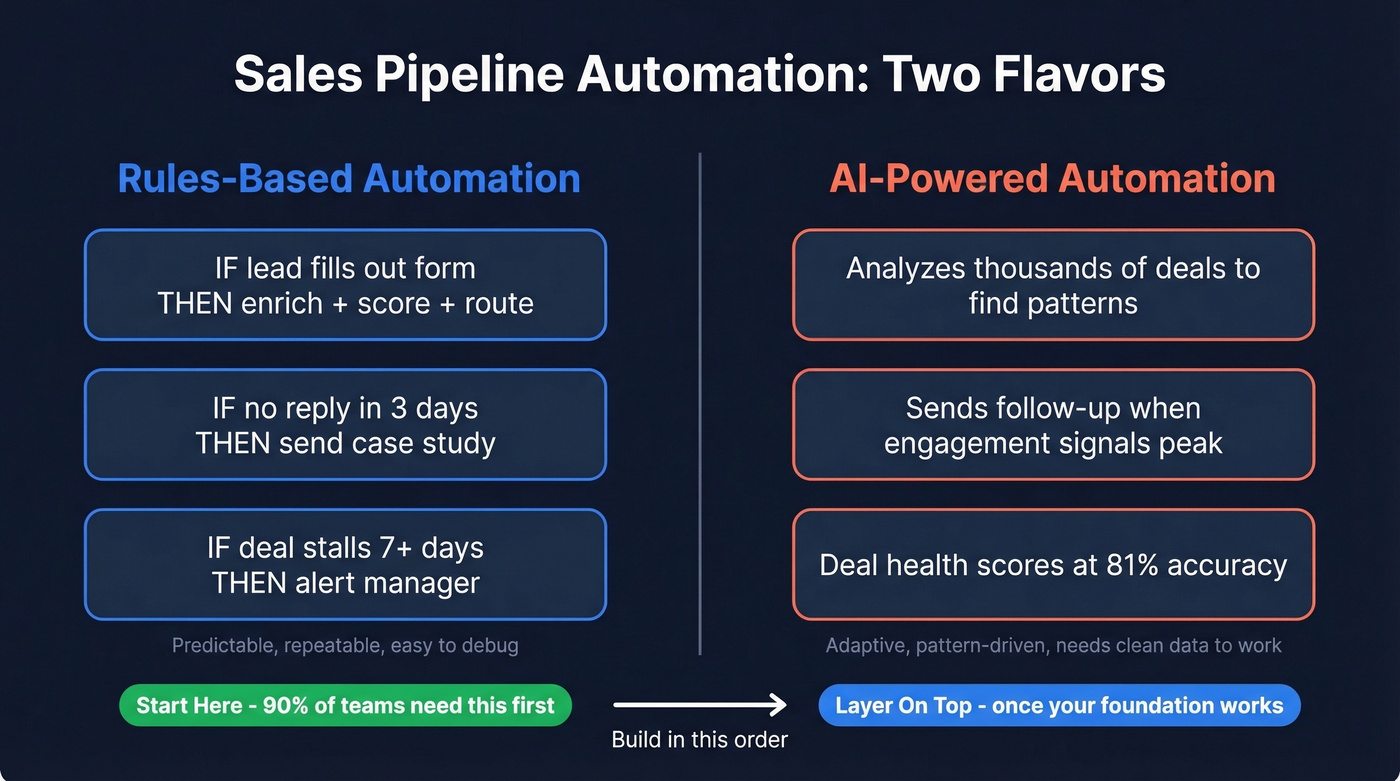
There are two flavors. Rules-based automation is if/then logic: if a lead fills out a form, then enrich the contact, score it, and route it to a rep. AI-powered automation goes further - it recognizes patterns across thousands of deals and adapts. A rules-based system sends a follow-up on day 3. An AI system sends the follow-up when engagement signals suggest the prospect is most likely to respond.
The distinction matters because most teams should start with rules-based automation and layer AI on top once the foundation works. Jumping straight to AI agents on a messy CRM is how you get expensive chaos.
Why Automating Your Pipeline Matters Now
Sales cycles aren't getting shorter. 34% of revenue teams report average cycles of 1-2 quarters. That's a lot of time for deals to stall, go dark, or get lost in a rep's inbox.
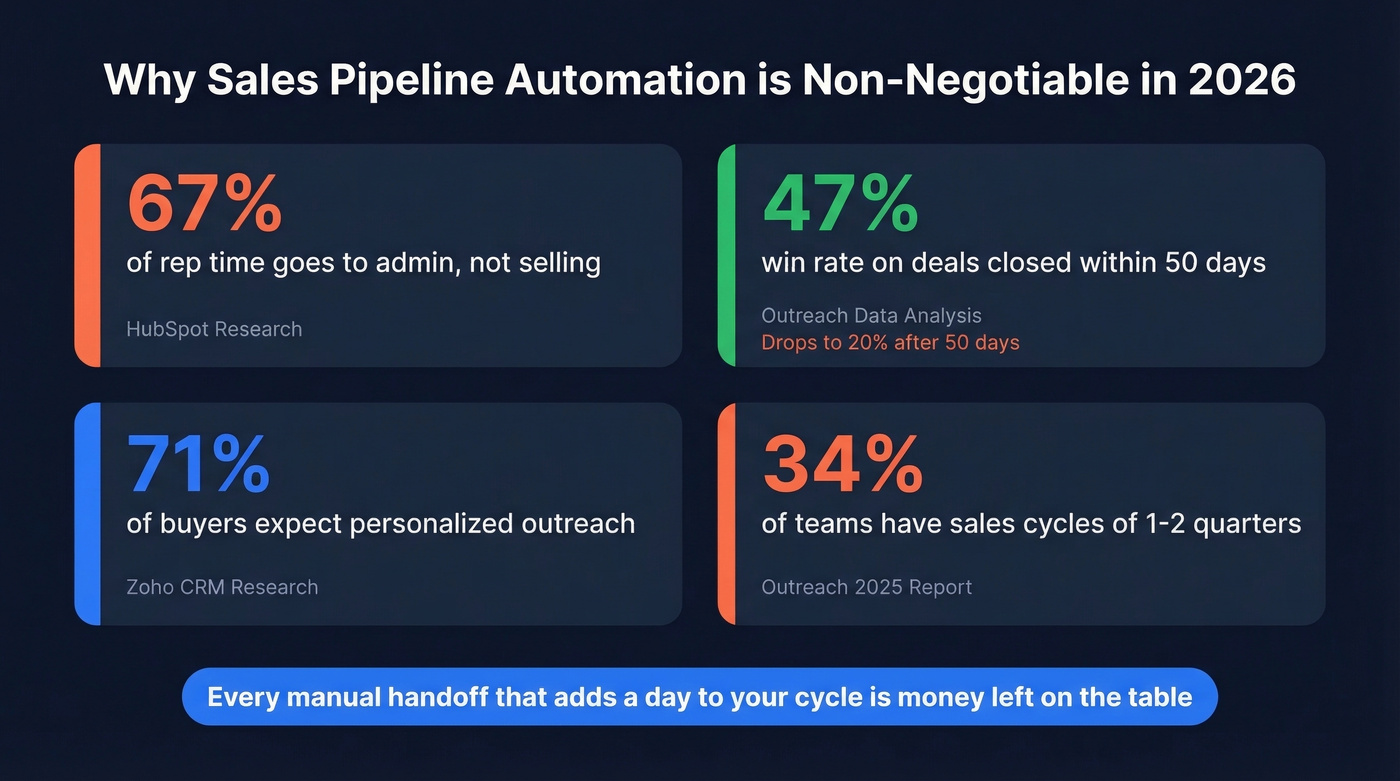
Buyer expectations keep climbing, too. 71% of buyers expect personalized outreach, and 75% get frustrated when they don't get it. Generic "just checking in" sequences don't cut it anymore (if you need better language, use these follow-up templates).
Let's make this concrete. Your best SDR just quit. They had 200 active leads in various stages, follow-up tasks scattered across their calendar, and a mental model of which deals needed attention. Without automation, those leads go dark within a week. With an automated sales pipeline, follow-ups fire, stalled deals get escalated, and the new hire inherits a system instead of a mess.
If you're still routing leads manually and relying on rep memory for follow-ups, you're giving automated competitors a structural advantage.
Stage-by-Stage Automation Recipes
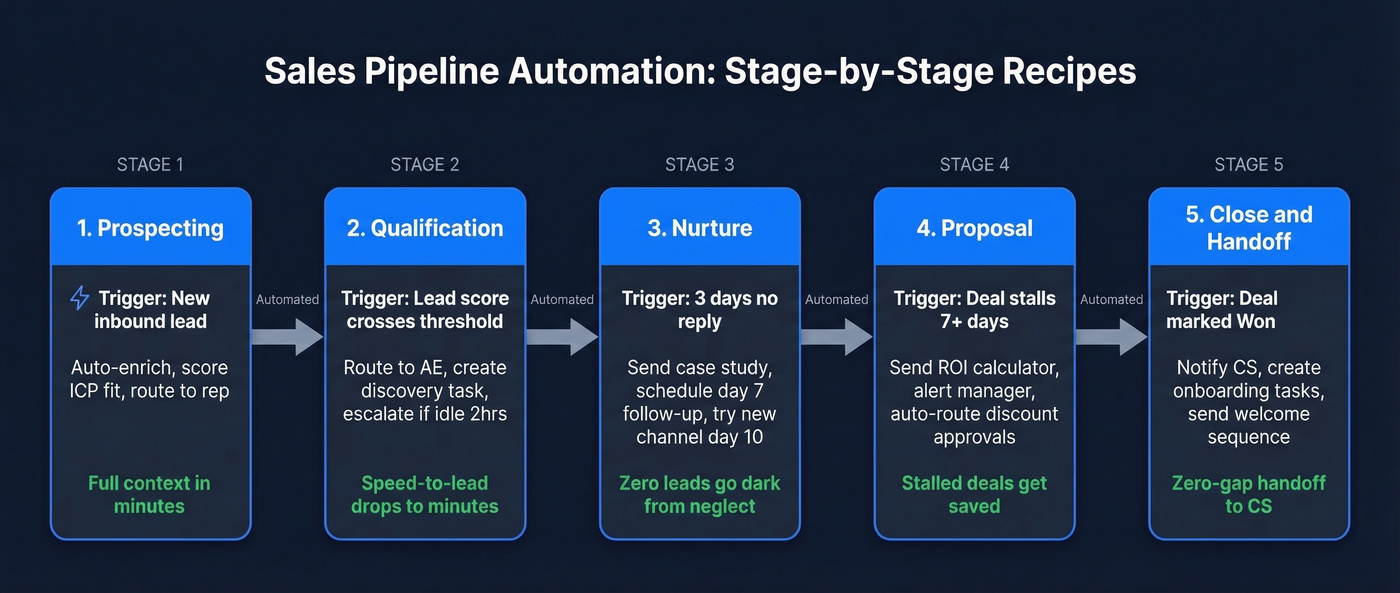
Each recipe follows a trigger → action → outcome format you can build in any modern CRM. One thing these recipes won't replace: your weekly pipeline review. Automation should feed the review with accurate, real-time data - flagging stalled deals, surfacing engagement trends, updating forecasts - so your team spends the meeting making decisions, not updating spreadsheets (track it with pipeline health metrics).
Prospecting & Lead Capture
Trigger: New inbound lead - form fill, pricing page visit, demo request.
Action: Auto-enrich the contact with firmographic and technographic data (use a firmographic and technographic data framework). Score based on ICP fit: company size, industry, tech stack, and intent signals. Assign to the right rep by territory or vertical. Create a task: "Call within 15 minutes."
Outcome: The rep gets a qualified lead with full context in minutes, not days. No manual research, no Slack messages asking "who owns this account?"
Qualification & Routing
Trigger: Lead score crosses your qualification threshold - say, ICP fit above 75 and engagement above 50.
Action: Route to the assigned AE. Create a discovery call task with a deadline. Enqueue a personalized discovery email with the prospect's company context pre-loaded. If no action within 2 hours, escalate to the sales manager.
Outcome: Hot leads never sit unworked. The speed-to-lead gap - which kills conversion rates faster than almost anything else - shrinks from days to minutes.
Nurture & Follow-Up
Trigger: 3 days with no reply after the discovery call.
Action: Send a case study relevant to the prospect's industry. Schedule a follow-up task for day 7. If still no response by day 10, trigger a different channel - a phone call task or a direct mail sequence.
Outcome: Consistent follow-up without relying on rep memory. We've seen teams where 40% of qualified leads went dark simply because nobody followed up on time. This recipe kills that problem (more on the importance of follow-up in sales).
Proposal & Negotiation
Trigger: Deal sits in the Proposal stage for 7+ days without movement.
Action: Auto-send a relevant customer story or ROI calculator. Alert the sales manager. Create an escalation task with context: "Deal stalled - last activity was [X] on [date]." If the deal involves a non-standard discount, route an approval request to the deal desk automatically rather than waiting for a rep to remember the policy.
Outcome: Stalled deals get attention before they die quietly. The 7-day trigger is a starting point - adjust based on your average cycle length.
Close & Handoff
Trigger: Deal marked Won in the CRM.
Action: Notify the CS team with deal context - use case, stakeholders, contract terms. Create onboarding tasks from a template. Send the customer a welcome sequence. Update forecasting and revenue dashboards automatically.
Outcome: Zero-gap handoff. No more "the customer signed three weeks ago and nobody told CS" situations.

Every automation recipe above starts with the same ingredient: verified contact data. Prospeo enriches leads with 50+ data points at 98% email accuracy - so your auto-routing, scoring, and follow-up sequences run on contacts that actually connect. At $0.01 per email, bad data stops being the bottleneck in your pipeline.
Stop automating on garbage contacts. Start with data that connects.
A Real B2B Automation Stack
A practitioner on r/startups shared a detailed breakdown of running pipeline automation as a solo GTM operator. The system had three layers: TAM expansion, signal-based activation, and multi-channel orchestration - built on Clay, HubSpot, Apollo, and Instantly.
An AI classification pipeline turned roughly 3,000 messy CRM accounts into 30,000+ mapped and scored companies, identifying about 4,000-5,000 ready for activation. Lead response time dropped from days to hours. One person was managing 2-5K active leads weekly.
The key insight isn't the specific tools - it's the architecture. A data layer feeds a signal engine, which triggers multi-channel sequences. Every piece connects. Nothing relies on someone remembering to check a spreadsheet (build the upstream system with a lead generation workflow).
AI Agents vs. Rules-Based Automation
Analysis of 33M weekly interactions across 6,000+ customers reveals what AI agents actually do well. Deal Health Scores hit 81% accuracy using signals like stakeholder involvement, engagement frequency, and close date shifts. The Kaia coaching assistant shaves 11 days off sales cycles while boosting win rates by up to 10 percentage points on $50K+ deals.
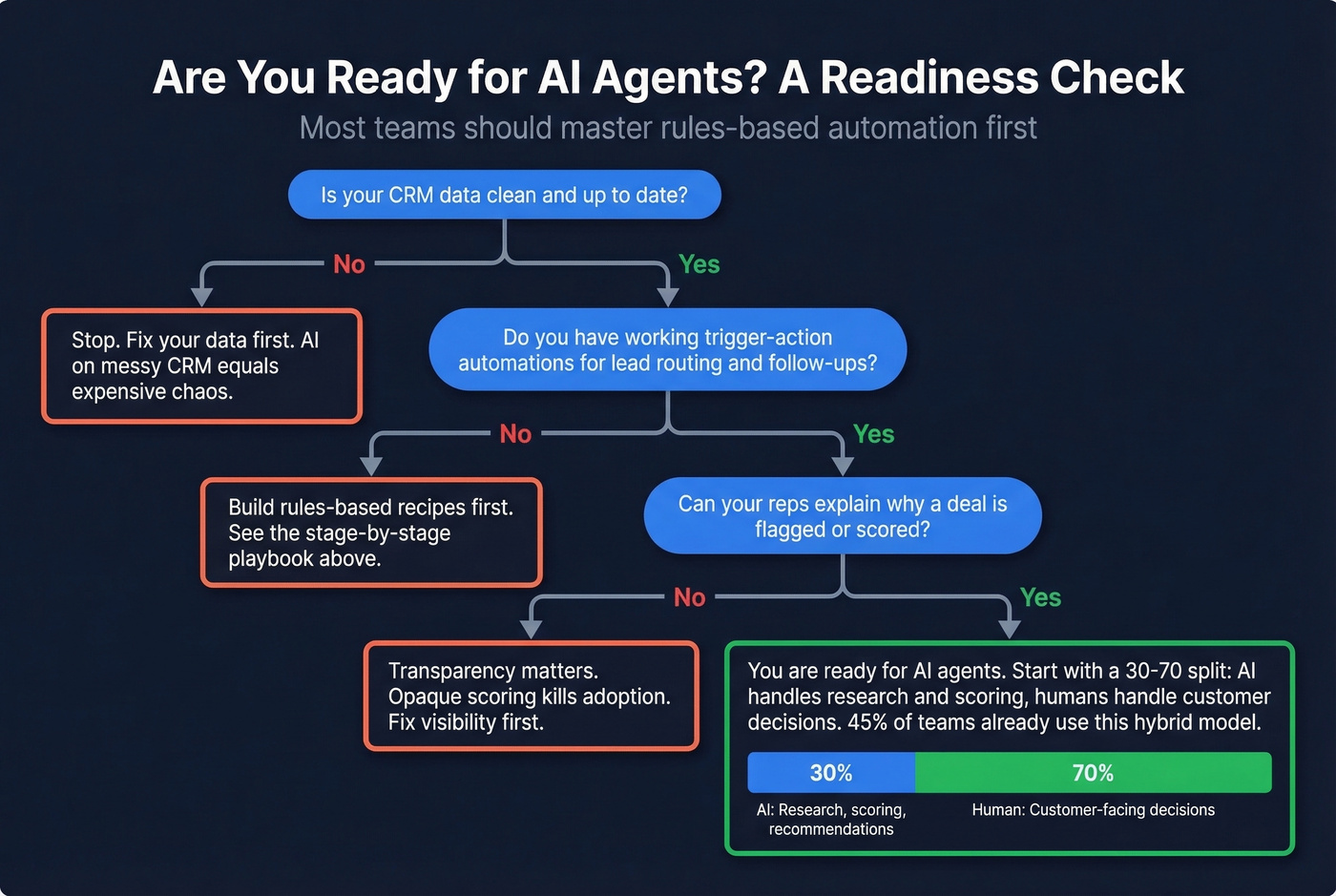
Impressive numbers. But the failures are instructive. Opaque scoring - where reps can't understand why a deal is flagged - kills adoption. Alert fatigue means reps ignore everything. Agents deployed in isolation, without workflow context, just create more context-switching.
Here's my hot take: 90% of teams should master rules-based automation before touching AI agents. If your lead routing is still manual and your follow-up cadences are inconsistent, an AI agent won't save you - it'll just add complexity to a broken foundation. By 2027, an estimated 95% of seller research workflows will begin with AI. That tracks. But the path there runs through solid trigger-action recipes first (and a clean lead scoring model).
When you're ready for agents, start with a 30-70 split: let AI handle research, scoring, and recommendations, but keep humans in the loop for decisions that touch the customer. 45% of teams already use a hybrid AI-SDR model like this. The best implementations we've seen augment reps rather than replace judgment.
Best Tools for Pipeline Automation
| Layer | Tool | Starting Price | Best For |
|---|---|---|---|
| CRM | HubSpot Sales Hub | Free CRM; Starter $20/user/mo | Best automation builder |
| CRM | Pipedrive | $14/user/mo | Small teams, simplicity |
| CRM | Salesforce Sales Cloud | $25/user/mo+ | Enterprise workflows |
| Data | Prospeo | Free; ~$0.01/email | Verified emails + mobiles |
| Data | Clay | $134/mo | AI enrichment |
| Data | Apollo | Free; ~$49/user/mo | All-in-one prospecting |
| Sequencing | Outreach | $100+/user/mo | Enterprise sequences |
| Sequencing | Instantly | ~$30-97/mo | High-volume cold email |
| Orchestration | Zapier | Free; $19.99/mo | No-code connections |
| Orchestration | Make | Free; ~$9/mo | Complex automations |
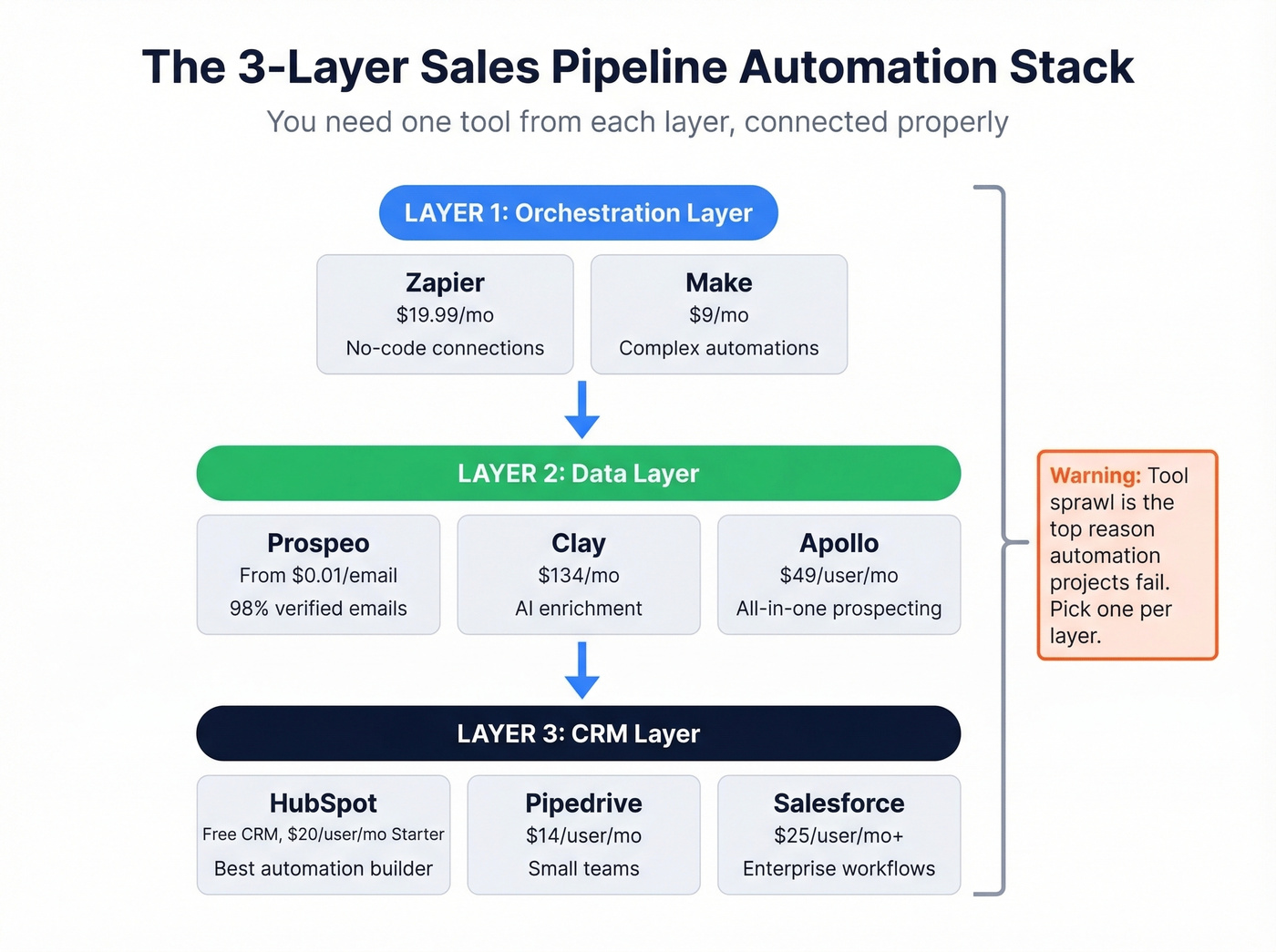
You don't need 10 tools. You need one from each layer, connected properly. Tool sprawl is one of the top reasons automation projects fail - teams buy six overlapping platforms, none of them talk to each other, and reps end up doing more manual work than before.
Your automation is only as good as the data feeding it. Prospeo's database runs every record through 5-step verification - catch-all handling, spam-trap removal, honeypot filtering - and refreshes the entire dataset every 7 days, compared to the 6-week industry average. The free tier includes 75 emails/month plus 100 Chrome extension credits, enough to test the workflow before committing, and it integrates natively with HubSpot, Salesforce, Clay, Zapier, Instantly, and Make (compare vendors in data enrichment services).

Watch out for ActiveCampaign. It looks like a CRM, but CRM functionality is an add-on to their marketing automation core. Plans start around $15-$19/mo, but in late 2025 they switched to contact-based billing that counts all contacts - including unsubscribed, bounced, and unconfirmed - for new users. Teams with overlapping segments have seen bills jump 2-3x overnight. If you're evaluating it, audit your contact overlap first.
Here's a frustration worth sharing: if you have to "talk to sales" to learn what a tool costs, budget for 2-3x what you expect. Prospeo, Pipedrive, and Zapier all publish pricing. That transparency matters when you're building a stack on a budget.
Mistakes That Kill Pipeline Automation
Automating on bad data. If your bounce rate is above 5%, you're burning your sender domain at scale. We've watched teams automate outbound and see bounce rates triple overnight because nobody verified the list first. Before you automate a single sequence, verify your data (use these email bounce rate benchmarks and fixes). Snyk cut bounce rates from 35-40% to under 5% and generated 200+ new opportunities per month after switching to verified contact data.
Over-automating. Removing every human touchpoint kills deal quality. Automation should handle the repetitive stuff - routing, scheduling, data entry - not replace the discovery call or the negotiation.
No personalization. "Hi {first_name}, I noticed your company is in {industry}" isn't personalization - it's a mail merge. Real personalization means referencing specific triggers, recent company events, or relevant case studies. 71% of buyers expect it, and 75% are frustrated without it.
Alert fatigue. If your CRM sends 30 notifications a day, reps ignore all of them. Three high-signal alerts beat thirty low-signal ones every time.
Skipping phased rollout. Trying to automate every pipeline stage in week one is a recipe for chaos. Start with one stage - lead routing or follow-up sequences deliver the highest impact - get it working, then expand (common blockers are covered in sales pipeline challenges).
That enrichment step in your prospecting recipe? Prospeo handles it with a 92% match rate and 7-day data refresh - so your automated workflows always route fresh, scored leads to reps. Native integrations with HubSpot, Salesforce, Clay, and Zapier mean zero manual wiring.
Plug verified data into your automation stack in minutes, not weeks.
How to Implement in Three Phases
Phase 1 - Data Foundation (Week 1-2). Clean your CRM. Deduplicate records, fill in missing fields, and verify every email address. Run your existing database through an enrichment API before building a single automation.
Phase 2 - Core Automations (Week 2-4). Build 3-5 trigger→action recipes for your highest-impact stages. Lead routing and follow-up sequences are the obvious starting points. Test with a small segment before rolling out to the full team.
Phase 3 - Optimize (Month 2+). Layer in AI scoring, intent signals, and multi-channel orchestration. Measure pipeline velocity and win rate before and after. If the numbers don't move, the automation isn't working - iterate. At this stage, connecting your sequencing tools, CRM, and analytics into a single feedback loop becomes critical so every touchpoint informs the next.
Timeline ranges vary. SMB teams with a clean CRM can have core automations running in 1-3 weeks. Mid-market teams with multiple integrations typically need 4-8 weeks. Enterprise rollouts with governance and training run 2-6 months.
FAQ
What's the best CRM for sales pipeline automation?
HubSpot for most teams - its workflow builder is the most intuitive and the free CRM includes basic automation. Pipedrive at $14/user/month suits smaller teams wanting simplicity. Salesforce Sales Cloud fits enterprise orgs with complex routing needs, but expect a longer setup and higher total cost.
How long does setup take?
SMB teams with a clean CRM typically launch core automations in 1-3 weeks. Mid-market orgs needing multiple integrations should plan 4-8 weeks. Enterprise rollouts with governance, training, and compliance reviews run 2-6 months. Start with one stage - lead routing or follow-up - and expand from there.
Does pipeline automation work without good data?
No. Bad data is the #1 failure mode. Automating outreach on unverified emails burns your sender domain and wastes rep time on bounces. Start with a provider delivering 98%+ email accuracy before building any outbound workflows. Bad data doesn't just slow you down - it actively damages your infrastructure.
How is B2B pipeline automation different from B2C?
The core trigger→action logic is identical, but B2B automation involves longer cycles, multiple stakeholders, and higher deal values. Your workflows need multi-threaded engagement - routing updates when a new decision-maker enters the deal, escalating stalled opportunities based on deal size, and syncing activity data across nurture sequences that can span months.