

How to Build a B2B Sales Pitch That Actually Wins Deals
Your SDR sent 200 cold emails last week. Three replies. Two were "unsubscribe." The problem isn't effort - it's that your pitch was built for a B2B buyer who doesn't exist anymore.
83% of buyers mostly or fully define their requirements before they ever talk to sales. Buying committees now average 25 stakeholders, up from 16 in 2017. Only 16% of reps hit quota recently. Here's how to build a pitch that works in 2026, backed by data from 326K sales calls and recent buying-behavior research.
Why B2B Pitches Must Change
The buyer you're pitching has already made up their mind - or close to it. First contact now happens at 61% of the buying journey, down from 69% the year prior. Sales is getting pulled in earlier, but buyers are showing up far more informed.
Meanwhile, 86% of B2B purchases stall, and 81% of buyers end up dissatisfied with the provider they chose. Win rates hover around 20-21%. If your pitch sounds like it was written for a single decision-maker who hasn't done any research, you're losing before you open your mouth. Pitching to an entire committee - not just one champion - is now table stakes.
What Winning Pitches Sound Like
Gong analyzed 326K sales calls of 10+ minutes. The gap between winning and losing is narrower than you'd think, and it's almost entirely about how much you shut up.
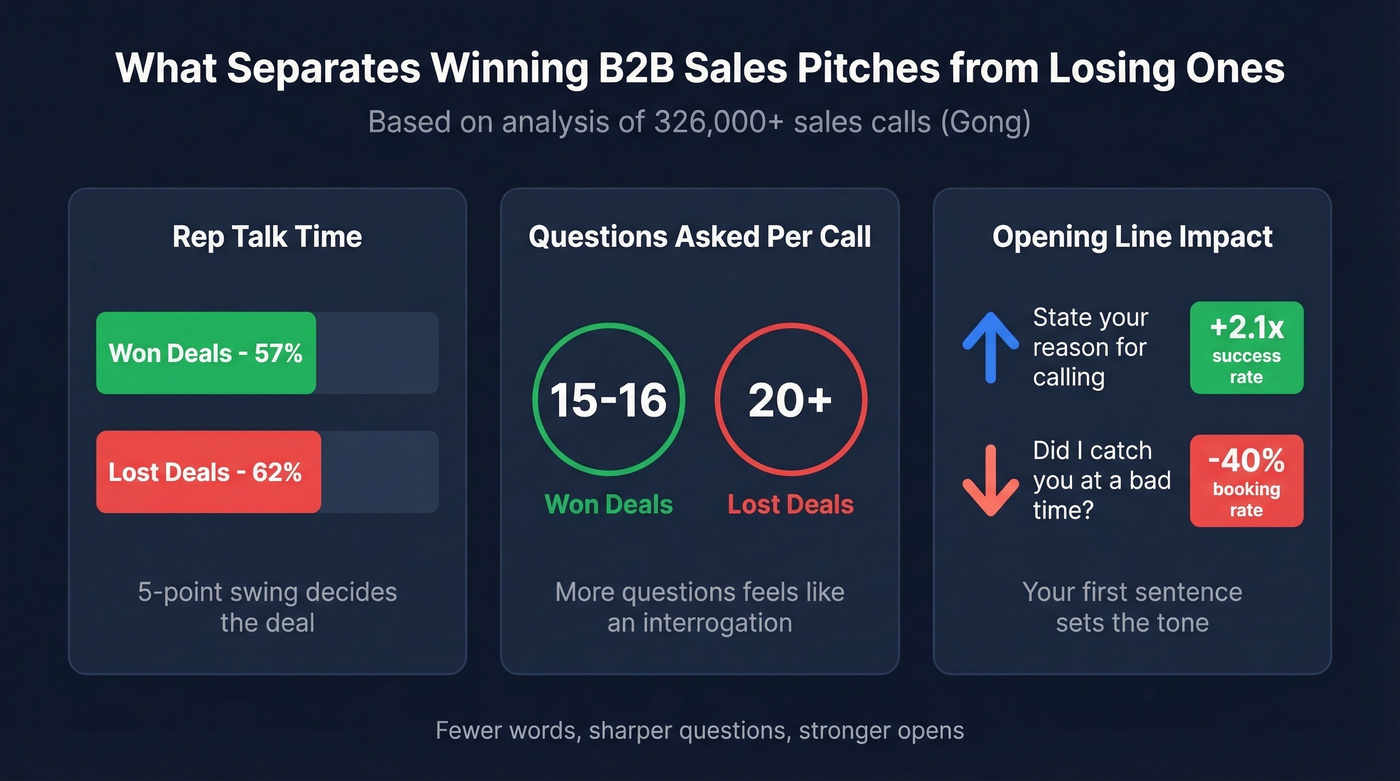
Closed-won deals: reps talked 57% of the time. Lost deals: 62%. That five-point swing is the difference between understanding the buyer's real problem and steamrolling them with your deck. Stating the reason for your call increases success rate 2.1x, while opening with "Did I catch you at a bad time?" drops your meeting-booking rate by 40%.
Question count matters too. Won deals averaged 15-16 questions; lost deals hit around 20. Past a threshold, it feels like an interrogation. Ask fewer, sharper discovery questions. Let the answers breathe.
The Pitch Structure That Works
Forget memorizing scripts. You need a five-step skeleton that flexes across channels.
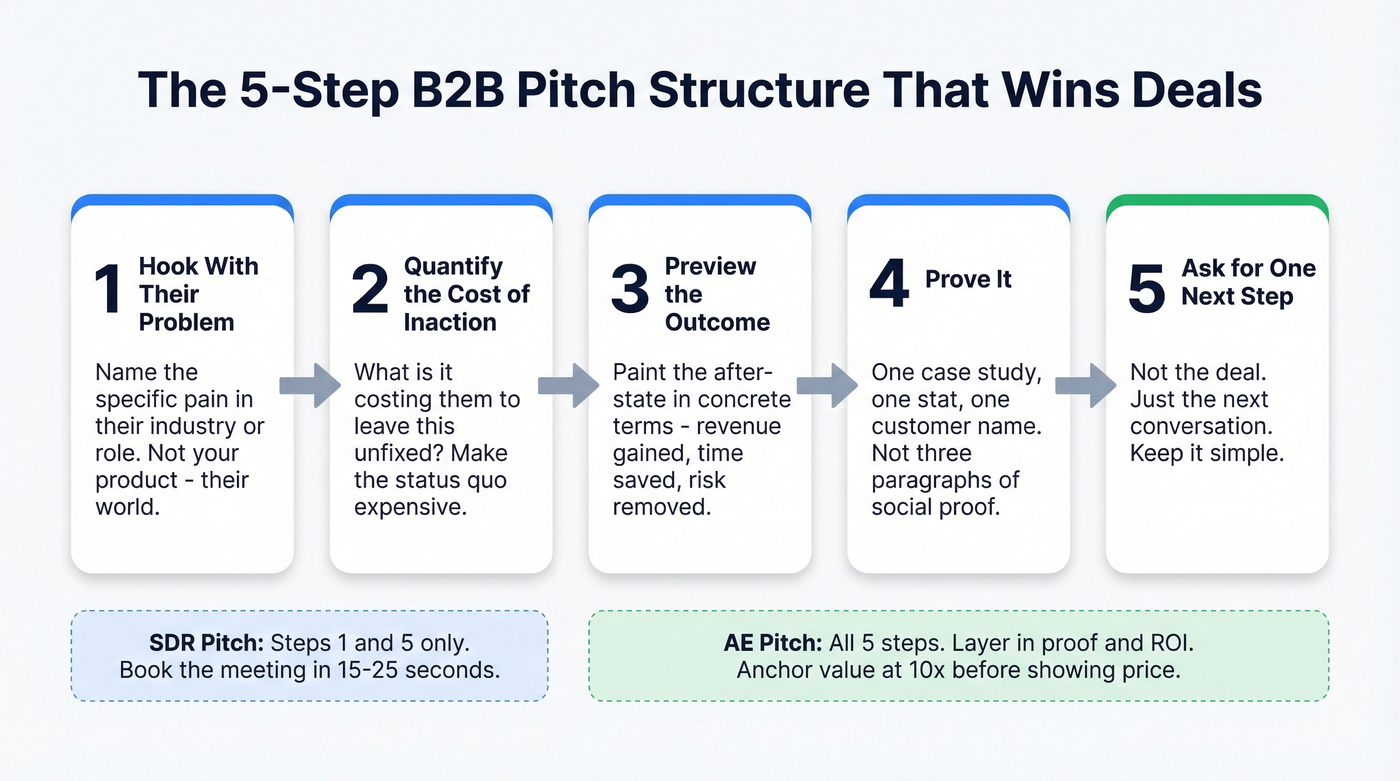
- Hook with their problem - not your product. Name the specific pain you've seen in their industry or role.
- Quantify the cost of inaction - "What's it costing you to leave this unfixed?" beats any feature list.
- Preview the outcome - paint the after-state in concrete terms: revenue gained, time saved, risk removed.
- Prove it - one case study, one stat, one customer name. Not three paragraphs of social proof.
- Ask for one next step - not the deal. Just the next conversation.
An SDR's pitch books a meeting in 15-25 seconds - a hook and a CTA. An AE's job is to advance the deal, layering in proof and ROI. Don't confuse the two. And remember: price without context is always too expensive. Anchor value at 10X the investment before you ever show a number (more on anchoring if you want the mechanics).

You just built a pitch structure that wins. Now make sure it reaches the right person. Prospeo delivers 143M+ verified emails at 98% accuracy and 125M+ mobile numbers - so your cold calls and emails actually connect with decision-makers, not dead inboxes.
Stop perfecting pitches that bounce. Start reaching real buyers.
Pitch Scripts by Channel
Cold Call Script
You've got about 30 seconds. Name the problem, hint at the outcome, ask if it's worth 15 minutes. If you need a full system, build it like a repeatable cold calling system, not a one-off script.
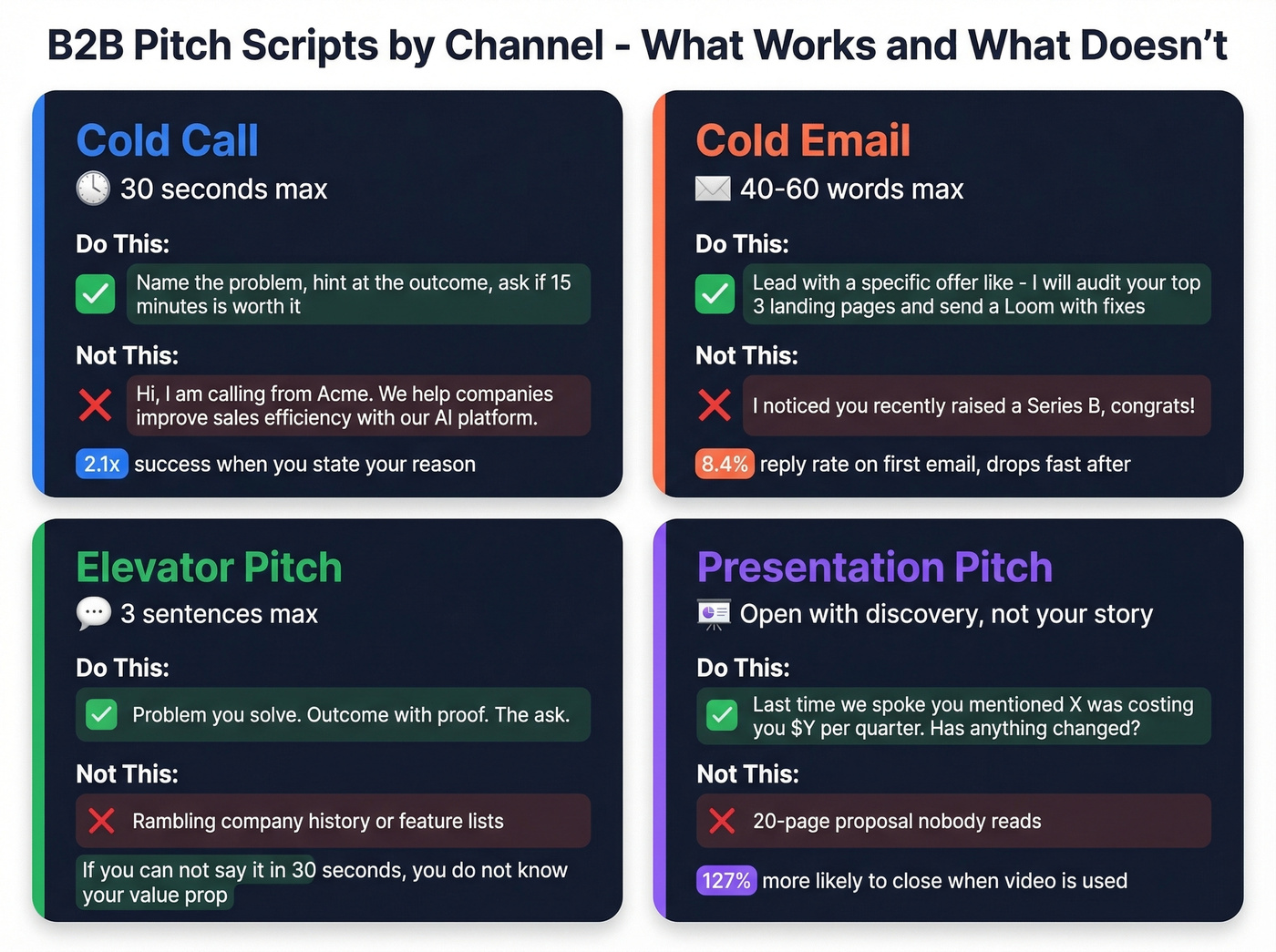
Bad: "Hi, I'm calling from Acme. We help companies like yours improve sales efficiency with our AI-powered platform."
Good: "Hi Sarah, I'm calling because three companies in your space just cut onboarding time by 40% using [approach]. Worth 15 minutes to see if that applies to you?"
The first is about you. The second is about them. That's the whole game. (If you're getting shut down fast, these cold call rejection fixes help.)
Value-Driven Emails
Aim for 40 to 60 words. If your email is longer, you wrote it for yourself, not for the prospect.
The offer does the heavy lifting. "I'll audit your top 3 landing pages and send a Loom with fixes" beats "I noticed you recently raised a Series B - congrats!" every time. 71% of buyers expect personalized interactions, but personalization means a relevant offer, not flattery. End with a soft CTA: "Worth a conversation?" (For more examples, see emails that get responses.)
Belkins' analysis of 16.5M cold emails found the highest reply rate (8.4%) comes from the first email. Four or more follow-ups triple spam rates. And using "ROI" language in cold emails decreases success by 15%. Drop the buzzwords.
Here's the thing, though: the best cold email in the world bounces if the address is dead. We've seen teams burn entire domains because they skipped verification. Prospeo's email finder runs 143M+ verified emails at 98% accuracy and includes 125M+ verified mobile numbers, so your outreach doesn't rely on a single channel. If you're diagnosing deliverability, start with email bounce rate benchmarks and fixes.
Elevator Pitch (30 Seconds)
Three sentences, max. The problem you solve. The outcome you deliver, with proof. The ask. If you can't compress your pitch to 30 seconds, you don't understand your value prop well enough yet. (You can steal a few sample elevator pitches and adapt them.)
Presentation Pitch
Open with what you heard in discovery - not your company story. "Last time we spoke, you mentioned X was costing you $Y per quarter. Has anything changed?" This earns trust and surfaces new objections early.
Quantify ROI before you show the price. Then go quiet. The first person to speak after the number loses leverage. Deals are 127% more likely to close when video is used at any point in the sales process, so consider sending a Loom walkthrough before or after the live meeting. And stop writing 20-page proposals - the consensus on r/sales is blunt: nobody reads them.
Mistakes That Kill Your Pitch
Don't manufacture fake urgency. Bryan Vasquez at LinkBuilder.io replaced urgency-based CTAs with data-backed proposals and tailored value maps. His team's win rate jumped 20% over two quarters.
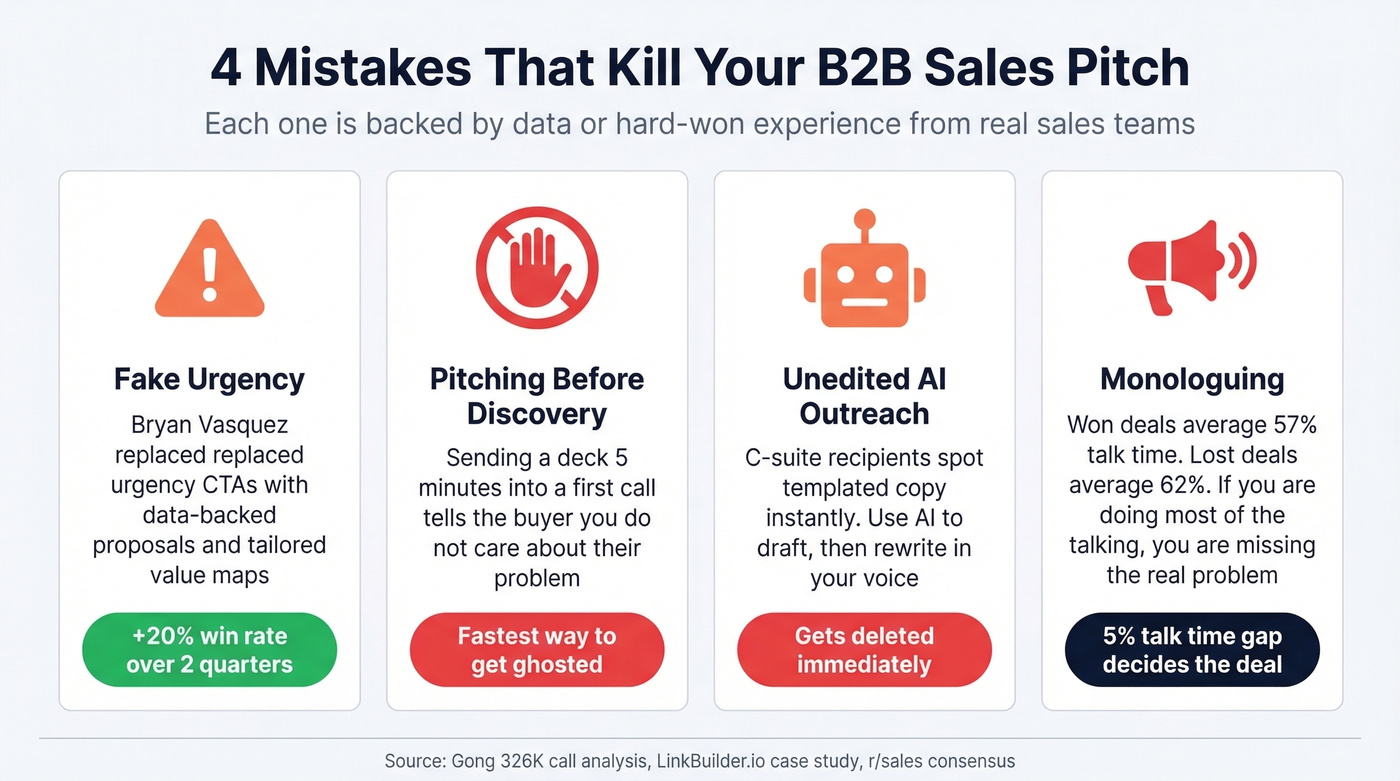
Don't pitch before discovery. Sending a deck five minutes into a first call tells the buyer you don't care about their problem. It's the fastest way to get ghosted.
Don't let AI write your outreach unedited. The sentiment on r/sales is consistent: unedited AI-written outreach sounds generic and gets deleted. Use AI to draft, then rewrite in your voice. C-suite recipients can spot templated copy instantly. If you're using automation, keep it grounded in AI cold email outreach best practices.
Don't monologue. In that 326K-call dataset, closed-won calls average 57% talk time while lost deals average 62%. If you're doing most of the talking, you're missing the real problem.
Follow-Up and Methodology
If you can track proposal views, call the moment they open it the second time. If it was forwarded to a colleague, call that colleague. Email-only outreach averages around 3% response rates; channel stacking - email plus call plus social - can lift response rates to 15%+. If you need copy you can deploy fast, use these sales follow-up templates.
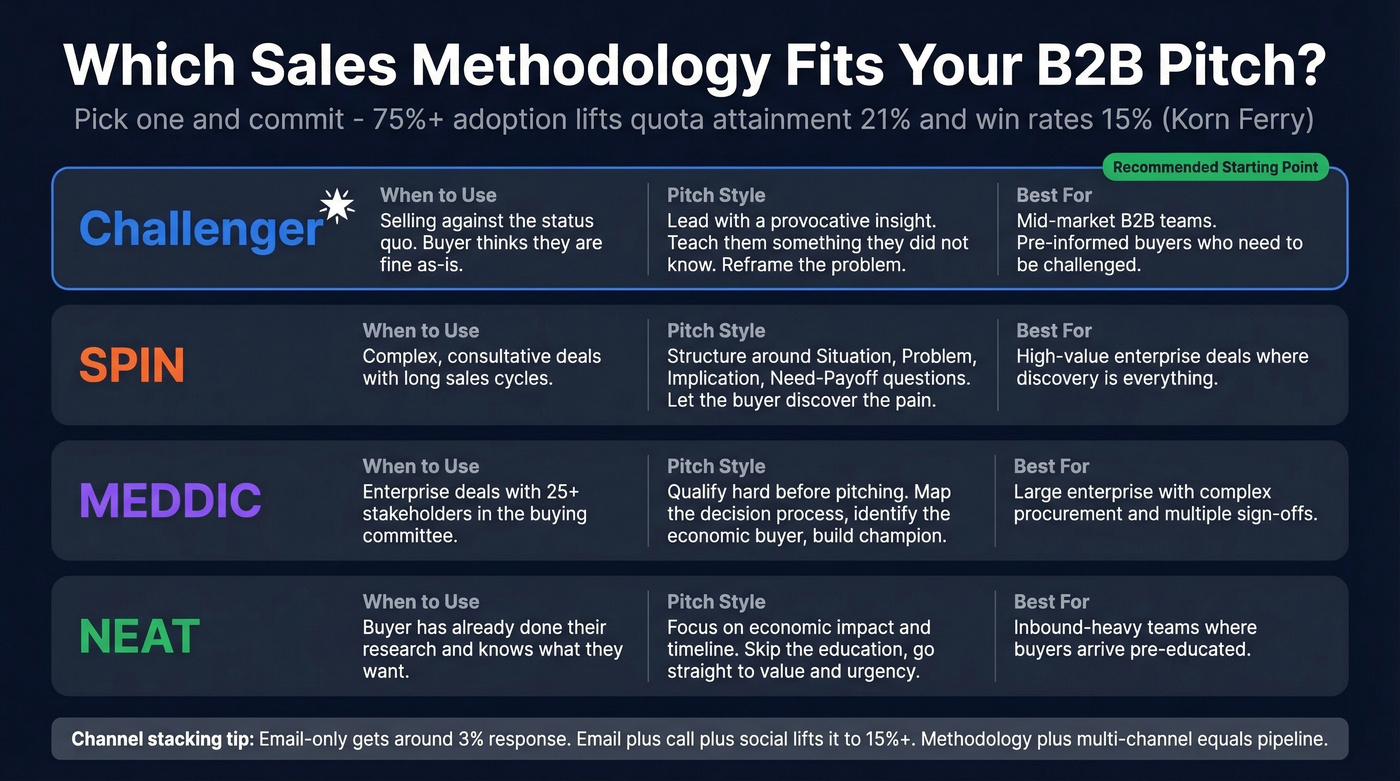
| Methodology | When to Use | Pitch Implication |
|---|---|---|
| Challenger | Selling against status quo | Lead with insight, not questions |
| SPIN | Complex, consultative deals | Structure around implications |
| MEDDIC | Enterprise, 25+ stakeholders | Qualify hard before pitching |
| NEAT | Buyer already researched | Focus on economic impact |
For most mid-market B2B teams, start with Challenger. It's the methodology best suited to a world where buyers show up pre-informed and need to be taught something new, not walked through a discovery script they've already rehearsed in their heads. Korn Ferry research shows that when teams reach 75%+ adoption of any methodology, quota attainment rises 21% and win rates climb 15%. Pick one and commit. (If you're selling into bigger committees, pair this with MEDDIC sales qualification.)
Channel stacking lifts response rates from 3% to 15%+, but only if you have both email and phone. Prospeo gives you both - verified emails at $0.01 each and 125M+ direct dials with a 30% pickup rate - so your follow-up sequence actually works.
Stack every channel without burning a single domain.
The Real Problem
Let's be honest: most teams don't have a pitch problem. They have a listening problem.
In our experience across thousands of outbound campaigns, the reps who book the most meetings aren't the ones with the best scripts. They're the ones who talk less, verify their data before hitting send, and treat every touchpoint like it's the only one they'll get. One team we worked with - a five-person SDR squad at a mid-market SaaS company - doubled their booked meetings in a single quarter just by cutting their cold call talk time from 70% to 55% and switching to verified contact data so they stopped wasting dials on dead numbers.
You don't need 10 templates. You need one framework, the discipline to listen more than you talk, and data clean enough to reach the right person. A great B2B sales pitch means nothing if it lands in the wrong inbox - or a dead one. If you want to widen the top of funnel, start with these sales prospecting techniques and tighten your targeting with an ideal customer profile.