

Sales Pitch Dos and Don'ts: Data-Backed Rules for Every Channel
You ran a demo last Tuesday, nailed every talking point, felt the prospect leaning in - then got ghosted. Generic "be confident!" and "tell a story!" advice doesn't fix that because it ignores the channel you're pitching on and the numbers behind what actually works.
Three rules that'll move the needle this week:
- State the reason for your outreach in the first 10 seconds. This increases cold-call success rates by 2.1x.
- Keep discovery calls at 57% talk or less. That's the closed-won benchmark.
- Verify your list before sending. A bounce rate above 2% means your pitch literally doesn't arrive.
Buyers Already Know More Than You Think
Your pitch doesn't compete with other vendors anymore. It competes with the research buyers already did. 6sense research shows 83% of buyers fully define their requirements before speaking with sales, and first contact now happens at 61% of the buying journey. Two-thirds prefer to engage a rep only after doing their own homework.
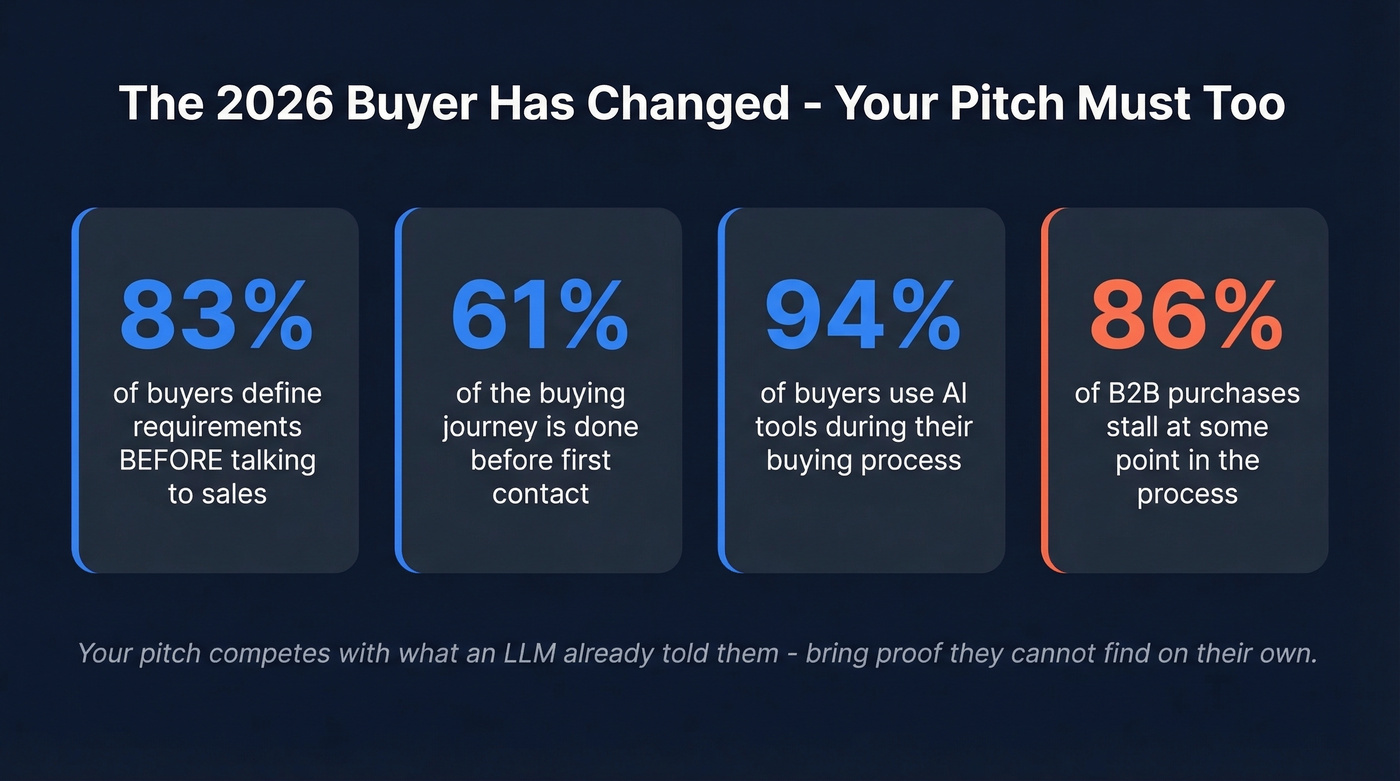
Here's the 2026 twist: 94% of buyers now use AI tools during their buying process, and 80% trust those answers at least sometimes. Your pitch is competing with what an LLM already told them.
Even when buyers do engage, 86% of B2B purchases stall at some point. Your pitch isn't just about persuasion - it's about giving buyers proof they can't find on their own.
The Master Do/Don't Checklist
Pin this somewhere.
| ✅ Do | ❌ Don't |
|---|---|
| State your reason in the first 10 seconds | Open with "Did I catch you at a bad time?" |
| Keep talk time at 57% or below | Monologue past 65% talk time |
| Ask 15-16 focused questions | Interrogate with 20+ questions |
| Personalize every email | Blast large untargeted lists |
| Compress your deck to one takeaway | Feature-dump across 30 slides |
| Classify objections before responding | Improvise rebuttals on the fly |
| Verify your contact list (bounces <2%) | Send to unverified addresses |
| Set a clear next step on every call | End with "let me know what you think" |
| Say "investment" not "price" | Use low-impact words that trigger skepticism |
Cold Call Dos and Don'ts
Do this: Open with "How have you been?" - Gong's data shows it produces a 6.6x higher success rate. Then state why you're calling within 10 seconds. That one move alone increases your booking rate by 2.1x.
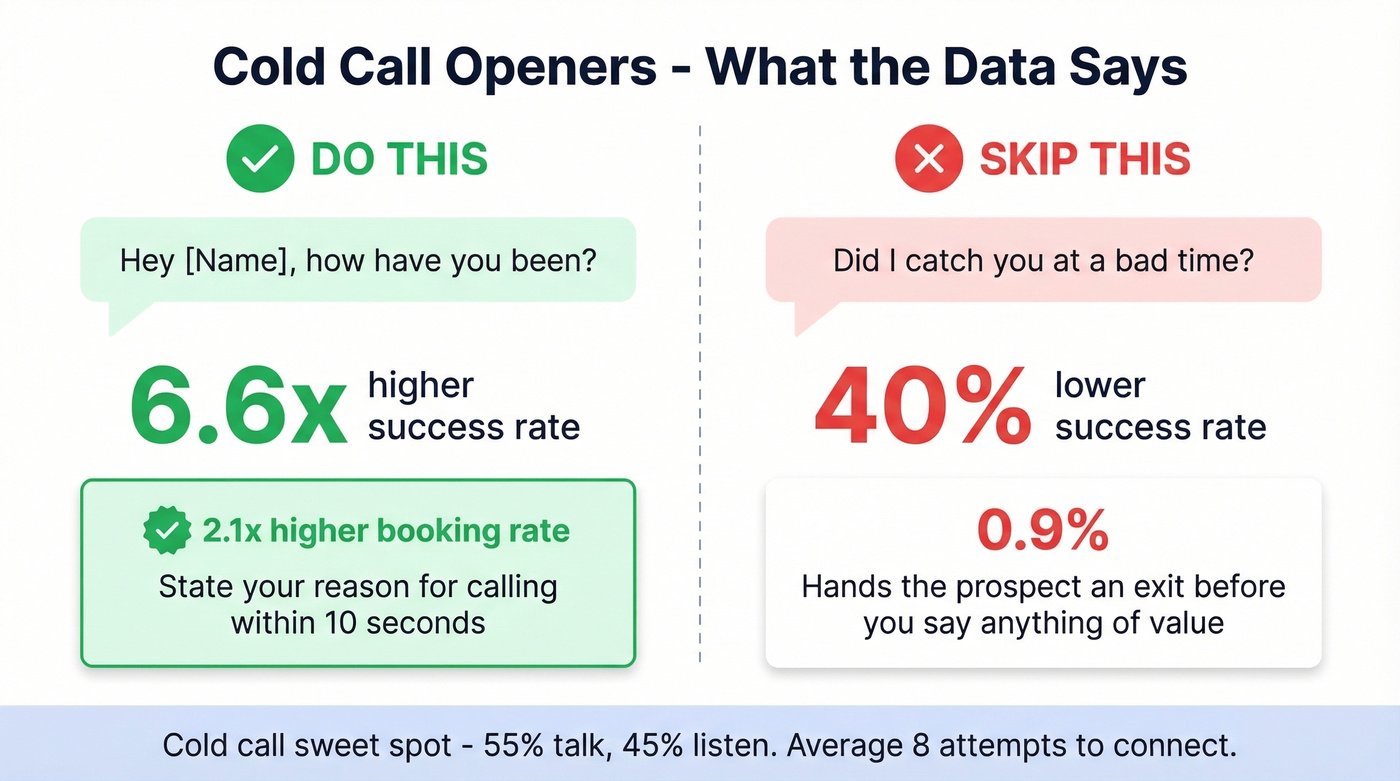
Skip this: "Did I catch you at a bad time?" tanks your success rate by 40%, landing at a dismal 0.9% booking rate. It hands the prospect an exit before you've said anything of value, framing the call as an interruption rather than an opportunity - one of the most common cold call mistakes reps make.
Successful cold calls actually have higher talk time than unsuccessful ones: 55% talk, 45% listen. That's the opposite of discovery calls. On a cold call, you're earning 30 more seconds, then a meeting - not running a needs analysis.
Copy/paste opener:
"Hey [Name], it's [Your Name] at [Company]. How've you been? - Listen, the reason I'm calling: we help [role/company type] solve [specific problem], and I had a quick idea for [their company]. Worth 30 seconds?"
It takes an average of 8 attempts to connect on a cold call. Persistence isn't optional.
Discovery and Demo Dos and Don'ts
Top-performing reps only "pitch" their product 7% of the time. The rest is conversation. Let that reshape how you think about every demo.
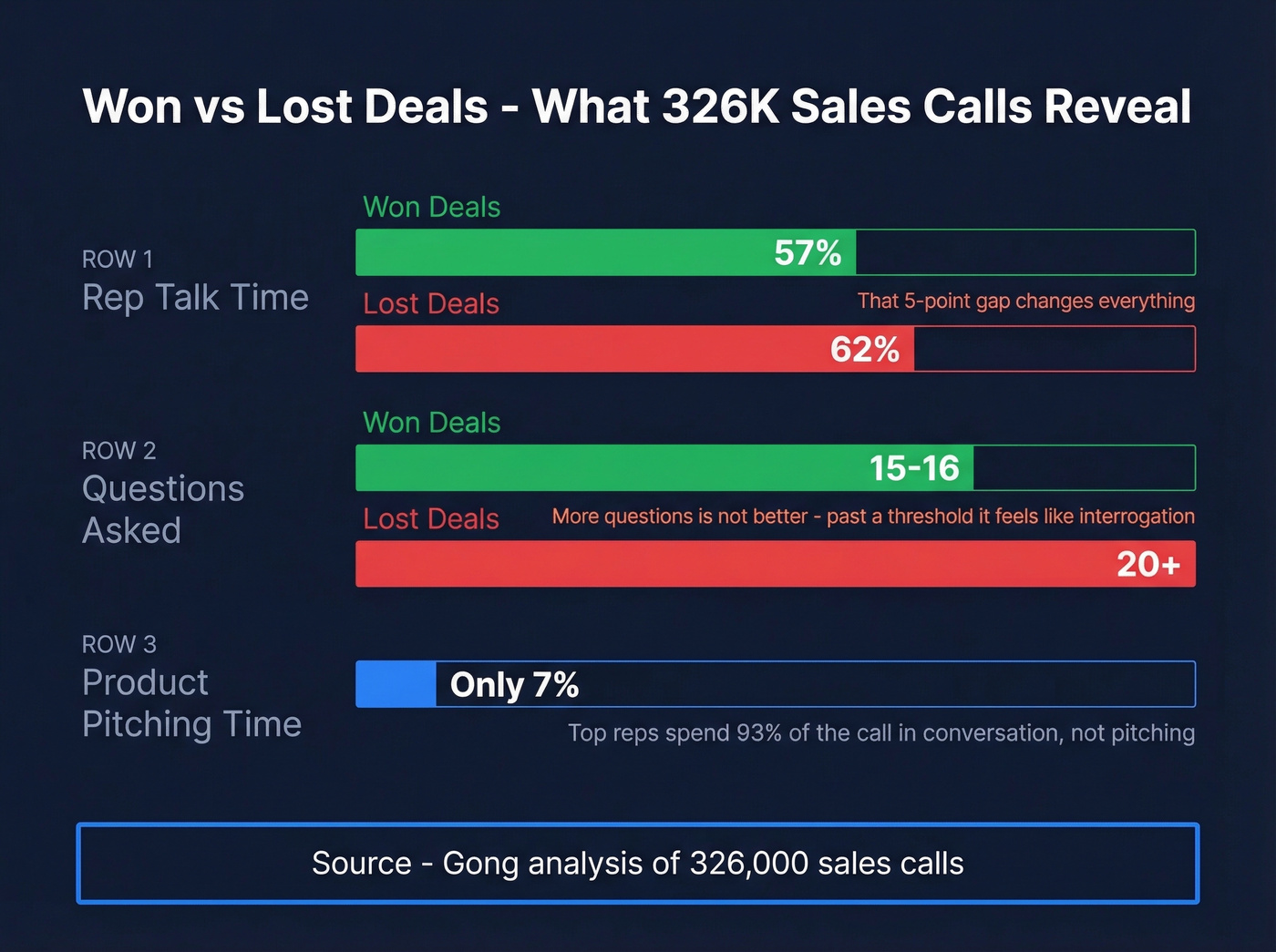
An analysis of 326K sales calls tells a clear story: closed-won deals average 57% rep talk time, while lost deals average 62%. That 5-point gap sounds small, but it represents a fundamentally different conversation dynamic - one where the buyer feels heard versus one where they feel lectured. The real killer isn't talk time alone, though. Long uninterrupted monologues correlate with losses even when overall ratios look fine.
Won deals average 15-16 questions; lost deals average around 20. More questions isn't better - past a threshold, it starts feeling like an interrogation. And 79% of decision-makers say they're least likely to engage reps who lack company knowledge. Do your homework before the call, not during it.
If you want a tighter structure for the conversation, start with a discovery call script and a bank of discovery questions.
Hot take: Stop manufacturing scarcity. Bryan Vasquez, Head of Sales at LinkBuilder.io, documented a 20% win-rate increase over two quarters after replacing urgency-based closing with data-backed proposals. Buyers can smell fake deadlines.
Quick call scorecard - grade yourself after every demo:
| Metric | Target |
|---|---|
| Talk time | ≤57% |
| Questions asked | 15-16 |
| Longest monologue | Under 2 min |
| Next step set? | Yes/No |
Turn Your Camera On
Deals are 127% more likely to close when video is used in meetings, and win rates jump 94% when the seller's camera is on. Most reps still default to audio-only. Turn your camera on. It's the easiest win-rate improvement you'll make this quarter.
If you're running remote calls all day, these remote sales meeting tips help you keep control without talking more.

You just read that bounce rates above 2% kill your domain reputation. Prospeo's 5-step email verification delivers 98% accuracy - so every pitch you craft actually reaches the inbox. At $0.01 per email, bad data is no longer an excuse.
Stop perfecting pitches that bounce. Start reaching real buyers.
Words and Phrases to Avoid
ROI language in cold outreach decreases success rates by 15%. Phrases like "10x your pipeline" or "300% ROI" trigger skepticism, not curiosity. Cut them.
Emails sent to big generic lists get 67% fewer replies than smaller, targeted sends. Segmented campaigns drive 14.31% higher open rates. Personalized emails see 32.7% higher response rates, and 59% of buyers say they're actively irritated by generic pitches.
Compare these two approaches:
❌ "Hi, we help companies like yours increase revenue with our AI-powered platform. Would you like to see a demo?"
✅ "Hi [Name], I noticed [Company] just opened a new SDR team in Austin - congrats. We helped [similar company] cut their ramp time from 10 weeks to 4 by giving reps verified direct dials on day one. Worth a quick look?"
Say "investment" not "price." Say "agreement" not "contract." Say "opportunity" not "problem." These micro-changes shift the frame from adversarial to collaborative, and they cost you nothing.
Your email can't convert if it bounces. Verify addresses before loading them into any cadence - a bounce rate above 2% doesn't just waste sends, it damages your domain reputation for every future campaign. If you need the benchmarks and fixes, start with email bounce rate and the full email deliverability guide.
Pitch Deck Dos and Don'ts
Buyers remember roughly 10% of your presentation after 48 hours. Your entire deck needs to drive one takeaway - and you need to repeat it. If you're cramming 12 value props into 25 slides, none of them stick.
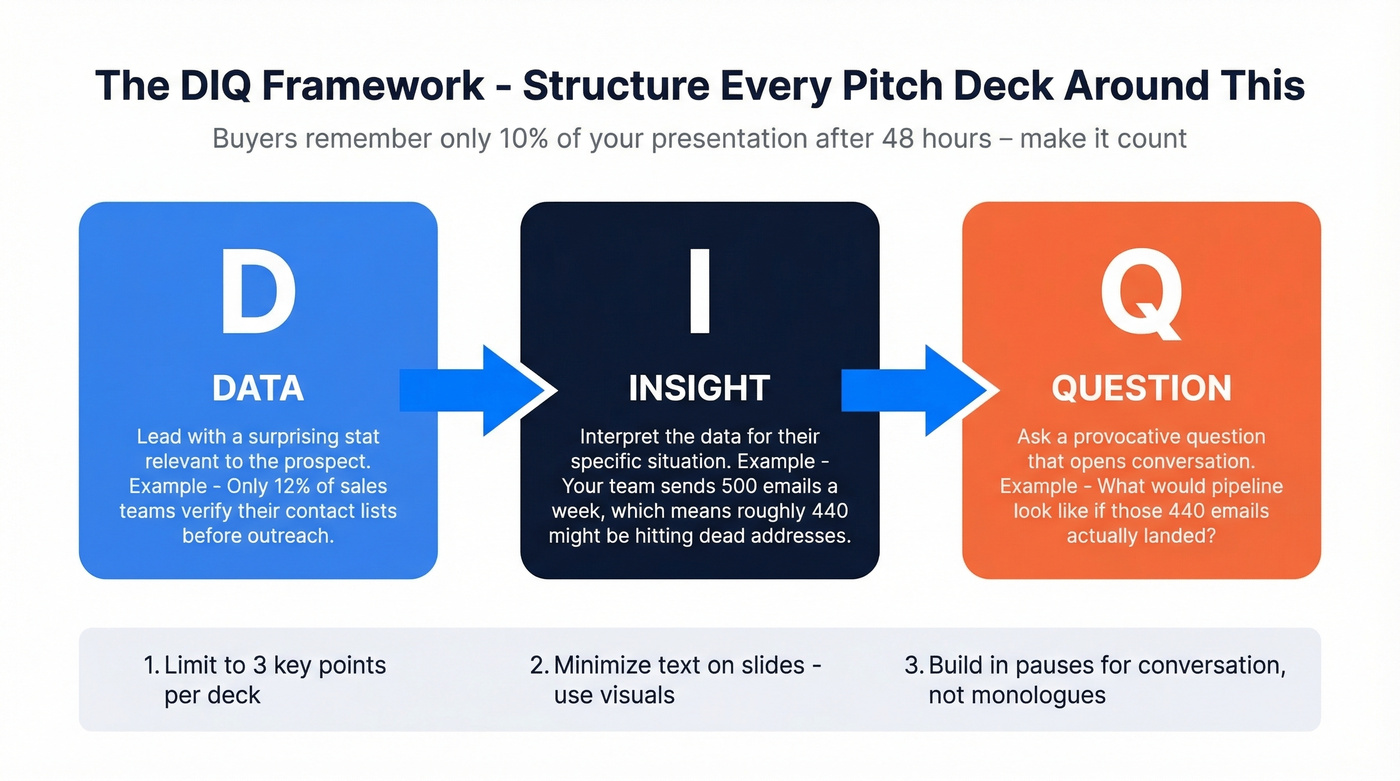
Use the DIQ framework from Corporate Visions: lead with a Data point - a surprising stat relevant to the prospect - interpret it as an Insight for their specific situation, then ask a provocative Question that opens the conversation. We've seen this structure work especially well in competitive deals where the buyer already has a shortlist and needs a reason to rethink it.
For more structure, borrow a few patterns from sales deck storytelling and these software demo tips.
For storytelling structure, use the "man in a hole" arc: comfort zone, trigger event, crisis, recovery, better place. A thread on r/startups analyzing 100+ problem slides distilled patterns like "It's been done for X, we're doing it for Y" and "A day in the life of our customer." These work in sales decks, not just fundraising. Three rules: limit to 3 key points, minimize slide text, and build in pauses for conversation.
Objection Handling Dos and Don'ts
Stop crafting clever rebuttals. The better move is to classify the objection first, then run one consistent process. Outreach identifies 9 categories: price, timing, authority, need, competitor, product, trust, indifference, and risk. Treating a trust objection like a price objection is how you lose deals you should've won.
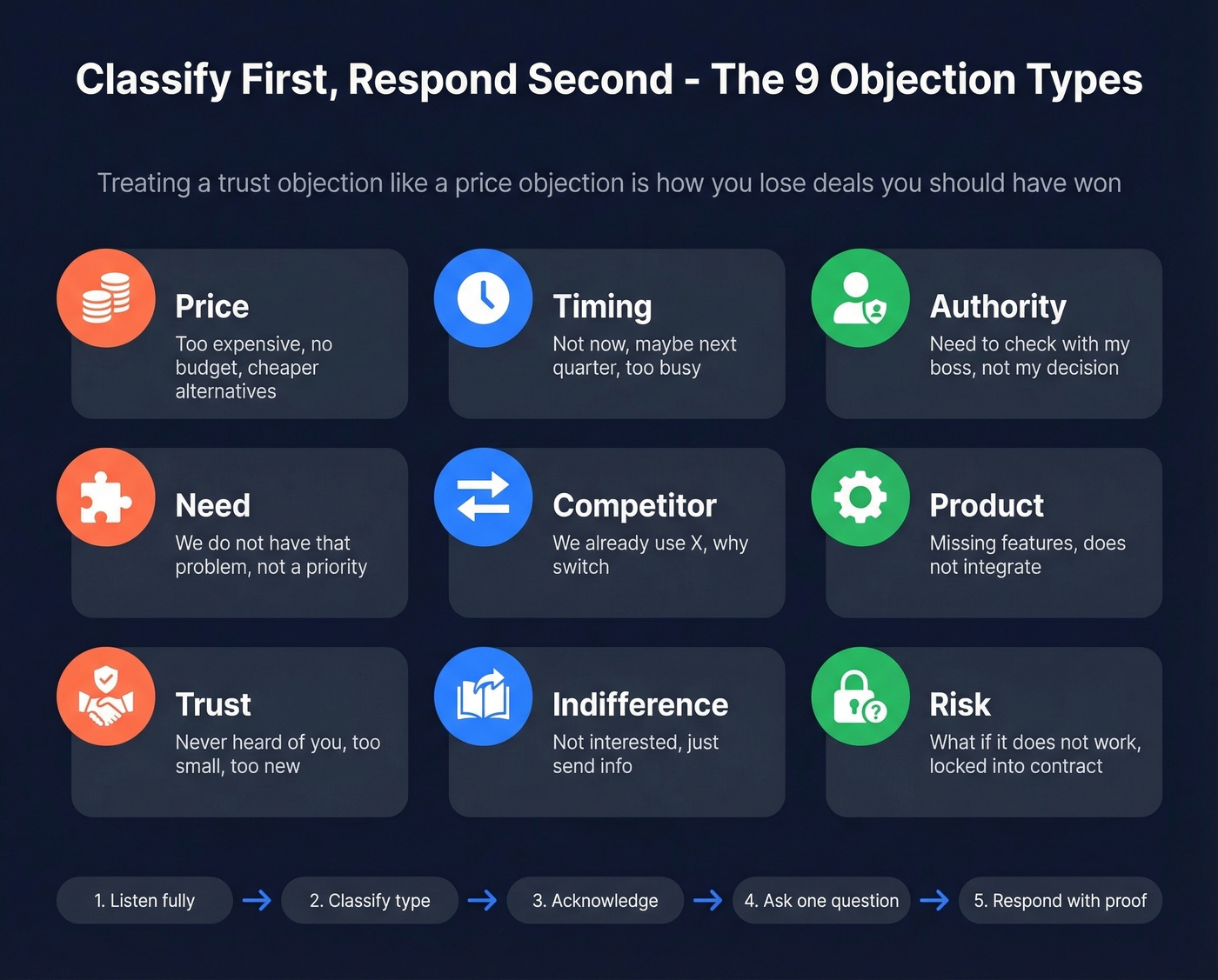
| Step | Action |
|---|---|
| 1 | Listen fully - don't interrupt |
| 2 | Classify the objection type |
| 3 | Acknowledge the concern |
| 4 | Ask one clarifying question |
| 5 | Respond with relevant proof |
As Jamie Yates at Outreach puts it: "Spend less time trying to 'overcome' objections and more time trying to understand them." That's the whole game. If you want a repeatable system, use this playbook on how to reduce sales objection rate.
List Quality: The Pitch Killer Nobody Talks About
Look, we've watched teams spend weeks refining their messaging only to send it to a list full of dead addresses. Bad data destroys response rates faster than bad slides ever will. People polish the words while ignoring who actually receives them.
The thresholds are strict: keep your bounce rate under 2% and spam complaints under 0.01%, or deliverability starts to suffer. Cold email response rates range from 1-5% for generic sends but climb to 15-25% for well-targeted, verified lists. The gap between those numbers is almost entirely a data quality problem - and 80% of consumers expect personalized experiences, which you can't deliver without clean data.
Prospeo runs 5-step verification with catch-all handling, spam-trap removal, and honeypot filtering, delivering 98% email accuracy on a 7-day refresh cycle. The free tier gives you 75 verified emails per month - enough to test before committing a dollar. If you're building lists at scale, compare options in data enrichment services and best sales prospecting databases.

Personalized emails get 32.7% more replies, but personalization requires real data. Prospeo gives you 50+ data points per contact - job changes, tech stack, headcount growth - so every opener feels like the ✅ example, not the ❌.
Turn every cold pitch into a warm conversation with data buyers can't ignore.
FAQ
How long should a sales pitch be?
Cold call pitch: under 30 seconds. Cold emails: under 150 words. Decks: one core takeaway repeated throughout. Buyers remember about 10% of a presentation within 48 hours, so brevity and repetition beat volume every time.
What's the biggest sales pitch mistake?
Talking too much. Reps who exceed 65% talk time correlate with lower win rates across 326K analyzed calls. Filler phrases, hedge language, and unnecessary qualifiers compound the problem - cut them ruthlessly.
How do I handle objections mid-pitch?
Classify the objection first - price, timing, authority, need, or risk. Then listen fully, acknowledge the concern, ask one clarifying question, and respond with specific proof. Don't improvise a rebuttal before understanding the category.
How do I make sure my outreach actually reaches prospects?
Keep your bounce rate under 2% by verifying every address before sending. Prospeo's 5-step verification catches dead emails, spam traps, and honeypots at 98% accuracy with a 7-day refresh cycle. The free tier covers 75 emails per month for testing.
Should I use urgency or scarcity in my pitch?
Fake urgency backfires. One sales leader documented a 20% win-rate increase after replacing urgency-based CTAs with data-backed proposals. Use real deadlines like budget cycles and contract renewals - never manufactured ones.