

Sales Plateau: How to Diagnose and Break Through in 2026
It's week 10 of a flat pipeline. The number won't move. 84% of reps missed quota last year, and 67% don't expect to hit it this year. That's not a blip - that's structural. Without intervention, a sales plateau drags on for months, sometimes years, while leadership keeps waiting for the quarter that "turns things around."
Quick version: Most plateaus have internal, fixable causes. Check three numbers first: lead velocity rate, opportunity-to-close ratio, and average cycle length. If those are healthy, the problem is messaging or culture. If they're not, the fix is almost always pipeline quality - cleaner data, tighter targeting, multichannel sequences.
What a Sales Plateau Actually Is
A plateau isn't a slump. A slump means numbers are dropping. A plateau means you're maintaining but not growing - revenue flat, pipeline flat, effort going nowhere. It isn't a crisis, and that's exactly what makes it dangerous. Urgency stays low while the problem compounds quietly underneath stable-looking dashboards.
It's also not seasonality. Seasonal dips are predictable and cyclical; plateaus persist across quarters without an obvious external trigger. Meanwhile, sales professionals spend only about a third of their time actually selling. The rest goes to admin, internal meetings, and CRM hygiene. That time compression makes stagnation harder to break because reps simply don't have bandwidth to experiment with new approaches.
Why Plateaus Hit Harder Now
The B2B buying environment has fundamentally shifted. 80% of B2B sales interactions now happen through digital channels, and 33% of buyers prefer a completely seller-free experience - climbing to 44% among millennial buyers. Your reps aren't just competing against other vendors. They're competing against the buyer's preference to not talk to anyone at all.
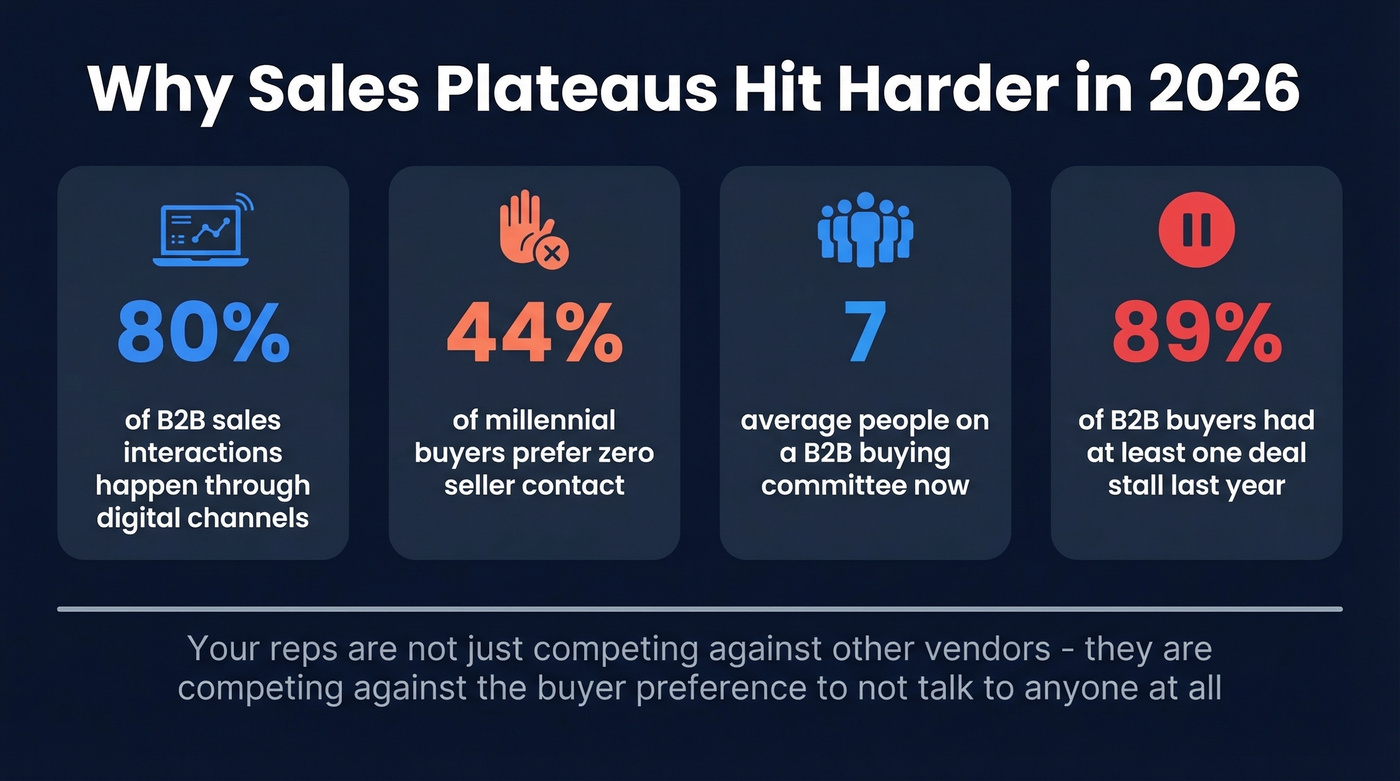
Buying committees have ballooned to roughly 7 people for mid-sized firms, 89% of B2B buyers report at least one deal stalling in the past year, and 75% are taking longer to decide now than they were in 2023. When cycles stretch, pipeline coverage ratios that looked healthy six months ago suddenly aren't. SMB teams can often get by with ~3x pipeline-to-quota coverage, while mid-market and enterprise teams typically need ~4-5x.
The 5-KPI Diagnostic Scorecard
Before you fix anything, you need to know where the problem lives. Most plateau advice tells you to "review your metrics." This scorecard gives you the exact thresholds that separate a temporary dip from a structural issue.
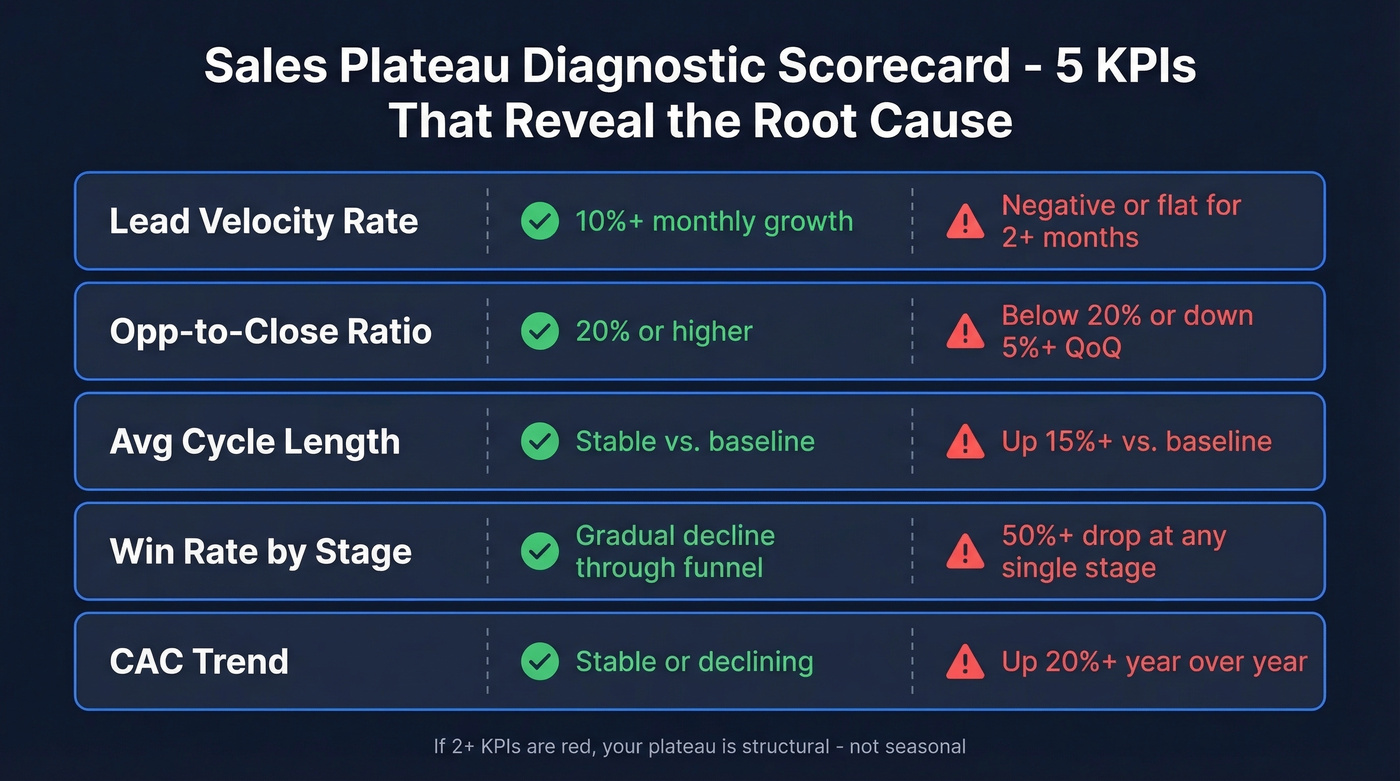
| KPI | Healthy Range | Red Flag |
|---|---|---|
| Lead Velocity Rate | ≥10% monthly growth | Negative or flat 2+ months |
| Opp-to-Close Ratio | ≥20% | Below 20% or down >5% QoQ |
| Avg Cycle Length | Stable vs. baseline | Up >15% vs. baseline |
| Win Rate by Stage | Gradual decline | >50% drop at any stage |
| CAC Trend | Stable or declining | Up >20% YoY |
Lead Velocity Rate is the earliest warning signal - and in our experience, the single most undertracked metric on sales dashboards. If your qualified pipeline isn't growing month over month, revenue will flatten 60-90 days later. Two consecutive months of stagnant LVR means the plateau is already baked in.
Opportunity-to-close ratio tells you whether pipeline quality is degrading. Benchmarks commonly cited put the average B2B close rate around 29% and average win rate around 21%. If you're significantly below those baselines, pipeline quality is the first place to look. A ratio that's dropped more than 5 points quarter over quarter usually means reps are stuffing the funnel with unqualified opportunities to hit activity metrics - a symptom that looks productive but actively masks the real problem.
Cycle length is the silent killer. Opportunities closed within 50 days carry a 47% win rate. Past that threshold, win rates drop to roughly 20%. If your average cycle has crept up 15% or more from baseline, deals are stalling in committee and your forecast is lying to you.
Win rate by stage pinpoints exactly where the funnel breaks. Losing more than half your opportunities at a single stage isn't a volume problem - it's a conversion problem that needs a targeted fix.
CAC trend catches the efficiency decay that flat revenue creates. When customer acquisition cost climbs 20%+ year over year without corresponding growth, you're spending more to stand still.

Data quality erosion is the #1 hidden cause of sales plateaus. When bounce rates creep above 5%, your pipeline silently decays. Prospeo's 5-step verification delivers 98% email accuracy with a 7-day refresh cycle - so your reps stop wasting sequences on dead contacts and start filling the funnel with leads that convert.
Stop diagnosing the plateau. Fix the data underneath it.
Six Root Causes
Once you've identified which KPIs are red, trace them back to one of these six causes.
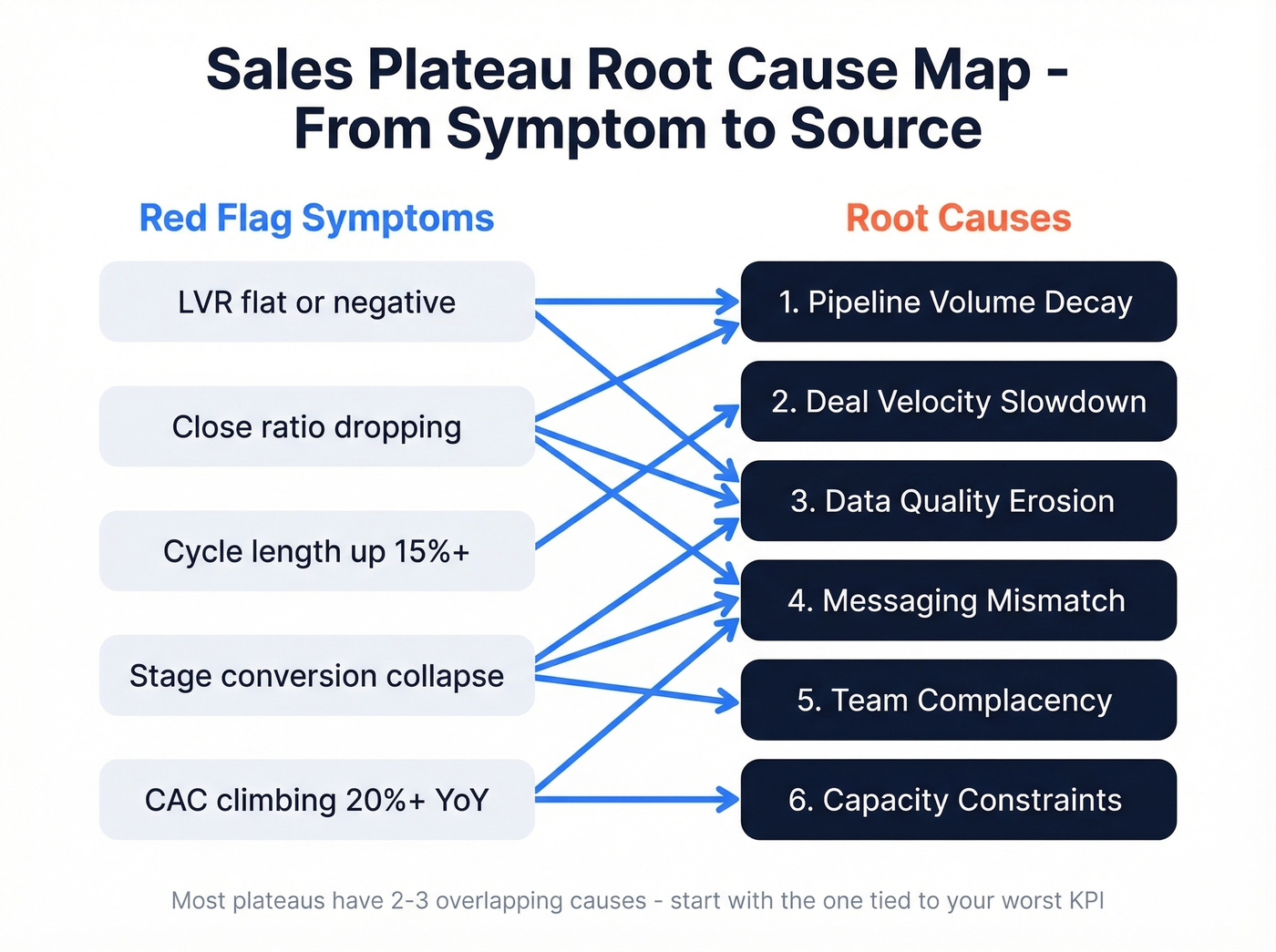
Pipeline Volume Decay
When LVR is negative or flat, fewer qualified leads are entering the pipeline even though top-of-funnel activity hasn't changed. Compare inbound lead volume and outbound response rates over the last 90 days against the prior quarter. If both are down, your channels are fatiguing. If outbound is down but inbound is stable, your targeting or messaging has drifted.
Deal Velocity Slowdown
Cycle length creeps up. Deals that used to close in 35 days now take 50+. Forecast accuracy declines because "committed" deals keep slipping. Pull your last two quarters of closed-won deals and compare median days-to-close. A jump of 15% or more points to a velocity problem - likely driven by larger buying committees or insufficient multi-threading.
Data Quality Erosion
The consensus on r/coldemail is clear: spray-and-pray high-volume outbound stopped working. Teams that didn't adapt are watching their deliverability crater. Bounce rates climb, reply rates drop even though send volume is constant, and domain reputation degrades quietly in the background.
If your email bounce rate is above 5%, your list hygiene is already a problem. This is the root cause we see most often in teams that "can't figure out" why pipeline dried up. If you need a baseline and remediation steps, start with bounce rates.
Messaging Mismatch
In one documented case, a business plateaued for 10 months. A deep buyer behavior analysis found that a specific objection word appeared 20+ times across non-buyer feedback - and the company's own marketing was unintentionally reinforcing it. Four core disconnects between audience needs and messaging were identified. Sometimes the problem isn't reach. It's resonance.
If pipeline volume is fine but conversion rates are dropping at specific stages, start here.
Team Complacency and Rep Stagnation
The Spinning Wheels Model describes this perfectly: assumed continuity, fear-based resistance to change, and dysfunctional feedback loops. Activity metrics are stable but outcomes are flat. Here's the thing - most people don't resist change. They resist being changed without understanding why.
A sales rep performance plateau often looks like consistent activity with declining results: same call volume, same email cadences, fewer meetings booked, fewer deals advancing. A common refrain on r/sales is "great product, nobody responds to calls or emails" - which usually points to a targeting or channel problem, not a product problem. If your team isn't adapting, look at whether sales leadership is creating space for adaptation or just demanding results.
Capacity Constraints
Track how reps actually spend their time for a week. If selling activities account for less than a third of their hours, the stagnation isn't a sales problem - it's an operational one. Pipeline suffers not because of strategy but because of bandwidth. This is where RevOps and process design usually move the needle fastest.
How to Break Through
Each root cause has a corresponding fix. Let's walk through them.
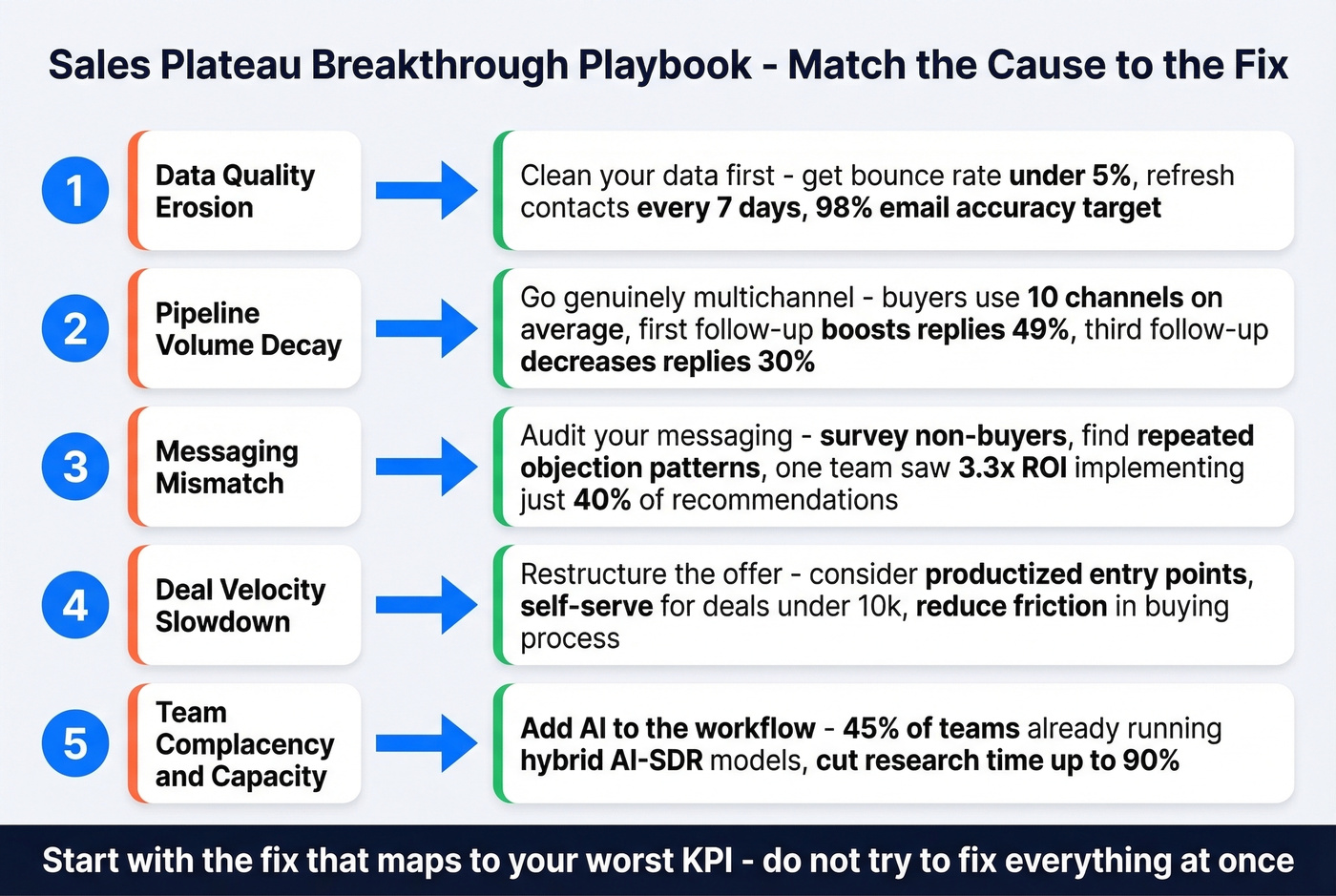
Clean Your Data First
If your bounce rate is above 5%, your plateau starts in your database. Bad data doesn't just waste sends - it degrades your domain reputation, which tanks deliverability across every sequence you run. If you're troubleshooting deliverability end-to-end, use an email deliverability guide and tighten sender reputation controls.
Prospeo's 98% email accuracy and 7-day data refresh cycle prevent the slow data decay that silently kills pipeline. Snyk's 50-person AE team went from 35-40% bounce rates to under 5% after switching, and AE-sourced pipeline jumped 180%.

Go Genuinely Multichannel
Email-only outbound is dying. Buyers use roughly 10 interaction channels on average, up from 5 in 2016. If you're only showing up in one, you're invisible in nine.
Here's a useful benchmark for email specifically: the first follow-up boosts reply rates by 49%. The second adds just 3%. A third follow-up actually decreases reply chance by 30%. More touches help - but only if you stop repeating the same move in the same channel. If you need copy you can deploy fast, pull from these sales follow-up templates.
Audit Your Messaging
Remember the 10-month plateau case study? The business implemented only about 40% of the recommendations from a 25-page buyer behavior analysis and still saw 3.3x ROI on the investment. Pull your lost-deal reasons, survey recent non-buyers, and look for repeated objection patterns. The answer is usually hiding in the language your prospects use - not the language your team uses. For a structured way to pressure-test positioning, use a B2B brand positioning checklist.
Restructure the Offer
One company reported 973% revenue growth in 9 months after pivoting to a productized offer with a $7 first-week entry point. If your conversion rates are healthy but deal volume is capped, the market might be telling you the packaging is wrong.
Real talk: if your average deal size is under $10k, you probably don't need a complex enterprise sales motion at all. A self-serve entry point with expansion revenue will outperform a full-cycle sales team nine times out of ten.
Add AI to the Workflow
45% of revenue teams are already running hybrid AI-SDR models. Early data suggests AI can cut research and personalization time by up to 90%, freeing reps to focus on actual selling - not replacing them, but giving them back the two-thirds of their time currently eaten by admin. If you're building this into your outbound motion, start with AI cold email outreach and a practical SDR tools stack.
Prevent the Next Plateau
Breaking through once isn't enough. You need a system that catches the next one before it sets in.
Monthly: Review the 5-KPI scorecard. Identify friction points. Set 30-day adjustments with clear owners. Don't just track revenue - track the leading indicators that predict revenue 60-90 days out. Run your active prospect list through verification monthly; data decays faster than most teams realize. If you want a broader set of leading indicators, track pipeline health alongside your scorecard.
Quarterly: Revisit market data, reassess ICP definitions, and realign goals based on what the pipeline is actually telling you. One professional services firm caught a 20% lead dip during their monthly review, pivoted channels within 30 days, and saw a 40% increase in leads the following quarter with CPA down 27%. Use an Ideal Customer Profile scoring rubric to keep targeting from drifting.
Your Lead Velocity Rate is flat because your targeting data is stale. Most providers refresh every 6 weeks - by then, prospects have changed roles, companies, or gone dark. Prospeo refreshes 300M+ profiles every 7 days and gives you 30+ filters including buyer intent, job changes, and headcount growth to rebuild pipeline momentum fast.
Reignite pipeline growth with data that's never more than a week old.
FAQ
How long does a sales plateau usually last?
Some companies plateau for an average of 27 months before breaking through. The longer you wait to diagnose root causes using leading KPIs like lead velocity rate and cycle length, the harder reversal becomes.
What's the difference between a plateau and a slump?
A plateau is flat performance - you're maintaining revenue but not growing. A slump is active decline. Plateaus are usually caused by pipeline quality or messaging drift; slumps often signal market shifts or product-market fit erosion.
Can bad data cause flat revenue?
Yes, and it's more common than most teams realize. When bounce rates exceed 5%, emails stop landing, domain reputation degrades, and pipeline quietly dries up. Snyk cut bounce rates from 35-40% to under 5% using Prospeo's 7-day data refresh cycle and 98% email accuracy, growing AE-sourced pipeline 180% in the process.
What's the fastest way to diagnose stalled growth?
Start with the 5-KPI scorecard: lead velocity rate, opp-to-close ratio, average cycle length, win rate by stage, and CAC trend. Two or more red flags across these metrics confirm a structural problem, not a temporary dip. Most teams can run this audit in under a day using existing CRM data.