

Best Sales Process Automation Software for Every Budget in 2026
You sent 500 cold emails last week. 140 bounced. Your domain reputation took a hit, your sequences stalled, and your reps spent the morning cleaning up a mess that better data would have prevented. That's the real cost of automating on top of bad data - you just move faster toward worse outcomes.
Here's the number that should bother every sales leader: 61% of overperforming sales teams use automation, compared to just 46% of underperformers. Yet reps still spend only 28% of their time actually selling, losing roughly 6 hours per week to data entry, follow-ups, list building, and CRM hygiene. The right sales process automation software gives that time back. But the tools you pick - and the order you stack them - matter more than most listicles admit.
We've organized this by the layer of your stack each tool serves: data, sequencing, CRM. That's the order you should build in.
Our Picks (TL;DR)
| Tool | Best For | Starting Price | Free Tier |
|---|---|---|---|
| Prospeo | Verified B2B data | Free (75 emails/mo) | Yes |
| Apollo.io | All-in-one prospecting | Free, paid from $49/user/mo | Yes |
| HubSpot Sales Hub | CRM + automation | Free, paid from $9/seat/mo | Yes |
| Instantly | High-volume cold email | $30/mo | No |
| Outreach | Enterprise engagement | ~$100/user/mo | No |
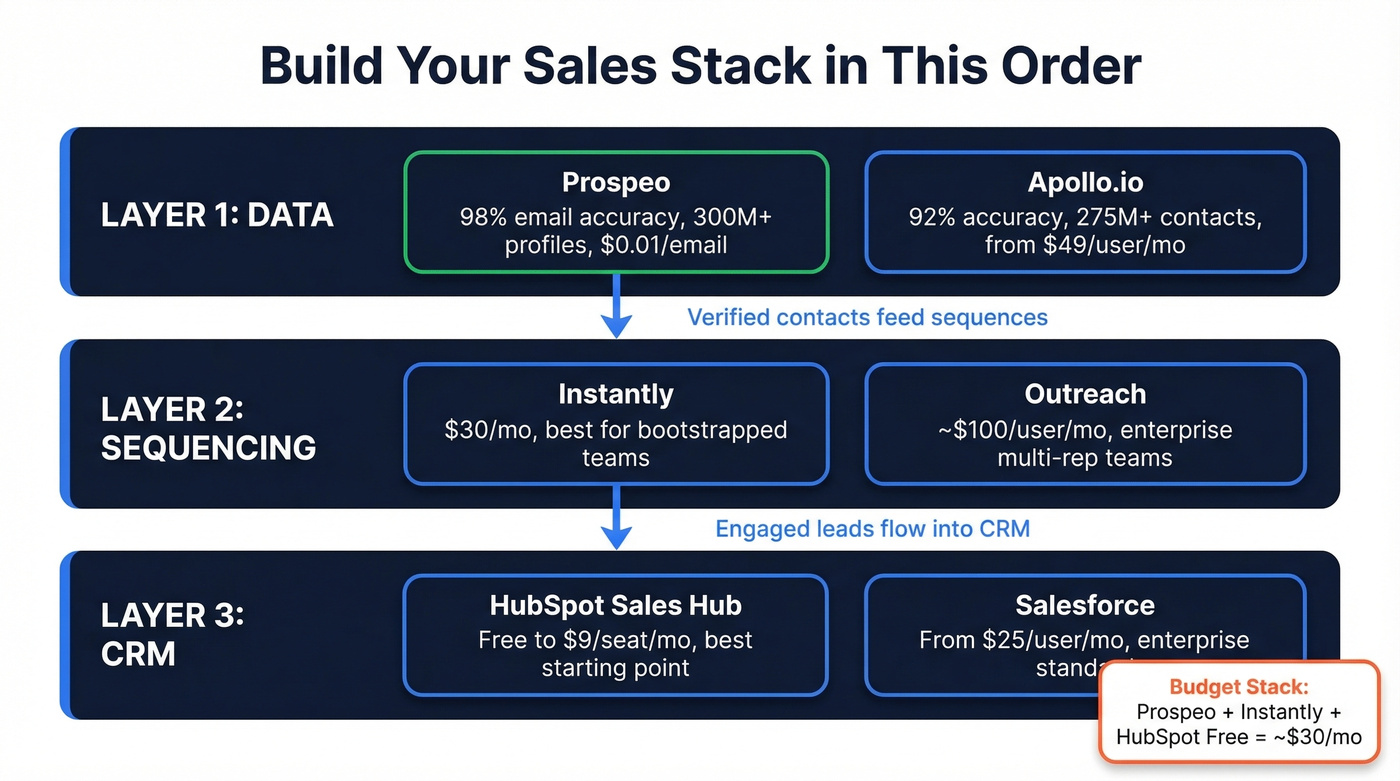
Budget stack for a solo sender: Prospeo (data) + Instantly (sending) + HubSpot free (CRM). That covers prospecting, sequencing, and pipeline management for around $30/month total - roughly $0.01 per verified email.
Best Tools to Automate Your Sales Process
Data first, then sequencing, then CRM. That's the order your workflow actually runs.
Prospeo - Verified B2B Data
Your sequencing tool is only as good as the data feeding it. Automation without verification is just faster spam.
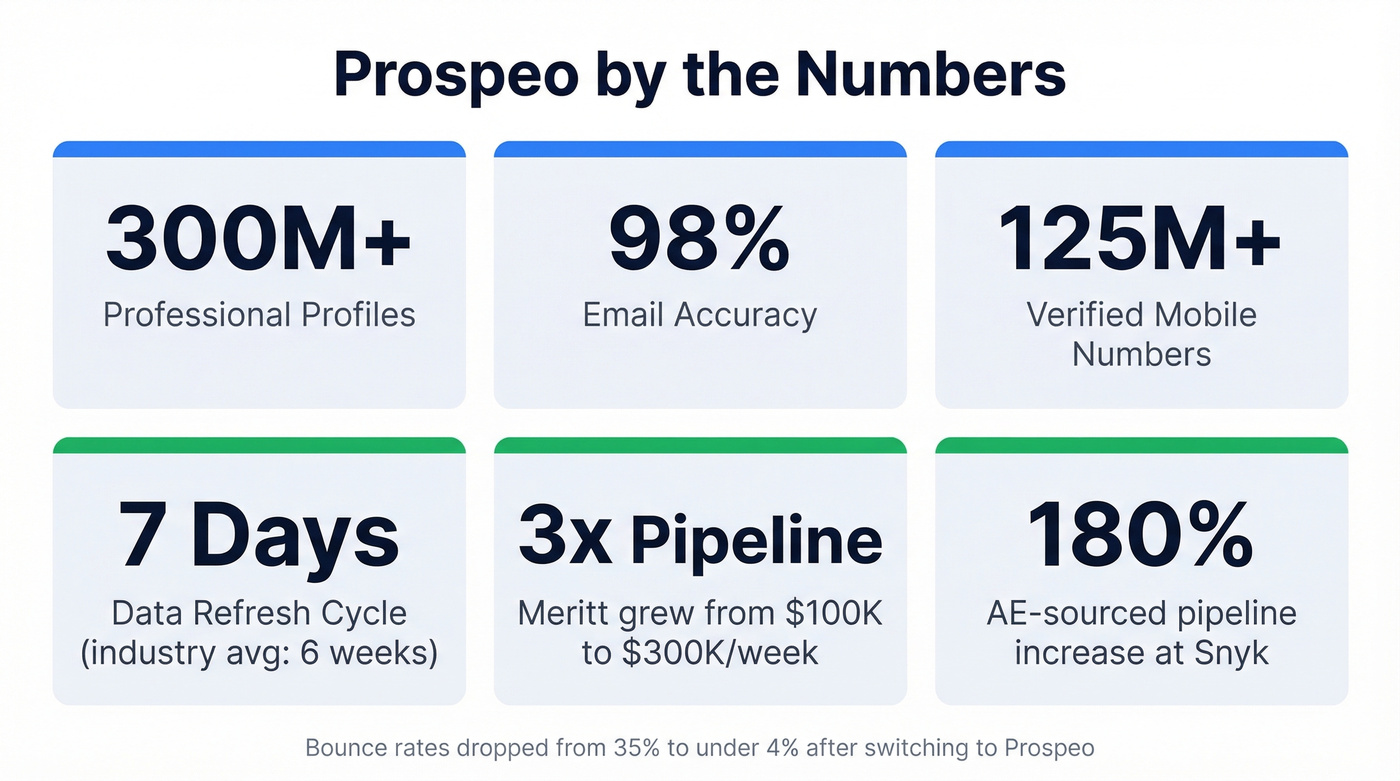
Prospeo's database covers 300M+ professional profiles with 98% email accuracy and 125M+ verified mobile numbers with a 30% pickup rate. Data refreshes every 7 days - the industry average is 6 weeks, which means most providers are serving you stale contacts while Prospeo's already re-verified them. It also tracks 15,000 intent topics via Bombora, so you're not just finding contacts but finding contacts who are actively in-market. The proprietary email-finding infrastructure doesn't rely on third-party providers, which is why the accuracy numbers hold up under real-world conditions rather than just in marketing copy.

The proof point that matters: Meritt tripled pipeline from $100K to $300K per week after switching, with bounce rates dropping from 35% to under 4%. Snyk's 50-person AE team saw AE-sourced pipeline jump 180%.
Pricing: Free tier gives you 75 verified emails/month plus 100 Chrome extension credits/month. Paid plans scale on credits with no contracts and no sales calls required. Native integrations with Salesforce, HubSpot, Instantly, Lemlist, Clay, and Smartlead mean it slots into whatever you're already running.
If you’re comparing providers, start with sales prospecting databases and then validate accuracy with data enrichment services.
Apollo.io - All-in-One for SMBs
Apollo is the obvious starting point if you want prospecting, sequencing, and a dialer in one platform without stitching together multiple tools. Its 275M+ contact database, built-in sequences, and dialer mean a single rep can go from search to booked meeting without leaving the app. Email accuracy runs around 92% - decent, but not best-in-class.
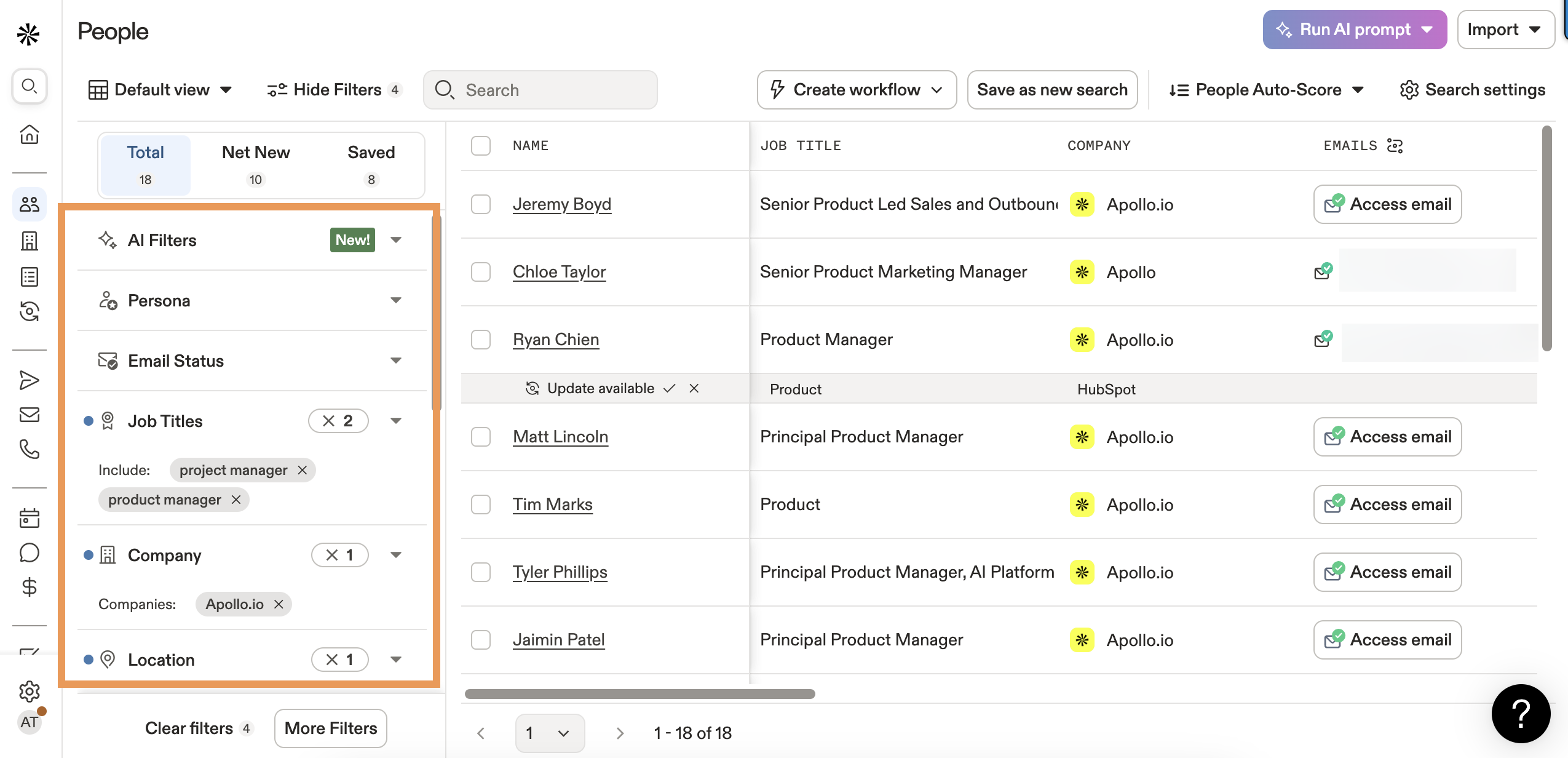
The catch? Reddit threads on r/sales consistently flag Apollo's title filters as "incredibly noisy." You'll get irrelevant roles mixed into your lists, especially in niche verticals, which means more manual cleanup - and that defeats the automation purpose. For broad-market outbound, Apollo is excellent. For a narrow ICP, you'll want a dedicated data layer upstream.
If you’re building outbound from scratch, these sales prospecting techniques help you avoid “spray and pray.”
Pricing: Free tier available. Basic at $49/user/mo, Professional at $79, Organization at $119 (minimum 3 users).
HubSpot Sales Hub - Free CRM Starting Point
If you need a CRM yesterday and don't have budget, HubSpot's free plan includes contact management, deal pipeline tracking, email tracking, and basic reporting. G2 ranks it among the top sales software products for 2026, and paid tiers start at just $9/seat/mo to unlock workflow automation and lead nurturing sequences.
Here's the thing: plan for the upgrade. The free tier's contact limits and lack of workflow automation are the #1 pain point on Reddit - one CRM subreddit OP specifically said they outgrew HubSpot free due to "contact limit and lack of automation." You'll hit that ceiling faster than you expect.
If you’re evaluating CRMs, it helps to compare a few examples of a CRM and the best contact management options for your team size.
Skip this if: You're scaling past 10 reps and need advanced sales forecasting or deal velocity reporting. At that point, you're looking at Salesforce.
Outreach - Enterprise Engagement
Outreach makes sense once you're running a multi-rep SDR team and need AI-powered sequencing, deal intelligence, and a built-in dialer on one platform. Standard pricing sits around ~$100/user/mo, with Professional around ~$130/user/mo.
What Outreach doesn't solve is your data problem. Enrichment isn't included. You're paying separately for a data provider, which is why a 5-person SDR stack can exceed $30K-$50K/year once you add data costs. Typical contracts are annual with a 5-seat minimum. Budget accordingly.
If you’re rolling this out across reps, use a structured implementing a sales engagement platform plan to avoid tool sprawl.
Clay - Data Orchestration for RevOps
Most enrichment workflows pull from one provider, get a 60% match rate, and call it done. Clay's approach is different: it layers 100+ data sources in a waterfall, hitting ~95% email accuracy by trying the next provider when the first one misses. For revenue operations teams obsessed with coverage, it's the best orchestration layer available.
The tradeoff is complexity. Clay isn't plug-and-play - it's a power tool that rewards technical users and punishes everyone else. If your team doesn't have someone comfortable building workflows, you'll spend more time configuring than prospecting.
If you want the real workflow math, see Clay list building.
Pricing: Free (100 credits/mo), Starter at $149/mo, Explorer at $349/mo, Pro at $800/mo.
Instantly - $30/mo Cold Email
At $30/month, Instantly is the cheapest way to get cold email sequences running with strong deliverability features. That price point alone makes it the default for bootstrapped teams and agencies.
But Instantly is a sending tool, not a prospecting tool. You need a data source upstream - feed it verified contacts and it performs. Feed it garbage and you'll burn domains. Hypergrowth runs $77.6/mo, Light Speed $286.3/mo.
To keep deliverability stable, track your email bounce rate and follow a proper email deliverability guide.
Salesforce Sales Cloud - Enterprise CRM
Salesforce dominates enterprise CRM for a reason: deep automation via Flow Builder, a massive app ecosystem, and a 4.7/5 G2 rating. Starting at $25/user/mo (annual), it's not cheap once you add seats and customization - but for teams above 20 reps, it's the standard. Its sales force automation capabilities, from lead assignment rules to approval workflows, are unmatched at scale. Budget a few weeks of implementation; this isn't a self-serve setup.
If you’re budgeting, this breakdown of Salesforce pricing helps avoid surprises.
More Tools Worth Knowing
Salesloft (~$125-$180/user/mo) competes directly with Outreach for enterprise engagement. The dialer is an add-on at $300-$400/user/year, which adds up fast. Strong if you're already in their ecosystem.
Pipedrive (from $14/seat/mo) is visual pipeline management built for small sales teams. Clean UI, easy setup, limited automation depth.
Zoho CRM (from $14/user/mo) delivers surprisingly capable automation workflows at budget-friendly pricing. Best for teams that want Salesforce-like features without Salesforce costs.
Gong (~$100-$150/user/mo) is conversation intelligence, not a CRM or sequencer. It complements your engagement platform by analyzing calls and surfacing deal risks. Worth it once the rest of your stack is running.
Zapier (free-$19.99/mo on annual billing) connects everything else. If two tools in your stack don't integrate natively, Zapier bridges the gap. Most teams end up needing it somewhere.

Your sales automation stack is only as good as its data layer. Prospeo delivers 300M+ profiles with 98% email accuracy, refreshed every 7 days - not the 6-week industry average. Meritt tripled pipeline to $300K/week and dropped bounce rates from 35% to under 4%.
Stop automating your way to a burned domain. Start with verified data.
What This Software Actually Costs
Most teams underestimate this badly. Outreach cites Gartner research noting that fragmented systems can cost companies 20-30% of revenue - so getting the stack right isn't just a tooling decision, it's a revenue decision.
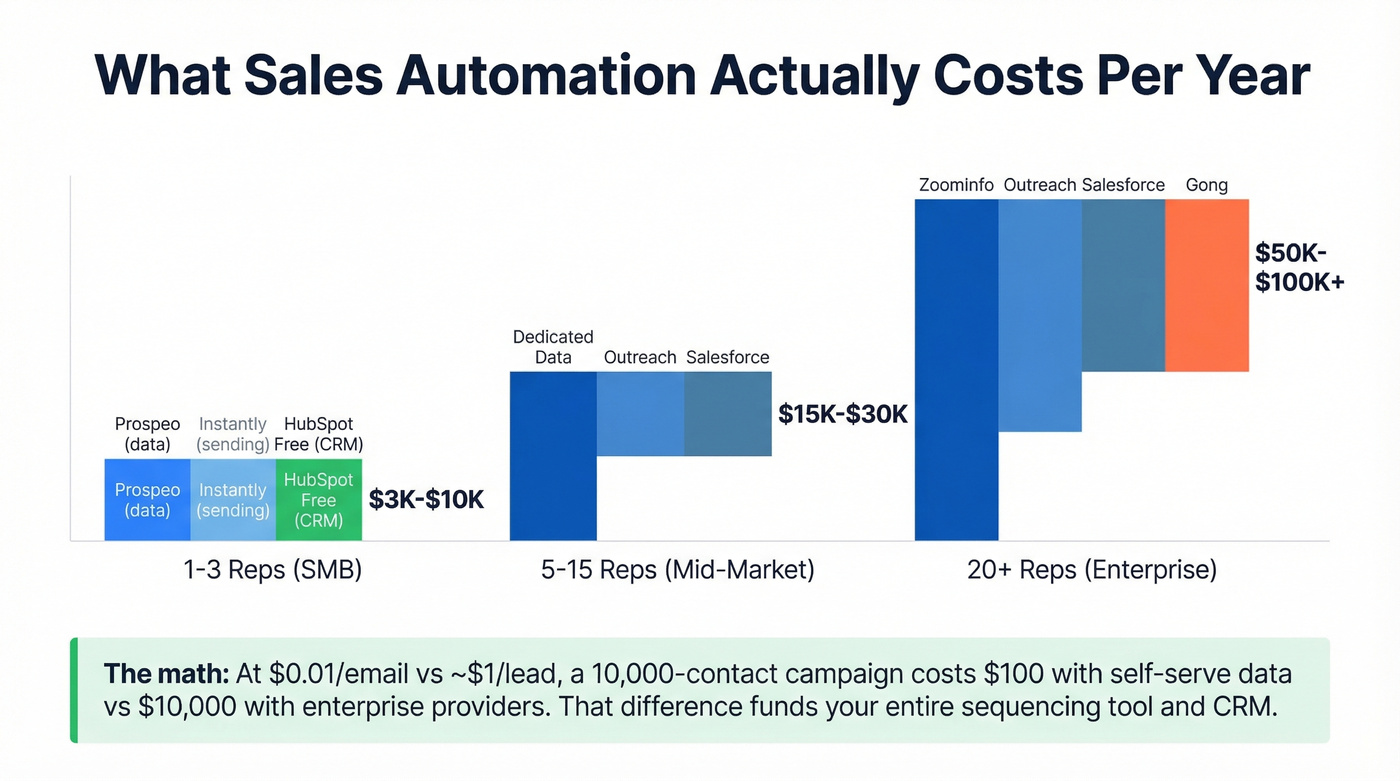
| Team Size | Stack | Annual Cost |
|---|---|---|
| 1-3 reps (SMB) | Prospeo + Instantly + HubSpot free | $3K-$10K/yr |
| 5-15 reps (mid-market) | Dedicated data + Outreach + Salesforce | $15K-$30K/yr |
| 20+ reps (enterprise) | ZoomInfo + Outreach + Salesforce + Gong | $50K-$100K+/yr |
The sales process automation software market was valued at roughly $8.6B in 2023 and is projected to reach $19.5B by 2030. A lot of that growth is coming from mid-market teams realizing they don't need the enterprise stack to compete.
Let's be honest about the math. If your average deal size is under $15K, you almost certainly don't need ZoomInfo-level tooling. At $0.01/email versus ~$1/lead, a 10,000-contact campaign costs $100 with a self-serve data provider versus $10,000 with an enterprise one. That difference funds your entire sequencing tool and CRM combined.
If you’re trying to tighten the process before buying more tools, start with sales process optimization.
A $30/mo sending tool paired with bad data costs you domains, reputation, and pipeline. Prospeo's free tier gives you 75 verified emails/month with native Instantly, HubSpot, and Salesforce integrations - so your automation stack actually works.
Feed your sequences verified contacts at $0.01 per email. No contracts.
Mistakes That Kill Your Automation ROI
We've seen teams buy the full stack and still underperform. These are the patterns that keep showing up:
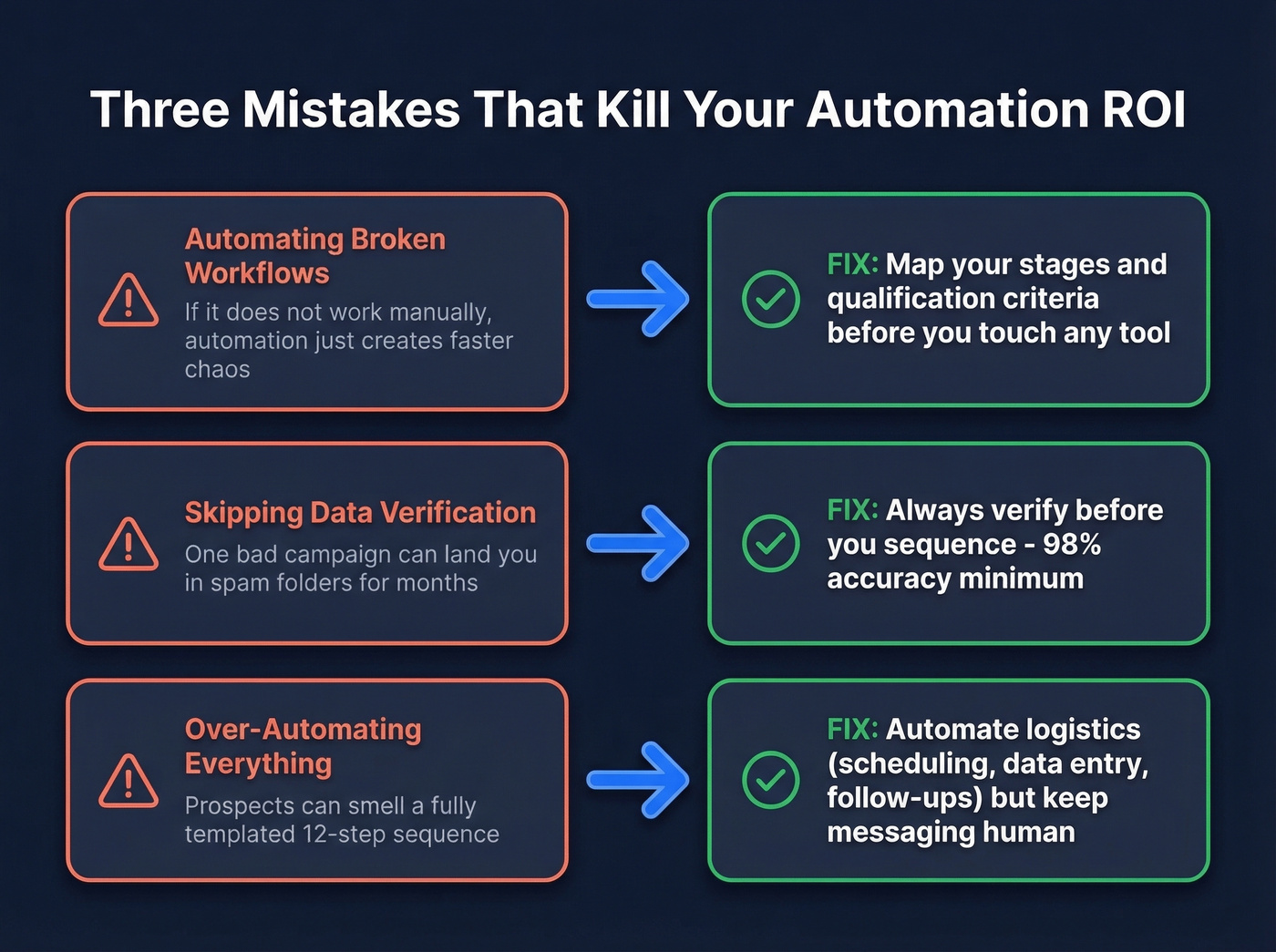
Automating broken workflows. If your sales process doesn't work manually, automating it just creates faster chaos. Map your stages and qualification criteria before you touch a tool.
Skipping data verification. Sending unverified emails tanks your domain reputation. One bad campaign can land you in spam folders for months. Verify before you sequence - always.
Over-automating everything. Prospects can smell a fully templated sequence. Automate the logistics - scheduling, data entry, follow-up triggers - but keep the messaging human where it counts. I've watched a team automate a 12-step sequence with zero personalization tokens and wonder why reply rates cratered. Don't be that team.
Ignoring lead scoring. Without scoring, your reps treat every lead the same. That means equal effort on a VP who visited your pricing page and a coordinator who accidentally clicked an ad.
Forgetting compliance. GDPR and CAN-SPAM aren't optional. Maintain suppression lists, honor unsubscribes immediately, and build compliance into your workflows from day one.
How to Choose the Right Tool
Three questions cut through the noise:
What's your team size? Solo founders and teams under 5 reps should start with an all-in-one like Apollo or a lightweight stack. Teams above 15 need dedicated tools per layer.
What's your monthly budget? Under $200/mo, you're in verified-data-plus-sending-tool-plus-free-CRM territory. Between $500 and $2,000/mo, Apollo paid tiers or Outreach open up. Above $5,000/mo, you're evaluating enterprise platforms.
Where are you losing deals? If reps can't find accurate contact data, fix that first. If they have data but can't sequence efficiently, add an engagement tool. If deals disappear in the pipeline, you need a better CRM. Don't buy all three at once - stack sequentially based on where the bottleneck actually is.
Most tools on this list are self-serve. The exceptions: Salesforce and Outreach often take a few weeks with admin support.
By end of 2026, 40% of enterprise applications will feature AI agents according to Gartner. The tools are getting smarter fast. But AI agents still need clean data to act on. Get your data layer right - verified contacts, fresh records, working emails - and every piece of sales process automation software downstream performs better. Start there.
FAQ
What is sales process automation software?
Software that handles repetitive sales tasks - data entry, follow-up emails, lead routing, pipeline updates, and CRM hygiene - so reps spend more time selling. Reps currently lose about 6 hours per week to manual busywork, and automation tools reclaim that time across the entire sales cycle.
How does a sales force automation process differ from general sales automation?
A sales force automation process targets workflows your reps repeat daily: lead assignment, opportunity tracking, quote generation, and forecasting. General automation can include marketing touches and customer success tasks. CRMs like Salesforce and HubSpot handle the former; platforms like Outreach and Instantly focus on outbound engagement.
How long does sales automation take to show ROI?
Most teams see measurable time savings within the first month through reduced manual data entry and automated follow-up sequences. Revenue impact typically shows within one quarter. The benchmark is $5.44 return per $1 invested, though teams that skip data verification see significantly lower returns.
Can I build a complete automation stack for under $100/month?
Yes. A free data tier for 75 verified emails/month, Instantly at $30/month for cold email, and HubSpot's free CRM gives you prospecting, sequencing, and pipeline management. That stack handles everything a 1-3 person team needs. You'll outgrow it eventually, but it beats spending $50K/year on enterprise tools you'll only use 20% of.