

6 Sales Process Examples You Can Actually Copy
A RevOps lead we know spent three months building a "best-practice" sales process from a top-ranked blog template. Seven stages, clean Salesforce fields, the works. Pipeline velocity dropped 15% because the stages didn't match how their buyers actually bought. The template was generic. Their deals weren't.
That's why sales process examples need to match your actual motion - not a textbook. Below are six real frameworks organized by business type, deal size, and cycle length so you can copy the one closest to yours and skip the template trap.
Why Generic Sales Frameworks Fail
96% of prospects research before they ever talk to a rep, and 71% prefer doing their own research over speaking with sales at all. Buyers use 10 channels on average, up from five in 2016. The buying process has fundamentally changed, but most "sales process" content still reads like it was written in 2014 - prospecting, qualifying, presenting, closing, done.
That linear model isn't wrong. It's incomplete. A $10K SaaS deal and a $250K enterprise contract both move through stages, but the stages look nothing alike. The signals that trigger outreach differ. The number of decision-makers differs. The methodology that works differs.
Here's the thing: if your average contract value is under $15K, you probably don't need more than five stages. Adding stages to look sophisticated is how you slow your pipeline to a crawl.
Quick-Scan - Pick Your Framework
| Business Type | Avg Deal Size | Cycle Length | Best Methodology |
|---|---|---|---|
| [B2B SaaS (Signal-Based)](#b2b-saas - signal-based-outbound-10k50k-arr) | $10K-$50K ARR | 2-4 months | SPIN / Challenger |
| Enterprise Complex Sale | $100K+ ARR | 6-12 months | MEDDIC |
| [SMB / Founder-Led](#smb - founder-led-5k15k-arr) | $5K-$15K ARR | 2-6 weeks | Sandler |
| [Agency / Services](#agency - services-project-based-5k50k) | $5K-$50K project | 2-8 weeks | Consultative |
| Relationship-Led High-ACV | $50K-$500K+ | 3-9 months | Relationship |
| [B2C / eCommerce](#b2c - ecommerce-short-cycle-high-volume) | $50-$5K | Minutes to days | Funnel-optimized |
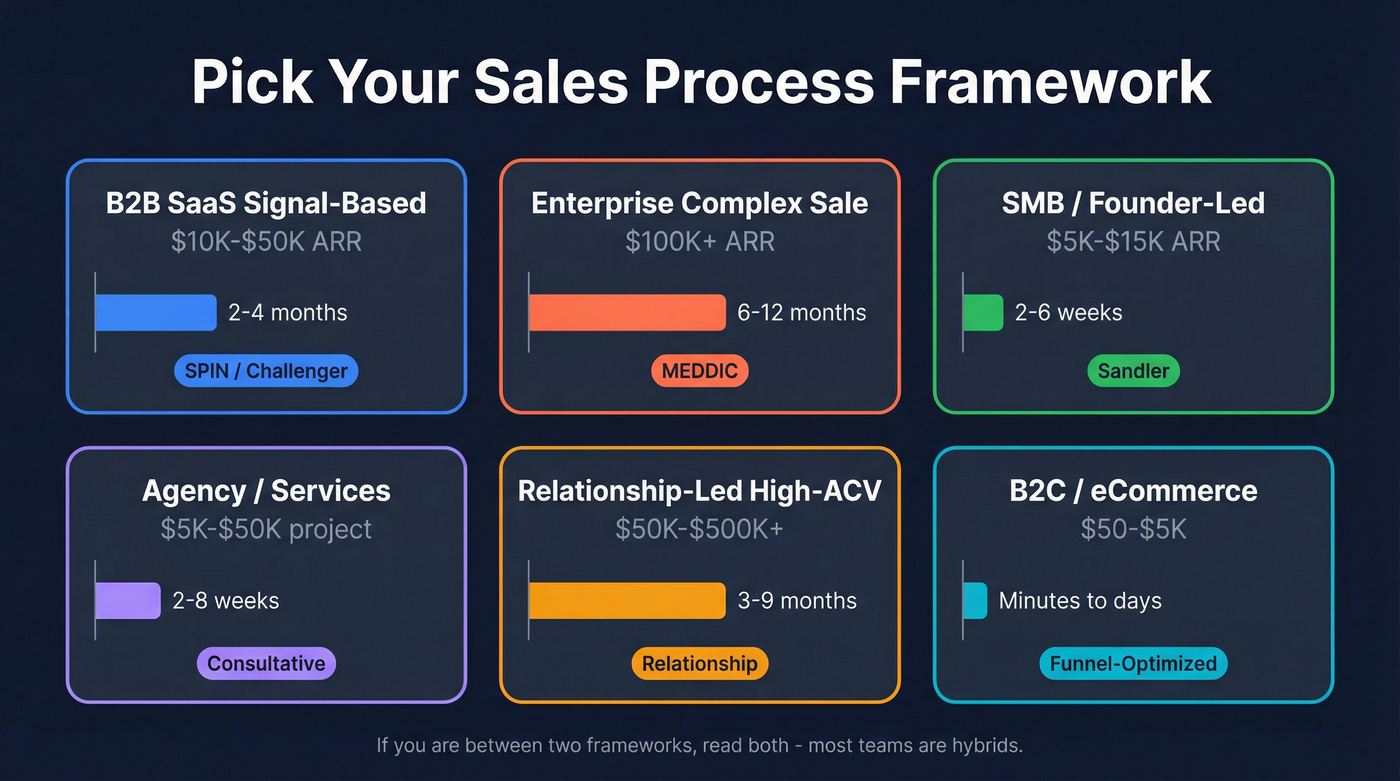
Jump to whichever matches your motion. If you're between two, read both - most teams are hybrids.
The 7 Stages (30-Second Refresher)
The standard sales process backbone runs seven stages. Think of these as the default structure - the sales process examples below show how real teams compress, expand, and reorder them.
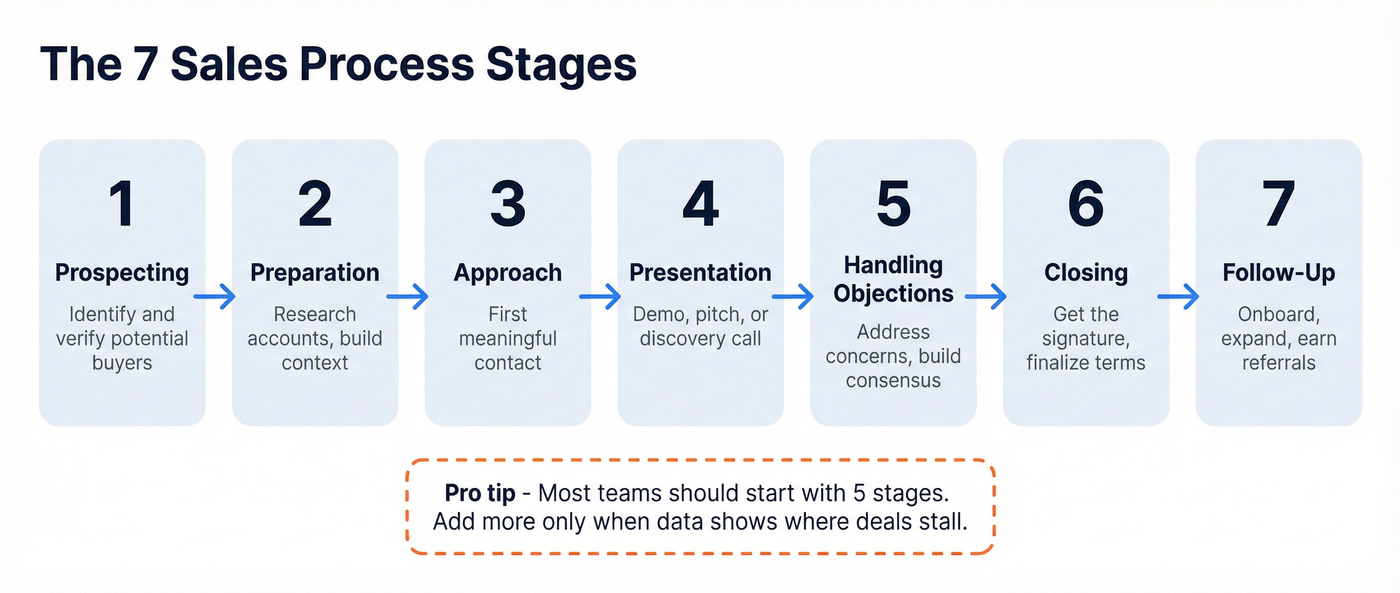
- Prospecting - Identify and verify potential buyers
- Preparation - Research accounts, build context, plan approach
- Approach - First meaningful contact (cold email, warm intro, inbound response)
- Presentation - Demo, pitch, or discovery call that frames your solution
- Handling Objections - Address concerns, validate fit, build consensus
- Closing - Get the signature, finalize terms
- Follow-Up - Onboard, expand, generate referrals
Most teams don't need all seven from day one. Start with five. You can always add stages once you have data showing where deals stall.
6 Real Sales Process Examples by Business Type
B2B SaaS - Signal-Based Outbound ($10K-$50K ARR)
This is the motion most modern SaaS teams run, and everything downstream depends on clean, verified data at the top of the funnel. Prospeo's B2B Database gives you 30+ filters - buyer intent, technographics, headcount growth, funding - to build verified prospect lists before you activate a single signal.
If you want to go deeper on the mechanics, start with sales prospecting techniques and then layer in lead scoring so activation is based on real priority, not gut feel.
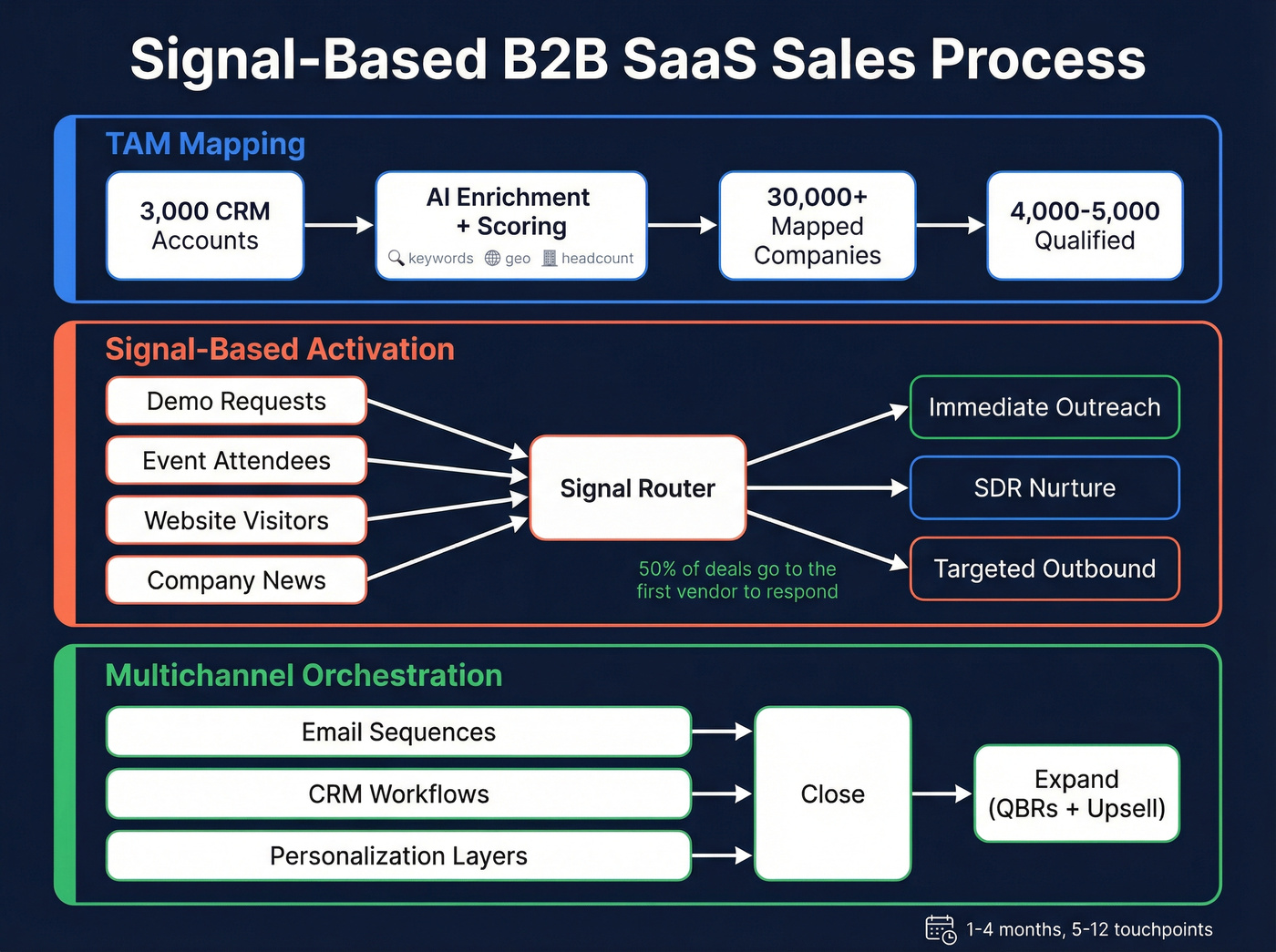
A practitioner on r/startups laid out exactly how this works at scale. They took roughly 3,000 messy CRM accounts and expanded them to 30,000+ mapped companies using Clay, Apollo, and AI enrichments. From that universe, about 4,000-5,000 qualified as ready for activation. The process runs on three systems working together:
TAM mapping. Classify companies into ICP segments and score by keywords, geo fit, headcount, and use-case alignment. Their segments included six eCommerce types, with retailers at $50K-$250K ARR and agencies and SaaS companies at $10K-$30K ARR.
Signal-based activation. Aggregate triggers from inbound forms, event attendee lists, anonymous website visitors, and company news. Route them accordingly: demo requests get immediate outreach, event attendees go to SDR nurture, news triggers get targeted outbound. Their response time dropped from days to hours. That matters - up to 50% of deals go to the first vendor to respond.
Multichannel orchestration. Coordinate across email sequences, CRM workflows, and personalization layers using tools like Instantly and HubSpot. Enterprise SaaS deals don't end at close - add an "expand" stage for QBRs and upsell motions once the customer is onboarded. The best SaaS teams treat post-sale as a revenue stage, not an afterthought.
Timeline: 1-4 months from first touch to close, with 5-12 touchpoints across channels.

Enterprise Complex Sale ($100K+ ARR, 6+ Month Cycle)
Use this if you're selling to buying committees of 10+ people and your deals regularly stall in legal or procurement. Skip this if your average deal is under $50K - MEDDIC is overkill at that price point.
We've seen this play out firsthand: a $72K ARR ITSM deal was slipping because the rep had never identified the economic buyer. The decision process was unclear, metrics for success were undefined, and there was no internal champion pushing the deal forward. Classic MEDDIC failure - the rep had checked activity boxes (demo done, proposal sent) without verifying buyer milestones.
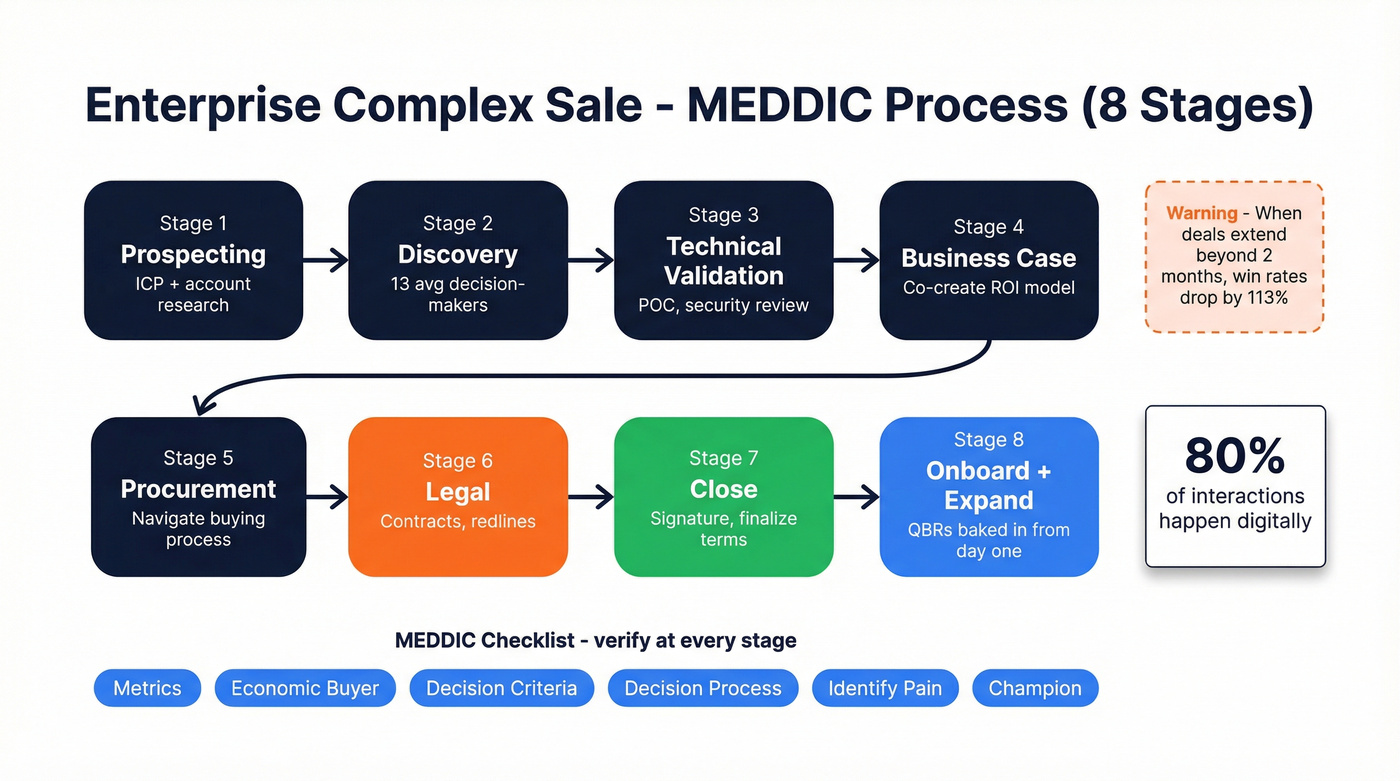
Enterprise deals average 13 decision-makers and 80% of interactions happen digitally. Your process needs explicit stages for stakeholder mapping, business case co-creation, and procurement navigation. The stages expand: prospecting, discovery, technical validation, business case, procurement, legal, close, onboard. Seven to eight stages is normal here, and post-close expansion through QBRs should be baked in from the start.
Salesforce handles opportunity management, Gong provides call intelligence and deal inspection. Expect 6-12 months. When deals extend beyond two months, win rates drop by 113%.
If you're building this motion from scratch, align your stages to enterprise B2B sales realities and use a consistent set of MEDDIC discovery questions so reps don’t skip the hard parts.
SMB / Founder-Led ($5K-$15K ARR)
Sandler shines here because it flips the script. Instead of convincing prospects to buy, you're qualifying and disqualifying fast. If the pain isn't real, the budget isn't there, or the decision-maker isn't on the call, you walk away early. This is the best approach for teams that can't afford long cycles eating into thin margins.
A founder selling an $8K-$10K EdTech SaaS product found that running fewer demos but qualifying harder upfront actually shortened the cycle. The process compresses to five stages: qualify, discover pain, confirm budget/authority, demo, close. No separate "proposal" stage - at this deal size, the demo IS the proposal. Founders running this motion typically use HubSpot or Pipedrive, keeping overhead minimal.
Two to six weeks from first touch to signature. Don't add stages that slow you down - every extra gate at this deal size costs you more in cycle time than it saves in deal quality.
Agency / Services (Project-Based, $5K-$50K)
Agency sales are referral-heavy, which changes the front end of your process entirely. Prospecting looks different when a big share of your pipeline comes from introductions and word-of-mouth. The qualification stage is shorter because the referral pre-qualifies, but the scoping stage is longer - and that's where agencies bleed money.
One digital agency agreed to "social media management" without defining post count, platforms, or reporting cadence. The project ran over budget before anyone noticed the scope had ballooned. This is the norm, not the exception.
The process: referral/inbound, discovery call, scope definition, proposal, negotiation, close, kickoff. The critical stage is scope definition. Nail deliverables, timelines, and revision limits in writing before the proposal goes out. B2B agency deals tend to be longer and more ROI-driven than B2C services, with more stakeholders involved. For outbound prospecting beyond referrals, Pipedrive keeps the pipeline visible and Lemlist handles cold email sequences. Timeline: 2-8 weeks from first conversation to signed SOW.
To tighten the leakiest parts, standardize your discovery questions and keep a set of sales follow-up templates for scope, proposal, and procurement nudges.
Relationship-Led High-ACV (Referral-Driven)
A top performer on r/sales shared their operating system: $1.3M in cash comp over nine years, $40-$50M in revenue generated as an individual contributor. Their "process" doesn't look like a flowchart. It looks like a lifestyle.
Attend conferences and industry events religiously. Be helpful beyond selling - make introductions, help contacts find jobs, share intel. Ask clients for advice, not just referrals. Deeply understand where your product adds value so you can spot opportunities in casual conversations. Proactively source leads from your personal network before they hit the market.
This isn't a CRM-stage process. It's a relationship flywheel: build trust, deliver value, earn referrals, repeat. The "stages" are informal but real - identify opportunity, warm introduction, consultative discovery, co-create solution, close. Salesforce tracks the pipeline, but the real work happens at dinners and conferences. Timeline: 3-9 months per deal, but the pipeline is always warm because relationships compound.
B2C / eCommerce (Short Cycle, High Volume)
B2C decisions are quicker and more emotionally driven than B2B. No buying committee, no procurement review, no six-month evaluation. The process compresses to four stages: attract, engage, convert, retain.
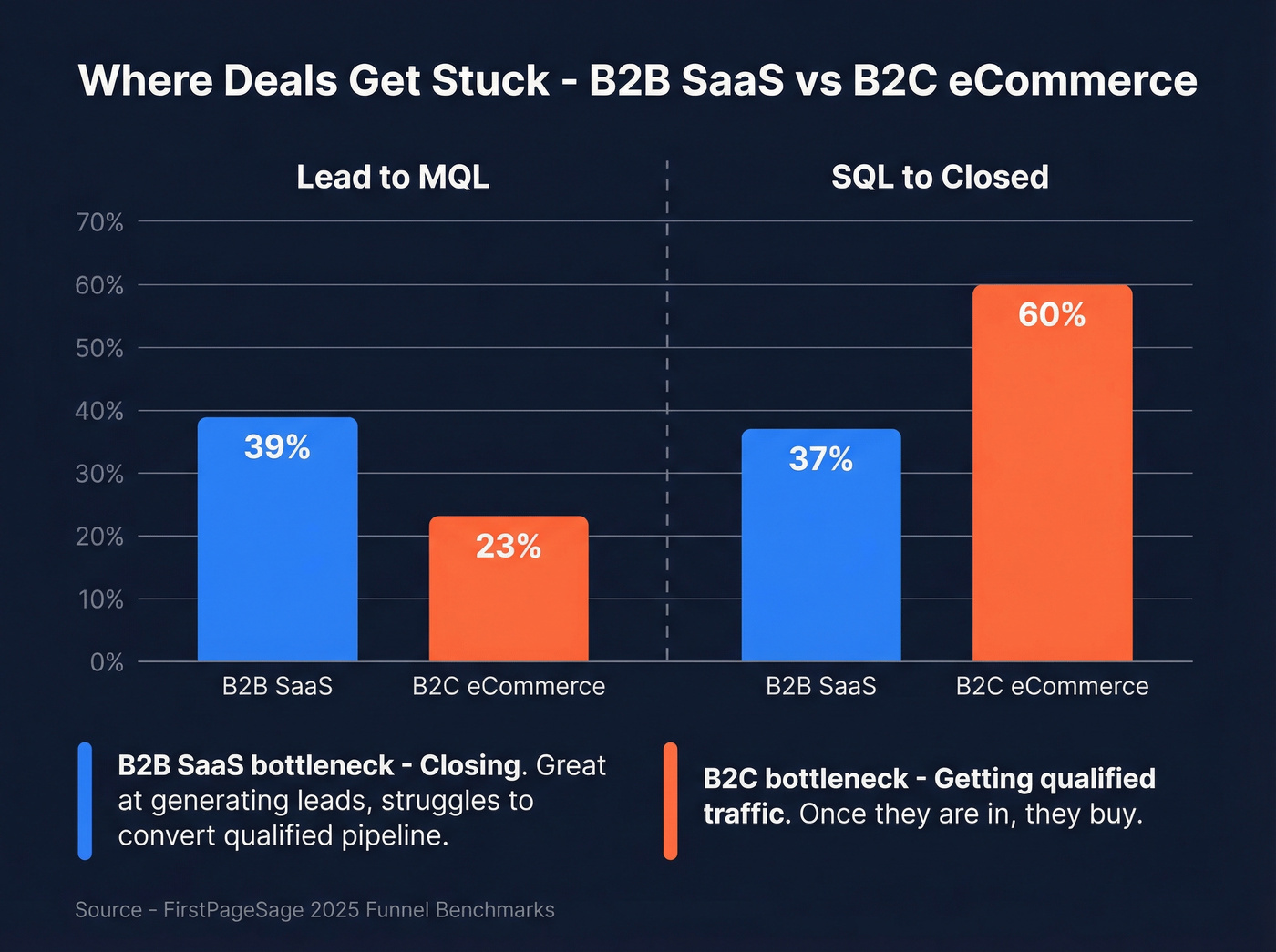
The benchmarks tell the story. eCommerce funnels convert at 23% from Lead to MQL, but 60% from SQL to Closed - meaning the hard part is getting qualified traffic, not closing it. Compare that to B2B SaaS where Lead-to-MQL runs 39% but SQL-to-Closed drops to 37%. Completely different bottlenecks require completely different process designs.
Shopify for the storefront, HubSpot for lifecycle marketing and retention flows. Timeline: minutes to days. Optimize for friction removal, not relationship building.

Your sales process is only as good as the data feeding it. Prospeo gives you 30+ filters - buyer intent, technographics, headcount growth, funding - so you can build signal-based prospect lists that actually match your ICP. 98% email accuracy, 7-day refresh cycle, $0.01 per lead.
Stop running a great process on garbage data.
Benchmarks That Prove Your Process Works
A process without benchmarks is just a guess. Here's what good looks like by industry, based on First Page Sage's funnel data:
| Industry | Lead-to-MQL | MQL-to-SQL | SQL-to-Opp | SQL-to-Closed |
|---|---|---|---|---|
| B2B SaaS | 39% | 38% | 42% | 37% |
| eCommerce | 23% | 58% | 66% | 60% |
| Cybersecurity | 24% | 40% | 43% | 46% |
| Manufacturing | 26% | 41% | 46% | 51% |
The median B2B conversion rate across all industries sits at just 2.9%. Most of the leakage happens between MQL and SQL - that's where qualification criteria either work or don't. MQL-to-SQL is the steepest drop at roughly 15%, making qualification the single biggest leak in most pipelines.
Beyond conversion rates, watch for deal slippage. 36% of forecasted deals slip past projected close dates, and 76% lack a compelling event driving urgency. HubSpot's State of Sales survey found that 59.9% of teams are on track to hit revenue targets - which means 40% aren't. Even more stark: 84% of reps missed quota last year. The top deal killers? No product fit (37%) and poor value for money (35%). Both are qualification problems, not closing problems.
If your MQL-to-SQL rate is below 30% or deals consistently slip past projected close dates, your qualification criteria need tightening. The process isn't broken at the close - it's broken at the top.
Which Methodology Fits?
Methodologies aren't interchangeable. Match them to your deal complexity and size.
| Methodology | Research Basis | Best For | Deal Size |
|---|---|---|---|
| SPIN | 35,000+ calls, 20+ countries | Discovery-heavy sales | $10K-$100K |
| Challenger | 6,000+ reps studied | Status-quo disruption | $50K-$500K+ |
| MEDDIC | Enterprise SaaS origin | Complex, multi-stakeholder | $75K-$500K+ |
| Sandler | Qualification-first | SMB, founder-led | $5K-$30K |
| BANT | IBM legacy | Quick qualification | Any (basic) |
MEDDIC is overkill for a $10K deal. You'll spend more time filling out qualification fields than actually selling. Sandler is too lightweight for a $200K enterprise deal with 13 stakeholders. The methodology has to match the motion.
Xerox reported a 17% increase in sales and $65M in contract value after implementing the Challenger approach. Impressive, but Xerox was selling complex solutions to enterprise buyers - the methodology fit the deal type. A five-person startup selling $8K contracts doesn't need to "teach, tailor, take control." They need to qualify fast and close faster.
Why Most Sales Processes Fail
The #1 failure mode we see isn't missing stages - it's activity-based stages instead of buyer-verified milestones. "Demo completed" isn't a milestone. "Prospect confirmed our solution addresses their top-three pain points" is. Even teams with a detailed pipeline map in their CRM fall into this trap when the stages track rep actions instead of buyer decisions.
Let's be honest: in our experience, the teams with the prettiest Salesforce dashboards are often the ones with the worst pipeline accuracy. They're measuring what reps did, not what buyers decided.
Replace vague stage names with these buyer-verified outcomes:
- Problem impact defined - the buyer can articulate the cost of inaction
- Buying committee mapped - you know every stakeholder and their stance
- Solution fit confirmed - technical and business requirements validated
- Business case agreed - ROI model co-created with the champion
- Procurement path defined - timeline, approvals, and legal requirements clear
- Mutual action plan in place - both sides have committed next steps with dates
The other silent killer? Bad contact data. If 30% of your emails bounce, your prospecting stage is broken before it starts. We've seen teams with beautiful CRM processes and terrible pipeline velocity - and the root cause was stale data feeding the top of the funnel. Verify your list with Prospeo's Email Finder before building sequences. A 98% accuracy rate means your reps spend time selling, not chasing bounces.
If you're diagnosing this systematically, use a pipeline health checklist and track email bounce rate as a first-class funnel metric.
Whether you're running a 2-week SMB cycle or a 6-month enterprise deal, bad contact data kills pipeline velocity. Prospeo's 5-step verification and 143M+ verified emails mean your reps spend time selling - not bouncing. Teams book 26% more meetings vs ZoomInfo.
Fix the top of your funnel and every stage downstream accelerates.
Build a Repeatable Process in 5 Steps
1. Define your ICP with scoring criteria. Don't just describe your ideal customer - score them. Firmographic fit (industry, headcount, revenue), technographic signals (what tools they use), and behavioral triggers like job changes, funding rounds, and content engagement. A scored ICP turns subjective qualification into a repeatable filter.
2. Map the buyer journey, not your seller activities. Start with how your buyer buys, then build stages around their decisions. Visualizing the buyer's decision points as a flowchart before you ever touch your CRM helps enormously - what do they need to believe at each stage to move forward? That's your stage definition.
3. Set stage exit criteria using buyer milestones. Every stage needs a clear exit gate - not "rep sent proposal" but "buyer confirmed budget range and decision timeline." The six milestones from the previous section are a strong starting framework.
4. Choose methodology by deal type. For teams selling multiple deal types - say, SMB self-serve and mid-market sales-assisted - you need multiple processes. That's fine. Most successful B2B companies run at least two.
5. Instrument in your CRM and measure. Build the stages as pipeline stages in Salesforce or HubSpot. Track conversion rates between stages weekly, using the benchmarks table above as your baseline. Start with five stages - you can always add more once you see where deals actually stall.
And one more that too many teams skip: review quarterly. Your process isn't a set-it-and-forget-it artifact. Every quarter, ask three diagnostic questions: Which stage has the longest average time-in-stage? Where do deals most often go dark? Are conversion rates between stages trending up or down? The answers tell you exactly where to intervene. Teams that review quarterly catch pipeline problems months before they show up in revenue - and that's how you build a predictable engine instead of hoping each quarter works out.
If you want a deeper teardown of what to fix first, use a sales process optimization framework and prioritize the biggest sales pipeline challenges by impact.
FAQ
Sales Process vs. Methodology?
A process is the stages a deal moves through - prospecting, discovery, demo, proposal, close. A methodology is the approach you use within those stages - SPIN questioning, Challenger reframing, MEDDIC qualification. You need both: the process is the map, the methodology is how you drive. Most teams pick one methodology and apply it across all stages.
How Many Stages Should I Use?
Start with five. Teams that launch with seven or more often end up with reps gaming stage progression to hit activity metrics. Add stages only once conversion data shows where deals stall. The examples above range from four (B2C) to eight (enterprise) - deal complexity determines the right number, not a template.
What Makes a Process Effective?
Three qualities: stages defined by buyer milestones rather than rep activities, clear exit criteria at every gate, and conversion benchmarks that reveal where deals leak. Review it quarterly and tighten the stages where velocity drops or deals go dark. These six sales process examples are blueprints to customize, not rigid scripts.
How Do I Know If My Process Is Working?
Compare your stage-by-stage conversion rates to the industry benchmarks above. If MQL-to-SQL is below 30%, or deals consistently slip past projected close dates, your qualification criteria need tightening. Track cycle length too - if it creeps up quarter over quarter, something in your middle stages is broken.
What Tools Support a Strong Sales Process?
Your CRM (Salesforce or HubSpot) handles pipeline stages and reporting. For prospecting data, tools like Prospeo provide 300M+ profiles with 98% email accuracy and a 7-day refresh cycle - critical when bad data is silently killing your top-of-funnel. Layer in Gong for call intelligence and Instantly or Lemlist for outbound sequencing.