

Sales Prospecting in 2026: Benchmarks, Cadences, and What Actually Works
A rep returning to cold outreach after a few years away nailed it on r/sales: "It's a lot harder to connect with folks through cold calls now... I haven't seen the numbers to back up what works and what doesn't." That frustration defines sales prospecting right now. The channels have shifted, the rules have tightened, and most advice is still recycling 2019 playbooks.
Here's what the 2026 data actually says - with cadence templates you can steal and benchmarks you can measure against.
The Short Version
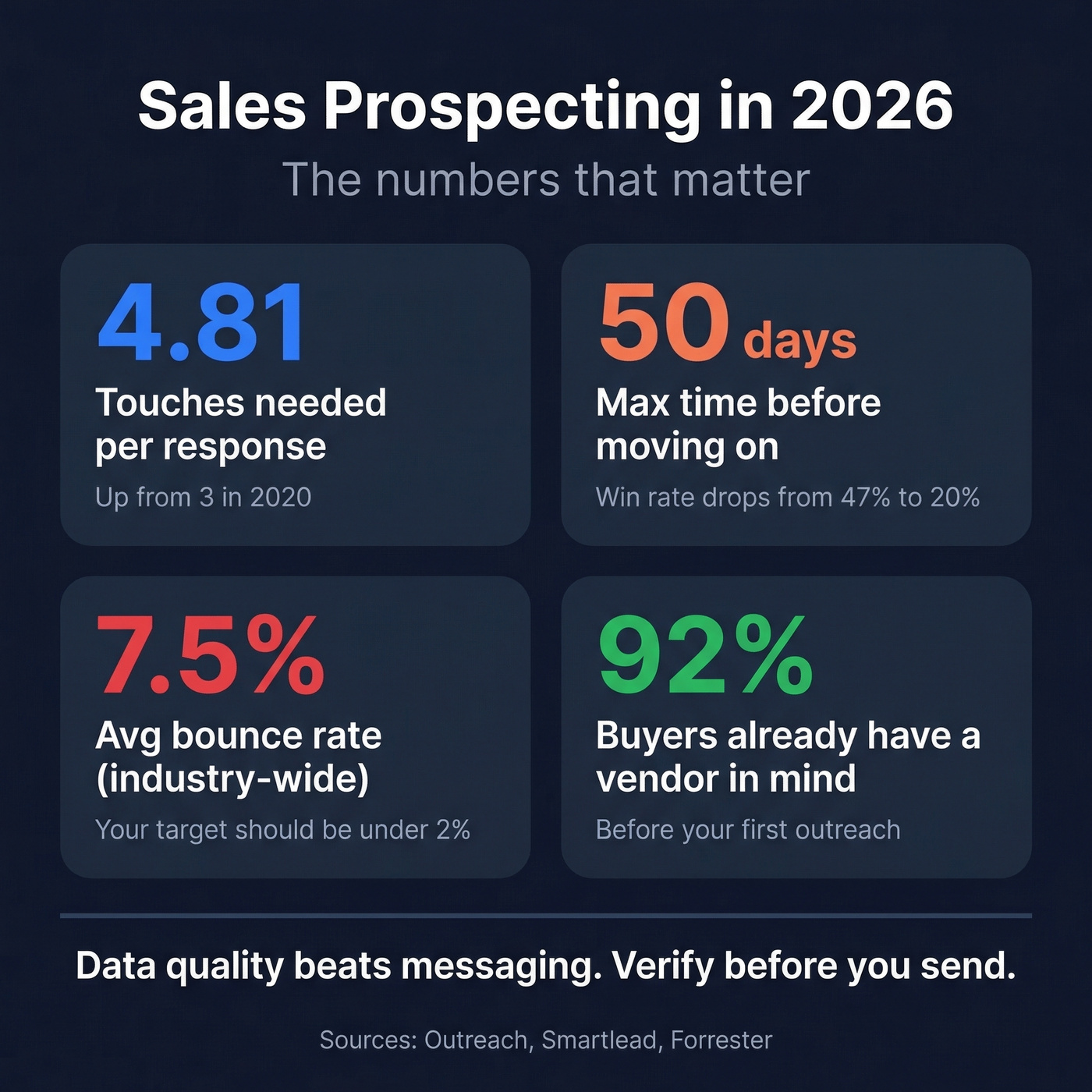
- Data quality matters more than messaging. Verify before you send. A 7.5% bounce rate will torch your domain faster than a bad subject line.
- Phone is back - call-heavy cadences are running alongside email again. Use both.
- A 7-touch, multi-channel cadence over 10 days is the baseline. Not 3 emails and a prayer.
- AI helps with personalization and research, but 78% of teams still need human SDRs in the loop.
- If you haven't created momentum within 50 days, move on. Win rates drop from 47% to roughly 20%.
What Is Prospecting (and What Isn't)
Prospecting is the act of identifying and reaching out to potential buyers who fit your ideal customer profile. It's rep-driven, outbound, and targeted - you're choosing who to talk to, not waiting for them to find you.
That's the distinction from lead generation. Lead gen is marketing-driven inbound: content, ads, and webinars pulling people toward you at scale. Prospecting is a rifle; lead gen is a net. Both feed the pipeline, but outbound prospecting gives reps direct control over who enters it.
One more distinction worth nailing down: a lead is anyone who's shown interest. A prospect is a lead you've qualified as worth pursuing - someone who matches your ICP and has a realistic path to becoming a customer. Not every lead becomes a prospect, and treating them the same is how reps waste 60% of their week.
What's Changed in 2026
The biggest shift isn't any single channel dying. It's that every channel got harder simultaneously. Cold email reply rates sit around 3% globally across 14.3 billion sends tracked by Smartlead. That's not zero, but it's thin enough that email alone won't build pipeline.
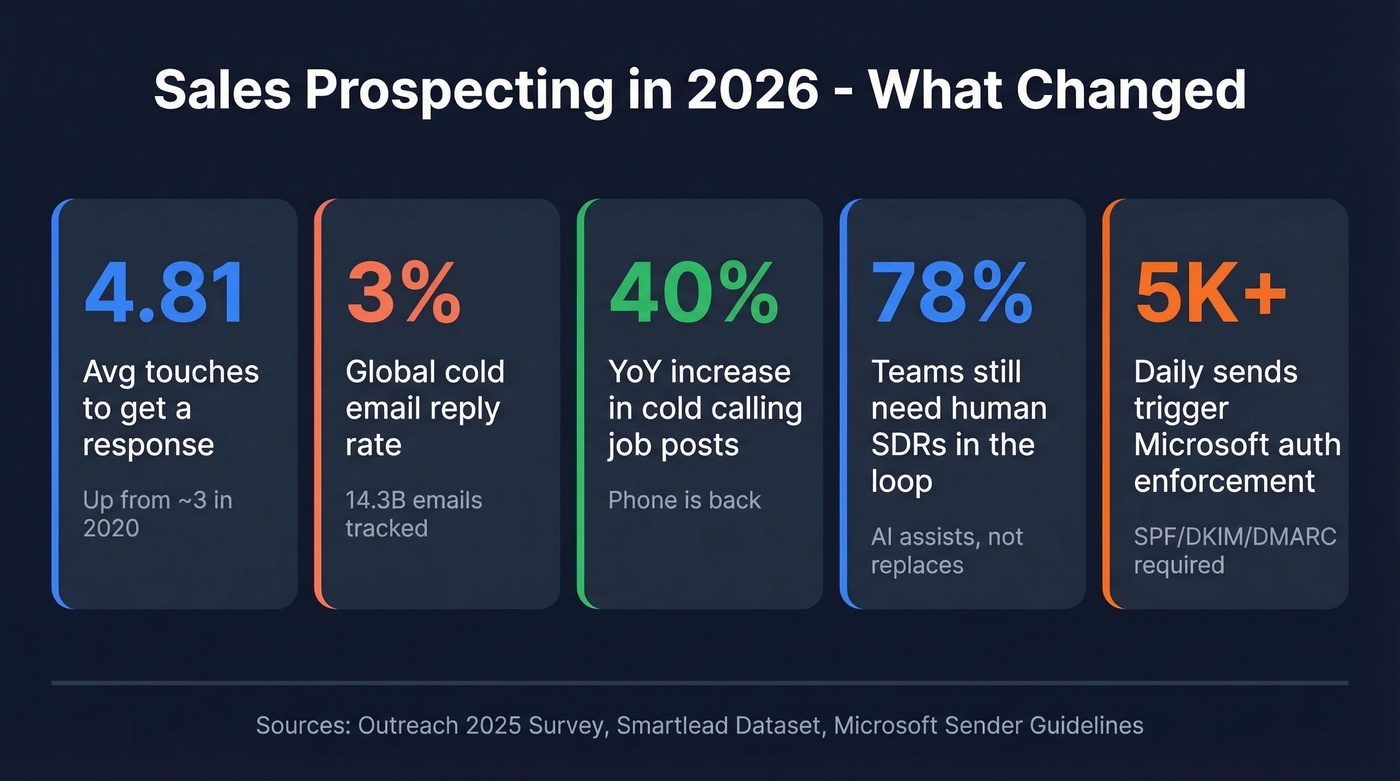
It now takes an average of 4.81 touches to get a response from a prospect, regardless of lead temperature - up from the 3-touch world of 2020. The "just hit the phones" era is gone, but so is the "just send sequences" era. The meta now is omnichannel: voicemails, emails, video, social touches, layered deliberately.
On the AI front, the Outreach survey of 500 revenue professionals shows adoption is real but uneven. 45% run a hybrid model with AI assisting human SDRs, 22% have fully replaced SDRs with AI agents, and 23% don't use AI for prospecting at all. The hype is loud; the execution is scattered.
Deliverability rules tightened hard. Microsoft started enforcing SPF/DKIM/DMARC requirements for senders pushing 5,000+ messages per day as of May 2025. Google and Yahoo had already moved. Practitioners on r/b2bmarketing are openly skeptical that 90%+ inbox placement is consistently achievable anymore - and they're right to be skeptical.
Here's the thing: job postings mentioning cold calling are up roughly 40% year-over-year. As one r/AiForSmallBusiness thread noted, the phone got quieter as email and automation made digital channels noisier - and smart teams are exploiting that gap. The consensus across Reddit threads is consistent: reps who combine verified dials with multi-channel sequences report better results than those relying on a single channel.
The Step-by-Step Process
There's no shortcut here, but there is a sequence that works. The hard part isn't understanding the concept - it's executing it consistently.
Define Your ICP
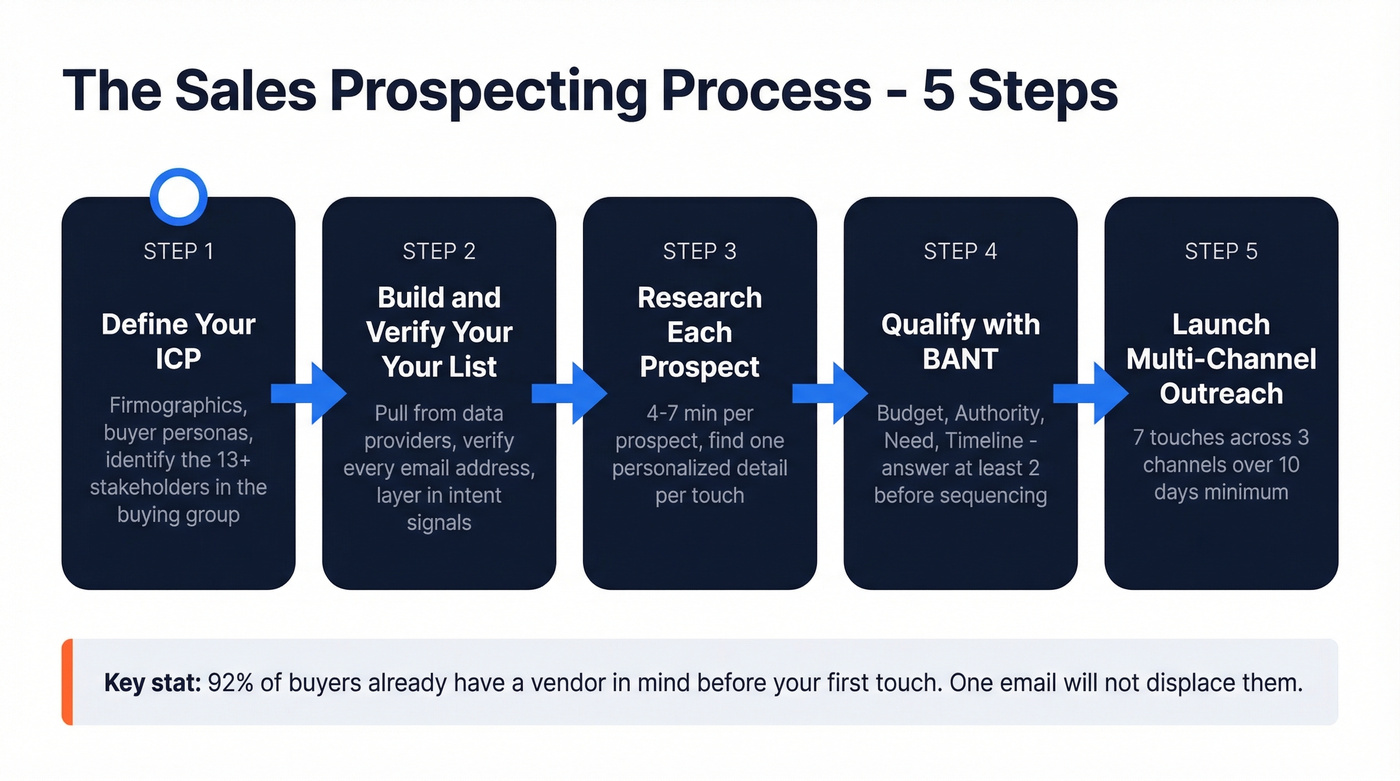
Start with the companies and people most likely to buy. Firmographics like industry, headcount, revenue, and funding stage, plus buyer persona details like title, department, and seniority. If you're selling to everyone, you're selling to no one. Typical buying decisions now involve roughly 13 internal stakeholders plus 9 external influencers, per Forrester's buying-group research. You need to know which of those 22 people you're targeting first.
Build and Verify Your List
Pull prospects matching your ICP from a data provider. This is where most teams introduce their first major error - loading unverified contacts into sequences. Before a single email goes out, run every address through verification. That step is the difference between a 2% bounce rate and a 7.5% bounce rate, and the difference between inbox placement and the spam folder.
Layer buying intent signals into your targeting while you're at it. Intent data tracks topics your prospects are actively researching, so you can prioritize accounts showing in-market behavior rather than treating every prospect as equally likely to buy. Prospeo tracks 15,000 intent topics powered by Bombora, which means you can combine buyer intent with job role and company growth signals to build a list that's both accurate and timely.
Research Each Prospect
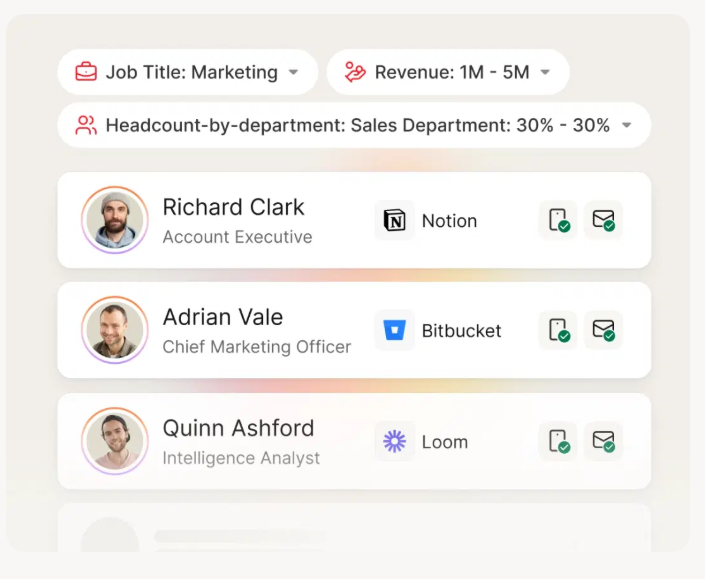
Spend 4-7 minutes per prospect before outreach. Check their company's recent news, job postings, tech stack changes, and the prospect's own activity. This isn't optional anymore - generic outreach gets deleted. The goal is one personalized detail per touch that proves you did the work. Lead with an insight or observation about their business, not a feature pitch. The best opening emails read like a colleague sharing something useful, not a vendor asking for time.
Qualify with BANT
Budget, Authority, Need, Timeline. BANT gets criticized as outdated, but for initial qualification it's still the fastest filter available. MEDDIC is better for complex enterprise deals - but you need a prospect worth qualifying before you pull out a 6-variable framework. Can they pay? Can they decide? Do they have the problem? Is the timing right? If you can't answer at least two of those, the prospect isn't ready for a sequence. They're ready for a nurture list.
Launch Multi-Channel Outreach
Here's the critical stat: 92% of buyers start with at least one vendor already in mind. Your outreach isn't just competing with other cold emails - it's competing with an incumbent relationship. One email won't displace a vendor they already know. Seven touches across three channels might.
Channels That Work in 2026
Cold Calling
The cold calling revival is real, and the data backs it up. Fewer reps are calling, which means the ones who do face less competition for attention. The phone remains one of the most direct ways to build rapport and qualify interest in a single conversation.
That said, 51% of reps still struggle to get prospects to pick up. The bottleneck isn't technique - it's data. If you're dialing switchboard numbers or mobiles that haven't been verified in months, your connect rate will be abysmal. We've seen teams go from single-digit connect rates to 20-30% just by switching to verified direct dials. Anything less is wasting your reps' time.
The verdict: cold calling works better in 2026 than it has since 2019, but only with verified direct numbers.
Cold Email
These benchmarks come from a Smartlead dataset covering 14.3 billion sends from 2021 through April 2025:
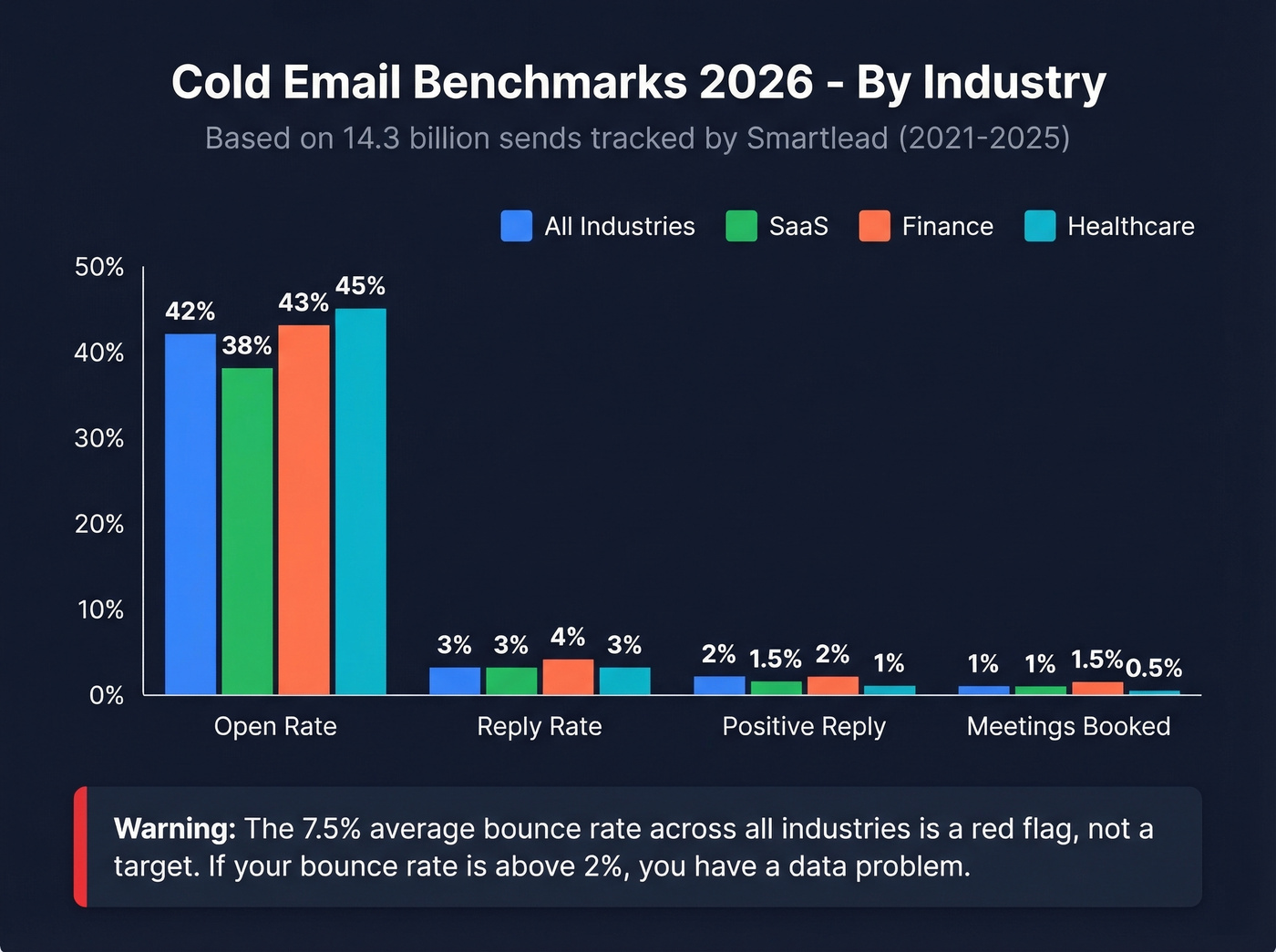
| Metric | All Industries | SaaS | Finance | Healthcare |
|---|---|---|---|---|
| Open rate | ~42% | ~38% | ~43% | ~45% |
| Reply rate | ~3% | ~3% | ~4% | ~3% |
| Positive reply | ~2% | ~1.5% | ~2% | ~1% |
| Meetings booked | ~1% | ~1% | ~1.5% | ~0.5% |
| Bounce rate | ~7.5% | ~7.5% | ~7.5% | ~7.5% |
A caveat on open rates: Apple's Mail Privacy Protection inflates them. Prioritize reply rate and meetings booked as your real performance indicators.
For writing cold emails, use a framework. PAS (Problem-Agitation-Solution) works well for pain-aware prospects: name the problem, twist the knife, offer the fix. AIDA (Attention-Interest-Desire-Action) is better for colder audiences who need to be pulled in before you pitch. Either way, keep it under 100 words. The subject line gets the open; the first sentence earns the read; the CTA earns the reply.
If you want more structure, start with a proven B2B cold email sequence and then iterate.
The deliverability checklist is non-negotiable:
- SPF + DKIM + DMARC configured and aligned on every sending domain
- One-click unsubscribe header (RFC 8058) - required by Google, Yahoo, and Microsoft
- Spam complaints under 0.3% (Gmail Postmaster threshold)
- Bounce rate under 2% - that 7.5% average above is a red flag, not a target
- Warmup new domains at 5-10 emails/day, ramping over 4-6 weeks
- Microsoft enforces authentication for senders at 5,000+ messages/day
If your bounce rate is anywhere near 7.5%, you have a data problem, not a deliverability problem. Fix the inputs before you optimize the copy. (If you need a deeper checklist, see our email deliverability guide.)
Social Selling, Video, and Referrals
Social selling is a standard channel in any serious cadence. Connection requests that reference a prior email or call convert at meaningfully higher rates than cold connection requests alone.
Video prospecting - 60-90 second personalized clips - is gaining traction as a pattern interrupt. It's harder to ignore than text, and it signals effort. Not every prospect will watch, but the ones who do tend to engage.
Referrals remain the highest-conversion channel by a wide margin. If you're not systematically asking happy customers for introductions, you're leaving the easiest pipeline on the table.
One more data point: 90% of BDRs multithread, reaching roughly 9 people per account. Single-threaded outreach to one contact at a target account is a losing strategy when buying committees run 13+ stakeholders deep.

The article says it: a 7.5% bounce rate torches your domain faster than bad copy. Prospeo's 5-step verification delivers 98% email accuracy with a 7-day refresh cycle - so every touch in your multi-channel cadence lands in a real inbox, not a spam trap.
Stop burning sequences on bad data. Verify before you send.
Build Your Prospecting Cadence
Template A: Leads at Scale (7 touches / 10 days)
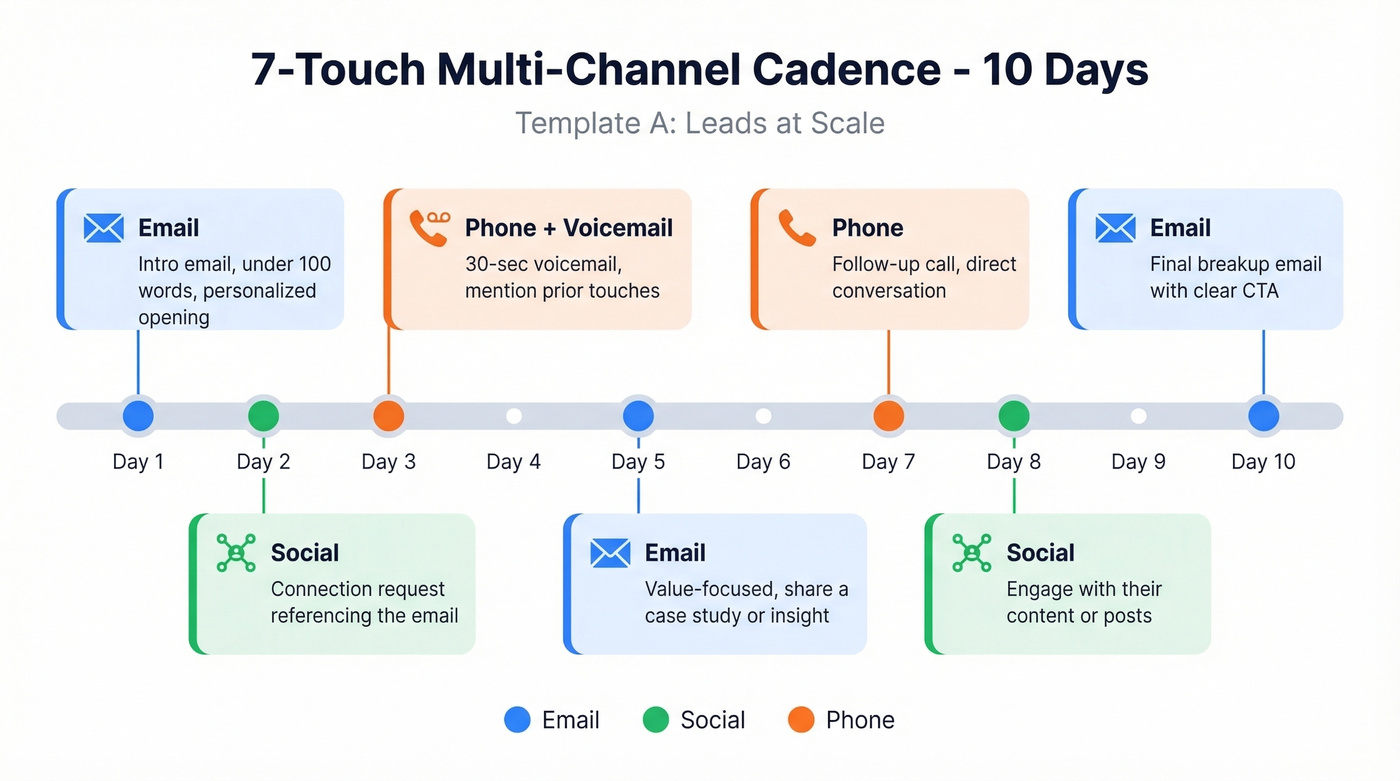
| Day | Channel | Purpose |
|---|---|---|
| 1 | Intro (<100 words, personalized) | |
| 2 | Social | Connection request referencing email |
| 3 | Phone + VM | 30-sec voicemail, reference prior touches |
| 5 | Value-focused (case study or insight) | |
| 7 | Phone | Follow-up call |
| 8 | Social | Engage with their content |
| 10 | Breakup / permission close |
If you want copy you can paste, use these sales follow-up templates (and adapt them per persona).
Template B: Call-Heavy Variant (7 touches / 10 days)
| Day | Channel | Purpose |
|---|---|---|
| 1 | Email + Call | Intro email, immediate call |
| 2 | Value email with proof point | |
| 4 | Call + VM | Second call attempt with voicemail |
| 6 | Video | 60-90 sec personalized video |
| 8 | Objection-handling email | |
| 10 | Clean exit / permission close |
Cadence Design Rules
Every touch needs a job - new angle, new proof point, new ask. Delete "just checking in." Coverage should mean more channels and more stakeholders, not repeated pings to one person. If you haven't created momentum by day 10, change something: persona, channel, angle, or offer. Don't just extend the same failing sequence.
The benchmark context matters: teams average roughly 21 attempts per contact across a mix of 8 calls, 8 emails, and 5 social touches. The average cadence runs 53 days before reps move on.
The 50-day cliff: Opportunities closed within 50 days win at 47%. After 50 days, win rates drop to roughly 20%. Speed matters more than persistence.
AI and Outbound Teams
Bain's 2025 research found that sellers spend only about 25% of their time actually selling to customers. The rest is admin, research, CRM updates, and internal meetings. AI's promise is to compress that non-selling time, and in early deployments, Bain reports 30%+ improvement in win rates.
Let's be honest about what we've seen: AI is a force multiplier, not a replacement - yet. The teams getting the most value aren't automating existing steps slightly faster, which is what Bain calls the "micro-productivity trap." They're reimagining processes end-to-end. Using AI to research 50 accounts in the time it used to take to research 5 is a genuine leap. Using AI to send the same generic email slightly faster is not.
If you're building this motion, it helps to standardize your sequence management so AI and humans aren't stepping on each other.
If your average deal size is under $10K, you probably don't need a human SDR touching every prospect. Let AI handle the first three touches and have a human step in only when a prospect engages. But for six-figure contracts, fully automated outreach is a reputation risk you can't afford. The 22% of companies that replaced SDRs entirely are mostly selling low-ACV products. Know which camp you're in.
Prospecting Tools and Costs
You need three things: a data provider, a sequencing tool, and a CRM. Everything else is optional until you're past $5M ARR. Sales engagement software alone can free up roughly 25% of admin time, which is meaningful - but stacking six tools when you need three just creates integration headaches.
If you're evaluating stacks, start with a shortlist of SDR tools and work backward from your workflow.
| Tool | Category | Starting Price | Best For |
|---|---|---|---|
| Apollo | Data + engagement | $49/user/mo | All-in-one starter stack |
| ZoomInfo | Data provider | ~$15-40K/yr | Enterprise coverage at scale |
| Cognism | Data provider | ~$588/mo | European mobile numbers |
| Lusha | Data provider | $29/mo | Quick lookups, small teams |
| Hunter | Email finder | $49/mo | Email-only workflows |
| LinkedIn Sales Nav | Social selling | $79.99-$99/mo | Social prospecting + InMail |
| Outreach | Engagement | ~$100/user/mo | Enterprise sequencing |
| Salesloft | Engagement | ~$125/user/mo | Mid-market engagement |
| Instantly | Engagement | $37/mo | Cold email at volume |
| Lemlist | Engagement | $39-$55/user/mo | Personalized email + video |
| Clay | Enrichment / workflow | $149/mo (credits) | Custom enrichment sequences |
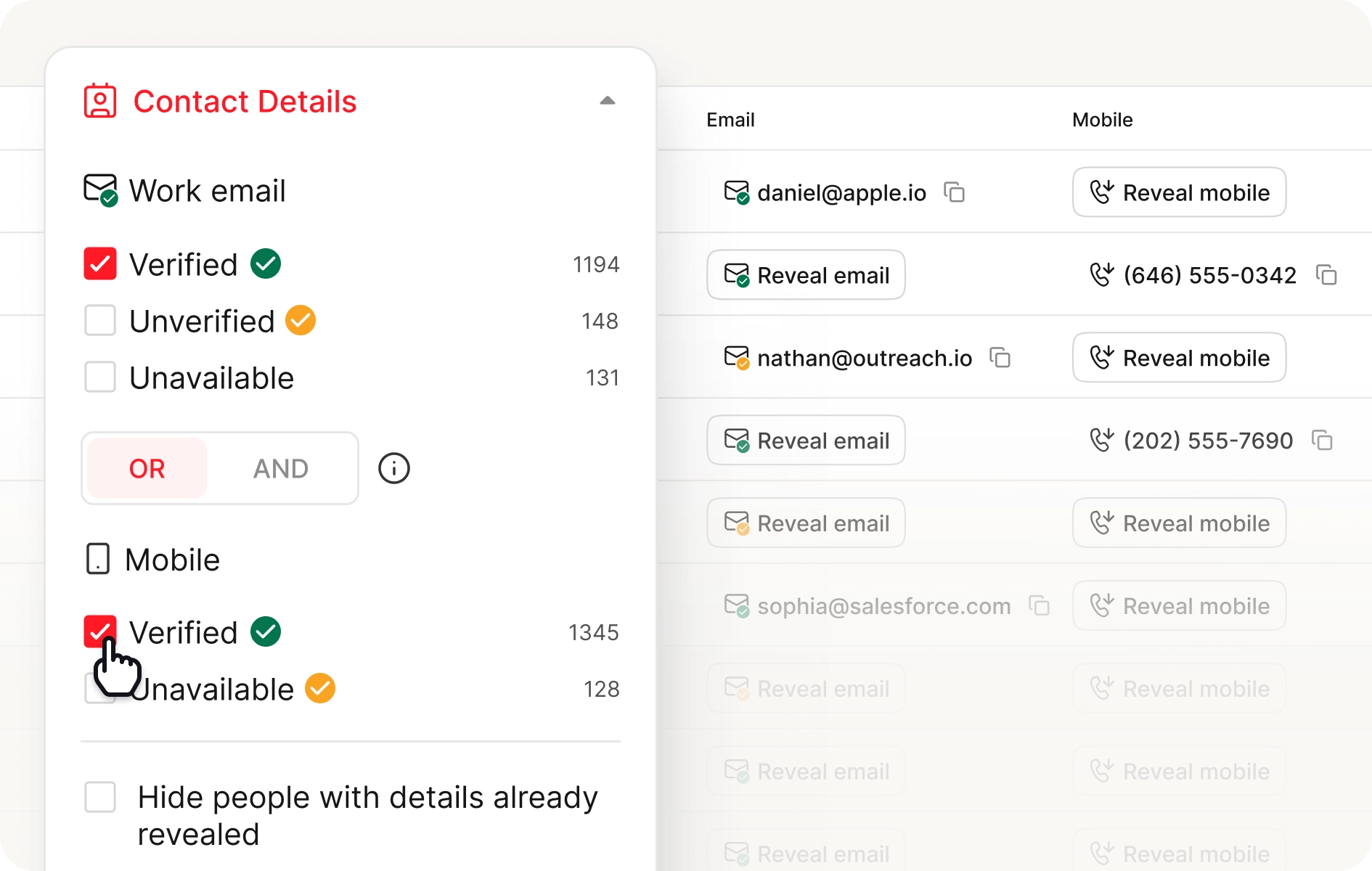
A quick note on Clay and Trigify - both are getting love on r/sales as workflow and enrichment tools. Clay is particularly strong for chaining data sources together and building custom enrichment sequences. It's not a replacement for a data provider, but it's a powerful orchestration layer on top of one. Skip Clay if you're running a simple two-tool stack and don't need multi-source enrichment - it adds complexity that smaller teams won't use.
In our experience testing data providers head-to-head, the accuracy gap between tools is wider than most people assume. On a 10,000-contact campaign, the difference between 98% accuracy and 79% accuracy is 200 bounces versus 2,100 bounces - and that gap compounds fast when you're running weekly campaigns across multiple domains. We've watched teams burn sender reputation in weeks because they skipped verification, then spend months recovering. (If you're comparing vendors, see our breakdown of data enrichment services.)
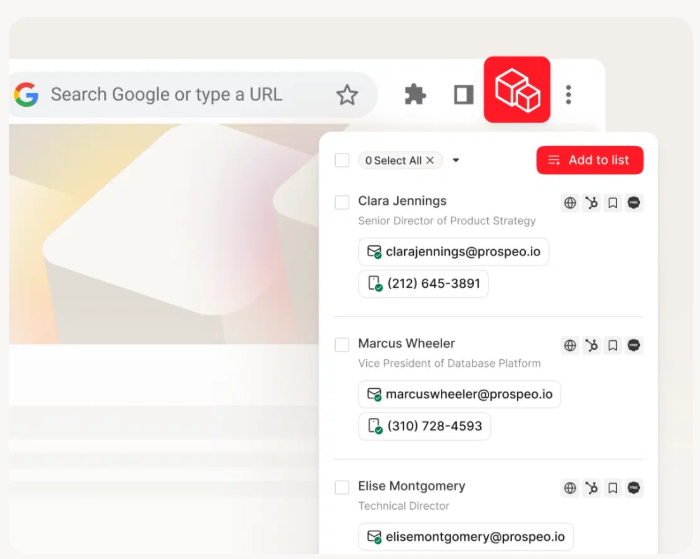
You need 4.81 touches across multiple channels to get a response. That means verified emails and direct dials for the same prospect. Prospeo gives you both - 143M+ verified emails and 125M+ mobile numbers with a 30% pickup rate - plus intent data across 15,000 topics so you hit accounts that are actually in-market.
Build cadences with emails, mobiles, and intent signals in one platform.
How to Measure Prospecting ROI
If you're not measuring cohorted win rates, you're guessing. Here's the KPI framework that actually tells you whether your outbound efforts are working.
Pipeline generation metrics track what's going in: opportunities created, pipeline value in expected ARR, and win rate segmented by source, rep, and ICP tier. The heuristic is roughly 20% win rate, but that average hides everything interesting - segment it or it's useless.
Pipeline conversion metrics tell you where things stall. Sales cycle length from opportunity creation to close. Cohorted win rates tracked by the month the opportunity was created, not the month it closed. Stage conversion rates showing where deals get stuck. Average time per stage revealing your bottlenecks. These four numbers, tracked monthly, will tell you more about your outbound health than any dashboard full of vanity metrics.
If you want a tighter set of leading indicators, track pipeline health alongside win rates.
The 50-day cliff again: If your average sales cycle is stretching past 50 days, the problem might not be closing. It might be that you're prospecting into accounts that aren't ready to buy.
Mistakes That Kill Your Pipeline
Bad data is the #1 upstream problem. Bounces destroy domain reputation. Wrong numbers waste call blocks. A 7.5% bounce rate isn't a benchmark to aim for - it's a crisis to fix. (If you need a diagnostic, start with email bounce rate.)
Mass impersonal emails are increasingly invisible. Personalized emails achieve 14% higher open rates and 10% higher click-through rates than generic messages, and the bar for "personalized" keeps rising. I've seen reps think swapping in a first name and company counts as personalization. It doesn't. Not anymore.
Ignoring compliance is an existential risk. GDPR penalties run up to 4% of global annual revenue or 20M euros, whichever is higher. That's not theoretical for companies selling into the EU.
Single-channel outreach underperforms multi-channel by a wide margin. Email-only or phone-only cadences leave pipeline on the table. Running without an ICP definition means you're just sending spam with extra steps. Skipping intent signals means treating every prospect as equally likely to buy - they're not. And ignoring deliverability guardrails like keeping bounce rate under 2% and spam complaints under 0.01% isn't a suggestion. It's the floor for staying in the inbox.
FAQ
How many touches does it take to book a meeting?
Current data shows an average of 4.81 touches to get a response, regardless of lead temperature. Plan for 7-21 total attempts across channels over 10-53 days, depending on your market and deal size.
Is cold calling still effective in 2026?
Yes - and more effective than recent years. As email and automation flooded digital channels, the phone got quieter. Connect rates are improving for reps who dial verified mobile numbers rather than switchboards. Expect 20-30% pickup rates on verified mobiles versus single digits on general office lines.
What's a good cold email reply rate?
The global average is roughly 3% across 14.3 billion sends. SaaS hovers around 3%, finance around 4%. Anything above 5% is strong. Below 1% signals a data or deliverability problem that no amount of copywriting will fix.
What's the difference between prospecting and lead generation?
Prospecting is rep-driven outbound - you choose specific people at target accounts and initiate contact directly. Lead generation is marketing-driven inbound - content, ads, and events attract interest at scale. Both feed the pipeline, but prospecting gives individual reps control over exactly who enters their funnel and when.