

Sales Prospecting Statistics That Actually Matter in 2026
Most sales prospecting statistics pages recycle numbers from 2018 with no source, no sample size, and no context. You've seen them - "80% of sales require 5 follow-ups" attributed to a blog that attributed it to another blog that attributed it to a dead link.
We pulled 40+ statistics from recent research (2025-2026), with named sources and sample sizes where available, organized around the one insight most teams miss: data quality is the highest-leverage variable in your entire outbound motion.
Benchmarks to Check First
Check yourself against these three numbers before you touch anything else. If you're below all three, fix your data before you rewrite your scripts.
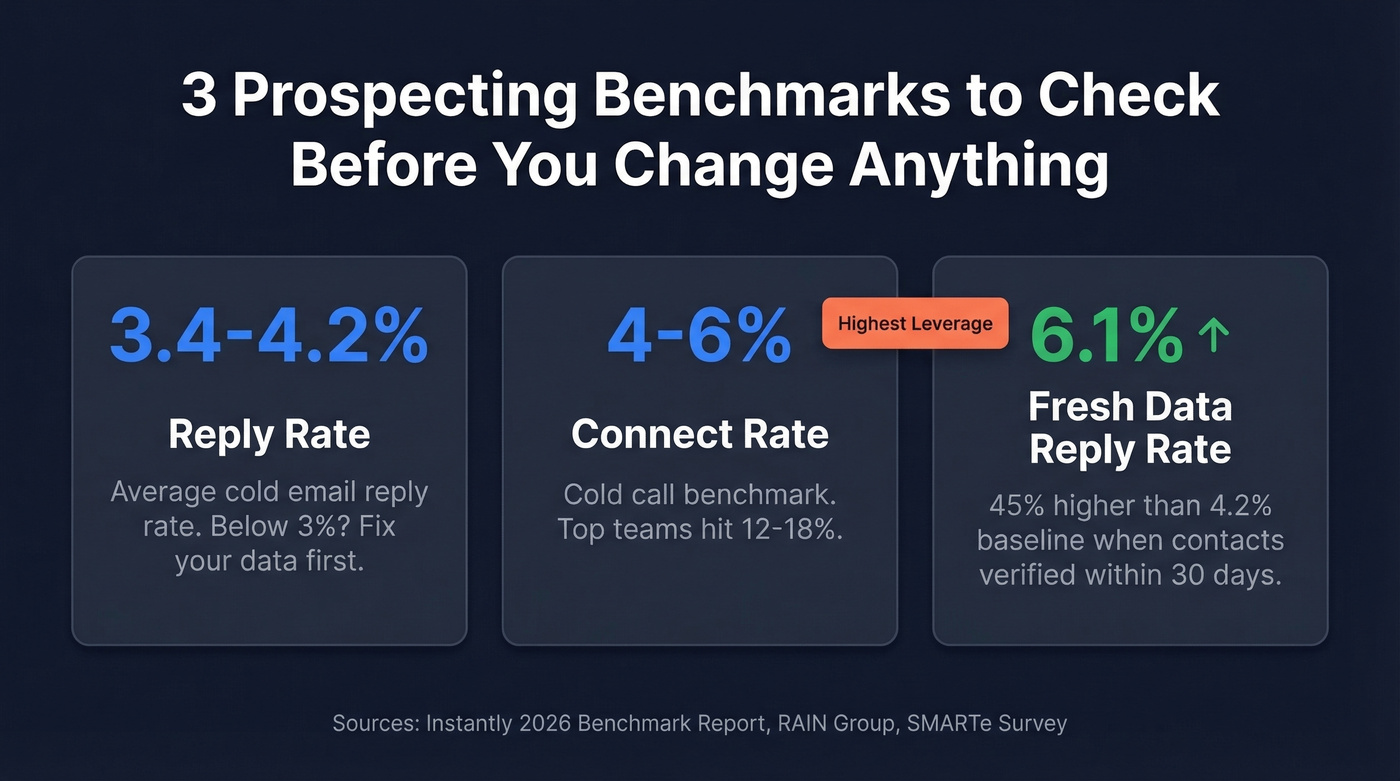
- Reply rate: 3.43-4.2% is average. Below 3%? Your list quality, offer, or deliverability needs attention first.
- Connect rate (cold call): 4-6% is a common benchmark range. Top teams hit 12-18%.
- Data freshness: Contacts verified within 30 days average 6.1% reply rates vs. 4.2% baseline - about 45% higher from the same sequences and CTAs.
Cold Email Prospecting Stats
The average cold email reply rate is 3.43% across billions of interactions on the Instantly platform. Elite campaigns (top 10%) exceed 10.7%. A separate survey of 1,200+ sales pros puts the average slightly higher at 4.2%, with only ~1.5% being positive replies - interest, not "remove me."
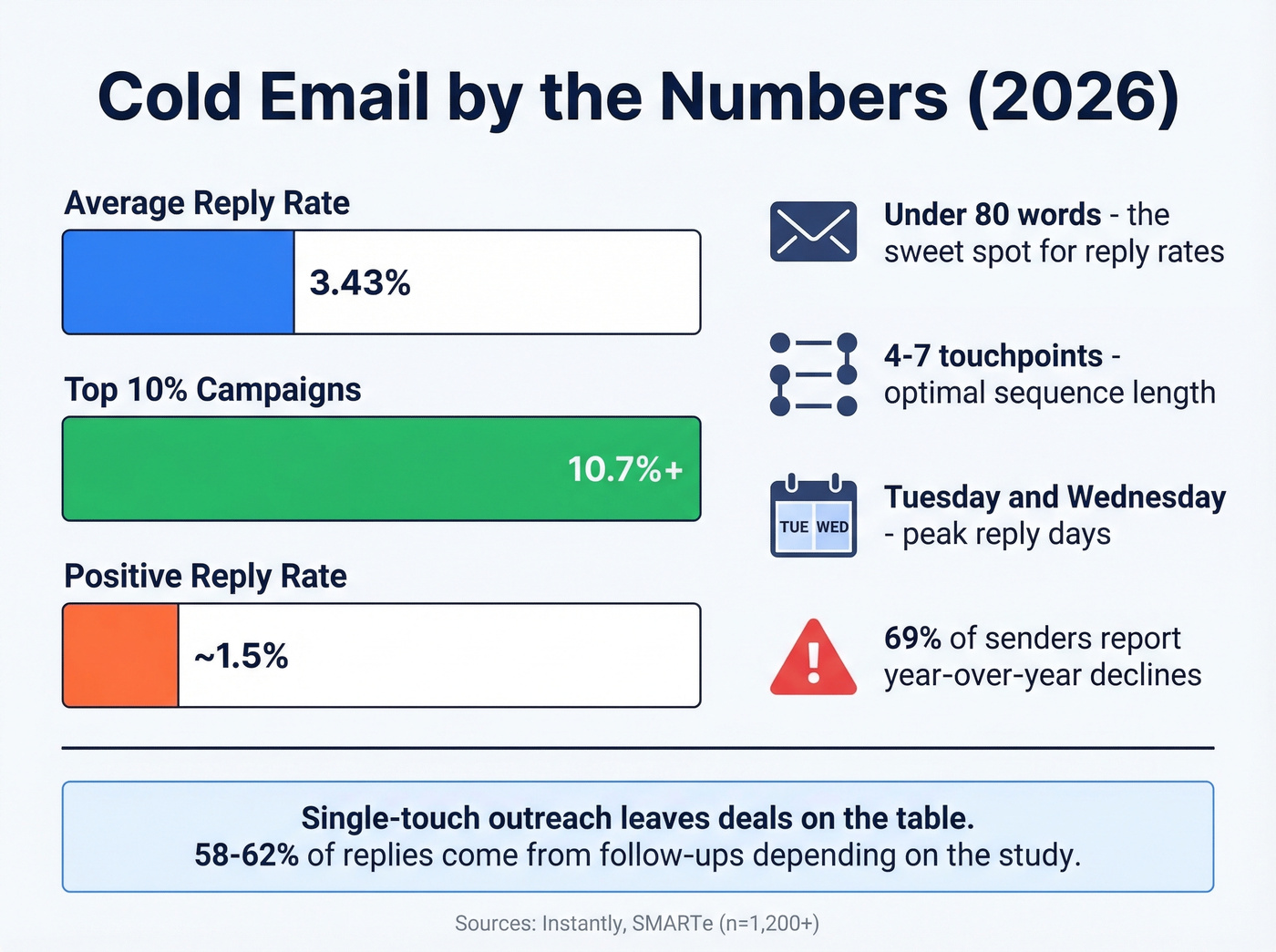
What separates the top quartile: brevity and persistence. Best-performing campaigns keep emails under 80 words. The sweet spot for sequence length is 4-7 touchpoints.
Sources disagree on where replies cluster - Instantly finds 58% from Step 1, while SMARTe's survey shows 62% from follow-ups - but the takeaway is the same: single-touch outreach leaves deals on the table. Tuesday and Wednesday are peak reply days, with Wednesday pulling the highest volume (see best time to send cold emails).
The headwinds are real, though. 69% of cold email senders report year-over-year performance declines due to spam filtering and AI-content fatigue. 48% report bounce rates between 2-5%, and 15% exceed 6%. Bounces damage your domain reputation, dragging down deliverability for every subsequent send (see email bounce rate). These numbers reflect a channel under pressure - but one that still rewards teams with clean data and tight copy.

Cold Calling Benchmarks
Cold calling isn't dead, but the math is brutal.
A common benchmark for connect rate is 4-6%, with top teams reaching 12-18%. Dial-to-meeting conversion runs at just 2.7% - roughly 37 dials to book one meeting. It takes 8-10 dials to reach a single decision-maker, and 41% of cold call attempts get blocked, filtered, or absorbed by gatekeepers.
Yet 57% of C-level buyers still prefer phone as a communication channel, and 37% of organizations say phone produces the most leads. The problem isn't that calling doesn't work - it's that most teams call with bad numbers and no warming. Pre-call warming through email or video touchpoints lifts connect rates 20-40%, which is the difference between an SDR booking 3 meetings a week and booking 5 (see warm calling).

41% of cold calls get blocked by gatekeepers, and connect rates sit at 4-6%. The fix isn't more dials - it's better numbers. Prospeo's 125M+ verified mobiles deliver a 30% pickup rate, turning 37 dials per meeting into real conversations with decision-makers.
Stop dialing dead numbers. Start connecting at 3x the industry rate.
Follow-Up and Persistence
In RAIN Group's research, 52% of sellers said it takes 5-10 touches to connect with a new prospect. Top performers in that research converted at 2.7x the rate of their peers and generated 1.8x higher-quality outcomes.
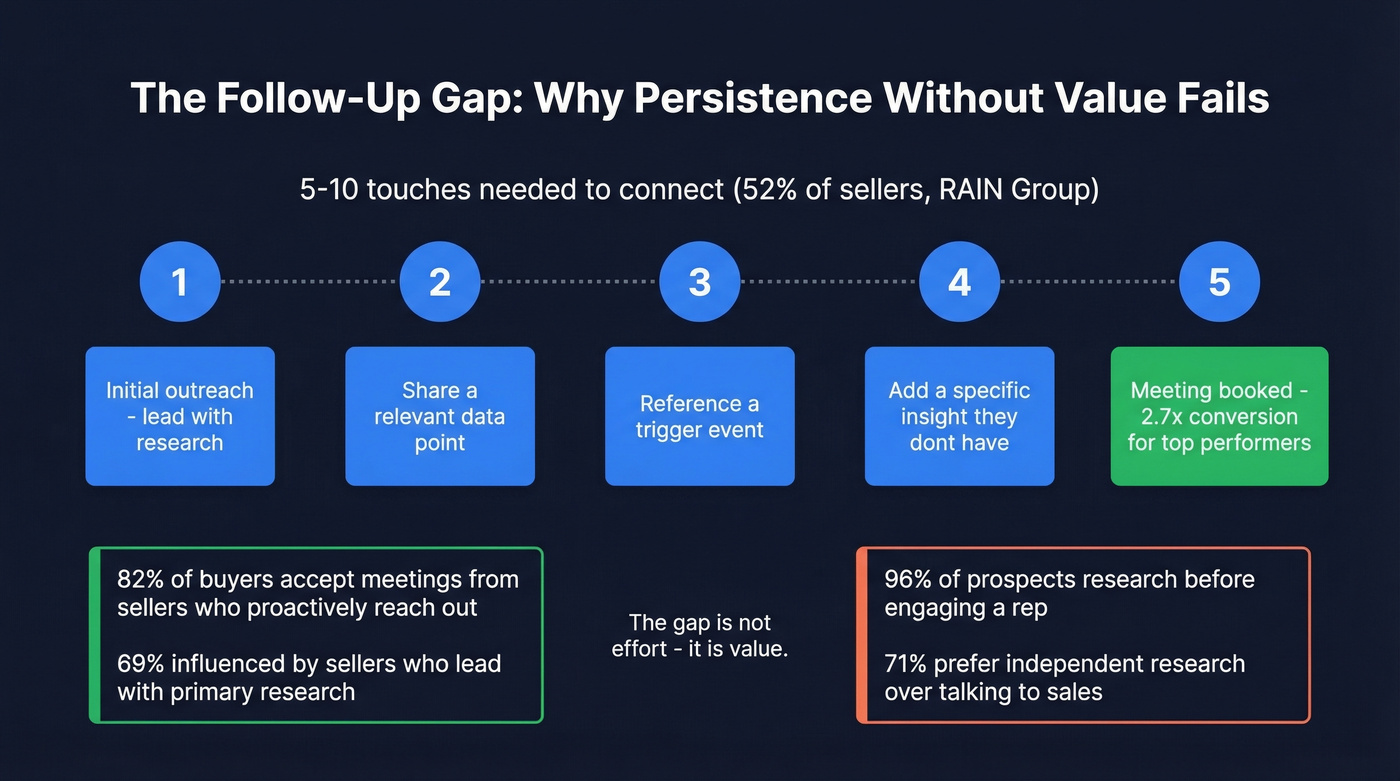
Here's the thing: 82% of buyers accept meetings from sellers who proactively reach out, and 69% are influenced by sellers who lead with primary research data. But 96% of prospects research before engaging a rep, and 71% prefer independent research over talking to a salesperson. The gap isn't effort - it's value. Each follow-up needs to add something new, not just "bumping this to the top of your inbox." (If you need copy ideas, start with these sales follow-up templates.)
We've seen this play out across our own outreach. The messages that get replies aren't the persistent ones - they're the ones where each touch adds a new data point, a relevant trigger event, or a specific insight the prospect didn't already have.
Sales Productivity and AI
Bain found sellers spend about 25% of their time actually selling to customers. Salesforce's State of Sales puts it even more bluntly: reps spend 60% of their time on non-selling tasks.
One SDR on r/sales described it perfectly: 15 tabs open, toggling between tools trying to find triggers and intel. That's not selling. That's data janitorial work.
Salesforce shared an internal example where an SDR agent created 3,200 opportunities in four months by working low-score leads that human reps had deprioritized. Bain's 2025 research found early AI successes driving 30%+ win-rate improvements - though they emphasize this requires process redesign, not just bolting AI onto existing workflows.
Look, here's what most vendors won't tell you: AI amplifies whatever data you feed it. If you're running stale lists through an AI SDR on deals under $10k, you're not automating growth - you're automating domain damage at scale. (More on this in our AI cold email outreach playbook.)
Data Quality: Where Prospecting Succeeds or Fails
This is where the entire prospecting equation either works or falls apart.
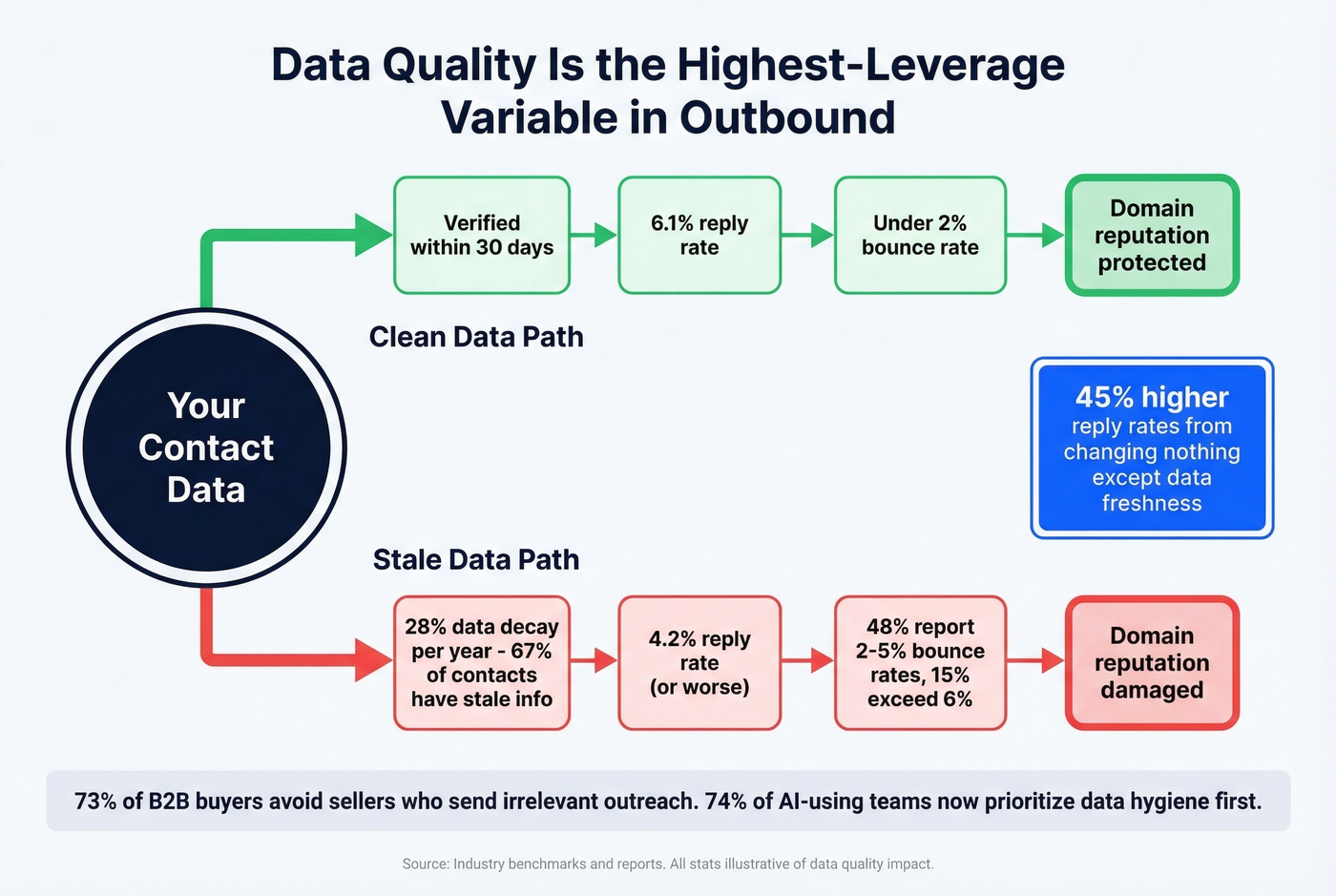
B2B contact data decays at 28% per year. Over twelve months, roughly a quarter of your database goes stale - wrong titles, wrong emails, wrong companies. 67% of contacted prospects had at least one stale data point. And 73% of B2B buyers actively avoid sellers who send irrelevant outreach - nothing screams "irrelevant" like emailing someone who left that company six months ago.
The impact is measurable. Campaigns using contacts verified within 30 days averaged 6.1% reply rates vs. 4.2% with older data. Same sequences, same CTAs - the only variable was data freshness. 74% of sales teams using AI are prioritizing data hygiene because they learned the hard way that automation without clean data just scales mistakes faster.
One Reddit user on r/sales documented their journey from 3% to 6% reply rates. The biggest lever? Stopping purchased lists and manually verifying contacts. Bounce rate dropped from 11% to under 2%. Total stack cost: ~$420/month for 16 qualified leads/month. That's roughly $26 per qualified lead from cold outreach - not bad when you consider the alternative is burning your domain sending to dead addresses.
Prospeo's 7-day data refresh cycle - compared to the 6-week industry average - and 98% email accuracy across 143M+ verified addresses exist to solve exactly this problem. The free tier gives you 75 verified emails per month, enough to test whether fresher contacts actually move your numbers. (If you're comparing vendors, see our guide to data enrichment services.)
What These Numbers Mean for Your Pipeline
Every stat in this article points to the same three actions - and they also reveal where outbound is heading over the next 12-24 months.
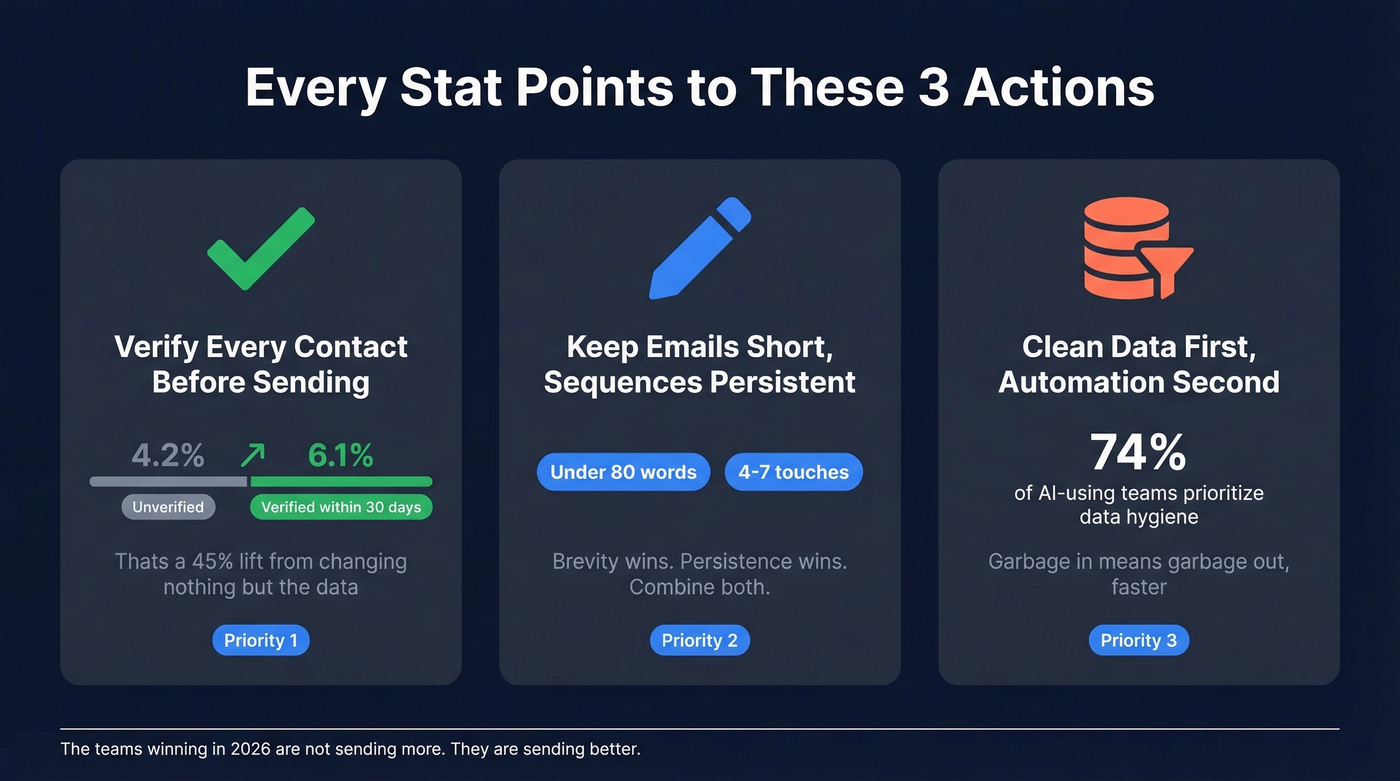
Verify every contact before sending. The 6.1% vs. 4.2% gap isn't subtle. That's about 45% higher reply rates from changing nothing except the data.
Keep emails under 80 words, sequences at 4-7 touches. Brevity wins. Persistence wins. Combine both.
Clean data first, automation second. The 74% of AI-using teams prioritizing data hygiene aren't doing it for fun - they learned that garbage in means garbage out, faster.
The future belongs to teams that treat data quality as infrastructure, not an afterthought. As AI agents handle more outreach execution, the competitive edge shifts entirely to who has the freshest, most accurate contact data feeding those systems. These sales prospecting statistics make one thing clear: the teams winning in 2026 aren't sending more. They're sending better. (For more tactics, see these sales prospecting techniques.)
You just read that contacts verified within 30 days get 6.1% reply rates vs. 4.2% with older data. Prospeo's 7-day refresh cycle and 98% email accuracy across 143M+ verified addresses mean your sequences hit real inboxes - not bounced addresses that torch your domain.
Fix your data quality first. Everything else gets easier after that.
FAQ
What's a good cold email reply rate in 2026?
The average cold email reply rate is 3.43% based on Instantly's 2026 benchmark report across billions of interactions; top 10% campaigns exceed 10.7%. If you're below 3%, audit your list quality and deliverability first - campaigns under 80 words consistently outperform longer ones.
How many follow-ups should you send?
Research shows 4-7 touchpoints is the sweet spot for cold outreach sequences. RAIN Group found 52% of sellers need 5-10 touches to connect with a new prospect. Each follow-up should add new value - a relevant stat, a case study, or a trigger event - not just a "checking in" nudge.
Does data quality actually affect prospecting results?
Contacts verified within 30 days average 6.1% reply rates vs. 4.2% with older data - a 45% lift from changing nothing but data freshness. A 7-day refresh cycle and real-time verification help teams maintain that edge without manual re-verification.
What are the most important prospecting metrics to track?
Three numbers matter most: reply rate (3.43-4.2% average), cold call connect rate (4-6% typical, 12-18% for top teams), and data freshness (30-day verified contacts lift replies ~45%). Reviewing these quarterly helps you spot pipeline problems before they compound.