

Sales Psychology Tactics That Actually Close Deals in 2026
A RevOps lead we know ran a cold email campaign last quarter deploying every sales psychology tactic in the book - loss aversion framing, social proof, a killer CTA. It bounced 23% on the first send. The psychology was perfect. The data underneath it wasn't. That's the gap nobody talks about: persuasion techniques only work when the execution layer - timing, targeting, data quality - actually delivers the message to a human being.
What You Need (Quick Version)
Most sales psychology guides recycle the same Cialdini principles (often taught as six, but the full framework is seven) without telling you how to use them on a cold call or in a proposal deck. This guide maps 12 data-backed persuasion techniques to the exact B2B moments where they work - and tells you when they backfire.
If you only master three: loss aversion framing, the authority credential play, and Unity (Cialdini's 7th principle that many articles still ignore).
Why Buyer Psychology Matters More Now
B2B buying behavior has shifted dramatically. 86% of B2B purchases stall, and 81% of buyers end up dissatisfied with the provider they chose. That's not a pipeline problem - it's a persuasion problem. Deals aren't dying because reps can't find prospects. They're dying because reps can't move prospects past the status quo.
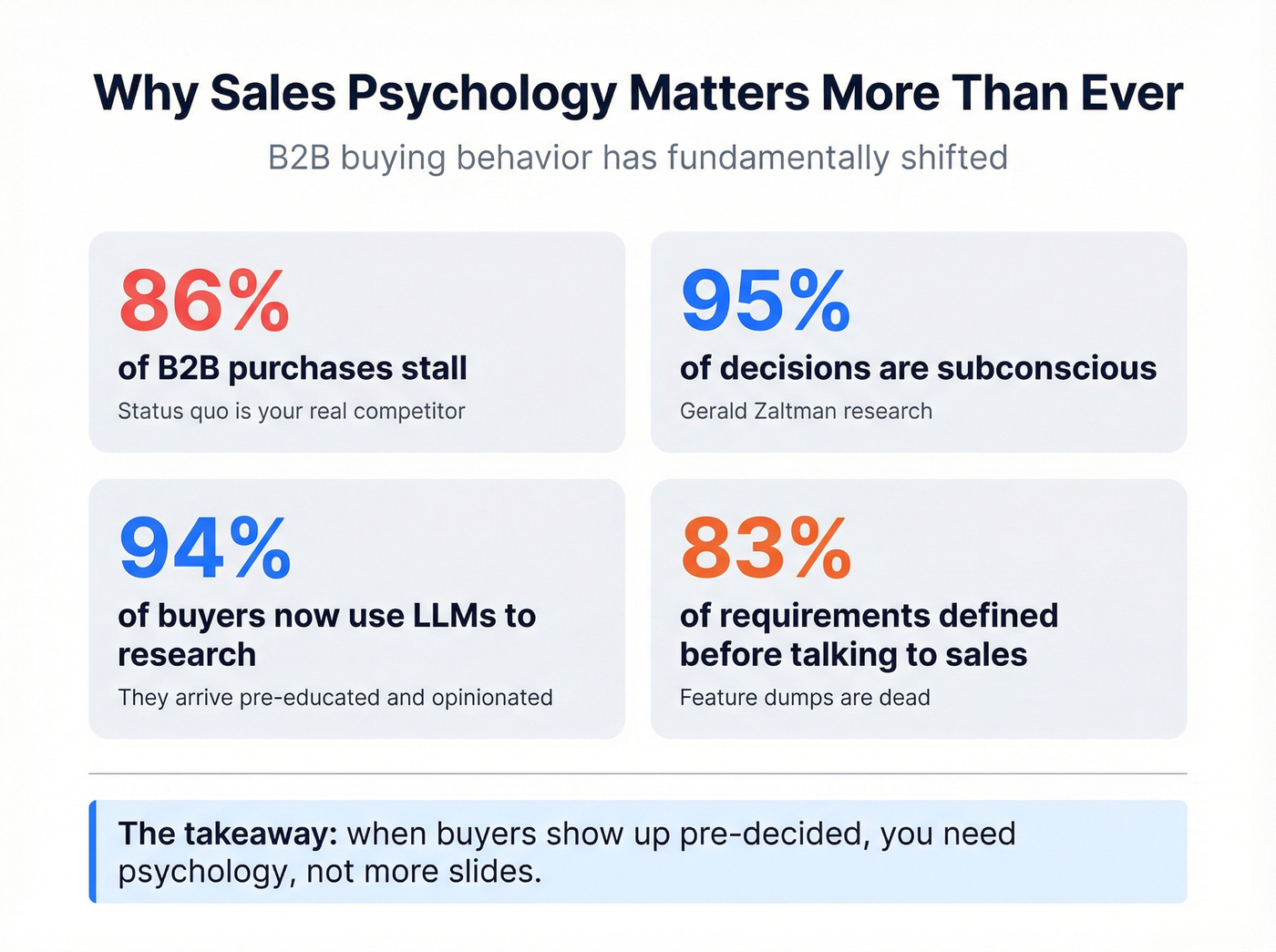
The window is shrinking too. Average sales cycle length dropped from 11.3 months to 10.1 months per 6Sense's B2B Buyer Experience Report, with 49% of buyers citing economic pressures as the reason. Meanwhile, 94% of buyers now use LLMs during their buying process - they show up more pre-educated and more opinionated than ever. Buyers define their requirements 83% of the time before they ever speak with sales, and first contact has moved from 69% to 61% of the buying journey.
Here's what that means: when buyers arrive pre-decided, the old "feature dump" pitch is dead. Gerald Zaltman found that 95% of purchase decisions happen subconsciously. You need to understand the cognitive shortcuts, the biases, the tribal instincts that drive a VP to pick vendor A over vendor B even when the feature sets are identical. That's what selling psychology rooted in real research gives you - a way to work with emotions without resorting to manipulation.
Most teams invest thousands in sales enablement content and zero in understanding how decisions actually get made. We've seen it over and over. The ROI on learning three psychology principles deeply will outperform your next five whitepapers combined.
The 7 Principles of Persuasion
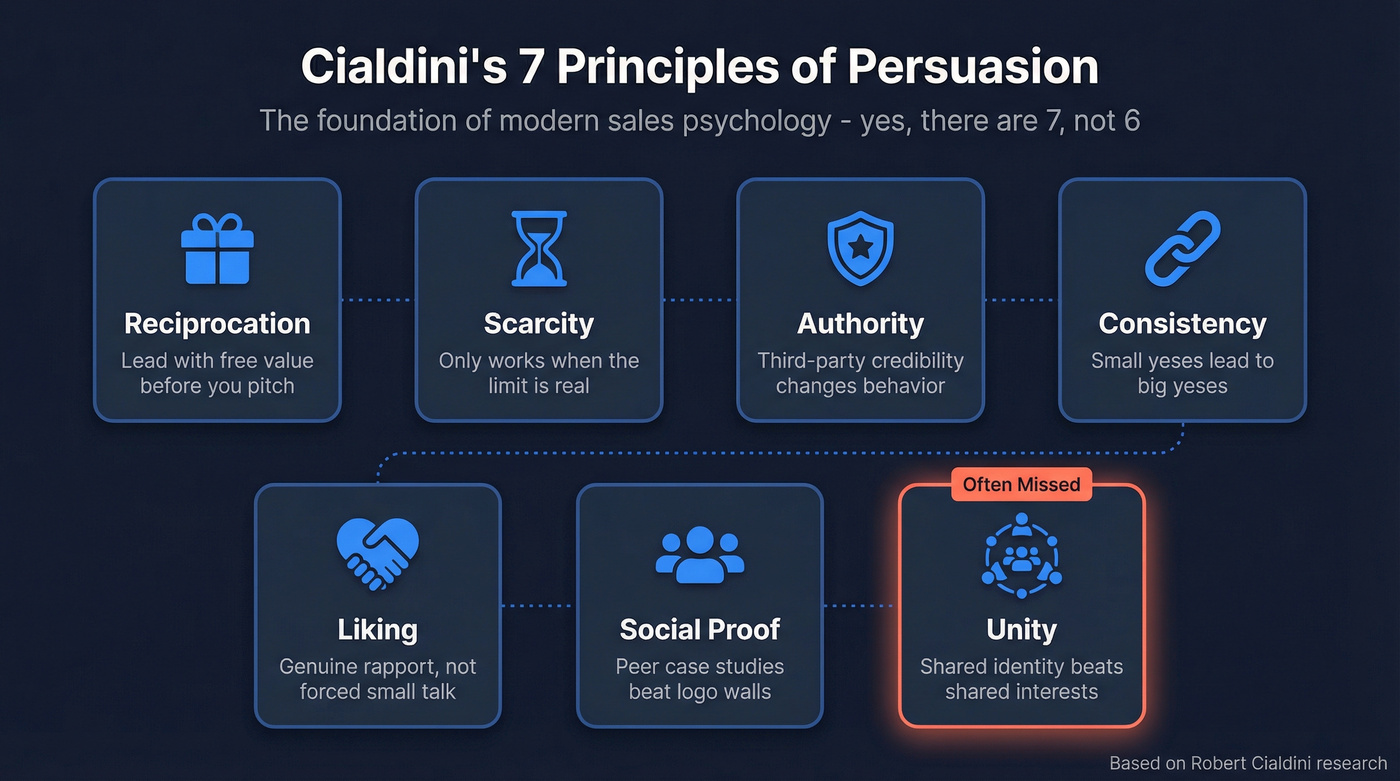
Robert Cialdini's framework is the foundation of modern selling psychology. Most articles cover six principles. There are actually seven. Here's each one with the data that makes it actionable.
Reciprocation
Give something valuable before you ask for anything. The classic study: restaurant servers who gave diners one mint with the bill saw tips increase roughly 3%. Two mints? About 14%. But the real number is the third condition - one mint, then the server returns and says "for you nice people, here's an extra mint." Tips jumped 23%.
The difference isn't the mint. It's the personalization and unexpectedness. In B2B, reciprocation means leading with a genuinely useful insight, a relevant benchmark, or a custom analysis before you pitch. Not a generic whitepaper gate. Something that makes the prospect think "this person actually did homework on my business."
Scarcity
Limited availability increases perceived value - but only when it's real. "Only 3 spots left in our Q2 onboarding cohort" is legitimate scarcity if your implementation team genuinely has capacity constraints. "Limited time offer!" on a SaaS product with infinite seats is transparent nonsense that erodes trust permanently.
Expert B2B buyers see through manufactured scarcity instantly, and the trust damage compounds across your entire brand.
Authority
Credibility signals change behavior more than most reps realize. In one real estate study, when reception staff mentioned the agent's credentials before transferring calls, the result was a 20% rise in appointments and a 15% increase in signed contracts. Nothing about the agent changed - only the introduction.
For B2B sellers, this means third-party validation matters enormously. Analyst mentions, published case studies, certifications, and even how your email signature reads all contribute to the authority frame.
Consistency and Commitment
People want to act consistently with what they've already said or done. Get a prospect to agree to a small, low-stakes commitment - a 15-minute call, a quick survey response, sharing their top priority - and they're psychologically primed to say yes to the next ask. Each yes makes the next yes easier because the prospect is now acting consistently with their self-image as someone who engages with your solution.
Liking
We buy from people we like. The mechanics are specific: mirroring speech patterns, finding genuine common ground, and using the prospect's name naturally in conversation. The key word is genuine. Forced rapport-building ("I see you went to Michigan - go Wolverines!") reads as manipulative. Authentic curiosity about the prospect's challenges reads as professional.
Social Proof
89% of consumers trust recommendations from people they know, and 72% of buyers say case studies are a key factor in their purchasing decisions. Social proof isn't optional in B2B - it's the single most powerful trust accelerator you have.
The hierarchy matters: peer recommendations beat analyst reports, which beat generic testimonials, which beat logo walls. A case study from a company that looks like the prospect's company, solving the same problem, carries far more weight than a Fortune 500 logo on your website.
Unity
This is Cialdini's 7th principle, and almost every article ignores it. Unity isn't the same as Liking. Liking is "I enjoy talking to this person." Unity is "this person is one of us." It's shared identity - tribal belonging.
In B2B, Unity sounds like "we're both dealing with this compliance nightmare" or "as fellow Series B operators, you know how this goes." When a prospect feels you're part of their in-group - same industry, same stage, same pain - resistance drops dramatically. It's the difference between an outsider selling to them and an insider helping them. This tactic is subtle but extraordinarily effective because it bypasses rational objections entirely.

Every tactic above - loss aversion, authority, Unity - falls apart when 23% of your emails bounce. Prospeo's 98% email accuracy and 7-day data refresh mean your perfectly crafted psychology actually lands in a real inbox, not a dead address.
Stop perfecting the pitch and failing on delivery. Fix the data first.
Advanced Tactics Beyond Cialdini
The seven principles are the foundation. These five techniques go deeper into the cognitive science that drives B2B decisions.
Pre-Suasion and Priming
What happens before your pitch matters as much as the pitch itself. Cialdini's pre-suasion research showed that when a furniture website displayed background images of clouds, visitors gravitated toward comfort-oriented products. Coins in the background? They prioritized price. Same products, different priming.
For sales, your opening frame - the first slide, the first question, the email subject line - sets the psychological context for everything that follows. Open with a cost-of-inaction frame, and the entire conversation tilts toward loss aversion. Open with a growth opportunity frame, and you're playing a different game entirely.
Loss Aversion and Prospect Theory
Kahneman and Tversky's 1979 research established that losses are felt approximately twice as intensely as equivalent gains. People who owned a mug demanded roughly $7 to sell it, while non-owners would only pay about $3 to buy it. Same mug - the endowment effect makes what you already have feel more valuable.
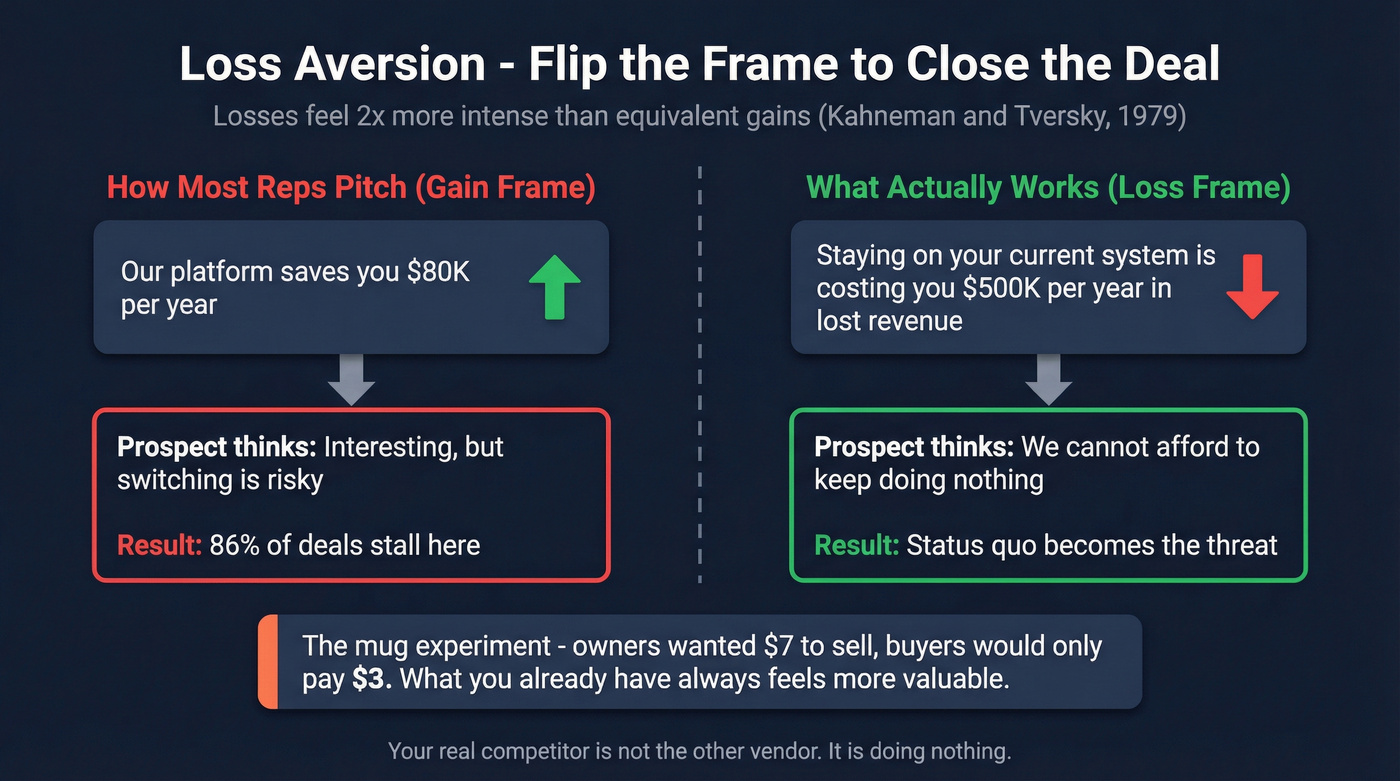
In B2B, the status quo is your real competitor - not the other vendor. That 86% deal-stall rate? It's loss aversion working against you. Prospects fear the disruption, learning curves, and political risk of switching more than they value your solution. Your job is to flip the frame: make staying the same feel like the bigger loss. Recognizing that this fear of change is the default state, not the exception, is where managing buyer emotions actually starts.
Anchoring in Proposals
The first number a prospect sees becomes the reference point for everything after. Smart sellers present the cost of inaction before the solution price. If the prospect's current problem costs $500K/year in lost revenue, your $80K solution feels like a bargain.
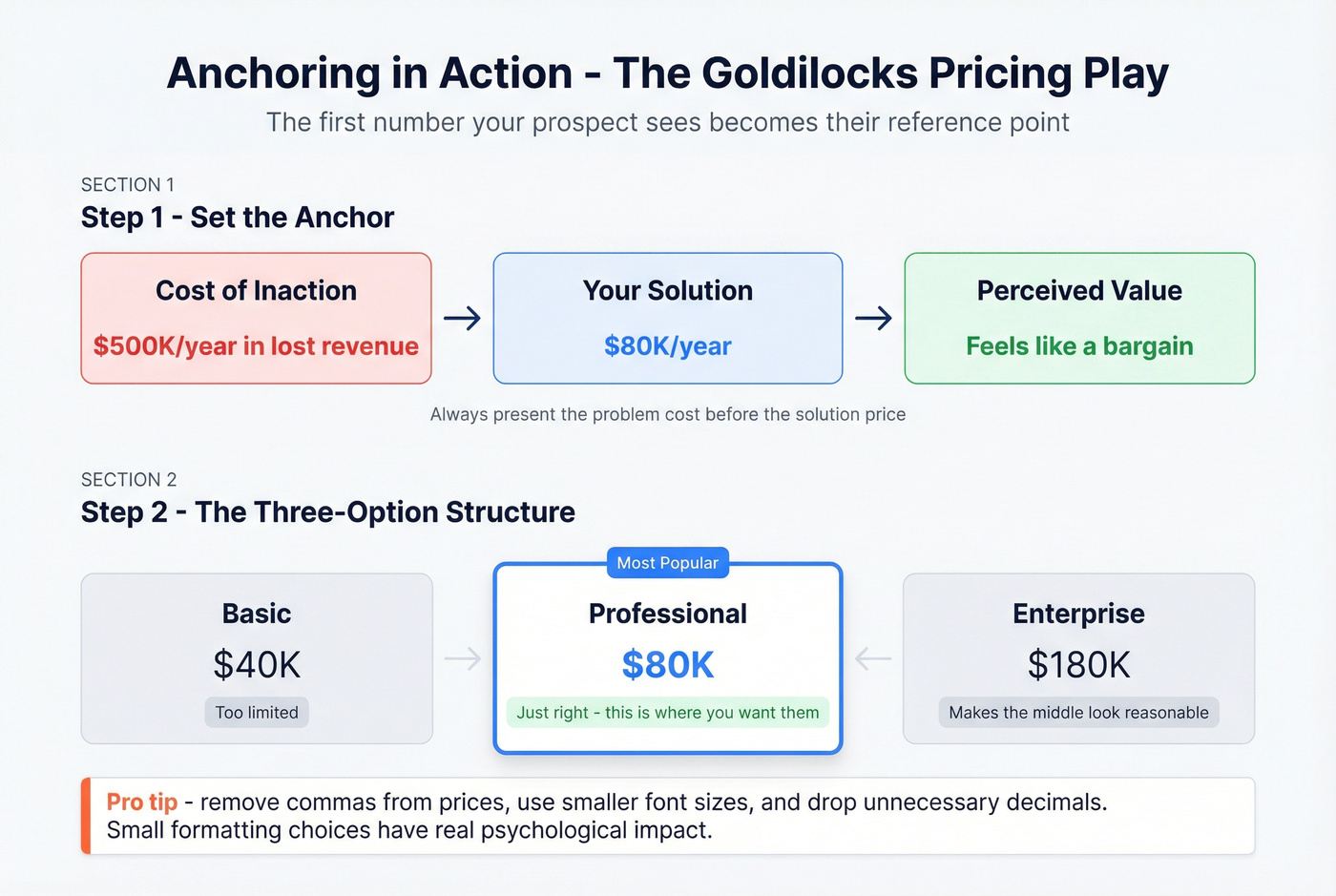
Three-option pricing (the Goldilocks structure) uses anchoring too. The premium tier makes the mid-tier look reasonable. Most buyers pick the middle - which is exactly where you want them.
One detail most guides miss: how you visually present the number matters. Removing commas, reducing font size on the price, and dropping unnecessary decimals all reduce the perceived magnitude of the cost. Small formatting choices, real psychological impact.
The Ben Franklin Effect
Ask someone for a small favor, and they'll like you more afterward. The person rationalizes the favor by deciding they must like you - otherwise, why would they help? In sales, this looks like asking a prospect for their opinion on an industry trend, requesting a quick introduction, or asking which of two case study formats they'd find more useful. (If you want scripts, the Ben Franklin Effect is a full playbook on this.)
The favor has to be small and genuine. Asking a VP to review your entire product roadmap is presumptuous. Asking for their take on a market shift is flattering.
Adaptive Selling
A 2026 SAGE Open study of 115 investment bank customers in Chile found that technical knowledge and adaptive selling behavior both significantly improve customer attitudes - and they reinforce each other. Reps who knew the product deeply and adapted their approach to the buyer's style outperformed on both dimensions.
The study also found that adaptive selling's impact was strongest with older buyers and female customers in that specific context. The takeaway isn't to stereotype - it's to pay attention to how each individual buyer processes information and adjust accordingly. One-size-fits-all pitches leave money on the table.
Tactics Mapped to B2B Moments
Theory is useful. Application is what closes deals. Let's map these persuasion techniques to the five moments that matter most.
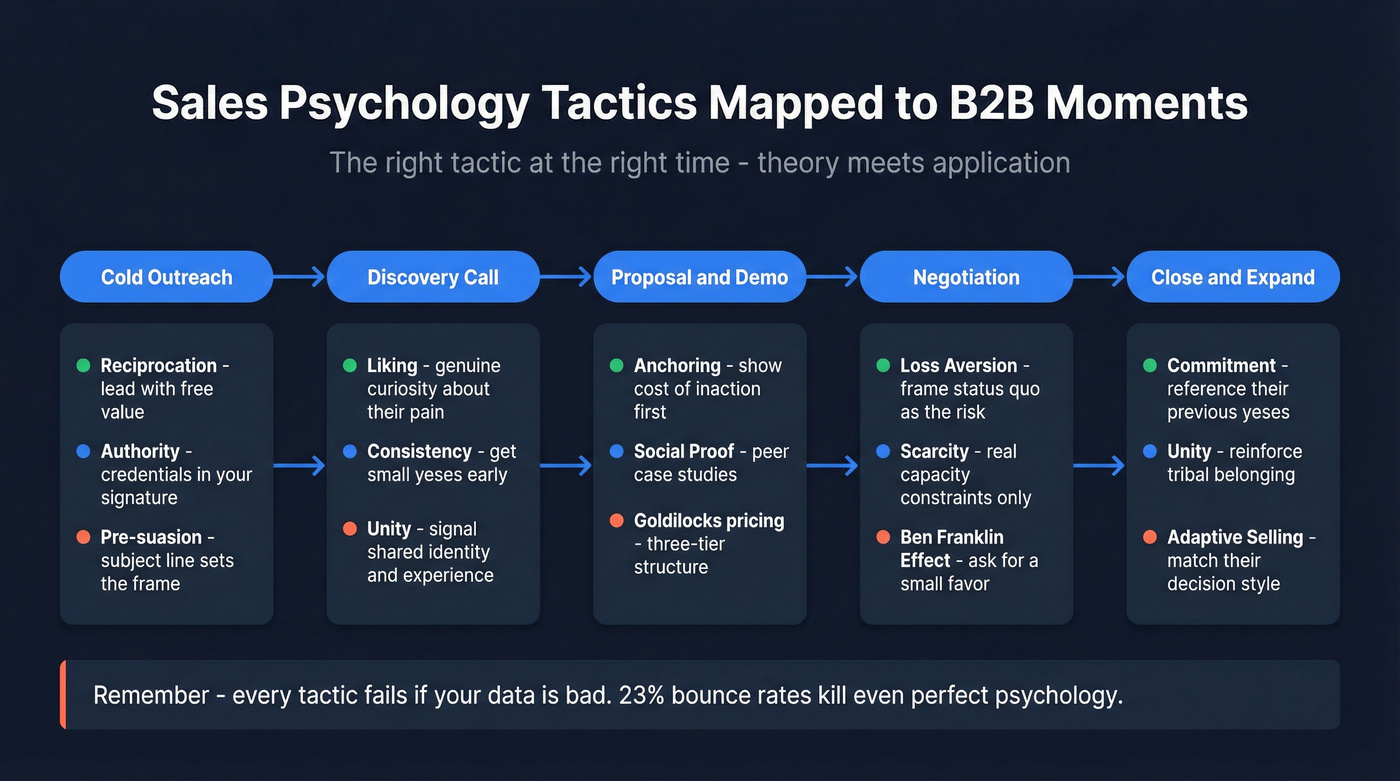
Cold Calls
The first seven seconds determine whether the prospect hangs up or listens. One approach that consistently performs: "May I have 27 seconds to tell you why I'm calling?" The specific number (not "a minute" or "a moment") signals respect for their time and gives them a sense of control.
Timing matters too. Intelemark's analysis found Wednesday shows a 65.6% success rate for starting real conversations - significantly higher than Monday or Friday. Stack your highest-value dials mid-week. (If you're building a repeatable motion, start with a cold calling system.)
Cold Emails
Subject line psychology drives open rates, but the body is where reciprocity does its work. Lead with something the prospect can use immediately - a relevant benchmark, a competitor insight, a specific observation about their business. The ask comes second. If you need a swipe file, use these email subject line examples to test angles fast.
Here's the thing: none of this matters if your email bounces. High bounce rates don't just waste that send - they damage your domain reputation and hurt deliverability for every future campaign. We've watched teams craft brilliant loss-aversion emails only to torch their sender score because 15% of the list was garbage. Prospeo's 98% email accuracy and 7-day data refresh cycle exist to solve exactly that problem. (For benchmarks and fixes, see bounce rates and sender reputation.)
Discovery and Demos
Anchor the cost of inaction before you ever show the product. "What's this problem costing you per quarter?" isn't just a discovery question - it's a pre-suasion frame that makes your price feel small by comparison.
The real key in discovery is diagnosing the buying motive. Most prospects cluster around five core motives, and each requires a different psychological frame. Pitching gain to a fear-motivated buyer is like speaking the wrong language. Here's how to diagnose each one (more in-depth discovery questions help here):
- Fear (avoiding a bad outcome): "What happens to the team if this isn't solved by Q3?"
- Gain (capturing upside): "What would hitting that number mean for your team's trajectory?"
- Prestige (looking good internally): "Who gets credit when this initiative succeeds?"
- Security (reducing risk): "What would need to be true for you to feel confident in this decision?"
- Convenience (saving time): "How many hours per week does your team spend on this manually?"
Match your demo narrative to the motive you uncover. A fear-motivated buyer needs to see the cost of inaction. A prestige-motivated buyer needs to see the internal win.
Proposals
87% of B2B buyers check prices before contacting suppliers - they already have an anchor in their head. Your job is to reframe it. Use perceptual contrast: present the most expensive option first, then the recommended option. The contrast makes the recommended tier feel like a smart deal rather than a big expense.
Loss-frame your ROI section. Instead of "you'll gain $400K in efficiency," write "you're currently losing $400K annually to manual processes." Same number, twice the psychological impact. Three-option pricing structures work because they give the buyer a sense of agency - they're choosing, not being sold to.
Negotiations
Principled negotiation (Fisher and Ury's framework) outperforms positional bargaining in B2B because it preserves the relationship. Know your BATNA (best alternative to a negotiated agreement) and frame it early - not as a threat, but as context. "We're evaluating three vendors" is a BATNA signal that shifts the power dynamic without burning bridges. (If you want a deeper breakdown, use this guide on anchoring in negotiation.)
When Persuasion Backfires
We've seen teams memorize every tactic in this article and still blow deals - because they applied the wrong technique to the wrong buyer at the wrong moment.
CXL's Intention-Outcome Matrix is the best framework for understanding this. It maps tactics across two axes: your intention (help the buyer vs. exploit the buyer) and the outcome (positive vs. negative). The dangerous quadrant is "good intention, bad outcome" - where a well-meaning tactic backfires because you misjudged the audience.
The Dunning-Kruger effect is the biggest risk with expert buyers. Overconfident selling triggers immediate skepticism from someone who knows the domain better than you do. IBM solved this with their "Experts at IBM" program - when the seller is outmatched technically, bring in a product expert who can engage as a peer. Acknowledging your limits actually increases credibility with sophisticated buyers.
And fake scarcity? It doesn't just fail - it destroys trust permanently. A prospect who catches you manufacturing urgency won't believe anything you say again. The reputational damage extends beyond that one deal to every future interaction with that account and their network. Skip scarcity entirely if you can't point to a real constraint.
Quick-Reference Checklist
| Tactic | When to Use | Example Action | Risk |
|---|---|---|---|
| Reciprocity | Cold email, first touch | Lead with free insight | Low |
| Scarcity | Proposal, close | Real capacity limits | Med |
| Authority | Intro, cold call | Third-party credential | Low |
| Consistency | Discovery, follow-up | Micro-yes questions | Low |
| Social Proof | Demo, proposal | Peer case study | Low |
| Unity | Discovery, negotiation | "We" language, shared pain | Low |
| Loss Aversion | Demo, proposal | Cost-of-inaction frame | Med |
| Anchoring | Proposal, pricing | Three-option structure | Med |
| Pre-Suasion | Opening of any touch | Frame before the pitch | Low |
| Ben Franklin Effect | Discovery, relationship | Ask for small favor | Low |
| Adaptive Selling | All stages | Match buyer's style | High |
| Buying Motive Diagnosis | Discovery | Motive-specific questions | Low |
Step zero before any outbound campaign: verify your prospect list. Bad data breaks the persuasion chain before it starts. (If you're evaluating vendors, start with data enrichment services.)
Social proof and authority only work when you reach the right decision-maker. Prospeo gives you 300M+ verified profiles with 30+ filters - buyer intent, job changes, tech stack - so your psychology targets the VP who can actually sign, not a gatekeeper who can't.
Reach real buyers for $0.01 per email. No contracts, no gatekeeping.
FAQ
What's the most effective tactic for B2B deals?
Loss aversion framing consistently outperforms other approaches. Losses hit roughly twice as hard as equivalent gains, per Kahneman and Tversky's foundational research. Frame your pitch around what the prospect loses by not acting - revenue leakage, competitive disadvantage, compounding inefficiency - then anchor the cost of inaction before presenting your solution price.
Is using psychology in sales manipulative?
CXL's Intention-Outcome Matrix draws a clear line: persuasion helps buyers make decisions that genuinely benefit them, while dark patterns exploit cognitive biases for the seller's gain. If the buyer would thank you for the nudge after the deal closes, you're on the right side. If they'd feel tricked, you've crossed it.
How many techniques should a rep actually master?
Three, mastered deeply, beats twelve applied superficially. Pick the ones that match your selling motion - loss aversion for enterprise, reciprocity for outbound, social proof for competitive deals - and drill them until they're instinct. Most reps who try to deploy every tactic end up sounding scripted, which is the fastest way to trigger skepticism from a buyer who's heard it all before.
How does data quality affect persuasion outcomes?
Bad data breaks the chain before psychology gets a chance. A bounced email or wrong number signals you don't know who the prospect is - the opposite of authority and liking. Prospeo's 7-day refresh cycle and 98% email accuracy ensure your outreach reaches the right person, so the techniques you've built into your messaging actually land.