

What Is a Sales System? How to Build One in 2026
Your VP asks why pipeline is down 30%. The CRM says one thing, the reps say another, and the forecast spreadsheet hasn't been updated since last quarter. Nobody can answer the question because every rep tracks deals differently, half the contact data is stale, and the "process" lives in three people's heads.
This isn't a tool problem. It's a sales system problem.
What You Need (Quick Version)
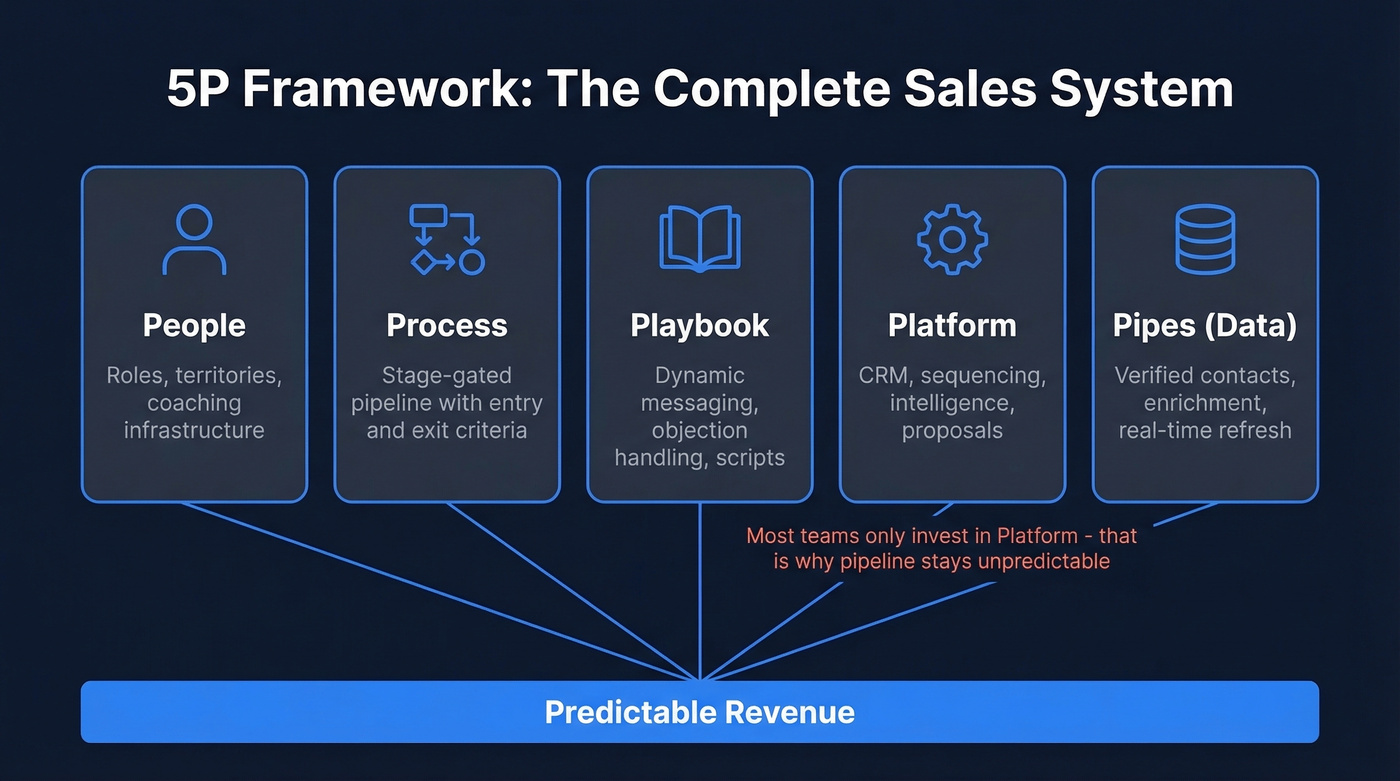
A sales system has five layers - what we call the 5P Framework: People, Process, Playbook, Platform (technology), and Pipes (data). Most teams only invest in the platform layer. They buy a CRM and call it done, then wonder why pipeline is unpredictable.
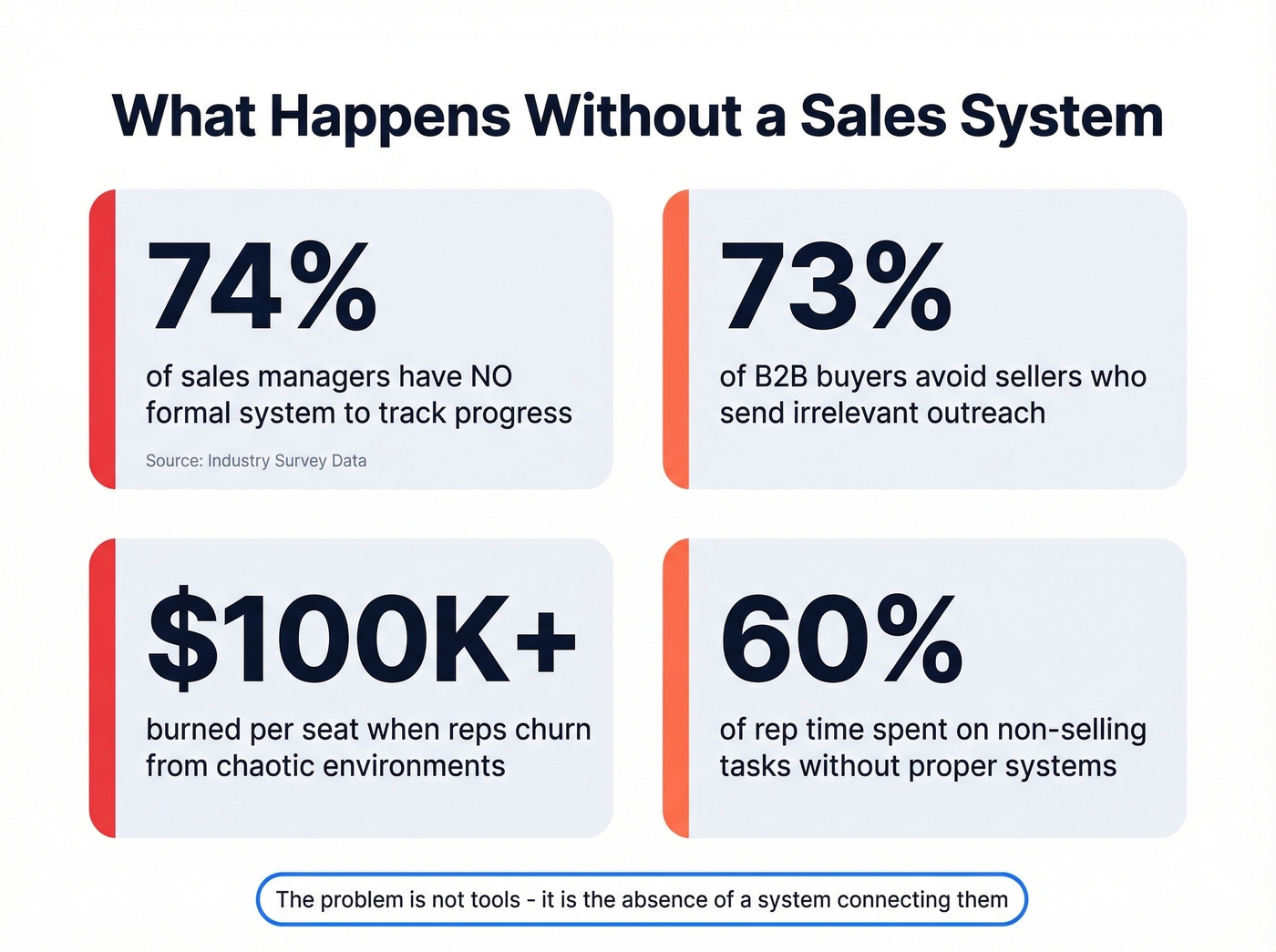
The rest of this guide walks through all five pillars with specific tools, benchmarks, and a build sequence you can follow this quarter. The short version: document your process first, pick a CRM that matches it (not the other way around), and plug in a data layer so your reps aren't wasting outreach on dead contacts. Reps already spend 60% of their time on non-selling tasks. A real system fixes that. A CRM alone doesn't.
What Is a Sales System, Exactly?
Every CRM company wants you to believe their tool is your revenue engine. It's not. A CRM is one technology component inside a broader system - the same way an engine is one part of a car. You still need a chassis, wheels, fuel, and someone who knows how to drive.
A sales system is the complete architecture governing how your team finds, qualifies, advances, and closes deals. It includes the people doing the work, the process they follow, the playbook guiding their conversations, the technology that automates and tracks, and the data feeding everything. When all five layers work together, pipeline becomes predictable instead of chaotic.
| Sales System | CRM | SFA | |
|---|---|---|---|
| Scope | End-to-end revenue engine | Customer lifecycle tool | Pre-sale pipeline execution |
| Goal | Predictable revenue | Maximize CLV | Increase sales velocity |
| Key users | Entire revenue org | Sales, CS, marketing | Sales reps, managers |
| Key metrics | All of the below | Churn, NPS, CLV | Cycle length, conversion |
One quick note: if you searched expecting point-of-sale hardware for a retail store, that's a different world entirely. POS systems handle checkout and inventory. This guide is about B2B sales infrastructure - prospecting, pipeline, forecasting, and closing.
What Happens Without One
Only 26% of sales managers have a formal system in place to track progress. The other 74% run on tribal knowledge and hope.
Missed targets become the norm. Without standardized stages and KPIs, forecasting is guesswork. Reps sandbag or over-commit, and leadership can't tell which until it's too late.
Performance is wildly inconsistent. Your top rep closes at 35%. Your bottom rep closes at 8%. Without a system, you can't diagnose why - and you definitely can't transfer what works.
Onboarding takes forever. New reps shadow a senior hire for a few weeks, absorb whatever habits that person has (good and bad), and take 6+ months to ramp. Only 15% of SMBs even prioritize customers based on their potential, so new hires waste cycles on the wrong accounts from day one. Turnover climbs because reps who can't hit quota in a chaotic environment leave, and then you start the hiring-onboarding cycle again, burning another $100K+ per seat.
Buyers punish you for it. 73% of B2B buyers actively avoid sellers who send irrelevant outreach. And 57% of sales professionals say cycles are getting longer. After a decade of "automation" promises, most teams bought tools without building a system - and buyers can tell.
The 5P Framework
People
Your system is only as good as the humans running it. That means clear role definitions - who prospects, who closes, who manages accounts - realistic territory assignments, and coaching infrastructure.
Here's the uncomfortable stat: 96% of salespeople are coachable, but managers have only 44% of the skills necessary to coach effectively. The gap isn't talent. It's that most orgs treat management as a promotion reward rather than a skill set requiring its own training.
Process
A documented, stage-gated sales process is the backbone. Every deal moves through defined stages with clear entry and exit criteria. Your CRM must match your process - not the other way around. We've seen teams contort their entire sales motion to fit default pipeline stages in whatever CRM they bought. That's backwards.
Define your stages first. Map the leading KPIs for each: calls booked, demos completed, proposals sent, contracts out. Then configure your CRM to reflect reality.
Playbook
A sales playbook captures what your best reps do and makes it repeatable. The shift in 2026 is from static playbooks - PDFs gathering dust in a shared drive - to dynamic playbooks embedded in your CRM that surface contextual guidance by deal stage, industry, and persona.
A complete messaging framework covers 12 elements: purpose, vision, mission, values, problem statement, value proposition, brand story, elevator pitch, boilerplate, key messages, tone guidelines, and style vocabulary. You don't need all 12 on day one, but the best playbooks show up when and where reps need them, not as a 40-page document they read once during onboarding and never open again. (If you need examples, steal from these elevator pitch templates.)
Technology
Technology is the pillar everyone over-invests in and under-configures. Your stack should include a CRM, an engagement/sequencing tool, a conversation intelligence platform, a proposals tool, and a data layer. Five categories, not one mega-platform.
The trap is tool sprawl. Teams buy Salesforce, then Outreach, then Gong, then ZoomInfo, then Clari - suddenly spending $200+/user/month with data flowing in six directions and nobody trusting any of it. Fewer tools, better configured, beats a bloated stack every time.
Data (Pipes)
84% of data and analytics leaders say AI outputs are only as good as the data inputs. Sales leaders estimate 19% of company data is inaccessible. If your CRM is full of stale emails, wrong titles, and duplicate records, every tool built on top of it - forecasting, sequencing, intent scoring - produces garbage.
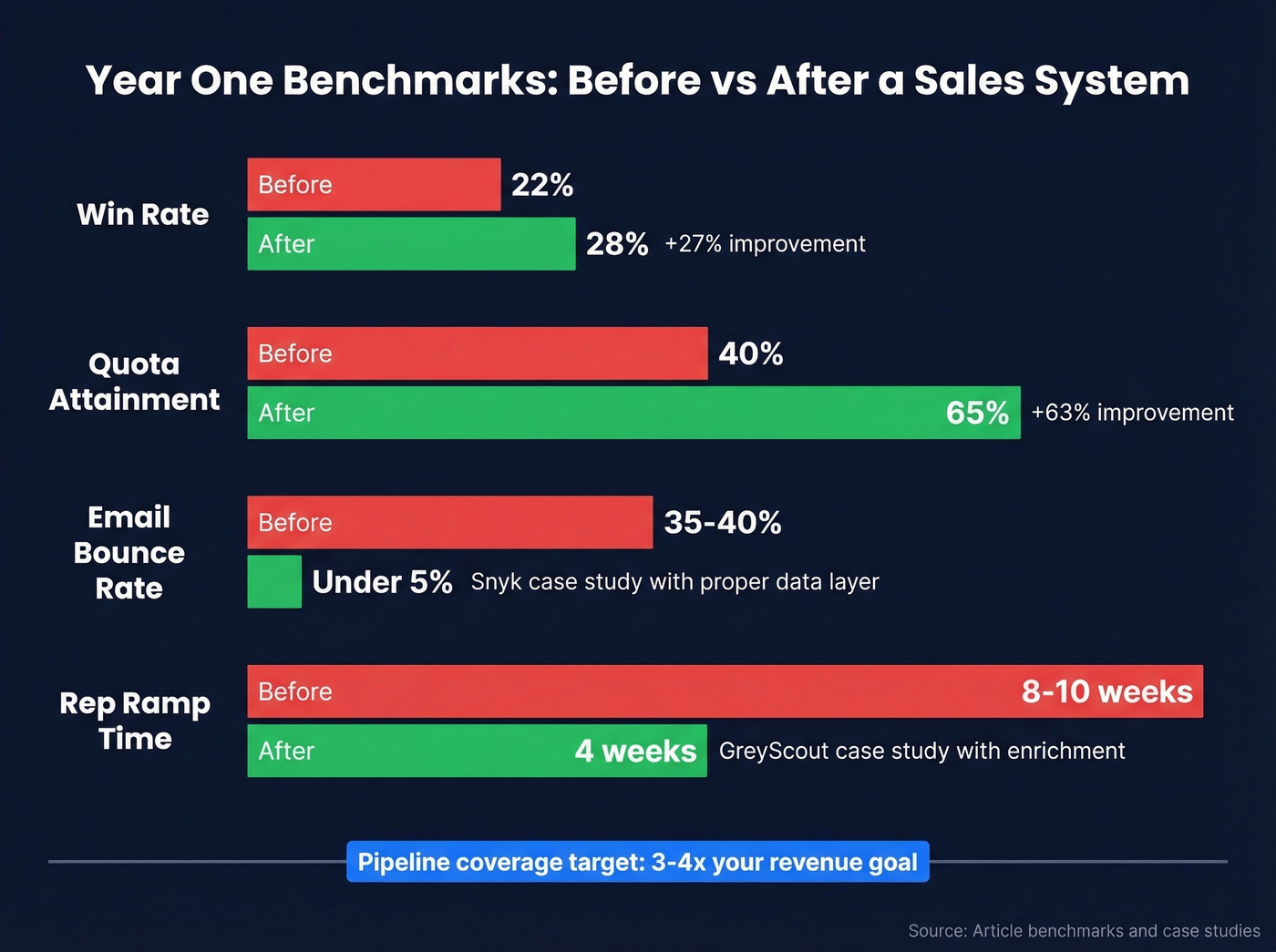
Your data layer needs real-time verification and a refresh cycle as close to weekly as possible. When Snyk plugged a proper data enrichment layer into their workflow, bounce rates dropped from 35-40% to under 5%, and AE-sourced pipeline jumped 180%. (If you're evaluating vendors, start with these data enrichment options.)


You just read that 84% of leaders say AI outputs are only as good as data inputs - and 19% of company data is inaccessible. Prospeo's 5-step verification delivers 98% email accuracy with a 7-day refresh cycle, so every layer of your sales system runs on data you can trust. Snyk cut bounce rates from 35% to under 5% and grew AE-sourced pipeline 180%.
Stop building your sales system on stale data.
Choose Your Sales Methodology
Most teams don't fail because they picked the wrong methodology. They fail because they picked none.
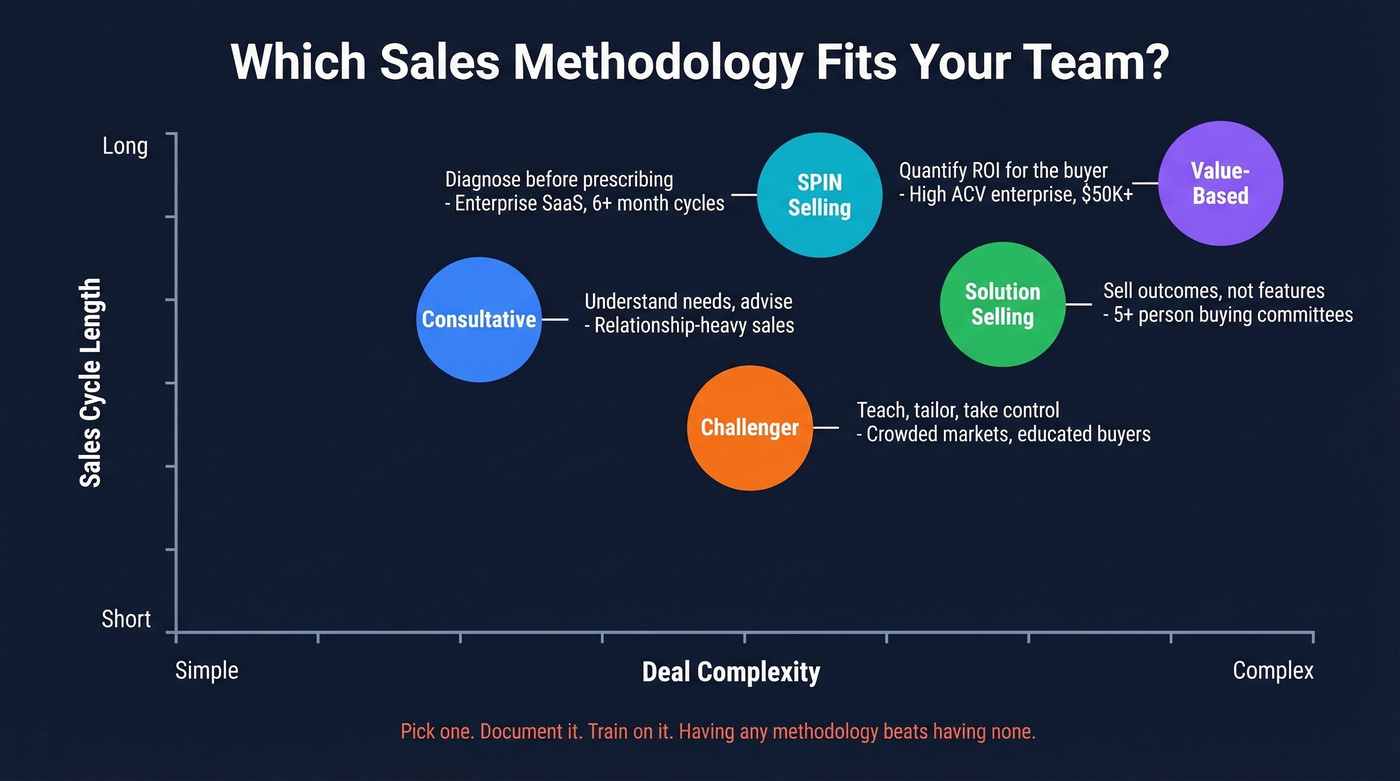
| Methodology | Core Idea | Best For | Watch Out For |
|---|---|---|---|
| SPIN Selling | Diagnose before prescribing | Enterprise SaaS, 6+ month cycles | Can feel formulaic if scripted |
| Challenger | Teach, tailor, take control | Crowded markets with educated buyers | Requires deep industry knowledge |
| Consultative | Understand needs, advise | Services and relationship-heavy sales | Too slow for transactional deals |
| Solution Selling | Sell outcomes, not features | IT/services with 5+ person buying committees | Needs strong discovery skills |
| Value-Based | Quantify ROI for the buyer | High-ACV enterprise ($50K+) | Requires financial fluency |
Pick one. Document it. Train on it. You can evolve later, but having a methodology that every rep follows beats having five reps using five different approaches. The methodology becomes the language your team speaks - it's how they talk about deals in pipeline reviews and how managers coach.
How to Build a Sales System
Audit What You Have
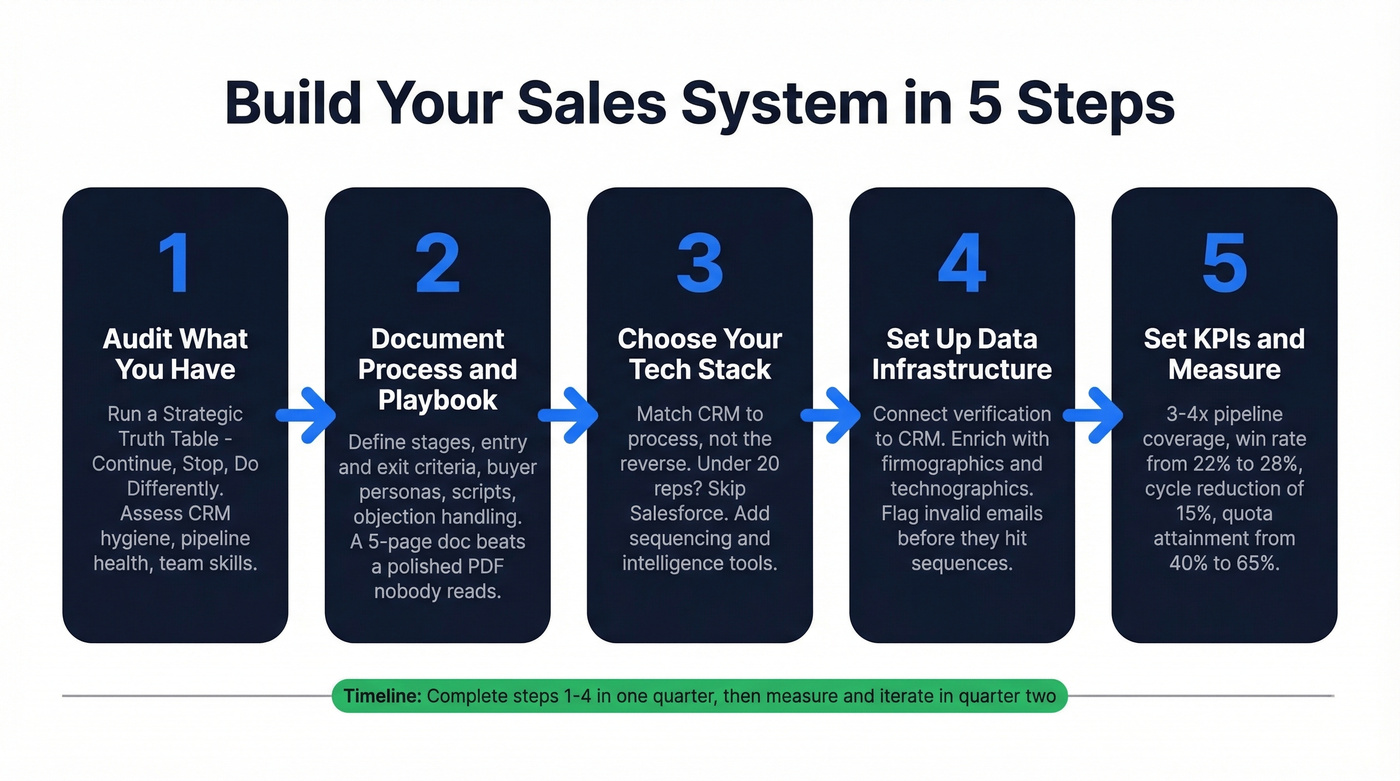
Before you buy anything, run a Strategic Truth Table across your current operation:
- Continue - what's working and should stay.
- Stop - what's actively hurting you.
- Do Differently - what exists but needs rethinking.
Audit performance metrics, pipeline health, CRM hygiene, team skills, and market positioning. Be honest. Most teams discover they have more tools than they need and less process than they think. (If you want a tighter diagnostic, start with pipeline health metrics.)
Document Process and Playbook
Write down your sales stages. Define what "qualified" means. Build a playbook that includes buyer personas, scripts, product positioning, process stages, objection handling, and a messaging framework. A 5-page Google Doc that every rep actually reads beats a polished PDF nobody opens. (For faster iteration, keep sales battle cards updated by stage.)
Choose Your Tech Stack
Match your CRM to your process, not the reverse. If you have fewer than 20 reps, an enterprise CRM like Salesforce is almost certainly overkill - Pipedrive or Close will get you moving faster at a fraction of the cost. Add an engagement tool (Smartlead, Instantly, or Lemlist for outbound; Outreach or Salesloft for larger teams) and conversation intelligence if your deal sizes justify it. (If you're comparing options, here are examples of a CRM with real pricing.)
Set Up Your Data Infrastructure
Connect a verification tool to your CRM. Enrich records with contact data, firmographics, and technographics. Flag invalid emails before they ever hit a sequence. (If bounces are a recurring issue, use these email bounce rate benchmarks and fixes.)
When GreyScout built their data infrastructure with real-time enrichment, rep ramp time dropped from 8-10 weeks to 4 weeks because new hires weren't wasting their first month cleaning lists. That's a real, measurable return on a step most teams skip entirely.
Set KPIs and Measure
Pipeline coverage should run 3-4x your revenue target. Aim for win rate improvement from 22% to 28% in year one, cycle reduction of ~15%, and quota attainment moving from 40% to 65%. Measure playbook ROI through ramp time, win rate on comparable deals, and deal velocity. If you can't measure it, you can't improve it - and you definitely can't prove to your CFO that the system is working. (Use these sales operations metrics to standardize reporting.)
Sales System Software in 2026
| Tool | Category | Starting Price | Best For | Key Strength |
|---|---|---|---|---|
| Prospeo | Data & Prospecting | Free; ~$0.01/email | Data accuracy, enrichment | 98% accuracy, 7-day refresh, 300M+ profiles |
| Pipedrive | CRM | $14/seat/mo | SMB visual pipeline | Simple UI, fast setup |
| HubSpot Sales Hub | CRM | Free; paid from ~$30/mo | Growing teams | Free tier depth |
| Salesforce | CRM | ~$75-150/user/mo | Enterprise, complex orgs | Customization |
| Close | CRM | ~$49/user/mo | Outbound-first teams | Built-in calling + email + SMS |
| Zoho CRM | CRM | Free tier available | Budget SMBs | Value for money |
| Gong | Intelligence | ~$100-150/user/mo | Call coaching | Conversation analytics |
CRM Layer
Pipedrive is the obvious pick for teams under 20 reps who want a visual pipeline without six months of implementation. At $14/seat/mo on annual billing, it's hard to beat on value. HubSpot's free CRM supports up to 1M contacts and is genuinely useful, though it gets expensive once you need heavier automation and reporting. Salesforce is powerful, but a realistic mid-market deployment runs $75-150/user/mo once you factor in plan level and the modules you actually need. Close is purpose-built for outbound teams that want calling, email, and SMS inside the CRM, with activity logged automatically.
Here's our hot take: if your average deal size is under $10K, you probably don't need Salesforce-level infrastructure. The teams we've seen get the best ROI spend less on their CRM and more on their data layer and rep enablement. A $14/seat CRM with clean data outperforms a $150/seat CRM full of garbage contacts every single time. (If you're implementing Salesforce anyway, read this Salesforce pricing breakdown first.)
Data and Prospecting Layer
This is where most systems quietly fail. You can have the best CRM and the slickest sequences, but if 30% of your emails bounce, nothing else matters.
Prospeo covers 300M+ professional profiles with 98% email accuracy and 143M+ verified emails, plus 125M+ verified mobile numbers with a 30% pickup rate. Intent data across 15,000 topics lets you prioritize accounts showing buying signals. At roughly $0.01/lead, it's up to 90% cheaper than ZoomInfo with higher accuracy - 98% vs 87% on emails. When Meritt switched their data layer, pipeline tripled from $100K to $300K/week and bounce rates dropped from 35% to under 4%. (To pressure-test your list-building, use these sales prospecting techniques.)

ZoomInfo and Cognism are viable if you're enterprise and need deep ABM orchestration, but for most teams, better data at a fraction of the cost wins.
Intelligence and Engagement
Gong leads conversation intelligence - it earned a spot on the G2 2026 Best Sales Software list, which saw 60% turnover from 2025. PandaDoc and Consensus also made the top 5, worth evaluating if proposals or demo automation are bottlenecks.
For engagement, Outreach and Salesloft dominate enterprise at around $100-150/user/month. Smartlead and Instantly own the SMB outbound space at $30-99/month. The pattern is clear: pick one sequencer, commit to it, and make sure it talks to your CRM.
For teams under 10 reps: Pipedrive or Close + one data tool + one outreach tool. That's the whole stack.
For solopreneurs: HubSpot free CRM can be $0.
The ROI of Getting This Right
The sales automation market was valued at roughly $9.25B as of 2024 and is growing 8-10% annually - putting it north of $10.5B by now. Companies adopting automation see 10-15% efficiency gains and 5-10% revenue lifts. For every $1 invested in automation, the average return is $8.
But automation amplifies whatever system you have. If your process is broken, you'll just break it faster. If your data is bad, you'll send bad outreach at scale. The teams that see real returns built the system first and then automated it. 91% of companies with 10+ employees use a CRM. Far fewer have an actual system around it.
Solopreneurs vs. Scaling Teams
| Solo Operator | Scaling (10+ Reps) | |
|---|---|---|
| CRM | HubSpot Free or Airtable Free | Pipedrive or Salesforce |
| Data | Free tier (75 emails/mo) | Paid data platform, weekly refresh |
| Outreach | Lemlist or Instantly starter | Outreach or Salesloft |
| Intelligence | Skip it for now | Gong or similar |
| Monthly budget | $0-50 | $75-150/user all-in |
The consensus on r/sales is that HubSpot feels overwhelming for one person managing everything. Fair. If that's you, start with Airtable's free tier for tracking and a simple sequencing tool. Your entire system takes an afternoon to set up.
For teams scaling past 10 reps, the investment pays for itself if it cuts ramp time by even two weeks - that's two weeks of quota-carrying capacity you'd otherwise lose per hire. Whether you're a solo founder or leading a growing org, the principle is the same: get the foundation right before you layer on complexity. (If you're building onboarding, start with a 30-60-90 day plan for reps.)
The 5P Framework falls apart without the Pipes layer. Most teams spend $200+/user/month on CRMs and sequencers, then feed them garbage contacts. Prospeo gives you 143M+ verified emails at $0.01 each, 125M+ verified mobiles, and 30+ filters - intent, technographics, job changes - so your reps sell instead of scrubbing spreadsheets.
Build the data foundation your sales system actually needs.
FAQ
Is a CRM the same as a sales system?
No. A CRM is one technology component inside a complete system that also includes people, process, playbook, and data. Buying Salesforce doesn't give you a sales system any more than buying a stove makes you a chef. The CRM tracks - the system drives.
How much does a sales system cost?
Anywhere from $0 to $300+/user/month depending on team size. Solopreneurs can run a free CRM and a free data tier for nothing. Most SMB teams build a complete stack for $50-100/user/month. Enterprise setups with Salesforce, Gong, and ZoomInfo push past $200/user/month.
What's the difference between a sales system and a POS system?
A POS (point-of-sale) system handles retail transactions - checkout, inventory, payments. A B2B sales system manages pipeline - prospecting, deals, forecasting, and customer relationships. Completely different worlds, same search term.
How long does it take to build one?
A minimum viable setup - documented process, configured CRM, connected data tool - can be running in 2-4 weeks. A mature system with playbooks, KPIs, coaching loops, and optimized automation takes 2-3 quarters to fully operationalize. Start small, iterate fast.
What's the most important layer?
Process. Technology amplifies whatever process you have - good or bad. Document your stages, define what "qualified" means, and standardize handoffs before you buy any software. We've seen teams spend $50K on tools and skip the $0 step of writing down how they sell. Don't be that team.