

Sales Technologies: What Actually Works in 2026 (and What's Burning Your Budget)
Your VP of Sales just forwarded a Gartner report and asked you to "audit the stack." You open the billing dashboard and count 14 subscriptions. Three people use the $40K intent platform. The SDR team built a workaround in Google Sheets because the engagement tool doesn't talk to the CRM properly. Sales technologies are supposed to make your team faster - instead, they've become the bottleneck.
Here's the thing: half the salestech content online is written by vendors citing their own research to sell their own product. This guide isn't that. What follows is the categories that move pipeline, the benchmarks that justify (or kill) your spend, and a framework for cutting the fat.
What You Need (Quick Version)
If you're building or auditing a sales tech stack in 2026, start with three tools:
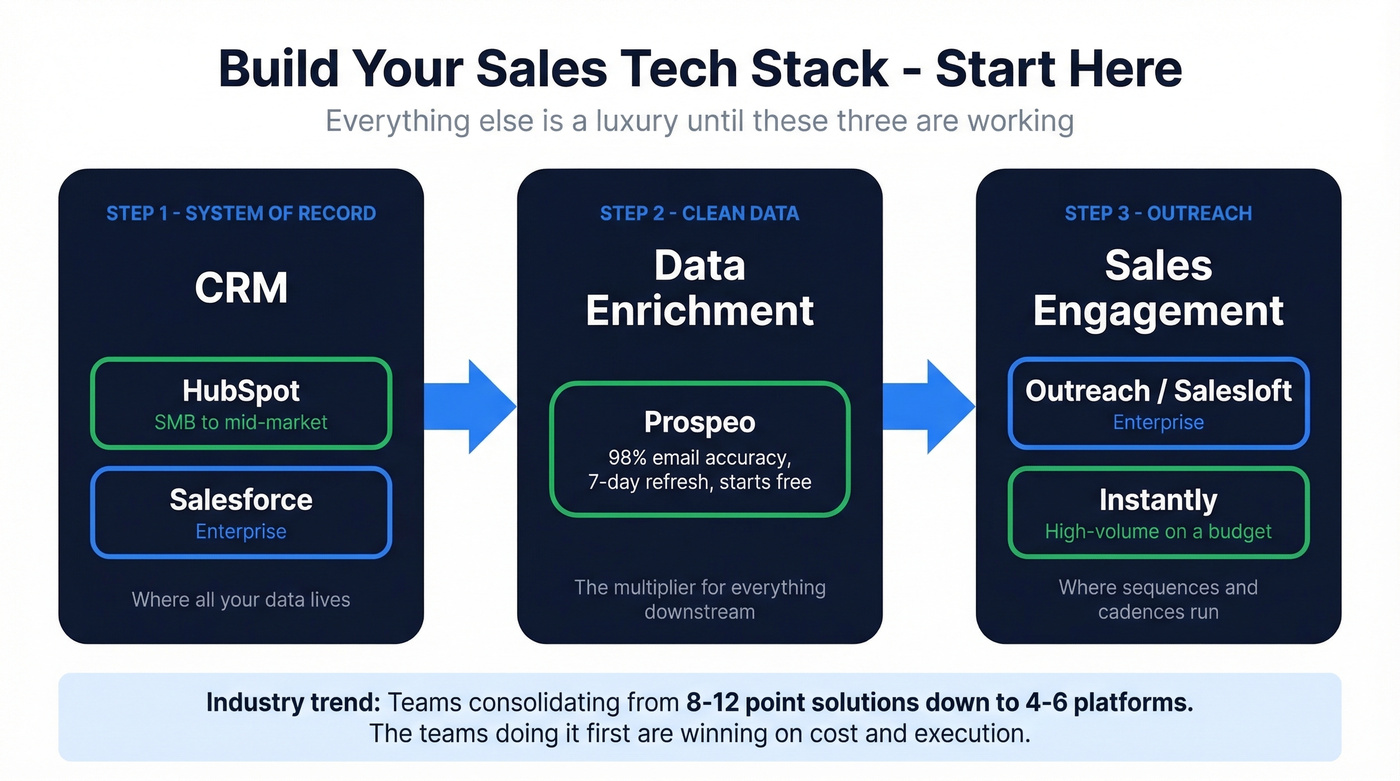
- CRM: HubSpot or Salesforce. This is your system of record. Everything connects here. (If you’re comparing options, see examples of a CRM.)
- Data enrichment: Prospeo. 98% email accuracy, 7-day data refresh, and pricing that starts free. Clean data is the multiplier for everything else in your stack. (More: data enrichment services.)
- Sales engagement: Outreach or Salesloft for enterprise. Instantly if you're running high-volume outbound on a budget. (Implementation guide: sales engagement platform.)
Everything else is a luxury until those three are working. The industry is consolidating from 8-12 point solutions down to 4-6 platforms, and the teams doing it first are winning on both cost and execution.
What Are Sales Technologies?
Sales technologies span any software that helps revenue teams find, engage, close, and retain customers - from your CRM to the AI agent drafting follow-up emails at 2 AM.
The market is massive. Global spending on sales tech exceeds $30B annually, and it's still growing. Gartner forecasts worldwide IT spending will hit $6.08 trillion in 2026, up 9.8% year-over-year, with software specifically climbing 15.2% - driven largely by GenAI features getting baked into tools you already own. That means your existing subscriptions are getting more expensive whether you asked for AI or not.
The challenge isn't finding solutions. There are 300+ vendors worth knowing about. The challenge is building a stack where the pieces compound instead of creating overhead, and that's what separates B2B sales teams that hit quota from teams that just have nice dashboards. (Related: sales process optimization.)
Why Sales Tech Matters - The Numbers
Let's talk ROI, because "sales tech matters" is a meaningless statement without benchmarks.
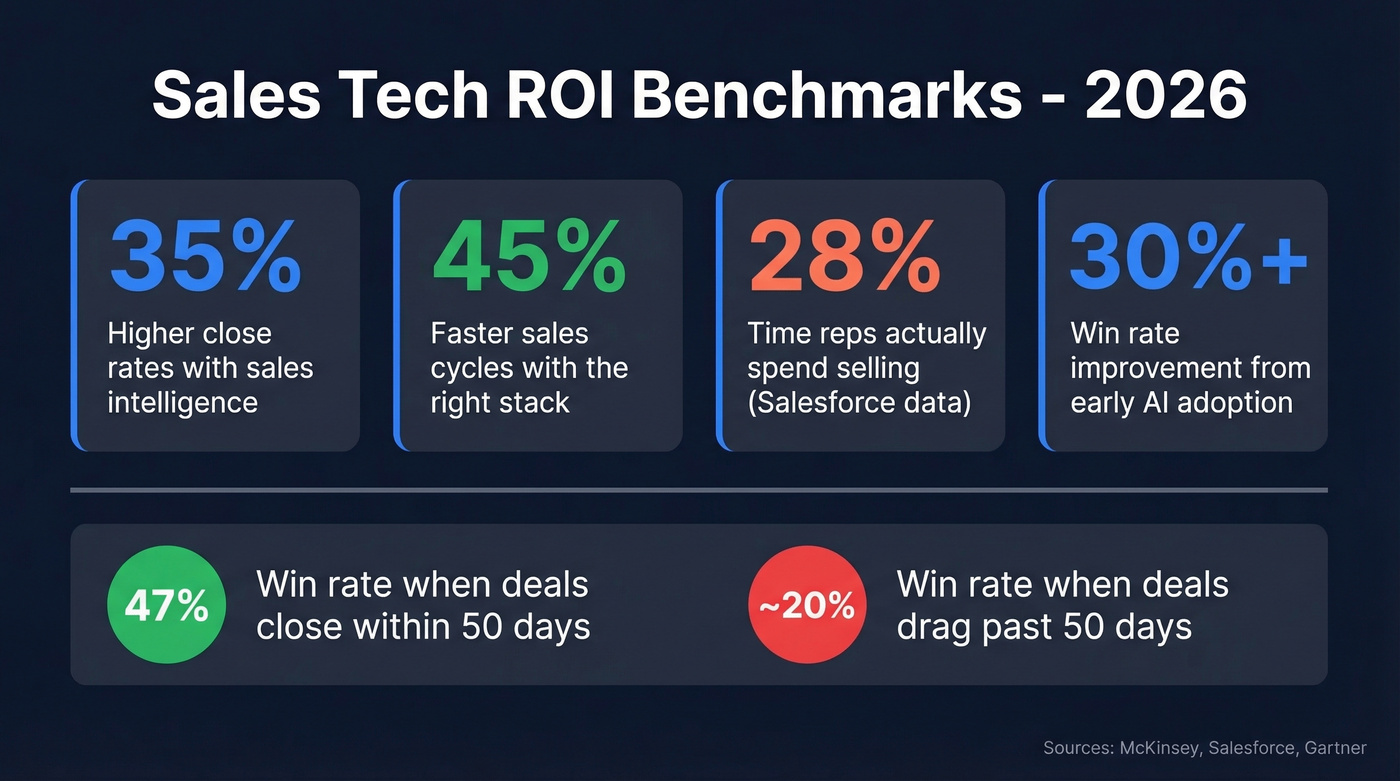
McKinsey research shows next-generation revenue tools drive 5-10% higher sales and 10-20% productivity gains. Companies using sales intelligence see 35% higher close rates and 45% faster sales cycles. Those aren't marginal improvements - that's the difference between hitting plan and missing by a mile.
Speed matters more than most teams realize. Deals closed within 50 days carry a 47% win rate. Push past 50 days and that number drops to roughly 20%. Every day your reps spend toggling between tools, cleaning bad data, or waiting on enrichment is a day that drags win rates down. Sellers spend about 25% of their time actually selling to customers - Salesforce's own research puts it at 28%. Either way, it's abysmal. (If you want to fix the follow-up side, start with sales follow-up templates.)
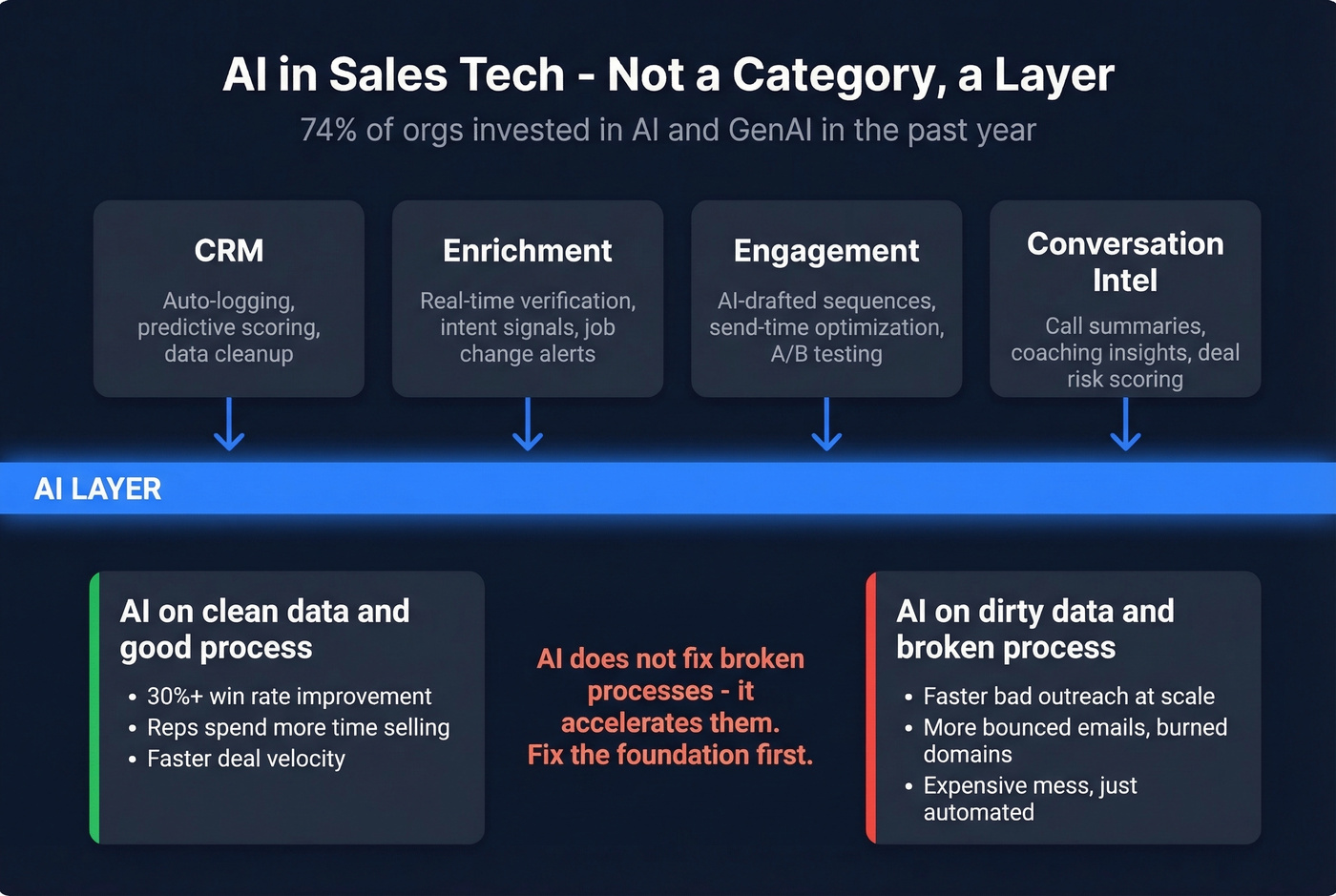
The AI angle is real, too. 74% of organizations invested in AI and GenAI over the past year - 20 percentage points higher than the next most popular tech investment category. Early AI adopters in sales are seeing 30%+ improvement in win rates, not from magic, but from freeing reps to spend more time on actual selling.
None of these gains are automatic, though. AI doesn't fix broken processes - it accelerates them. If your data is dirty, your sequences are generic, and your CRM is a graveyard of stale records, throwing AI on top just makes the mess faster. The foundation has to be right first. (More on the tooling layer: generative AI sales tools.)
The 8 Core Categories of Sales Tech
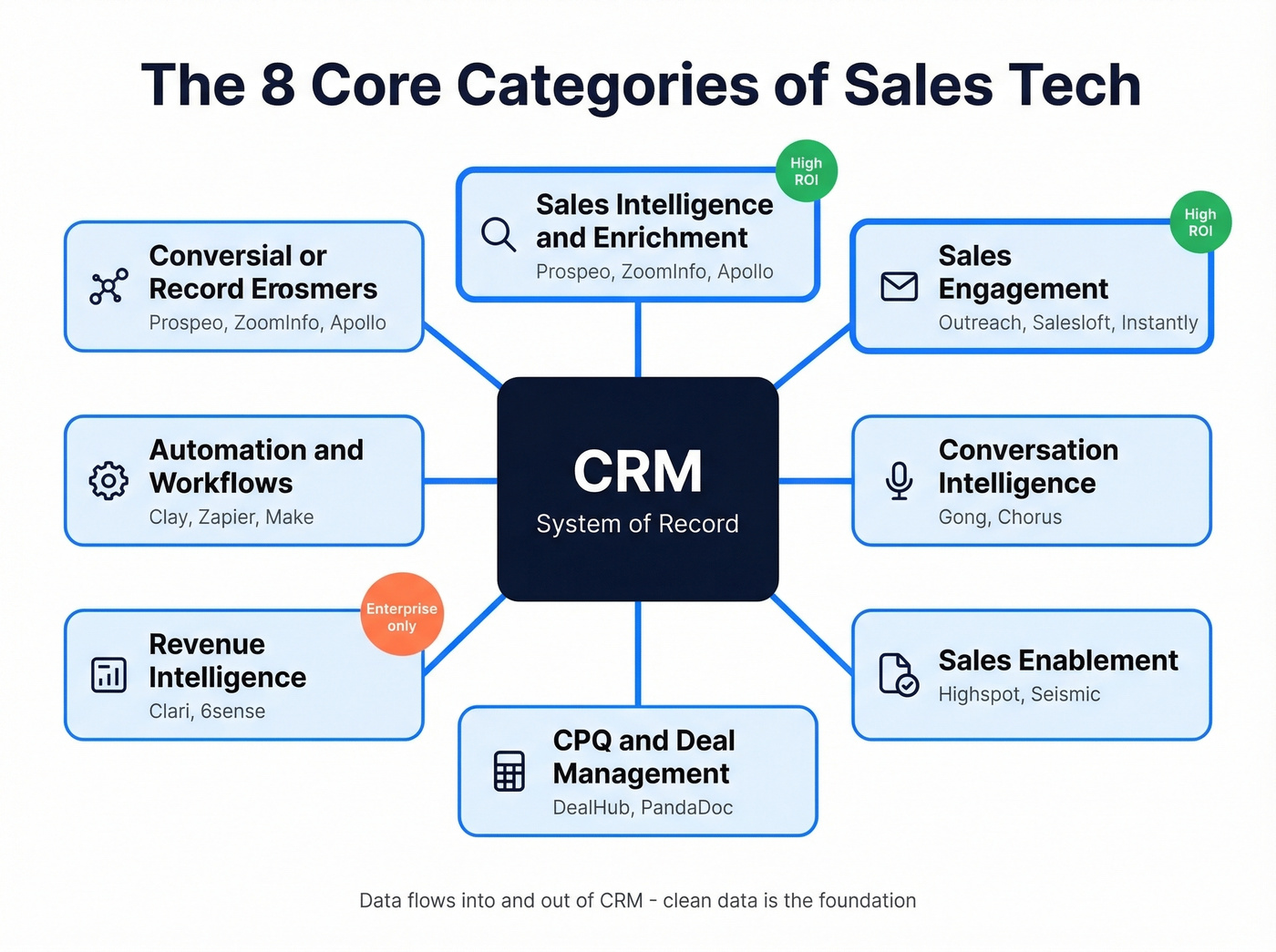
Not every category deserves equal investment. Some are table stakes. Some are force multipliers. A few are shelfware waiting to happen.
CRM
The center of gravity. Every other tool in your stack either feeds data into your CRM or pulls data out of it. Salesforce dominates enterprise ($25-300/user/mo depending on edition), and HubSpot owns the SMB-to-mid-market lane with a genuinely useful free tier that scales to ~$150/user/mo on Sales Hub Enterprise.
The CRM itself isn't a differentiator anymore - it's plumbing. What matters is how clean the data inside it is and how well your other tools integrate. We've seen teams spend six figures on Salesforce customization and still lose deals because the contact data feeding it was garbage. (If you’re evaluating costs, see Salesforce pricing.)
Sales Intelligence & Enrichment
This is the most underinvested category in the stack, and it's the one that compounds everything else. Bad data doesn't just waste credits - it burns sender reputation, tanks reply rates, and makes your engagement platform look broken when the real problem is upstream. (Benchmarks and fixes: email bounce rate.)
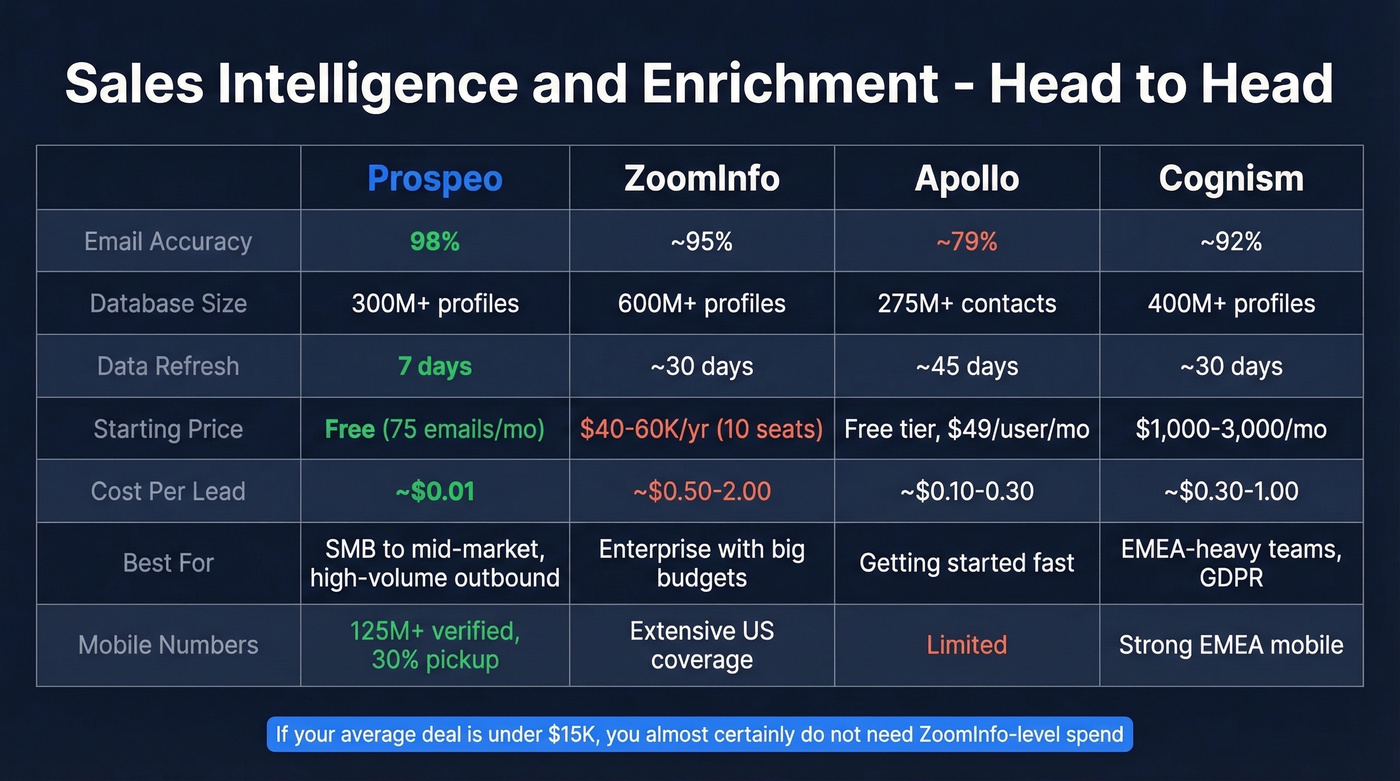
Prospeo stands out here with 300M+ professional profiles, 143M+ verified emails at 98% accuracy, and 125M+ verified mobile numbers with a 30% pickup rate. The proprietary email-finding infrastructure runs a 5-step verification process - catch-all handling, spam-trap removal, honeypot filtering - rather than relying on third-party data providers. The database refreshes every 7 days, while the industry average sits at 6 weeks. That gap matters more than most teams realize, because a contact who changed jobs three weeks ago is a bounced email and a wasted touch.

The 30+ search filters cover buyer intent (15,000 topics via Bombora), technographics, job changes, headcount growth, funding, and revenue, plus department-level headcount. Native integrations with Salesforce, HubSpot, Outreach, Salesloft, Instantly, Smartlead, Lemlist, Clay, Zapier, n8n, and Make mean no middleware tax. Pricing starts free (75 emails/month + 100 Chrome extension credits/month) and scales at roughly $0.01 per lead.
ZoomInfo remains the 800-pound gorilla with the deepest US database and the broadest feature set - intent, chat, workflow automation. But a 10-seat contract with intent data and mobile numbers can run $40-60K/year. That's real money for a Series A company. Apollo offers a strong free tier and paid plans from ~$49-119/user/mo, great for getting started, though email accuracy trails at roughly 79%. Cognism is the pick for EMEA-heavy teams, typically $1,000-3,000/mo, with strong GDPR compliance and mobile verification.
If your average deal is under $15K, you almost certainly don't need ZoomInfo-level spend. A combination of Prospeo for data and Instantly for outreach will get you 90% of the pipeline at 10% of the cost. Save the enterprise contracts for when you're actually enterprise. (More options: best sales prospecting databases.)
Sales Engagement
This is where sequences, cadences, and multi-channel outreach live. Outreach (~$100-150/user/mo) and Salesloft (~$100-130/user/mo) own the enterprise segment. Both are mature, both integrate well with Salesforce, and both are adding AI features aggressively.
For high-volume outbound on a tighter budget, Instantly starts around $30/mo and handles email warm-up, rotation, and sequencing without the enterprise overhead.
Conversation Intelligence
Gong is the category leader (~$100-150/user/mo, with annual minimums typically $15-30K). Teams using conversation intelligence close deals 11 days faster on average and see a 10 percentage point win-rate improvement on deals over $50K. Hard to argue with those numbers.
Chorus is now bundled into ZoomInfo's platform, which makes it essentially free if you're already paying for ZoomInfo - and expensive if you're not. Skip Gong if your average deal size is under $20K. The ROI math just doesn't work for transactional sales.
Sales Enablement
Highspot and Seismic (~$30-60/user/mo) help reps find the right content at the right moment. These tools matter most when you have 50+ reps and a content library that's grown unwieldy. For smaller teams, a well-organized Google Drive and a good onboarding doc get you 80% of the way there. (If you’re building the function, see sales enablement manager.)
CPQ & Deal Management
DealHub, DocuSign, and PandaDoc handle quoting, proposals, and e-signatures. DocuSign and PandaDoc run $25-50/user/mo for business plans, while DealHub is custom-priced for enterprise (expect $50-150/user/mo based on team size). If your reps are still building quotes in spreadsheets and emailing PDFs, this category pays for itself in weeks.
Revenue Intelligence & Forecasting
Clari (~$25-50K+/year) gives RevOps leaders a single view of pipeline health, forecast accuracy, and deal risk. 6sense and Bombora ($30-100K+/year) layer intent data on top, showing which accounts are actively researching your category before they ever fill out a form. (If you’re shopping, compare sales forecasting solutions.)
Real talk: intent data is powerful but expensive, and most teams under 100 employees don't have the volume to act on it effectively. If a vendor won't show pricing on their website in 2026, that tells you everything about their sales process.
Automation & Workflow Tools
Clay, Zapier, Make, Calendly, and Slack aren't "sales tools" in the traditional sense, but they're the connective tissue that makes everything else work. Clay runs on credits (~$150-500/mo depending on volume) and has become the go-to for building custom enrichment and lead generation workflows. Zapier and Make ($20-100/mo) handle the integrations your native connectors can't. Calendly (free-$16/user/mo) is table stakes for booking meetings - if you're still doing the "does Tuesday at 3 work?" email dance, fix that today. Slack (free-$12.50/user/mo) keeps deal communication out of email threads where context goes to die.
Category Comparison
| Category | Top Tools | Price Range | Best For |
|---|---|---|---|
| CRM | Salesforce, HubSpot | Free-$300/user/mo | Enterprise: Salesforce / SMB: HubSpot |
| Sales Engagement | Outreach, Salesloft, Instantly | $30-$150/user/mo | Enterprise: Outreach / Budget outbound: Instantly |
| Conversation Intel | Gong, Chorus | $100-$150/user/mo | High-ACV deals: Gong |
| Sales Enablement | Highspot, Seismic | $30-$60/user/mo | 50+ rep teams with large content libraries |
| CPQ & Deals | DealHub, DocuSign, PandaDoc | $25-$150/user/mo | SMB: PandaDoc / Enterprise: DealHub |
| Revenue Intel | Clari, 6sense | $25K-$100K+/yr | Pipeline visibility: Clari / Intent signals: 6sense |
| Automation | Clay, Zapier, Make | $20-$500/mo | Custom workflows: Clay / Simple integrations: Zapier |

Your sales tech stack is only as good as the data feeding it. Prospeo gives you 300M+ profiles, 98% email accuracy, and a 7-day refresh cycle - so every tool downstream actually works. At $0.01/lead, it's the highest-ROI line item in your stack.
Stop blaming your engagement tools for what bad data broke.
AI in Sales Tech - The 2026 Shift
AI isn't a category anymore. It's a layer running through every category. But the way it shows up matters enormously, and most teams are still figuring out where to deploy it.
Autopilot vs. Copilot
Pocus introduced a useful framework here. Autopilot systems handle end-to-end workflows without human intervention - think AI SDRs that research accounts, write personalized emails, and manage follow-up sequences autonomously. Copilot systems augment human reps with suggestions, summaries, and next-best-action prompts while keeping the human in the loop.
The smart play is matching the mode to the motion. Autopilot works best for lower-ticket, higher-volume segments where you have clean data and proven playbooks. Copilot shines on complex, high-ACV deals where human judgment and relationship-building still matter. Trying to autopilot a $200K enterprise deal is a recipe for cringe-worthy outreach that gets screenshotted on social media for all the wrong reasons. (If you’re evaluating tools, see SDR tools.)
The Hybrid AI-SDR Model
45% of high-performing teams have already adopted hybrid human-AI SDR models. Among teams using AI SDR tools, 100% report saving time on prospecting, and 40% save 4-7 hours per week. That's not a rounding error - that's half a workday back.
The research time reduction is where the impact hits hardest. LivePerson's sales team cut prospect research from 20 minutes to 2 minutes per prospect after adopting AI-powered prospecting tools, driving a 35% lift in engagement rates. Bain has mapped 25 distinct AI use cases across the sales life cycle - from lead scoring to contract analysis - but the highest-ROI applications cluster around prospecting and research automation. AI could realistically double the time sellers spend actually selling, from that dismal 25% baseline to something approaching 50%.
But outreach saturation is real. Touches required to engage a prospect have ballooned from 7-8 to 30+. AI makes it easier to send more messages, which means everyone is sending more messages, which means the bar for quality keeps rising. The teams winning aren't the ones sending the most - they're the ones sending the most relevant outreach, powered by better data and smarter sequencing. (Tactics: sales prospecting techniques.)
From Dashboards to Guided Action
The analytics layer is shifting from retrospective reporting to anticipatory guidance. Instead of showing you what happened last quarter, tools like Highspot and Clari are surfacing risk signals and recommended interventions before they hit your forecast.
GenAI is compressing planning cycles from quarterly to weekly. When messaging, assets, and plays can be regenerated in hours instead of weeks, there's no reason to wait for a quarterly business review to adjust strategy. The teams that adapt fastest will be the ones where AI agents translate scattered signals into concrete next steps - not just prettier dashboards.
The Data Quality Foundation
Picture this: your SDR team is sending 500 emails a day. Reply rate is 0.3%. The sequences look fine. The messaging has been A/B tested. But 35% of those emails are bouncing.
The problem isn't the copy. It's the data. (If you’re troubleshooting, start with email deliverability.)
We've watched this pattern play out repeatedly - a team invests in a $100K engagement platform, builds beautiful multi-touch sequences, and then feeds it contact lists that are three months stale. The emails bounce, the domain reputation tanks, and suddenly even the valid emails are landing in spam. I've seen a practitioner describe exactly this scenario: "99% delivered" according to the tool, but recipients saying emails weren't showing up. Domain reputation damage is invisible until it's catastrophic.

The Snyk case study makes the math concrete. Fifty AEs were prospecting 4-6 hours per week with bounce rates running 35-40%. After switching to verified, weekly-refreshed contact data, bounce rates dropped under 5%. AE-sourced pipeline jumped 180%, generating 200+ new opportunities per month. That's not incremental improvement - that's a step-change in pipeline generation.
Data quality is the single most underinvested category in the stack. Teams will spend $40K on intent data and $30K on conversation intelligence but balk at paying for verified contact data. That's like buying a Ferrari and filling it with the wrong fuel.
How to Build a Stack That Works
Pocus calls it the "toggle tax" - the productivity drain of jumping between 15+ point solutions to complete a single workflow. It's the reason your reps have 12 Chrome tabs open and still can't find the prospect's phone number.
Let's break down a five-step framework for building a B2B sales stack that actually works:
1. Audit what you have. Pull every subscription, every seat license, every API cost. Map each tool to a workflow. If you can't name the workflow, the tool is shelfware. We've run this exercise with teams and consistently found 30-40% of their stack is either unused or redundant.
2. Consolidate to 4-6 platforms. Start with the three-tool foundation (CRM + data enrichment + engagement) and add only what your specific motion demands. An outbound-heavy team needs conversation intelligence. A PLG company needs product analytics instead. Don't copy someone else's stack.
3. Integrate around the CRM. Your CRM is the hub. Every other tool should push data into it or pull data from it cleanly. If a tool doesn't have a native integration with your CRM, think hard about whether it's worth the Zapier workaround. Gartner's RevTech framework emphasizes this - the stack should be an ecosystem, not a collection of islands.
4. Enable with training and adoption tracking. Buying the tool is 20% of the work. Getting reps to actually use it correctly is the other 80%. Track login rates, feature adoption, and workflow completion. Fewer than 60% of licensed users logging in monthly? That tool is dead weight.
5. Review quarterly. Check ROI per tool, gather rep feedback, and kill anything that isn't earning its keep. The best RevOps teams treat their stack like a portfolio - rebalancing regularly based on performance data, not vendor relationships. (If you’re building the function, see RevOps manager.)
The goal isn't to have the best tools. It's to have the fewest tools that cover your workflows without gaps or overlap. Every additional tool adds training time, integration risk, and monthly cost. Subtract before you add.
Sales Technology Trends for 2026
Four shifts are reshaping revenue tech this year.
AI agents are replacing dashboards. The next generation of sales automation doesn't just show you data - it acts on it. Highspot and others are building systems where AI agents deliver next-best actions based on real-time signals. The shift from "here's what happened" to "here's what to do next" is the biggest UX change in the space since the move to cloud.
GenAI is compressing planning cycles. Quarterly strategy reviews are becoming weekly iterations. When AI can regenerate messaging, battle cards, and outreach sequences in hours, there's no reason to wait 90 days to adjust. Teams that plan weekly will outmaneuver teams that plan quarterly.
Stack consolidation is accelerating. The 15-tool stack is dying. Most of the 74% of organizations investing in AI/GenAI are directing that spend toward platforms that consolidate multiple functions rather than adding new point solutions. Vendors that can't offer a unified platform are getting acquired or squeezed out.
Software costs are rising - fast. Software spending is projected up 15.2% in 2026, driven by GenAI features embedded into existing tools. Your CRM, your engagement platform, your analytics suite - they're all adding AI capabilities and raising prices accordingly. Auditing your stack isn't just about cutting waste anymore. It's about making sure you're actually using the AI features you're now paying for.
Teams using Prospeo book 35% more meetings than Apollo and 26% more than ZoomInfo - with 90% lower cost per lead. 30+ filters, intent data on 15,000 topics, and native integrations with every tool in this guide. No contracts, no sales calls.
Cut your stack spend and triple your pipeline. Start in under two minutes.
FAQ
What is a sales tech stack?
A sales tech stack is the collection of software tools a revenue team uses daily - typically a CRM at the center, surrounded by data enrichment, engagement, intelligence, and automation layers. The best stacks in 2026 run 4-6 integrated platforms, not 15 disconnected point solutions competing for your reps' attention.
How much do sales technologies cost?
A startup can build a functional stack for under $500/month using a free CRM, Prospeo's free tier for data enrichment, and Instantly for outbound sequences. Enterprise stacks with Salesforce, ZoomInfo, Gong, and intent data easily run $200K-500K+/year. Map tools to workflows before buying to avoid overspending on features your team won't touch.
What's the most important tool in the stack?
CRM is the foundation, but data enrichment is the multiplier. A $100K engagement platform is worthless if 35% of your emails bounce. Start with clean, verified contact data - everything else compounds on top of it.
How is AI changing sales tech in 2026?
AI is splitting into autopilot systems that handle junior tasks end-to-end and copilot systems that augment experienced reps with real-time guidance. 45% of high-performing teams now run hybrid human-AI SDR models, and early adopters report 30%+ win-rate improvements. The biggest impact is on research automation and personalization at scale.
How often should I audit my stack?
Quarterly at minimum. Check usage rates, cost per tool, ROI metrics, and whether any tools overlap in function. If fewer than 60% of licensed users log in monthly, that tool is shelfware - cut it or replace it before the next renewal cycle locks you in for another year.