

The Only Sales Tools Startups Actually Need in 2026
A founder on Reddit recently shared his paid tool stack: $355/month, and he called it "overkill." He's not wrong. Most startups bleed cash on sales tools before they've closed their tenth customer. Meanwhile, 84% of reps missed quota last year, and the average outbound team runs 5.6 tools just to keep sequences moving.
The problem isn't too few sales tools for startups - it's the wrong ones, stacked badly, with unverified data underneath.
Here's our hot take: most startups don't have a tools problem. They have a data quality problem. Fix the foundation and everything downstream - deliverability, reply rates, pipeline - gets easier.
Our Picks
| Need | Our Pick | Starting Price |
|---|---|---|
| Verified data & emails | Prospeo | Free (75 emails/mo) |
| All-in-one prospecting | Apollo | Free / $49/user/mo |
| CRM | HubSpot | $0 |
| Email outreach | Instantly | $47/mo |
| Scheduling | Calendly | Free |
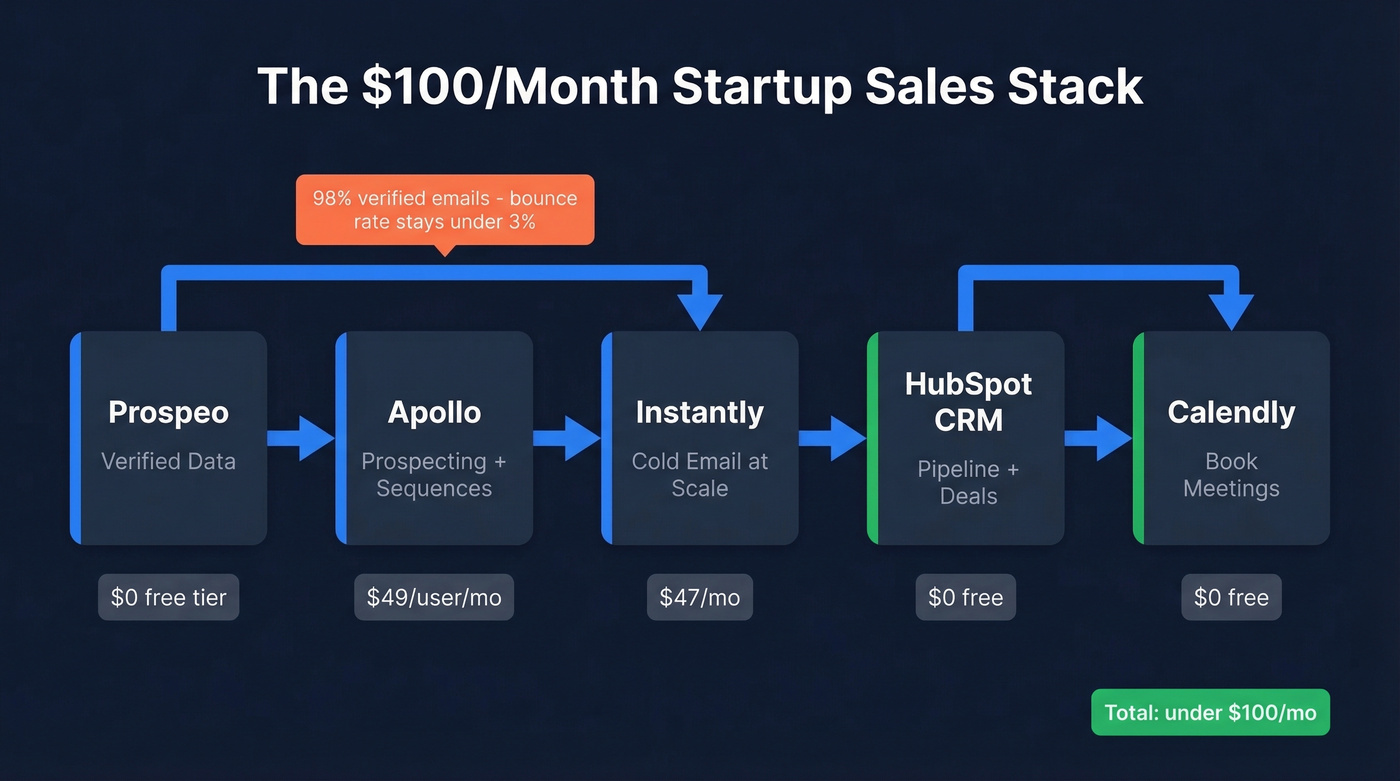
Total starter stack cost: under $100/month (assuming Apollo Basic + Instantly's entry plan). That's less than one bad hire's weekly lunch budget.
Best Sales Tools for Startups
Data & Enrichment
Prospeo
Prospeo's database covers 300M+ professional profiles with 98% verified email accuracy and a 7-day data refresh cycle. Most competitors refresh around every six weeks, which means you're emailing people who changed jobs a month ago. The 30+ search filters cover buyer intent via Bombora, technographics, job changes, and headcount growth - so you're not just finding contacts, you're finding ones actually in-market.

The Chrome extension (40,000+ users) pulls verified emails and phones from any website, professional profile, or CRM in one click. Native integrations with HubSpot, Salesforce, Instantly, Lemlist, and Clay mean data flows straight into your stack without manual exports. Stack Optimize built from $0 to $1M ARR on this data, maintaining 94%+ client deliverability with bounce rates under 3%.
Pricing runs on credits at roughly $0.01 per email. The free tier gives you 75 verified emails and 100 Chrome extension credits per month - enough to validate the tool before spending a dollar. No contracts, no sales calls. For any startup evaluating prospecting software, that kind of risk-free entry point should be the baseline expectation.
If you're comparing providers, start with data enrichment and how often records refresh.
Apollo
Apollo's the Swiss Army knife: 210M+ contacts, built-in sequencing, a CRM-lite layer, and a free tier that's genuinely usable for early prospecting. Basic runs $49/user/month, Professional $99/user/month with unlimited emails and 48,000 credits. It recently added AI-assisted email writing and waterfall enrichment, which helps fill gaps across multiple data sources.
Use Apollo if you want one login for prospecting, sequencing, and basic pipeline tracking. Skip it if data accuracy is your top priority - Apollo tries to do everything, and the email verification isn't as tight as dedicated providers. We've seen bounce rates climb when teams scale Apollo sequences past a few hundred contacts per week without a separate verification step.
If verification is the bottleneck, use a dedicated checker (see email bounce rate benchmarks).
Clay
Clay starts at $149/month and uses a spreadsheet-like UI to build logic-driven enrichment workflows, pulling from dozens of data sources with if/then fallback rules. Powerful for teams that want to waterfall enrich across providers and build custom lead scoring.
Here's the thing: Clay isn't plug-and-play. The learning curve is steep, and it's not an outreach tool - you still need Instantly or Lemlist for sending. If nobody on your team gets excited about API connections, skip it.
If you're going deeper here, this is basically lead enrichment plus workflow logic.
CRM
HubSpot CRM
HubSpot's free CRM handles contacts, deals, and basic reporting without costing a cent. The ecosystem is massive, integrations are everywhere, and HubSpot keeps layering in AI features like email drafting across the platform. It's the default CRM recommendation for early-stage companies because the onboarding friction is nearly zero.
The upgrade trap is real, though. Sales Hub starts at $99/month, and once you need serious automation, you're often looking at around $700/month in real-world spend. Start free, but budget for the jump.
If you're still deciding, compare a few examples of a CRM before committing.
Pipedrive
| Pipedrive | HubSpot Free | |
|---|---|---|
| Best for | Pure sales teams | Sales + marketing alignment |
| Starting price | $14/user/mo | $0 |
| Realistic stack cost (5 users) | ~$570/mo | $0-$800/mo |
| Pipeline UI | Cleaner, deal-focused | Feature-rich, busier |
| Marketing tools | None | Built in |
Pipedrive wins if your team only cares about managing deals. Skip it if marketing alignment matters.
If your CRM becomes messy fast, you may need stronger contact management software.
Email Outreach & Sequencing
Instantly
Instantly starts at $47/month and the standout feature is unlimited email accounts. Competitors like MailReach charge per account, which gets expensive fast when you're warming multiple domains. Warmup is built in, and the sending infrastructure is solid for cold outreach at scale.
Pair verified data with Instantly - that's the combo that works best for founder-led outbound. Bad data means burned domains, and one Reddit founder learned that the hard way: "ruined our domain reputation with email." We've seen this pattern repeatedly in our own testing - deliverability collapses fast when bounce rates creep above 3%.
To keep volume safe, follow an email deliverability guide and monitor email velocity.
Lemlist
Lemlist starts at $79/month and adds multichannel sequencing - email plus social touches in one workflow. Better than Instantly if you want non-email steps baked into your sequences rather than running separate tools. For pure cold email, though, Instantly's unlimited accounts make it the better value.
If you're building sequences from scratch, use a proven B2B cold email sequence.
Scheduling & Calls
Calendly
Free tier handles basic scheduling. Paid plans from $12/seat/month. Nearly universal adoption means prospects already know how it works. Just use it.
tl;dv
AI call recording and transcription starting at $18/seat/month - the budget alternative to Gong, which runs $1,000+/month for small teams. If you need call intelligence without the enterprise price tag, tl;dv delivers.

Most startups don't need more tools - they need better data underneath the tools they already have. Prospeo gives you 98% verified emails at $0.01 each, a 7-day refresh cycle, and 30+ filters to find buyers actually in-market. Stack Optimize built to $1M ARR on this data with bounce rates under 3%.
Get 75 free verified emails and stop burning domains on bad data.
Master Comparison
| Tool | Category | Starting Price | Free Tier? | Best For |
|---|---|---|---|---|
| Prospeo | Data & emails | ~$0.01/email | ✅ 75 emails/mo | Highest email accuracy |
| Apollo | All-in-one | $49/user/mo | ✅ Limited | One-tool prospecting |
| Clay | Enrichment | $149/mo | ❌ | Custom data workflows |
| HubSpot | CRM | $0 | ✅ Full CRM | First CRM for any startup |
| Pipedrive | CRM | $14/user/mo | ❌ | Deal-focused sales teams |
| Instantly | Outreach | $47/mo | ❌ | Scaling cold email |
| Lemlist | Outreach | $79/mo | ❌ | Multichannel sequences |
| Calendly | Scheduling | $0 | ✅ Basic | Meeting booking |
| tl;dv | Call intel | $18/seat/mo | ❌ | Budget call recording |
What a Startup Sales Stack Actually Costs
| Tier | Tools | Monthly Cost |
|---|---|---|
| Starter | Free data + HubSpot + Instantly + Calendly | ~$50/mo |
| Growth | Paid data + HubSpot + Instantly + Apollo + Calendly + tl;dv | ~$175-250/mo |
| Scale | Paid data + Pipedrive (x2) + Instantly + Clay + Calendly + tl;dv | ~$345-450/mo |
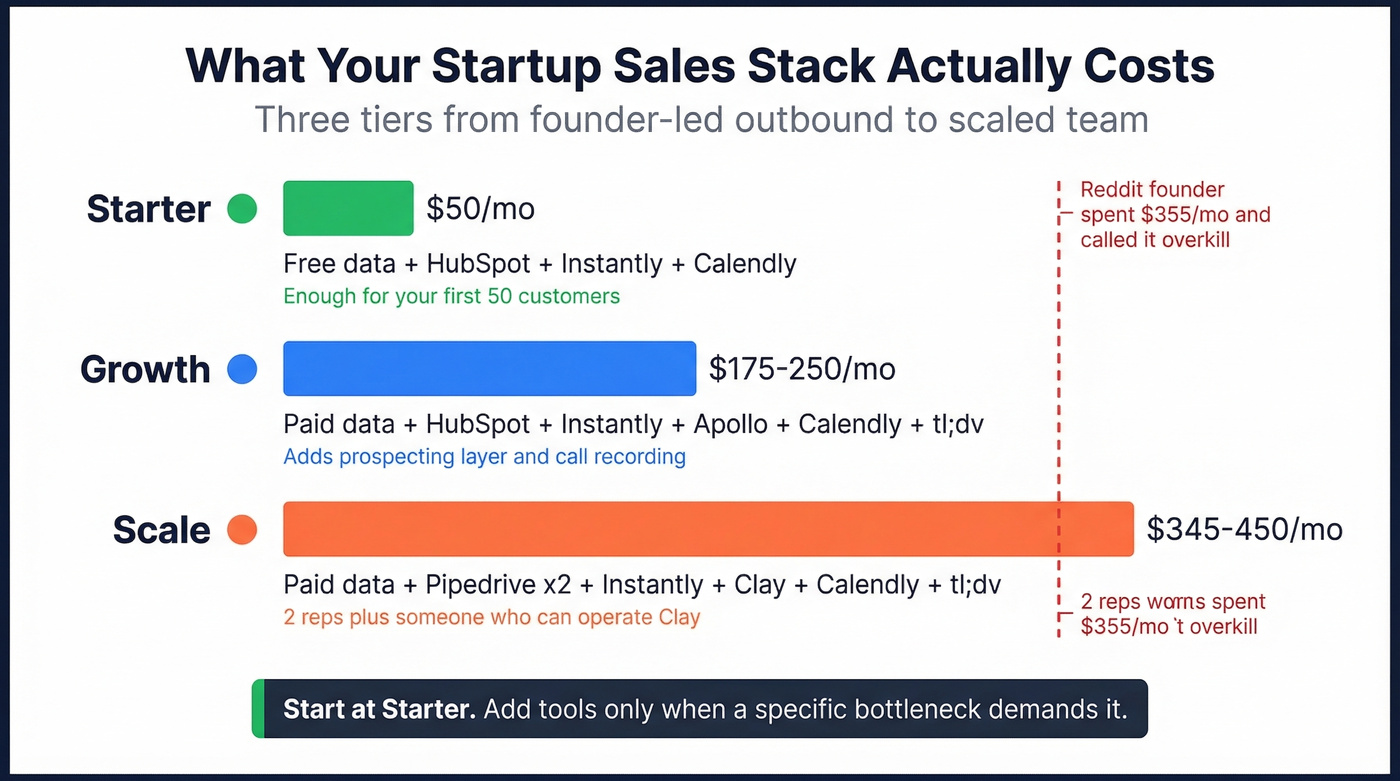
The Starter tier is enough to run founder-led outbound to your first 50 customers. Growth adds a prospecting layer and call recording. Scale is for teams with two reps and someone who can actually operate Clay.
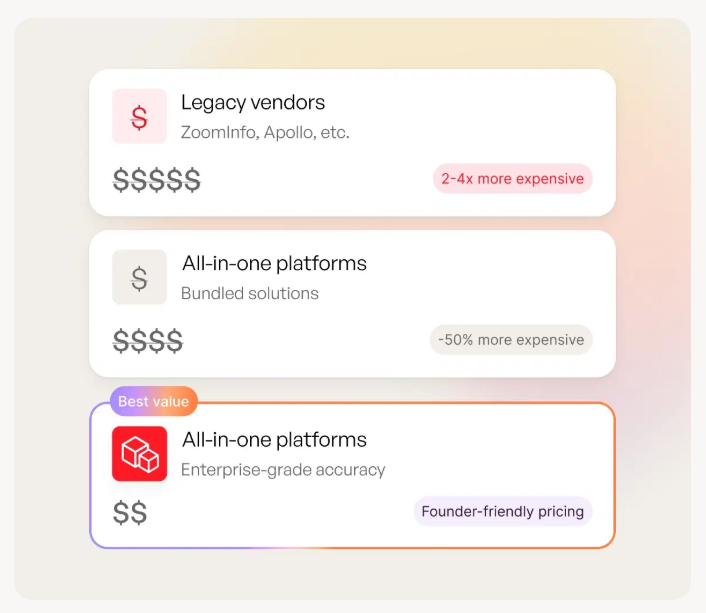
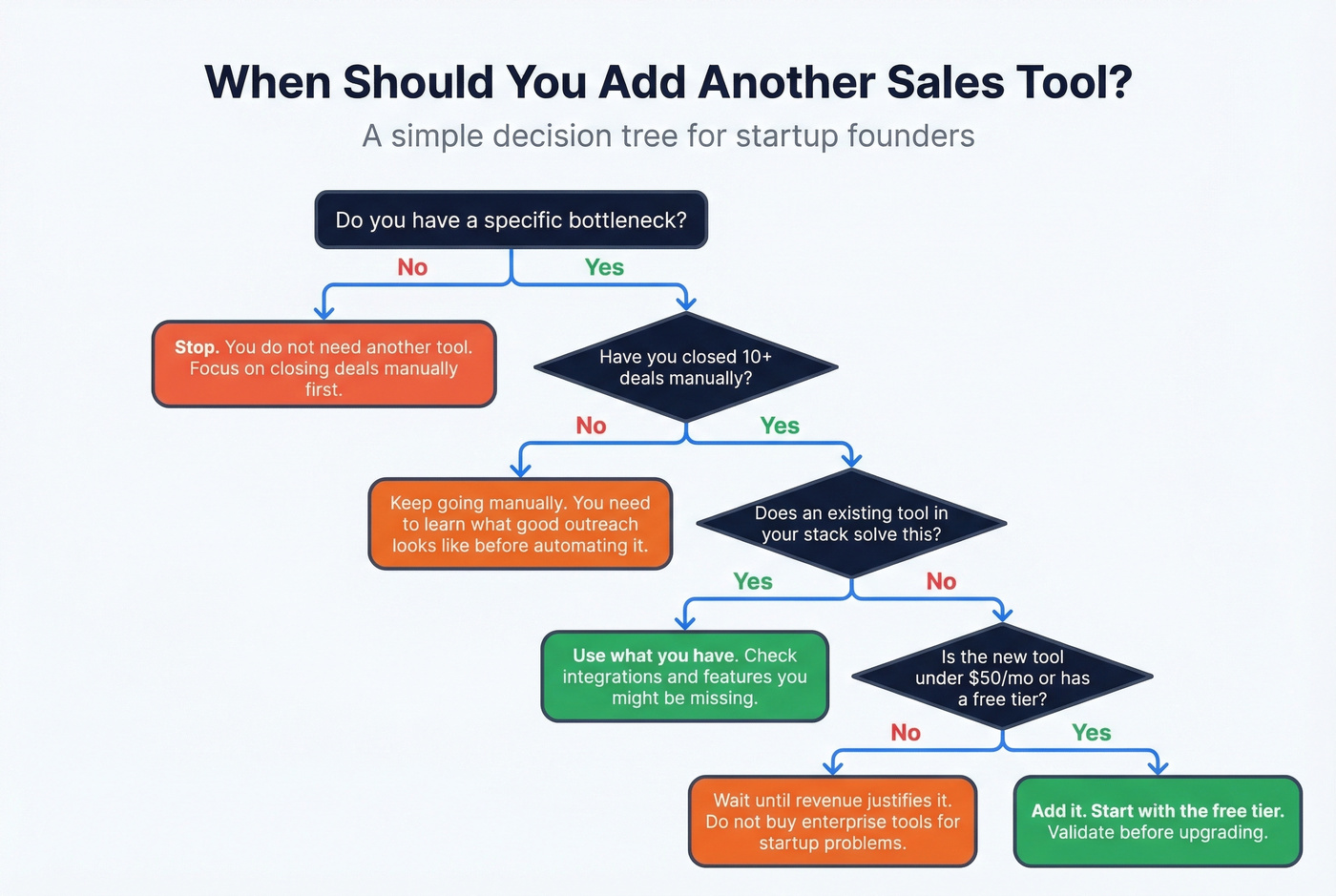
Let's be honest - most startups should start at Starter and add tools only when a specific bottleneck demands it, not because a blog post told them they need 12 tools.
Mistakes That Kill Your Outreach
Sending unverified emails. One founder on r/startups described it perfectly: "99% delivered" on SendGrid, but prospects said emails weren't showing up. Delivered doesn't mean inboxed. If your bounce rate is above 3%, your data provider is the problem.
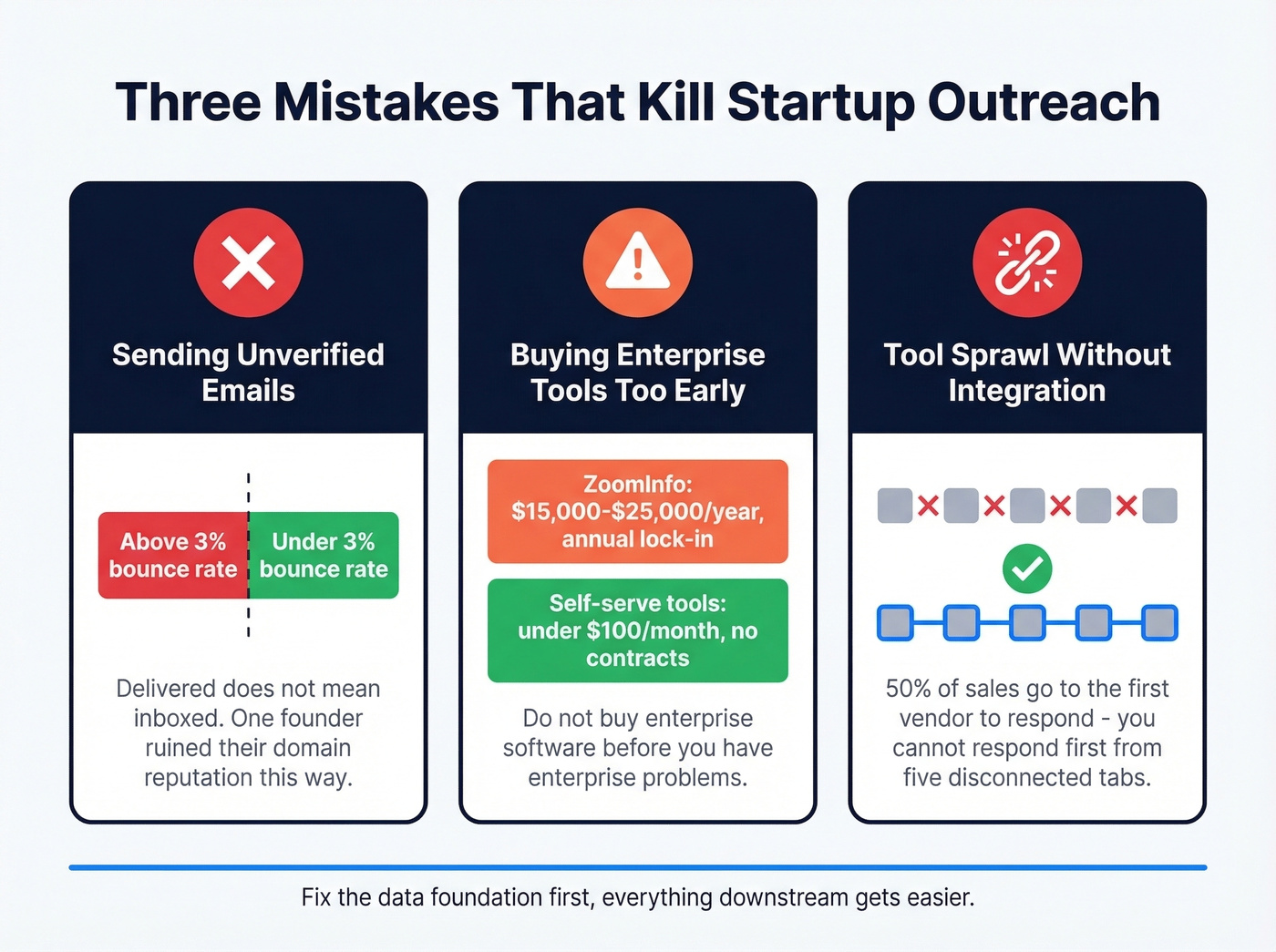
Buying enterprise tools too early. ZoomInfo runs $15,000-$25,000/year minimum with annual contracts. SaaStr's advice applies: don't hire a VP of Sales before you have 2 scaled reps. Same logic applies to tooling - don't buy enterprise software before you have enterprise problems. The best startup prospecting tools are the ones that scale with you, not the ones that lock you into a contract you'll regret in six months.
If you're still early, start with sales prospecting techniques before buying more software.
Tool sprawl without integration. Every tool that doesn't sync to your CRM is a data silo creating duplicate contacts and missed follow-ups. Up to 50% of sales go to the first vendor to respond - you can't respond first if your data lives in five disconnected tabs.
If you're fixing this, use a simple checklist to connect outreach tool to CRM.
Your $100/month starter stack is only as good as the data feeding it. One founder ruined their domain reputation with unverified emails - don't repeat that mistake. Prospeo's free tier gives you 75 verified emails and 100 Chrome extension credits monthly. No contracts, no sales calls, no risk.
Validate the data before you spend a dollar. Free tier, zero commitment.
FAQ
How many tools does a startup need?
Start with three: a CRM, a data provider, and a sequencer. Add scheduling and call recording when volume justifies it. Every tool you add should solve a specific bottleneck, not a hypothetical one.
What's the cheapest effective stack?
HubSpot free CRM + a free data tier for verified emails + Instantly at $47/month + Calendly free. Total: under $50/month. That's enough to run founder-led outbound to your first 50 customers.
Do startups need AI sales tools?
Not as standalone purchases. Apollo, HubSpot, and Instantly already ship AI features - email drafting, enrichment, workflow assistance - inside tools you're already paying for. Buy a dedicated AI SDR platform after you've manually closed 10 deals and know what good outreach looks like.
Is ZoomInfo worth it for early-stage teams?
Almost never. At $15,000-$25,000/year with annual contracts, ZoomInfo is built for enterprise teams with dedicated ops resources. Self-serve alternatives offer comparable accuracy at a fraction of the cost, with no contracts and free tiers to start.