

Sales Training Topics Your Team Actually Needs in 2026
Your VP just asked you to "put together a training plan for Q3" and you're staring at a blank doc wondering which sales training topics actually matter. Here's the uncomfortable truth: 62% of sales leaders cite outdated training as their biggest barrier to effectiveness, and 85-90% of sales training has no lasting impact after 120 days. Commercial training investment hours jumped 27% from 2024 to 2025 - companies are spending more and getting less.
Training doesn't fail because of bad topics. It fails because there's no structure behind them.
The Topics That Move Revenue Fastest
If you've got 60 seconds, here are the five that matter most:
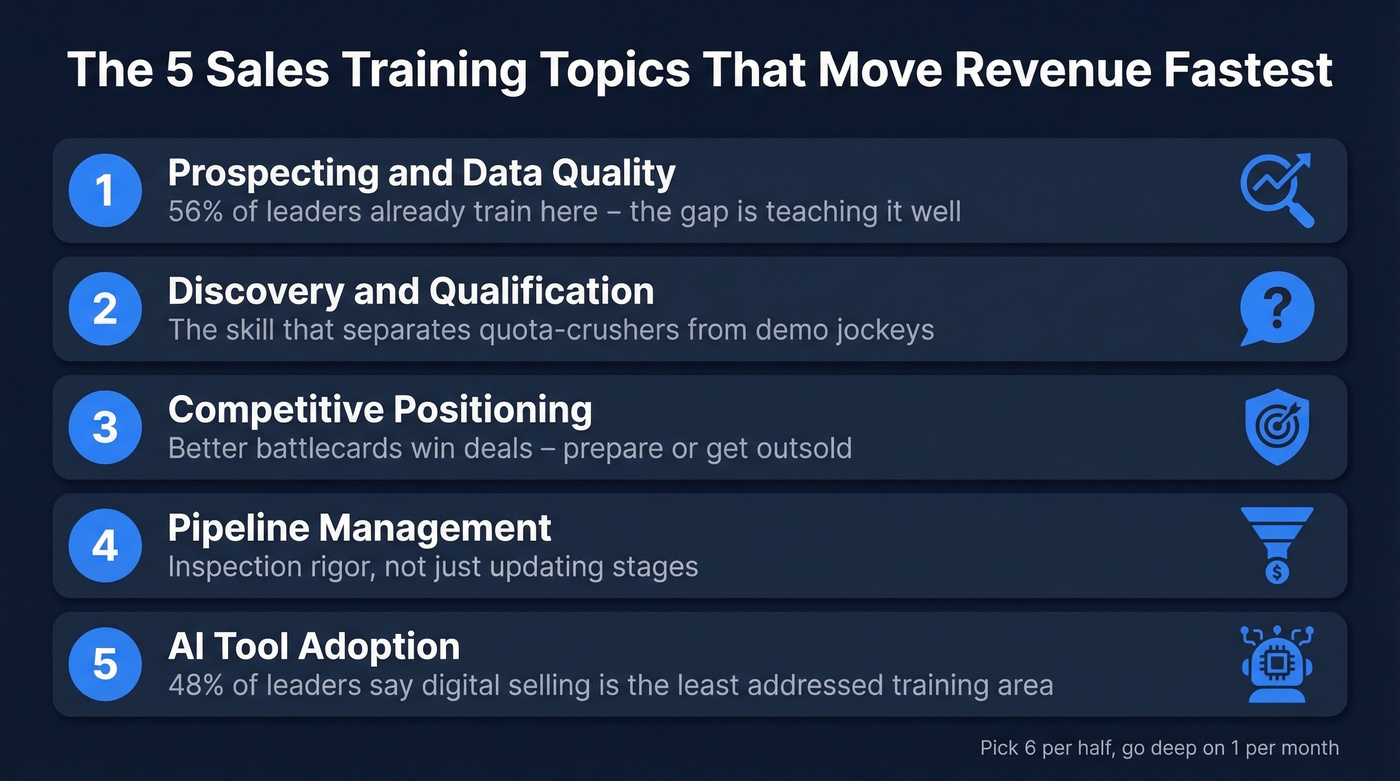
- Prospecting and data quality - 56% of sales leaders already train on this; the gap is teaching it well (see sales prospecting techniques)
- Discovery and qualification - the skill that separates quota-crushers from demo jockeys (use better discovery questions)
- Competitive positioning - your reps are getting outsold by someone who prepared better battlecards (build stronger sales battle cards)
- Pipeline management - inspection rigor, not just "update your stages" (track pipeline health)
- AI tool adoption - 48% of sales leaders say digital selling is the least addressed area in their training (see generative AI sales tools)
Listing 30 topics is a curriculum catalog, not a strategy. Your team can absorb one topic per month. Pick six per half and go deep.
Core Skills by Role
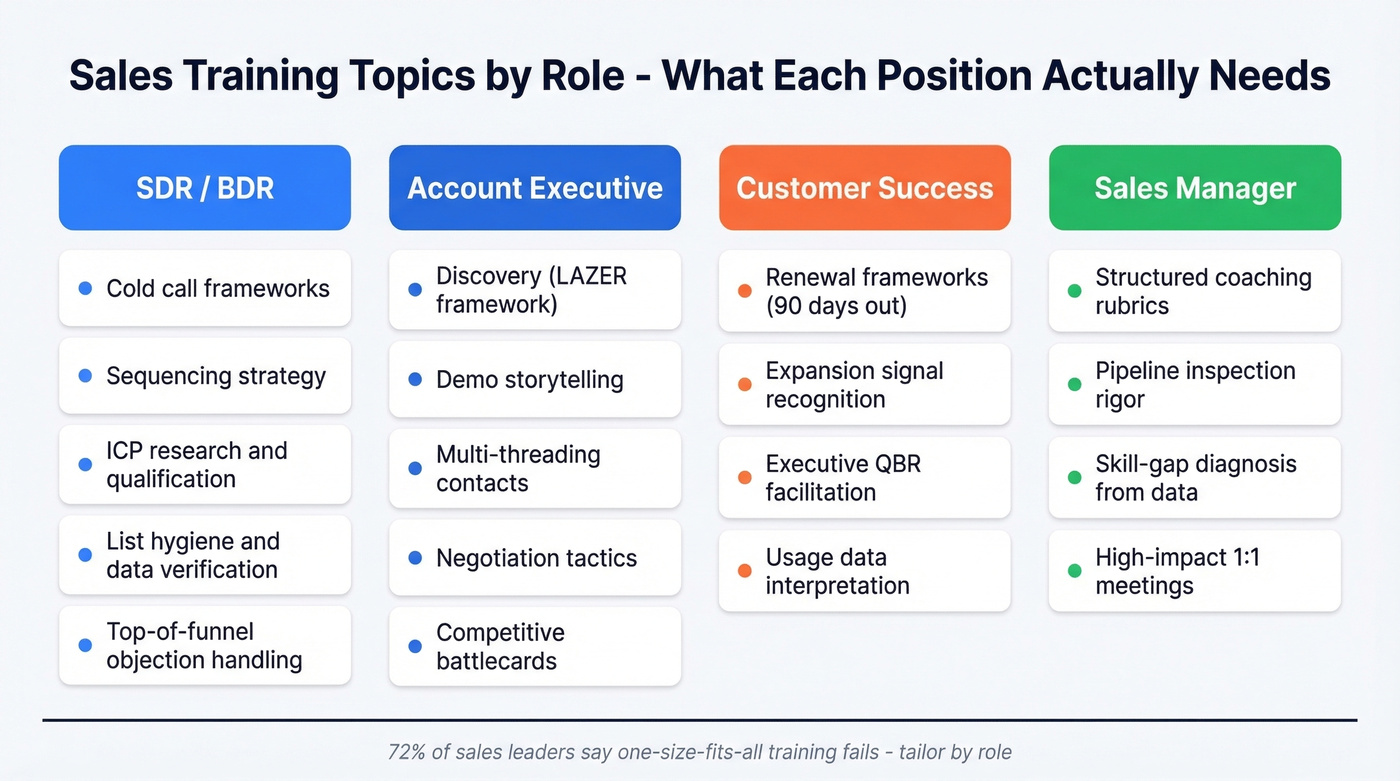
72% of sales leaders say training fails because it tries to be one-size-fits-all. An SDR cold-calling 80 accounts a week needs fundamentally different skills than an AE running a six-month enterprise deal cycle. Let's break it down.
SDR / BDR
SDRs live in the highest-volume, highest-rejection zone of your org. 58% juggle 75+ accounts per quarter. Training needs to be tight, practical, and immediately applicable.
Cold call frameworks - not scripts, but pattern interrupts, tone control, and opening structures. Give reps three openers to rotate, not a monologue to memorize. Pair that with sequencing strategy: when to call, when to email, when to go multi-channel, and when to stop (tighten sequence management).
ICP research and qualification is where most SDR programs fall short. Teaching reps to spend five minutes researching before hitting "send" instead of blasting 200 generic emails sounds obvious, but we've seen teams skip this entirely and wonder why reply rates sit at 1% (use an ideal customer profile template).
List hygiene and data verification is the most undertrained SDR skill we encounter. Reps burn domain reputation sending to bad emails because nobody taught them to verify first (see email deliverability). Snyk's 50 AEs cut bounce rates from 35-40% to under 5% after cleaning their data - and AE-sourced pipeline jumped 180%. Tools like Prospeo make verification a zero-friction habit with 98% email accuracy and a free tier.
Top-of-funnel objection handling rounds it out - the "I'm not interested" / "send me an email" / "we already have a vendor" responses that kill conversations before they start (reduce it with a system for cold call rejection).

Account Executive
Modern buyers complete roughly 70% of their buying journey before talking to a rep. By the time your AE gets the meeting, the prospect already has opinions, a shortlist, and a bias toward whoever educated them first. That reality changes what AE development needs to accomplish.
Discovery is the highest-leverage skill. The LAZER framework - Listen, Acknowledge, Zip It, Explore, Respond - shared by a practitioner in the HubSpot community, captures the core principle: shut up long enough to hear the real problem. Train reps to ask three open-ended questions before touching a demo screen. Then layer on demo storytelling - stop walking through features and start walking through the prospect's day, showing how it changes (use a product demo checklist).
Beyond discovery, AEs need multi-threading skills. One contact isn't a deal; it's a single point of failure. Add negotiation tactics for reaching economic buyers and competitive battlecards - not a 40-page doc nobody reads, but a one-pager per competitor with the three things reps need to say in the moment. Whether your team runs Challenger, MEDDIC, or Sandler, the methodology matters less than the reinforcement cadence behind it.
Customer Success Manager
CSMs are your most efficient path to expansion revenue, but most orgs train them like support reps. Focus on renewal frameworks (start the conversation 90 days out, not 30), expansion signal recognition - usage spikes, new team members, feature requests that signal a bigger need - and executive QBR facilitation. The goal: make the VP of Ops say "this is the most useful vendor meeting I have."
Sales Manager
| Competency | What Good Looks Like |
|---|---|
| Coaching | Structured rubrics for call reviews, not "that was good, do more of that" |
| Pipeline inspection | "What's the next step and who owns it?" - not "how's that deal going?" |
| Skill-gap diagnosis | Using call recordings and CRM data to pinpoint where each rep is stuck |
| High-impact 1:1s | 30 minutes that change behavior, not 30 minutes of status updates |
Managers are the biggest lever you have. A great one makes every rep 15-20% better. A bad one makes your best reps leave.

You just read how Snyk cut bounce rates from 35-40% to under 5% and grew AE-sourced pipeline 180%. That's what happens when prospecting training meets verified data. Prospeo gives your reps 300M+ profiles with 98% email accuracy at $0.01/lead - so every cold call framework and sequencing strategy you teach actually reaches a real person.
Stop training reps to prospect with bad data. Fix the foundation first.
The AI Training Gap
Reps spend roughly 70% of their week on non-selling tasks - admin, data entry, research, internal meetings. AI tools can reclaim 10+ hours a week, but only if reps know how to use them.
The competencies that matter in 2026 aren't "how to use ChatGPT." They're GTM stack orchestration - connecting your CRM, sequencer, data platform, and conversation intelligence into a workflow that eliminates manual data entry. They're AI-assisted personalization, where reps use AI to research accounts and draft first-pass messaging, then edit with human judgment (see AI for sales emails). True 1-to-1 personalization drives 2-3x better results, but only about 5% of companies do it effectively. And they're data-driven decision-making - Gartner predicts 65% of B2B orgs will shift to data-driven selling by 2026 (build the muscle with data-driven selling).
Here's the thing: most teams are still training reps on slide decks and product features while their competitors are training on AI-augmented workflows. The gap is widening fast.
A 4-Week Reinforcement Cadence
The biggest anti-pattern in sales training? Treating it as a one-time event. A two-day offsite with a motivational speaker and some role-plays feels productive. Then 90% of those new skills are lost within a year. Scenario-based training with reinforcement improves retention up to 70% compared to lecture-only formats.
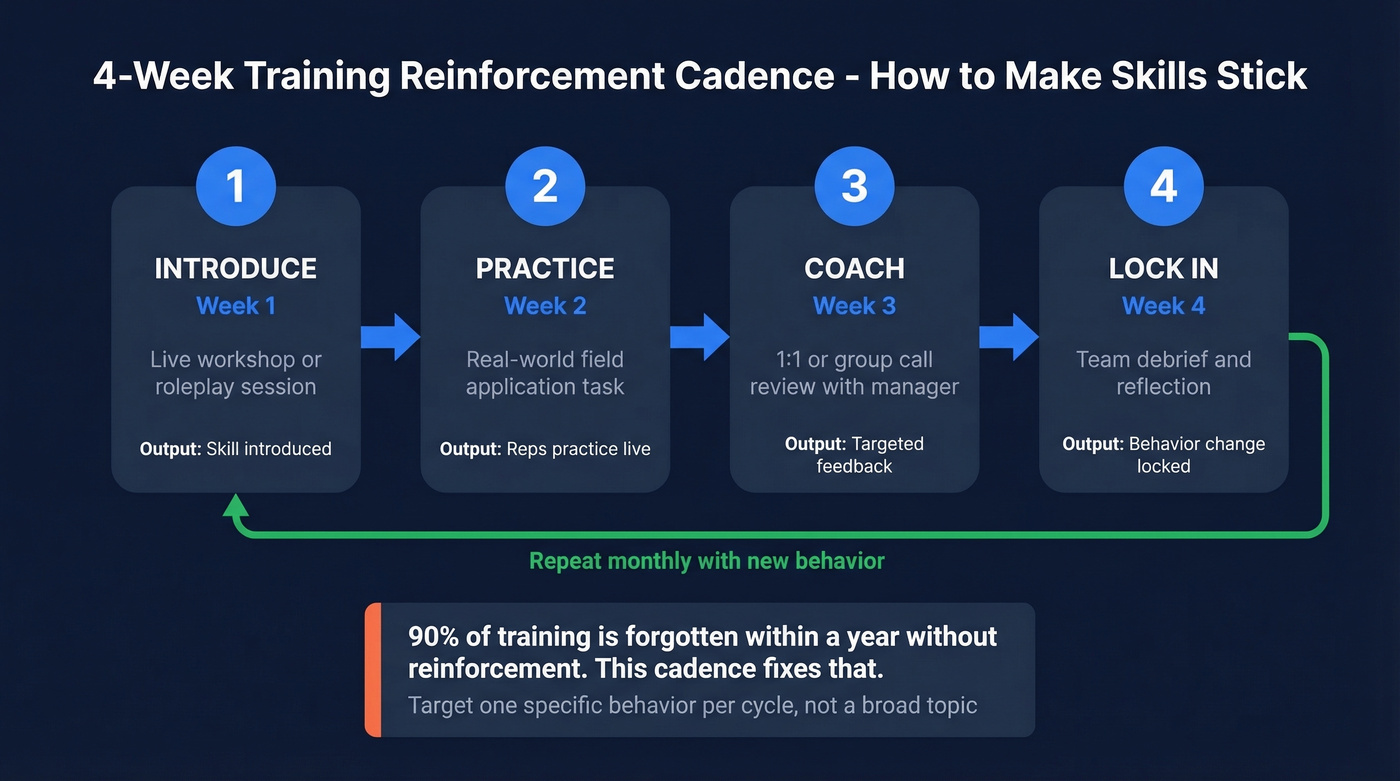
Here's a cadence that actually sticks:
| Week | Activity | Format | Output |
|---|---|---|---|
| 1 | Live training on one behavior | Workshop / roleplay | Skill introduced |
| 2 | Field application task | Real-world assignment | Reps practice live |
| 3 | Coaching + accountability | 1:1 or group call review | Manager feedback |
| 4 | Reflection + adjustment | Team debrief | Behavior locked in |
Each cycle targets one specific behavior change - not a topic, a behavior. "Improve discovery" is a topic. "Ask three open-ended questions before demoing" is a behavior. Behind each cycle, use a simple planning frame: define the business problem, the desired behavior, the weekly method, the field application, and the tracking metric.
In our experience, teams that run a monthly cadence retain far more than those doing quarterly offsites. The most common complaint about training isn't the content - it's the delivery. Reps want roleplay and live call reviews, not slide decks. Run this cadence monthly. Three topics per quarter. Twelve per year. That's more than enough if each one actually changes how reps sell (more sales training tips).
Skip the 30-topic curriculum if your average deal size is under $10k. You need three skills executed with religious consistency - prospecting, discovery, and objection handling. Everything else is a distraction until those three are muscle memory.
How to Measure Training ROI
Finance doesn't care that reps "liked the training." They care whether it moved numbers. Companies spent $874 per learner on training in 2025, averaging 40 hours per employee per year. If you can't point to behavior change and pipeline impact, that budget is getting cut.
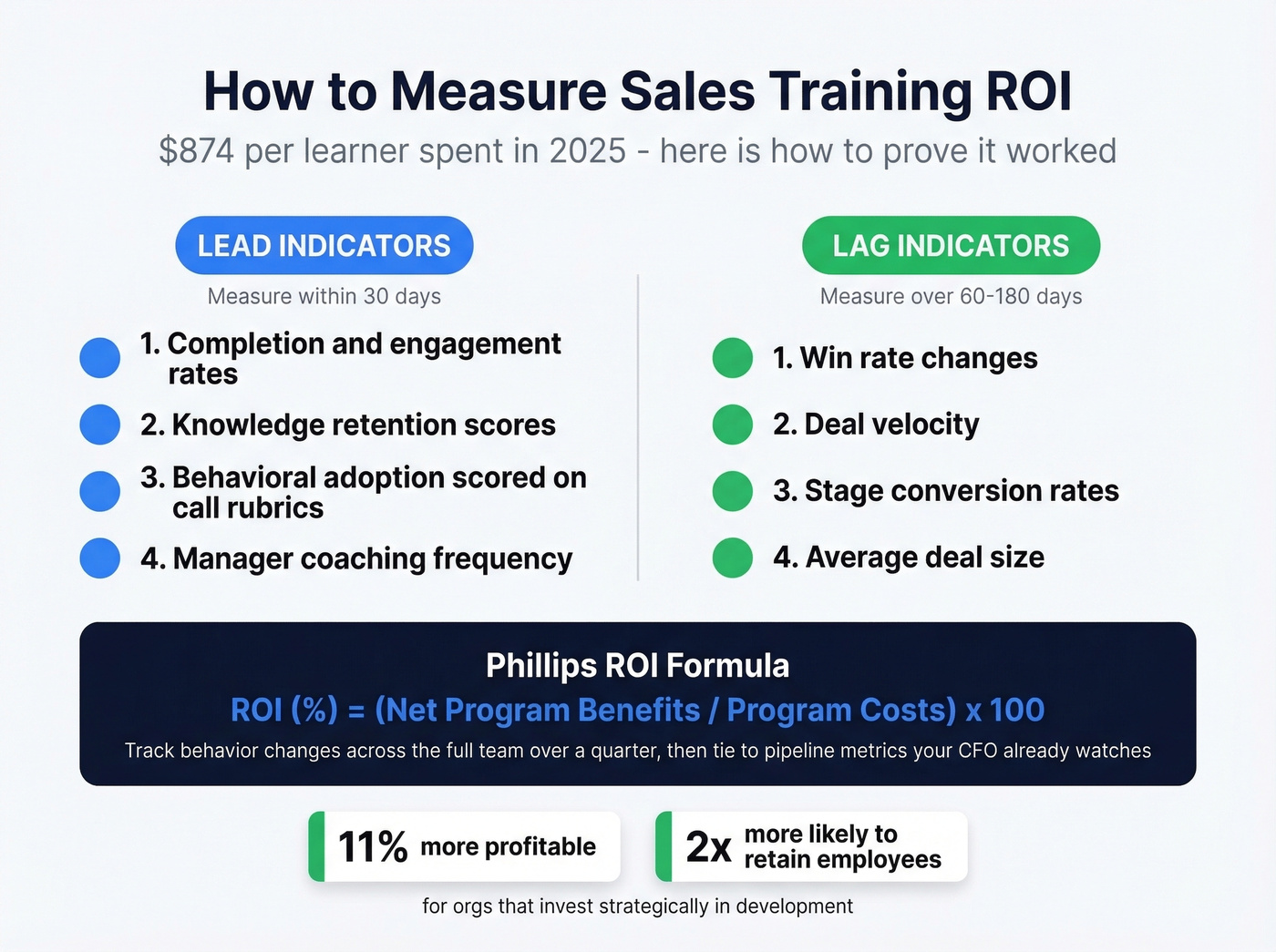
Use the Kirkpatrick Model as your backbone: Reaction, Learning, Behavior, Results. For dollar precision, the Phillips ROI formula works: ROI (%) = (Net Program Benefits / Program Costs) x 100.
Lead indicators (measure within 30 days):
- Completion and engagement rates
- Knowledge retention scores
- Behavioral adoption scored against call rubrics
- Manager coaching frequency
Lag indicators (measure over 60-180 days):
- Win rate changes
- Deal velocity
- Stage conversion rates
- Average deal size
Organizations that commit strategically to development are 11% more profitable and twice as likely to retain employees. Don't cherry-pick one great call as proof. Track a volume of behavior changes across the team over a full quarter, then tie those changes back to pipeline metrics your CFO already watches.
Your AI training module should include the tools reps actually use. Prospeo's Chrome extension (40K+ users) and CRM enrichment eliminate the manual research eating 70% of your team's week - returning 50+ data points per contact with a 92% match rate. That's the GTM stack orchestration skill this article recommends.
Reclaim 10+ hours per rep per week with data that's refreshed every 7 days.
FAQ
How many sales training topics should a team cover per quarter?
Three, maximum - one per month with a full reinforcement cycle of workshop, field practice, coaching, and debrief. Teams that try to cover eight topics per quarter end up with reps who retain none of them. Depth beats breadth every time.
What's the biggest training gap in 2026?
AI tool adoption is the most neglected area - 48% of sales leaders confirm it's underaddressed even as reps spend 70% of their week on tasks AI could automate. Prioritize GTM stack orchestration and AI-assisted personalization over generic product walkthroughs.
How do you train SDRs on data quality?
Teach list hygiene as a core prospecting skill, not an afterthought. Have reps verify emails before every outreach sequence and run a weekly bounce-rate review. Prospeo's free tier gives you 75 verified emails a month - enough to build the habit before it costs anything.
How do you prove training ROI to leadership?
Track lead indicators (call rubric scores, coaching frequency) within 30 days and lag indicators (win rate, deal velocity, stage conversion) over 60-180 days. Use the Phillips ROI formula - ROI (%) = (Net Program Benefits / Program Costs) x 100 - to translate behavior change into dollar impact.