

How to Build a Scalable Sales Process (With Actual Benchmarks)
70% of startups fail because they scale too fast without the right infrastructure. Not the wrong product - the wrong timing. Only 1.2% of SaaS companies that clear $3M ARR ever reach $100M within a decade.
The difference? A scalable sales process - not just one that's documented.
Here's the short version: you need stage exit criteria any rep can follow, a structured onboarding system so new hires ramp in weeks instead of months, and clean data infrastructure so outreach doesn't collapse at volume. If you only do one thing today, document what moves a deal from one stage to the next. The rest of this guide gives you benchmarks, a framework, and the specific mistakes to avoid.
What Makes a Sales Process Scalable
Documentation means you wrote it down. Scalability means it's repeatable across reps and controllable at volume - you can add headcount and predict what happens next.
HBR research confirmed that companies with a formal sales process generate more revenue. Without one, you end up with 10 reps doing 10 different things and no way to diagnose what's broken. The goal isn't just to grow revenue. It's to grow predictably.
When to Stop Founder-Led Selling
Close your first 10-20 customers yourself. This is how you learn what objections actually sound like, which features close deals, and who your real buyer is. SaaStr's guidance is clear: the transition to commissioned reps typically happens around ~$1M ARR, or when you physically can't handle the lead volume anymore.
Hire two reps - not one. One rep gives you zero signal. Two let you run a controlled experiment and isolate whether results come from the person or the process. Don't hire a VP of Sales until both can hit quota consistently. Before handoff, lock down your ICP, a basic playbook, and CRM discipline.
Stages and Exit Criteria
Deals are 23% more likely to close when AEs follow a defined process. Once you cross 10 reps, the tax of inconsistency compounds fast - which is why clear exit criteria matter more than adding headcount.
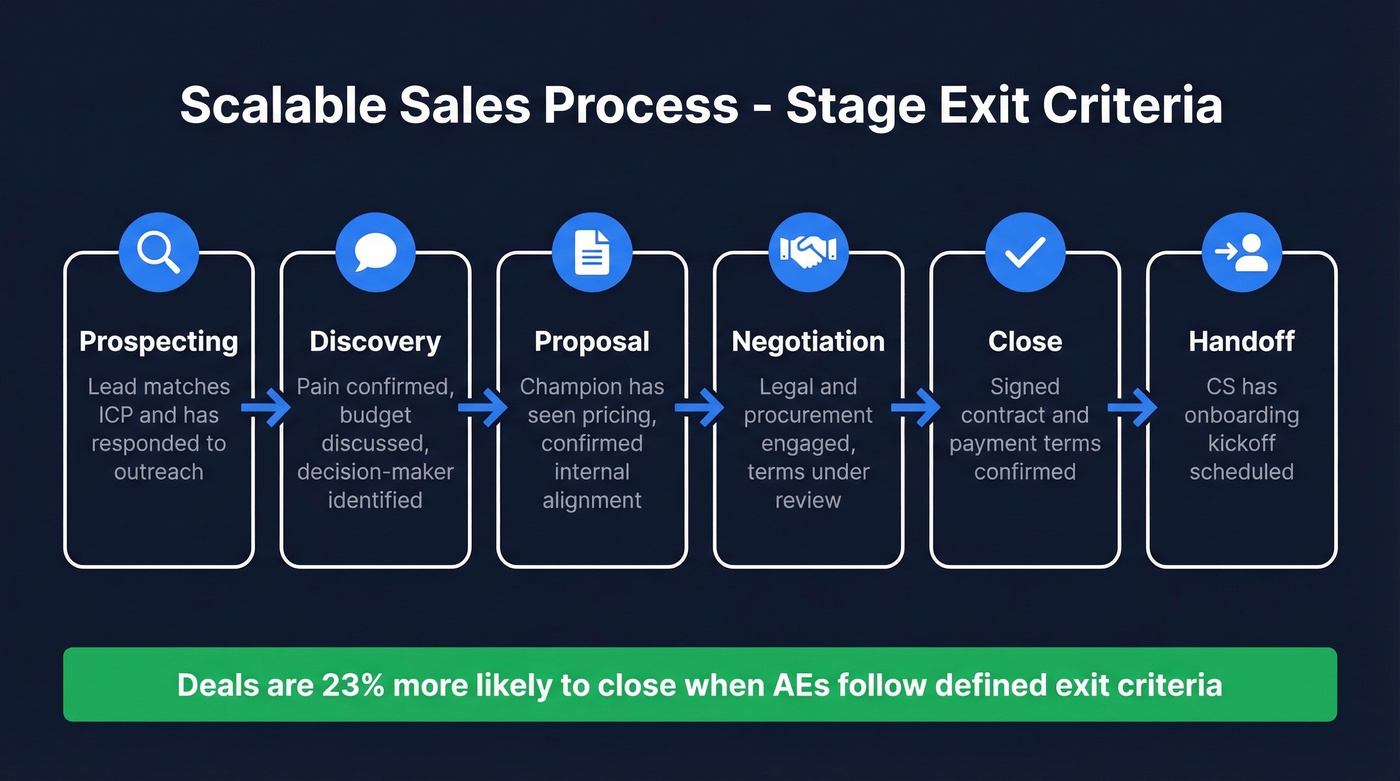
Build your stages with one-sentence exit criteria:
- Prospecting: Lead matches ICP and has responded to outreach.
- Discovery: Pain confirmed, budget range discussed, decision-maker identified using BANT or MEDDIC.
- Proposal: Champion has seen pricing and confirmed internal alignment.
- Negotiation: Legal/procurement engaged, terms under review.
- Close: Signed contract and payment terms confirmed.
- Handoff: CS has onboarding kickoff scheduled. This is where churn prevention starts - most teams skip it entirely.

Your sales process is only as scalable as the data underneath it. When reps go from 500 to 5,000 emails per week, bad data tanks deliverability. Prospeo delivers 98% email accuracy on a 7-day refresh cycle at ~$0.01/lead - the data infrastructure that holds up when you double headcount.
Fix the data layer before you hire the next rep.
The Onboarding System That Scales
A founder who scaled to 24 AEs built a 4Ps framework that replaced inconsistent, leader-dependent onboarding:
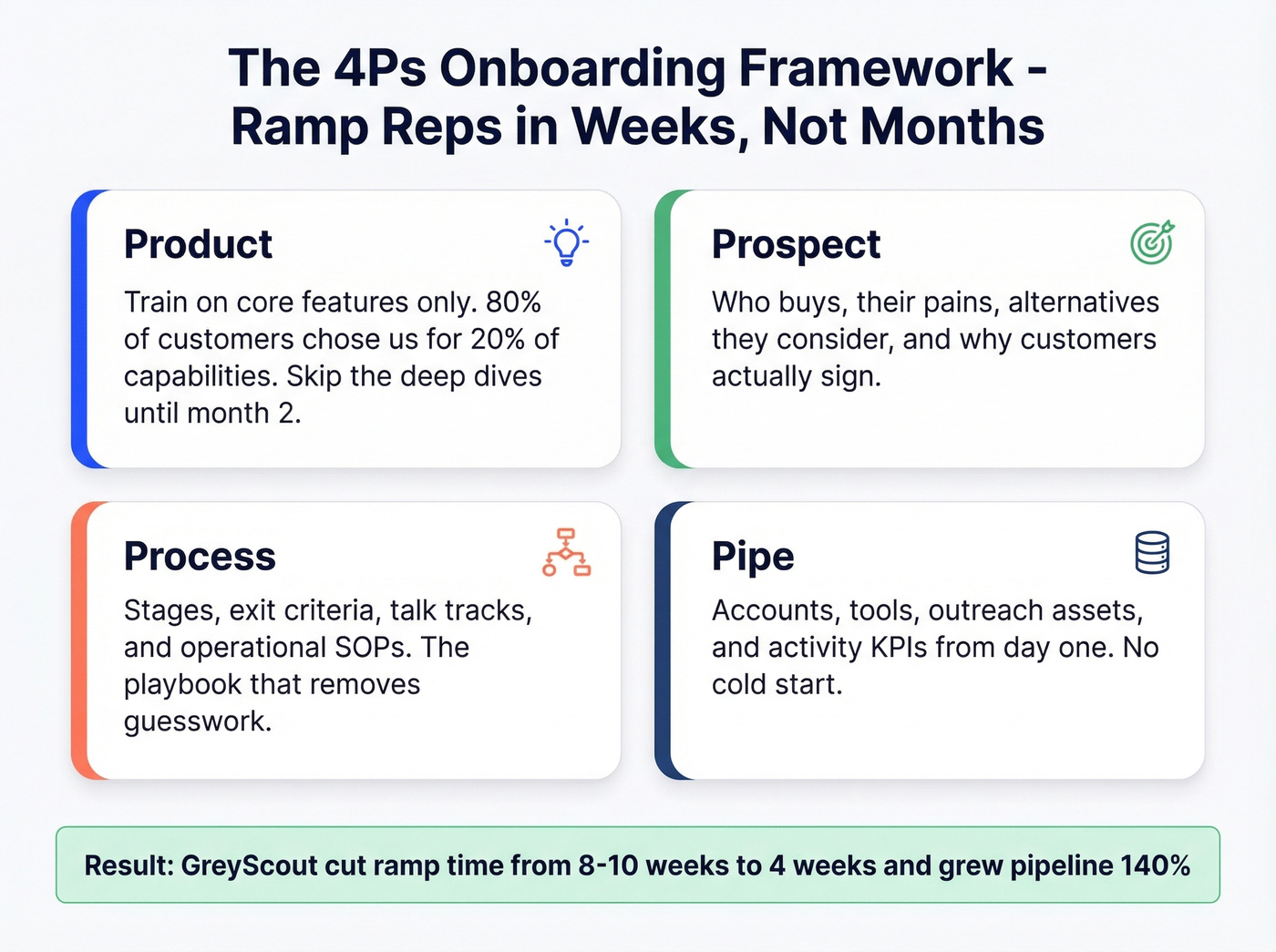
- Product: Train on core features only. "80% of customers chose us for 20% of capabilities."
- Prospect: Who buys, their pains, alternatives they're considering, and why customers sign.
- Process: Stages, exit criteria, talk tracks, operational SOPs.
- Pipe: Accounts, tools, outreach assets, and activity KPIs from day one.
GreyScout used this structured approach alongside Prospeo's verified contact data and cut rep ramp time from 8-10 weeks to 4 weeks - doubling their team from 2 to 5 reps while growing pipeline 140%. If you want a rep-ready ramp plan, pair this with a 30-60-90 day plan and a set of sales follow-up templates.
Funnel Benchmarks to Target
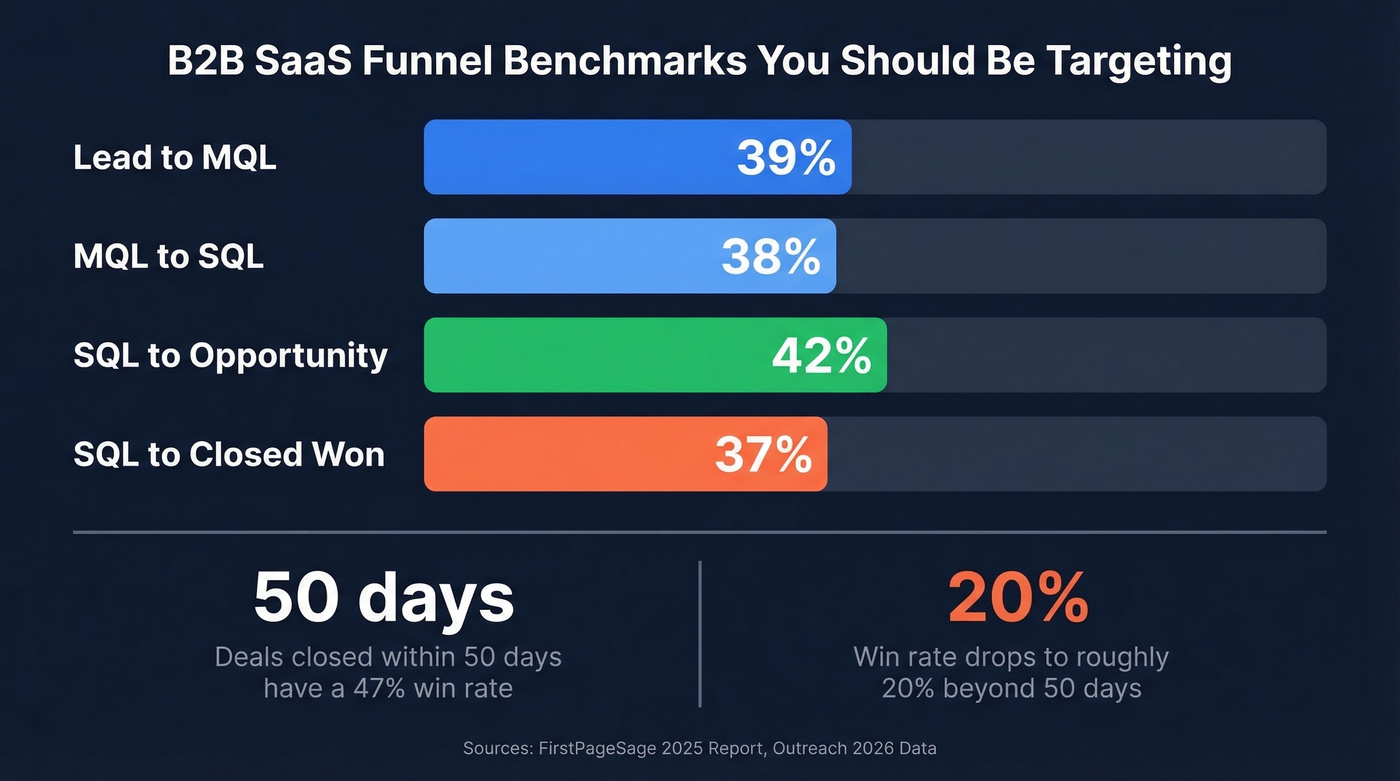
Here are the B2B SaaS funnel benchmarks your process should target:
| Stage | Conversion Rate |
|---|---|
| Lead to MQL | 39% |
| MQL to SQL | 38% |
| SQL to Opportunity | 42% |
| SQL to Closed Won | 37% |

Outreach's 2026 data shows opportunities closed within 50 days have a 47% win rate. Beyond that, win rates drop to ~20%. In our experience, the 50-day threshold is real - deals that drag past it rarely recover, and you're better off reallocating that rep's time to fresher pipeline.
Pipeline coverage should run 3-5x quota. Only 43.5% of reps hit quota, 17% generate 81% of revenue, and reps spend just 30% of their time actually selling. A repeatable process attacks all three problems - especially if you track funnel metrics and monitor pipeline health.
Five Mistakes That Break Scale
1. Hiring before proving repeatability. Building a big sales team before PMF is outsourcing product-market fit to salespeople. That's the founder's job.
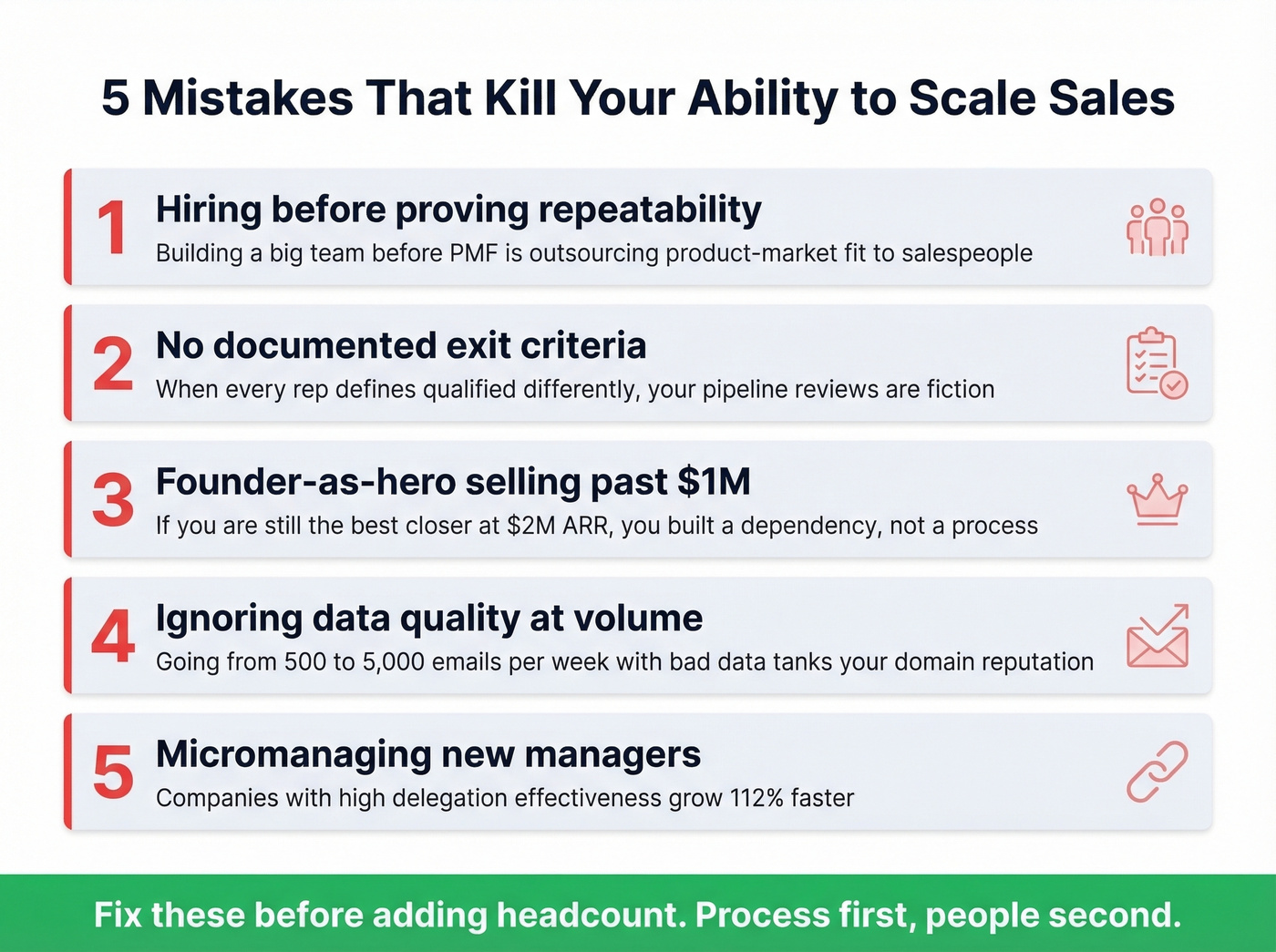
2. No documented exit criteria. When every rep defines "qualified" differently, your pipeline reviews are fiction. We've sat through pipeline calls where the same deal was simultaneously "about to close" and "still in discovery" depending on who you asked.
3. Founder-as-hero selling past $1M. If you're still the best closer at $2M ARR, you haven't built a process - you've built a dependency.
4. Ignoring data quality. When you go from 500 to 5,000 emails per week, high bounce rates tank your domain reputation. Prospeo verifies emails in real time with 98% accuracy at ~$0.01/lead - the kind of infrastructure that prevents deliverability collapse at volume. (If you’re auditing this, start with email bounce rate and an email deliverability guide.)
5. Micromanaging new managers. Companies with high delegation effectiveness grow 112% faster. Build systems, then trust the people running them.
Here's the thing: most teams invest in sequencing tools and CRMs before fixing their data layer. That's backwards. I've seen teams spend $40k/year on a data platform and still have reps manually verifying emails. The data layer is the invisible scaling dependency - it breaks first when you move from founder-curated lists to team-level outreach.
The Tech Stack That Supports Scale
Start with three things: a CRM, a data platform with verified contacts, and a sequencing tool. Everything else is a distraction until you're past 10 reps.

For CRM, HubSpot offers a free tier with Sales Hub starting at $50/month, while Salesforce typically runs into multi-thousand-dollar annual commitments once you factor in seats and add-ons. For sequencing, Outreach or Salesloft runs $100-200/user/month depending on plan and volume.
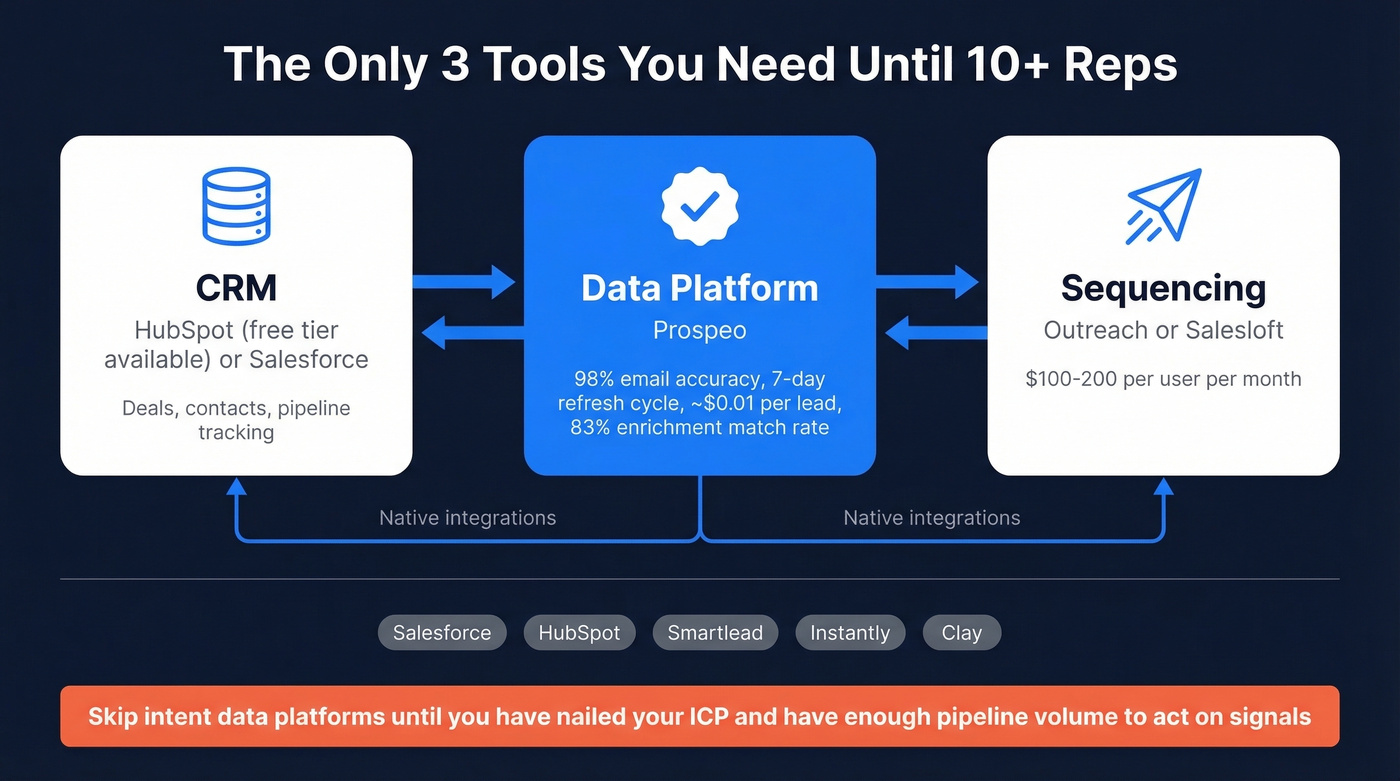
For data, Prospeo delivers 98% email accuracy on a 7-day refresh cycle versus the 6-week industry average, with an 83% enrichment match rate that keeps your CRM clean without manual work. It starts free with 75 verified emails per month, and paid plans run ~$0.01 per email. Native integrations with Salesforce, HubSpot, Smartlead, Instantly, and Clay mean your data flows directly into existing workflows without duct-tape automation. If you’re comparing vendors, see data enrichment services and sales prospecting databases.
Skip intent data platforms until you've nailed your ICP and have enough pipeline volume to act on the signals. Buying Bombora-powered intent data when you're running 200 emails a week is like buying a Formula 1 telemetry system for your go-kart.
GreyScout cut rep ramp time from 8-10 weeks to 4 weeks and grew pipeline 140% by pairing structured onboarding with Prospeo's verified contacts. With 83% enrichment match rates and 125M+ verified mobiles, new reps start with clean pipeline from day one - not stale CSVs.
Give every new hire a pipeline that actually connects to real buyers.
FAQ
How many reps should I hire first?
Two, not one. A single rep gives you no baseline for comparison - two let you run a controlled experiment and isolate whether results come from the rep or the process. Don't hire a VP of Sales until both can hit quota consistently.
What's the biggest sign my process isn't scalable?
If every rep defines "qualified" differently, your process can't scale. Standardize stage exit criteria with one-sentence definitions before adding headcount. When pipeline reviews turn into debates about deal stage, that's your red flag.
How does data quality affect scaling?
Bad data compounds at volume. Going from 500 to 5,000 emails per week with a 15% bounce rate will tank your domain reputation within weeks. Fix your data layer before you scale outreach volume - it's cheaper to prevent deliverability problems than to recover from them.
How long should it take to close a B2B deal?
Opportunities closed within 50 days have a 47% win rate; beyond that, win rates drop to roughly 20%. If your average sales cycle exceeds 60 days for mid-market deals, audit your discovery and proposal stages for bottlenecks slowing momentum.