

The SDR AE Relationship Is a Systems Problem - Here's How to Fix It
You booked 18 meetings this month and your AE closed zero. The AE says the leads were garbage. You say the AE didn't follow up fast enough. Both of you are right, and both of you are wrong.
The SDR AE relationship isn't a chemistry problem. It's a systems problem, and systems can be fixed.
What You Need (Quick Version)
Five fixes, ranked by impact:
- Define a real SLA with hour-based targets. One team cut response time from 38 hours to 3.2 hours and saw a 34% lift in qualified-to-opportunity conversion.
- Use a handoff brief template - not a calendar invite with a one-line note.
- Run structured weekly 1:1s with a set agenda, not a vibe check.
- Fix your contact data. If your bounce rate isn't consistently under 5%, trust breaks before any process can help.
- Align comp incentives with quality gates, not just volume.
If you only do one thing, implement a 4-hour speed-to-lead SLA. It's the single highest-leverage fix.
Why the Sales Model Creates Conflict
The conflict is structural, not personal. SDRs earn $80-95K OTE on a 60/40 split and get measured on meetings booked. AEs earn $150-300K+ OTE on a 50/50 split and get measured on closed revenue. One role optimizes for quantity, the other for quality. That's a built-in collision baked into the model from day one.
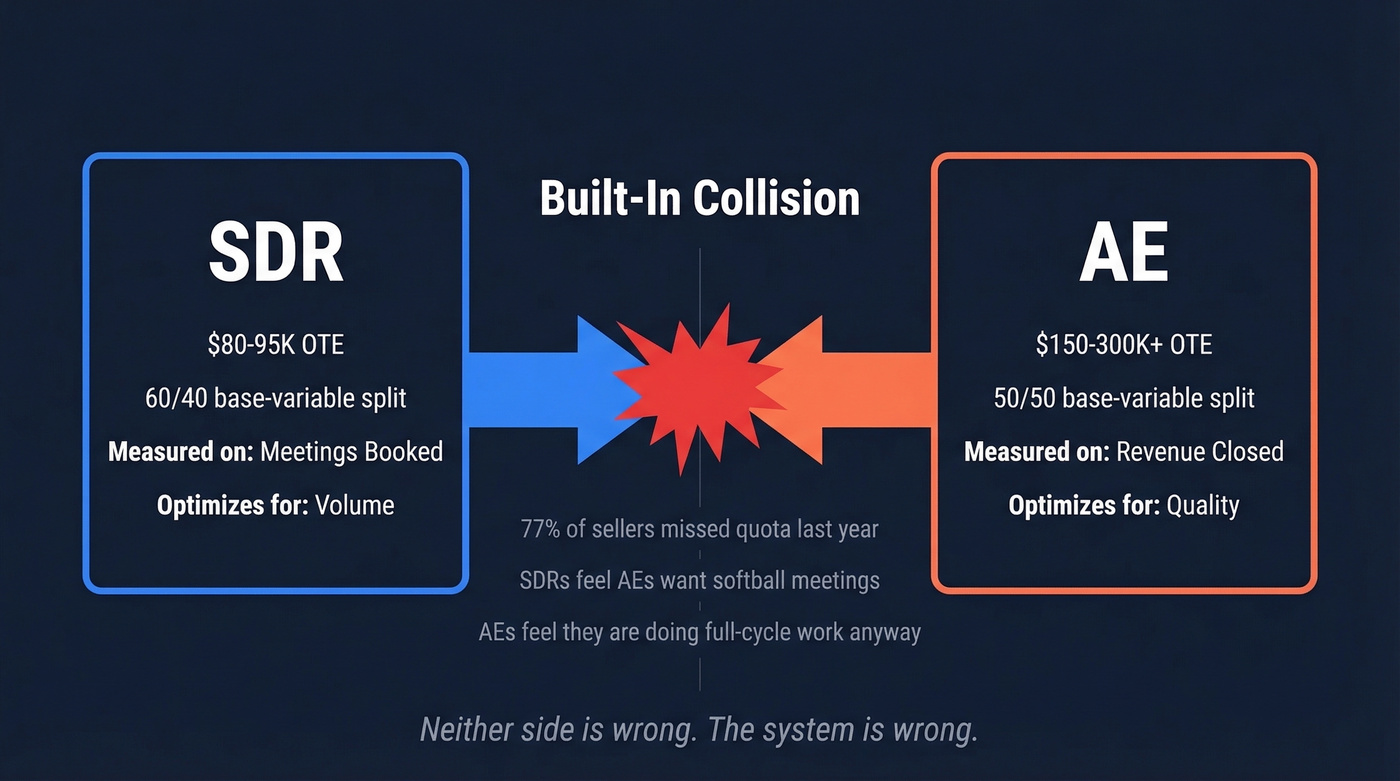
Layer on the career tension and it gets worse. Most SDRs view the partnership through a promotion lens - they need AE advocacy to move up. AEs, meanwhile, sometimes gatekeep that path, consciously or not, especially when they feel SDR-sourced pipeline isn't pulling its weight. The power imbalance compounds every operational friction point.
And before anyone blames the SDR's pitch - outcomes depend as much on territory quality and timing as they do on skill. When 77% of sellers missed quota last year, you've got two stressed-out people pointing fingers at each other over a pipeline that isn't converting. The consensus on r/sales mirrors this exactly: SDRs feel AEs want "softball pitch meetings," while AEs feel like they're doing full-cycle work because SDR-sourced meetings don't hold up. One recurring thread describes AEs doing 60+ dials a day when BDR support falls apart, which breeds resentment fast.
Neither side is wrong. The system is wrong.
The Operational Playbook
Set a Real SLA With Numbers
Only 7% of companies respond to new leads within five minutes - and those that do are 9x more likely to convert (and those that do are 9x more likely to convert). The average response time? 42 hours. Each hour of delay cuts conversion probability by 10%, and 25-40% of qualified leads receive no AE follow-up within 48 hours. That's not a handoff. That's a black hole.
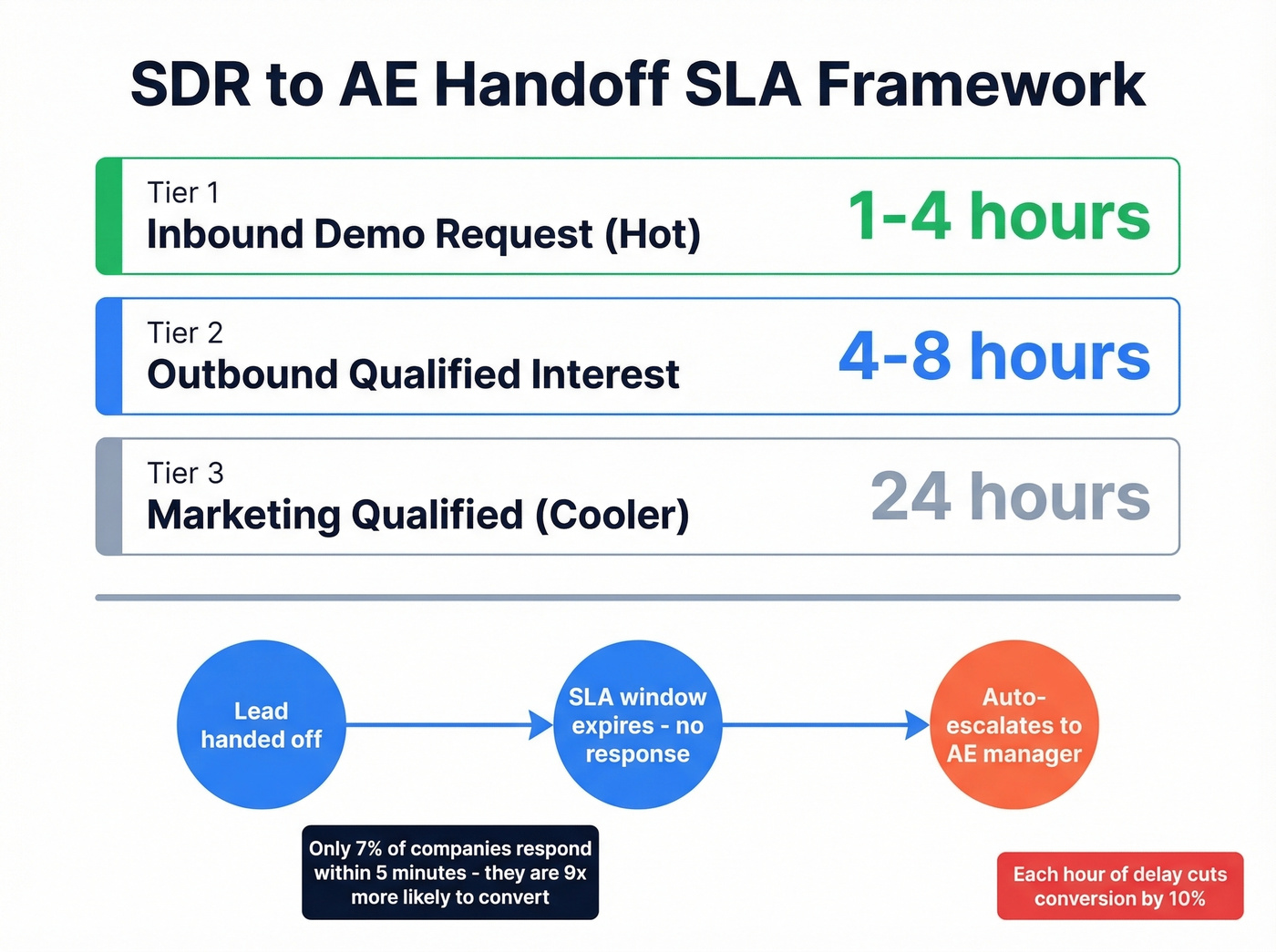
Here's what a tiered SLA looks like:
- Inbound demo request (hot): 1-4 hours
- Outbound qualified interest: 4-8 hours
- Marketing qualified (cooler): 24 hours
Build a Slack escalation mechanic: if an AE hasn't accepted or rejected a handoff within the SLA window, it auto-escalates to their manager. No exceptions, no cherry-picking. Track rejection rates by AE - if someone's rejecting more than 15-20% of meetings, either the qualification criteria need tightening or that AE needs a conversation. (If you need a system for tightening qualification, start with a lead scoring rubric.)
One diagnostic that takes less than an hour: pull your last 10 meetings that didn't convert to pipeline. Pattern-match the handoff notes. You'll find the gap.
Give AEs a Handoff Brief
The single biggest friction point we see between SDRs and AEs is the handoff itself. A calendar invite with "Spoke to John, he's interested" is useless. Here's the template that actually works (and if you want a ready-to-send version, use these handoff email templates):
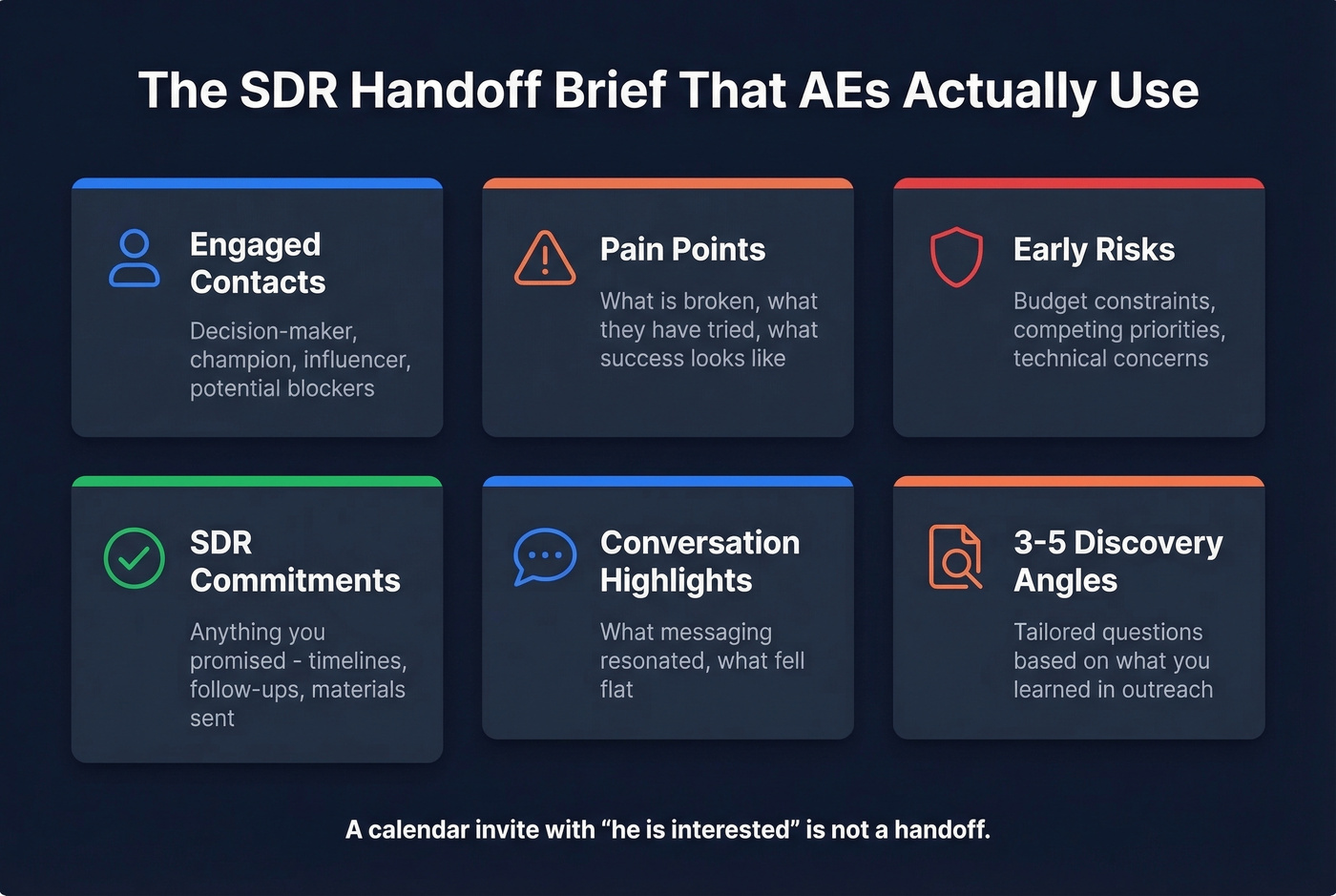
- Engaged contacts: Decision-maker, champion, influencer, potential blockers
- Pain points: What's broken, what they've tried, what success looks like
- Early risks: Budget constraints, competing priorities, technical concerns
- SDR commitments: Anything you promised - timelines, follow-ups, materials
- Conversation highlights: What messaging resonated, what fell flat
- 3-5 suggested discovery angles tailored to what you learned (pair this with a strong set of discovery questions)
Done right, this saves the AE from running a blind discovery call. It's the difference between a strong meeting and a number that makes everyone miserable.
Run a Structured Weekly 1:1
A practitioner playbook on r/sales nails the agenda format:
- Target account updates - progress, blockers, results
- Upcoming meeting review - what's on the calendar, what the AE needs to know
- BDR plan for next week - which accounts, which approach
- Hot leads and closed-lost review - what's working, what died and why
- Co-write messaging together - AEs bring deal context, SDRs bring frontline signal
Set up a dedicated Slack channel for the pair. Not a team channel - a 1:1 channel where intel flows between syncs. The goal is continuous signal sharing, not a weekly status update. If you want to formalize this across the org, treat it as sales communication infrastructure, not a “nice to have.”
Coordinate Above and Below the Line
SDRs work managers and ICs. AEs target VPs and CROs. This sounds obvious, but without explicit coordination, you'll have an SDR emailing the VP of Engineering the same week the AE is trying to get a warm intro through the CTO. On average, it takes 7+ touchpoints to book a meeting - document every one of them in your CRM, not in Slack DMs that disappear when someone leaves. (If your team needs better sequencing discipline, use a sequence management framework.)

Every rejected meeting and ignored handoff brief traces back to the same root cause: contact data your AE doesn't trust. Prospeo's 98% email accuracy and 7-day refresh cycle mean SDR-sourced leads actually connect - so your SLAs and handoff processes work instead of collecting dust.
Stop building process on top of contacts that bounce.
Fix the Data Before the Process
Here's the thing most sales leaders don't want to hear: if your average deal size is under $25K, the SDR AE relationship probably isn't your real problem. Your data is. (If you’re evaluating vendors, start with a shortlist of data enrichment services.)
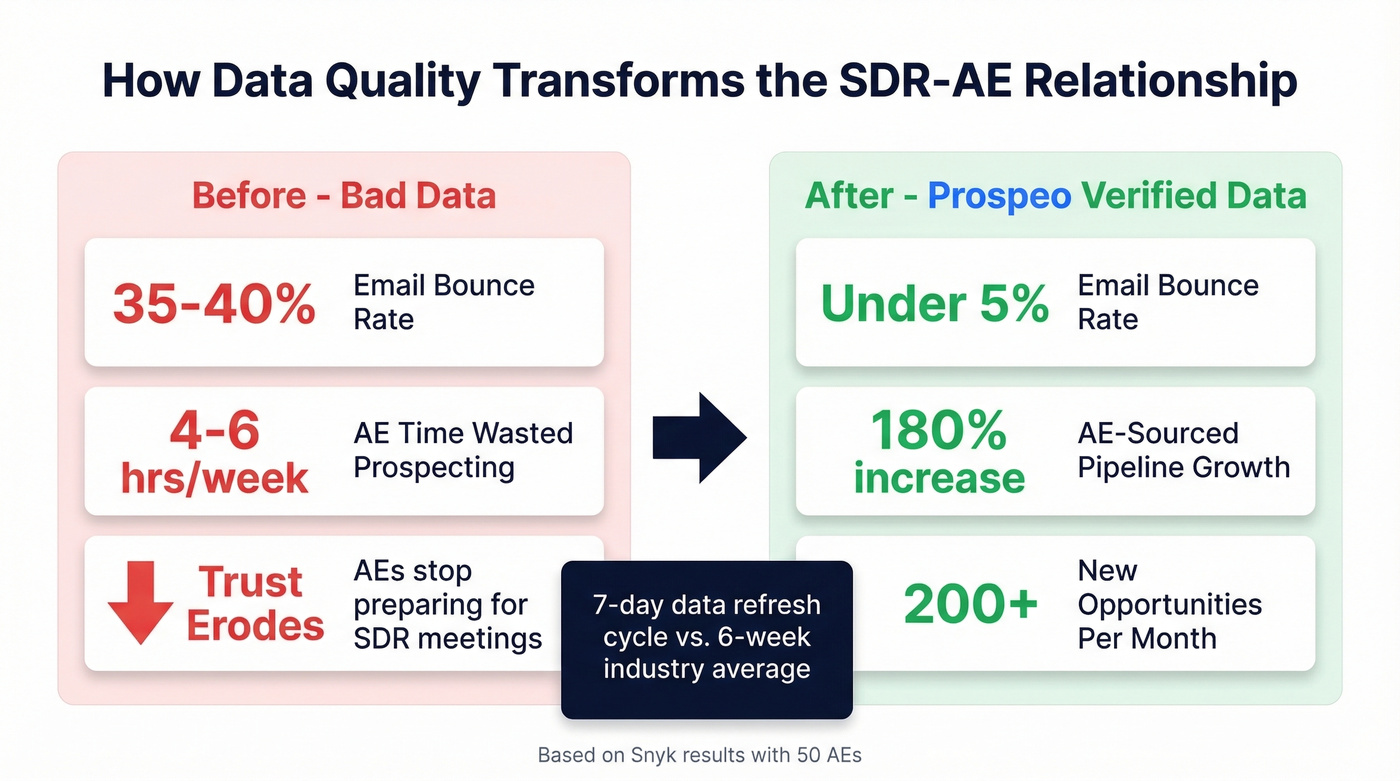
58% of SDR-qualified leads become opportunities - but only if the prospect's email actually works. When SDR-sourced contacts bounce, AEs stop trusting the meetings. They stop preparing. They start no-showing on their own pipeline. We've watched this cycle play out at dozens of companies, and it always starts the same way: bad contact data quietly eroding trust until the whole handoff process collapses. If you’re diagnosing the root cause, start with email bounce rate benchmarks and failure modes.
Snyk's story is instructive. Their 50 AEs were prospecting 4-6 hours per week with bounce rates running 35-40%. After switching to Prospeo's verified data, bounce rates dropped below 5%, AE-sourced pipeline jumped 180%, and they were generating 200+ new opportunities per month. A 7-day data refresh cycle - compared to the 6-week industry average - meant contacts stayed accurate long enough for the handoff process to actually matter. (If you’re building lists at scale, a lead enrichment workflow helps keep fields usable for AEs.)
When your data foundation is solid, the handoff brief matters. The SLA matters. The 1:1 agenda matters. Without it, you're building process on top of contacts that don't exist.
Snyk's 50 AEs cut bounce rates from 35% to under 5% and grew AE-sourced pipeline 180% after switching to Prospeo. When SDRs hand off contacts that actually pick up, AEs prepare, show up, and close. That's the trust loop no SLA template can manufacture.
Fix the data and the SDR-AE relationship fixes itself.
When Handoffs Keep Breaking - Try the Pod Model
If you've implemented SLAs, handoff briefs, and weekly 1:1s and the assembly-line model still isn't working, the pod model is your nuclear option. It pairs an SDR and AE - sometimes plus a CSM - against a shared territory or segment. Comp shifts to a commission pool: the pod hits $1M in revenue, 10% gets allocated, and the split reflects each member's contribution. (This is a specific flavor of team selling.)
Let's be honest - pooling reps this way eliminates the handoff entirely because there's no "your lead" vs. "my lead." For teams where trust has fully eroded, it's a reset button. Skip this if your org is under 10 reps, though. The overhead of restructuring into pods usually isn't worth it at that scale.
Building Teams That Scale
Getting the SDR AE relationship right for one pair is hard enough. Scaling it across an entire org requires deliberate team structure decisions.
Start by defining your inbound and outbound roles separately - inbound reps need speed and qualification instincts, while outbound reps reward research depth and creative sequencing. Blending the two into one role usually means both suffer. As you grow, revisit your SDR-to-AE ratio quarterly. A ratio that worked at $20K ACV with a transactional cycle will break when you move upmarket and deals take three months to close. The team structure should follow the sales motion, not the other way around. If you’re pressure-testing the broader system, map it to your sales process optimization plan.
FAQ
What's the ideal SDR-to-AE ratio?
The industry average sits around 2.6 AEs per SDR. Higher-ACV deals need more research time per account, so the ratio shifts toward 1:1 or 2:1. For teams selling sub-$15K deals with high volume, 3:1 or 4:1 can work.
How do you measure handoff quality?
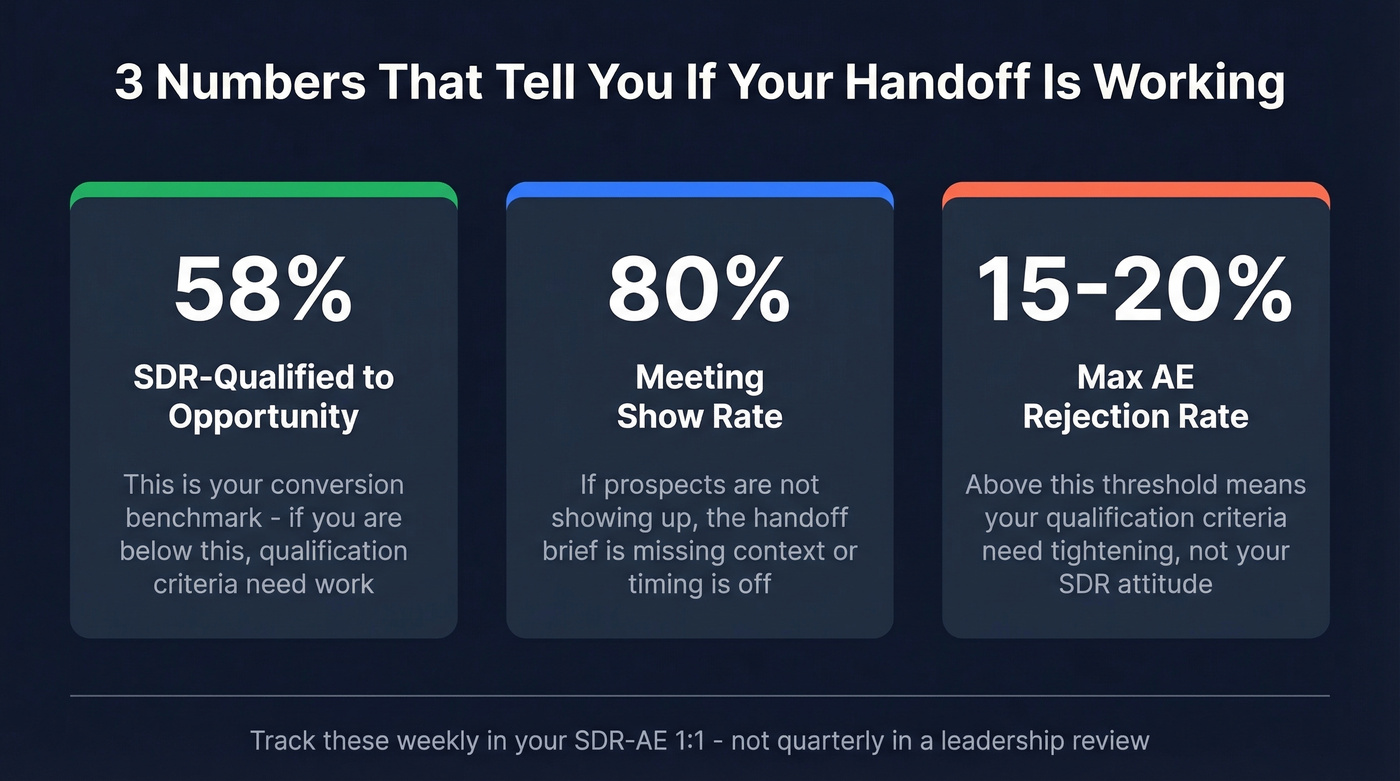
Track three numbers: SDR-qualified-to-opportunity conversion rate (benchmark: 58%), show rate (benchmark: 80%), and AE rejection rate. If AEs reject more than 15-20% of SDR-booked meetings, your qualification criteria need tightening - not your SDR's attitude.
What causes SDR-AE conflict?
Misaligned incentives are the root cause. SDRs get paid on meetings booked; AEs get paid on revenue closed. Add career tension - SDRs wanting promotion, AEs feeling unsupported - and you get finger-pointing over pipeline that neither side fully controls. The fix is structural: shared SLAs, quality gates on comp, and accurate contact data so neither side wastes time on dead leads.
Can better contact data improve alignment?
Dramatically. When bounce rates drop below 5%, show rates climb and AEs start trusting SDR-sourced meetings again. Keeping contacts verified and refreshed weekly - rather than relying on data that's months old - means the handoff process actually works instead of becoming the silent friction point no SLA can fix.