

How to Build and Scale an SDR Team in 2026
Your VP just told you to build out the SDR team. You've got a headcount budget, a vague timeline, and a mandate to "generate more pipeline." The fact that most SDR guides still recommend "100 dials a day" without mentioning data quality tells you they were written by people who've never managed one.
The average SDR generates $3M/year in pipeline and drives 30-45% of new revenue. That's not a cost center - it's a growth engine. But only if you build it right.
The 2026 sales development function looks different from what most playbooks describe. It's smaller, better-equipped, and more productive per rep. The era of throwing bodies at pipeline is over. Let's build the thing properly.
What You Need (Quick Version)
Before we go deep, here's the cheat sheet:
How many SDRs? One per 2.4 AEs. Start with 2-3 reps, overhire by 20-30% during ramp to absorb fallout.
What will it cost? $100k-$120k/year fully loaded per rep - salary, benefits, tools, management overhead. Or ~$2,490/month outsourced. Add $2k-$5k/month in tools on top.
What tools do they need? Five categories, not fifteen:
- CRM (Salesforce or HubSpot)
- Sales engagement (Outreach, Salesloft, or Instantly)
- Parallel dialer (Orum or Nooks)
- Verified data (Prospeo)
- Scheduling (Chili Piper or Calendly)
That's the foundation. Everything else is optimization.
How to Structure Your SDR Team
Structure decisions compound. Get the organizational design wrong and you'll spend six months debugging a people problem that's actually a systems problem. The Bridge Group's 2026 Sales Development Report - covering 351 B2B companies with a median revenue of $47M and median ASP of $50K - gives us the baseline: 60% of SDR orgs report to Sales, 82% align reps to AE territories, and the SDR-to-AE ratio has held steady at 1:2.4 since 2018.
Assembly Line vs. Island vs. Pod
Three models dominate. The right one depends on your deal size, team maturity, and inbound volume.
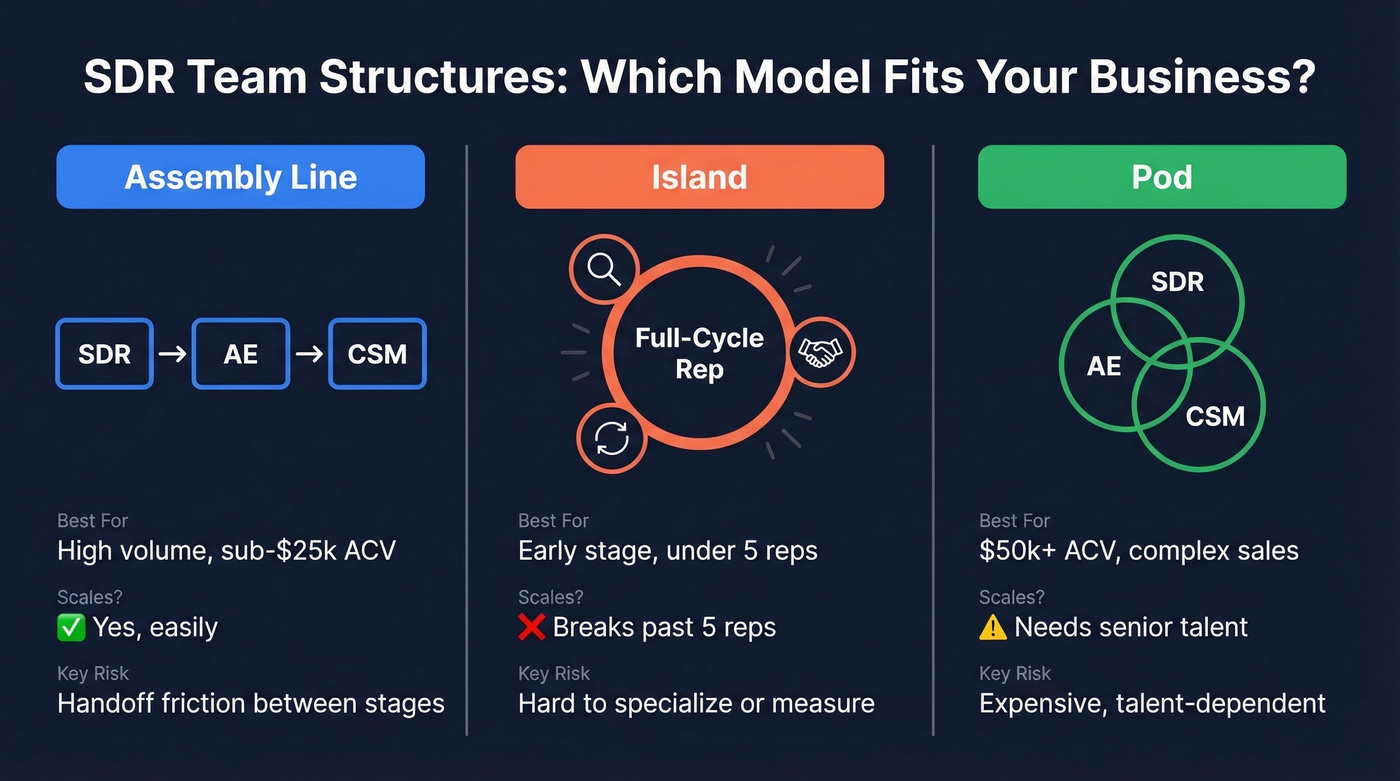
| Model | How It Works | Best For | Watch Out For |
|---|---|---|---|
| Assembly Line | SDRs prospect -> AEs close -> CSMs retain | High volume, sub-$25k ACV | Handoff friction |
| Island | Each rep owns full cycle | Early-stage, <5 reps | Hard to scale |
| Pod | SDR + AE + CSM in mini-teams | $50k+ ACV, complex sales | Needs senior talent |
Assembly Line is the default for a reason - it lets you specialize roles and measure each stage independently. But if you're selling six-figure deals with 4+ stakeholders, pods give AEs and SDRs shared context that assembly lines can't replicate. Island works when you've got 2-3 scrappy reps and no budget for specialization, but it breaks past 5 people.
The SDR Process in 3 Steps
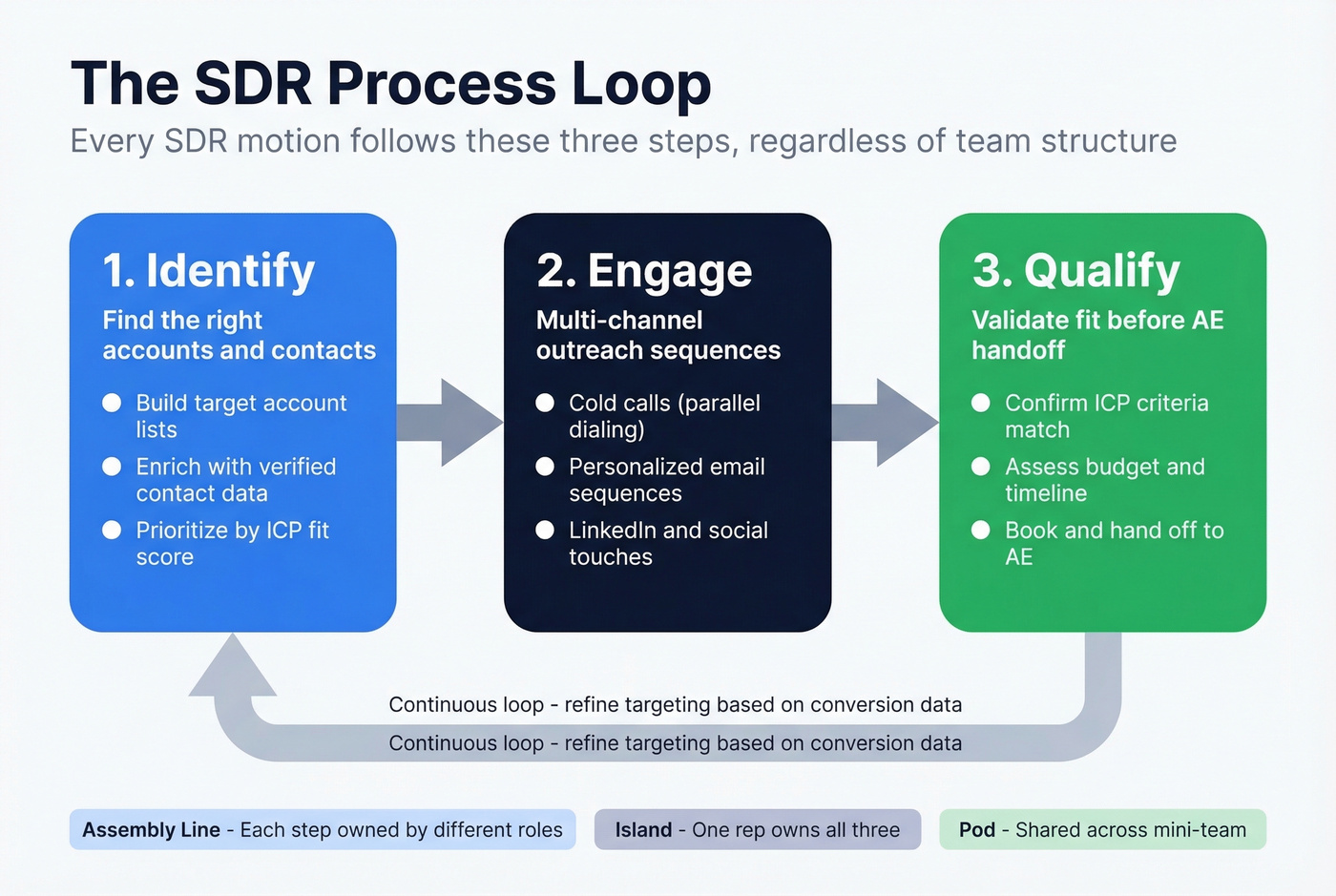
Regardless of org model, every SDR motion follows the same core loop: Identify the right accounts and contacts, Engage through multi-channel sequences (calls, emails, social touches), and Qualify against your ICP criteria before handing off to AEs. The model you choose determines who owns each step and how handoffs work - but the loop stays the same.
If you need a tighter playbook for the Identify step, borrow a few sales prospecting techniques that still work at scale.
Inbound vs. Outbound vs. Allbound
The industry data shows a clear trend toward allbound - reps handling both inbound and outbound motions. Tech adoption tells the story: allbound teams use contact data tools at 82% adoption versus 56% for inbound-only teams, sales engagement platforms at 84% versus 72%, and LinkedIn Sales Nav at 88% versus 56%.
If your inbound volume can keep reps busy - roughly 300 leads per month per rep - a dedicated inbound team makes sense. Below that threshold, allbound is more efficient. Each inbound SDR can handle about 15 leads/day, but the conversion math varies wildly: high-intent demo requests convert at 75-80%, while low-intent content downloads convert at just 5-10%.
Org Chart and Reporting Structure
Who do SDRs report to? 60% report to Sales leadership, but a growing minority report to the CMO, especially in product-led growth companies where inbound qualification is the primary motion. There's no universally right answer, but alignment matters more than hierarchy. If your reps report to marketing, make sure comp and quota are still tied to pipeline outcomes, not just MQL volume.
Hiring and Onboarding SDRs
What to Look For
The average SDR has 1.2 years of experience. That's not a lot. You're hiring for coachability, not expertise. The traits that predict success - curiosity, resilience, pattern recognition - don't show up on a resume. They show up in how a candidate handles a mock cold call on day two of the interview process.
Plan for churn. Average tenure is 1.9 years, which means you're rebuilding a third of your team every year. Overhire by 20-30% during ramp periods. It sounds expensive, but it's cheaper than running at 60% capacity for three months while you backfill.
The 90-Day Ramp Plan
Ramp time has dropped to 3.0 months - the lowest since 2010. That's not because reps are better; it's because onboarding programs are tighter. The best programs follow a phased approach:
Week 1: Product knowledge, ICP definition, tool setup. By Day 5, you should know who's going to make it. Structured assessments - quizzes, mock calls, simulated objection handling - work as early gates. If someone can't articulate your value prop by Friday, that's a signal. Some teams add gamification here: leaderboards for mock call scores, small prizes for fastest ICP mastery. It sounds gimmicky, but it builds competitive energy before reps ever touch a real prospect.
Weeks 2-4: Shadowing, first live calls with coaching, initial account assignments. Pipeline equality matters here - don't give your best accounts to the new rep or your worst accounts to the struggling one. Distribute by tier.
Weeks 5-12: Full quota ramp. Weekly 1:1s focused on efficiency diagnosis, not activity volume. Chili Piper's outbound team found that teaching reps to diagnose their own conversion bottlenecks early was the single biggest needle-mover in their coaching program.
If you want a more detailed onboarding template, adapt a 30-60-90 day plan and map it to your SDR motion.
Build vs. Outsource
| Cost Factor | In-House SDR | Outsourced SDR |
|---|---|---|
| Monthly cost | ~$8k-$10k | ~$2,490 |
| Annual fully loaded | $100k-$120k | ~$30k |
| Ramp time | 3 months | 2-4 weeks |
| Control over messaging | Full | Limited |
| Institutional knowledge | Builds over time | Resets with turnover |
| Best for | Core motion, $50k+ ACV | Testing new markets, overflow |
Outsourcing makes sense when you're testing a new segment or need pipeline fast. For your core motion - especially complex deals - an in-house team builds the institutional knowledge that compounds over quarters. You get control over messaging, data, and the feedback loop between SDRs and AEs that outsourced agencies simply can't replicate.
SDR Compensation in 2026
Comp is the first thing candidates ask about and the last thing most guides get specific on. Betts Recruiting's data shows SDR salaries increased 5-10% year over year, driven by competition for experienced reps in major metros.
If you’re standardizing offers, it helps to define OTE clearly so candidates and managers are aligned.
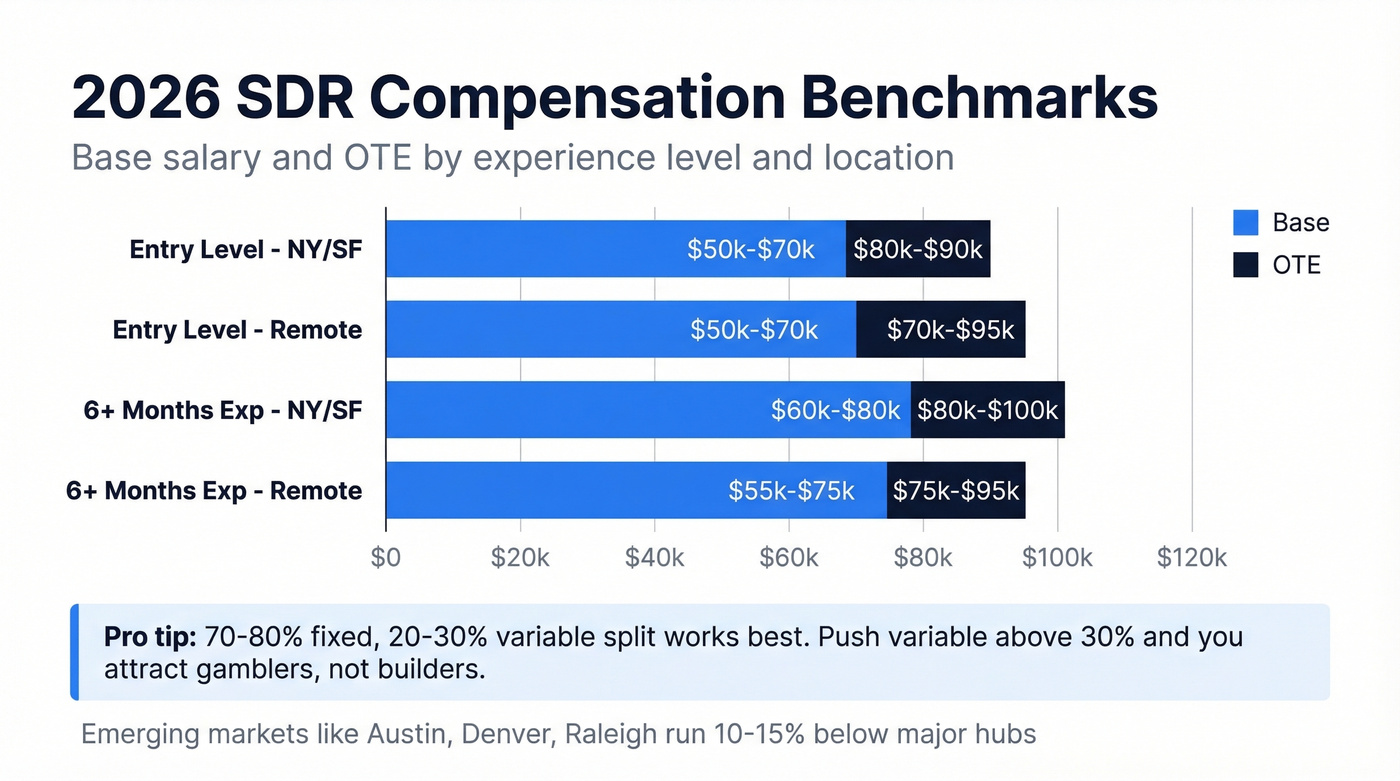
| Level | Location | Base | OTE |
|---|---|---|---|
| Entry-level | NY/SF | $50k-$70k | $80k-$90k |
| Entry-level | Remote | $50k-$70k | $70k-$95k |
| 6+ months exp | NY/SF | $60k-$80k | $80k-$100k |
| 6+ months exp | Remote | $55k-$75k | $75k-$95k |
Emerging markets like Austin, Denver, and Raleigh typically run 10-15% below traditional hubs but are closing the gap fast.
The comp structure matters as much as the number. A 70-80% fixed / 20-30% variable split works best for SDR roles. Push variable above 30% and you'll attract gamblers, not builders.
What companies actually pay on varies more than you'd expect:
| Variable Trigger | % of Companies Using |
|---|---|
| Deals signed | 39% |
| Meetings booked | 33% |
| Revenue generated | 33% |
| Meetings held | 28% |
| Leads sent to AEs | 11% |
| Pipeline created | 11% |
The trend is toward outcome-based comp over activity-based. If your reps are paid purely on meetings, you'll get a lot of meetings that go nowhere. A hybrid formula works better - something like $35 per meeting booked plus ~1% of revenue generated per lead. That aligns incentives without making reps feel like they can't control their paycheck.
Metrics That Actually Matter
Most dashboards track too many things and measure the wrong ones. Activity metrics without conversion context are vanity metrics. Here's what the benchmarks actually say.
If you’re rebuilding your reporting, start from funnel metrics and work backward into SDR inputs.
Activity Benchmarks
| Metric | Benchmark |
|---|---|
| Dials/day | 46 |
| Quality conversations/day | 5.8 |
| Meetings set/month | 21 |
| Qualified opps/month | 13 |
| Attempts per prospect | 8.2 avg, 9-12 sweet spot |
| Touches per account | 16 |
| Quota attainment (avg) | 68% |
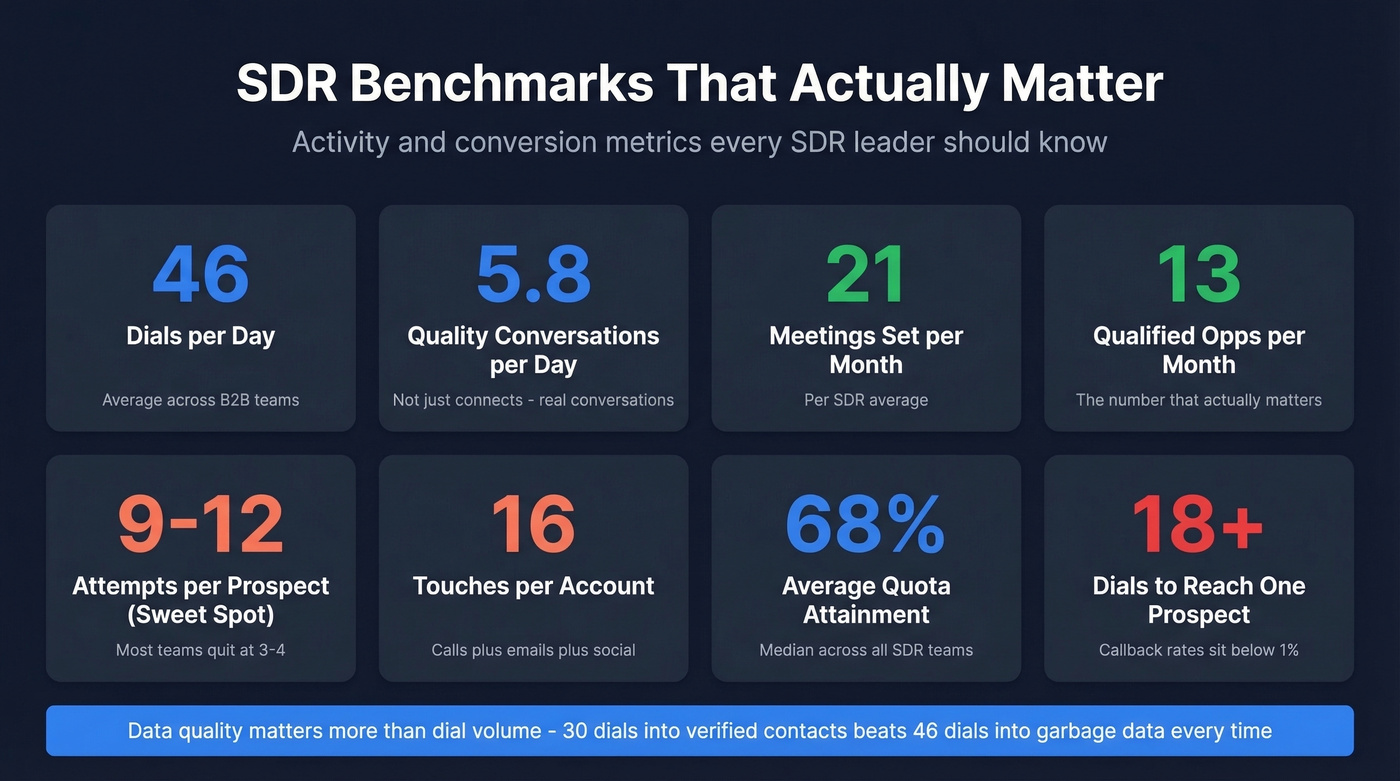
Most teams quit too early. The average is 8.2 attempts per prospect, but the sweet spot is 9-12. Gartner's data makes this even starker: it takes 18+ dials to reach a single prospect, and callback rates sit below 1%. That's why data quality matters more than dial volume.
Input vs. Output: What to Track
The numbers above are useful as baselines, not targets. A rep making 46 dials/day into garbage data will underperform a rep making 30 dials into verified, well-targeted contacts every single time.
Input metrics like dials and emails sent tell you about effort. Output metrics like conversations, qualified opps, and pipeline created tell you about results. Track both, but manage to outputs.
Teams using parallel dialing tech report 28% more dials and 30% more quality conversations per day. That's a real edge - but only if the numbers being dialed are accurate. We've seen teams invest $300/user/month in a parallel dialer and feed it unverified mobile numbers. The math doesn't work.
If you want a cleaner KPI set, use a pipeline health view to separate “busy” from “effective.”
The Chili Piper Case
Here's a cautionary tale worth studying. Chili Piper's outbound team was sending 200+ emails/day and working 600-700 accounts/month - massive activity volume - without consistent quota attainment. The fix wasn't more activity. It was enforcing pipeline equality through account distribution by tier, redesigning 1:1 coaching around efficiency diagnosis, and pivoting to a hybrid call-plus-email approach. The result: the team ended at 118% of their closed-won goal.
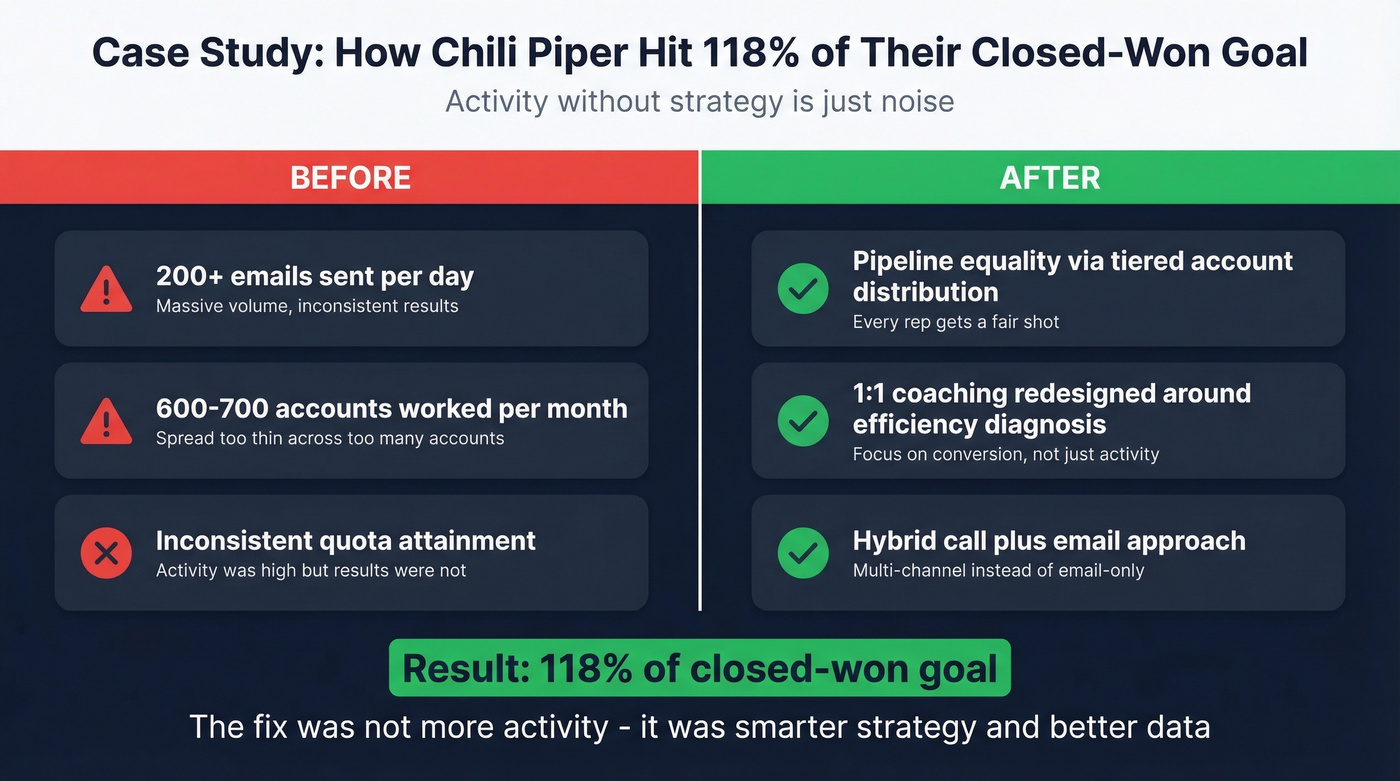
Activity without strategy is just noise.

Bad data is the #1 reason SDR teams underperform. Prospeo gives your reps 300M+ verified profiles with 98% email accuracy and 125M+ direct dials - refreshed every 7 days, not 6 weeks. Snyk's 50 AEs cut bounce rates from 35% to under 5% and grew AE-sourced pipeline 180%.
Give your SDR team data that actually connects them to real buyers.
The SDR Tech Stack
The average sales development team uses 12-15 tools per day. Your tech stack probably costs $2k-$5k/month per rep, and half those tools overlap.
If you want a curated shortlist, start with our SDR tools breakdown and build from there.
| Category | Tools | Typical Cost |
|---|---|---|
| CRM | Salesforce, HubSpot | $25-$300/user/mo |
| Prospecting/Data | Prospeo, Apollo, ZoomInfo | $0.01/lead-$50k/yr+ |
| Sales Engagement | Outreach, Salesloft, Instantly | $25-$150/user/mo |
| Dialer | Orum, Nooks | $50-$350/user/mo |
| Scheduling | Chili Piper, Calendly | $10-$30/user/mo |
| Intent Data | Bombora, 6sense | $500-$5k/mo |
| Conversation Intel | Gong | $100-$200/user/mo |
The most impactful investment in that table isn't the CRM or the sequencer - it's the data layer. Bad data poisons everything downstream. Your dialer wastes cycles on disconnected numbers. Your sequencer burns domain reputation on invalid emails. Your reps lose confidence after a week of bounces and wrong numbers.
If you’re fixing bounces, start with email bounce rate and work backward to list quality.

We recommend Prospeo for the data layer. At 98% email accuracy with a 7-day refresh cycle - versus the 6-week industry average - it solves the freshness problem that plagues most B2B databases. At roughly $0.01 per lead, it's 90% cheaper than legacy data contracts that typically run $20-50k/year.
The customer results back this up. GreyScout cut new rep ramp time from 8-10 weeks to 4 weeks after switching their data source - when reps trust the data, they ramp faster. Snyk saw bounce rates drop from 35-40% to under 5%, AE-sourced pipeline jumped 180%, and the team generated 200+ new opportunities per month.
You're spending $100K+ per SDR per year. Don't let $0.01 emails be the bottleneck. Prospeo's verified data, 30+ ICP filters, and native integrations with Salesforce, HubSpot, Outreach, and Instantly slot directly into the SDR tech stack you're already building.
Cut your SDR ramp time and triple pipeline output with verified data.
AI SDRs vs. Human SDRs
AI SDRs won't replace your team in 2026, but they'll replace the teams that ignore them. Let's look at the actual numbers instead of the hype.
Where AI Wins
AI SDRs excel at speed, consistency, and technical depth. Data from SaaStr's AI SDR deployments shows AI answering technical questions immediately 87% of the time versus 15% for human SDRs. Time to technical qualification drops from 8.3 days to 2.1 days. AI handles 200-500 personalized touchpoints per day versus 30-50 for humans before quality degrades, and follow-up consistency runs 98-100% versus 65-75% for manual outreach.
The cost difference is stark: $500-$2,000/month for an AI SDR platform versus $75k-$100k/year for a human rep.
Where Humans Win
Cheaper doesn't mean better. An experiment by AI Agenix found that while AI was 54x cheaper per touchpoint, human SDRs produced 2.6x more revenue ($147k vs $56k) and achieved a 71% show rate versus 52% for AI-booked meetings. Humans build trust. They read tone. They know when to push and when to back off. For complex, high-ACV deals, that matters enormously.
The Hybrid Model
The answer isn't either/or. Hybrid teams - AI handling initial outreach, research, and follow-up cadences while humans take over for live conversations and relationship-building - deliver a 35% productivity boost and 2.5x revenue growth over pure-human teams.
| Metric | Human SDR | AI SDR | Hybrid |
|---|---|---|---|
| Annual cost | $75k-$100k | $6k-$24k | $85k-$110k |
| Qualified opps/mo | 15-20 | 40-60 | 50-70 |
| Show rate | 71% | 52% | ~65% |
| Cost per qualified lead | $262 | $39 | ~$80-$150 |
| Revenue growth | Baseline | 0.4x human | 2.5x |
Implementation reality check: plan for 40-60 hours of data cleaning and segmentation before launch, and expect 3-6 months to positive ROI with clean data. AI SDRs need accurate contact data to function - feed them garbage and they'll just send garbage faster.
If you’re operationalizing AI follow-ups, use an AI sales follow-up workflow so you don’t spam your TAM.
Here's the thing: stop building 10-person teams. Build a 4-person squad with better data, better tools, and AI handling the repetitive work. The math is clear - a lean hybrid team outperforms a bloated manual one every time, and it costs less.
Headcount Planning and Scaling
Most sales development orgs fail to scale because they treat headcount as a linear function of pipeline targets. Smart resource planning starts with your conversion data, not your ambition.
How Many SDRs Do I Need?
Work backward from your revenue target. If your average deal size is $50k, you need 200 deals to hit $10M. If your SDR-to-opportunity conversion rate is 15% and each rep generates 13 qualified opps per month, you need roughly 8-10 SDRs to feed that pipeline. The 1:2.4 SDR-to-AE ratio is a reliable starting point across B2B companies.
How Many SDRs Per Manager?
The Bridge Group data shows the optimal span of control is 6-8 reps per frontline manager. Go above 10 and coaching quality drops measurably - managers spend all their time in pipeline reviews and none in 1:1 skill development. Planning to scale past 15 reps? You need at least two frontline managers and a director-level leader to coordinate them.
If you’re building the management layer, align it with your sales leadership system (cadences, coaching, and accountability).
Team Composition
As you scale, composition matters more than raw headcount. A mix of experience levels - a few senior SDRs who can mentor, a core of mid-tenure reps carrying quota, and a cohort of new hires ramping - creates a self-sustaining system. Pure cohort hiring where everyone starts the same week creates a cliff when they all hit tenure limits simultaneously.
Mistakes That Kill SDR Teams
Most teams fail because of bad systems, not bad reps. Here are the five patterns we see kill them repeatedly.
1. Activity obsession without strategy. Remember the Chili Piper case - 200+ emails/day, missed quota. The fix was smarter account distribution and efficiency coaching, not more emails. If your dashboard only shows activity counts, you're managing inputs and hoping for outputs.
2. Unverified data destroys everything downstream. Snyk's team was running a 35-40% bounce rate before they fixed their data source. That's not just wasted effort - it's active domain damage. Bounce rates of 30%+ will torch your sending reputation, and recovering from that takes months. This is the single cheapest performance fix available to any sales development org.
3. No career path. A common complaint on r/techsales? "SDR purgatory" - being stuck in the role with no clear path to AE or another promotion. If your best reps don't see a future, they'll leave in 12 months. Every time.
4. Over-tooling. Your reps don't need 12-15 tools. They need 5-6 that work well together. Every additional tool is another login, another tab, another context switch. Consolidate ruthlessly.
5. Ignoring pipeline equality. Not all accounts are created equal. If your top performers get the best territories and your new reps get the scraps, you're measuring territory quality, not rep quality. Distribute accounts by tier and rotate regularly.
Retention and Career Pathing
Average SDR tenure is 1.9 years. That gives you roughly 15 productive months after ramp before you're backfilling. The math is brutal if you don't have a retention strategy.
The most effective lever is a published, measurable promotion path with concrete criteria at each stage:
- Junior SDR (first 6 months): Hit 80%+ quota for 2 consecutive months, demonstrate consistent CRM hygiene, complete all onboarding certifications.
- Associate SDR (6-12 months): Maintain 90%+ quota for 3 consecutive months, achieve 70%+ SAL-to-opportunity conversion, mentor one new hire through their first month.
- Senior SDR (12-18 months): Hit 100%+ quota for 3+ consecutive months, demonstrate multi-threading on 5+ accounts, run at least one team training session.
- AE Promotion: Sustained Senior SDR performance, completed discovery call certification, shadowed and co-led 10+ AE demos.
When reps can see exactly what they need to do to advance, they stay longer and perform better. The r/sales and r/techsales communities are full of posts from SDRs who left good companies because the promotion criteria were vague or constantly shifting. Don't be that company.
Real talk: if your SDR-to-AE promotion rate is below 30%, you have a retention problem disguised as a hiring problem. The reps who can sell will find companies that promote them. The ones who stay are the ones who can't leave. That's not a team - it's a waiting room.
Compensation matters, but it's table stakes. Coaching, career clarity, and the feeling that leadership actually understands the role - those are the retention levers that compound. Invest in managers who've done the job themselves. A manager who's never made a cold call will never earn a cold caller's respect.
FAQ
How many SDRs do I need per AE?
The industry benchmark across 351 B2B companies is 1 SDR per 2.4 AEs, a ratio that's held steady since 2018. Start with 2-3 reps, overhire by 20-30% during ramp, and adjust based on your pipeline targets and AE capacity.
How long does it take to ramp an SDR?
Average ramp time is 3.0 months - the lowest reading since 2010. Phased onboarding with Day 5 assessment gates, structured mock calls, and early account assignments accelerates this. Teams using clean, verified data consistently ramp reps faster - GreyScout cut ramp from 8-10 weeks to 4 weeks after switching their data source.
Should I outsource my SDR team?
Outsourcing runs ~$2,490/month versus $8k-$10k/month in-house per rep. It works for testing new markets, handling overflow, or generating pipeline fast. For your core sales motion - especially complex deals above $50k ACV - in-house teams build institutional knowledge that outsourced agencies can't replicate.
What's a realistic SDR quota?
Expect 21 meetings set or 13 qualified opportunities per month, with 68% average quota attainment across the industry. Set quotas based on your conversion data, not aspirational targets. If fewer than half your reps hit quota, it's a system problem, not a people problem.
When should I hire my first SDR team?
Hire when your AEs spend more than 30% of their time prospecting instead of closing. If founders or AEs are sourcing their own pipeline and it's pulling them away from active deals, that's the signal. Most companies wait too long - by the time pipeline dries up, you're already three months behind because of ramp time.