

SDR to AE: What the Data Says and How to Make the Jump
The SDR to AE promotion feels close and impossibly far at the same time. You're 18 months in, hitting 120% of quota, and your manager keeps saying "keep doing what you're doing" while the one AE opening goes to someone from outside the company.
This isn't another "be coachable and ask for feedback" article. The sales development rep to account executive transition is a structural problem, not a self-help problem. Two of the three variables that matter - your company and available headcount - are outside your control. Let's focus on the third: making yourself impossible to ignore, at the right time, in the right place.
What You Need (Quick Version)
- Wait 16+ months as an SDR. SDRs promoted before 11 months fail 55% of the time. At 16+ months, that drops to 6%.
- Stay internal if you can. Internal promotion failure rate is 26%. External jumps hit 41%.
- Pick the right company. Fast sales cycles, sub-$25k deals, a proven history of promoting SDRs.
- Your comp roughly doubles. SDR OTE of $70k-$95k becomes mid-market AE OTE of $140k-$180k.
- Start prepping 6 months out. The rest of this guide gives you the data and the plan.
How Hard Is This Jump, Really?
The Bridge Group studied roughly 205 reps who moved from SDR/BDR to AE roles. The overall failure rate - defined as lasting 6 months or less in the AE seat - was 26%. One in four.
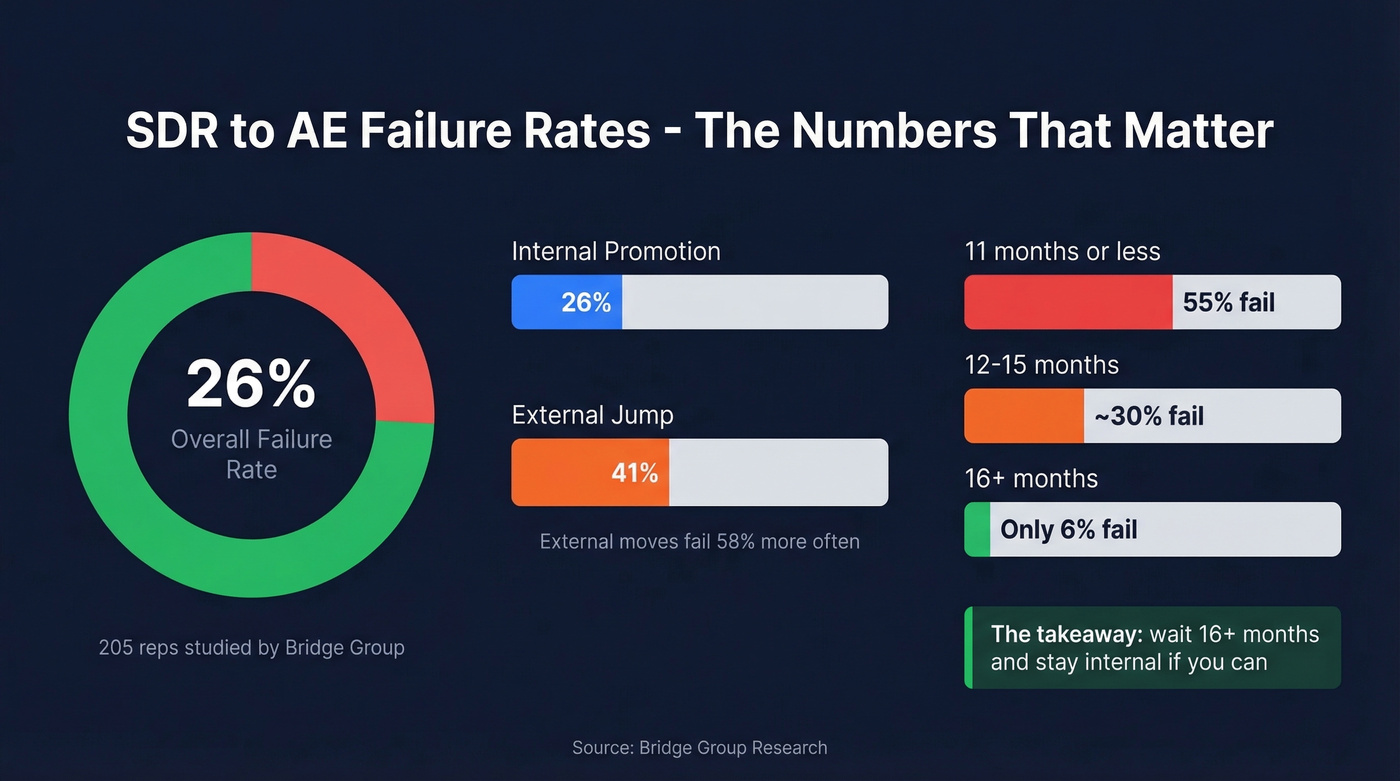
But the averages hide the real story. SDRs who left their company to take an external AE role failed 41% of the time. Tenure before promotion was the single biggest predictor of success: SDRs promoted with 11 months or less of experience failed at a 55% clip. Those who waited 16+ months? Just 6%.
We've seen this pattern play out dozens of times. One rep on r/sales shared their story: left an inbound-heavy SDR role for an external AE position, chasing a comp jump from $80k to $125k OTE. Three months in, they'd closed one deal - for $400 - against a $15k quota. No enablement, no pipeline support, drowning in self-sourcing. That's the 41% stat with a face on it.
Most SDRs get promoted too early or at the wrong company. The BDR to account executive transition follows the same pattern - the data doesn't distinguish between SDR and BDR titles, so everything here applies equally.
Career Ladder: Timeline and Comp
The Bridge Group tracked 236 Enterprise AEs who started in sales development. The median journey to Enterprise AE took 6.25 years, spanned 3 companies and 6 distinct roles. Only 9% made it from entry-level SDR to Enterprise AE at the same company. Each company switch added roughly 8 months to the timeline.
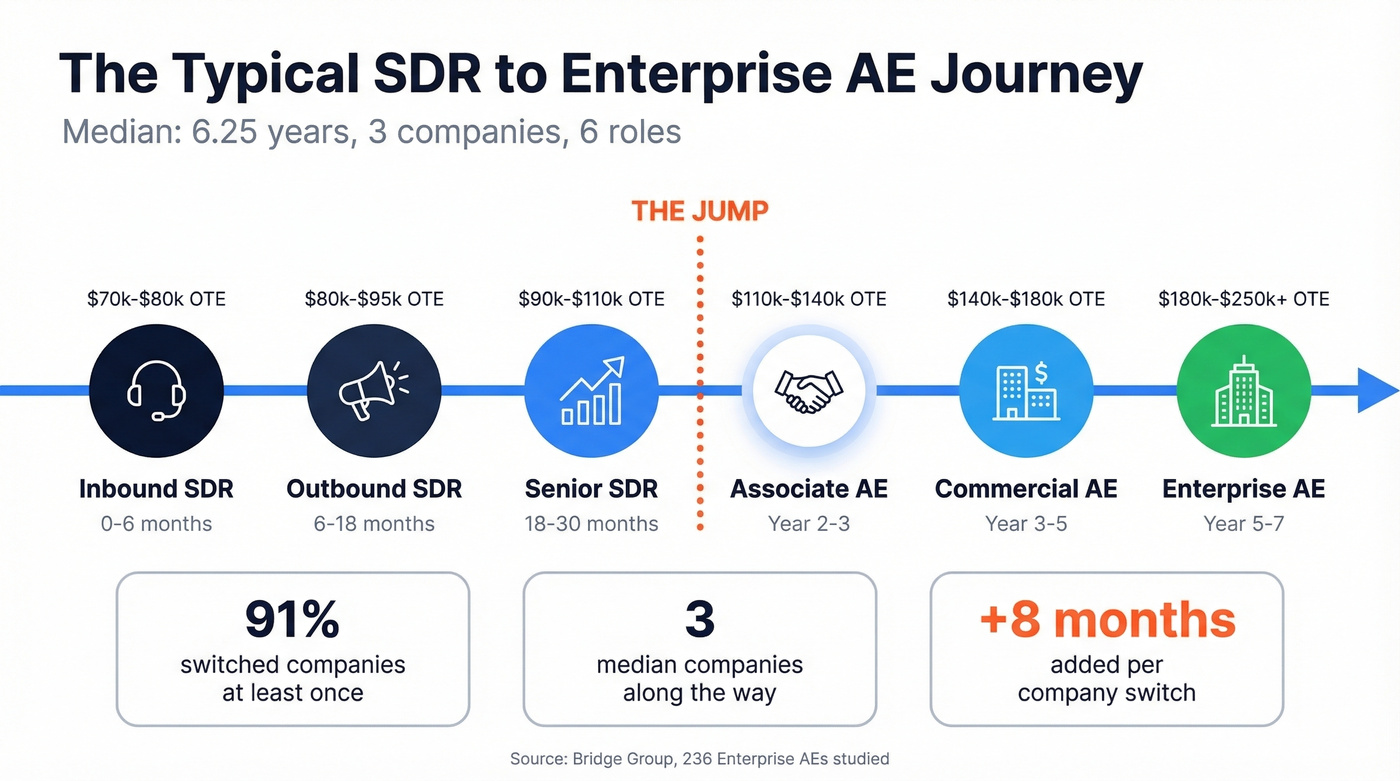
If you're expecting a 6-month sprint to a full-cycle closing role, recalibrate. The typical career progression looks something like: Inbound SDR, then Outbound SDR, then Senior SDR, then Associate AE, then Commercial AE, then Enterprise AE.
Here's what the comp progression looks like:
| Role | Base | OTE | Pay Mix |
|---|---|---|---|
| SDR | $55k-$75k | $70k-$95k | 60/40 or 70/30 |
| Mid-Market AE | $75k-$100k | $140k-$180k | 50/50 |
| Enterprise AE | $100k-$140k | $180k-$250k+ | 50/50 |
OTE roughly doubles from SDR to mid-market AE. But notice the pay-mix shift: you go from 60/40 or 70/30 to 50/50. Your floor drops significantly if you miss quota. And 77% of sellers missed quota last year. The closing role isn't a guaranteed raise - it's a risk/reward trade.
Here's the thing: if your average deal size is under $10k and your company has a Senior SDR track paying AE-level comp, you might be better off staying in that seat. Some companies now offer Senior SDR roles with mid-market AE OTE. If yours does, that's a green flag - it means they take SDR development seriously, and you can earn closing-role money without the 50/50 pay-mix risk.

The fastest way to prove you're AE-ready? Source pipeline that actually converts. SDRs who use Prospeo's 98% accurate emails book 35% more meetings than Apollo users - and leadership notices when your sourced deals close, not bounce.
Show up to your AE interview with a pipeline your manager can't ignore.
How to Actually Get Promoted
Pick the Right Company
This is the highest-leverage decision you'll make. Get it wrong and no amount of skill-building matters.
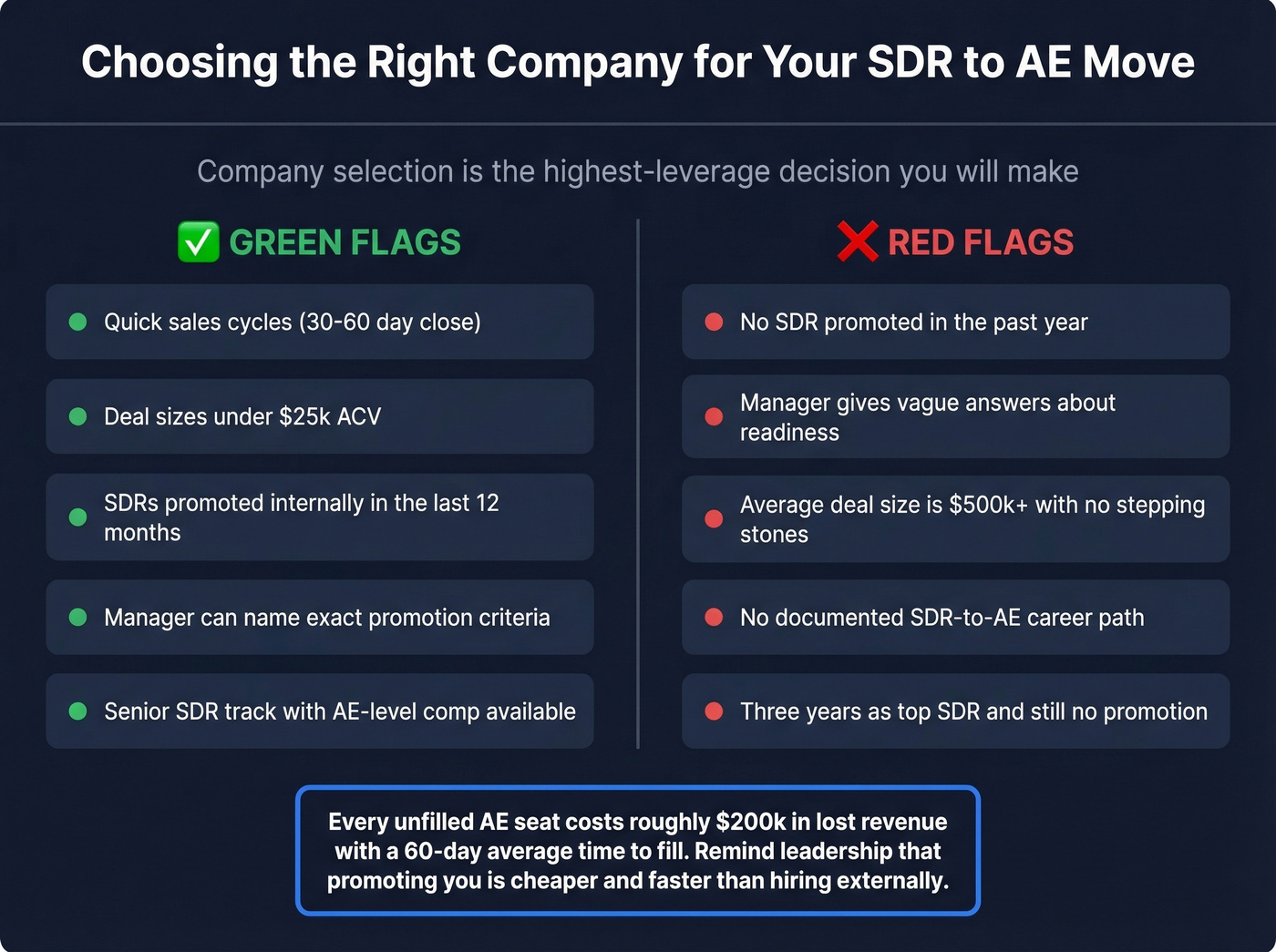
Green flags: Quick sales cycles (30-60 day close), lower deal sizes (under $25k ACV), a documented history of promoting SDRs internally, and a manager who can articulate exactly what you need to hit.
Red flags: No SDR has been promoted in the last year. Your manager gives vague answers about "readiness." The average deal is $500k+ and leadership won't trust a new seller with those opportunities. The consensus on r/sales backs this up - company selection trumps everything.
Three years as a top SDR and no promotion? That's not a development gap. That's a company that doesn't promote SDRs.
And here's a number to bring into your next 1:1: every unfilled AE seat costs the company roughly $200k in lost revenue, with a 60-day average time-to-fill. Remind leadership that promoting you is cheaper and faster than an external search.
Build AE Skills Now
The gap between SDR and AE isn't activity volume - it's the type of thinking. SDRs qualify in. AEs qualify out.
Discovery calls. Run mock discoveries weekly with a peer or manager. Focus on open-ended questions, not feature pitches. Record yourself and listen back - you'll cringe, but you'll improve faster than any coaching session could deliver. (If you want a tighter structure, use a discovery call script and iterate from there.)
Call review. Pull Gong or Chorus recordings from your top AEs' closed-won deals. Study multi-stakeholder conversations, objections, and pricing discussions. Pay attention to how the best closers handle silence after stating a price. That pause is where deals are won or lost.
Frameworks. Learn MEDDIC or BANT cold. Know when to use each. If you're going deep on MEDDIC, start with MEDDIC sales qualification.
Objection handling. Build a personal objection library - not just memorized responses, but the buyer psychology behind each pushback. A simple way to systematize this is to track patterns and reduce your sales objection rate over time.
The single most powerful move? Ask your manager to let you close a deal you sourced. Even a small one. Nothing proves AE readiness like a closed-won deal with your name on it. In our experience, SDRs who own even one mini-deal before promotion ramp 2-3x faster once they're in the AE seat.
Make Yourself Visible
Promotion decisions don't happen in a vacuum. They include backchannel feedback from AEs you've partnered with, managers in adjacent teams, and sometimes executives who've never spoken to you directly.
Share wins publicly - in Slack, in team meetings, in pipeline reviews. Lead a peer training session on something you've figured out. Volunteer for cross-functional projects that put you in front of leadership.
Use this talk track with your manager, verbatim: "I've done X. I want Y. What specifically do I need to do to get to Y?" If they can't answer that question clearly, you have your answer about the company. (If you want more scripts like this, keep a swipe file of talk track examples.)
Nail the AE Interview
Start preparing at least 6 months before your target promotion date. The HowToSellAcademy framework maps prep to each AE responsibility:
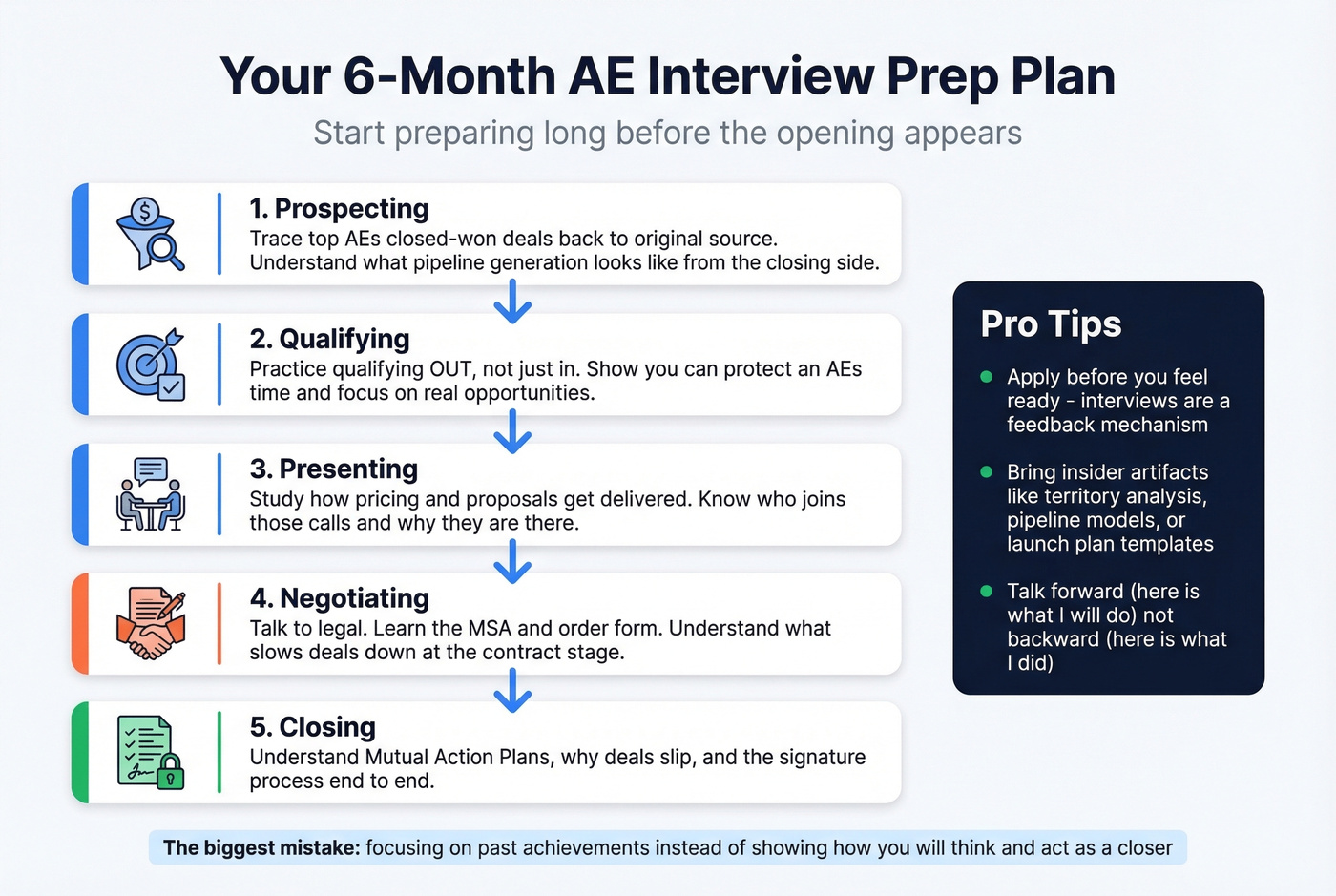
- Prospecting: Trace top AEs' closed-won deals back to the original source. Understand what pipeline generation actually looks like from the closing side. (Brush up on sales prospecting techniques so your plan is concrete.)
- Qualifying: Practice qualifying out, not just in. Show you can protect an AE's time.
- Presenting: Study how pricing and proposals get delivered. Know who joins those calls and why.
- Negotiating: Talk to legal. Learn the MSA and order form. (It also helps to understand the anchor in negotiation concept before you’re in live deals.)
- Closing: Understand Mutual Action Plans, why deals slip, and the signature process. If you want a clean mental model, use these steps to close a sale.
Apply for AE roles before you feel ready. The interview itself is a feedback mechanism - you'll learn exactly what gaps to close before the next opening.
The mistake most SDRs make in these interviews: they focus backward ("here's what I've achieved") instead of forward ("here's what I will achieve and how"). Bring insider artifacts - an updated launch plan template, a territory analysis, a pipeline model. Show you've already started thinking like a closer.
Should You Stay or Leave?
The data strongly favors staying. Internal promotions fail 26% of the time. External moves fail 41%. Each additional company switch adds about 8 months to your Enterprise AE timeline.
Look, the external jump to a closing role is a trap for most reps. The comp bump looks great on paper, but you're walking into a new org without relationships, without context on the product or ICP, and often without the enablement infrastructure you're used to.
When does leaving make sense? Three conditions need to be true simultaneously: you've hit 16+ months of SDR tenure, your current company has no defined promotion path, and you've thoroughly vetted the new org's enablement, pipeline support, and ramp expectations. If all three check out, go. If even one is shaky, stay and keep building.
What Changes After the Promotion
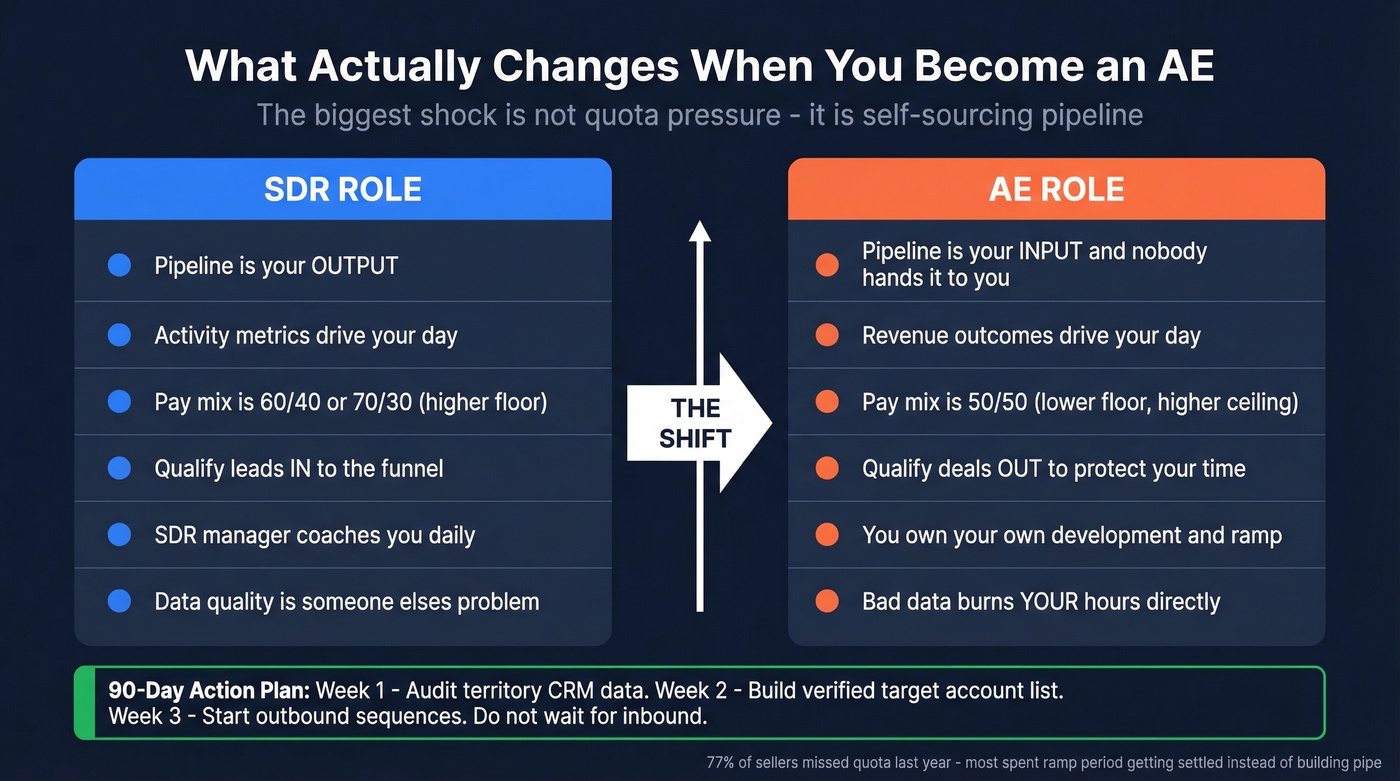
The biggest operational shock isn't quota pressure or comp structure - it's self-sourcing pipeline. As an SDR, pipeline was your output. As an AE, it's your input, and nobody's handing it to you.
Remember the rep who was drowning after the external jump? A big part of the problem was data quality - stale CRM records, bounced emails, disconnected numbers. When you're self-sourcing, every hour spent chasing bad data is an hour you're not building real pipeline. We've watched new AEs burn their entire first month on lists that were 40% garbage before they ever picked up the phone.
Before you start dialing or sequencing, verify your list. Prospeo gives you 75 free verified emails a month with 98% accuracy and a 7-day data refresh cycle - a fast way to start building clean outreach lists without waiting on budget approval. (If you’re comparing options, see our breakdown of data enrichment services.)
Your first 90 days should follow a simple framework: audit your territory's CRM data in week one, build a verified target account list in week two, and start outbound sequences by week three. Don't wait for inbound. The 77% quota-miss stat is real, and most of those reps spent their ramp period "getting settled" instead of building pipe. If you want a more formal template, use a 30-60-90 day plan for sales reps.
One more thing that catches new AEs off guard: you're now on the receiving end of the SDR-to-AE handoff. Set clear expectations with your SDRs on what a qualified meeting looks like. The best AEs we've seen build a one-page handoff doc in their first week - it saves both sides hours of frustration. (You can start from a handoff email template and adapt it to your process.)
New AEs drown when they have to self-source with bad data - that's the 41% failure rate in action. Prospeo gives you 300M+ verified contacts with 30+ filters so you spend hours closing, not hunting. At $0.01 per email, it costs less than one missed deal.
Ramp 2-3x faster with contacts that actually pick up the phone.
What If AE Isn't for You?
AE is the default path, but it's not the only one. Skip this section if you're dead set on closing - but if you've got even a flicker of doubt, it's worth a scan.
SDR Manager. If you love coaching and building process more than carrying a bag, this is a natural fit. Comp often matches mid-market AE OTE without the 50/50 risk.
Sales Ops / RevOps. The analytical SDRs thrive here. A Salesforce certification signals seriousness as an entry credential, and the demand for RevOps talent has outpaced supply for three straight years. (If you’re exploring the path, start with what a RevOps Manager actually does.)
Sales Engineer / Pre-Sales. If you're more technical than your peers and love the demo side, SE roles pay well and carry less quota stress.
Account Manager / Customer Success. Your relationship-building and ROI communication skills transfer directly. The pay mix is friendlier - typically 80/20 or 90/10.
Marketing or Sales Enablement. SDRs who understand messaging, ICP, and what actually gets replies are gold in demand gen, product marketing, and enablement functions. (If that’s you, read up on marketing enablement.)
FAQ
How long does the SDR to AE progression typically take?
Most SDRs land their first closing role in 12-18 months. The median journey to Enterprise AE is 6.25 years across 3 companies and 6 roles. Getting promoted at 11 months or less correlates with a 55% failure rate - wait for 16+ months of tenure.
What's the failure rate for this transition?
26% for internal promotions and 41% for external moves. SDRs with 16+ months of tenure before promotion fail only 6% of the time, making patience the single strongest predictor of success.
How much more do AEs make than SDRs?
OTE roughly doubles - SDR OTE of $70k-$95k becomes mid-market AE OTE of $140k-$180k. But the 50/50 pay mix means your guaranteed floor drops significantly. If you miss quota, you could earn less than you did as an SDR.
Can you move to a closing role at a different company?
Yes, but the failure rate jumps to 41%. Mitigate the risk with 16+ months of SDR tenure, thorough vetting of the new org's enablement and pipeline support, and targeting companies with fast sales cycles and deal sizes under $25k ACV.
How do you build pipeline as a new AE?
Audit your CRM for stale data in week one, build a verified target account list in week two, and start outbound sequences by week three. Don't wait for inbound to save you - the reps who ramp fastest are the ones who treat their first month like an outbound blitz, not an onboarding vacation.