

15 Self Introduction Email Samples (With Data on What Actually Works)
First day. HR says send a team-wide intro. You stare at the blank compose window for 20 minutes, type "Hi everyone, my name is..." and immediately delete it.
We've all been there. Writing a self introduction email isn't something you need talent for - it's about structure. And we've got data from [16.5M+ emails](https://belkins.io/blog/cold-email-response-rates) to prove what works.
Three Rules Before You Write
Keep it under 100 words. Lead with purpose, not "My name is..." And include one clear CTA. If you're sending cold intros at scale, verify every address first - bounces and spam traps will wreck your deliverability fast. (If you want the full deliverability checklist, see our Email Deliverability Guide.)
What a Good Introduction Email Achieves
Most introduction emails get ignored. That's not pessimism - it's math. The [average cold email reply rate is 3.43%](https://instantly.ai/cold-email-benchmark-report-2026). Top-quartile performers hit 5.5%+. Elite campaigns break 10%.
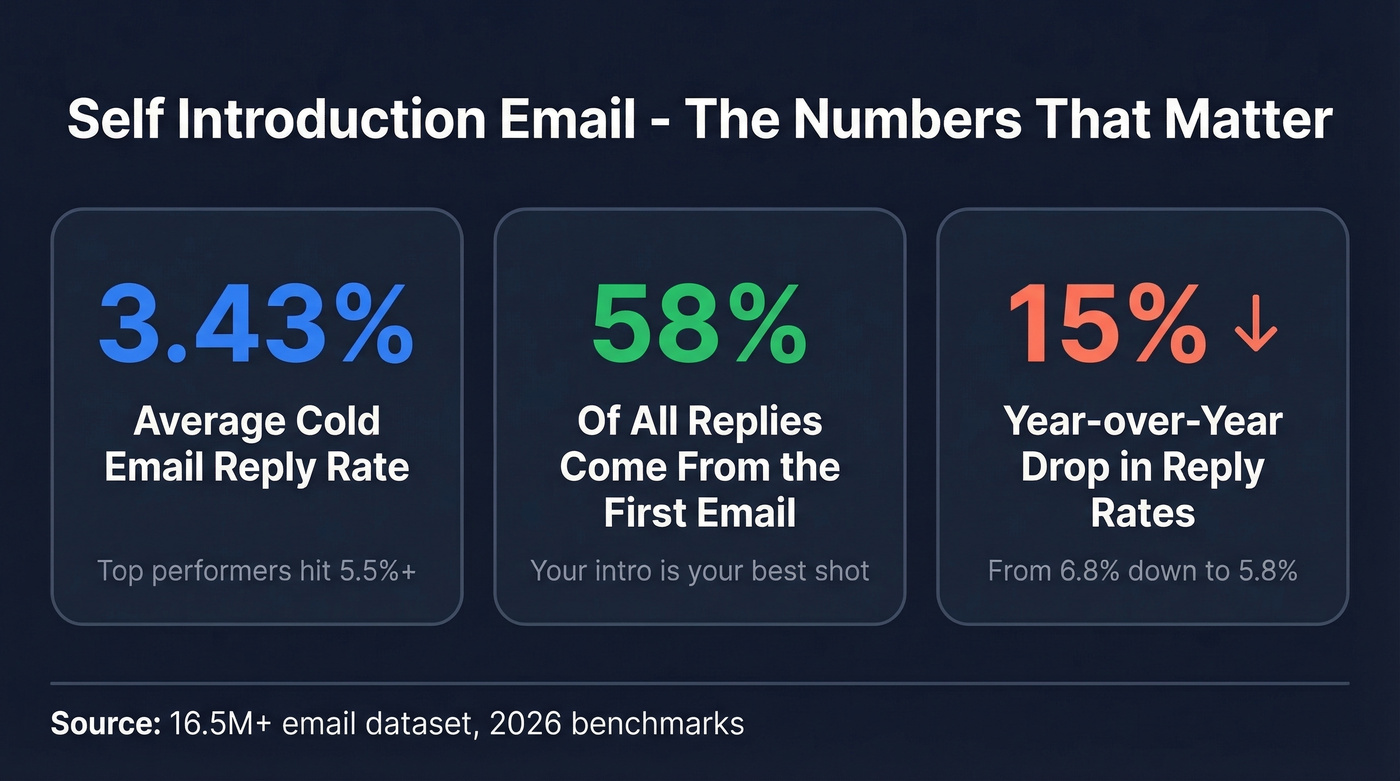
Reply rates are also declining. The same 16.5M-email dataset showed a 15% year-over-year drop, from 6.8% down to 5.8%. Your intro email needs to work harder than it did 12 months ago.
Here's the number that matters most: 58% of all replies come from the first email. Follow-ups contribute the rest, but your initial introduction is your best shot. A mediocre first touch doesn't just underperform - it wastes the highest-leverage moment in the entire sequence.
Anatomy of an Effective Introduction Email
Every effective self introduction email follows six parts. Not five, not eight. Six.
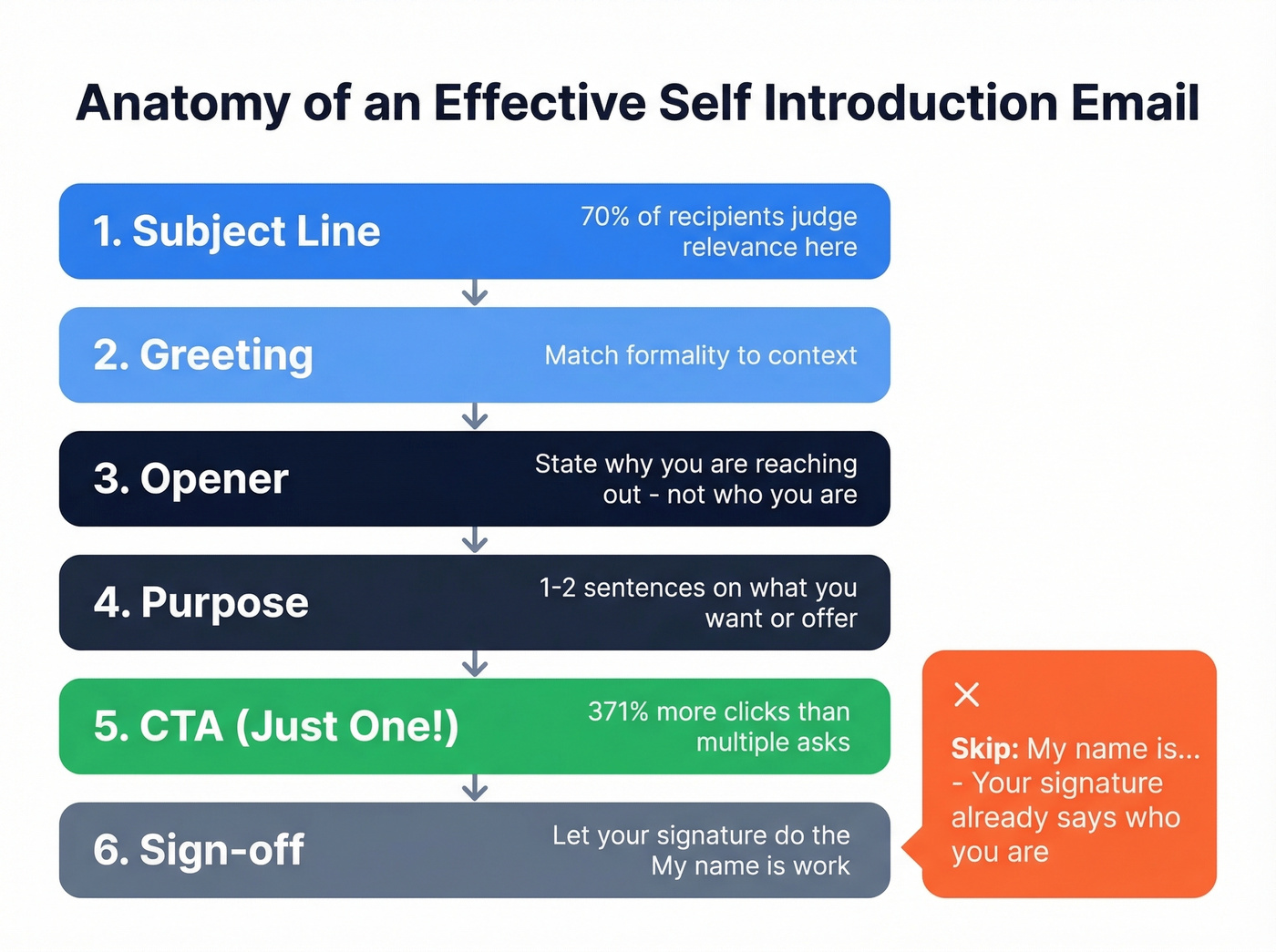
- Subject line - Nearly 70% of recipients judge relevance here alone. This is your first filter. (Need more ideas? See our email subject line examples.)
- Greeting - Match formality to context. "Hi Sarah" for peers, "Dear Dr. Chen" for executives you've never met.
- Opener - State why you're reaching out. Not who you are - your signature handles that.
- Purpose - One to two sentences on what you want or what you're offering.
- CTA - One. Exactly one. A single clear CTA gets 371% more clicks than emails with multiple asks. (More on this in our Email Call to Action guide.)
- Sign-off - Name, title, contact info. Let this do the "My name is..." work for you.
That "My name is..." opener? Redundant. Reddit's r/careerguidance has debated this at length, and the consensus is clear: it feels awkward in professional email because your signature already says who you are.
How Long Should It Be?
Shorter than you think. The 16.5M-email dataset found that 6-8 sentences hit a 6.9% reply rate. Boomerang's research points to 50-125 words. Lavender, which focuses specifically on cold email, recommends 25-50 words for a first touch.
One Reddit practitioner cut their emails from 141 words to under 56 and doubled their reply rate from 3% to 6%. The consensus across every study we've seen: under 100 words for a first touch. Save the detail for the reply thread. (If you're building sequences, our emails that get responses guide goes deeper.)
Subject Lines That Get Opened
Personalized subject lines are 26% more likely to be opened. But "personalized" doesn't mean stuffing in a first name - it means signaling relevance. (For a data-backed framework, see Subject Lines That Get Opened.)
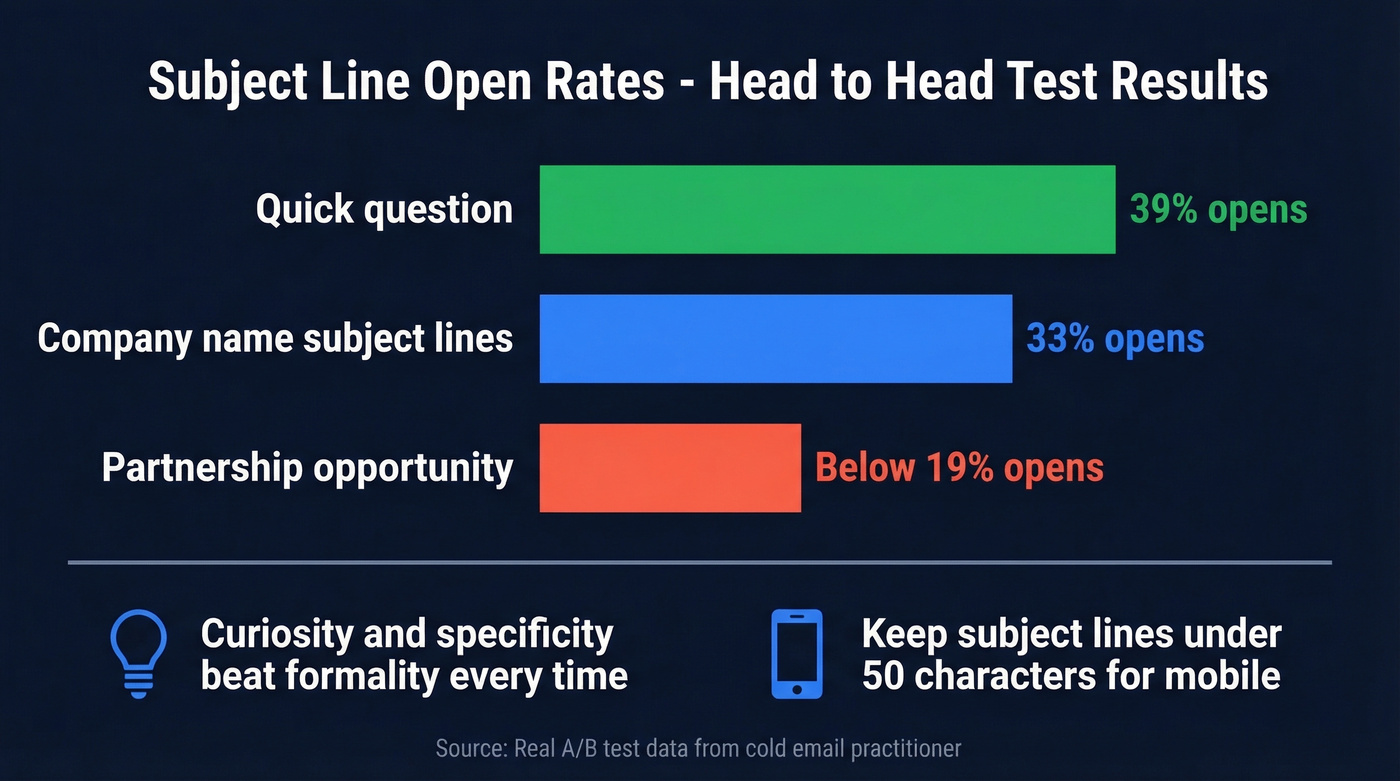
That same Reddit practitioner tested subject lines head-to-head. "Quick question" pulled 39% opens. Company-name subject lines hit 33%. "Partnership opportunity" landed below 19%. Curiosity and specificity beat formality every time.
Keep subject lines under 50 characters for mobile - that's where 60%+ of emails get opened.
Professional: "Quick question about [team/project]" - "Intro - [Your Name], new [Role]"
Casual/Internal: "The new person on floor 3" - "Hi from your new [Role]"
Referral: "[Mutual Contact] suggested we connect" - "Introduction: [Your Name] <> [Their Name]"
Cold outreach: "Quick question, [First Name]" - "[Their Company] + [Your Company]"

58% of replies come from the first email - don't waste it on an address that bounces. Prospeo verifies every email through a 5-step process with 98% accuracy, so your carefully crafted introduction actually reaches the inbox.
Nail the intro. We'll make sure it lands. Starting at $0.01 per email.
15 Templates You Can Copy Today
All templates below are designed to copy, paste, and customize in under two minutes. Use them as a starting point, then adapt the tone to match your context.
New Job and Team Intros
Casual team intro:
Subject: The new [Role] says hi
Hi team - I'm [Name], joining as [Role] starting [date]. Previously at [Company] doing [one-liner]. Outside work, I'm into [hobby/interest]. Looking forward to putting faces to Slack handles. Coffee's on me if you're in [office/city].
One Reddit user nailed their team intro by keeping it short with light self-mockery - coworkers called it funny.
Professional team intro:
Subject: Introduction - [Name], [Role]
Hi everyone, I'm joining [Team] as [Role] on [date], reporting to [Manager]. My background is in [area] - most recently at [Company] where I [one achievement]. I'm looking forward to learning how things work here before I have too many opinions. Feel free to say hi anytime.
New manager introducing themselves:
Subject: Your new [Title] - quick hello
Hi [Team Name] - I'm [Name], your new [Title] starting [date]. My priority for the first two weeks is listening. I'll be scheduling 1:1s with each of you to learn what's working and where I can help. In the meantime, my door (and Slack DMs) are open.
Cold Outreach and Sales
Cold sales intro:
Subject: Quick question, [First Name]
Hi [Name] - noticed [Company] recently [trigger: hired, raised, launched]. We help [similar companies] with [specific outcome]. Worth a 15-min call this week to see if it's relevant?
For a more formal version, swap "Hi [Name]" for "Dear [Name]," replace the question-mark CTA with "I'd welcome the opportunity to discuss," and drop the contraction. The best way to introduce yourself via email in a sales context is to lead with the prospect's situation, not your own credentials. (If you're prospecting heavily, see sales prospecting techniques.)
Freelancer/consultant pitch:
Subject: [Specific result] for [their industry]
Hi [Name] - I'm a [role] who specializes in [niche]. Recently helped [similar company] achieve [result with number]. Would love to share how. Open to a quick chat Thursday or Friday?
Partnership inquiry:
Subject: [Your Company] + [Their Company]
Hi [Name] - I lead [function] at [Company]. Our customers overlap with yours, and I think there's a co-marketing angle worth exploring. Could I send over a one-pager on what I have in mind?
Networking and Referrals
Mutual connection:
Subject: [Mutual Contact] suggested we connect
Hi [Name] - [Mutual Contact] mentioned you'd be a great person to talk to about [topic]. I'm [one-line context]. Would you be open to a 20-minute call in the next couple weeks?
Event follow-up:
Subject: Good meeting you at [Event]
Hi [Name] - enjoyed our conversation about [topic] at [Event]. You mentioned [specific detail]. I'd love to continue that discussion - free for coffee next week?
To adjust tone for a more formal recipient, replace "Good meeting you" with "It was a pleasure meeting you" and swap "free for coffee" with "would you have time for a brief follow-up call."
Warm introduction connecting two people:
Subject: Introduction: [Name A] <> [Name B]
[Name A], meet [Name B] - [one-line context about B]. [Name B], [Name A] is [one-line context about A]. I think you'd both benefit from a conversation about [topic]. I'll let you two take it from here.
Job Applications and Career
Recruiter outreach:
Subject: [Role] opportunity at [Company]
Hi [Name] - your background in [skill] caught my attention. We're hiring a [Role] at [Company], and I think it'd be a strong fit. Interested in hearing more?
Job application intro:
Subject: [Role] application - [Your Name]
Hi [Name] - I'm applying for the [Role] posted on [platform]. My experience in [area] at [Company] maps directly to what you're looking for, especially [specific requirement]. I've attached my resume - happy to discuss further.
This is one of the most common self introduction email formats - and one of the most frequently botched. Keep the focus on what you bring to the role, not a biography.
Informational interview request:
Subject: Quick question about [their field/company]
Hi [Name] - I'm exploring a move into [field/industry] and your career path is exactly what I'm aiming for. Would you have 15 minutes for a quick call? I have specific questions, not a vague "pick your brain" ask.
Client and Account Management
New client intro:
Subject: Your [Company] team - quick intro
Hi [Name] - I'll be your primary contact at [Company] going forward. My job is to make sure [specific deliverable] stays on track. I've reviewed your account and have a few ideas to discuss. Can we find 30 minutes this week?
One CSM on Reddit called the typical background-and-history spiel "tacky peacocking." They're right - lead with what you'll do for the client, not your resume.
Customer success handoff:
Subject: Your new CSM - [Name]
Hi [Name] - I'm taking over as your CSM from [Previous CSM]. I've reviewed your account history and goals for [quarter]. Let's schedule a 20-minute sync so I can hear directly from you what's working and what isn't. [Calendar link]
Vendor/partner introduction:
Subject: New point of contact at [Company]
Hi [Name] - I'm [Name], replacing [Previous Contact] on the [Project/Account]. I'm up to speed on where we left off and want to make sure the transition is smooth. Any open items I should prioritize?
Mistakes That Kill Your Introduction Email
Here's the thing - most of these are obvious once you see them, but people make every single one daily.
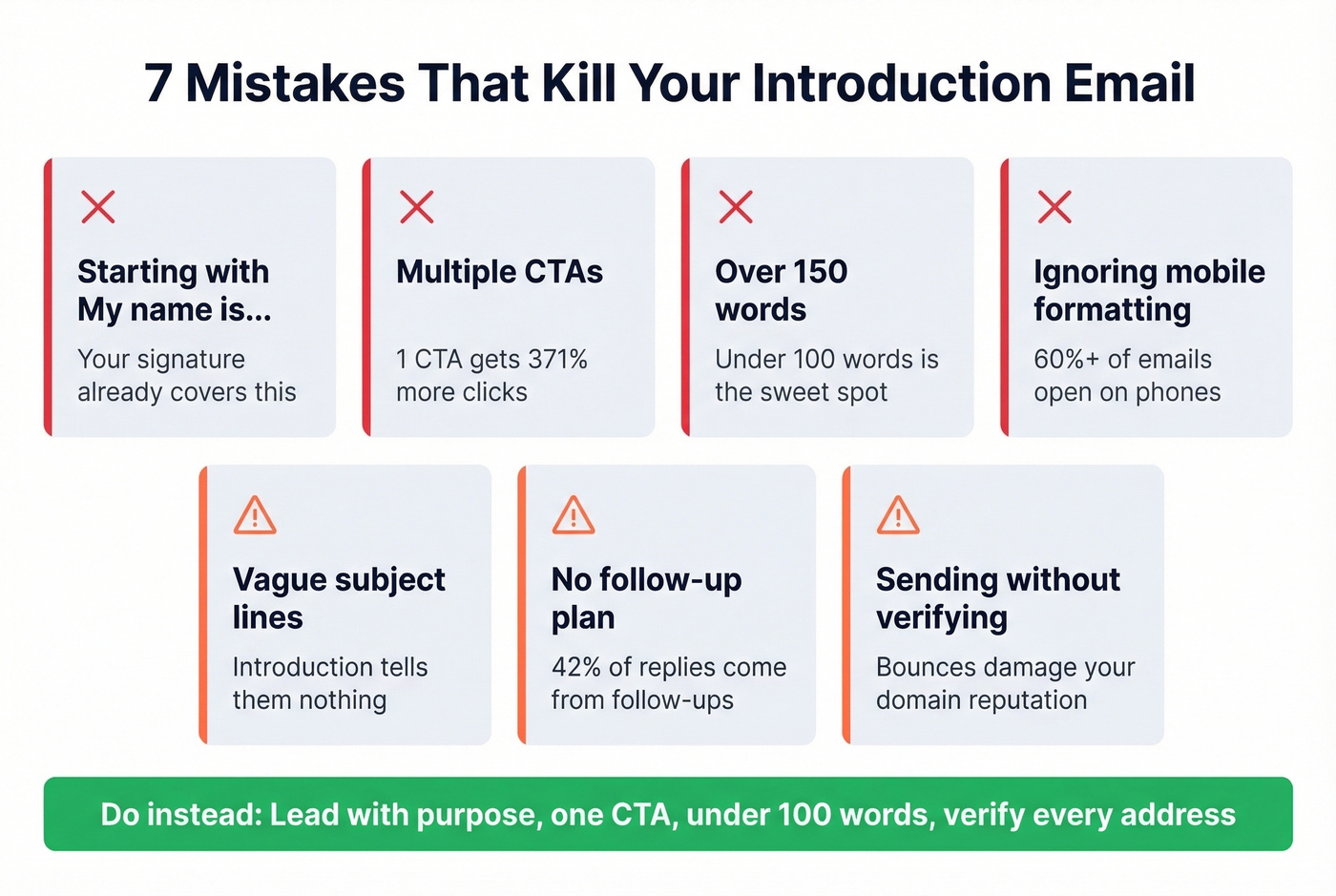
- Starting with "My name is..." - Your signature says who you are. Use the opener for why you're writing.
- Multiple CTAs - Pick one ask. One CTA gets 371% more clicks than scattering three different requests across the email.
- Going over ~150 words - Engagement drops sharply past this threshold. If you can't say it in 100 words, you haven't figured out what you're saying yet.
- Ignoring mobile formatting - Over 60% of emails open on phones. Long paragraphs become walls of text on a 6-inch screen.
- Vague subject lines - "Introduction" tells the recipient nothing. "Quick question about [topic]" gives them a reason to click.
- No follow-up plan - 42% of replies come from follow-ups. Sending one email and hoping isn't a strategy. (Use these sales follow-up templates if you need a starting point.)
- Sending without verifying the address - A bounced introduction email doesn't just fail silently. It damages your domain reputation for every email you send after it. (Benchmarks and fixes: email bounce rate.)
Skip the self-sabotage. Whether you're writing an email to introduce yourself at a new job or a cold sales pitch, these mistakes apply equally.
When to Hit Send
For 1:1 cold or warm intros: Buzzstream's 85,000-email dataset points to Monday 6-9 AM PST, with a 2.8% reply rate. The 16.5M-email dataset found Thursday performs best at 6.87%, with evenings (8-11 PM) surprisingly strong.
Reddit practitioners report Tue-Thu, 8-11 AM in the recipient's timezone improved opens by 16%. Our takeaway: send Tuesday through Thursday morning for cold intros. (More data here: best time to send cold emails.)
For group or broadcast intros like team announcements: MailerLite's analysis of 2.1M campaigns shows Friday at 6 PM hitting a 49.72% open rate - the highest of any day/time combination. For internal team intros, Friday afternoon actually works.
Follow-Up Without Getting Flagged
The first follow-up can lift replies by up to 49%. That's massive.
But there's a cost curve. Spam complaints rise from 0.5% on the first email to 1.6% by the fourth. Unsubscribe rates hit 2% by round four. The sweet spot is 4-7 total touchpoints, with 4-5 business days between each.
And here's a detail most people miss: emailing 1-2 contacts per company yields a 7.8% reply rate. Blast 10+ people at the same company and it drops to 3.8%. Targeted beats broad, every time.
Make Sure It Actually Arrives
None of the templates above matter if your email lands in spam. Deliverability is the unsexy prerequisite that determines whether your introduction gets read or gets filtered.
Start with the basics - SPF and DKIM authentication on your domain. If you're sending from a new domain, warm it up gradually: start with a small daily volume, then scale over weeks. (To avoid getting throttled, see email velocity.)
One Reddit practitioner dropped their bounce rate from 11% to under 2% after manually verifying every address. That single change was part of doubling their reply rate. Another counterintuitive finding: turning off open-tracking pixels improved response rates by 3%. And Apple Mail Privacy Protection inflates open rates by 18 points, so track replies, not opens.
Let's be honest: if your average deal is under $15K, you probably don't need a complex 12-step sequence. You need one clean, verified email that actually lands in the inbox. One outbound agency built from $0 to $1M ARR using verified contact data - maintaining 94%+ deliverability, under 3% bounce rates, and zero domain flags across every client campaign. The difference wasn't copywriting. It was data hygiene.
Verify every email address before sending. Prospeo's 5-step verification catches invalid addresses, spam traps, and honeypots with 98% accuracy, and the free tier covers 75 verifications per month - enough to validate any introduction email list before you hit send. If you're emailing EU-based recipients cold, make sure you have a legitimate interest basis under GDPR, or you risk fines, not just spam folders.
Great cold intro templates mean nothing without the right contact data behind them. Prospeo gives you 300M+ profiles with 30+ filters - buyer intent, job changes, technographics - so every self introduction email hits a real decision-maker.
Stop introducing yourself to dead inboxes. Find verified contacts in seconds.
International Introduction Emails
Default to higher formality until the recipient signals otherwise. This is the safest rule for cross-cultural email, whether you're reaching out to a potential client in Tokyo or a new colleague in Berlin.
Avoid idioms and slang - "let's touch base" doesn't translate well everywhere. Use appropriate titles and honorifics (Dr., Professor, Mr./Ms.) until invited to use first names. Double-check date formats, because 03/04 means March 4th in the US and April 3rd in Europe. And always account for time zone differences in your CTA: "Would Tuesday work? I'm flexible on time to accommodate your schedule" goes further than assuming everyone operates on your clock.
Be cautious with humor - what's charming in one culture reads as unprofessional in another. When you introduce yourself via email to an international contact, clarity and respect for local norms matter more than cleverness.
FAQ
How long should a self introduction email be?
Under 100 words for cold outreach. A study of 16.5M emails found 6-8 sentences hit the highest reply rates at 6.9%. Internal team intros can run slightly longer, but shorter emails consistently get more engagement.
What's the best format for an introduction email?
Follow the six-part structure: subject line, greeting, opener, purpose, CTA, and sign-off. The format stays the same whether you're emailing a hiring manager, a new team, or a cold prospect - only the tone and content shift.
How should I start instead of "My name is"?
Lead with why you're reaching out - your email signature already includes your name and title. Opening with purpose signals relevance immediately and respects the reader's time. Save self-identification for contexts where the recipient genuinely has no other way to know who you are.
When should I follow up if I don't get a reply?
Wait 4-5 business days. The first follow-up lifts replies by up to 49%, but spam complaints double by the fourth email. Stick to 4-7 total touchpoints, and add new value or a different angle each time - don't just resend the same message.
How do I make sure my introduction email doesn't land in spam?
Verify every recipient address before sending. Authenticate your domain with SPF and DKIM, warm up new domains gradually, and disable open-tracking pixels - which improved reply rates by 3% in one large-scale study. We've seen teams cut bounce rates from double digits to under 3% just by cleaning their lists before hitting send.