

How to Write a Short Introduction Email That Gets Replies
Most introduction emails fail because they're essays disguised as emails. Your prospect doesn't need your company's origin story - they need a reason to reply in under 15 seconds.
A short introduction email works because it respects the reader's time. A Boomerang study of 40M+ emails found that 75-100 words hits a 51% response rate. Meanwhile, cold email reply rates have fallen from 8.5% in 2019 to around 5-6% now. The emails getting replies aren't clever - they're short. As one r/sales practitioner put it, most cold email examples online are "selfish and rep-focused." The ones that work are simple, clear, and minimal.
The Quick Reference
- Cold outreach: under 100 words (25-50 for pure cold)
- Warm intro / networking: 100-150 words
- Internal (new team, new role): 75-125 words
- One CTA only. Every additional ask makes replies less likely. (More rules in our guide to email call to action.)
- Ask 1-3 questions max. Emails with 1-3 questions get 50% more responses than those without.
- Verify your list before sending. A perfect 80-word email means nothing if it bounces. (Use an AI email checker to catch issues early.)
How Short Is Short Enough?
Here's the benchmark data that still gets referenced everywhere:
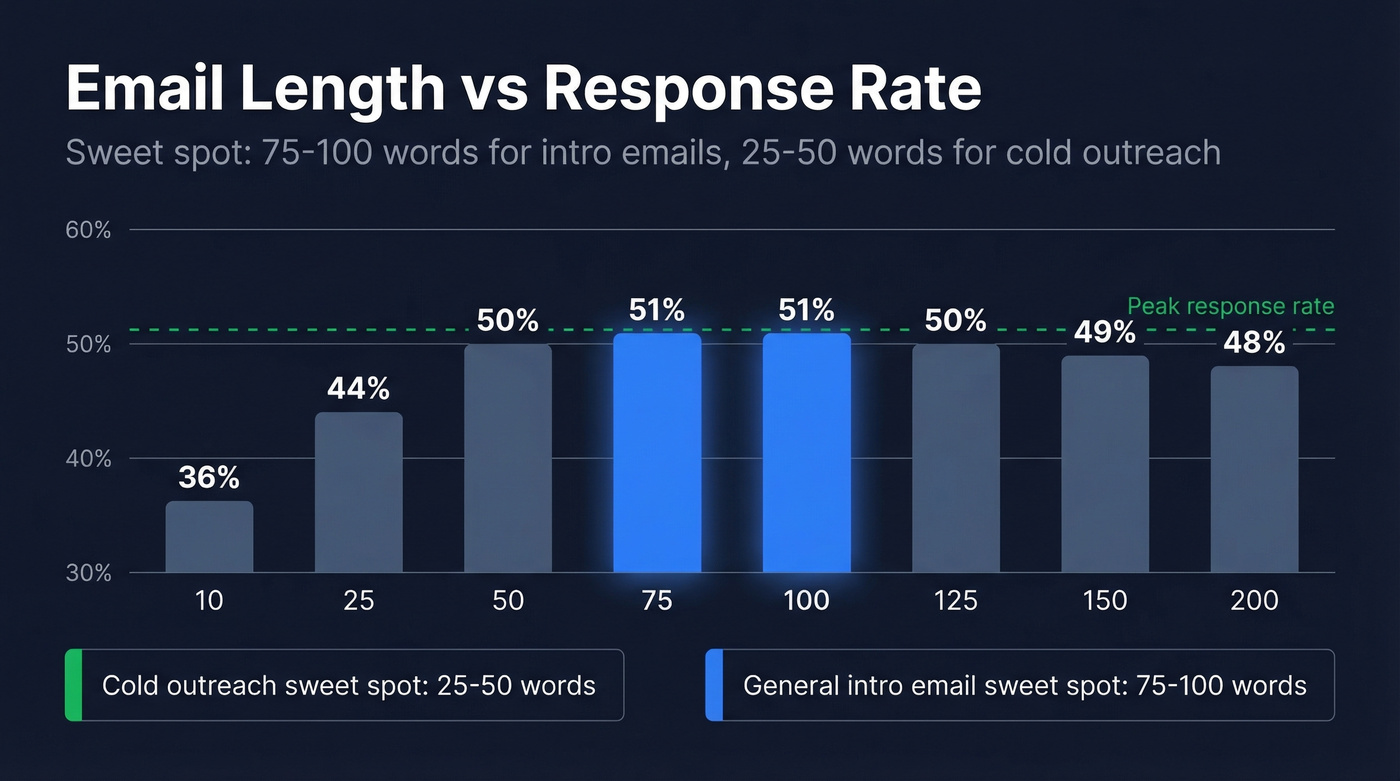
| Word Count | Response Rate |
|---|---|
| 10 | 36% |
| 25 | 44% |
| 50 | 50% |
| 75 | 51% |
| 100 | 51% |
| 125 | 50% |
| 150 | 49% |
| 200 | 48% |
The sweet spot is 75-100 words for a brief intro email. But cold outreach is a different animal. Lavender's data puts the ideal initial cold email at 25-50 words, and Hunter's research suggests 20-39 words. That's barely a paragraph - and that's the point.
Belkins analyzed 16.5M cold emails and found that emails with 6-8 sentences hit a 42.67% open rate and 6.9% reply rate. The takeaway: stay under 200 words in most cases. For cold, aim for half that. If you want a full sequence structure, use a B2B cold email sequence instead of cramming everything into one message.
Anatomy of an Effective Intro Email
Every introduction email that works follows six components:
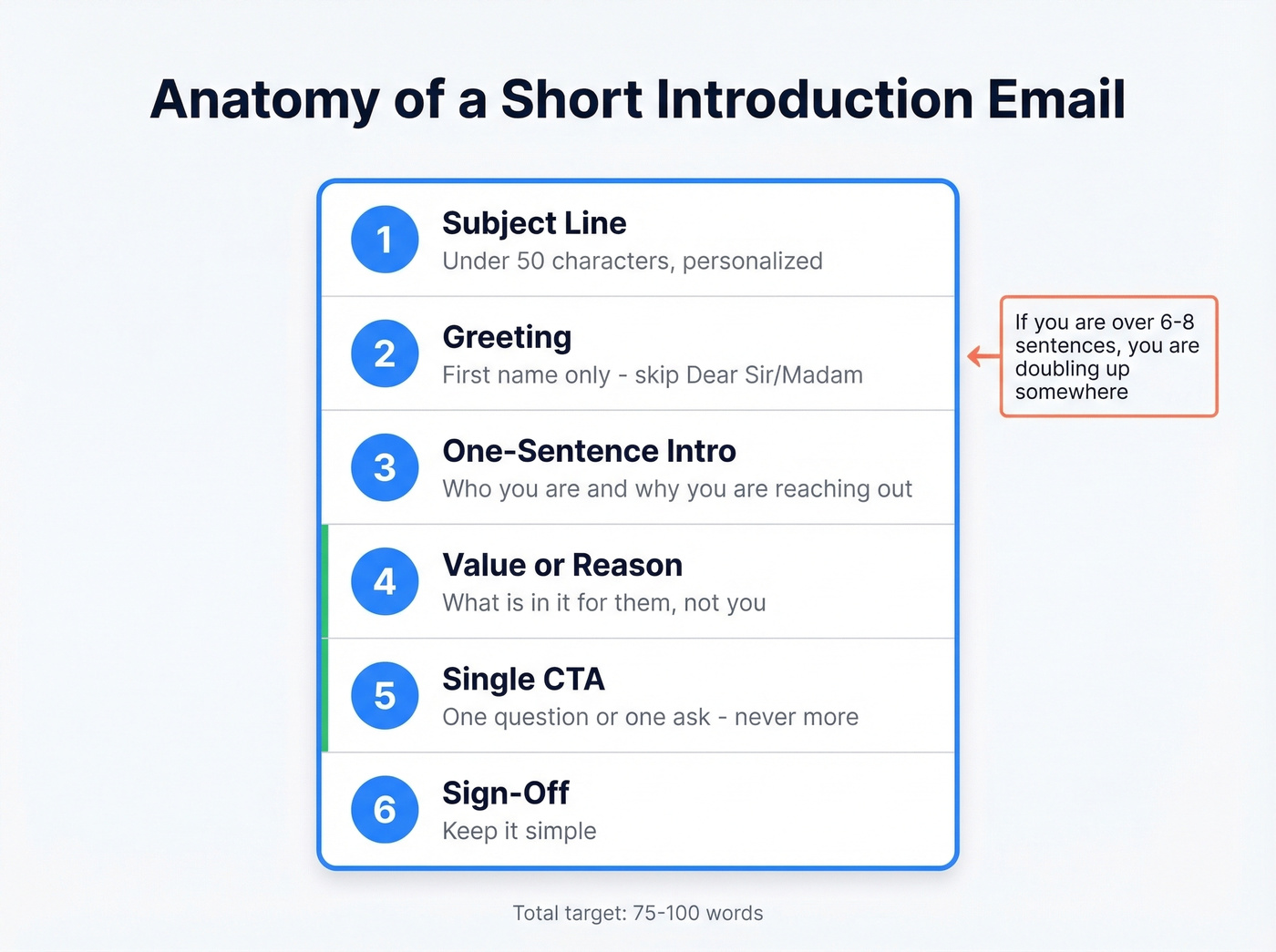
- Subject line - under 50 characters, personalized if possible (more ideas in our cold email subject line examples)
- Greeting - first name, no "Dear Sir/Madam"
- One-sentence intro - who you are and why you're reaching out
- Value or reason - what's in it for them, not you (see how to add value in sales)
- Single CTA - one question or one ask
- Sign-off - keep it simple
If you're over 6-8 sentences, you're probably doubling up somewhere. The most common mistake we see is cramming the value prop and the CTA into a single run-on paragraph. Split them. Give each its own line.
Templates by Scenario
Each template below is under 100 words. Use them as a starting point, then personalize before sending. If you want more variations, pull from these emails that get responses.
Cold Sales Outreach
The biggest rookie mistake in cold email is opening with "My name is..." - that wastes your first sentence on something they can see in your signature. Lead with their world, not yours.
Subject: Quick question about [specific challenge]
Hi [First Name],
I noticed [Company] recently [specific trigger - hiring, funding, product launch]. Teams in that phase usually run into [specific problem].
We help [similar companies] solve that by [one-line value prop]. [Client name] cut their [metric] by [number] in [timeframe].
Worth a 15-minute call this week?
Best, [Your name]
Networking / Informational Interview
When you email someone you admire, specificity is your best friend. Generic flattery gets ignored; a concrete reference to their work gets replies.
Subject: Fellow [shared interest] - quick intro
Hi [First Name],
I've been following your work on [specific topic] and it's shaped how I think about [related area]. I'm currently [your context] and would love to hear how you approached [specific challenge].
Would you be open to a 15-minute call sometime in the next couple weeks?
Thanks in advance, [Your name]
"I loved your talk" is forgettable. "Your point about X changed how I approach Y" gets replies. That's the difference.
New Job - Introducing Yourself to a Team
Subject: Excited to Join the [Company] Team
Hi everyone,
I'm [Name], your new [Job Title] starting [date]. I'll be working on [brief scope] alongside [team/department].
A bit about me: [one sentence on background]. I'd love to grab coffee (virtual or otherwise) with anyone who's up for it.
Best, [Your name]
Account Handoff
We've seen this format work well for CSMs and account managers taking over a book of business. The agenda bullets set expectations and signal that you're prepared - not just going through the motions.
Subject: Your new point of contact at [Company]
Hi [First Name],
I'm [Name], your new [CSM/Account Manager], taking over from [Previous Rep].
I'd love a quick 15-minute call to cover:
- How you'd define success with us right now
- Any open issues or feedback
- Your priorities for next quarter
[Calendar link] - pick any time that works.
Best regards, [Your name]
Referral / Mutual Connection
A mutual contact is the highest-trust opener you can use. Don't bury the name - lead with it.
Subject: [Mutual Contact] suggested I reach out
Hi [First Name],
[Mutual Contact] mentioned you'd be a great person to talk to about [specific topic]. I'm [one-line context] and I'm exploring [specific goal].
Would you have 15 minutes for a quick call?
Thanks, [Your name]
Event Follow-Up
Subject: Great chatting at [Event Name]
Hi [First Name],
Really enjoyed our conversation about [specific topic] at [Event]. Your point about [specific detail] stuck with me.
I'd love to continue that conversation - are you free for a quick call next week?
Best, [Your name]
Referencing a specific detail proves you actually talked to them, not that you're blasting every attendee.

A perfect short introduction email still needs a verified email address behind it. Prospeo delivers 98% email accuracy with a 7-day refresh cycle - so your 75-word masterpiece actually lands in the inbox, not a bounce folder.
Stop crafting great emails that bounce. Start with verified data.
Subject Lines That Get Opens
The average email open rate across industries is 42.35%. Welcome emails hit 83.63% - your intro email won't match that, but personalization closes the gap. Including the recipient's name lifts open rates by about 26%. Keep subject lines under 50 characters so they display fully on mobile. For more options, browse these email subject line examples.
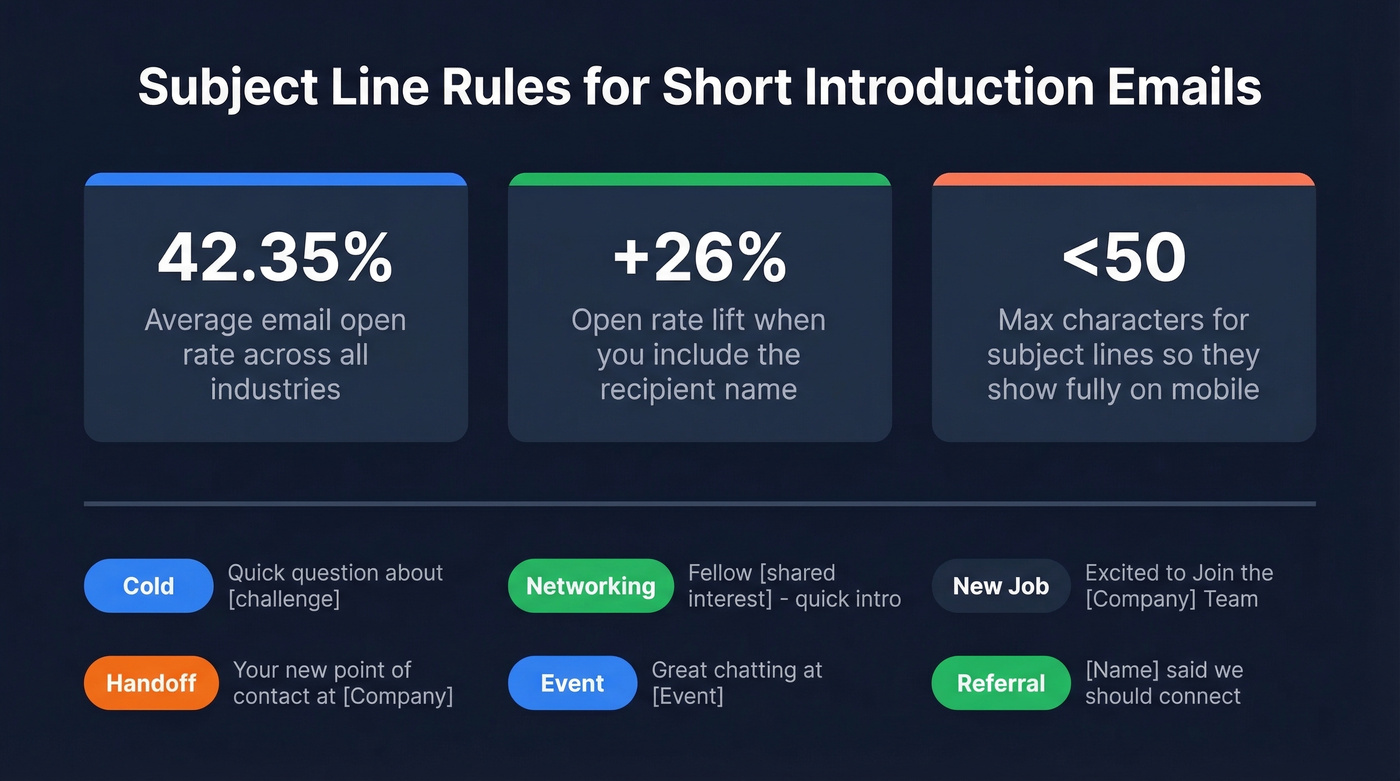
- Cold: "Quick question about [challenge]" / "[Mutual connection] suggested I reach out"
- Networking: "Fellow [shared interest] - quick intro" / "Loved your talk on [topic]"
- New job: "Excited to Join the [Company] Team"
- Account handoff: "Your new point of contact at [Company]"
- Event follow-up: "Great chatting at [Event]"
- Referral: "[Name] said we should connect"
Tone, Timing, and Follow-Ups
Emails written at a third-grade reading level see a 36% higher open rate than college-level writing. That doesn't mean dumbing down your message - it means short words, short sentences, and zero jargon. Moderately positive emails get 10-15% more responses than neutral ones, but too much enthusiasm performs about the same as neutral. Warm and direct beats desperate every time.
If you're building a follow-up cadence, start with these cold email follow-up templates and keep the sequence tight.
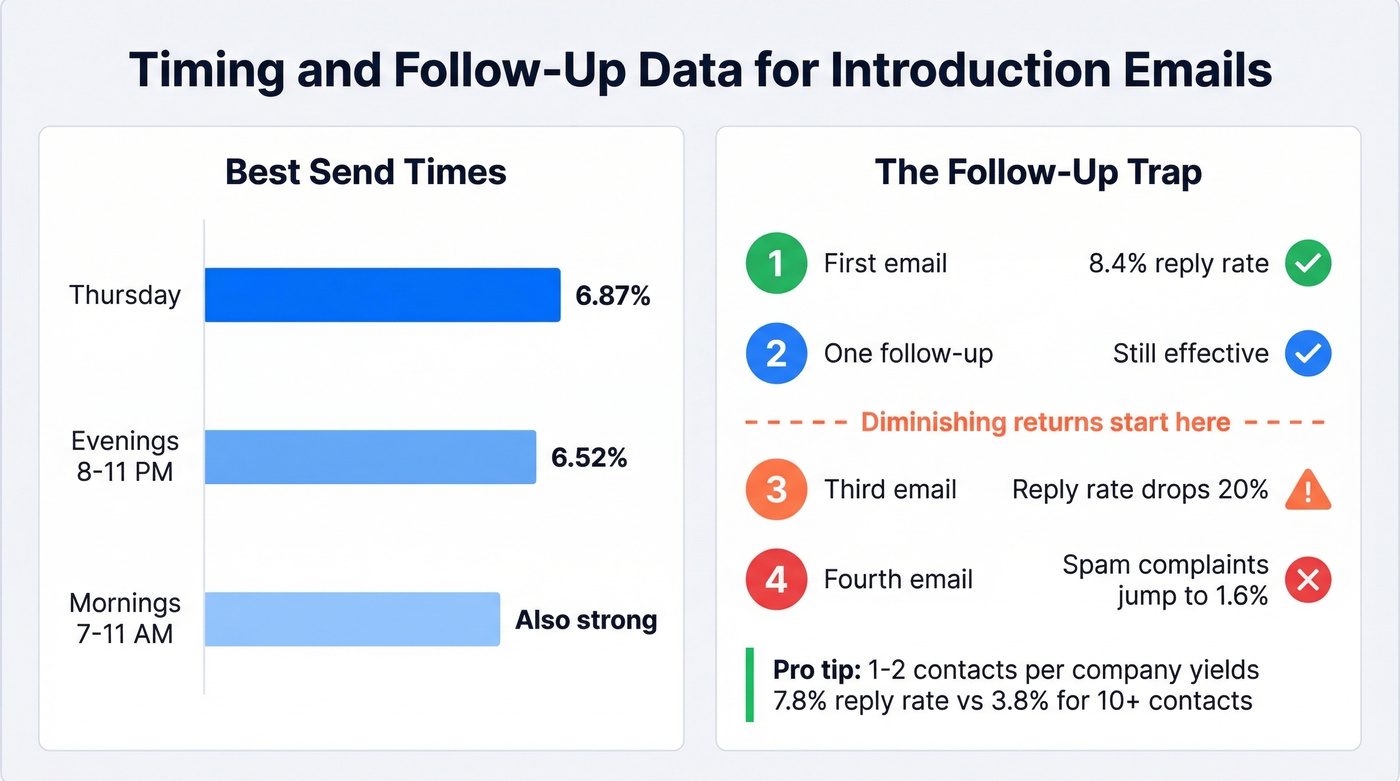
Thursday is the best send day at a 6.87% reply rate. Evenings between 8-11 PM hit 6.52%, though mornings (7-11 AM) are also strong. (More benchmarks in our guide to the best time to send cold emails.)
Here's the thing about follow-ups: one-touch sequences actually had the highest reply rate at 8.4%. A third email drops reply rates by up to 20%, and spam complaints jump from 0.5% on the first email to 1.6% by the fourth. Emailing 1-2 contacts per company yields a 7.8% reply rate; blasting 10+ contacts at the same company drops you to 3.8%.
Let's be honest - if your deal size is under five figures, you probably don't need a five-touch sequence. Send one great email, follow up once, and move on. The data backs this up.
Before You Hit Send
The average cold email reply rate sits around 5-6%. That's emails that actually reached the inbox. Every bounce chips away at your sender reputation, which means fewer future emails land at all. It's a compounding problem - and we've watched teams wreck perfectly good domains by skipping this step.
Before you launch any outreach, verify your list. Prospeo's 5-step verification process catches invalid addresses, spam traps, and honeypots at 98% accuracy, and the free tier gives you 75 verifications per month - enough to test before you commit. If you're troubleshooting bounces, start with email bounce rate benchmarks and fixes.
You just wrote a killer cold intro under 50 words. Now you need the right person's real email. Prospeo's 300M+ profiles and 30+ filters let you find decision-makers by intent, tech stack, and job changes - then deliver verified contacts at $0.01 each.
Great copy deserves great data. Get 75 free emails and start sending.
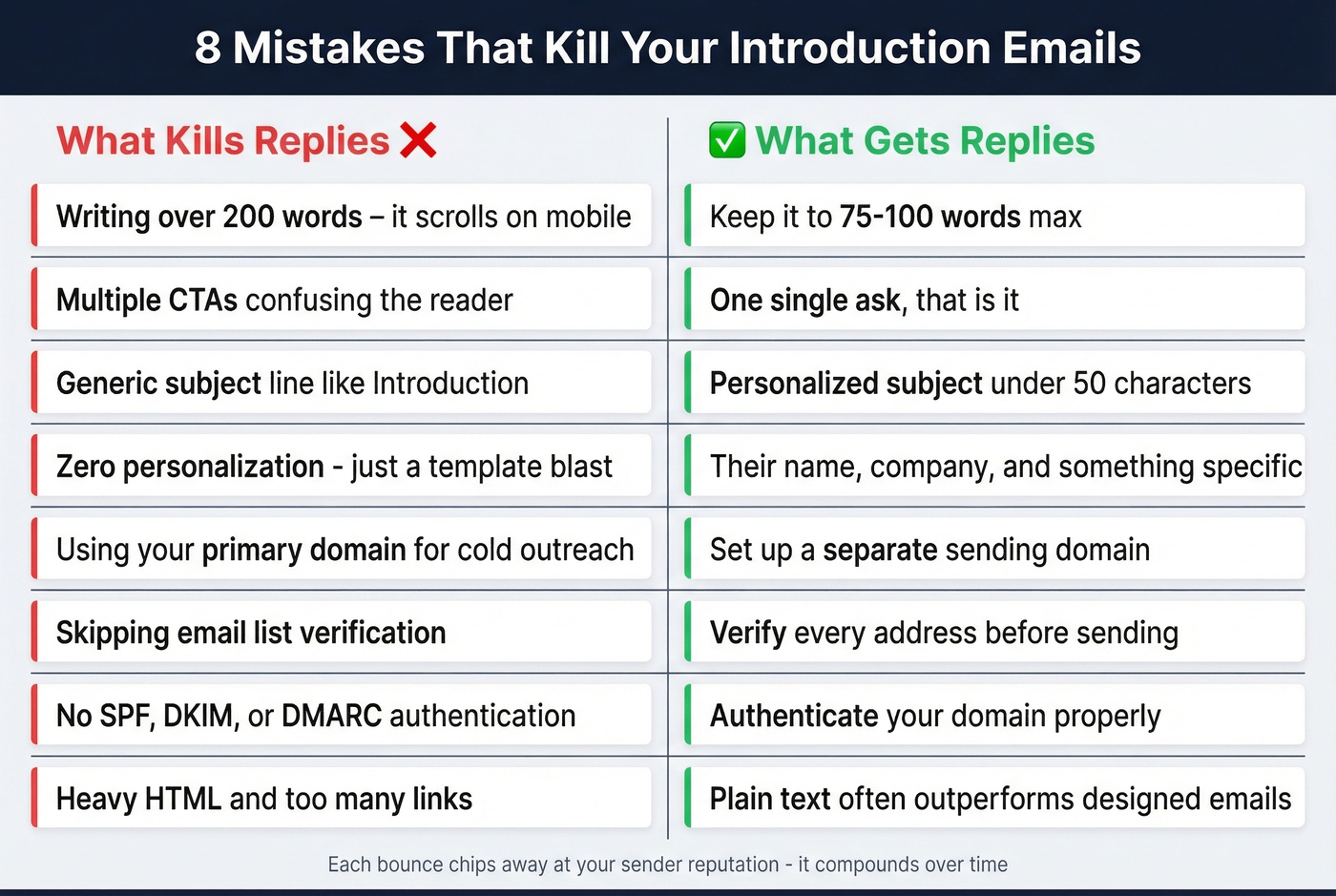
Mistakes That Kill Introduction Emails
- Writing over 200 words. If it scrolls on mobile, it's too long.
- Multiple CTAs. One ask. That's it.
- Generic subject lines. "Introduction" tells them nothing.
- Zero personalization. Their name, their company, something specific.
- Using your primary domain for cold outreach. Set up a separate sending domain.
- Skipping list verification. Bad addresses compound - each bounce chips away at your sender reputation.
- No SPF/DKIM/DMARC authentication. Without these, you're practically asking to land in spam. (Use this email deliverability guide to get the basics right.)
- Heavy HTML or too many links. Plain text often outperforms heavily designed emails for cold outreach.
FAQ
How long should a short introduction email be?
75-100 words delivers a 51% response rate according to Boomerang's study of 40M+ emails. For cold outreach specifically, aim for 25-50 words. Stay under 200 words in every scenario - anything longer and you're losing readers on mobile.
Should I follow up on an introduction email?
One follow-up is fine - single-touch sequences actually hit an 8.4% reply rate. A third email drops reply rates by up to 20% and spam complaints jump from 0.5% to 1.6% by the fourth. After two touches, move on or try a different channel.
How do I verify emails before sending intro messages?
Use a verification tool that catches spam traps and honeypots before you send. Set up SPF, DKIM, and DMARC on your sending domain so inbox providers treat you as legitimate. Even a small batch of bounces can hurt your deliverability for weeks.