

Spintax: The Honest Guide to What It Does (and Doesn't Do) for Cold Email
An analysis of 44 million emails found that reply rates were actually lower with spintax than without - 1.09% versus 1.28%. That's not the story most cold email blogs tell you. The truth is more nuanced: spinning syntax helps inbox placement, not replies, and it's usually a later-stage lever for deliverability, not the first thing you should fix.
What You Need (Quick Version)
Spintax helps inbox placement for high-volume senders pushing hundreds of emails per day. It doesn't improve reply rates. If you're sending low volume, fix your authentication, warm up your domains, and clean your data first - copy variation is optional. If you're already using per-lead AI personalization through tools like Clay, it adds marginal value. For everyone else sending semi-personalized templates at scale, spinning syntax is a useful but not essential layer.
What Is Spintax?
Spintax is short for "spinning syntax" - a text markup format that lets you define multiple word or phrase variations inside curly braces, separated by pipes, so a sending tool can randomly select one option per email. The result: unique messages from a single template. The format looks like this: {option1|option2|option3}.
The technique didn't start in cold email. It came from SEO article spinning, which took off around 2010-2011 as Google began cracking down on duplicate content and content farms. Marketers needed a way to generate "unique" articles at scale, so they'd spin one piece into hundreds of variations. Google got wise to it fast, and article spinning became synonymous with spam.
Cold email spinning serves a different purpose. You're not trying to fool a search engine - you're trying to prevent email service providers from flagging identical messages sent in rapid succession. The goal is variation, not deception.
How Spintax Works
Basic Syntax and Examples
The standard format uses curly braces with pipe-separated options:
{Hi|Hey|Hello} {FirstName},

{I noticed|I saw|Came across} your {recent post about|work on|talk at} {topic}.

{Would love to|I'd like to|Happy to} {chat about|discuss|explore} how we {help teams like yours|work with companies in your space|solve this for similar orgs}.

{Best|Cheers|Talk soon},
{YourName}
The math is straightforward multiplication. Three blocks with four options each gives you 4 x 4 x 4 = 64 unique email combinations from one template. Five blocks with four options? That's 1,024 variations.
Spin blocks and merge tags like {FirstName} serve different roles. Merge tags pull personalized data per recipient. Spinning syntax randomizes static copy. You want both - merge tags for the personal details, spin variations for the surrounding language.
Nested Syntax
You can nest blocks inside each other for deeper variation:
{I {noticed|saw} your {post|article} on {topic}|Your {recent work|latest project} on {topic} caught my eye}
The outer block picks one of two sentence structures, then the inner blocks randomize within whichever structure was selected. This recursive approach can easily generate 50+ unique messages from a single template.
Some platforms also support fallbacks and conditional logic for more advanced personalization patterns. For conditional logic to populate, the referenced variable must be present in the email body or included as a hidden HTML element.
One edge case to watch: if your email content contains literal pipe characters, some platforms will misparse them as separators. Always preview your spun output before sending. Skipping that step is how you end up sending "Hi {FirstName|" to 500 people.
Syntax Reference by Platform
Not every tool uses the same format. Here's the cross-platform reference:
| Platform | Syntax | Notes |
|---|---|---|
| Standard | {opt1\|opt2} |
Curly braces + pipe separators |
| GMass | {{spin}}...{{variation}}...{{end spin}} |
Tag-based; includes SpinMax and an AI generator |
| Instantly | {{RANDOM \| opt1 \| opt2 \| opt3}} |
Supports fallbacks and conditional logic |
| SmartReach | {%spin%}...{%endspin%} |
Uses wrapper tags, not curly braces |
GMass is the outlier with its tag-based syntax, and SmartReach uses its own {%spin%} wrapper tags rather than standard curly braces. GMass also has an account-level "Maximize spintax randomization" setting that changes how options distribute across multiple blocks.
Here's the gotcha: if you enable A/B testing and spinning simultaneously in GMass, the A/B testing overrides the randomization behavior. You'll think your variations are working when they aren't.
Both GMass and Instantly offer AI-assisted workflows that take a base email and automatically create variations. Convenient, but review the output - AI-generated spin options sometimes drift in tone across variants.
Does It Improve Deliverability?
The data tells two different stories depending on what you're measuring.
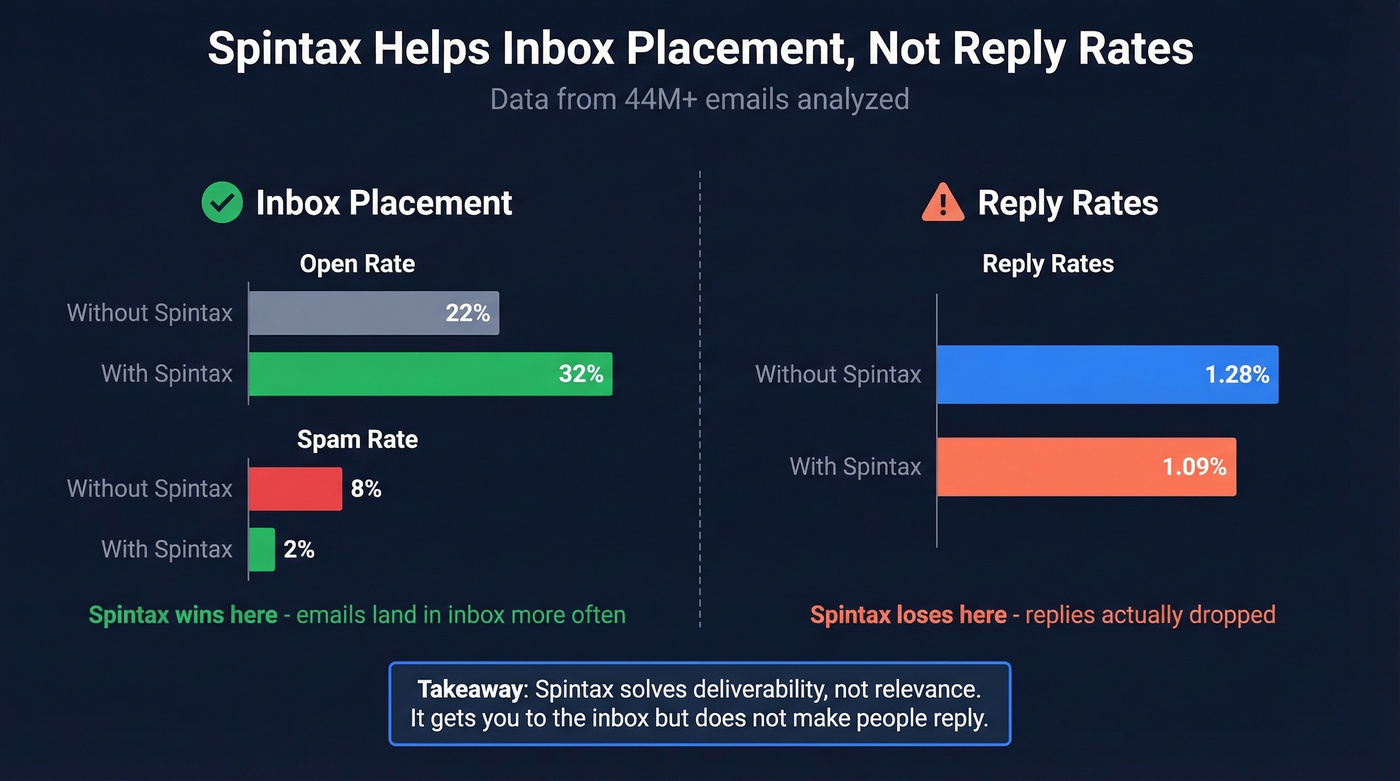
That 44-million-email analysis showed reply rates of 1.09% with spin variations versus 1.28% without. On the surface, it made things worse. But DitLead's benchmarks tell a different story on inbox placement: open rates jumped from 22% to 32%, and spam rates dropped from 8% to 2% when copy variation was used properly.
Here's the reconciliation: spinning syntax improves whether your email lands in the inbox. It doesn't improve whether someone replies. Inbox placement is a deliverability metric - it's about avoiding the spam folder. Reply rate is a relevance metric - it's about whether your message resonates. Copy variation solves the first problem, not the second.
2026 cold email benchmarks: Reply rates sit at 1-5%, bounce rates average 7.5%, and conversion into deals lands around 0.22%. (If you want to sanity-check your numbers, start with bounce rates and reply-rate benchmarks.)
If your reply rate is already in the 1-3% range, spinning your copy won't move that needle. If your emails are landing in spam and your open rates are below 15%, copy variation might help - but it's probably not the first thing to fix. Use a proper email deliverability checklist before you touch templates.

Spinning copy won't save emails sent to dead addresses. Prospeo's 5-step verification catches spam traps, honeypots, and invalid emails on a 7-day refresh cycle - so your messages actually reach real inboxes. Meritt cut their bounce rate from 35% to under 4% and tripled their pipeline.
Clean data beats clever copy. Start with 75 free verified emails.
The Deliverability Priority Stack
Look, spintax is a finishing layer. We've seen teams obsess over copy variation while their DMARC record is set to "none" and their bounce rate is 30%. Fixing the fundamentals will do more for your deliverability than any amount of spinning.
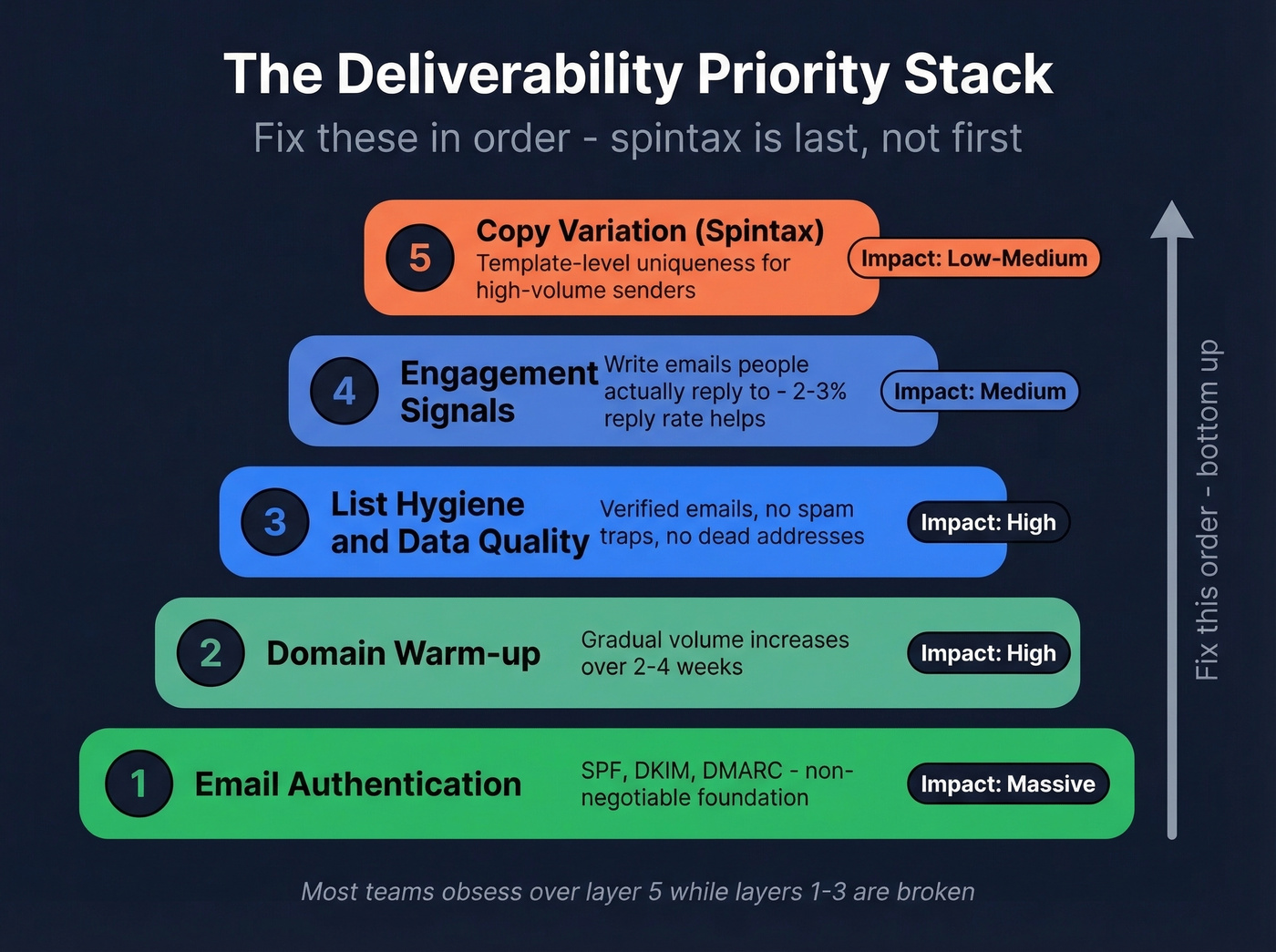
1. Email authentication (SPF/DKIM/DMARC). Non-negotiable. Gmail's enforcement has tightened steadily since February 2024. One practitioner reported that fixing their DMARC policy from "none" to "quarantine/reject" improved inbox placement to 94% within two weeks - they'd been losing 23% of emails to spam before the fix. (If you're troubleshooting, start with SPF record examples and DMARC alignment.)
2. Domain warm-up and sender reputation. New domains need a few weeks of gradual volume increases before you scale. Skip this and nothing else matters. (More on safe ramping in email velocity and unlimited email warmup tools.)
3. List hygiene and data quality. A perfectly spun email sent to a dead address is still a bounce. Prospeo's 5-step verification process catches invalid addresses, spam traps, and honeypots on a 7-day refresh cycle, compared to the 6-week industry average most providers operate on. One customer, Meritt, saw their pipeline triple after switching to verified data and getting bounces under control. If you're auditing sources, compare email list providers and data enrichment services.
4. Engagement signals. Gmail weighs replies heavily. A 2-3% reply rate can outperform high-open, zero-reply campaigns for inbox placement. Write emails people actually want to respond to. (Tighten your copy with emails that get responses and email copywriting.)
5. Copy variation (spintax). Now - and only now - does spinning syntax earn its place.
Gmail's spam filters process 15 billion unwanted messages daily and block 99.9%+ of spam. The RETVec upgrade improved detection by 38% while cutting false positives by 19.4%. Swapping "Hi" for "Hey" isn't fooling these systems.
You read the priority stack: authentication, warm-up, then list hygiene - all before spintax. Prospeo delivers 98% email accuracy at $0.01 per lead, so you're not burning sender reputation on bounces while perfecting your spin blocks.
Fix deliverability at the source, not the template.
Spintax vs AI Personalization
The question on r/coldemail keeps coming up: is spinning syntax redundant when you're already personalizing every email per lead with tools like Clay?
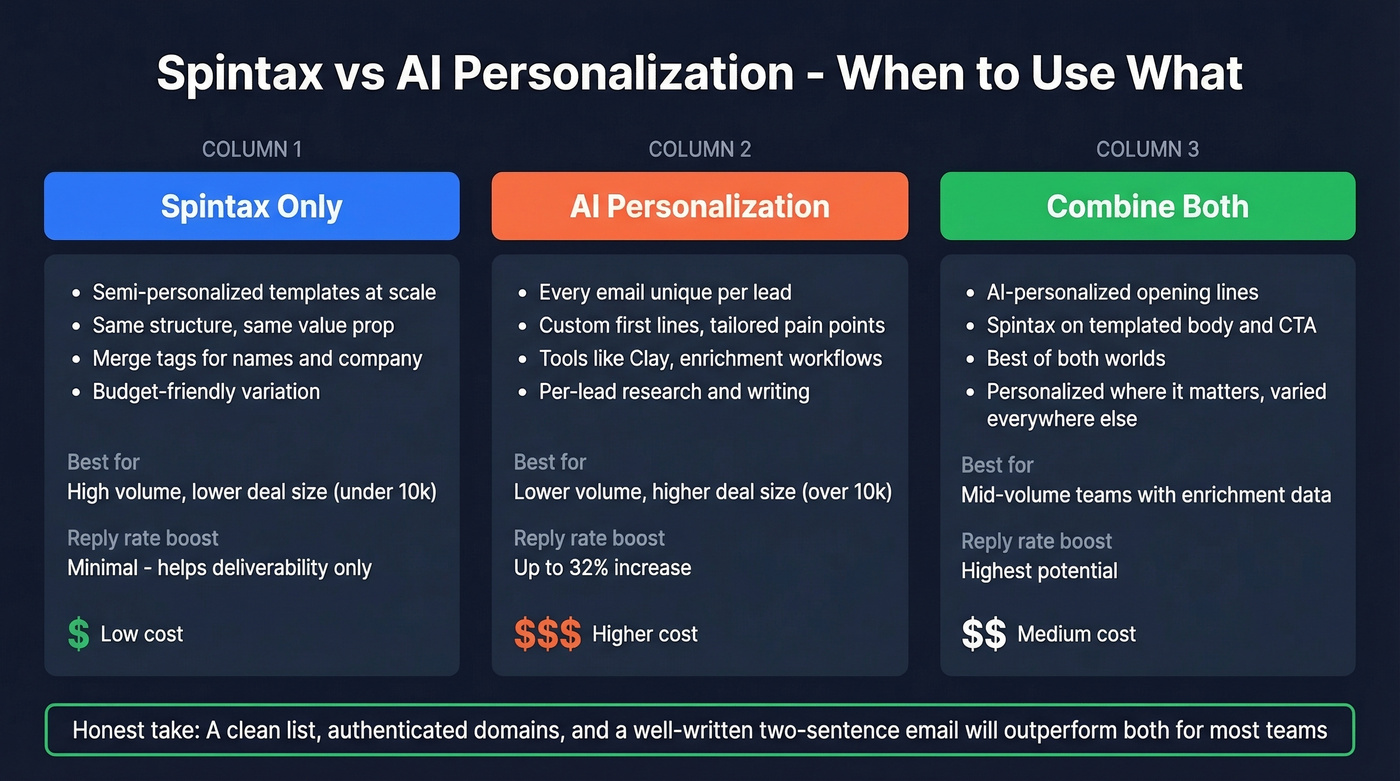
Use spin variations when you're sending semi-personalized templates at scale - same structure, same value prop, with merge tags for names and company details. This is still how most outbound teams operate, and copy variation adds meaningful uniqueness at the template level. If you're building sequences, a solid B2B cold email sequence matters more than extra variants.
Skip it when every email is genuinely unique - custom first lines, tailored pain points, personalized CTAs generated per lead through enrichment workflows. If Clay or a similar tool is writing each email from scratch, layering spin blocks on top is redundant and can introduce tone inconsistency. (Related: Clay list building workflows.)
Combine both when you have a personalized opening generated by an enrichment tool but a templated body and CTA. Spin the templated sections, leave the personalized parts alone.
The numbers back this up: personalization can increase reply rates up to 32%, and referencing company updates boosts engagement by 12%. Spinning syntax does neither of those things. AI per-lead personalization is replacing template-level variation for teams that can afford the tooling and data costs. Spinning is the budget-friendly alternative that still gets you most of the variation benefit at a fraction of the complexity.
Let's be honest: if your deal size is under $10k, you probably don't need Clay-level personalization or elaborate copy spinning. A clean list, authenticated domains, and a well-written two-sentence email will outperform both.
Best Practices and Mistakes
What to Do
Spin at the clause or sentence level, not the word level. Swap entire phrases or sentence structures to create genuine variation in how your message reads. Aim for 3-5 blocks with 3-4 options each - that gives you 27-1,024 unique combinations per template, enough to avoid pattern detection without creating a maintenance nightmare.
Build ICP-specific spin pools. The language that resonates with a VP of Engineering is different from what works for a Head of Marketing. Don't use the same variants across segments. Keep sentiment consistent across all options too - if one variant is casual and another is formal, your brand voice is incoherent.
What Not to Do
Word-level spinning is the most common mistake we see. Swapping just greetings while keeping everything else identical is exactly the pattern modern ESPs detect. Instantly's own blog warns that simple greeting spins can "raise some alarms."
Don't spin every word in a sentence either. Grammar drift is real - the more individual words you randomize, the higher the chance of producing awkward combinations that read like machine-generated text. That's a spam signal in itself.
Never use spin syntax for personalization fields. {John|the team|your group} isn't a spin block - it's a broken merge tag. Use {FirstName} for personalization, spinning syntax for copy variation. And if you're on GMass, don't enable A/B testing and spinning simultaneously - the A/B testing overrides randomization.
When to Skip It Entirely
Not everyone needs this.
If you're sending low volume - your first couple hundred emails - copy spinning is optional. The volume isn't high enough for pattern detection to be a real risk. If you're writing fully personalized emails through enrichment tools, it adds marginal value. If you're in single-thread conversations like replies, warm intros, or inbound follow-ups, it makes zero sense.
And if your SPF/DKIM/DMARC isn't configured, your domains aren't warmed up, or your bounce rate is above 5%, stop thinking about copy variation entirely. Fix the foundation first. Spinning syntax on broken infrastructure is like putting racing stripes on a car with no engine.
Spintax FAQ
Is spintax still worth using in 2026?
Yes, for high-volume senders pushing hundreds of daily emails with semi-personalized templates. It helps inbox placement, not reply rates. Fix authentication and data quality first - those drive the biggest deliverability gains.
How many variations do I need?
Aim for 3-5 blocks with 3-4 options each, producing 27-1,024 unique combinations. Going beyond 10 options per block usually introduces grammar drift and awkward phrasing.
Does it work in native Gmail?
Native Gmail doesn't support spinning syntax. You need GMass or a dedicated cold email platform like Instantly or SmartReach that processes spin blocks before sending.
Can spinning syntax hurt deliverability?
Yes, if done poorly. Word-level spinning - swapping only greetings while keeping everything else identical - can trigger spam filters. Spin at the clause or sentence level, and don't sacrifice grammar for variation count.