

SQL Marketing Means Two Things - Here's Why Both Matter
Marketers with SQL and Python skills earn 30% more than their peers, and only 31% have those skills. Meanwhile, the average B2B SaaS team converts just 13% of MQLs into Sales Qualified Leads. Both sentences use "SQL" - and they mean completely different things.
SQL marketing is either about qualifying leads or querying databases. Most teams are underperforming at both.
Quick version: If you're here for Sales Qualified Leads, your MQL-to-SQL conversion rate probably sits between 12% and 21% depending on industry. Following up within one hour triples your odds. A lead scoring model you can copy is below. If you're here for Structured Query Language, learning basic SQL is one of the highest-ROI career moves a marketer can make. Starter templates are below.
Sales Qualified Leads - The SQL Marketing Funnel
An SQL (Sales Qualified Lead) is a prospect vetted by sales as ready for a real conversation about scope, pricing, and fit. Not someone who downloaded an ebook. Someone who's demonstrated genuine purchase intent and matches your ideal customer profile.
Common sales qualified lead examples: a prospect who books a demo after visiting your pricing page three times, a trial user who invites their team, or a contact who explicitly asks about enterprise pricing during a webinar Q&A.
The distinction matters because 57-70% of buyers are already through their buying journey before they ever engage with sales. By the time a lead reaches SQL status, they've self-educated. Your job isn't to pitch - it's to qualify and close.
MQL vs SQL - The Real Difference
An MQL is an engagement signal. Someone visited your pricing page, attended a webinar, or opened five emails in a row. An SQL is a purchase intent signal - they've told sales (explicitly or implicitly) that they have budget, authority, need, and timeline.
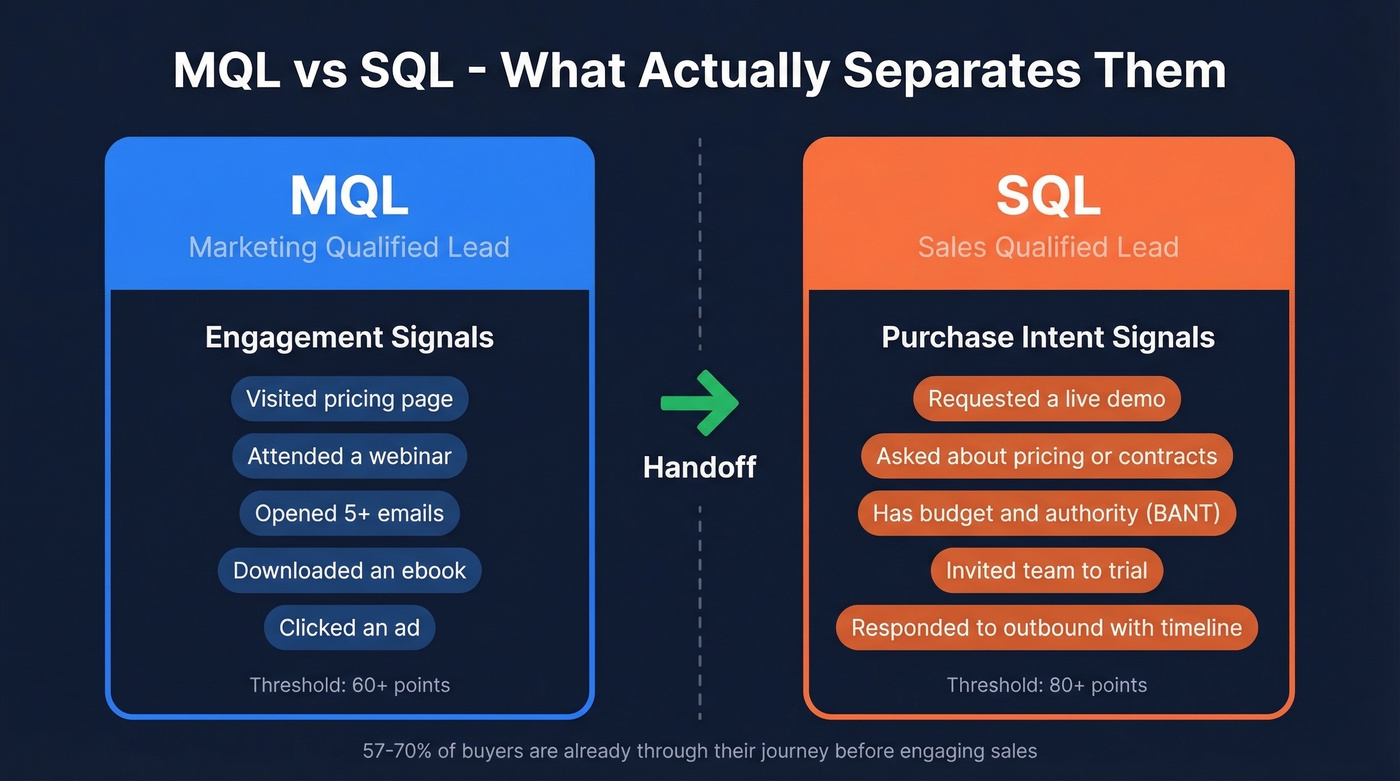
MQLs aren't dead - they're just misused. The problem is treating the funnel as a linear conveyor belt when modern B2B buying is anything but. Leads loop back, go dark, re-engage through different channels. The MQL-to-SQL handoff is a useful checkpoint, not a one-way gate.
MQL-to-SQL Conversion Rates by Industry
Here's where most teams sit, based on First Page Sage's benchmarks:
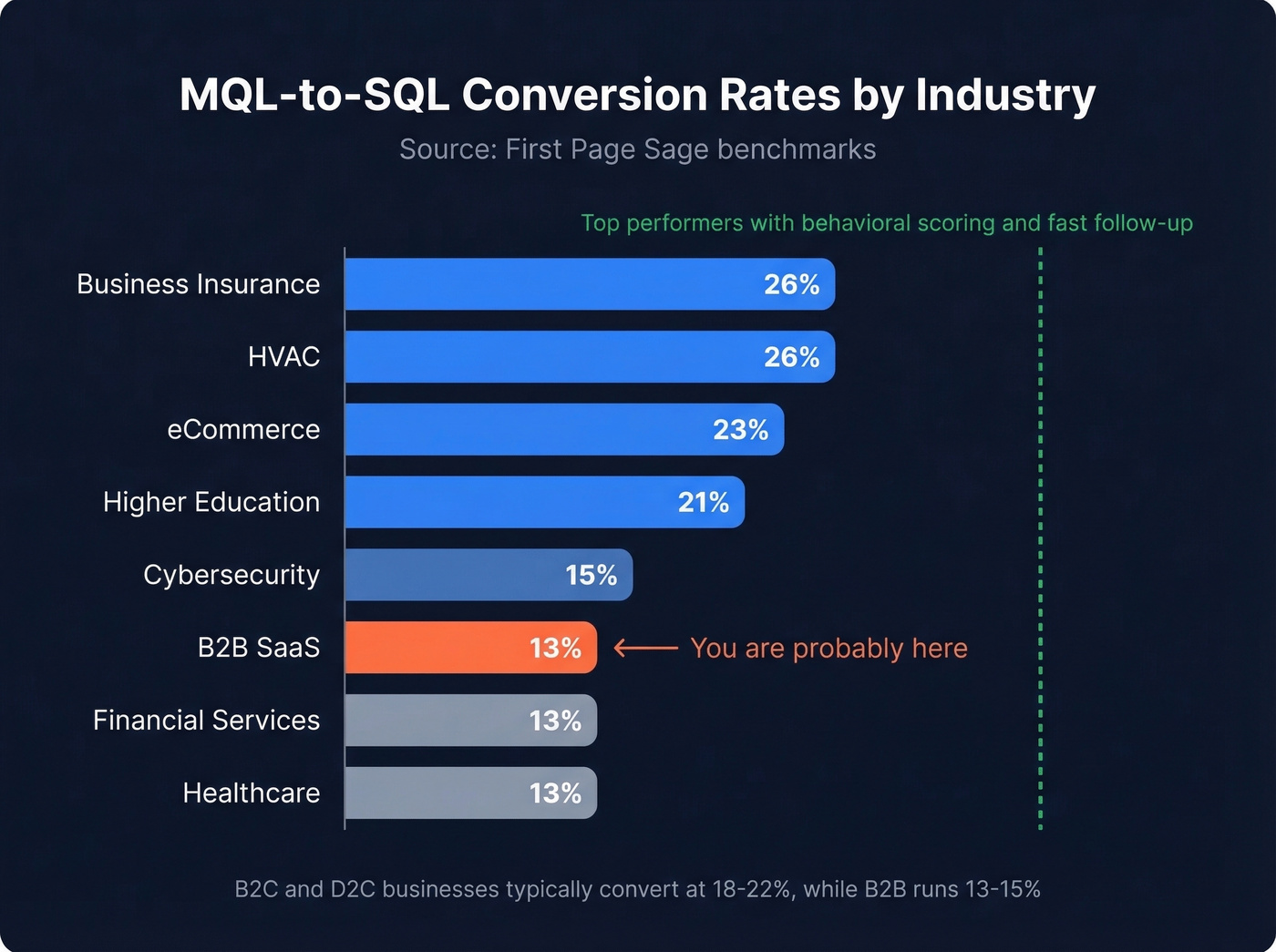
| Industry | MQL-to-SQL Rate |
|---|---|
| Business Insurance | 26% |
| HVAC | 26% |
| eCommerce | 23% |
| Higher Education | 21% |
| Cybersecurity | 15% |
| B2B SaaS | 13% |
| Financial Services | 13% |
| Healthcare | 13% |
B2C and D2C businesses convert at 18-22%, while B2B runs 13-15%. If you're a B2B SaaS company at 13%, you're average. Below 10% means your scoring model needs surgery. Top performers with behavioral scoring and fast follow-up reach 40%.
How to Improve Your MQL-to-SQL Rate
Three levers actually move the needle:
- Speed-to-lead. Following up within the first hour yields a 53% conversion rate vs 17% after 24 hours. That's a 3x difference. If your SDRs aren't responding within 60 minutes, fix that before you touch anything else. (If you need copy, start with these sales follow-up templates.)
- Behavioral scoring. Weighting actions over demographics boosts conversion by up to 40%. A demo request is worth more than a job title. Score what people do, not just who they are. For a deeper build, see our lead scoring guide.
- Decay scoring. Leads go stale. Build negative scoring for inactivity and revisit thresholds every quarter based on closed-won data.
Here's the thing: one prerequisite gets overlooked constantly. We've seen teams obsess over scoring models while a third of their contact records bounce. At that point, speed-to-lead is irrelevant because the SDR can't reach anyone. Enriching lead records with verified contact data before handoff isn't optional - it's foundational. (If you're evaluating vendors, compare data enrichment services.)
A Lead Scoring Model You Can Copy
Here's a scoring framework you can adapt to your CRM today:
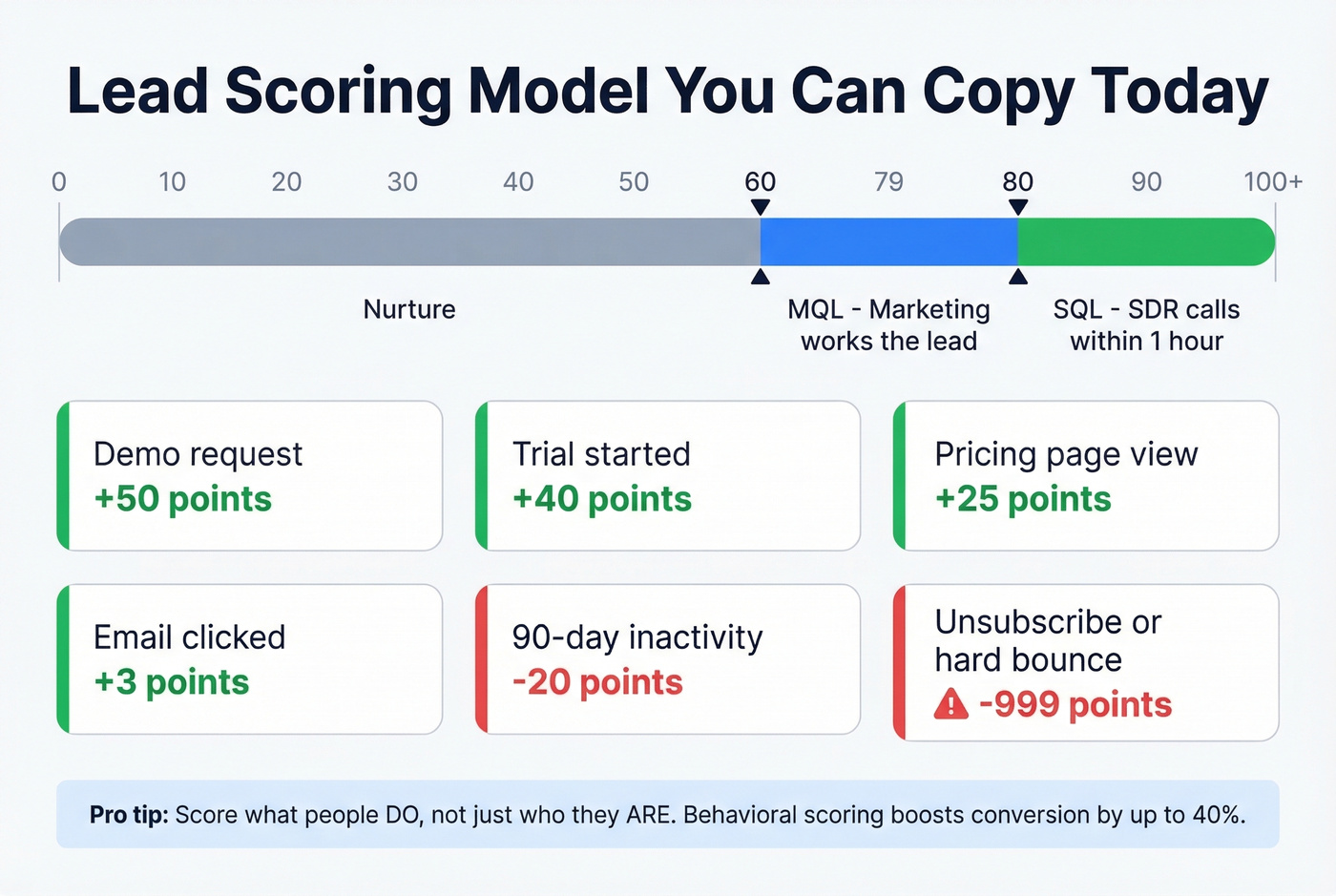
| Action | Points |
|---|---|
| Demo request | +50 |
| Trial started | +40 |
| Pricing page view | +25 |
| Email clicked | +3 |
| 90-day inactivity | -20 |
| Unsubscribe / hard bounce | -999 |
Set 60+ as MQL, 80+ as SQL. Anything above 70 gets an SDR call within the hour.
For framework selection, BANT works for transactional sales, CHAMP fits mid-market where challenges lead the conversation, and MEDDIC is the standard for enterprise deals with multiple stakeholders. Pick one and commit - a mediocre framework applied consistently beats a perfect one that nobody follows.
Understanding Average SQL Value
Knowing your average SQL value - the revenue each Sales Qualified Lead is worth once it enters the pipeline - is critical for budgeting and forecasting. Divide total closed-won revenue by the number of SQLs that entered the pipeline over the same period. For B2B SaaS companies, this figure typically ranges from a few hundred dollars for SMB deals to tens of thousands for enterprise contracts. Track it quarterly so you can set realistic CAC ceilings and justify marketing spend to finance without guessing. (Related: how to calculate cost to acquire customer.)

Speed-to-lead means nothing if a third of your SQL records bounce. Prospeo enriches every lead with 98% verified emails and 125M+ direct dials - so your SDRs actually reach the people your scoring model flagged. 83% of leads come back with contact data, refreshed every 7 days.
Stop losing SQLs to bad data. Enrich before you hand off.
Structured Query Language - SQL for Marketers
The other SQL is Structured Query Language - the programming language that lets you pull data from databases. Think of a database as an Excel workbook (but much larger), and a table as a single sheet. SQL is how you ask questions of that data without waiting for someone else to run the report.
It's difficult to break things using SQL. You're reading data, not writing it. That makes it one of the safest technical skills a marketer can pick up.
Is SQL Worth Learning?
Every marketer should learn basic SQL - not to become a data analyst, but to stop waiting for one.
The analyst bottleneck is real. You need a campaign performance breakdown by channel, and the analytics team's queue is two weeks deep. With basic SQL, you pull it yourself in five minutes. That's the whole argument.
Marketers on Reddit frequently debate whether learning SQL pigeonholes you as the team's "data person." In our experience, the opposite happens - it makes you the person who can answer their own questions, which is a promotion signal, not a career trap. The 30% salary premium backs this up.
Essential Queries for Marketers
You don't need dozens of queries. These three patterns cover most of what marketers actually need day to day, and the core syntax translates across MySQL, PostgreSQL, and BigQuery.
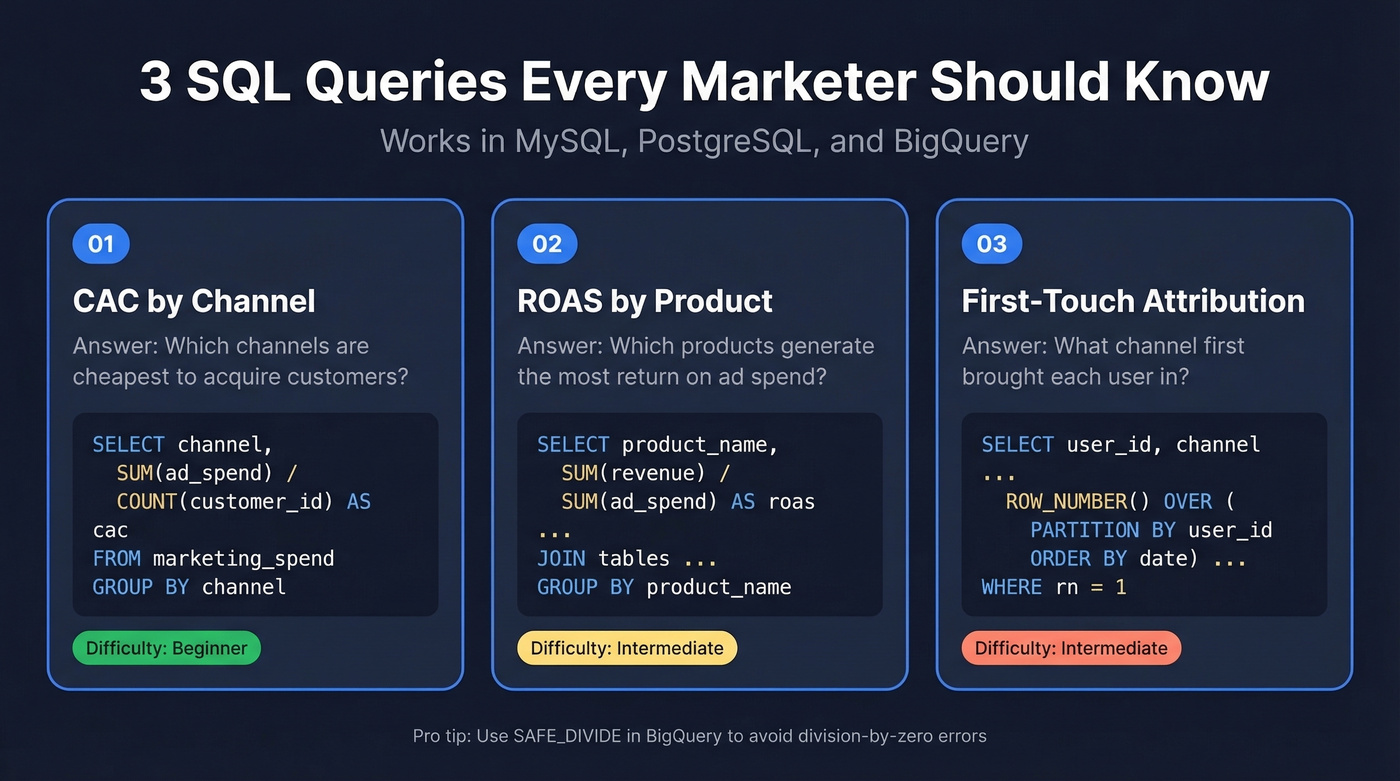
CAC by channel:
SELECT channel, SUM(ad_spend) / COUNT(DISTINCT customer_id) AS cac
FROM marketing_spend
GROUP BY channel;
ROAS by product:
SELECT p.product_name, SUM(s.revenue) / SUM(a.ad_spend) AS roas
FROM sales s
JOIN advertising a ON s.utm_campaign = a.campaign_id
JOIN products p ON s.product_id = p.id
GROUP BY p.product_name;
First-touch attribution:
SELECT user_id, channel, touchpoint_date
FROM (
  SELECT *, ROW_NUMBER() OVER (PARTITION BY user_id ORDER BY touchpoint_date ASC) AS rn
  FROM touchpoints
) t WHERE rn = 1;
Pro tip: use SAFE_DIVIDE in BigQuery to avoid division-by-zero errors in conversion rate calculations. BigQuery has a free tier - more than enough for many marketing teams to start without budget approval. (If you're standardizing reporting, track your funnel metrics alongside these queries.)
Both Meanings Share One Problem: Bad Data
Let's be honest - the biggest problem with either meaning of SQL in marketing isn't your framework or your queries. It's your data.
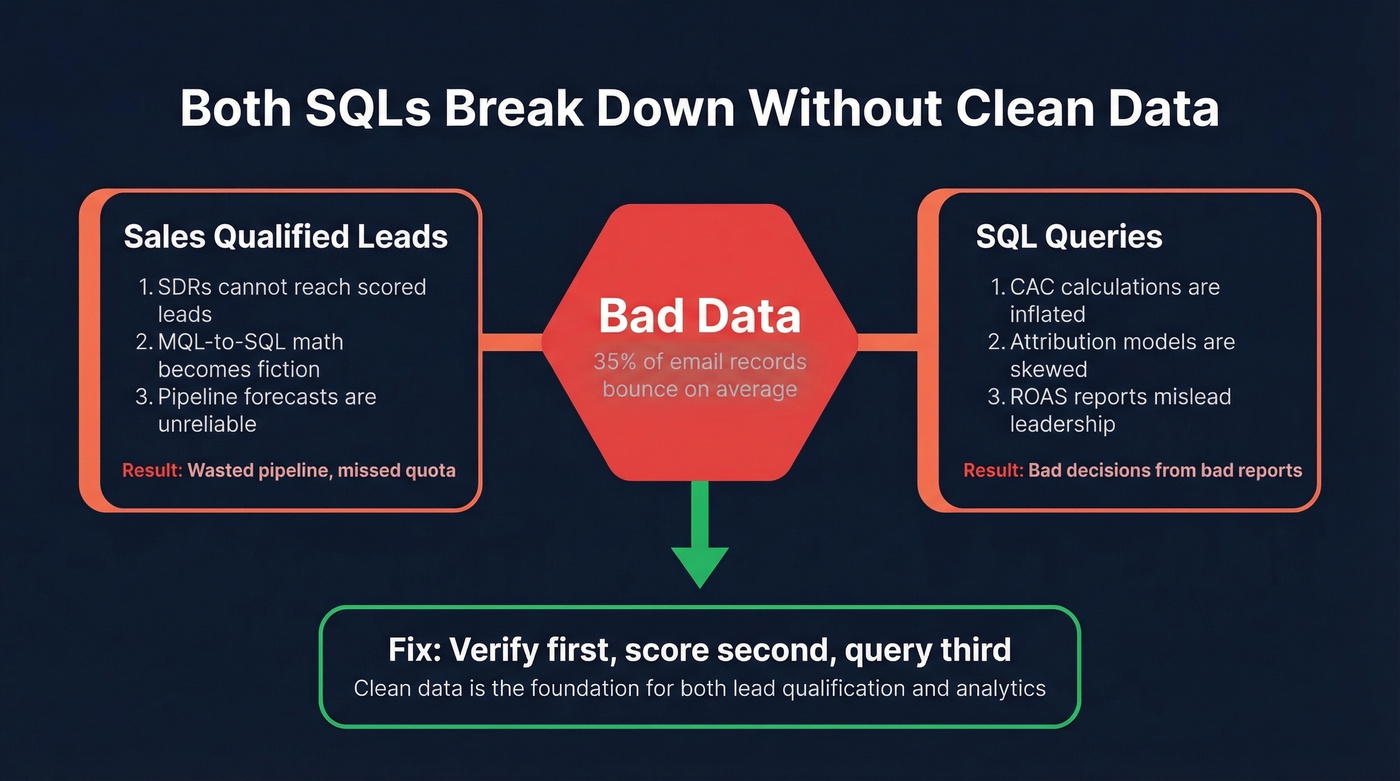
If a third of your contact records bounce, your MQL-to-SQL conversion math is fiction. You're measuring a funnel built on bad inputs. And if you're querying a database full of stale records, your CAC and attribution numbers are equally unreliable. Both sides of the equation collapse when the underlying data is garbage.
I've watched teams spend months refining their lead scoring thresholds while 35% of their emails hard-bounced. That's not a scoring problem. That's a data hygiene problem wearing a scoring costume.
Skip the framework overhaul if you haven't verified that the leads you already have are reachable. A perfectly scored SQL is worthless if the email bounces and the phone number is disconnected. Tools like Prospeo - with 98% email accuracy and a 7-day data refresh cycle - exist specifically to solve this, but whatever tool you use, verify first, score second. (Start by monitoring your email bounce rate and fixing email deliverability issues.)
You're querying databases to calculate CAC and ROAS - but your outbound list is full of stale contacts. Prospeo's 300M+ profiles refresh every 7 days (not 6 weeks), so the data you build campaigns on actually connects. At $0.01 per verified email, the math works for any team size.
Run better queries on better data. Start with 75 free emails.
FAQ
What Does SQL Stand for in Marketing?
SQL has two meanings in marketing. A Sales Qualified Lead is a prospect vetted by sales as ready for a deal conversation. Structured Query Language is the programming language marketers use to pull campaign and revenue data from databases. Context makes the meaning obvious - funnel discussions mean leads, analytics discussions mean queries.
What's a Good MQL-to-SQL Conversion Rate?
B2B SaaS averages 13%, eCommerce around 23%, and top performers reach 40% with behavioral scoring and sub-hour follow-up. Below 10% signals your scoring model or data quality needs recalibration - verify contact records are deliverable before blaming the framework.
What Are Common Sales Qualified Lead Examples?
Typical examples include a prospect who requests a live demo after multiple pricing page visits, a free trial user who adds teammates and integrates with their CRM, or a decision-maker who responds to outbound with specific questions about implementation timelines and contract terms. The common thread is explicit buying behavior, not passive engagement.
Do Marketers Actually Need to Learn SQL?
Yes - it's a career multiplier, not a career trap. Marketers with SQL skills earn 30% more, and only 31% currently have them. Start with CAC-by-channel and ROAS queries, then expand to attribution modeling as you get comfortable.
How Can I Improve Lead Data Quality Before the SQL Handoff?
Use a verification tool that checks emails in real time rather than relying on months-old records. Bounce rates of 30-40% are common with stale CRM data - getting that under 5% means your SDRs actually reach the leads your scoring model qualifies. Whatever solution you pick, look for catch-all domain handling and frequent data refreshes as table stakes.