

SQL vs MQL vs SAL: The 2026 Operational Playbook
It's Monday morning. Marketing is celebrating - MQL targets hit for the third straight month. Sales is fuming - pipeline is thin, and the VP just told the CRO that "marketing's leads are garbage." The 20% MQL-to-SQL conversion target leadership set last quarter? Nowhere close. Both teams have dashboards proving they're right.
This blame cycle isn't a people problem. It's a definitions problem. Forrester research shows modern B2B purchases involve 13 stakeholders on average across multiple departments. When nobody agrees on what "qualified" means - and there's no checkpoint between marketing's handoff and sales' verdict - every lead becomes Schrodinger's opportunity. Alive and dead at the same time, depending on who you ask.
Most guides define MQL, SAL, and SQL and call it a day. That's useless without the operational infrastructure to make the definitions stick. What follows are benchmarks, scoring templates, SLA checklists, and the diagnostic framework to figure out where your pipeline is actually breaking.
Quick-Reference Verdict
| MQL | SAL | SQL | |
|---|---|---|---|
| Definition | Shows buying signals | Sales accepted, working it | Sales confirmed buying intent |
| Owner | Marketing | SDR / BDR | AE / Sales |
| Funnel stage | Mid-funnel | Handoff gate | Lower funnel |
| Key signals | Content engagement, repeat visits | ICP fit verified, contact valid | Budget, authority, timeline confirmed |
| Example behavior | Downloads 3 guides, views pricing | SDR confirms title + need | Requests demo, discusses contract |
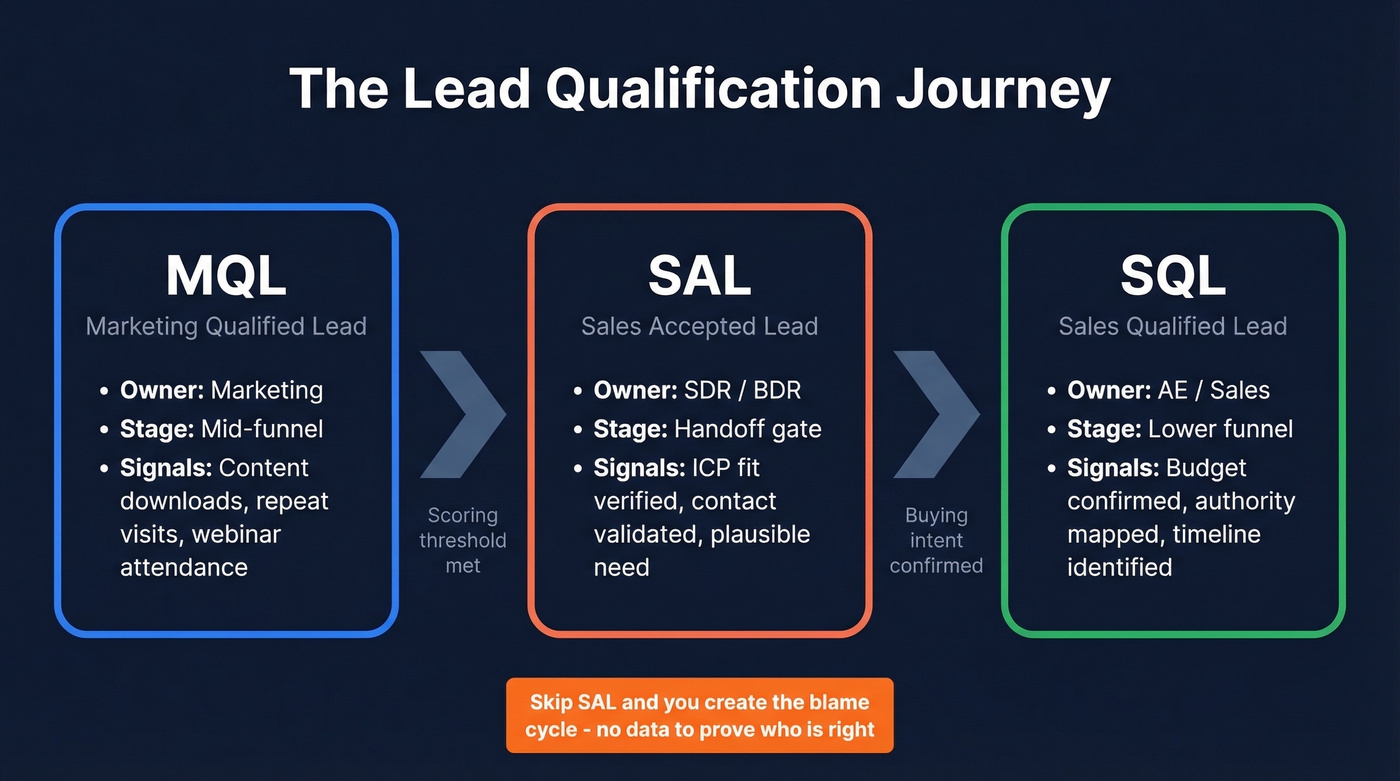
SAL is the most underrated stage in this framework. Skip it and you'll never diagnose why MQLs die between marketing's dashboard and sales' pipeline. It's the SLA enforcement checkpoint that keeps both teams honest.
What Each Stage Actually Means
Marketing Qualified Lead (MQL)
An MQL is a lead that's done something beyond filling out a form. They've shown behavioral signals - downloading multiple pieces of content, attending a webinar, visiting the pricing page twice in a week, or returning to the site across several sessions. The key distinction from a raw lead is pattern, not a single action.
The most common mistake: treating every form fill as an MQL. Someone who downloads one whitepaper to satisfy curiosity isn't showing buying intent. They're showing content interest. There's a meaningful gap between those two things, and collapsing them inflates your MQL count while tanking downstream conversion. Use scoring thresholds to separate signal from noise.
Skip the MQL stage if you're a two-person startup where the founder handles everything. Keep it the moment you have separate marketing and sales functions - it's the first line of defense against wasting sales capacity on unqualified names.
Sales Accepted Lead (SAL)
Here's a scenario that plays out constantly: an SDR gets a "hot MQL" alert, calls the contact, and discovers it's a summer intern who downloaded a competitive analysis for a class project. The lead scored high on engagement but had zero buying authority. Without a SAL stage, that lead goes straight from MQL to "rejected" - and marketing never finds out why.
SAL is the SLA enforcement checkpoint. It's the moment where sales formally accepts a lead and agrees to work it. Not qualified yet - just accepted. The SDR verifies basic fit: right company size, right title, valid contact info, plausible need. If the lead passes, it becomes an SAL. If it doesn't, the rejection reason flows back to marketing as structured feedback.
The distinction matters operationally: marketing's job ends at generating interest, while a sales accepted lead represents the first moment a human on the revenue team has validated that interest is worth pursuing.
Skip SAL and you create the blame cycle from the intro. Marketing says "we sent 500 MQLs." Sales says "they were all junk." Nobody has data to prove either claim because there's no acceptance checkpoint recording why leads were rejected.
When Does a Lead Become an SQL?
B2B buying groups now range from 5 to 16 people across up to 4 functions. That stat alone should change how you think about SQL qualification. An SQL isn't a checkbox exercise - it's the result of a real conversation where the rep has mapped the buying committee, understood the problem, and identified budget and timeline signals.
A demo request from a director is a strong signal. But it only becomes an SQL when the AE has confirmed that the director can actually mobilize budget and that the problem is real enough to prioritize. Qualifying an SQL means understanding who else is involved in the decision, not just confirming that one person is interested.
Let's be clear about the SAL-to-SQL distinction: SAL is the handshake ("we'll work this lead"), SQL is the verdict ("this lead has real buying intent"). After auditing many B2B pipelines, we've found that the teams who conflate these two stages are the same ones fighting about lead quality every Monday morning.
Funnel Benchmarks That Matter
Full-Funnel Conversion Waterfall
Most teams obsess over one conversion rate in isolation. That's like diagnosing a car problem by only checking the oil.
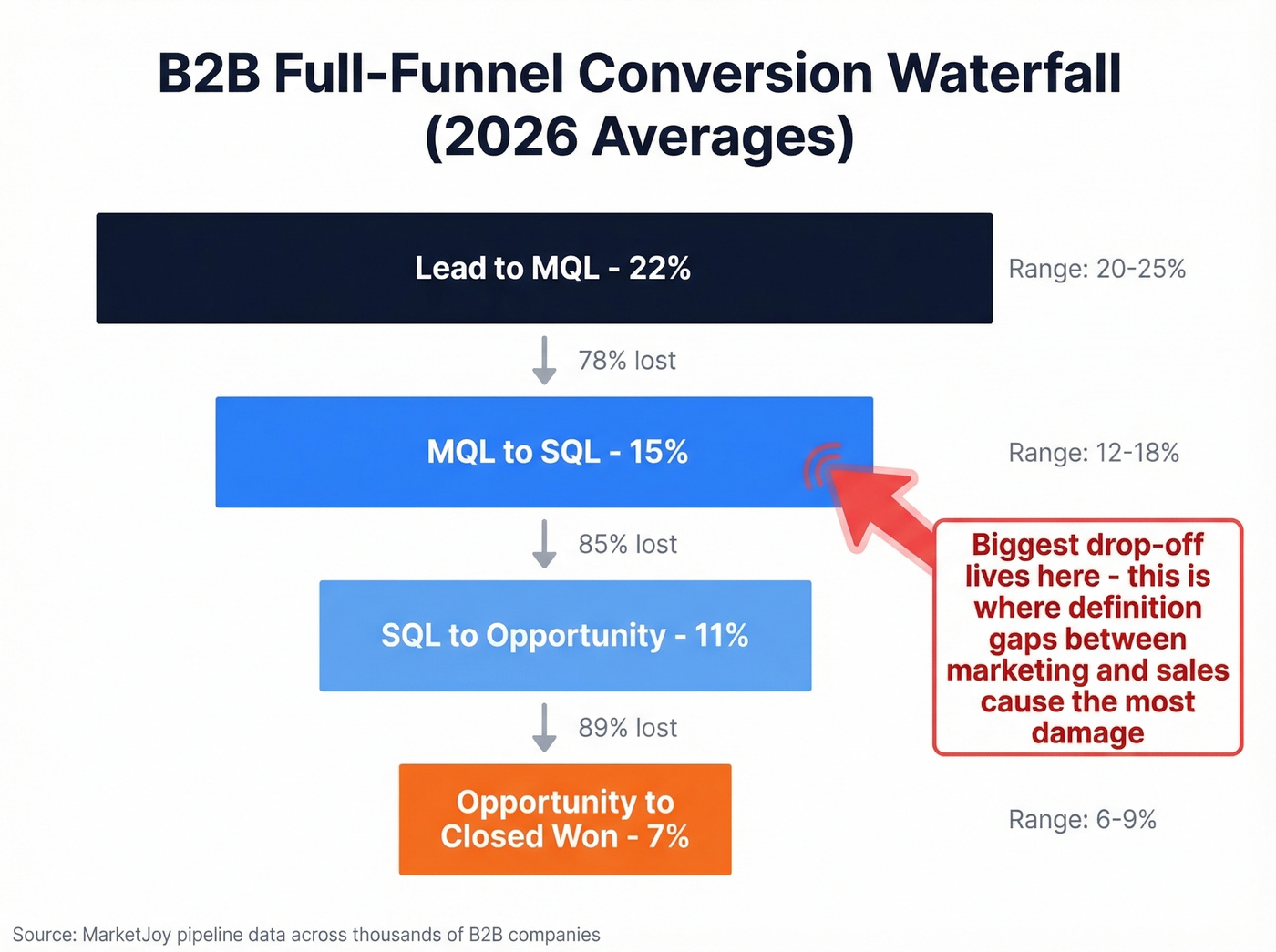
MarketJoy's averages across thousands of B2B pipelines:
| Stage | Average | Typical Range |
|---|---|---|
| Lead → MQL | 22% | 20-25% |
| MQL → SQL | 15% | 12-18% |
| SQL → Opportunity | 11% | 10-12% |
| Opp → Closed-Won | 7% | 6-9% |
The biggest drop-off is MQL → SQL. That's not surprising - it's where the definition gap between marketing and sales lives. If your MQL → SQL rate is below 12%, you almost certainly have a definition alignment problem, a data quality problem, or both.
First Page Sage's B2B SaaS benchmark puts MQL → SQL at 13%, based on multi-year client data. That number gets copied everywhere, but it's an average across their client base - not a universal target.
Benchmarks by Company Stage
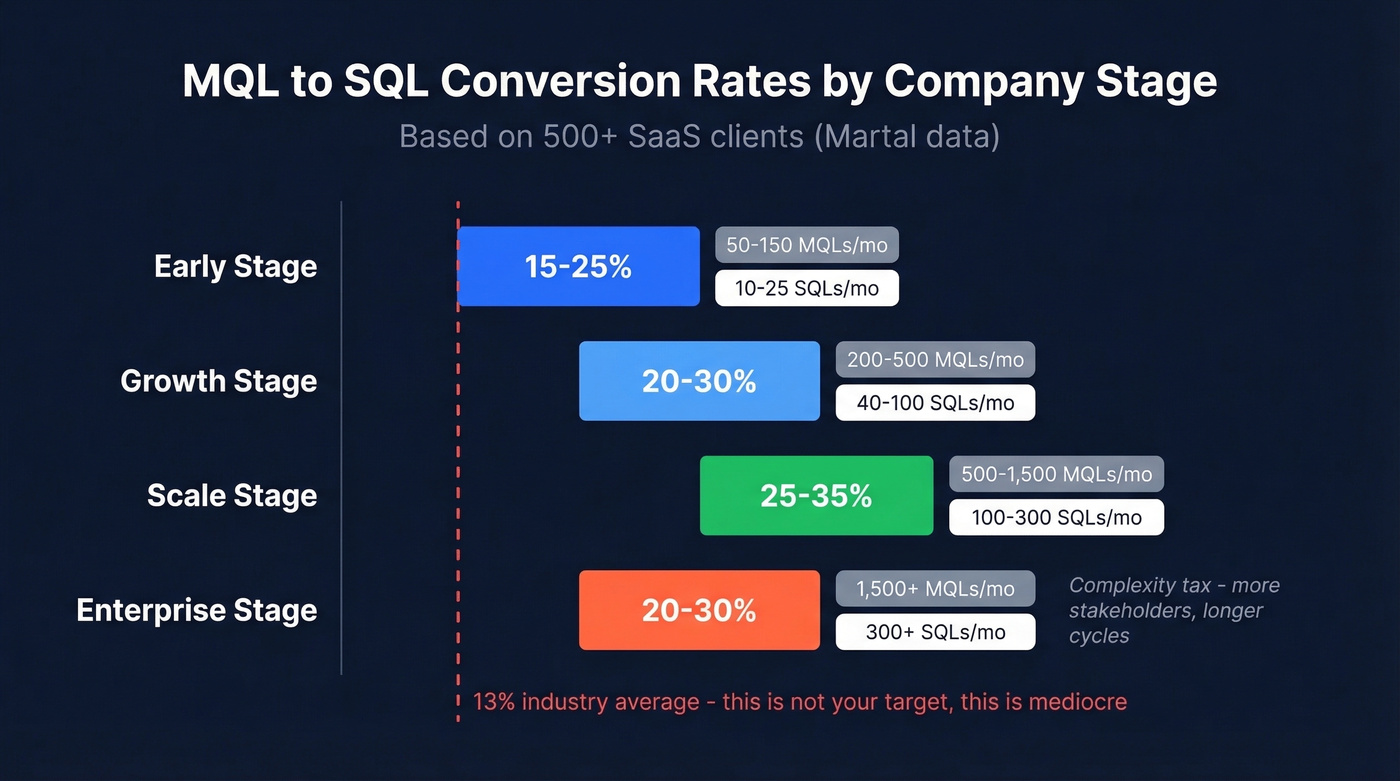
A 13% conversion rate means very different things depending on whether you're a 10-person startup or a 500-person scale-up. Martal's stage-segmented data from 500+ SaaS clients is more useful:
| Company Stage | MQL → SQL | Monthly MQLs | Monthly SQLs |
|---|---|---|---|
| Early | 15-25% | 50-150 | 10-25 |
| Growth | 20-30% | 200-500 | 40-100 |
| Scale | 25-35% | 500-1,500 | 100-300 |
| Enterprise | 20-30% | 1,500+ | 300+ |
Notice that enterprise conversion rates dip back down. That's the complexity tax - more stakeholders, longer cycles, more opportunities for deals to stall. Early-stage teams should target 15-25% and treat anything below 15% as a red flag worth investigating.
Here's the thing: 13% is an average, not a target. If you're building your plan around the average, you're planning to be mediocre.
SQL Qualification Frameworks
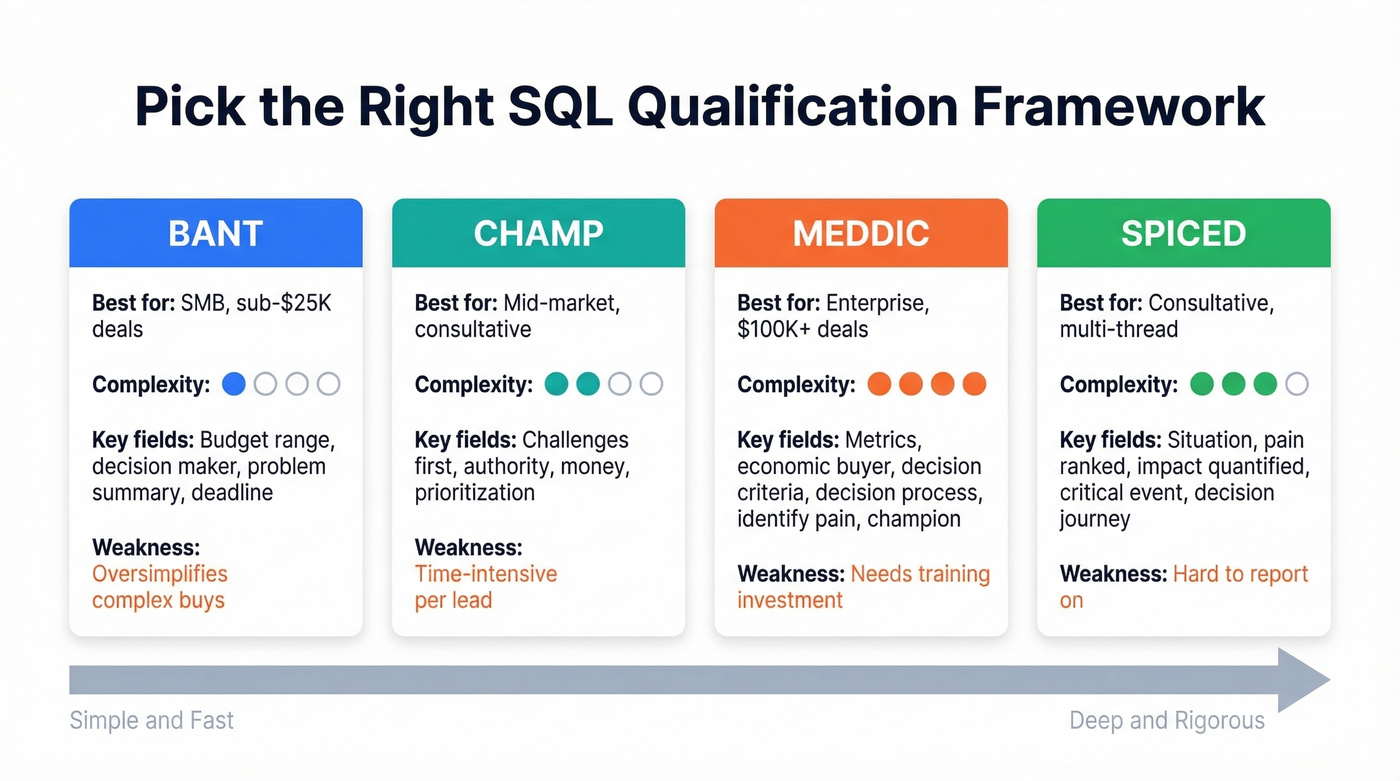
Not every SQL needs the same qualification rigor. A $15K deal with one decision-maker doesn't need the same framework as a $200K enterprise contract with 13 stakeholders.
| Framework | Best For | Complexity | Weakness |
|---|---|---|---|
| BANT | SMB, sub-$25K deals | Low | Oversimplifies complex buys |
| CHAMP | Mid-market, consultative | Medium | Time-intensive per lead |
| MEDDIC | Enterprise, $100K+ | High | Needs training |
| SPICED | Consultative, multi-thread | Medium-High | Hard to report on |
BANT works fine for high-velocity SMB sales where you need a quick yes/no. MEDDIC is what you want when you're selling into organizations with a 6-month evaluation cycle and a dozen stakeholders. SPICED sits in between - more consultative than BANT, less rigid than MEDDIC.
For CRM implementation, each framework maps to specific fields your reps should fill out during discovery.
BANT fields: budget range, decision maker identified, problem summary, key date or deadline.
MEDDIC fields: baseline metrics the prospect measures today, buyer roles mapped, evaluation criteria documented, decision process stages, champion signals showing who's advocating internally. (If you want a deeper build-out, use a MEDDIC field checklist.)
SPICED fields: current tech stack, pain list ranked by severity, quantified upside, critical event driving urgency, decision journey mapped.
A hybrid approach works well for many teams - use BANT as a quick screen, then layer in SPICED or MEDDIC depth for deals above a certain threshold. The framework matters less than consistency. Pick one, embed it in your CRM fields, and enforce it.

Bad data is the silent killer of MQL-to-SQL conversion. When SDRs call invalid numbers or bounce emails during the SAL stage, leads get rejected - and marketing takes the blame. Prospeo's 98% verified emails and 125M+ verified mobiles mean your SAL acceptance rate climbs because every lead comes with contact data that actually works.
Stop losing qualified leads to bad phone numbers and bounced emails.
Build a Lead Scoring Model
Fit vs. Intent Split
Every scoring model boils down to two dimensions: fit and intent. Fit asks whether this person matches your ICP. Intent asks whether they're showing buying behavior. Fit without intent is a target account that isn't in-market. Intent without fit is someone who loves your content but will never buy.
RevBlack's data shows that typical teams convert 25-35% of MQLs to SQLs, while high-alignment organizations hit 40-50%. The difference isn't magic - it's tighter scoring that weights both dimensions properly.
Scoring is only as good as the data feeding it, though. If 20% of your email addresses bounce and your phone numbers connect to voicemail boxes that haven't been set up, your scoring model is grading ghosts. Verify before you score - tools like Prospeo handle this with 98% email accuracy on a 7-day refresh cycle, so your model grades real people instead of dead records. (If you’re formalizing this, align it with your Ideal Customer Profile and your lead status definitions.)
The bigger point from practitioners on r/sales is dead-on: scoring layers just add friction unless they're tied to actual opportunity creation, not just MQL counts. Your scoring model should predict pipeline, not just generate a number that makes marketing's dashboard look good.
Copy-Paste Scoring Template
Here's a starter template based on HubSpot's scoring system, adaptable to Salesforce or any CRM with custom fields.
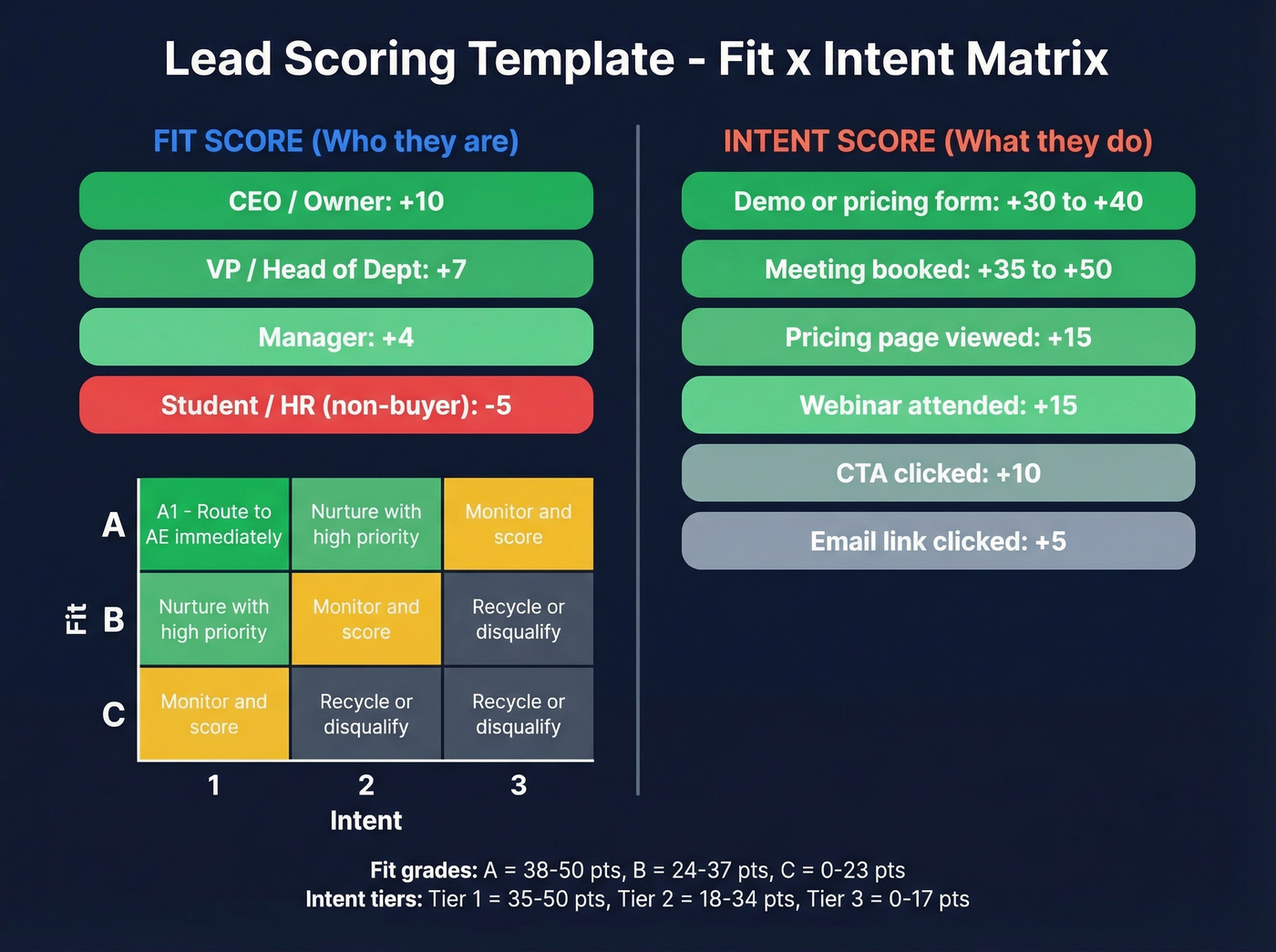
Fit scoring by title or role:
- CEO / Owner: +10
- VP / Head of Department: +7
- Manager: +4
- Student / HR (non-buyer): -5
Engagement scoring by behavior:
- Demo or pricing form submitted: +30 to +40
- Meeting booked: +35 to +50
- Pricing page viewed: +15
- Webinar attended: +15
- CTA clicked: +10
- Email link clicked: +5
These thresholds assume a 50/50 split between fit and engagement, scored out of 100 total points:
- Fit Grade A: 38-50 points | Grade B: 24-37 | Grade C: 0-23
- Engagement Tier 1: 35-50 | Tier 2: 18-34 | Tier 3: 0-17
An A1 lead - high fit, high engagement - is your MQL. Route it immediately. A C3 is noise - nurture or disqualify. Everything in between needs judgment, which is exactly where the SAL stage earns its keep.
One HubSpot-specific note: Marketing Hub Pro caps you at 100 total scoring points. Enterprise gives you 500. Plan your point allocation accordingly, and use time-frame or decay settings to prevent stale engagement from inflating scores. You can't use both time-frame and decay in the same scoring group - pick one approach and stick with it.
The Marketing-Sales SLA
Only about 22% of companies feel their marketing and sales teams are tightly aligned. The other 78% are living the Monday morning blame cycle. Companies with strong alignment grow roughly 20% per year. Misaligned organizations see revenue stall or decline.
An SLA makes alignment concrete instead of aspirational. A typical SLA term looks like this: marketing commits to handing off qualified leads within 24 hours of scoring, and sales commits to a first touch within 4 hours. If either side misses the window, it gets flagged in the weekly pipeline review. That kind of specificity is what separates a real SLA from a slide deck nobody reads.
Your SLA should also cover shared definitions of MQL, SAL, and SQL written down rather than assumed, a minimum follow-up cadence before a lead can be rejected, structured rejection reasons that flow back to marketing, and shared incentives that reward pipeline outcomes rather than activity metrics. This isn't a document you write once and file away - it's a living agreement that gets reviewed every quarter and updated when conversion patterns shift. (If you need a starting point for the actual touches, use sales follow-up templates and standardize them in your sequences.)
Where Your Pipeline Breaks
Five failure modes show up in almost every pipeline audit we've run:
MQL volume is up but SQL count is flat. The classic definition gap. Marketing is optimizing for volume; sales is rejecting leads that don't meet their undocumented criteria. Fix it with shared definitions and the SAL checkpoint.
SDR response times are creeping up. When reps don't trust lead quality, they deprioritize inbound follow-up. Response times drift from minutes to hours to days. For demo requests, you should be responding within 5-15 minutes. Contacting leads within 24 hours increases conversion by 5x.
Sales rejection rate is above 40%. Some rejection is healthy - it means your SAL stage is working. But if sales is rejecting more than 4 in 10 leads, your scoring model or ICP definition needs recalibration.
No feedback loop from sales to marketing. If rejected leads just disappear into a "disqualified" bucket with no reason code, marketing can't improve targeting. Require structured rejection reasons in your CRM.
CRM stages don't match your actual process. If your CRM has "Lead" and "Opportunity" with nothing in between, you're flying blind on the MQL → SAL → SQL journey. Add the stages. Map them to your SLA. (This is also where sales process optimization work pays off fast.)
And then there's the failure mode nobody talks about: your SDRs are calling disconnected numbers and emailing addresses that bounce. Even perfect definitions and scoring models fail when the underlying contact data is stale. Only 9% of teams trust their data enough for accurate reporting, and if 20-35% of your contact records are dead on arrival, your reps are wasting hours every day on leads that literally can't convert. Clean data won't fix bad definitions, but bad data will destroy good ones. (If you’re fixing this systematically, start with lead enrichment and a short list of data enrichment services.)
Your SAL checkpoint only works if reps can actually reach the lead. Prospeo enriches every contact with 50+ data points - job title, company size, department headcount - so SDRs validate ICP fit in seconds, not hours. At $0.01 per email, fixing your handoff problem costs less than one wasted sales call.
Enrich your MQLs before the handoff and watch SQL conversion climb.
Beyond the MQL/SAL/SQL Framework
Product-Qualified Leads (PQLs)
If you're running a freemium or free-trial motion, PQLs matter more than MQLs. A PQL is a user who's signed up, matches your ICP, and has derived actual value from the product. Not every trial signup qualifies - only those who hit meaningful activation milestones.
For multi-user B2B products, the stronger signal is the PQA - product-qualified account - where 3+ active users have connected an integration and returned across multiple weeks. An email marketing tool might trigger PQL status when a user connects a domain, imports a list, and sends a campaign. A project management tool triggers when someone creates a project, invites a teammate, and moves tasks through stages.
PQLs don't replace MQLs. They complement them. Both flow into the same SAL/SQL qualification process.
Is the MQL Framework Dead?
Default's argument is that the MQL/SAL/SQL waterfall was built for linear funnels, and modern buyers don't move linearly. They're 57-70% through their buying journey before they ever engage sales. The framework encourages process-driven behavior - hitting SLA steps - rather than outcomes-driven behavior like accelerating revenue.
There's truth in that critique. But here's our hot take: if your average deal size is under $50K, you probably don't need to reinvent the funnel. You need to actually implement the one you have. The stages still work as diagnostic checkpoints, not as a rigid assembly line. You don't need every lead to flow neatly from MQL → SAL → SQL → Opportunity. You do need shared language for where leads are, who owns them, and why they're stalling. (If you want to pressure-test your funnel end-to-end, use a B2B sales funnel template and compare your stage math.)
The teams that abandon the framework entirely don't end up with something better - they end up with no shared language at all, which is worse.
FAQ
What's the difference between SAL and SQL?
SAL means sales has accepted the lead and agreed to work it - the handshake. SQL means sales has qualified the lead through discovery and confirmed genuine buying intent - the verdict. SAL is the checkpoint; SQL is the outcome. You can have an SAL that never becomes an SQL if discovery reveals the lead isn't a fit.
What's a good MQL-to-SQL conversion rate?
The B2B SaaS average is 13% based on First Page Sage's multi-year client data. Early-stage SaaS teams should target 15-25%. Below 13% consistently signals a definition problem, a data quality problem, or both. Benchmark against your company stage, not the industry average.
Do you need all three stages?
Most B2B teams benefit from all three. SAL is optional for small teams where marketing and sales sit next to each other and communicate constantly. It becomes critical once you have dedicated SDRs or any formal handoff process. When in doubt, add the SAL stage - you can always simplify later.
How does bad contact data affect lead conversion?
Directly and severely. If 20-35% of your contact data bounces or connects to wrong numbers, SDRs waste hours on dead leads that never had a chance of converting. Verifying emails and phone numbers before they enter the pipeline lets your scoring model and SLA actually work as designed.