

Talk Tracks: The Complete Guide to Selling Without Sounding Scripted
A new SDR posted on r/sales last month, frustrated that every cold call felt "too pitchy and salesy" no matter how they structured it. They had the opener, the value prop, the meeting ask - but it all came out sounding like a robot reading a teleprompter. Dozens of comments piled on with the same complaint.
That's the exact problem a talk track solves. Structured calls that hit specific talking points convert 27% better than unstructured ones, and new reps ramp 39% faster when they've got proven frameworks to lean on. Not scripts. Frameworks.
What Is a Talk Track?
A talk track is a conversational framework that guides a rep through key messaging points while leaving room for natural dialogue. Think of it as jazz, not sheet music - you know the chord changes, but how you play depends on the room.
Here's the critical distinction: it's an outline, not a monologue. It identifies the themes you need to hit - pain points, differentiators, proof points, questions to ask - without dictating exact words. The best reps internalize the structure so deeply they forget they have one. That's the goal.
How It Differs From a Script
| Dimension | Talk Track | Script |
|---|---|---|
| Flexibility | High - adapts in real time | Low - verbatim delivery |
| Best for | Complex/personalized sales | Compliance, onboarding |
| Adaptability | Branches based on responses | Linear, fixed sequence |
| Rep skill required | Moderate to high | Low (by design) |
| Ideal sales cycle | Multi-touch, consultative | Transactional, short |
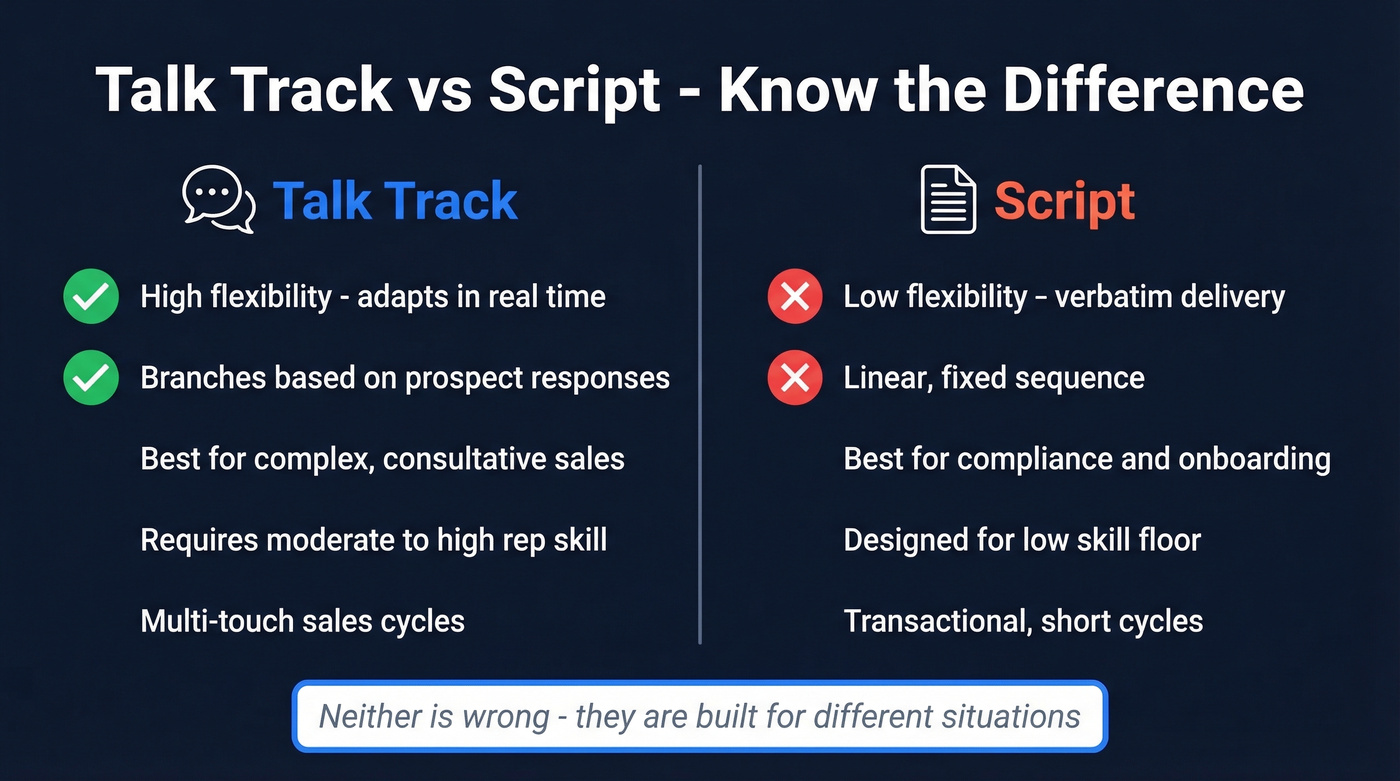
Scripts aren't bad - they're built for different situations. If you're onboarding a brand-new rep who's never sold before, a script gets them on the phone faster. Regulated industries where specific disclosures are required? Scripts keep you compliant.
But the moment a prospect goes off-script (and they always do), a script-dependent rep freezes. A flexible framework gives reps the structure to navigate objections, pivot based on what they hear, and still sound like a human being. For any sales cycle longer than one call, the conversational approach wins. Understanding the talk track meaning at a deeper level - flexible structure, not rigid recitation - separates reps who sound natural from reps who sound rehearsed.
Why Structured Conversations Convert
Every second of a cold call matters more than most reps realize. The average live cold call lasts 93 seconds. Connect rates sit around 16.6%, and it takes an average of 8 attempts to reach a prospect. When you finally get someone on the line, you can't afford to wing it.
The good news: 69% of buyers are open to cold calls, and 57% of C-level and VP buyers actually prefer phone contact. The channel works. Execution is the problem - and that's where a well-built talk track earns its keep.
Conversion benchmarks (SQL to closed deal):
| Category | Type | Conversion Rate |
|---|---|---|
| Business services | Industry | 24.47% |
| Tech/software | Industry | 9.39% |
| Referral channel | Channel | 25.56% |
| Direct sales/cold calling | Channel | 9.38% |
Those numbers tell you something important: cold calling converts at roughly 9%, which means 91 out of 100 conversations don't close. A structured framework that moves the needle even two or three percentage points represents real pipeline impact at scale.
Let's be honest: if your deal size is under $10K and your sales cycle is one call, you probably don't need a full framework - a tight script will do. But the moment you're running multi-touch deals with discovery calls and demos, structured messaging isn't optional. It's the difference between a team that scales and a team that stays dependent on a few star reps.
How to Build a Talk Track
1. Map your conversation hotspots. Identify the moments where deals stall or reps stumble - objections, discovery questions, demo transitions, pricing discussions. Don't try to framework the entire call. Focus on the five or six moments that actually determine outcomes.
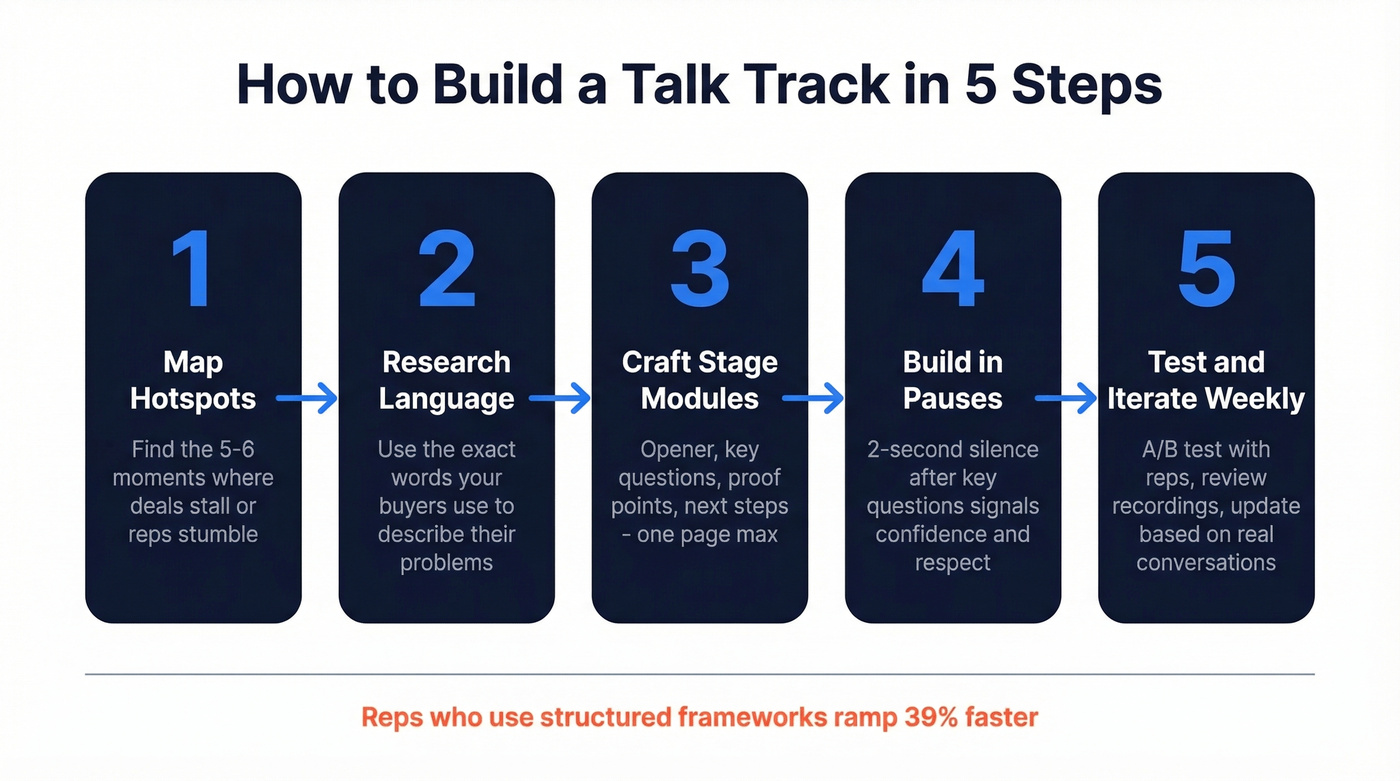
2. Research your audience's language. Listen to call recordings. Read your prospects' job postings, their professional profiles, their industry forums. The words your buyers use to describe their problems should be the words in your messaging. If they say "pipeline velocity" and you say "sales speed," you've already lost a beat.
3. Craft concise messaging per stage. Each module should fit on one page. If it's longer, you'll never internalize it. Write the opener, the key questions, the proof points, and the transition to next steps. That's it.
4. Build in strategic pauses. One of the most underrated techniques: plan your silence. A two-second pause after a key question gives the prospect space to think and signals confidence. Pauses replace filler words like "um" and "so basically" - and they make your buyer feel heard rather than steamrolled.
5. Test collaboratively and iterate weekly. Don't hand reps a framework from on high. Build it with them. Weekly reviews, A/B testing messaging variations, and updates based on what reps hear in real conversations - that's how these stay alive. If structured messaging helps new reps ramp 39% faster, it's worth treating iteration like a real operating cadence, not a one-time enablement project. (If you need the system around this, start with a sales playbook.)

You just built the perfect cold call opener. Now make sure it reaches a real person. Prospeo gives you 125M+ verified mobile numbers with a 30% pickup rate - so your talk track actually gets heard instead of hitting voicemail or a dead line.
Stop wasting power hours on disconnected numbers.
Templates by Sales Stage
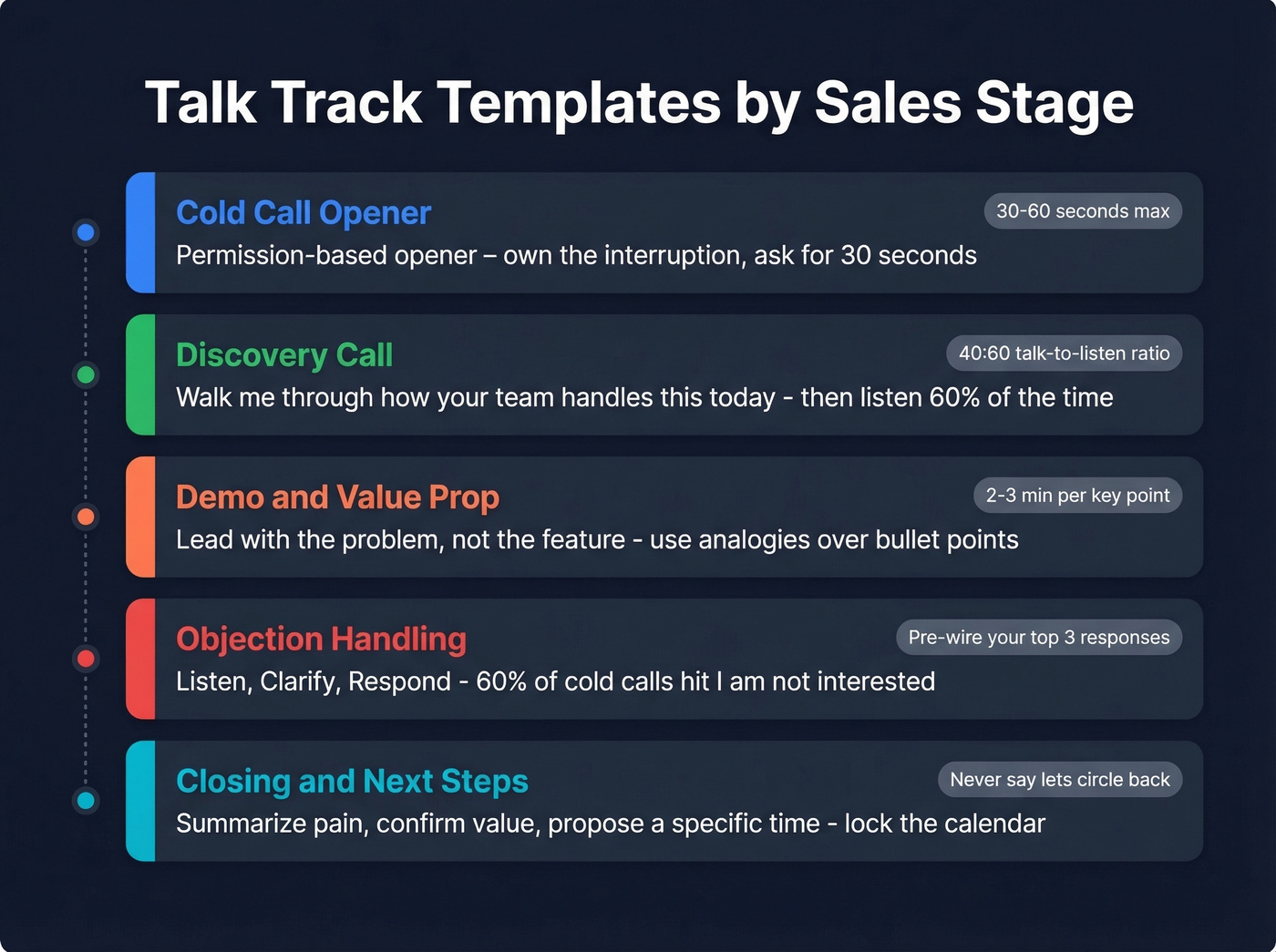
Cold Call Opener
Here's the example first - then why it works:
"Hey [Name], this is [You] from [Company]. I know I'm catching you out of the blue - can I get 30 seconds to tell you why I called, and you can tell me if it's worth continuing?"
This permission-based opener does two things: it respects the prospect's time, and it gives them a sense of control. You're not pretending this isn't a cold call - you're owning the interruption. Keep this to 30-60 seconds max. From there, anchor on a specific pain or trigger: a job posting, a funding round, a tech stack signal. One stat worth knowing: calling between 4-5 PM yields 71% better results than the 11 AM-noon window.
Pro tip: run your list through a verification tool before your call block. Bad numbers kill momentum - nothing derails a power hour faster than six disconnected lines in a row. (This is also where bad leads quietly destroy output.)
Discovery Call
Do this: "Walk me through how your team handles [process] today." Open-ended. Curious. Lets the prospect talk.
Not that: "What's your biggest challenge?" Generic. Feels like an interrogation. Gets a one-word answer.
The 40:60 rule matters here - you should be talking 40% and listening 60%. Open with context from the cold call, then move to questions that surface real pain. Active listening isn't just polite - it's how you find the angle that closes the deal. In our experience, reps who nail discovery convert at nearly double the rate of reps who rush to the demo. (If you want to benchmark this, track your talk-to-listen ratio.)
Demo / Value Prop
Lead with the problem you're solving, not the feature you're showing. Analogies work better than feature lists - "Think of it like Waze for your sales pipeline; it doesn't just show you where you are, it reroutes you around traffic in real time" is more memorable than a bullet-point walkthrough of your dashboard.
Budget 2-3 minutes per key point. When a prospect asks about a feature you don't have, don't panic - acknowledge it, share your roadmap timeline if you can, and redirect to the value you do deliver.
Objection Handling
Sixty percent of cold calls hit the "I'm not interested" objection. You need a framework, not a comeback. Listen, Clarify, Respond works across every objection type.
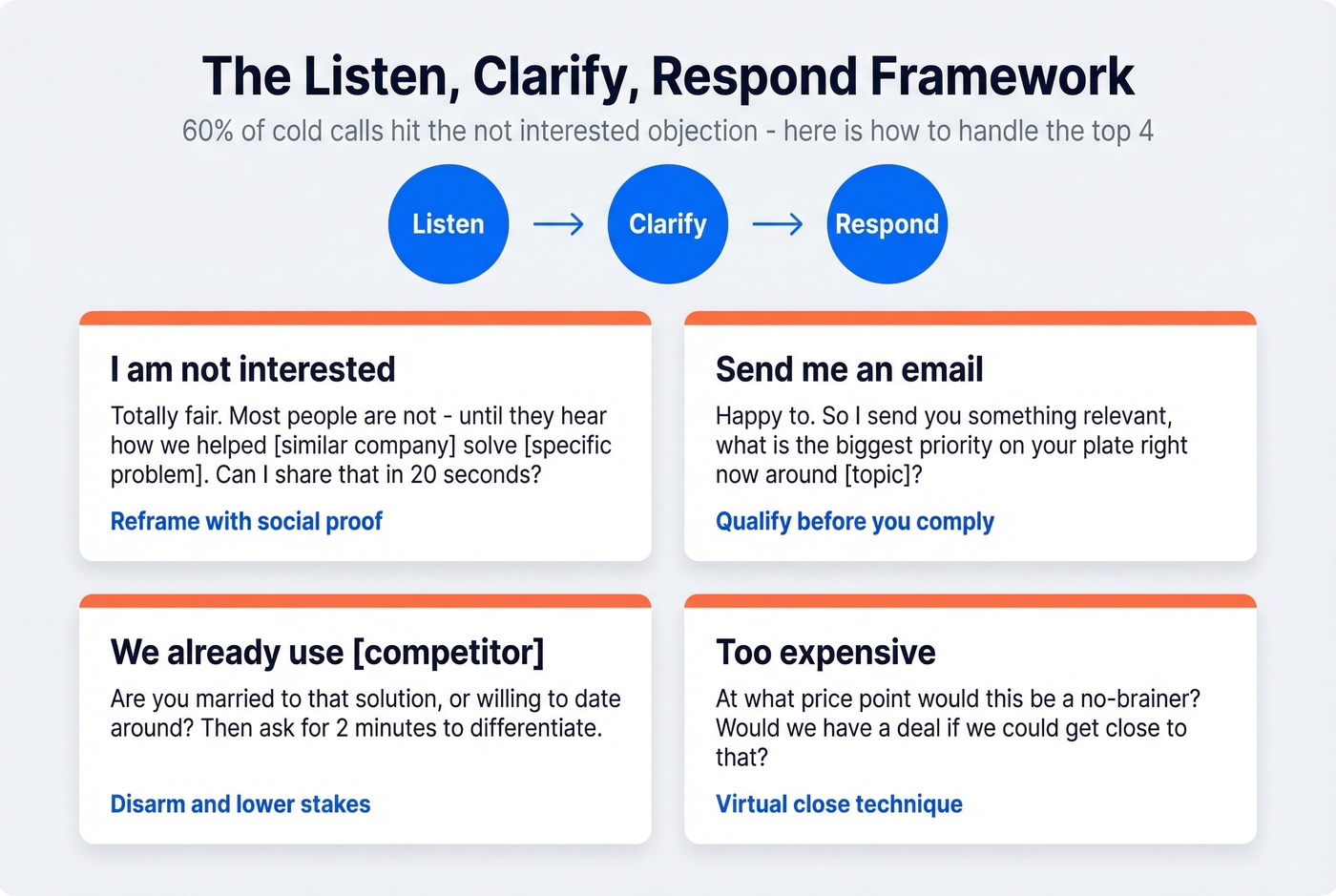
- "I'm not interested." - "Totally fair. Most people I call aren't - until they hear how we helped [similar company] solve [specific problem]. Can I share that in 20 seconds?"
- "Send me an email." - "Happy to. So I send you something relevant, what's the biggest priority on your plate right now around [topic]?"
- "We already use [competitor]." - "Are you married to that solution, or willing to date around?" This disarming line works because it reframes the conversation as low-stakes. Then ask for two minutes to differentiate.
- Pricing objection - Use the virtual close: "At what price point would this be a no-brainer? Would we have a deal if we could get close to that?"
Closing / Next Steps
Here's what kills deals: "Let's circle back next week." That vague non-commitment is where pipeline goes to die.
Flip the structure instead. Summarize what the prospect told you, confirm the value they acknowledged, and propose a specific time: "Based on what you shared about [pain], it sounds like [solution] could save your team [outcome]. Can we get 30 minutes on Thursday at 2 PM to walk through the details with [stakeholder]?" Lock the calendar before you hang up. Every time. (If you need a system for this, use a close process.)
Common Mistakes
Talking too much. Enforce the 40:60 ratio. If you're talking more than 40% of the call, you're pitching, not selling. Record yourself. The numbers don't lie. A common complaint on r/sales: reps who memorize frameworks word-for-word end up sounding worse than reps with no structure at all.
Feature-dumping. Opening with your company's capabilities is like pulling out a resume on a first date. Nobody wants that. Start with their problem, not your solution.
No objection prep. If you haven't rehearsed answers to "I'm not interested," "we don't have budget," and "we already have a solution," you're not ready to dial. Pre-wire your top three responses. (If you want drills, build around objection handling skills.)
Never iterating. The best teams A/B test messaging variations and update based on conversation intelligence data. If your enablement team built the framework once and never measured it, that's why reps stopped using it after week two.
Skip the memorization entirely. The goal is to internalize the structure so deeply you forget you have one.
Measuring Effectiveness
| KPI | What It Tells You | Target Range |
|---|---|---|
| Conversion rate | Is the messaging working? | 9-25% by industry |
| Talk-to-listen ratio | Are reps listening enough? | 40:60 (rep:prospect) |
| Objection frequency | Are you pre-handling concerns? | Decreasing over time |
| Message coverage | Are reps hitting key points? | 80%+ of framework |
| New rep ramp time | Is enablement effective? | 39% faster with structure |
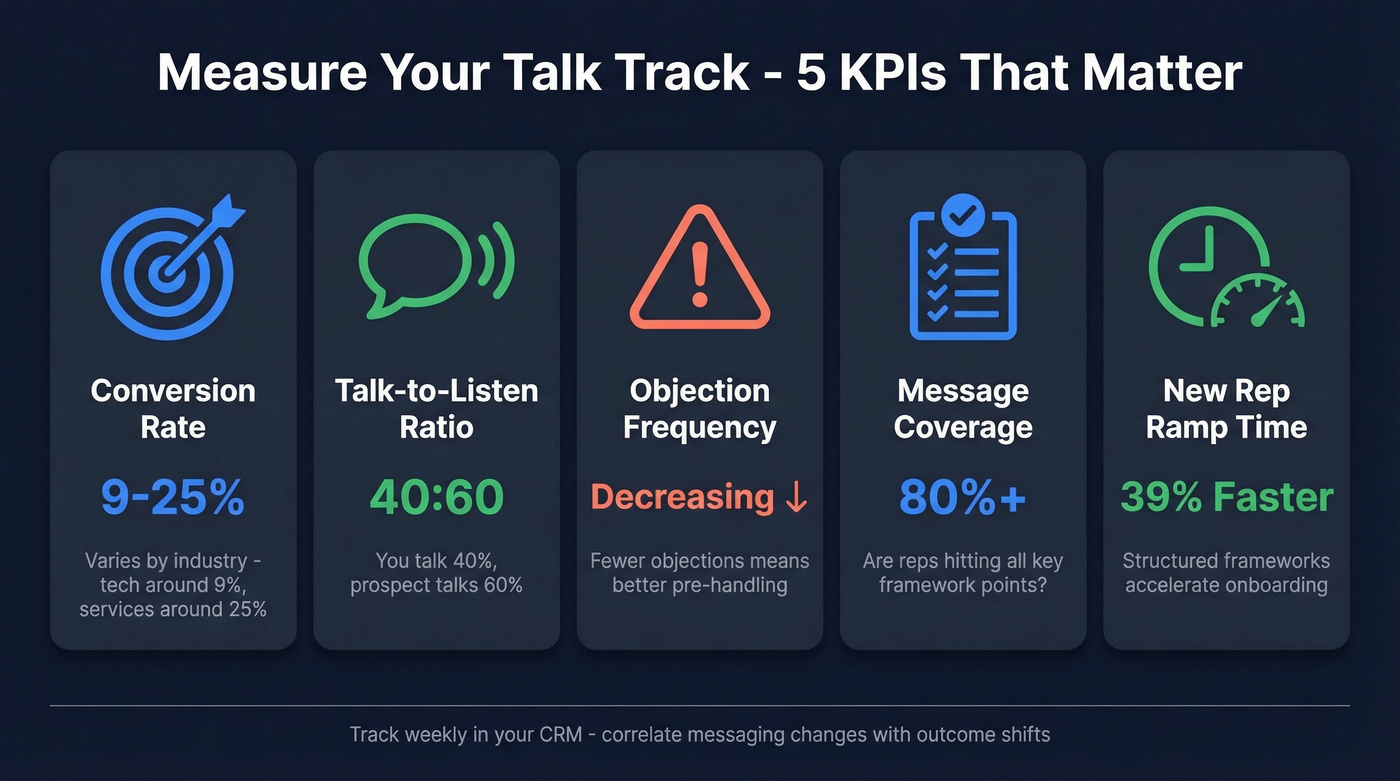
Conversion benchmarks vary wildly by industry - tech/software sits around 9.39%, while business services can hit 24.47%. Know your baseline before you start optimizing. Track these KPIs in your CRM, review them weekly, and correlate messaging changes with outcome shifts. That's how you turn a document into a system. (For a broader view, align on common sales metrics.)
Tools for Iterating
Conversation Intelligence
Gong is one of the best-known platforms for post-call analysis - it records, transcribes, and surfaces patterns across your team's conversations. Which modules correlate with won deals? Where do reps deviate? CI platforms answer those questions.
Outreach Kaia takes a different angle: real-time guidance during live calls. It surfaces content cues, objection tips, and competitor battle cards while the rep is still talking. Teams using Kaia shorten sales cycles by 19%.
Chorus, now part of ZoomInfo, offers similar CI capabilities as part of a broader platform. If you're already paying for ZoomInfo, it's a convenient way to centralize data and conversation insights.
Verified Contact Data
Your talk track is worthless if you're calling a disconnected number or emailing a dead inbox. This is the unsexy prerequisite that most guides skip entirely.
We've seen this firsthand with our own team's outbound: bad data doesn't just waste time, it wrecks the energy of an entire call block. Prospeo covers 300M+ professional profiles with 98% email accuracy, 143M+ verified emails, and 125M+ verified mobile numbers. The mobile pickup rate runs 30%, which matters when your entire call cadence depends on actually reaching a human. Data refreshes every 7 days, compared to the 6-week industry average, so you're not calling people who changed jobs last month. Pricing is credit-based at roughly $0.01 per email, with a free tier of 75 emails/month plus 100 Chrome extension credits/month and no contracts. GreyScout used Prospeo to cut rep ramp time from 8-10 weeks to 4 weeks, partly because reps weren't wasting their first month dialing bad numbers.

CRM + Enablement Platforms
HubSpot (free CRM; Sales Hub starts ~$20/user/month) and Salesforce (Sales Cloud ~$25-300/user/month) are where you log performance data - which messaging resonates, which objections come up most, which reps hit their framework consistently. Without CRM tracking, you're optimizing blind. (If you need examples of what to report, use these sales report examples.)
Enablement platforms like Highspot (~$40-60/user/month) handle distribution and versioning: making sure every rep has the latest version, tracking adoption, and surfacing coaching opportunities. Layer in AI coaching tools that flag when a rep skips the discovery questions or talks past the 40% threshold - that's how you catch bad habits before they cost you pipeline. (For stack options, see sales enablement platforms.)
Beyond Sales Calls
Talk tracks aren't just for SDRs. Executive communication follows the same structural logic - just compressed into tighter windows.
A fireside chat gives you 12-15 minutes. A keynote, 8-12 minutes. A panel? You've got 5-7 minutes of total talking time. The "3-minute per topic" rule means you're covering 2-4 topics max, each anchored by a pithy point of view in 2-3 sentences, backed by precise numbers.
The same methodology applies across functions. Recruiting candidate outreach follows the same opener-to-next-steps flow. Customer success renewal conversations need structured frameworks for pricing changes, feature gaps, and expansion opportunities. Partnership pitches and fundraising decks benefit from guided messaging just as much as prospect calls. If you're having a structured conversation where the outcome matters, you need a framework. The format is universal - only the content changes. (Same idea applies to recruiting outreach.)
A structured talk track ramps reps 39% faster - but only if they're calling the right people. Prospeo's 30+ search filters let you build lists by buyer intent, tech stack, and job changes, then verify every contact before your team dials. 98% email accuracy. 7-day data refresh. $0.01 per lead.
Give your reps a list worth running their talk track on.
FAQ
What is a talk track in sales?
A talk track is a flexible conversation framework that guides reps through key messaging points - pain points, differentiators, proof points, and questions - without dictating exact words. Unlike a rigid script, it adapts in real time based on prospect responses. Pitches are monologues; these are dialogues with structure.
How long should one be?
A cold call opener should run 30-60 seconds; a full discovery framework covers 3-5 minutes of your talking time. Write it on one page max - anything longer won't get internalized. Brevity forces clarity and keeps reps from reading verbatim.
How often should you update them?
Review weekly at minimum, or after every 50 conversations. The best teams A/B test messaging variations and update based on conversation intelligence data - not gut feel. If your win rate shifts more than a few points, that's a signal to revisit immediately.
What tools help you build better talk tracks?
Gong and Chorus surface which messaging correlates with won deals. For the data layer, Prospeo provides 98%-accurate emails and verified mobile numbers so reps actually reach prospects. HubSpot or Salesforce tracks which frameworks drive conversions. Stack all three for a closed-loop system.